Multi-instance Multi-label Learning for Relation Extraction
Mihai Surdeanu†, Julie Tibshirani†, Ramesh Nallapati?, Christopher D. Manning†
† Stanford University, Stanford, CA 94305
{mihais,jtibs,manning}@stanford.edu ? Artificial Intelligence Center, SRI International
Abstract
Distant supervision for relation extraction (RE) – gathering training data by aligning a database of facts with text – is an efficient ap-proach to scale RE to thousands of different relations. However, this introduces a challeng-ing learnchalleng-ing scenario where the relation ex-pressed by a pair of entities found in a sen-tence is unknown. For example, a sensen-tence containing Balzac and France may express
BornInorDied, an unknown relation, or no re-lation at all. Because of this, traditional super-vised learning, which assumes that each ex-ample is explicitly mapped to a label, is not appropriate. We propose a novel approach to multi-instance multi-label learning for RE, which jointly models all the instances of a pair of entities in text and all their labels using a graphical model with latent variables. Our model performs competitively on two difficult domains.
1 Introduction
Information extraction (IE), defined as the task of extracting structured information (e.g., events, bi-nary relations, etc.) from free text, has received re-newed interest in the “big data” era, when petabytes of natural-language text containing thousands of dif-ferent structure types are readily available. How-ever, traditional supervised methods are unlikely to scale in this context, as training data is either lim-ited or nonexistent for most of these structures. One of the most promising approaches to IE that ad-dresses this limitation isdistant supervision, which generates training data automatically by aligning a
DB=
BornIn(Barack Obama,United States)
EmployedBy(Barack Obama,United States)
Sentence Latent Label
Barack Obama is the 44th and current President of the United States.
EmployedBy
Obama was born in the United States just as he has always said.
BornIn
United States President Barack Obama meets with Chinese Vice President Xi Jinping today.
EmployedBy
Obama ran for the United States Senate in 2004. –
Figure 1: Training sentences generated through distant supervision for a database containing two facts.
database of facts with text (Craven and Kumlien, 1999; Bunescu and Mooney, 2007).
In this paper we focus on distant supervision for relation extraction (RE), a subproblem of IE that ad-dresses the extraction of labeled relations between two named entities. Figure 1 shows a simple exam-ple for a RE domain with two labels. Distant super-vision introduces two modeling challenges, which we highlight in the table. The first challenge is that some training examples obtained through this heuristic are not valid, e.g., the last sentence in Fig-ure 1 is not a correct example for any of the known labels for the tuple. The percentage of such false positives can be quite high. For example, Riedel et al. (2010) report up to 31% of false positives in a corpus that matches Freebase relations with New York Times articles. The second challenge is that the same pair of entities may have multiple labels and it is unclear which label is instantiated by any textual mention of the given tuple. For example, in Figure 1, the tuple (Barack Obama,United States) has two valid labels: BornInandEmployedBy, each (latently) instantiated in different sentences. In the
instance ... instance
label
instance
label
...
[image:2.612.121.250.65.118.2]object
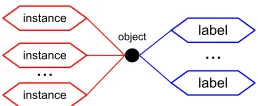
Figure 2: Overview of multi-instance multi-label learn-ing. To contrast, in traditional supervised learning there is one instance and one label per object. For relation ex-traction the object is a tuple of two named entities. Each mention of this tuple in text generates a different instance.
Riedel corpus, 7.5% of the entity tuples in the train-ing partition have more than one label.
We summarize this multi-instance multi-label (MIML) learning problem in Figure 2. In this pa-per we propose a novel graphical model, which we calledMIML-RE, that targets MIML learning for re-lation extraction. Our work makes the following contributions:
(a) To our knowledge,MIML-REis the first RE ap-proach that jointly models both multiple instances (by modeling the latent labels assigned to instances) and multiple labels (by providing a simple method to capture dependencies between labels). For example, our model learns that certain labels tend to be gener-ated jointly while others cannot be jointly assigned to the same tuple.
(b) We show thatMIML-REperforms competitively on two difficult domains.
2 Related Work
Distant supervision for IE was introduced by Craven and Kumlien (1999), who focused on the ex-traction of binary relations between proteins and cells/tissues/diseases/drugs using the Yeast Protein Database as a source of distant supervision. Since then, the approach grew in popularity (Bunescu and Mooney, 2007; Bellare and McCallum, 2007; Wu and Weld, 2007; Mintz et al., 2009; Riedel et al., 2010; Hoffmann et al., 2011; Nguyen and Moschitti, 2011; Sun et al., 2011; Surdeanu et al., 2011a). However, most of these approaches make one or more approximations in learning. For example, most proposals heuristically transform distant super-vision to traditional supervised learning (i.e., single-instance single-label) (Bellare and McCallum, 2007; Wu and Weld, 2007; Mintz et al., 2009; Nguyen and Moschitti, 2011; Sun et al., 2011; Surdeanu
et al., 2011a). Bunescu and Mooney (2007) and Riedel et al. (2010) model distant supervision for relation extraction as a multi-instance single-label problem, which allows multiple mentions for the same tuple but disallows more than one label per ob-ject. Our work is closest to Hoffmann et al. (2011). They address the same problem we do (binary rela-tion extracrela-tion) with a MIML model, but they make two approximations. First, they use a deterministic model that aggregates latent instance labels into a set of labels for the corresponding tuple by OR-ing the classification results. We use instead an object-level classifier that is trained jointly with the clas-sifier that assigns latent labels to instances and can capture dependencies between labels. Second, they use a Perceptron-style additive parameter update ap-proach, whereas we train in a Bayesian framework. We show in Section 5 that these approximations gen-erally have a negative impact on performance.
MIML learning has been used in fields other than natural language processing. For example, Zhou and Zhang (2007) use MIML for scene classifica-tion. In this problem, each image may be assigned multiple labels corresponding to the different scenes captured. Furthermore, each image contains a set of patches, which forms the bag of instances assigned to the given object (image). Zhou and Zhang pro-pose two algorithms that reduce the MIML problem to a more traditional supervised learning task. In one algorithm, for example, they convert the task to a multi-instance single-label problem by creating a separate bag for each label. Due to this, the pro-posed approach cannot model inter-label dependen-cies. Moreover, the authors make a series of approx-imations, e.g., they assume that each instance in a bag shares the bag’s overall label. We instead model all these issues explicitly in our approach.
data is generated.
3 Distant Supervision for Relation Extraction
Here we focus on distant supervision for the ex-traction of relations between two entities. We de-fine arelationas the construct r(e1, e2), whereris the relation name, e.g., BornIn in Figure 1, ande1 and e2 are two entity names, e.g., Barack Obama and United States. Note that there are entity tu-ples (e1, e2) that participate in multiple relations, r1, . . . , ri. In other words, the tuple (e1, e2) is the
object illustrated in Figure 2 and the different rela-tion names are the labels. We define anentity men-tion as a sequence of text tokens that matches the corresponding entity name in some text, andrelation mention(for a given relationr(e1, e2)) as a pair of entity mentions ofe1 ande2 in the same sentence. Relation mentions thus correspond to the instances in Figure 2.1 As the latter definition indicates, we focus on the extraction of relations expressed in a single sentence. Furthermore, we assume that entity mentions are extracted by a different process, such as a named entity recognizer.
We define the task ofrelation extractionas a func-tion that takes as input a document collecfunc-tion (C), a set of entity mentions extracted fromC(E), a set of known relation labels (L) and an extraction model, and outputs a set of relations (R) such that any of the relations extracted is supported by at least one sen-tence inC. To train the extraction model, we use a database of relations (D) that are instantiated at least once in C. Using distant supervision, D is aligned with sentences inC, producing relation mentions for all relations inD.
4 Model
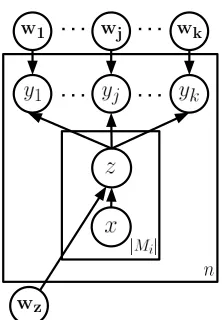
Our model assumes that each relation mention in-volving an entity pair has exactly one label, but al-lows the pair to exhibit multiple labels across differ-ent mdiffer-entions. Since we do not know the actual re-lation label of a mention in the distantly supervised setting, we model it using a latent variable z that can take one of the k pre-specified relation labels as well as an additional NIL label, if no relation is expressed by the corresponding mention. We model the multiple relation labels an entity pair can assume
1For this reason, we use relation mention and relation
in-stance interchangeably in this paper.
. . .
. . . . . .
[image:3.612.371.482.64.224.2]. . .
Figure 3: MIML model plate diagram. We unrolled the
yplate to emphasize that it is a collection of binary clas-sifiers (one per relation label), whereas thezclassifier is multi-class. Each z andyj classifier has an additional
prior parameter, which is omitted here for clarity.
using a multi-label classifier that takes as input the latent relation types of the all the mentions involving that pair. The two-layer hierarchical model is shown graphically in Figure 3, and is described more for-mally below. The model includes one multi-class classifier (for z) and a set of binary classifiers (for eachyj). Thezclassifier assigns latent labels from
Lto individual relation mentions orNIL if no rela-tion is expressed by the menrela-tion. Eachyj classifier
decides if relation j holds for the given entity tu-ple, using the mention-level classifications as input. Specifically, in the figure:
• nis the number of distinct entity tuples inD;
• Miis the set of mentions for theith entity pair;
• xis a sentence andzis the latent relation clas-sification for that sentence;
• wz is the weight vector for the multi-class
mention-level classifier;
• kis the number of known relation labels inL;
• yjis the top-level classification decision for the
entity pair as to whether thejth relation holds;
• wj is the weight vector for the binary top-level
classifier for thejth relation.
Additionally, we define Pi (Ni) as the set of all
known positive (negative) relation labels for theith entity tuple. In this paper, we constructNiasL \Pi,
al. (2011a) proposed models whereNifor theith
tu-ple(e1, e2)is defined as:{rj |rj(e1, ek)∈ D, ek6=
e2, rj ∈/ Pi}, which is a subset ofL \Pi. That is,
en-titye2 is considered a negative example for relation rj (in the context of entitye1) only ifrj exists in the
training data with a different value.
The addition of the object-level layer (fory) is an important contribution of this work. This layer can capture information that cannot be modeled by the mention-level classifier. For example, it can learn that two relation labels (e.g.,BornInandSpouseOf) cannot be generated jointly for the same entity tu-ple. So, if the z classifier outputs both these la-bels for different mentions of the same tuple, they
layer can cancel one of them. Furthermore, the y
classifiers can learn when two labels tend to appear jointly, e.g.,CapitalOfandContainedbetween two locations, and use this occurrence as positive rein-forcement for these labels. We discuss the features that implement these ideas in Section 5.
4.1 Training
We train the proposed model using hard discrimina-tive Expectation Maximization (EM). In the Expec-tation (E) step we assign latent mention labels us-ing the current model (i.e., the mention and relation level classifiers). In the Maximization (M) step we retrain the model to maximize the log likelihood of the data using the current latent assignments.
In the equations that follow, we refer to
w1, . . . ,wk collectively as wy for compactness.
The vectorzicontains the latent mention-level
clas-sifications for theith entity pair, whileyirepresents
the corresponding set of gold-standard labels (that is, y(ir) = 1 ifr ∈ Pi, and yi(r) = 0for r ∈ Ni.)
Using these notations, the log-likelihood of the data is given by:
LL(wy,wz) = n X
i=1
logp(yi|xi,wy,wz)
=
n X
i=1
logX
zi
p(yi,zi|xi,wy,wz)
The joint probability in the inner summation can be broken up into simpler parts:
p(yi,zi|xi,wy,wz)
=p(zi|xi,wz)p(yi|zi,wy)
= Y
m∈Mi
p(zi(m)|x(im),wz) Y
r∈Pi∪Ni
p(yi(r)|zi,w(yr))
where the last step follows from conditional inde-pendence. Thus the log-likelihood for this problem is not convex (it includes a sum of products). How-ever, we can still use EM, but the optimization fo-cuses on maximizing the lower bound of the log-likelihood, i.e., we maximize the above joint proba-bility for each entity pair in the database. Rewriting this probability in log space, we obtain:
logp(yi,zi|xi,wy,wz) (1)
= X
m∈Mi
logp(zi(m)|x(im),wz)+
X
r∈Pi∪Ni
logp(yi(r)|zi,wy(r))
The algorithm proceeds as follows.
E-step: In this step we infer the mention-level classificationszi for each entity tuple, given all its
mentions, the gold labelsyi, and current model, i.e., wzandwyweights. Formally, we seek to find:
zi∗ = arg max z
p(z|yi,xi,wy,wz)
However it is computationally intractable to con-sider all vectors z as there is an exponential num-ber of possible assignments, so we approximate and consider each mention separately. Concretely,
p(zi(m)|yi,xi,wy,wz)
∝p(yi, zi(m)|xi,wy,wz)
≈p(zi(m)|x(im),wz)p(yi|z0i,wy)
=p(zi(m)|x(im),wz) Y
r∈Pi∪Ni
p(y(ir)|z0i,w(yr))
where z0i contains the previously inferred mention labels for group i, with the exception of compo-nent m whose label is replaced by zi(m). So for i= 1, . . . , n, and for eachm∈Miwe calculate:
zi(m)∗ = arg max
z
p(z|x(im),wz)× (2)
Y
r∈Pi∪Ni
Intuitively, the above equation indicates that men-tion labels are chosen to maximize: (a) the prob-abilities assigned by the mention-level model; (b) the probability that the correct relation labels are as-signed to the corresponding tuple; and (c) the prob-ability that the labels known to be incorrect arenot assigned to the tuple. For example, if a particular mention label receives a high mention-level proba-bility but it is known to be a negative label for that tuple, it will receive a low overall score.
M-step: In this step we find wy,wz that
maxi-mize the lower bound of the log-likelihood, i.e., the probability in equation (1), given the current assign-ments forzi. From equation (1) it is clear that this
can be maximized separately with respect towyand wz. Intuitively, this step amounts to learning the
weights for the mention-level classifier (wz) and the
weights for each of thektop-level classifiers (wy).
The updates are given by:
wz∗= arg max
w n X
i=1 X
m∈Mi
logp(zi(m)∗|x(im),w) (3)
wy(r)∗= arg max w
X
1≤i≤n s.t. r∈Pi∪Ni
logp(y(ir)|z∗i,w) (4)
Note that these are standard updates for logistic re-gression. We obtained these weights using k+ 1 logistic classifiers: one multi-class classifier forwz
andkbinary classifiers for each relation labelr∈ L. We implemented all using the L2-regularized logis-tic regression from the publicly-downloadable Stan-ford CoreNLP package.2 The main difference be-tween the classifiers is how features are generated: the mention-level classifier computes its features based on xi, whereas the relation-level classifiers
generate features based on the current assignments for zi and the corresponding relation label r. We
discuss the actual features used in our experiments in Section 5.
4.2 Inference
Given an entity tuple, we obtain its relation labels as follows. We first classify its mentions:
zi(m)∗ = arg max
z p(z|x
(m)
i ,wz) (5)
2nlp.stanford.edu/software/corenlp.shtml
then decide on the final relation labels using the top-level classifiers:
yi(r)∗= arg max
y∈{0,1}p(y|z ∗ i,w
(r)
y ) (6)
4.3 Implementation Details
We discuss next several details that are crucial for the correct implementation of the above model.
Initialization: Since EM is not guaranteed to con-verge at the global maximum of the observed data likelihood, it is important to provide it with good starting values. In our context, the initial values are labels assigned tozi, which are required to compute
equation (2) in the first iteration (z0i). We generate these values using a local logistic regression classi-fier that uses the same features as the mention-level classifier in the joint model but treats each relation mention independently. We train this classifier using “traditional” distant supervision: for each relation in the databaseDwe assume that all the corresponding mentions are positive examples for the correspond-ing label (Mintz et al., 2009). Note that this heuris-tic repeats relation mentions with different labels for the tuples that participate in multiple relations. For example, all the relation mentions in Figure 1 will yield datums with both theEmployedByandBornIn labels. Despite this limitation, we found that this is a better initialization heuristic than random assign-ment.
For the second part of equation (2), we initial-ize the relation-level classifier with a model that replicates theat least oneheuristic of Hoffmann et al. (2011). Eachw(yr)model has a single feature with
a high positive weight that is triggered when labelr is assigned to any of the mentions inz∗i.
Avoiding overfitting: A na¨ıve implementation of our approach leads to an unrealistic training scenario where thezclassifier generates predictions (in equa-tion (2)) for the same datums it has seen in training in the previous iteration. To avoid this overfitting problem we used cross validation: we divided the training tuples inKdistinct folds and trainedK dif-ferent mention-level classifiers. Each classifier out-putsp(z|x(im),wz)for tuples in a given fold during
At testing time, we compute p(z|x(im),wz) in
equation (5) as the average of the probabilities of the above set of mention classifiers:
p(z|x(im),wz) = PK
j=1p(z|x (m)
i ,w j z)
K
wherewjz are the weights of the mention classifier
responsible for fold j. We found that this simple bagging model performs slightly better in practice (a couple of tenths of a percent) than training a sin-gle mention classifier on the latent mention labels generated in the last training iteration.
Inference during training: During the inference process in the E-step, the algorithm incrementally “flips” mention labels based on equation (2), for each group of mentionsMi. Thus,z0ichanges as the
algorithm progresses, which may impact the label assigned to the remaining mentions in that group. To avoid any potential bias introduced by the arbitrary order of mentions as seen in the data, we randomize each groupMibefore we inspect its mentions.
5 Experimental Results
5.1 Data
We evaluate our algorithm on two corpora. The first was developed by Riedel et al. (2010) by aligning Freebase3relations with the New York Times (NYT) corpus. They used the Stanford named entity recog-nizer (Finkel et al., 2005) to find entity mentions in text and constructed relation mentions only between entity mentions in the same sentence.
Riedel et al. (2010) observes that evaluating on this corpus underestimates true extraction accuracy because Freebase is incomplete. Thus, some re-lations extracted during testing will be incorrectly marked as wrong, simply because Freebase has no information on them. To mitigate this issue, Riedel et al. (2010) and Hoffman et al. (2011) perform a second evaluation where they compute the accuracy of labels assigned to a set of relation mentions that they manually annotated. To avoid any potential an-notation biases, we instead evaluate on a second cor-pus that has comprehensive annotations generated by experts for all test relations.
We constructed this second dataset using mainly resources distributed for the 2010 and 2011 KBP
3freebase.com
shared tasks (Ji et al., 2010; Ji et al., 2011). We gen-erated training relations from the knowledge base provided by the task organizers, which is a subset of the English Wikipedia infoboxes from a 2008 snapshot. Similarly to the corpus of Riedel et al., these infoboxes contain open-domain relations be-tween named entities, but with a different focus. For example, more than half of the relations in the evaluation data are alternate names of organi-zations or persons (e.g., org:alternate names) or re-lations associated with employment and member-ship (e.g., per:employee of) (Ji et al., 2011). We aligned these relations against a document collec-tion that merges two distinct sources: (a) the col-lection provided by the shared task, which contains approximately 1.5 million documents from a vari-ety of sources, including newswire, blogs and tele-phone conversation transcripts; and (b) a complete snapshot of the English Wikipedia from June 2010. During training, for each entity tuple (e1, e2), we retrieved up to 50 sentences that contain both en-tity mentions.4 We used Stanford’s CoreNLP pack-age to find entity mentions in text and, similarly to Riedel et al. (2010), we construct relation mention candidates only between entity mentions in the same sentence. We analyzed a set of over 2,000 relation mentions and we found that 39% of the mentions wheree1 is an organization name and 36% of men-tions wheree1 is a person name do not express the corresponding relation.
At evaluation time, the KBP shared task requires the extraction of all relationsr(e1, e2)given a query that contains only the first entitye1. To accommo-date this setup, we adjusted our sentence extraction component to use juste1 as the retrieval query and we kept up to 50 sentences that contain a mention of the input entity for each evaluation query. For tuning and testing we used the 200 queries from the 2010 and 2011 evaluations. We randomly selected 40 queries for development and used the remaining 160 for the formal evaluation.
To address the large number of negative examples in training, Riedel et al. subsampled them randomly with a retention probability of 10%. For the KBP corpus, we followed the same strategy, but we used
4
# of gold # of gold % of gold entity tuples % of gold entity tuples % of mentions that
relations relations with more than one label with multiple mentions in text do not express # of relation labels
in training in testing in training in training their relation
Riedel 4,700 1,950 7.5% 46.4% up to 31% 51
[image:7.612.69.537.56.107.2]KBP 183,062 3,334 2.8% 65.1% up to 39% 41
Table 1: Statistics about the two corpora used in this paper. Some of the numbers for the Riedel dataset is from (Riedel et al., 2010; Hoffmann et al., 2011).
a subsampling probability of 5% because this led to the best results in development for all models.
Table 1 provides additional statistics about the two corpora. The table indicates that having mul-tiple mentions for an entity tuple is a very common phenomenon in both corpora, and that having mul-tiple labels per tuple is more common in the Riedel dataset than KBP (7.5% vs. 2.8%).
5.2 Features
Our model requires two sets of features: one for the mention classifier (z) and one for the relation clas-sifier (y). In the Riedel dataset, we used the same features as Riedel et al. (2010) and Hoffmann et al. (2011) for the mention classifier. In the KBP dataset, we used a feature set that was developed in our previous work (Surdeanu et al., 2011b). These features can be grouped in three classes: (a) features that model the two entities, such as their head words; (b) features that model the syntactic context of the relation mention, such as the dependency path be-tween the two entity mentions; and (c) features that model the surface context, such as the sequence of part of speech tags between the two entity mentions. We used these features for all the models evaluated on the KBP dataset.5
For the relation-level classifier, we developed two feature groups. The first models Hoffmann et al.’s at least one heuristic using a single feature, which is set to true if at least one mention inzihas the
la-belr, which is modeled by the current relation clas-sifier. The second group models the dependencies between relation labels. This is implemented by a set of |L| −1 features, where feature j is instan-tiated whenever the label modeled (r) is predicted jointly with another labelrj (rj ∈ L, rj 6= r) inzi.
These features learn both positive and negative re-inforcements between labels. For example, if labels
5
To avoid an excessive number of features in the KBP exper-iments, we removed features seen less than five times in train-ing.
r1andr2tend to be generated jointly, the feature for the corresponding dependency will receive a posi-tive weight in the models forr1 andr2. Similarly, if r1andr2cannot be generated jointly, the model will assign a negative weight to feature2 inr1’s classi-fier and to feature1inr2’s classifier. Note that this feature is asymmetric, i.e., feature1 inr2’s classi-fier may have a different value than feature2inr1’s classifier, depending on the accuracy of the individ-ual predictions forr1andr2.
5.3 Baselines
We compare our approach against three models:
Mintz++ – This is the model used to initialize the mention-level classifier in our model. As discussed in Section 4.3, this model follows the “traditional” distant supervision heuristic, similarly to (Mintz et al., 2009). However, our implementation has several advantages over the original model: (a) we model each relation mention independently, whereas Mintz et al. collapsed all the mentions of the same entity tuple into a single datum; (b) we allow multi-label outputs for a given entity tuple at prediction time by OR-ing the predictions for the individual rela-tion menrela-tions corresponding to the tuple (similarly to (Hoffmann et al., 2011))6; and (c) we use the simple bagging strategy described in Section 4.3 to combine multiple models. Empirically, we observed that these changes yield a significant improvement over the original proposal. For this reason, we con-sider this model a strong baseline on its own.
Riedel– This is the “at-least-once” model reported in (Riedel et al., 2010), which had the best perfor-mance in that work. This approach models the task as a multi-instance single-label problem. Note that this is the only model shown here that does not allow multi-label outputs for an entity tuple.
6We also allow multiple labels per tuple at training time,
Hoffmann– This is the “MultiR” model, which per-formed the best in (Hoffmann et al., 2011). This models RE as a MIML problem, but learns using a Perceptron algorithm and uses a deterministic “at least one” decision instead of a relation classifier. We used Hoffman’s publicly released code7 for the experiments on the Riedel dataset and our own im-plementation for the KBP experiments.8
5.4 Results
We tuned all models using three-fold cross valida-tion for the Riedel dataset and using the develop-ment queries for the KBP dataset. MIML-RE has two parameters that require tuning: the number of EM epochs (T) and the number of folds for the men-tion classifiers (K).9 The values obtained after tun-ing areT = 15, K = 5for the Riedel dataset and T = 8, K = 3 for KBP. Similarly, we tuned the number of epochs for the Hoffmann model on the KBP dataset, obtaining an optimal value of20.
On the Riedel dataset we evaluate all models us-ing standard precision and recall measures. For the KBP evaluation we used the official KBP scorer,10 with two changes: (a) we score with the
parame-ter anydoc set to true, which configures the scorer
to accept relation mentions as correct regardless of their supporting document; and (b) we score only on the subset of gold relations that have at least one mention in our sentences. The first decision is neces-sary because the gold KBP answers contain support-ing documents only from the corpus provided by the organizers but we retrieve candidate answers from multiple collections. The second is required because the focus of this work is not on sentence retrieval but on RE, which should be evaluated in isolation.11
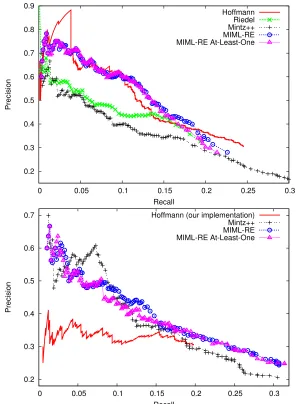
Similarly to previous work, we report preci-sion/recall curves in Figure 4. We evaluate two variants of MIML-RE: one that includes all the features for the y model, and another (MIML-RE
7
cs.washington.edu/homes/raphaelh/mr/ 8
The decision to reimplement the Hoffmann model was a practical one, driven by incompatibilities between their imple-mentation and our KBP framework.
9We could also tune the prior parameters for both our model
and Mintz++, but we found in early experiments that the default value of1yields the best scores for all priors.
10
nlp.cs.qc.cuny.edu/kbp/2011/scoring.html
11Due to these changes, the scores reported in this paper are
not directly comparable with the shared task scores.
At-Least-One) which has only the at least one feature. For all the Bayesian models implemented here, we sorted the predicted relations by the noisy-or scnoisy-ore of the top predictions fnoisy-or their mentions. Formally, we rank a relationrpredicted for groupi, i.e.,r∈y∗i, using:
noisyOri(r) = 1− Y
m∈Mi
(1−s(im)(r))
wheres(im)(r) = p(r|x
(m)
i ,wz) if r = zi(m)∗ or 0
oth-erwise. The noisy-or formula performs well for ranking because it integrates model confidence (the higher the probabilities, the higher the score) and re-dundancy (the more mentions are predicted with a label, the higher that label’s score). Note that the above ranking score does not include the probability of the relation classifier (equation (6)) forMIML-RE. While we use equation (6) to generatey∗i, we found that the corresponding probabilities are too coarse to provide a good ranking score. This is caused by the fact that our relation-level classifier works with a small number of (noisy) features. Lastly, for our implementation of the Hoffmann et al. model, we used their ranking heuristic (sorting predictions by the maximum extraction score for that relation).
6 Discussion
0.2 0.3 0.4 0.5 0.6 0.7 0.8 0.9
0 0.05 0.1 0.15 0.2 0.25 0.3
Precision
Recall
Hoffmann Riedel Mintz++ MIML-RE MIML-RE At-Least-One
0.2 0.3 0.4 0.5 0.6 0.7
0 0.05 0.1 0.15 0.2 0.25 0.3
Precision
Recall
[image:9.612.148.444.61.465.2]Hoffmann (our implementation) Mintz++ MIML-RE MIML-RE At-Least-One
Figure 4: Results in the Riedel dataset (top) and the KBP dataset (bottom). The Hoffmann scores in the KBP dataset were generated using our implementation. The other Hoffmann and Riedel results were taken from their papers.
which provides a more formal implementation of the MIML problem.
Figure 4 also indicates thatMIML-REyields a con-sistent improvement over Mintz++ (with the excep-tion of a few points in the low-recall porexcep-tion of the KBP curves). The difference in precision for the same recall point is as high as 25 precision points in the Riedel dataset and up to 5 points in KBP. Over-all, the best F1 score ofMIML-REis slightly over 1 point higher than the best F1 score of Mintz++ in the Riedel dataset and 3 points higher in KBP. Con-sidering that Mintz++ is a strong baseline and we evaluate on two challenging domains, we consider these results proof that the correct modeling of the MIML scenario is beneficial.
P R F1 Hoffmann (our implementation) 48.6 29.8 37.0
Mintz++ 43.8 36.8 40.0
MIML-RE 64.8 31.6 42.6
[image:10.612.74.300.57.120.2]MIML-RE At-Least-One 56.1 32.5 41.1
Table 2: Results at the highest F1 point in the preci-sion/recall curve on the dataset that contains groups with at least 10 mentions.
In a similar vein, we tested the models previ-ously described on a subset of the Riedel evalua-tion dataset that only includes groups with at least 10 mentions. This corpus contains approximately 2% of the groups from the original testing partition, out of which 90 tuples have at least one known label and 1410 groups serve as negative examples.
For conciseness, we do not include the entire precision/recall curves for this experiment, but sum-marize them in Table 2, which lists the performance peak (highest F1 score) for each of the models investigated. The table shows thatMIML-REobtains the highest F1 score overall, 1.5 points higher than MIML-RE At-Least-One and 2.6 points higher than Mintz++. More importantly, for approximately the same recall point,MIML-REobtains a precision that is over 8 percentage points higher than that of MIML-RE At-Least-One. A post-hoc inspection of the results indicates that, indeed, MIML-RE suc-cessfully eliminates undesired labels when two (or more) incompatible labels are jointly assigned to the same tuple. Take for example the tuple (Mexico City, Mexico), for which the correct re-lation is /location/administrative division/country. MIML-RE At-Least-One incorrectly predicts the additional /location/location/contains relation, while MIML-RE does not make this prediction because it recognizes that these two labels are in-compatible in general: one location cannot both be within another location and contain it. Indeed, ex-amining the weights assigned to label-dependency features in MIML-RE, we see that the model has assigned a large negative weight to the depen-dency feature between /location/location/contains and /location/administrative division/country for the /location/location/contains class. We also observe positive dependencies between la-bels. For example, MIML-RE learns that the relations /people/person/place lived and
/peo-ple/person/place of birth tend to co-occur and assigns a positive weight to this dependency feature for the corresponding classes.
These results strongly suggest that when all as-pects of the MIML scenario are present, our model can successfully capture them and make use of the additional structure to improve performance.
7 Conclusion
In this paper we showed that distant supervision for RE, which generates training data by aligning a database of facts with text, poses a distinct multi-instance multi-label learning scenario. In this set-ting, each entity pair to be modeled typically has multiple instances in the text and may have multiple labels in the database. This is considerably differ-ent from traditional supervised learning, where each instance has a single, explicit label.
We argued that this MIML scenario should be formally addressed. We proposed, to our knowl-edge, the first approach that models all aspects of the MIML setting, i.e., the latent assignment of labels to instances and dependencies between labels assigned to the same entity pair.
We evaluated our model on two challenging do-mains and obtained state-of-the-art results on both. Our model performs well even when not all aspects of the MIML scenario are common, and as seen in the discussion, shows significant improvement when evaluated on entity pairs with many labels or men-tions. When all aspects of the MIML scenario are present, our model is well-equipped to handle them. The code and data used in the experiments re-ported in this paper are available at:http://nlp. stanford.edu/software/mimlre.shtml.
Acknowledgments
References
Kedar Bellare and Andrew McCallum. 2007. Learn-ing extractors from unlabeled text usLearn-ing relevant databases. In Proceedings of the Sixth International Workshop on Information Extraction on the Web. Carla Brodley and Mark Friedl. 1999. Identifying
mis-labeled training data. Journal of Artificial Intelligence Research (JAIR).
Razvan Bunescu and Raymond Mooney. 2007. Learning to extract relations from the web using minimal super-vision. InProceedings of the 45th Annual Meeting of the Association for Computational Linguistics. Mark Craven and Johan Kumlien. 1999. Constructing
biological knowledge bases by extracting information from text sources. InProceedings of the Seventh Inter-national Conference on Intelligent Systems for Molec-ular Biology.
Jenny Rose Finkel, Trond Grenager, and Christopher D. Manning. 2005. Incorporating non-local information into information extraction systems by gibbs sampling. InProceedings of the 43nd Annual Meeting of the As-sociation for Computational Linguistics.
Raphael Hoffmann, Congle Zhang, Xiao Ling, Luke Zettlemoyer, and Daniel S. Weld. 2011. Knowledge-based weak supervision for information extraction of overlapping relations. In Proceedings of the Annual Meeting of the Association for Computational Linguis-tics (ACL).
Heng Ji, Ralph Grishman, Hoa T. Dang, Kira Griffitt, and Joe Ellis. 2010. Overview of the TAC 2010 knowl-edge base population track. InProceedings of the Text Analytics Conference.
Heng Ji, Ralph Grishman, and Hoa T. Dang. 2011. Overview of the TAC 2011 knowledge base popula-tion track. InProceedings of the Text Analytics Con-ference.
Mike Mintz, Steven Bills, Rion Snow, and Daniel Juraf-sky. 2009. Distant supervision for relation extrac-tion without labeled data. InProceedings of the 47th Annual Meeting of the Association for Computational Linguistics.
Truc Vien T. Nguyen and Alessandro Moschitti. 2011. End-to-end relation extraction using distant supervi-sion from external semantic repositories. In Proceed-ings of the 49th Annual Meeting of the Association for Computational Linguistics: Human Language Tech-nologies.
Sebastian Riedel, Limin Yao, and Andrew McCallum. 2010. Modeling relations and their mentions without labeled text. InProceedings of the European Confer-ence on Machine Learning and Knowledge Discovery in Databases (ECML PKDD ’10).
Ang Sun, Ralph Grishman, Wei Xu, and Bonan Min. 2011. New York University 2011 system for KBP slot filling. In Proceedings of the Text Analytics Confer-ence.
Mihai Surdeanu, Sonal Gupta, John Bauer, David Mc-Closky, Angel X. Chang, Valentin I. Spitkovsky, and Christopher D. Manning. 2011a. Stanford’s distantly-supervised slot-filling system. In Proceedings of the Text Analytics Conference.
Mihai Surdeanu, David McClosky, Mason R. Smith, An-drey Gusev, and Christopher D. Manning. 2011b. Customizing an information extraction system to a new domain. InProceedings of the Workshop on Re-lational Models of Semantics, Portland, Oregon, June. Fei Wu and Dan Weld. 2007. Autonomously semanti-fying Wikipedia. InProceedings of the International Conference on Information and Knowledge Manage-ment (CIKM).