Domain Adaptation for Coreference Resolution: An Adaptive Ensemble
Approach
Jian Bo Yang†‡∗, Qi Mao†, Qiao Liang Xiang†, Ivor W. Tsang†, Kian Ming A. Chai§, Hai Leong Chieu§
†School of Computer Engineering, Nanyang Technological University, Singapore ‡Electrical and Computer Engineering Department, Duke University, USA
§DSO National Laboratories, Singapore
[email protected],{qmao1,qlxiang,ivortsang}@ntu.edu.sg,
{ckianmin,chaileon}@dso.org.sg
Abstract
We propose an adaptive ensemble method to adapt coreference resolution across domains. This method has three features: (1) it can op-timize for any user-specified objective mea-sure; (2) it can make document-specific pre-diction rather than rely on a fixed base model or a fixed set of base models; (3) it can auto-matically adjust the active ensemble members during prediction. With simplification, this method can be used in the traditional within-domain case, while still retaining the above features. To the best of our knowledge, this work is the first to both (i) develop a domain adaptation algorithm for the coreference reso-lution problem and (ii) have the above features as an ensemble method. Empirically, we show the benefits of (i) on the six domains of the ACE 2005 data set in domain adaptation set-ting, and of (ii) on both the MUC-6 and the ACE 2005 data sets in within-domain setting.
1 Introduction
Coreference resolution is a fundamental component of natural language processing (NLP) and has been widely applied in other NLP tasks (Stoyanov et al., 2010). It gathers together noun phrases (mentions) that refer to the same real-world entity (Ng and Cardie, 2002). In the past decade, several corefer-ence resolution systems have been proposed, e.g., (Ng and Cardie, 2002), (Denis and Baldridge, 2007) and (Stoyanov et al., 2010). All of these focus on the within-domain case — to use the labeled doc-uments from a domain to predict on the unlabeled
∗The work is done during postdoc in NTU, Singapore.
documents in the same domain. However, in prac-tice, there is usually limited labeled data in a specific domain of interest, while there may be plenty of la-beled data in other related domains. Effective use of data from the other domains for predicting in the do-main of interest is therefore an important strategy in NLP. This is called domain adaptation, and, in this context, the former domains is called thesource do-mains, while the latter domain is called the target domain(Blitzer et al., 2006; Jiang and Zhai, 2007).
Based on the type of the knowledge to be trans-ferred to the target domain, domain adaptation learn-ing can be categorized as instance-based method, feature-based method, parameter-based method or relational-knowledge-based method (Pan and Yang, 2010). Previously, domain adaptation learning has been successfully used in other NLP tasks such as relation extraction (Jiang, 2009) and POS tagging (Jiang and Zhai, 2007), semantic detection (Tan et al., 2008), name entity recognition (Guo et al., 2009) and entity type classification (Jiang and Zhai, 2007). However, to the best of our knowledge, it has yet to be explored for coreference resolution.
In this paper, we propose an adaptive ensemble method to adapt coreference resolution across do-mains. This proposed method can be categorized as both feature-based and parameter-based domain adaptation learning methods. It has three main steps:
ensemble creation, cross-domain knowledge learn-ing and decision inference. The first step creates the ensemble by collecting a set of base models, which can be any individual methods with various features/instances/parameters settings. The second step analyzes the collected base models from
ous domains and learns the cross-domain knowledge between each target domain and the source domain. The third step infers the final decision in the target domain based on all ensemble results.
In addition to domain adaptation, the proposed adaptive ensemble method has the following fea-tures that are absent in the other ensemble methods. First, it can optimize any user-specified objective measurewithout using a separate development set. Second, it can providedocument-specific prediction
instead of relying on a fixed base model or a fixed set of base models for all documents. Third, it can automatically adjust the active ensemble members
in decision inference so that underperforming base models are filtered out. The proposed method can also be used in the traditional within-domain prob-lem with some simplifications.
We conduct experiments for coreference resolu-tion under both the within-domain setting and the domain-adaptation setting. In the within-domain setting, we compare the proposed adaptive ensemble method with the mention-pair methods and other en-semble methods on the MUC-6 and ACE 2005 cor-pora. The results show that the proposed adaptive ensemble method consistently outperforms these baselines. In the domain adaptation setting, we use the ACE 2005 corpora to create six domain adap-tation tasks to evaluate the effectiveness of our do-main adaptation learning. The results show that our method outperforms baselines that do not use do-main adaptation.
The paper is organized as follows. Section 2 re-views some existing ensemble methods for coref-erence resolution. Section 3 presents the proposed adaptive ensemble method for domain adaptation problems. Section 4 presents a special case of the proposed method for the within-domain setting. Section 5 presents the experiments under both the within-domain and the domain adaptation settings. We conclude and discuss future work in Section 6.
2 Existing Ensemble Methods
Many ensemble methods have been proposed in the machine learning literature, e.g., bagging (Breiman, 1996), boosting (Freund and Schapire, 1996), ran-dom forest (Breiman, 2001) and mixture models (Bishop, 2007). Some of them have been
success-fully used in coreference resolution (Pang and Fan, 2009; Munson et al., 2005; Rahman and Ng, 2011a). However, these methods only focus on the within-domain setting.
All these methods comprise of two steps: ensem-ble creation and decision inference. Ng and Cardie (2003) and Vemulapalli et al. (2009) applied the bagging and boosting techniques on the documents to create the ensemble. Recently, Rahman and Ng (2011a) further enriched the ensemble by consider-ing various feature sets and learnconsider-ing models. Specif-ically, three types of feature sets (conventional, lex-ical and combined) and three learning algorithms (mention-pair model, mention-ranking model and the clustering-ranking model) are employed. In de-cision inference, these methods used voting or av-eraging to get the final prediction. Rahman and Ng (2011a) proposed four voting strategies for predic-tion: applying best Per-NP-Type model, antecedent-based voting, cluster-antecedent-based voting and weighted clustering-based voting. Although their approaches achieved promising results in their end-to-end sys-tems, these do not consider the user-specific perfor-mance measure during the ensemble learning.
Another branch of ensemble methods uses model selection (Munson et al., 2005; Ng, 2005), simi-lar to the conventional model selection method for generic parameter-tuning. The method of (Munson et al., 2005) first collects a large family of base mod-els. Then, a separate tuning set with ground truth is used to evaluate each base model’s performance. Finally, an iterative approach is used to select the best performed base models to form the ensemble. Like other methods, this method uses the average strategy in decision inference. Similarly, the method of (Ng, 2005) ranks base models according to their performance on separate tuning set, and then uses the highest-ranked base model for predicting on test documents. These methods require a separate set of labeled documents to assess the generalization per-formance.
3 Adaptive Ensemble Method
In this section, we give our adaptive ensemble method for domain adaptation for coreference res-olution. We first introduce some notations.
is the ith document, and it contains ni
men-tions mi = (m1i, . . . , m ni
i ) with the ordering of
each mention as they appear in the document. The index set of all mention pairs in Di is
Ei={(a, b)|1≤a < b≤ni}. The transpose of
vectorx is x′. The performance measure function for documentDisΛ(g(D);f(D)), whereg(D)and f(D) represent the coreference ground-truth and prediction by modelf on documentDrespectively. In coreference resolution, typical performance mea-sure functions include MUC (Vilain et al., 1995), Rand index (Rand, 1971), B-CUBED (Bagga and Baldwin, 1998) and CEAF (Luo, 2005). In this pa-per,Λcan either be used as part of an objective func-tion in learning or as an evaluafunc-tion measure for as-sessing the performance of a coreference system.
We consider the typical domain adaptation prob-lem, which has one target domain tand p(p≥1) source domains s1, . . . , sp. The target domain
contains N(t) labeled documents and M unla-beled documents, while source domains contain N(s1), . . . , N(sp) labeled documents. Unlabeled
data in the source domains are not used. We use
D(v)
i for theithdocument in domainv.
3.1 Ensemble Creation
Mention-pair methods have been widely-used for coreference resolution due to their efficiency and effectiveness, and they have often been taken as base models in ensemble learning (Rahman and Ng, 2011a; Munson et al., 2005). We adopt a similar ap-proach by using the standard mention-pair method (Soon et al., 2001; Ng and Cardie, 2002) with var-ious parameters to form the ensemble, though our framework can incorporate other coreference meth-ods in the ensemble. Mention-pair methmeth-ods usu-ally comprise of two steps. The first step classifies every mention pair into either coreference or non-coreference with a confidence between 0 and 1. The second step partitions the set of mentions into clus-ters based on the confidence values, where mentions in each cluster are presumed to be the same under-lying entity.
Classification We use Soon’s approach (Soon et al., 2001) to select a portion of mention pairs to train a binary classifier because this has better generaliza-tion (Soon et al., 2001). The positive mengeneraliza-tion pairs
are the anaphoric mentionmbi(b= 2, . . . , ni) paired
with its closest antecedent mention mai (a < b), while the negative mention pairs are the mention mbi paired with each of the intervening mentions mai+1, mai+2, . . . , mbi−1. Following (Rahman and Ng, 2011a), our binary classifier is SVM with the regularization parameterC. The classifier is trained with the software Liblinear (Fan et al., 2008), which is also used to give probabilistic binary predictions.
Clustering We adopt closest-first clustering (Soon et al., 2001) and best-first clustering (Ng and Cardie, 2002) to determine whether a mention pair is coref-erent. For each mention, the closest-first method (or best-first method) links it to the the closest (or the best) preceding mention if the confidence value (obtained from the first step) of this mention pair is above a specified thresholdt.
Features For each mention pair, we use the
d= 39 features proposed by Rahman and Ng
(2011b) to represent it. These features can be ex-tracted using the Reconcile software (Stoyanov et al., 2010). We useϕˆa,b ∈ Rd to represent the
fea-tures of a mention pair(ma, mb). With this feature set, we found that the linear kernel is insufficient to fit the training data. However, using an rbf kernel would be too computationally expensive. Hence, we augment ϕˆa,b with a dˆ-dimensional feature vector
[ψ1 · · · ψdˆ]to give a new feature vector
ϕa,b= [ ˆϕa,b ψ1 · · · ψ
ˆ
d], (1)
where thedˆaugmented features[ψ1 · · · ψdˆ]are de-termined by
ψj = exp(−∥ϕˆa,b−c
j∥2
d ),∀j = 1, . . . , ˆ d. (2)
Herein, c1, . . . , cdˆ are the dˆ centroids of the randomly-selected subset C from all labeled men-tion pairs {ϕˆa,b|(a, b)∈ E1, . . . ,EN}. In our
ex-periments, we use thek-means algorithm to obtain the centroids ofC.
Ensemble For domain v, we create a domain-specified ensemble F(v)={f1, . . . , fℓ} of ℓ base
the domain-specific ensembles into a grand ensem-bleF =F(s1)∪ · · · F(sp)∪ F(t).
3.2 Cross-domain Knowledge Learning
Generally, the feature distributions are different in different domains. Therefore, effective domain adaptation requires using some knowledge of cross-domain similarity. We now propose an approach to learn the parametric-distances between the doc-uments in source and target domains to characterize this cross-domain knowledge.
Distances between documents A documentDiis
represented by the sum of its new mention-pair fea-tures (Yu and Joachims, 2009; Finley and Joachims, 2005):
Φ(Di) =
∑
(a,b)∈Ei
ϕa,b. (3)
The distance between a source labeled document
D(su)
i in domainsu and a target labeled document
D(t)
j is parameterized as
Dist(D(su)
i ,D
(t)
j ;µ) =µ′∆(D
(su)
i ,D
(t)
j ), (4)
where vector µ∈Rd+ ˆd is to be learned, and vec-tor function∆(D(su)
i ,D
(t)
j )∈Rd+ ˆdis the Euclidean
distance vector between two documents given by
∆(D(su)
i ,D
(t)
j ) = (Φ(D
(su)
i )−Φ(D
(t)
j ))
⊙(Φ(D(su)
i )−Φ(D
(t)
j )). (5)
The operator ⊙ is the element-wise product. Dis-tance (4) is actually the Mahanalobis disDis-tance (Yang and Jin, 2006) with the scaling of features:
(Φ(D(su)
i )−Φ(D
(t)
j ))′W(Φ(D
(su)
i )−Φ(D
(t)
j )),
whereW is a diagonal matrix with diagonal entries µ. MatrixW is diagonal to reduce computation cost and to increase statistical confidence in estimation when there is limited target labeled data (as is typi-cally the case in domain adaptation).
Thatµis the vector of diagonal entries inW re-quires that each entry inµis non-negative. If thelth entry of µis non-zero, then the lth feature in ϕ
a,b
contribute towards (4). To ensure that at leastB fea-tures are used, we also constrain that each entry inµ is not more than unity and that1′µ≥B.
Matching best base models For each labeled doc-umentDj(v) in domainv, we identify the best per-forming base modelfj(v)∗inF(v)with
fj(v)∗ = arg max
f∈F(v)Λ(g(D (v)
j );f(D
(v)
j )), (6)
whereΛ(·; ·)is the the performance objective func-tion to be instantiated in Secfunc-tion 3.3.
Then, for each source domain su and document
D(t)
j in the target domain, we find the setI(D
(t)
j ;su)
of the documents in domain su that have the same
best performing base model as that forDj(t):
I(D(jt);su) ={D(isu)|f
(su)∗
i =f
(t)∗
j ,
i= 1, . . . , N(su)}. (7)
The key idea inI(D(jt);su)is to select documents
in a source domainsu that are similar to document
Dj(t) in the sense that they have the same best per-forming base model under a specificΛ. This ensures that optimization step (to be described next) is tar-geted towards Λ and not confounded by document pairs that should be disimilar anyway.
Optimization We determine the vectorµby mini-mizing the parametric distance (4) between all target labeled documents and their corresponding source labeled document identified in the previous step. That is,
min
µ µ ′N
(t)
∑
j=1
∑
D(su)
i ∈I(D
(t)
j ;su)
∆(D(su)
i ,D
(t)
j ). (8)
The solutionµto this linear programming problem can be regarded as the cross-domain knowledge be-tween source domainsuand the target domaint.
Re-peating for every source domain su, u= 1, . . . , p,
gives the cross-domain knowledge between every source domain and the target domain.
3.3 Decision Inference
After ensemble creation and cross-domain knowl-edge learning, we need to provide the coreference result on an unseen document in the target domain based on the results of all the members inF. Un-like the previous methods using the voting/average or their variants (Pang and Fan, 2009; Munson et al., 2005; Rahman and Ng, 2011a), we propose the following nearest neighbor based approach.
Given the grand ensembleFand all labeled doc-uments, the task is to predict on the target unlabeled documentD(jt), j = 1, . . . , M. The idea of the pro-posed method is to first find thekmost similar docu-mentsN(Dj(t))from all labeled documents for doc-ument Dj(t). Then, we choose the base model that performs best on the documents in N(Dj(t)) as the methodfj(t)∗ for documentDj(t).
Firstly, we employ the parametric-distance (4) to measure the similarity between any labeled docu-mentD(iv),∀v, i, from all source and target domains, and the target unlabeled document Dj(t). Here, the cross-domain knowledgeµin (4) has already been determined by the optimization (8) in Section 3.2.
Secondly, based on the computed distance values, we selectknearest neighbor documents for the tar-get unlabeled document D(jt) from all labeled doc-umentsD(iv),∀v, i. Theseknearest neighbor docu-ments for documentD(jt)make up the setN(Dj(t)).
Thirdly, the optimal base model for the unlabeled documentDj(t)prediction is chosen by
fj(t)∗ = arg max
Dp∈N(D(jt)), f∈F
Λ(g(Dp);f(Dp)). (9)
We can instantiate the performance objective func-tion Λ(g(·);f(·)) in expressions (6) and (9) to be any coreference resolution measures, such as MUC, Rand index, B-CUBED and CEAF. We have not known of other (ensemble) coreference resolution methods that optimize for these measures. This ab-sence is possibly due to their complex discrete and non-convex properties.
3.4 Discussion
The above proposed adaptive ensemble approach in-corporates the domain adaptation knowledge during
(a) the identification of similar documents between different domains and (b) the determination of ac-tive ensemble members. Beside these, it has the fol-lowing features over other (ensemble) coreference methods: (i) It can optimize any user-specified ob-jective measure via (6) and (9). An intuitive rec-ommendation is to directly optimize for an objective function that matches the evaluation measure. (ii) It can make document-specific decisions, as expres-sions (4) and (9) deal with each testing document separately. (iii) The prediction on the testing docu-mentD(jt)is not based on all members inF but only on the active ensemble membersN(Dj(t)). This can filter out some potentially unsuitable base models for documentD(jt). Moreover, the active ensemble membersN(Dj(t))is dynamically adjusted for each test document.
For computational cost, the majority is by ensem-ble creation, since a large number of base models are usually used. This is common among all ensem-ble methods. In contrast, the costs in (4) and (9) are trivial as both are at the document level. The cost of generating centroids in (2) can also be high if the size ofC is more than ten thousand, but this is still negligible compared to the cost of ensemble creation.
4 Special Case: Within-domain Setting
The adaptive ensemble method presented in Sec-tion 3 is for the domain adaptaSec-tion setting. How-ever, it is possible to simplify it for the special case of within-domain setting. In the within-domain set-ting, the adaptive ensemble method only has ensem-ble creation and decision inference steps.
In the ensemble creation step, we still use the closest-first and best-first mention-pair methods with various parameters to create the ensemble. Un-like the domain adaptation setting, here we can only use the labeled documents in the target domain to create the ensembleF(t). Therefore, the size of en-semble here is reduced byptimes compared to the domain adaptation setting.
In the decision inference step, we directly use the Euclidean distance ∆(D(it),Dj(t)) in (5) for the la-beled documentD(it),i= 1, . . . , N(t)and unlabeled
dis-tance values, we similarly selectknearest neighbor documentsN(Dj(t))for documentDj(t), and then de-termine the final methodfj(t)∗for documentDj(t)by (9) but withF replaced byF(t).
5 Experiments
We test the proposed adaptive method and sev-eral baselines under both the within-domain and the domain adaptation settings on the MUC-6 and
ACE 2005 corpora. MUC-6 contains 60
docu-ments. ACE 2005 contains 599 documents from six different domains: Newswire (NW), Broadcast News (BN), Broadcast Conversations (BC), Web-blog (WL), Usenet (UN), and Conversational Tele-phone Speech (CTS). In all our experiments, we use two popular performance measures, B-CUBED measure (Bagga and Baldwin, 1998) and CEAF F-measure (Luo, 2005)1, to evaluate the coreference resolution result. Since the focus of the paper is to investigate the effectiveness of coreference resolu-tion methods, we use thegold standard mentionsin all experiments.
For the proposed method, the ensemble F(v) in every domain v has 208 members totally. They are created by the closest-first and the best-first mention-pair methods using SVM trained with pa-rameterCtaking values
C ∈[0.001,0.01,0.1,1,10,100,1000,1000] (10)
and using clustering with the threshold parameterst taking values
t∈[0.2,0.25,0.3,0.34,0.38,0.4,0.42,0.44,
0.46,0.48,0.5,0.6,0.7]. (11)
The size of the selected subset C is fixed to 2000, and the number of centroids is determined by the validation procedure from four possible values [10,20,30,40]. We usek-means algorithm to com-pute the centroids. Due to the randomness of sub-set C andk-means algorithm, we run the proposed method 5 times and report the average results. For the number of nearest neighbor k, we report three results, each fork∈ {1,3,5}.
1
[image:6.612.353.500.122.239.2]More exactly, we use the widely usedϕ3-CEAF F-measure.
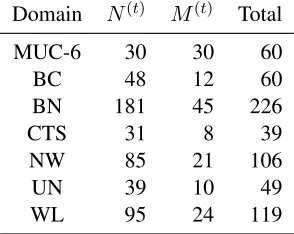
Table 1: The settings in the experiments under within-domain setting on MUC-6 and ACE 2005 corpora. N(t)
andM(t)and Total are the numbers of training, testing
and all documents respectively.
Domain N(t) M(t) Total
MUC-6 30 30 60
BC 48 12 60
BN 181 45 226
CTS 31 8 39
NW 85 21 106
UN 39 10 49
WL 95 24 119
5.1 Within-domain Setting
We conduct the experiment under the within-domain setting on seven tasks, with the per-domain setting shown in Table 1. The validation set is created by further splitting training data into validation train-ing and validation testtrain-ing sets with the ratio ofMN((tt)),
whereN(t) andM(t) are given in Table 1. In this experiment, we attempt to study the following three things. First, we investigate whether the proposed ensemble method is better than the tuned mention-pair methods and other ensemble methods. Second, we investigate the optimal number of active ensem-ble members. Third, we investigate the impact to the performance of the coreference system, when differ-ent objective measures are used with differdiffer-ent eval-uation measures.
For the proposed ensemble method, we experi-mented with nearest neighbor set of sizesk= 1,3,5 paired with objective functionΛ in (9) set to Rand Index, CEAF or B-CUBED. For baselines, the fol-lowing four are used:
• Two mention-pair baselines. Two baselines are the closest-first and the best-first mention-pair methods with the tuned parametersCandt. In the tuning process, the ranges of C andt are specified in (10) and (11) respectively. These two mention-pair methods are named as Scand
Sbfor short.
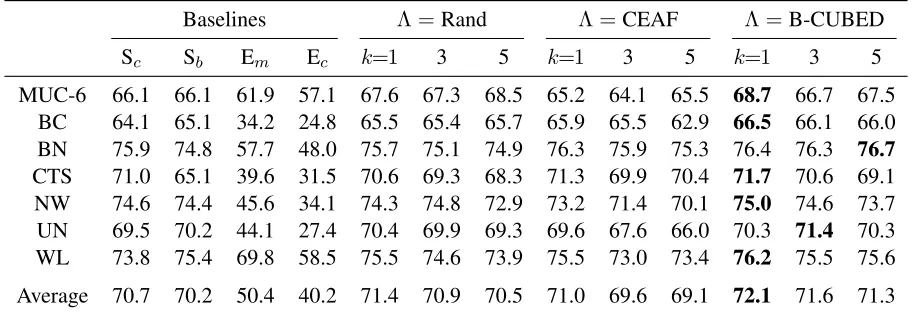
Table 2: B-CUBED F-measure results by all methods under within-domain setting on MUC-6 and ACE 2005 corpora.
Baselines Λ =Rand Λ =CEAF Λ =B-CUBED
Sc Sb Em Ec k=1 3 5 k=1 3 5 k=1 3 5
MUC-6 66.1 66.1 61.9 57.1 67.6 67.3 68.5 65.2 64.1 65.5 68.7 66.7 67.5
BC 64.1 65.1 34.2 24.8 65.5 65.4 65.7 65.9 65.5 62.9 66.5 66.1 66.0
BN 75.9 74.8 57.7 48.0 75.7 75.1 74.9 76.3 75.9 75.3 76.4 76.3 76.7
CTS 71.0 65.1 39.6 31.5 70.6 69.3 68.3 71.3 69.9 70.4 71.7 70.6 69.1
NW 74.6 74.4 45.6 34.1 74.3 74.8 72.9 73.2 71.4 70.1 75.0 74.6 73.7
UN 69.5 70.2 44.1 27.4 70.4 69.9 69.3 69.6 67.6 66.0 70.3 71.4 70.3
WL 73.8 75.4 69.8 58.5 75.5 74.6 73.9 75.5 73.0 73.4 76.2 75.5 75.6
Average 70.7 70.2 50.4 40.2 71.4 70.9 70.5 71.0 69.6 69.1 72.1 71.6 71.3
These two baselines use the same ensemble as the proposed method for fair comparison. In decision inference, these two baselines use the mention-based voting and cluster-based voting respectively, as proposed in (Rahman and Ng, 2011a). In these two baselines, all members in the ensemble participate the voting process. These two ensemble baselines are named as Em
and Ec for short.
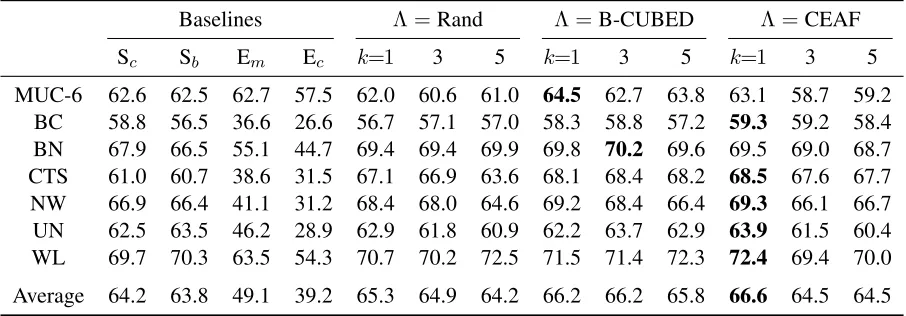
Tables 2 and 3 show the experiment results using B-CUBED and CEAF as the evaluation measures respectively. The best result for each of the seven tasks is highlighted in bold. The last rows of the ta-bles show the average performance value among all seven tasks.
From the results, we observe that the proposed en-semble method with objective function matching the evaluation measure and with k= 1 generally per-forms best among all methods and all tasks. Surpris-ingly, the common ensemble method with mention-based voting Emand cluster-based voting Ec
strate-gies do not perform well. The plausible reason is the current ensemble may incorporate some bad base models due to inappropriateC andtvalues, which would undermine the voting result. Nevertheless, it is difficult to judge the quality of the ensemble mem-bers in advance. Therefore, this validates the impor-tance of choosing an active set of ensemble members in decision inference. The better performance of the proposed method over the mention-pair baselines Sc
and Sbis probably because of the document-specific
decision. This is reasonable, as different base
mod-els in the ensemble would be good at predicting the different documents. For the proposed ensem-ble method with various configurations, we observe using an objective function that matches the evalu-ation measures is generally better. An exception is the MUC-6 and BN tasks in CEAF F-measure. We also observe that the ensemble method with k= 1 is generally better than that with the largerk, except the BN and UN tasks in B-CUBED F-measure. This suggests that the fewer the active ensemble members the better the generalization performance. Follow-ing (Rahman and Ng, 2011a), we also conduct the Student’s t-test, and the results show that the pro-posed method with the objective function matching the evaluation measure and with k = 1 is signifi-cantly better than the best baseline. In contrast, the two baseline ensemble methods that use voting are significantly worse than the best baseline. The sig-nificance level0.05.
5.2 Domain-adaptation Setting
Table 3: CEAF F-measure results by all methods under within-domain setting on MUC-6 and ACE 2005 corpora.
Baselines Λ =Rand Λ =B-CUBED Λ =CEAF
Sc Sb Em Ec k=1 3 5 k=1 3 5 k=1 3 5
MUC-6 62.6 62.5 62.7 57.5 62.0 60.6 61.0 64.5 62.7 63.8 63.1 58.7 59.2
BC 58.8 56.5 36.6 26.6 56.7 57.1 57.0 58.3 58.8 57.2 59.3 59.2 58.4
BN 67.9 66.5 55.1 44.7 69.4 69.4 69.9 69.8 70.2 69.6 69.5 69.0 68.7
CTS 61.0 60.7 38.6 31.5 67.1 66.9 63.6 68.1 68.4 68.2 68.5 67.6 67.7
NW 66.9 66.4 41.1 31.2 68.4 68.0 64.6 69.2 68.4 66.4 69.3 66.1 66.7
UN 62.5 63.5 46.2 28.9 62.9 61.8 60.9 62.2 63.7 62.9 63.9 61.5 60.4
WL 69.7 70.3 63.5 54.3 70.7 70.2 72.5 71.5 71.4 72.3 72.4 69.4 70.0
Average 64.2 63.8 49.1 39.2 65.3 64.9 64.2 66.2 66.2 65.8 66.6 64.5 64.5
(or unlabeled) documents in the target document is also the same as in Table 1. The validation set is created similarly as in the experiment under within-domain setting.
For the proposed ensemble method, we heuristi-cally determine the parameterBinµto be the num-ber of non-zero elements inΓ, where
Γ =
N(t)
∑
j=1
∑
D(su)
i ∈I(D
(t)
j ;su)
∆(D(su)
i ,D
(t)
j ).
Making use of the conclusion in the experiments for the within-domain setting, we fix the optimized measure to be the final performance measure in (9). We compare with the following five baselines.
• Two mention-pair baselines in within-domain setting. Two baselines are same as Sc and Sbin
the experiments under within-domain settings, except that the labeled training documents are reduced to 5.
• Three proposed adaptive ensemble methods without cross-domain knowledge learning. These three baselines uses neighborhood sizes k = 1,3,5with the grand ensembleF rather than the target domain ensembleF(t). In an-other words, these three baselines are the same as the proposed method, but withµ=1.
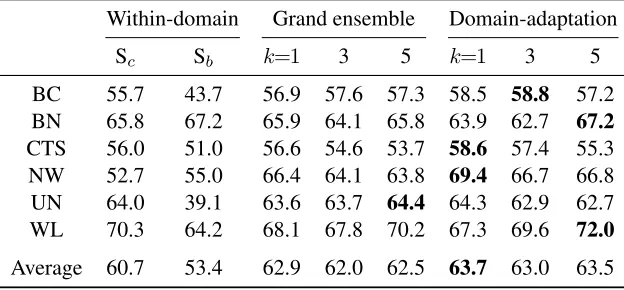
Tables 4 and 5 show the experimental results in the domain adaptation settings using B-CUBED and
CEAF as the final performance measures respec-tively. From the results, we can see that the pro-posed method with cross-domain knowledge gener-ally outperforms all the five baselines. Among them, the best proposed domain adaptation method on av-erage outperforms the best ofSc, Sbby 7.2% for
B-CUBED F-measure and 3% for CEAF F-measure. The grand-ensemble baselines are also significantly better than the within-domain baselines. These re-sults clearly illustrate the usefulness of making use of the labeled documents in the source domains. For the comparison between the proposed method with and without cross-domain knowledge learning, all tasks, except UN task in CEAF F-measure, show the superiority of the proposed method with cross-domain knowledge learning. Among them, except tasks BN and CTS in B-CUBED F-measure, the per-formance gains are among 1%—3% for all tasks in both measures. These results verify the necessity of cross-domain knowledge learning. For the com-parison of the proposed method with different k, unlike the results in the within-domain setting, the results here show that choosing optimal k is task-dependent. The reason of this observation is not clear yet. It is plausible due to the increased uncer-tainties from multiple domains.
6 Conclusions and Future Work
incor-Table 4: B-CUBED F-measure results by all methods under domain adaptation setting on ACE 2005 corpora, withΛ
set to B-CUBED. Thewithin-domainandgrand ensemblemethods are the baselines.
Within-domain Grand ensemble Domain-adaptation
Sc Sb k=1 3 5 k=1 3 5
BC 58.0 65.1 65.0 67.1 67.0 67.5 68.2 67.7
BN 72.7 73.8 75.0 75.3 75.0 75.3 75.4 74.3
CTS 63.2 62.1 65.7 64.8 64.0 64.1 65.8 65.8
NW 54.9 54.6 73.6 73.1 74.2 73.0 74.4 74.7
UN 66.5 42.7 67.2 68.2 68.9 69.7 68.7 68.2
WL 68.6 73.2 73.0 72.6 73.4 74.8 74.5 73.6
[image:9.612.148.463.96.239.2]Average 64.0 61.9 69.9 70.2 70.4 70.7 71.2 70.7
Table 5: CEAF F-measure results by all methods under domain adaptation setting on ACE 2005 corpora, withΛset to CEAF. Thewithin-domainandgrand ensemblemethods are the baselines.
Within-domain Grand ensemble Domain-adaptation
Sc Sb k=1 3 5 k=1 3 5
BC 55.7 43.7 56.9 57.6 57.3 58.5 58.8 57.2
BN 65.8 67.2 65.9 64.1 65.8 63.9 62.7 67.2
CTS 56.0 51.0 56.6 54.6 53.7 58.6 57.4 55.3
NW 52.7 55.0 66.4 64.1 63.8 69.4 66.7 66.8
UN 64.0 39.1 63.6 63.7 64.4 64.3 62.9 62.7
WL 70.3 64.2 68.1 67.8 70.2 67.3 69.6 72.0
Average 60.7 53.4 62.9 62.0 62.5 63.7 63.0 63.5
porating the cross-domain knowledge to aid coref-erence resolution learning. This is useful when the labeled coreference labels are scarce. We also demonstrate that the proposed adaptive ensemble method can be readily applied to conventional coref-erence tasks without cross-domain knowledge learn-ing. Compared with existing ensemble methods, the proposed method is simultaneously endowed with the following three distinctive features: optimizing any user-specified performance measure, making the document-specific prediction and automatically ad-justing the active ensemble members. In the exper-iments under both within-domain settings and do-main adaptation settings, the results evidence the effectiveness of the proposed cross-domain knowl-edge learning method, and also demonstrate the su-periority of the proposed adaptive ensemble method over other baselines.
Currently, the proposed method relies on some
limited target annotations. It would be interesting to consider the pure unsupervised tasks that have no any target annotations. Besides, to develop some better ways for document-level representation, e.g., incorporating the domain knowledge, also deserves our attentions. Similarly, to extend the diagonal Ma-halanobis matrix to the general covariance matrix is also desirable. Last but not least, to find a more sys-tematical way to determine the optimalkin the pro-posed method is also our possible future work.
Acknowledgments
This work is supported by DSO grant
DSOCL10021.
References
[image:9.612.149.461.283.428.2]model. In Proceedings of the 36th Annual Meeting of the Association for Computational Linguistics and 17th International Conference on Computational Lin-guistics - Volume 1, ACL’98, pages 79–85.
Christopher M. Bishop. 2007. Pattern Recognition and Machine Learning (Information Science and Statis-tics). Springer, 1st ed. 2006. corr. 2nd printing edition, October.
John Blitzer, Ryan McDonald, and Fernando Pereira. 2006. Domain adaptation with structural correspon-dence learning. In Proceedings of EMNLP, pages 120–128.
Leo Breiman. 1996. Bagging predictors. Machine Learning, 24(2):123–140, August.
Leo Breiman. 2001. Random forests. Machine Learn-ing, 45(1):5–32, October.
Pascal Denis and Jason Baldridge. 2007. Joint determi-nation of anaphoricity and coreference resolution us-ing integer programmus-ing. In Proc HLT, pages 236– 243, Rochester, New York, April.
Rong-En Fan, Kai-Wei Chang, Cho-Jui Hsieh, Xiang-Rui Wang, and Chih-Jen Lin. 2008. LIBLINEAR: A li-brary for large linear classification. Journal of Ma-chine Learning Research, 9:1871–1874.
Thomas Finley and Thorsten Joachims. 2005. Super-vised clustering with support vector machines. In
Proc. ICML.
Yoav Freund and Robert E. Schapire. 1996. Experiments with a New Boosting Algorithm. In Proc. ICML, pages 148–156.
Honglei Guo, Huijia Zhu, Zhili Guo, Xiaoxun Zhang, Xian Wu, and Zhong Su. 2009. Domain adapta-tion with latent semantic associaadapta-tion for named entity recognition. NAACL ’09, pages 281–289.
Jing Jiang and ChengXiang Zhai. 2007. Instance weight-ing for domain adaptation in NLP. In Proc. ACL, pages 264–271, Prague, Czech Republic, June. Jing Jiang. 2009. Multi-task transfer learning for
weakly-supervised relation extraction. InProceedings of the Joint Conference of the 47th Annual Meeting of the ACL and the 4th International Joint Conference on Natural Language Processing of the AFNLP, pages 1012–1020, Suntec, Singapore, August. Association for Computational Linguistics.
Xiaoqiang Luo. 2005. On coreference resolution perfor-mance metrics. In Proceedings of the conference on Human Language Technology and Empirical Methods in Natural Language Processing, HLT ’05, pages 25– 32.
Art Munson, Claire Cardie, and Rich Caruana. 2005. Optimizing to arbitrary NLP metrics using ensemble selection. InProc HLT and EMNLP, pages 539–546.
Vincent Ng and Claire Cardie. 2002. Improving ma-chine learning approaches to coreference resolution. InProc. ACL, pages 104–111.
Vincent Ng and Claire Cardie. 2003. Weakly supervised natural language learning without redundant views. In
Proc. HLT-NAACL.
Vincent Ng. 2005. Machine learning for coreference res-olution: From local classification to global ranking. In
Proceedings of the ACL, pages 157–164.
Sinno Jialin Pan and Qiang Yang. 2010. A survey on transfer learning. IEEE Transactions on Knowledge and Data Engineering, 22(10):1345–1359, October. Wenbo Pang and Xiaozhong Fan. 2009. Chinese
coref-erence resolution with ensemble learning. In Proc. PACIIA, pages 236–243.
Altaf Rahman and Vincent Ng. 2011a. Ensemble-based coreference resolution. In Proceedings of IJ-CAI, pages 1884–1889.
Altaf Rahman and Vincent Ng. 2011b. Narrowing the modeling gap: A cluster-ranking approach to corefer-ence resolution.JAIR, 1:469–52.
William M. Rand. 1971. Objective criteria for the eval-uation of clustering methods.Journal of the American Statistical Association, 66(336):pp. 846–850.
W. M. Soon, H. T. Ng, and D. C. Y. Lim. 2001. A ma-chine learning approach to coreference resolution of noun phrases.Computational Linguistics,, pages 521– 544.
Veselin Stoyanov, Claire Cardie, Nathan Gilbert, Ellen Riloff, David Buttler, and David Hysom. 2010. Coref-erence resolution with reconcile. InProc. ACL, pages 156–161.
Songbo Tan, Yuefen Wang, Gaowei Wu, and Xueqi Cheng. 2008. Using unlabeled data to handle domain-transfer problem of semantic detection. In Proceed-ings of the 2008 ACM symposium on Applied comput-ing, SAC ’08, pages 896–903.
S. Vemulapalli, X. Luo, J.F.Pitrelli, and I. Zitouni. 2009. classifier combination applied to coreference resolu-tion. InNAACL HLT Student Rsearch Workshop. Marc Vilain, John Burger, John Aberdeen, Dennis
Con-nolly, and Lynette Hirschman. 1995. A model-theoretic coreference scoring scheme. In Proceed-ings of the 6th conference on Message understanding, MUC6 ’95, pages 45–52.
Liu Yang and Rong Jin. 2006. Distance Metric Learning: A Comprehensive Survey. Technical report, Depart-ment of Computer Science and Engineering, Michigan State University.
Chun-Nam John Yu and Thorsten Joachims. 2009. Learning structural SVMs with latent variables. In