Towards Robust Linguistic Analysis Using OntoNotes
Sameer Pradhan1, Alessandro Moschitti2,3, Nianwen Xue4, Hwee Tou Ng5
Anders Bj¨orkelund6,Olga Uryupina2,Yuchen Zhang4 andZhi Zhong5
1 Boston Childrens Hospital and Harvard Medical School, Boston, MA 02115, USA 2 University of Trento, University of Trento, 38123 Povo (TN), Italy
3 QCRI, Qatar Foundation, 5825 Doha, Qatar
4 Brandeis University, Brandeis University, Waltham, MA 02453, USA 5 National University of Singapore, Singapore, 117417
6 University of Stuttgart, 70174 Stuttgart, Germany
Abstract
Large-scale linguistically annotated cor-pora have played a crucial role in advanc-ing the state of the art of key natural lan-guage technologies such as syntactic, se-mantic and discourse analyzers, and they serve as training data as well as evaluation benchmarks. Up till now, however, most of the evaluation has been done on mono-lithic corpora such as the Penn Treebank, the Proposition Bank. As a result, it is still unclear how the state-of-the-art analyzers perform in general on data from a vari-ety of genres or domains. The completion of the OntoNotes corpus, a large-scale, multi-genre, multilingual corpus manually annotated with syntactic, semantic and discourse information, makes it possible to perform such an evaluation. This paper presents an analysis of the performance of publicly available, state-of-the-art tools on all layers and languages in the OntoNotes v5.0 corpus. This should set the bench-mark for future development of various NLP components in syntax and semantics, and possibly encourage research towards an integrated system that makes use of the various layers jointly to improve overall performance.
1 Introduction
Roughly a million words of text from the Wall Street Journal newswire (WSJ), circa 1989, has had a significant impact on research in the lan-guage processing community — especially those in the area of syntax and (shallow) semantics, the reason for this being the seminal impact of the Penn Treebank project which first selected this text for annotation. Taking advantage of a solid syn-tactic foundation, later researchers who wanted to annotate semantic phenomena on a relatively large scale, also used it as the basis of their annota-tion. For example the Proposition Bank (Palmer et al., 2005), BBN Name Entity and Pronoun coref-erence corpus (Weischedel and Brunstein, 2005),
the Penn Discourse Treebank (Prasad et al., 2008), and many other annotation projects, all annotate the same underlying body of text. It was also con-verted to dependency structures and other syntac-tic formalisms such as CCG (Hockenmaier and Steedman, 2002) and LTAG (Shen et al., 2008), thereby creating an even bigger impact through these additional syntactic resources. The most re-cent one of these efforts is the OntoNotes corpus (Weischedel et al., 2011). However, unlike the previous extensions of the Treebank, in addition to using roughly a third of the same WSJ subcor-pus, OntoNotes also added several other genres, and covers two other languages — Chinese and Arabic: portions of the Chinese Treebank (Xue et al., 2005) and the Arabic Treebank (Maamouri and Bies, 2004) have been used to sample the genre of text that they represent.
One of the current hurdles in language process-ing is the problem of domain, or genre adaptation. Although genre or domain are popular terms, their definitions are still vague. In OntoNotes, “genre” means a type of source – newswire (NW),
broad-cast news (BN), broadcast conversation (BC),
mag-azine (MZ), telephone conversation (TC), web data
(WB) or pivot text (PT). Changes in the entity and
event profiles across source types, and even in the same source over a time duration, as explicitly ex-pressed by surface lexical forms, usually account for a lot of the decrease in performance of mod-els trained on one source and tested on another, usually because these are the salient cues that are relied upon by statistical models.
Large-scale corpora annotated with multiple layers of linguistic information exist in various languages, but they typically consist of a single source or collection. The Brown corpus, which consists of multiple genres, have been usually used to investigate issues of genres of sensitivity, but it is relatively small and does not include any
infor-1A portion of the English data in the OntoNotes corpus
is a selected set of sentences that were annotated for parse and word sense information. These sentences are present in a document of their own, and so the documents for parse layers for English are inflated by about 3655 documents and for the word sense are inflated by about 8797 documents.
Language Parse Proposition Sense Name Coreference
Documents Words Documents Verb Prop. Noun Prop. Documents Verb Sense Noun Sense Documents Words Documents Words English 7,9671 2.6M 6,124 300K 18K 12K 173K 120K 3,637 2.0M 2,384
(3493) 1.7M
Chinese 2002 1.0M 1861 148K 7K 1573 83K 1K 1,911 988K 1,729 (2,280) 950K
[image:2.595.75.526.69.121.2]Arabic 599 402K 599 30K - 310 4.3K 8.7K 446 298K 447 (447) 300K Table 1: Coverage for each layer in the OntoNotes v5.0 corpus, by number of documents, words, and some other attributes. The numbers in parenthesis are the total number of parts in the documents.
mal genres such as web data. Very seldom has it been the case that the exact same phenomena have been annotated on a broad cross-section of the same language before OntoNotes. The OntoNotes corpus thus provides an opportunity for studying the genre effect on different syntactic, semantic and discourse analyzers.
Parts of the OntoNotes Corpus have been used for various shared tasks organized by the language processing community. The word sense layer was the subject of prediction in two SemEval-2007 tasks, and the coreference layer was the subject of prediction in the SemEval-20102 (Recasens et
al., 2010), CoNLL-2011 and 2012 shared tasks (Pradhan et al., 2011; Pradhan et al., 2012). The CoNLL-2012 shared task provided predicted in-formation to the participants, however, that did not include a few layers such as the named entities for Chinese and Arabic, propositions for Arabic, and for better comparison of the English data with the CoNLL-2011 task, a smaller OntoNotes v4.0 portion of the English parse and propositions was used for training.
This paper is a first attempt at presenting a co-herent high-level picture of the performance of various publicly available state-of-the-art tools on all the layers of OntoNotes in all three languages, so as to pave the way for further explorations in the area of syntax and semantics processing.
The possible avenues for exploratory studies on various fronts are enormous. However, given space considerations, in this paper, we will re-strict our presentation of the performance on all layers of annotation in the data by using a strat-ified cross-section of the corpus for training, de-velopment, and testing. The paper is organized as follows: Section 2 gives an overview of the OntoNotes corpus. Section 3 explains the param-eters of the evaluation and the various underlying assumptions. Section 4 presents the experimental results and discussion, and Section 5 concludes the paper.
2 OntoNotes Corpus
The OntoNotes project has created a large-scale corpus of accurate and integrated annotation of
2A small portion 125K words in English was used for this
evaluation.
multiple layers of syntactic, semantic and dis-course information in text. The English lan-guage portion comprises roughly 1.7M words and Chinese language portion comprises roughly 1M words of newswire, magazine articles, broadcast news, broadcast conversations, web data and con-versational speech data3. The Arabic portion is
smaller, comprising 300K words of newswire ar-ticles. This rich, integrated annotation covering many layers aims at facilitating the development of richer, cross-layer models and enabling bet-ter automatic semantic analysis. The corpus is tagged with syntactic trees, propositions for most verb and some noun instances, partial verb and noun word senses, coreference, and named enti-ties. Table 1 gives an overview of the number of documents that have been annotated in the entire OntoNotes corpus.
2.1 Layers of Annotation
This section provides a very concise overview of the various layers of annotations in OntoNotes. For a more detailed description, the reader is re-ferred to (Weischedel et al., 2011) and the docu-mentation accompanying the v5.04release.
2.1.1 Syntax
This represents the layer of syntactic annotation based on revised guidelines for the Penn Tree-bank (Marcus et al., 1993; Babko-Malaya et al., 2006), the Chinese Treebank (Xue et al., 2005) and the Arabic Treebank (Maamouri and Bies, 2004). There were two updates made to the parse trees as part of the OntoNotes project: i) the in-troduction ofNMLphrases, in the English portion,
to mark nominal sub-constituents of flatNPs that
do not follow the default right-branching structure, and ii) re-tokenization of hyphenated tokens into multiple tokens in English and Chinese. The Ara-bic Treebank on the other hand was also signifi-cantly revised in an effort to increase consistency. 2.1.2 Word Sense
Coarse-grained word senses are tagged for the most frequent polysemous verbs and nouns, in or-3These numbers are for the portion that has all layers of
annotations. The word count for each layer is mentioned in Table 1
4For all the layers of data used in this study, the
der to maximize token coverage. The word sense granularity is tailored to achieve very high inter-annotator agreement as demonstrated by Palmer et al. (2007). These senses are defined in the sense inventory files. In the case of English and Arabic languages, the sense-inventories (and frame files) are defined separately for each part of speech that is realized by the lemma in the text. For Chinese, however the sense inventories (and frame files) are defined per lemma – independent of the part of speech realized in the text.
2.1.3 Proposition
The propositions in OntoNotes are PropBank-style semantic roles for English, Chinese and Arabic. Most English verbs and few nouns were anno-tated using the revised guidelines for the English PropBank (Babko-Malaya et al., 2006) as part of the OntoNotes effort. Some enhancements were made to the English PropBank and Treebank to make them synchronize better with each other: one of the outcomes of this effort was that two types of LINKs that represent pragmatic
coref-erence (LINK-PCR) and selectional preferences
(LINK-SLC) were added to the original PropBank
(Palmer et al., 2005). More details can be found in the addendum to the PropBank guidelines5 in the
OntoNotes v5.0 release. A part of speech agnostic Chinese PropBank (Xue and Palmer, 2009) guide-lines were used to annotate most frequent lem-mas in Chinese. Many verbs and some nouns and adjectives were annotated using the revised Ara-bic PropBank guidelines (Palmer et al., 2008; Za-ghouani et al., 2010).
2.1.4 Named Entities
The corpus was tagged with a set of 18 well-defined proper named entity types that have been tested extensively for inter-annotator agreement by Weischedel and Burnstein (2005).
2.1.5 Coreference
This layer captures general anaphoric corefer-ence that covers entities and events not limited to noun phrases or a limited set of entity types (Pradhan et al., 2007). It considers all pronouns (PRP,PRP$), noun phrases (NP) and heads of verb
phrases (VP) as potential mentions. Unlike
En-glish, Chinese and Arabic have dropped subjects and objects which were also considered during coreference annotation6. The mentions formed by
these dropped pronouns total roughly about 11% for both Chinese and Arabic. Coreference is the only document-level phenomenon in OntoNotes. Some of the documents in the corpus — especially the ones in the broadcast conversation, web data,
5doc/propbank/english-propbank.pdf
6As we will see later these are not used during the task.
and telephone conversation genre — are very long which prohibited efficient annotation in their en-tirety. These are split into smaller parts, and each part is considered a separate document for the sake of coreference evaluation.
3 Evaluation Setting
Given the scope of the corpus and the multitude of settings one can run evaluations, we had to restrict this study to a relatively focused subset. There has already been evidence of models trained on WSJ doing poorly on non-WSJ data on parses (Gildea, 2001; McClosky et al., 2006), semantic role label-ing (Carreras and M`arquez, 2005; Pradhan et al., 2008), word sense (Escudero et al., 2000;?), and named entities. The phenomenon of coreference is somewhat of an outlier. The winning system in the CoNLL-2011 shared task was one that was com-pletely rule-based and not directly trained on the OntoNotes corpus. Given this overwhelming evi-dence, we decided not to focus on potentially com-plex cross-genre evaluations. Instead, we decided on evaluating the performance on each layer of an-notation using an appropriately selected, stratified training, development and test set, so as to facili-tate future studies.
3.1 Training, Development and Test Partitions
vari-ous cross sections of the documents in the corpus, and would not provide a clean picture when look-ing at the collective performance for all the lay-ers. The documents that are annotated with coref-erence correspond to the intersection of all anno-tations. These are the documents that have also been annotated with all the other layers of infor-mation. The amount of data we can get together in such a test set is big enough to be represen-tative. Therefore, we decided that it would be ideal to choose a portion of these documents as the test collection for all layers. An additional ad-vantage is that it is the exact same test set used in the CoNLL-2012 shared task, and so in a way is already a standard. On the training and devel-opment side however, one can still imagine using all possible information for training models for a particular layer, and that is what we decided to do. The training and development data is gener-ated by providing all documents with all available layers of annotation for input, however, the test set is generated by providing as input to the algo-rithm the set of documents in the corpus that have been annotated for coreference. This algorithm tries to reuse previously established partitions for English, i.e., the WSJ portion. Unfortunately, in the case of Chinese and Arabic, either the histor-ical partitions were not in the selection used for OntoNotes, or were partially overlapping with the ones created using this scheme, and/or had a very small portion of OntoNotes covered in the test set. Therefore, we decided to create a fresh partition for the Chinese and Arabic data. Note, however, that the these test sets also match the ones used in the CoNLL-2012 evaluation. The algorithm for selecting the training, development and test parti-tions is described on the CoNLL-2012 shared task webpage, along with the list of training, develop-ment, and test document IDs7.
3.2 Assumptions
Next we had to decide on a set of assumptions to use while designing the experiments to mea-sure the automatic prediction accuracy for each of the layers. Since some of these decisions affect more than one layer of annotation, we will de-scribe these in this section instead of in the section where we discuss the experiment with a particular layer of annotation.
7http://conll.cemantix.org/2012/download/ids/
For each language there are two sub-directories — “all” contains more general lists which include documents that had at least one of the layers of annotation, and “coref” contains the lists that include documents that have coreference annotation. The former were used to generate training, development, test sets for layers other than coreference, and the latter was used to generate training/development/test sets for the coreference layer used in the CoNLL-2012 shared task.
Word Segmentation The three languages that
we are evaluating are from quite different lan-guage families. Arabic has a complex morphol-ogy, English has limited morpholmorphol-ogy, whereas Chinese has very little morphology. English word segmentation amounts to rule-based tokenization, and is close to perfect. In the case of Chinese and Arabic, although the tokenization/segmentation is not as good as English, the accuracies are in the high 90s. Given this we decided to use gold, Treebank segmentation for all languages. In the case of Chinese, the words themselves are lem-mas, whereas in English they can be predicted with very high accuracy. For Arabic, by default written text is unvocalised, and lemmatization is a complex process which we considered out of the scope of this study, so we decided to use correct, gold standard lemmas, along with the correct vo-calized version of the tokens.
Traces and Function Tags Treebank traces
Disfluencies One thing that needs to be dealt with in conversational data is the presence of dis-fluencies (restarts, etc.). In the English parses of the OntoNotes, disfluencies are marked using a special EDITED8 phrase tag – as was the case for
the Switchboard Treebank. Computing the accu-racy of identifying disfluencies is also out of the scope of this study. Given the frequency of dis-fluencies and the performance with which one can identify them automatically,9 a probable
process-ing pipeline would filter them out before parsprocess-ing. We decided to remove them using oracle infor-mation available in the English Treebank, and the coreference chains were remapped to trees with-out disfluencies. Owing to various technical con-straints, we decided to retain the disfluencies in the Chinese data.
Spoken Genre Given the scope of this study, we make another significant assumption. For the spo-ken genres –BC, BNandTC– we use the manual
transcriptions rather than the output of a speech recognizer, as would be the case in real world. The performance on various layers for these genres would therefore be artificially inflated, and should be taken into account while analyzing results. Not many studies have previously reported on syntac-tic and semansyntac-tic analysis for spoken genre. Favre et al. (2010) report the performance on the English subset of an earlier version of OntoNotes.
Discourse The corpus contains information on
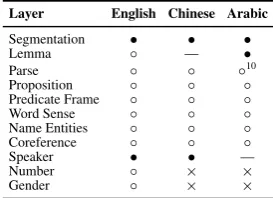
the speaker for broadcast communication, conver-sation, telephone conversation and writer for the web data. This information provides an important clue for correctly linking anaphoric pronouns with the right antecedents. This information could be automatically deduced, but is also not within the scope of our study. Therefore, we decided to pro-vide gold, instead of predicted, data both during training and testing. Table 2 lists the status of the layers.
4 Experiments
In this section, we will report on the experiments carried out using all available data in the train-ing set for traintrain-ing models for a particular layer, and using the CoNLL-2012 test set as the test set. 8There is another phrase type –EMBEDin the telephone
conversation genre which is similar to the EDITED phrase type, and sometimes identifies insertions, but sometimes con-tains logical continuation of phrases by different speakers, so we decided not to remove that from the data.
9A study by Charniak and Johnson (2001) shows that one
can identify and remove edits from transcribed conversational speech with an F-score of about 78, with roughly 95 precision and 67 recall.
10The predicted part of speech for Arabic are a mapped
down version of the richer gold version present in the Tree-bank
Layer English Chinese Arabic
Segmentation • • •
Lemma ◦ — •
Parse ◦ ◦ ◦10
Proposition ◦ ◦ ◦
Predicate Frame ◦ ◦ ◦
Word Sense ◦ ◦ ◦
Name Entities ◦ ◦ ◦
Coreference ◦ ◦ ◦
Speaker • • — Number ◦ × ×
[image:5.595.347.484.63.162.2]Gender ◦ × ×
Table 2: Status of layers used during prediction of other layers. A “•” indicates gold annotation, a “◦” indicates predicted, a “×” indicates an ab-sence of the predicted layer, and a “—” indicates that the layer is not applicable to the language.
The predicted annotation layers input to down-stream models were automatically annotated by using NLP processors learned with n-cross fold
validation on the training data. This way, the n
chunks of training data are annotated avoiding de-pendencies with the data used for training the NLP processors.
4.1 Syntax
Predicted parse trees for English were produced using the Charniak parser11 (Charniak and
John-son, 2005). Some additional tag types used in the OntoNotes trees were added to the parser’s tagset, including the nominal (NML) tag, and the
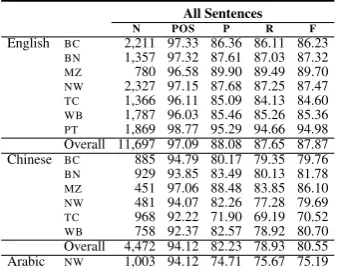
rules used to determine head words were extended correspondingly. Chinese and Arabic parses were generated using the Berkeley parser (Petrov and Klein, 2007). In the case of Arabic, the pars-ing community uses a mapppars-ing from rich Arabic part of speech tags to Penn-style part of speech tags. We used the mapping that is included with the Arabic Treebank. The predicted parses for the training portion of the data were generated us-ing 10-fold (5-folds for Arabic) cross-validation. For testing, we used a model trained on the entire training portion. Table 3 shows the precision, re-call and F1-scores of the re-trained parsers on the
CoNLL-2012 test along with the part of speech ac-curacies (POS) using the standardevalbscorer.
The performance on thePTgenre for English is
the highest among other English genres. This is possibly because of the professional, clean trans-lations of the underlying text, and are mostly shorter sentences. TheMZ genre and theNWboth
of which contain well edited text, share similar scores. There is a few points gap between these and the other genres. As for Chinese, the per-formance on MZ is the highest followed by BN.
Surprisingly, theWBgenre has a similar score and
the others are close behind except forTC. As
All Sentences
N POS P R F
English BC 2,211 97.33 86.36 86.11 86.23
BN 1,357 97.32 87.61 87.03 87.32
MZ 780 96.58 89.90 89.49 89.70
NW 2,327 97.15 87.68 87.25 87.47
TC 1,366 96.11 85.09 84.13 84.60
WB 1,787 96.03 85.46 85.26 85.36
PT 1,869 98.77 95.29 94.66 94.98 Overall 11,697 97.09 88.08 87.65 87.87 Chinese BC 885 94.79 80.17 79.35 79.76
BN 929 93.85 83.49 80.13 81.78
MZ 451 97.06 88.48 83.85 86.10
NW 481 94.07 82.26 77.28 79.69
TC 968 92.22 71.90 69.19 70.52
[image:6.595.351.481.62.204.2]WB 758 92.37 82.57 78.92 80.70 Overall 4,472 94.12 82.23 78.93 80.55 Arabic NW 1,003 94.12 74.71 75.67 75.19
Table 3: Parser performance on the CoNLL-2012 test set.
est among the three languages. 4.2 Word Sense
We used the IMS12 (It Makes Sense) (Zhong and
Ng, 2010) word sense tagger. IMS was trained on all the word sense data that is present in the train-ing portion of the OntoNotes corpus ustrain-ing cross-validated predictions on the input layers similar to the proposition tagger. During testing, for En-glish and Arabic, IMS must first use the auto-matic POS information to identify the nouns and verbs in the test data, and then assign senses to the automatically identified nouns and verbs. In the case of Arabic, IMS uses gold lemmas. Since automatic POS tagging is not perfect, IMS does not always output a sense to all word tokens that need to be sense tagged due to wrongly predicted POS tags. As such, recall is not the same as pre-cision on the English and Arabic test data. For Chinese the measure of performance is just the accuracy since the senses are defined per lemma rather than per part of speech. Since we provide gold word segmentation, IMS attempts to sense tag all correctly segmented Chinese words, so re-call and precision are the same and so is the F1
-score. Table 4 shows the performance of this clas-sifier aggregated over both the verbs and nouns in the CoNLL-2012 test set and an overall score split by nouns and verbs for English and Ara-bic. For both nouns and verbs in English, the F1-score is over 80%. The performance on
En-glish nouns is slightly higher than EnEn-glish verbs. Comparing to the other two languages, the perfor-mance on Arabic is relatively lower, especially the performance on Arabic verbs, whose F1-score is
less than 70%. For English, genres PT and TC,
and for Chinese genres TCandWB, no gold
stan-dard senses were available, and so their accuracies could not be computed. Previously, Zhong et al. (2008) reported the word sense performance on the Wall Street Journal portion of an earlier
ver-12http://www.comp.nus.edu.sg/
∼nlp/sw/IMS v0.9.2.1.tar.gz
Performance
P R F A
English BC 81.2 81.3 81.2
-BN 82.0 81.5 81.7
-MZ 79.1 78.8 79.0
-NW 85.7 85.7 85.7
-WB 77.5 77.6 77.5 -Overall 82.5 82.5 82.5 -Nouns 83.4 83.1 83.2 -Verbs 81.8 81.9 81.8 -Chinese BC - - - 80.5
BN - - - 85.4
MZ - - - 82.4
NW - - - 89.1 Overall - - - 84.3 Arabic NW 75.9 75.2 75.6 -Nouns 79.2 77.7 78.4 -Verbs 68.8 69.5 69.1
-Table 4: Word sense performance on the CoNLL-2012 test set.
sion of OntoNotes, but the results are not directly comparable.
4.3 Proposition
The revised PropBank has introduced two new links —LINK-SLCandLINK-PCR. Since the
com-munity is not used to the new PropBank represen-tation which (i) relies heavily on the trace struc-ture in the Treebank and (ii) we decided to ex-clude, weunfoldthe LINKs back to their original
representation as in the PropBank 1.0 release. We used ASSERT15 (Pradhan et al., 2005) to predict
the propositional structure for English. We made a small modification to ASSERT, and replaced the TinySVM classifier with a CRF16 to speed
up training the model on all the data. The Chi-nese propositional structure was predicted with the Chinese semantic role labeler described in (Xue, 2008), retrained on the OntoNotes v5.0 data. The Arabic propositional structure was predicted us-ing the system described in Diab et al. (2008). (Diab et al., 2008) Table 5 shows the detailed per-14The Frame ID column indicates the F-score for English
and Arabic, and accuracy for Chinese for the same reasons as word sense.
15http://cemantix.org/assert.html 16http://leon.bottou.org/projects/sgd
Frame Total Total % Perfect Argument ID + Class
ID Sent. Prop. Prop. P R F
English BC 93.2 1994 5806 52.89 80.76 69.69 74.82
BN 92.7 1218 4166 54.78 80.22 69.36 74.40
MZ 90.8 740 2655 50.77 79.13 67.78 73.02
NW 92.8 2122 6930 46.45 79.80 66.80 72.72
TC 91.8 837 1718 49.94 79.85 72.35 75.91
WB 90.7 1139 2751 42.86 80.51 69.06 74.35
PT 96.6 1208 2849 67.53 89.35 84.43 86.82 Overall 92.8 9,261 26,882 51.66 81.30 70.53 75.53 Chinese BC 87.7 885 2,323 31.34 53.92 68.60 60.38
BN 93.3 929 4,419 35.44 64.34 66.05 65.18
MZ 92.3 451 2,620 31.68 65.04 65.40 65.22
NW 96.6 481 2,210 27.33 69.28 55.74 61.78
TC 82.2 968 1,622 32.74 48.70 59.12 53.41
WB 87.8 758 1,761 35.21 62.35 68.87 65.45 Overall 90.9 4,472 14,955 32.62 61.26 64.48 62.83 Arabic NW 85.6 1,003 2337 24.18 52.99 45.03 48.68
[image:6.595.97.267.63.199.2]formance numbers17. The CoNLL-2005 scorer18
was used to compute the scores. At first glance, the performance on the English newswire genre is much lower than what has been reported for WSJ Section 23. This could be attributed to several fac-tors: i) the newswire in OntoNotes not only con-tains WSJ data, but also Xinhua news, and some other newswire evaluation data, ii) The WSJ train-ing and test portions in OntoNotes are a subset of the standard ones that have been used to report performance earlier; iii) the PropBank guidelines were significantly revised during the OntoNotes project in order to synchronize well with the Tree-bank, and finally iv) it includes propositions for
be verbs missing from the original PropBank. It looks like the newly added Pivot Text data (com-prised of the New Testament) shows very good performance. The Chinese and Arabic19 accuracy
is much worse. In addition to automatically pre-dicting the arguments, we also trained the IMS system to tag PropBank framesetIDs.
Language Genre Entity Performance
Count P R F
English BC 1671 80.17 77.20 78.66
BN 2180 88.95 85.69 87.29
MZ 1161 82.74 82.17 82.45
NW 4679 86.79 84.25 85.50
TC 362 74.09 61.60 67.27
WB 1133 77.72 68.05 72.56 Overall 11186 84.04 80.86 82.42 Chinese BC 667 72.49 58.47 64.73
BN 3158 82.17 71.50 76.46
NW 1453 86.11 76.39 80.96
MZ 1043 65.16 56.66 60.62
TC 200 48.00 60.00 53.33
[image:7.595.104.261.332.466.2]WB 886 80.60 51.13 62.57 Overall 7407 78.20 66.45 71.85 Arabic NW 2550 74.53 62.55 68.02
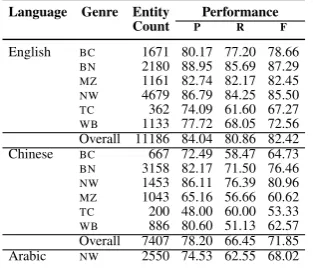
Table 6: Performance of the named entity recog-nizer on the CoNLL-2012 test set.
4.4 Named Entities
We retrained the Stanford named entity recog-nizer20(Finkel et al., 2005) on the OntoNotes data.
Table 6 shows the performance details for all the languages across all 18 name types broken down by genre. In English, BN has the highest
perfor-mance followed by the NWgenre. There is a
sig-nificant drop from those and theTCandWBgenre.
Somewhat similar trend is observed in the Chi-nese data, with Arabic having the lowest scores. Since the Pivot Text portion (PT) of OntoNotes
was not tagged with names, we could not com-pute the accuracy for that cross-section of the data. Previously Finkel and Manning (2009) performed 17The number of sentences in this table are a subset of the
ones in the table showing parser performance, since these are the sentences for which at least one predicate has been tagged with its arguments
18http://www.lsi.upc.es/
∼srlconll/srl-eval.pl
19The system could not not use the morphology features in
Diab et al. (2008).
20http://nlp.stanford.edu/software/CRF-NER.shtml
a joint estimation of named entity and parsing. However, it was on an earlier version of the En-glish portion of OntoNotes using a different cross-section for training and testing and therefore is not directly comparable.
4.5 Coreference
The task is to automatically identify mentions of entities and events in text and to link the corefer-ring mentions together to form entity/event chains. The coreference decisions are made using auto-matically predicted information on other structural and semantic layers including the parses, seman-tic roles, word senses, and named entities that were produced in the earlier sections. Each docu-ment part from the docudocu-ments that were split into multiple parts during coreference annotation were treated as separate document.
We used the number and gender predictions generated by Bergsma and Lin (2006). Unfortu-nately neither Arabic, nor Chinese have compara-ble data availacompara-ble. Chinese, in particular, does not have number or gender inflections for nouns, but (Baran and Xue, 2011) look at a way to infer such information.
We trained the Bj¨orkelund and Farkas (2012) coreference system21which uses a combination of
two pair-wise resolvers, the first is an incremen-tal chain-based resolution algorithm (Bj¨orkelund and Farkas, 2012), and the second is a best-first resolver (Ng and Cardie, 2002). The two resolvers are combined by stacking, i.e., the output of the first resolver is used as features in the second one. The system uses a large feature set tailored for each language which, in addition to classic coref-erence features, includes both lexical and syntactic information.
Recently, it was discovered that there is pos-sibly a bug in the official scorer used for the CoNLL 2011/2012 and the SemEval 2010 corefer-ence tasks. This relates to the mis-implementation of the method proposed by (Cai and Strube, 2010) for scoring predicted mentions. This issue has also been recently reported in Recasens et al., (2013). As of this writing, the BCUBED metric has been
fixed, and the correctness of the CEAFm, CEAFe
and BLANC metrics is being verified. We will
be updating the CoNLL shared task webpages22
with more detailed information and also release the patched scripts as soon as they are available. We will also re-generate the scores for previous shared tasks, and the coreference layer in this pa-per and make them available along with the mod-els and system outputs for other layers. Table 7 shows the performance of the system on the
21http://www.ims.uni-stuttgart.de/
∼anders/coref.html
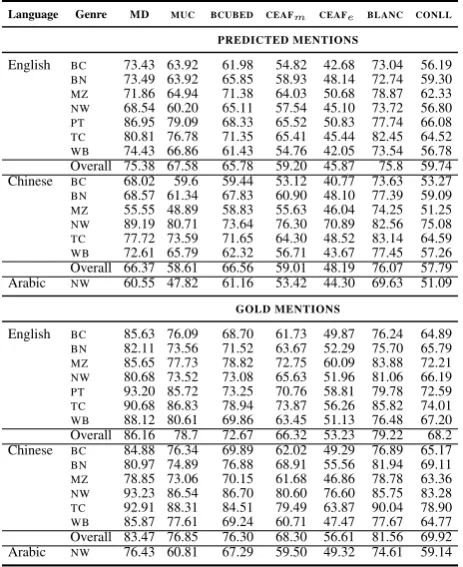
CoNLL-2012 test set, broken down by genre. The same metrics that were used for the CoNLL-2012 shared task are computed, with the CONLL
col-umn being the official CONLL measure.
Language Genre MD MUC BCUBED CEAFm CEAFe BLANC CONLL PREDICTED MENTIONS
English BC 73.43 63.92 61.98 54.82 42.68 73.04 56.19
BN 73.49 63.92 65.85 58.93 48.14 72.74 59.30
MZ 71.86 64.94 71.38 64.03 50.68 78.87 62.33
NW 68.54 60.20 65.11 57.54 45.10 73.72 56.80
PT 86.95 79.09 68.33 65.52 50.83 77.74 66.08
TC 80.81 76.78 71.35 65.41 45.44 82.45 64.52
WB 74.43 66.86 61.43 54.76 42.05 73.54 56.78 Overall 75.38 67.58 65.78 59.20 45.87 75.8 59.74 Chinese BC 68.02 59.6 59.44 53.12 40.77 73.63 53.27
BN 68.57 61.34 67.83 60.90 48.10 77.39 59.09
MZ 55.55 48.89 58.83 55.63 46.04 74.25 51.25
NW 89.19 80.71 73.64 76.30 70.89 82.56 75.08
TC 77.72 73.59 71.65 64.30 48.52 83.14 64.59
WB 72.61 65.79 62.32 56.71 43.67 77.45 57.26 Overall 66.37 58.61 66.56 59.01 48.19 76.07 57.79 Arabic NW 60.55 47.82 61.16 53.42 44.30 69.63 51.09
GOLD MENTIONS
English BC 85.63 76.09 68.70 61.73 49.87 76.24 64.89
BN 82.11 73.56 71.52 63.67 52.29 75.70 65.79
MZ 85.65 77.73 78.82 72.75 60.09 83.88 72.21
NW 80.68 73.52 73.08 65.63 51.96 81.06 66.19
PT 93.20 85.72 73.25 70.76 58.81 79.78 72.59
TC 90.68 86.83 78.94 73.87 56.26 85.82 74.01
WB 88.12 80.61 69.86 63.45 51.13 76.48 67.20 Overall 86.16 78.7 72.67 66.32 53.23 79.22 68.2 Chinese BC 84.88 76.34 69.89 62.02 49.29 76.89 65.17
BN 80.97 74.89 76.88 68.91 55.56 81.94 69.11
MZ 78.85 73.06 70.15 61.68 46.86 78.78 63.36
NW 93.23 86.54 86.70 80.60 76.60 85.75 83.28
TC 92.91 88.31 84.51 79.49 63.87 90.04 78.90
[image:8.595.71.303.126.410.2]WB 85.87 77.61 69.24 60.71 47.47 77.67 64.77 Overall 83.47 76.85 76.30 68.30 56.61 81.56 69.92 Arabic NW 76.43 60.81 67.29 59.50 49.32 74.61 59.14
Table 7: Performance of the coreference system on the CoNLL-2012 test set.
The varying results across genres mostly meet our expectations. In English, the system does best on TC and the PT genres. The text in the TCset
often involve long chains where the speakers re-fer to themselves which, given speaker informa-tion, is fairly easy to resolve. The PT section
includes many references to god (e.g. god and
the lord) which the lexicalized resolver is quite good at picking up during training. The more dif-ficult genres consist of texts where references to many entities are interleaved in the discourse and is as such harder to resolve correctly. For Chi-nese the numbers on the TC genre are also quite
good, and the explanation above also holds here — many mentions refer to either of the speak-ers. For Chinese the NW section displays by far
the highest scores, however, and the reason for this is not clear to us. Not surprisingly, restricting the set of mentions only to gold mentions gives a large boost across all genres and all languages. This shows that mention detection (MD) and
sin-gleton detection (which is not part of the annota-tion) remain a big source of errors for the coref-erence resolver. For these experiments we used a combination of training and development data for training — following the CoNLL-2012 shared
task specification. Leaving out the development set has a very negligible effect on the CoNLL-score for all the languages (English: 0.14; Chi-nese 0.06; Arabic: 0.40 F-score respectively). The effect on Arabic is the most (0.40 F-score) most likely because of its much smaller size. To gauge the performance improvement between 2011 and 2012 shared tasks, we performed a clean com-parison of over the best performing system and an earlier version of this system (Bj¨orkelund and Nugues, 2011) on the CoNLL 2011 test set us-ing the CoNLL 2011 train and development set for training. The current system has a CoNLL score of 60.09 (64.92+69.84+45.51
3 )23as opposed to
the 54.53 reported inbj¨orkelund(Bj¨orkelund and Nugues, 2011), and the 57.79 reported for the best performing system of CoNLL-2011. One caveat is that these score comparison are done using the earlier version (v4) of the CoNLL scorer. Nev-ertheless, it is encouraging to see that within a short span of a year, there has been significant improvement in system performance – partially owing to cross-pollination of research generated through the shared tasks.
5 Conclusion
In this paper we reported work on finding a rea-sonable training, development and test split for the various layers of annotation in the OntoNotes v5.0 corpus, which consists of multiple genres in three typologically very different languages. We also presented the performance of publicly avail-able, state-of-the-art algorithms on all the different layers of the corpus for the different languages. The trained models as well as their output will be made publicly available24 to serve as
bench-marks for language processing community. Train-ing so many different NLP components is very time-consuming, thus, we hope the work reported here has lifted the burden of having to create rea-sonable baselines for researchers who wish to use this corpus to evaluate their systems. We created just one data split in training, development and test set, covering a collection of genres for each layer of annotation in each language in order to keep the workload manageable However, the results do not discriminate the performance on individual gen-res: we believe such a setup is still a more realistic gauge for the performance of the state-of-the-art NLP components than a monolithic corpus such as the Wall Street Journal section of the Penn Tree-bank. It can be used as a starting point for devel-oping the next generation of NLP components that are more robust and perform well on a multitude of genres for a variety of different languages.
6 Acknowledgments
We gratefully acknowledge the support of the Defense Advanced Research Projects Agency (DARPA/IPTO) under the GALE program, DARPA/CMO Contract No. HR0011-06-C-0022 for sponsoring the creation of the OntoNotes corpus. This work was partially supported by grants R01LM10090 and U54LM008748 from the National Library Of Medicine, and R01GM090187 from the National Institutes of General Medical Sciences. We are indebted to Slav Petrov for helping us to retrain his syntactic parser for Arabic. Alessandro Moschitti and Olga Uryupina have been partially funded by the European Community’s Seventh Framework Programme (FP7/2007-2013) under the grant number 288024 (LIMOSINE). The content
is solely the responsibility of the authors and does not necessarily represent the official views of the National Institutes of Health. Nianwen Xue and Yuchen Zhang are supported in part by the DAPRA via contract HR0011-11-C-0145 entitled “Linguistic Resources for Multilingual Processing.”
References
Olga Babko-Malaya, Ann Bies, Ann Taylor, Szuting Yi, Martha Palmer, Mitch Marcus, Seth Kulick, and Libin Shen. 2006. Issues in synchronizing the English treebank and propbank. InWorkshop on Frontiers in Linguistically Annotated Corpora 2006, July.
Elizabeth Baran and Nianwen Xue. 2011. Singular or plural? exploiting parallel corpora for Chinese number prediction. InProceedings of Machine Translation Summit XIII, Xia-men, China.
Shane Bergsma and Dekang Lin. 2006. Bootstrapping path-based pronoun resolution. InProceedings of the 21st In-ternational Conference on Computational Linguistics and 44th Annual Meeting of the Association for Computa-tional Linguistics, pages 33–40, Sydney, Australia, July. Anders Bj¨orkelund and Rich´ard Farkas. 2012. Data-driven
multilingual coreference resolution using resolver stack-ing. InJoint Conference on EMNLP and CoNLL - Shared Task, pages 49–55, Jeju Island, Korea, July. Association for Computational Linguistics.
Anders Bj¨orkelund and Pierre Nugues. 2011. Exploring lex-icalized features for coreference resolution. In Proceed-ings of the Fifteenth Conference on Computational Natu-ral Language Learning: Shared Task, pages 45–50, Port-land, Oregon, USA, June. Association for Computational Linguistics.
Jie Cai and Michael Strube. 2010. Evaluation metrics for end-to-end coreference resolution systems. In Proceed-ings of the 11th Annual Meeting of the Special Interest Group on Discourse and Dialogue, SIGDIAL ’10, pages 28–36.
Shu Cai, David Chiang, and Yoav Goldberg. 2011. Language-independent parsing with empty elements. In
Proceedings of the 49th Annual Meeting of the Association for Computational Linguistics: Human Language Tech-nologies, pages 212–216, Portland, Oregon, USA, June. Association for Computational Linguistics.
Xavier Carreras and Llu´ıs M`arquez. 2005. Introduction to the CoNLL-2005 shared task: Semantic role labeling. In
Proceedings of the Ninth Conference on Computational
Natural Language Learning (CoNLL), Ann Arbor, MI, June.
Eugene Charniak and Mark Johnson. 2001. Edit detection and parsing for transcribed speech. InProceedings of the Second Meeting of the North American Chapter of the As-sociation for Computational Linguistics, June.
Eugene Charniak and Mark Johnson. 2005. Coarse-to-fine n-best parsing and maxent discriminative reranking. In
Proceedings of the 43rd Annual Meeting of the Associa-tion for ComputaAssocia-tional Linguistics (ACL), Ann Arbor, MI, June.
Mona Diab, Alessandro Moschitti, and Daniele Pighin. 2008. Semantic role labeling systems for Arabic using kernel methods. InProceedings of ACL-08: HLT, pages 798– 806, Columbus, Ohio, June. Association for Computa-tional Linguistics.
Gerard Escudero, Lluis Marquez, and German Rigau. 2000. An empirical study of the domain dependence of super-vised word disambiguation systems. In2000 Joint SIG-DAT Conference on Empirical Methods in Natural Lan-guage Processing and Very Large Corpora, pages 172– 180, Hong Kong, China, October. Association for Com-putational Linguistics.
Benoit Favre, Bernd Bohnet, and D. Hakkani-Tur. 2010. Evaluation of semantic role labeling and dependency parsing of automatic speech recognition output. In
Proceedings of 2010 IEEE International Conference on Acoustics, Speech and Signal Processing (ICASSP), page 5342–5345.
Jenny Rose Finkel and Christopher D. Manning. 2009. Joint parsing and named entity recognition. InProceedings of Human Language Technologies: The 2009 Annual Con-ference of the North American Chapter of the Association for Computational Linguistics, pages 326–334, Boulder, Colorado, June. Association for Computational Linguis-tics.
Jenny Rose Finkel, Trond Grenager, and Christopher Man-ning. 2005. Incorporating non-local information into in-formation extraction systems by Gibbs sampling. In Pro-ceedings of the 43rd Annual Meeting of the Association for Computational Linguistics, page 363–370.
Ryan Gabbard. 2010. Null Element Restoration. Ph.D. the-sis, University of Pennsylvania.
Daniel Gildea. 2001. Corpus variation and parser perfor-mance. In2001 Conference on Empirical Methods in Nat-ural Language Processing (EMNLP), Pittsburgh, PA. Julia Hockenmaier and Mark Steedman. 2002.
Acquir-ing compact lexicalized grammars from a cleaner tree-bank. InProceedings of the Third LREC Conference, page 1974–1981.
Mohamed Maamouri and Ann Bies. 2004. Developing an Arabic treebank: Methods, guidelines, procedures, and tools. In Ali Farghaly and Karine Megerdoomian, edi-tors,COLING 2004 Computational Approaches to Arabic Script-based Languages, pages 2–9, Geneva, Switzerland, August 28th. COLING.
Mitchell P. Marcus, Beatrice Santorini, and Mary Ann Marcinkiewicz. 1993. Building a large annotated corpus of English: The Penn treebank. Computational Linguis-tics, 19(2):313–330, June.
Vincent Ng and Claire Cardie. 2002. Improving machine learning approaches to coreference resolution. In Pro-ceedings of the Association for Computational Linguistics (ACL-02), pages 104–111.
Martha Palmer, Daniel Gildea, and Paul Kingsbury. 2005. The Proposition Bank: An annotated corpus of semantic roles.Computational Linguistics, 31(1):71–106.
Martha Palmer, Hoa Trang Dang, and Christiane Fellbaum. 2007. Making fine-grained and coarse-grained sense dis-tinctions, both manually and automatically. Journal of Natural Language Engineering, 13(2).
Martha Palmer, Olga Babko-Malaya, Ann Bies, Mona Diab, Mohammed Maamouri, Aous Mansouri, and Wajdi Za-ghouani. 2008. A pilot Arabic propbank. InProceedings of the International Conference on Language Resources and Evaluation (LREC), Marrakech, Morocco, May 28-30.
Slav Petrov and Dan Klein. 2007. Improved inferencing for unlexicalized parsing. InProc of HLT-NAACL.
Sameer Pradhan, Kadri Hacioglu, Valerie Krugler, Wayne Ward, James Martin, and Dan Jurafsky. 2005. Support vector learning for semantic argument classification. Ma-chine Learning, 60(1):11–39.
Sameer Pradhan, Lance Ramshaw, Ralph Weischedel, Jes-sica MacBride, and Linnea Micciulla. 2007. Unre-stricted coreference: Indentifying entities and events in OntoNotes. In Proceedings of the IEEE International Conference on Semantic Computing (ICSC), September 17-19.
Sameer Pradhan, Wayne Ward, and James H. Martin. 2008. Towards robust semantic role labeling. Computational Linguistics Special Issue on Semantic Role Labeling, 34(2).
Sameer Pradhan, Lance Ramshaw, Mitchell Marcus, Martha Palmer, Ralph Weischedel, and Nianwen Xue. 2011. CoNLL-2011 shared task: Modeling unrestricted corefer-ence in OntoNotes. InProceedings of the Fifteenth Con-ference on Computational Natural Language Learning: Shared Task, pages 1–27, Portland, Oregon, USA, June. Association for Computational Linguistics.
Sameer Pradhan, Alessandro Moschitti, Nianwen Xue, Olga Uryupina, and Yuchen Zhang. 2012. CoNLL-2012 shared task: Modeling multilingual unrestricted coreference in OntoNotes. InJoint Conference on EMNLP and CoNLL -Shared Task, pages 1–40, Jeju Island, Korea, July. Associ-ation for ComputAssoci-ational Linguistics.
Rashmi Prasad, Nikhil Dinesh, Alan Lee, Eleni Miltsakaki, Livio Robaldo, Aravind Joshi, and Bonnie Webber. 2008. The Penn discourse treebank 2.0. InProceedings of the Sixth International Conference on Language Resources and Evaluation (LREC’08), Marrakech, Morocco, May. Marta Recasens, Llu´ıs M`arquez, Emili Sapena, M. Ant`onia
Mart´ı, Mariona Taul´e, V´eronique Hoste, Massimo Poesio, and Yannick Versley. 2010. Semeval-2010 task 1: Coref-erence resolution in multiple languages. InProceedings of the 5th International Workshop on Semantic Evaluation, pages 1–8, Uppsala, Sweden, July.
Marta Recasens, Marie-Catherine de Marneffe, and Christo-pher Potts. 2013. The life and death of discourse enti-ties: Identifying singleton mentions. InProceedings of the 2013 Conference of the North American Chapter of the Association for Computational Linguistics: Human Language Technologies, pages 627–633, Atlanta, Geor-gia, June. Association for Computational Linguistics. Libin Shen, Lucas Champollion, and Aravind K. Joshi. 2008.
LTAG-spinal and the treebank. Language Resources and Evaluation, 42(1):1–19, March.
Ralph Weischedel and Ada Brunstein. 2005. BBN pro-noun coreference and entity type corpus LDC catalog no.: LDC2005T33. BBN Technologies.
Ralph Weischedel, Eduard Hovy, Mitchell Marcus, Martha Palmer, Robert Belvin, Sameer Pradhan, Lance Ramshaw, and Nianwen Xue. 2011. OntoNotes: A large train-ing corpus for enhanced processtrain-ing. In Joseph Olive, Caitlin Christianson, and John McCary, editors, Hand-book of Natural Language Processing and Machine Translation: DARPA Global Autonomous Language Ex-ploitation. Springer.
Nianwen Xue and Martha Palmer. 2009. Adding semantic roles to the Chinese Treebank. Natural Language Engi-neering, 15(1):143–172.
Nianwen Xue, Fei Xia, Fu dong Chiou, and Martha Palmer. 2005. The Penn Chinese TreeBank: phrase structure an-notation of a large corpus. Natural Language Engineer-ing, 11(2):207–238.
Nianwen Xue. 2008. Labeling Chinese predicates with se-mantic roles.Computational Linguistics, 34(2):225–255. Yaqin Yang and Nianwen Xue. 2010. Chasing the ghost:
recovering empty categories in the Chinese treebank. InProceedings of the 23rd International Conference on Computational Linguistics (COLING), Beijing, China. Wajdi Zaghouani, Mona Diab, Aous Mansouri, Sameer
Prad-han, and Martha Palmer. 2010. The revised Arabic prop-bank. InProceedings of the Fourth Linguistic Annotation Workshop, pages 222–226, Uppsala, Sweden, July. Zhi Zhong and Hwee Tou Ng. 2010. It makes sense: A
wide-coverage word sense disambiguation system for free text. InProceedings of the ACL 2010 System Demonstrations, pages 78–83, Uppsala, Sweden.