Proceedings of the 2019 Conference on Empirical Methods in Natural Language Processing 5247
Multiplex Word Embeddings for Selectional Preference Acquisition
Hongming Zhang♣∗, Jiaxin Bai♣∗, Yan Song♠, Kun Xu♥, Changlong Yu♣, Yangqiu Song♣, Wilfred Ng♣, and Dong Yu♥
♣Department of CSE, The Hong Kong University of Science and Technology ♠Sinovation Ventures
♥Tencent AI Lab
{hzhangal, jbai, cyuaq, yqsong, wilfred}@cse.ust.hk [email protected],{kxkunxu, dyu}@tencent.com
Abstract
Conventional word embeddings represent words with fixed vectors, which are usu-ally trained based on co-occurrence patterns among words. In doing so, however, the power of such representations is limited, where the same word might be functionalized separately under different syntactic relations. To address this limitation, one solution is to incorporate relational dependencies of different words into their embeddings. Therefore, in this paper, we propose a multiplex word embedding model, which can be easily extended according to var-ious relations among words. As a result, each word has a center embedding to represent its overall semantics, and several relational em-beddings to represent its relational dependen-cies. Compared to existing models, our model can effectively distinguish words with respect to different relations without introducing un-necessary sparseness. Moreover, to accom-modate various relations, we use a small di-mension for relational embeddings and our model is able to keep their effectiveness. Ex-periments on selectional preference acquisi-tion and word similarity demonstrate the effec-tiveness of the proposed model, and a further study of scalability also proves that our beddings only need 1/20 of the original em-bedding size to achieve better performance.
1 Introduction
Representing words as distributed representations is an important way for machines to process lexical semantics, which attracts much atten-tion in natural language processing (NLP) in the past few years (Mikolov et al., 2013; Penning-ton et al., 2014; Song et al., 2017, 2018b; Song and Shi, 2018) with respect to its usefulness in many downstream tasks, e.g., parsing (Chen and Manning, 2014), machine translation (Zou
∗
Equal contribution.
et al., 2013), coreference resolution (Lee et al.,
2018), etc. Conventional word embeddings, e.g., word2vec (Mikolov et al.,2013) and GloVe ( Pen-nington et al., 2014), leverage the co-occurrence information among words to train a unified em-bedding for each word. Such models are popu-lar and the resulting embeddings are widely used owing to their effectiveness and simplicity. How-ever, these embeddings are not helpful for scenar-ios requiring words functionalizing separately un-der different situations, where selectional prefer-ence (SP) (Wilks,1975) is a typical scenario.
In general, SP refers to that, given a word (pred-icate) and a dependency relation, human beings have certain preferences for the words (arguments) connecting to it. Such preferences are usually carried in dependency syntactic relations, for ex-ample, the verb ‘sing’ has plausible object words ‘song’ or ‘rhythm’ rather than other nouns such as ‘house’ or ‘potato’. With such characteristic, SP is proven to be important in natural language under-standing for many cases and widely applied over a variety of NLP tasks, e.g., sense disambigua-tion (Resnik, 1997), semantic role classification (Zapirain et al.,2013), and coreference resolution (Hobbs,1978;Zhang et al.,2019b,c), etc.
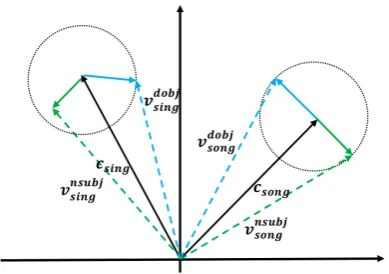
Figure 1: Illustration of the multiplex embeddings for ‘sing’ and ‘song’. Black arrows present center embed-dings for words’ overall semantics; blue and green ar-rows refer to words’ relational embeddings for relation-dependent semantics. All relational embeddings for each word are designed to near its center embedding.
nsubjanddobjrelations are used as examples.
treat ‘food’ and ‘eat’ as highly relevant words but never distinguish the function of ‘food’ to be a subject or an object to ‘eat’. To address this problem, the dependency-based embedding model (Levy and Goldberg, 2014) is proposed to treat a word through separate ones, e.g., ‘food@dobj’ and ‘food@nsubj’, under different syntactic rela-tions, with the skip-gram (Mikolov et al., 2013) model being used to train the final embeddings. However, this method is limited in two aspects. First, sparseness is introduced because each word is treated as two irrelevant ones (e.g., ‘food@dobj’ and ‘food@nsubj’), so that the overall quality of learned embeddings is affected. Second, the re-sulting embedding size is too large1, which is not appropriate either for storage or usage.
Therefore, in this paper, we propose a multiplex word embedding (MWE) model, which can be easily extended to various relations between two words. A multiplex network embedding model was originally proposed for modeling multiple re-lations among people in a social network (Zhang et al., 2018). Interestingly, we found it also use-ful in capturing various relations among different words. One example is shown in Figure1. ‘sing’ and ‘song’ are highly related to each other with the ‘predicate-objective’ rather than the ’predicate-subject’ relation. In our model, each word has a group of embeddings, including a center em-bedding representing its general semantics, and
1
Assuming one has 200,000 words in the vocabulary and 20 dependency relations, and follow conventional approaches (Mikolov et al.,2013;Pennington et al.,2014) to set the em-bedding dimension to 300, the resulting emem-bedding size will be about 10 Gigabytes.
several embeddings representing their relation-dependent semantics. To ensure that the embed-dings of the same word (under different relations) are similar to each other, we limit the Euclidean norm of relation-dependent embeddings within a small range, as shown in Figure1. Moreover, con-sidering that there could be many relations among words, if using a conventional dimension setting for embeddings to encode relations, the overall embedding size would be too big to be used in downstream tasks. To deal with it, we propose to use a small dimension for relation-dependent em-beddings and use a transformation matrix for each relation to project them into the same space of the center embeddings. Thus the two types of embed-dings can be jointly trained and the quality of the relation-dependent ones are guaranteed.
Experiments are conducted on SP acquisition over different dependency relations to evaluate whether the learned embeddings effectively cap-ture words’ semantics over these relations. In ad-dition, the word similarity measurement is used to assess how well words’ general semantics are learned in our model. Both evaluations confirm the superiority of our model, where the SP in-formation is effectively preserved and the words’ overall semantics are enhanced. Particularly, fur-ther analysis also indicates that our MWE dings are more powerful than all existing embed-ding methods in SP acquisition with around 1/20 in their size comparing to previous embeddings (Levy and Goldberg,2014). All code and resulting embeddings are available at: https://github.com/
HKUST-KnowComp/MWE.
2 Multiplex Word Embeddings
2.1 Model Overview
As introduced in Section 1, encoding selectional preference information into embeddings can be conducted by modeling word association patterns under different dependency relations. Similar to (Levy and Goldberg, 2014), the proposed MWE model also distinguishes different relations among words and learns separate embeddings for them on each dependency edge.
Formally, let W be the vocabulary set contain-ingnwordsw1, w2, ..., wnandRthe relations set
containingmrelationsr1, r2, ..., rm, the proposed
em-beddingcfor the general semantics. Particularly, each relational embedding has an overall and a lo-cal version, denoted asvandu, whereurecords the difference betweenv andc. For both the re-lational embeddings (vandu) and the center em-bedding, we use a similar way as that in word2vec (Mikolov et al.,2013) that each one has two vari-ants to represent the semantics of a wordwbeing the head or tail in different relations. We denote the head and tail embeddings as urh,w ∈ Rs and
urt,w ∈Rsfor the local embeddings of wordw un-der relation typer andcw,h ∈ Rdandcw,t ∈ Rd
for the center embedding, respectively, wheresis the dimension foruanddthe dimension forc.
Although learning on similar information as that in (Levy and Goldberg,2014), to reduce the sparseness of introducing m relational embed-dings for each word, we do not treat each word as multiple separate prototypes. Instead, we use its center embedding to transfer information among different relations and the sum of the center em-bedding and a local emem-bedding to represent the final embedding for the corresponding relation2. Moreover, considering there are various relations among words, we use a lower dimensionsfor stor-age compression, withs < d. Thus, a transforma-tion matrixXis introduced to transformuinto the same vector space ofc. As a result, the final em-beddingsvfor head and tail ofwunder relationr
are formulated as:
vh,wr =ch,w+Xrh Tur
h,w, vrt,w =ct,w+XrtTurt,w.
(1)
2.2 Learning the MWE model
To train vh,wr and vt,wr for each w under r, we adopt the negative sampling strategy to conduct the learning process. Specifically, for eachr, we use a relation tuple set Tr, with each tuple t = (wh, r, wt) ∈ Tr, wherewh is the head word and
wt the tail word. For each t, we randomly
gen-erate two negative tuples by replacingwh andwt
with the randomly selected fake headw0h and tail
w0trespectively. Then the learning process is ex-pected to distinguish the positive tuple against the
2Conceptually shown in Figure1, to ensure the resulting final embeddings not too far away from the center embed-dings, we add restriction to the Euclidean norm of the local relational embeddings.
negative ones. Therefore, formally, we maximize
J = 1
|Tr|
X
t∈Tr
log e
f(wh,r,wt)
ef(wh,r,wt)+ef(wh,r,w0t)+ef(w0h,r,wt),
(2)
over all tuples in Tr for each r, with f(·) evalu-ating wh andwt being positive samples underr
through
f(wh, r, wt) =vrh,wh >·
vt,wtr . (3)
For each (wh,wt), we use cross entropy as the
loss function
E=−logσ(vrh,wh >
·vrt,wt)−logσ(−v r h,wh
> ·vt,wr 0
t) −logσ(−vrh,w0
h >
·vrt,wt),
(4)
to measure the learning effect for Eq. (2), withσ
denoting the sigmoid function.
Combined with Eq. (1), the training process is thus to update c, ur, and Xr with the gradients passed from the loss function using stochastic gra-dient descent (SGD).
In detail, takewhas an example, its center
em-beddingch,whis updated by
ch,wh =ch,wh−λ·η·
∂E ∂vrh,wh
=ch,wh−λ·η·e(wh, wt)·vrt,wt,
(5)
wheree(wh, wt)=σ(eh,whr >·ert,wt)−tk, withtk =
1 if (wh, wt) is positive sample and tk = 0 for
negative ones.ηis the discounting learning rate.λ
is an alternating weight to control the contribution of the gradient, ranging from 0 to 1.
Moreover,Xrandurare updated as follows:
urh,wh =u r
h,wh−(1−λ)·η·
∂E ∂vr
h,wh ·∂X
r hu
r h,wh
∂ur h,wh
=urh,wh−(1−λ)·η·e(wh, wt)·X r h·vrt,wt,
(6)
Xrh=X
r
h−(1−λ)·η·
∂E ∂vr
h,wh ·∂X
r hurh,wh
∂Xr h
=Xrh−(1−λ)·η·e(wh, wt)·urh,wh·vrt,wt,
(7)
Meanwhile,ct,wt,urt,wt, andXrt are updated in
the same way ofch,wh,urh,wh, andXrh following
Eqs. (5), (6), and (7).
The above learning process is conducted on all
Algorithm 1Multiplex Word Embedding
Input: Relation specific tuple setsT1, . . . ,Tm,d,
s,a, andη.
Output:cw,urw, andXr.
Initializecw,uiw andXirandomly. forEach Iteration kdo
Updateλ.
forEach tupletp= (wh,r,wt)∈ Trdo
Randomly generate the two negative ex-amples tn1 = (wh0, r, wt) andtn2 = (wh,
r,w0t).
Ttmp = [tp, tn1, tn2] fort∈ Ttmpdo
e(wh, wt) =σ(v0h,whT ·vit,nt)−tk
Updatech,wh,urh,wh,Xrh,ct,wt,urt,wt,
andXrt based on Eqs. (5),6), and (7).
ifkXr h
Tur
h,whk> athen
UpdateXrhandurh,wh.
end ifkXr
tTurt,wtk> athen
UpdateXrt andurt,wt.
end end end end
drifting rangea, whose value controls the distance between the local relational embeddings and the center embedding. Specifically, ifkXTuk equals
toa0, which is greater thana, we scale downXT
anduwith
q
a0·ka1 , wherekis a scaling parame-ter set to 0.8 throughout this work.
The learning processing is summarized in Al-gorithm1. For complexity analysis, it is obvious drawn thatmrelation types andnwords result in
O(mn)andO((d+s∗m)∗n)for time and space complexities, respectively.
2.3 The Alternating Optimization Strategy
To balance the learning process between the over-all semantics and the relation-specific informa-tion, we adopt an alternating optimization strat-egy3 (Bezdek and Hathaway, 2003) to adjust λ
based on different stage of the training instead of using a fixed weight for λ. Specifically, consid-eringcis more reliable and possesses more infor-mation whileuis learned with sharedc, we
alter-3Alternating optimization was originally proposed to train different parameters in a sequential manner and applied in various areas.
natively updatec andu upon the convergence of
c. As a result, we setλto 1 in the first half of the training process and 0 afterwards.
3 Experiments
Experiments are conducted to evaluate how our embeddings are performed on SP acquisition and word similarity measurement.
3.1 Implementation Details
We use the English Wikipedia4as the training cor-pus. The Stanford parser5is used to obtain
depen-dency relations among words. For the fair com-parison, we follow existing work and setd= 300,
s = 10, and a = 1. Following (Keller and La-pata,2003) and (de Cruys,2014), we select three dependency relations (nsubj, dobj, and amod) as follows:
• nsubj: The preference of subject for a given verb. For example, it is plausible to say ‘dog barks’ rather than ‘stone barks’. The verb is viewed as the predicate (head) while the subject as the argument (tail).
• dobj: The preference of object for a given verb. For example, it is plausible for ‘eat food’ rather than ‘eat house’. The verb is viewed as the pred-icate (head) while the object as the argument (tail).
• amod: The preference of modifier for a given noun. For example, it is plausible to say ‘fresh air’ rather than ‘solid air’. The noun is viewed as the predicate (head) while the adjective as the argument (tail).
3.2 Baselines
We first compare the proposed multiplex embed-ding with the following embedembed-ding models. As it is trivial to apply these embedding models in downstream tasks, we label these models as down-stream friendly.
• word2vec, the embedding model proposed by
Mikolov et al. (2013). We use the skip-gram model for this baseline.
• GloVe(Pennington et al.,2014), learning word embeddings by matrix decomposition on word co-occurrences.
4
Model Downstream Keller SP-10K
dobj amod average nsubj dobj amod average
word2vec Friendly 0.29 0.28 0.29 0.32 0.53 0.62 0.49
GloVe Friendly 0.37 0.32 0.35 0.57 0.60 0.68 0.62
D-embeddings Friendly 0.19 0.22 0.21 0.66 0.71 0.77 0.71
ELMo Friendly 0.23 0.06 0.15 0.09 0.29 0.38 0.25
BERT (static) Friendly 0.11 0.05 0.08 0.25 0.32 0.27 0.28
BERT (dynamic) Friendly 0.19 0.23 0.21 0.35 0.45 0.51 0.41
PP Unfriendly 0.66 0.26 0.46 0.75 0.74 0.75 0.75
DS Unfriendly 0.53 0.32 0.43 0.59 0.65 0.67 0.64
NN Unfriendly 0.16 0.13 0.15 0.70 0.68 0.68 0.69
[image:5.595.85.520.63.255.2]MWE Friendly 0.63 0.43† 0.53† 0.76 0.79† 0.78 0.78†
Table 1:Results on different SP acquisition evaluation sets. As Keller is created based on the PP distribution and has relatively small size while SP-10K is created based on random sampling and has a much larger size, we treat the performance on SP-10K as the main evaluation metric. Spearman’s correlation between predicated plausibility and annotations are reported. The best performing models are denoted with bold font.†indicates statistical significant (p<0.005) overall baseline methods.
• D-embeddings, the model proposed by Levy and Goldberg (2014) uses a skip-gram frame-work to encode dependencies into embeddings with multi-prototypes of words.
To investigate whether the SP knowledge can be captured by the pretrained contextualized word embedding models, we also treat following pre-trained models as baselines.
• ELMo (Peters et al., 2018), a pretrained lan-guage model with contextual awareness. We use its static representations of words as the word embedding.
• BERT (Devlin et al., 2019), a pretrained bi-directional contextualized word embedding model with state-of-the-art performance on many NLP tasks.
Besides those embedding methods, we also compare with following conventional SP acqui-sition methods to demonstrate the effectiveness of the proposed multiplex embedding model, as it is still unclear how to leverage these methods in downstream tasks, we label these methods as downstream unfriendly.
• Posterior Probability (PP) (Resnik, 1997), a counting based method for the selectional pref-erence acquisition task.
• Distributional Similarity (DS) (Erk et al.,
2010), a method that uses the similarity of the
SP Evaluation Set #W #P
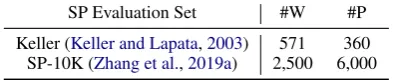
Keller (Keller and Lapata,2003) 571 360 SP-10K (Zhang et al.,2019a) 2,500 6,000
Table 2: Statistics of Human-labeled SP Evaluation Sets. #W and #P indicate the numbers of words and pairs, respectively. As different datasets have differ-ent SP relations, we only report statistics about ‘nsubj’, ‘dobj’, and ‘amod’ (if available).
embedding of the target argument and average embedding of observed golden arguments in the corpus to predict the preference strength.
• Neural Network (NN) (de Cruys, 2014), an NN-based method for the SP acquisition task. This model achieves the state-of-the-art perfor-mance on the pseudo-disambiguation task.
For word2Vec and GloVe, we use their released code. For D-embedding, we follow their original paper using the Gensim package6. The dimen-sions of the aforementioned embeddings are set to 300 according to their original settings. For ELMo and BERT, we use their pre-trained models. As BERT was not originally designed for word level semantics tasks, for the selectional preference ac-quisition task, we compare with two variations of the original BERT model: (1) BERT (static), which extracts static embedding from the BERT model in a similar way as that from the ELMo model; (2) BERT (dynamic), which takes a pair of
[image:5.595.318.515.327.367.2]Model noun verb adjective overall
word2vec 0.41 0.28 0.44 0.38 Glove 0.40 0.22 0.53 0.37
D-embedding 0.41 0.27 0.38 0.36
nsubj
h 0.46 0.29 0.54 0.43 t 0.45 0.25 0.48 0.40 h+t 0.44 0.23 0.50 0.40 [h,t] 0.47 0.27 0.51 0.42
dobj
h 0.46 0.27 0.45 0.41 t 0.45 0.23 0.46 0.40 h+t 0.45 0.20 0.45 0.38 [h,t] 0.46 0.25 0.48 0.42
amod
h 0.47 0.25 0.52 0.37 t 0.46 0.24 0.50 0.38 h+t 0.46 0.24 0.52 0.38 [h,t] 0.47 0.26 0.52 0.38
center
h 0.51 0.33 0.57 0.48
[image:6.595.71.294.62.301.2]t 0.51 0.30 0.56 0.47 h+t 0.52 0.31 0.54 0.46 [h,t] 0.51 0.32 0.57 0.48
Table 3:Spearman’s correlation of different embeddings for the WS measurement. ‘nsubj’, ‘dobj’, ‘amod’ represents the embeddings of the corresponding relation and ‘center’ indi-cates the center embeddings. h, t, h+t, and [h,t] refer to the head, tail, sum of two embeddings, and the concatenation of them, respectively. The best scores are marked in bold fonts.
words as input and produces a plausibility score for that pairs of words. The main difference be-tween the static and dynamic version of BERT is that in the dynamic version, the contextual infor-mation can be fully utilized, which is more similar to the training objective of BERT.
3.3 Selectional Preference Acquisition
The first task in our experiment is SP acquisi-tion. Currently, there are two methods that we can use to evaluate the quality of extracted SP knowl-edge: Pseudo-disambiguation (Ritter et al.,2010) and human labeled datasets (McRae et al.,1998;
Keller and Lapata, 2003). However, as shown in (Zhang et al.,2019a), pseudo-disambiguation se-lects positive SP tuples from the corpus and gen-erate negative SP tuples by randomly replacing the head/tail. As a result, pseudo-disambiguation only evaluates how good the model fits the cor-pus rather than evaluating the SP acquisition mod-els based on ground truth. Thus, in this sec-tion, we evaluate different SP acquisition methods with ground truth (human labeled datasets). Two representative datasets, Keller (Keller and Lapata,
2003) and SP-10K (Zhang et al., 2019a), are se-lected as the benchmark datasets.
In each dataset, for each SP relation, various
Model WS Dimension Training Time
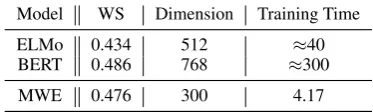
ELMo 0.434 512 ≈40 BERT 0.486 768 ≈300
[image:6.595.322.509.64.120.2]MWE 0.476 300 4.17
Table 4: Comparison of MWE against language models on the WS task. Overall performance, embedding dimension, and training time (days) on a single GPU are reported.
word pairs are provided. For each of the word pairs, the datasets also provide the annotated plau-sibility score of how likely a preference exists be-tween that word pair under the corresponding SP relation. Thus the job for all the models is to pre-dict the plausibility score for all word pairs under different SP relation settings. After that, we follow the conventional setting that uses the Spearman’s correlation to assess the correspondence between the predicted plausibility scores and human anno-tations on all word pairs for all SP relations. The statistics of these datasets are shown in Table2.
For embedding based methods (word2vec, GloVe, D-embedding7, and MWE8), we follow previous work (Mikolov et al., 2013; Levy and Goldberg,2014) and use the cosine similarity be-tween embeddings of head and tail words to pre-dict their relations. For conventional SP acquisi-tion methods (PP, DS, and NN), we follow their original paper to compute the plausibility scores.
The experimental results are shown in Table1. As Keller is created based on the PP distribution and have relatively small size while SP-10K is cre-ated based on random sampling and has a much larger size, we treat the performance on SP-10K as the major evaluation. Our embeddings signifi-cantly outperform other baselines, especially em-bedding based baselines. The only exception is PP on the Keller dataset due to its biased distribu-tion. In addition, there are other interesting obser-vations. First, compared with ‘dobj’ and ‘nsubj’, ‘amod’ is simpler for word2vec and GloVe. The reason behind is that conventional embeddings only capture the co-occurrence information, which is enough to predict the selectional preference of
7For D-embedding, since it provides embeddings for dif-ferent relations (e.g., ‘food@nsubj’, ‘food@dobj), we follow their work and directly use embeddings over certain relations to predict the score for the tested pairs. For example, given the test tuple (‘eat’,dobj, ‘food’), we compute the cosine sim-ilarity of ‘eat’ and ‘food@dobj’ rather than ‘food@subj’.
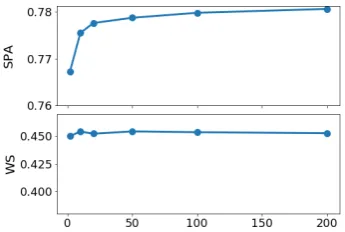
Figure 2: Effect of the different s on SP acquisition (SP-10K) and WS tasks.
‘amod’ rather than ‘nsubj’ or ‘dobj’9. Second, even though large-scale contextualized word em-bedding models like ELMo and BERT have been proved useful in many other tasks, they are still limited in learning specific and detailed seman-tics and thus perform inferior to our model in the SP acquisition task. For Example, ELMo and BERT can know that there is a strong semantic connection between ‘eat’ and ‘food’, but they do not know whether ‘food’ is a plausible subject or object of ‘eat’. Third, surprisingly, although NN achieves the state-of-the-art performance on the pseudo-disambiguation task, its performance is not satisfying against human annotation, espe-cially on Keller, which is probably because the NN model overfits the training data, whose distribu-tion is different from human SP knowledge.
3.4 Word Similarity Measurement
In addition to SP acquisition, we also evaluate our embeddings on word similarity (WS) mea-surement to test whether the learned embedding can effectively capture the overall semantics. We use SimLex-999 (Hill et al.,2015) as the evalua-tion dataset for this task because it contains dif-ferent word types, i.e., 666 noun pairs, 222 verb pairs, and 111 adjective pairs. We follow the con-ventional setting that uses the Spearman’s correla-tion to assess the correspondence between the sim-ilarity scores and human annotations on all word pairs. Evaluations are conducted on the final em-beddingsvfor each relation and the center ones.
Results are reported in Table3with several ob-servations. First, our model achieves the best over-all performance and significantly better on nouns, which can be explained by that nouns appear in all
9The only possible SP relation between nouns and adjec-tives is ‘amod’, while multiple SP relations could exist be-tween nouns and verbs, and co occurrence information can-not effectively distinguish them.
Figure 3: Effect of differentaon SP acquisition (SP-10K) and WS tasks.
three relations while most of the verbs and adjec-tives only appear in one or two relations. This re-sult is promising since it is analyzed bySolovyev et al. (2017) that two-thirds of the frequent words are nouns; thus there are potential benefits if our embeddings are used in downstream NLP tasks. Second, the center embeddings achieve the best performance against all the other relation-dependent embeddings, which demonstrates the effectiveness of our model in learning relation-dependent information over words and also en-hancing their overall semantics.
We also compare MWE with pre-trained con-textualized word embedding models in Table 4
for this task, with overall performance, embed-ding dimensions, and training times reported. It is observed that that MWE outperforms ELMo and achieves comparable results with BERT with smaller embedding dimension and much less training complexities.
4 Analysis
With the experiments on SP acquisition and word similarity measurement, we conduct further analy-sis for different settings for hyper-parameters and learning strategies, as well as the scalability of our model.
4.1 Effect of the Local Embedding Dimension
We investigating the performance of MWE on SPA (SP acquisition) and WS tasks with different
[image:7.595.95.268.60.176.2]Training Strategy Averaged SPA Overall WS
λ= 1 0.762 0.476
λ= 0 0.073 0.018
λ= 0.5 0.493 0.323
[image:8.595.314.509.56.180.2]Alternating optimization 0.775 0.476
Table 5:Comparisons of different training strategies.
4.2 Effect of the Semantic Drifting Range
Similar tos, we also investigate the model perfor-mance with the influence of different constrainta. It is observed in Figure3that, the constraint gets looser with the increase ofa. For SP acquisition, in a small range, the model performance grad-ually improves along with the increasing value ofabecause these embeddings are more flexible to capture intense relation-dependent information. However, once the range passes a threshold (1 in our experiment), the embeddings get farther away from their general semantics and start to overfit, which is also observed in the WS experiment, and thus the performance drops monotonically.
4.3 Effect of Alternating Optimization
An analysis is also conducted to demonstrate the effectiveness of the alternating optimization strat-egy. As shown in Table5, we compare our model with several different strategies. The first one is to put all weights to the center embedding (fix
λ to 1), which never updates the local relational embeddings. As a result, it can achieve similar performance on word similarity measurement but is inferior in SP acquisition because no relation-dependent information is preserved. The second strategy is to put all weights to the local relational embeddings (fixλto 0). In this case, it performs very poor owing to the loss of general semantics. Last but not least, the alternating optimization also outperforms the setting with a fixed λ = 0.5, which can be explained by alternating optimiza-tion can first get a good overall semantic represen-tation and then acquire the SP knowledge on top of that. To summarize, the alternating optimiza-tion provides an effective soluoptimiza-tion to training our model with a smart process in adjusting the con-tribution of different embeddings as well as stabi-lizing their optimization.
4.4 Scalability
[image:8.595.71.295.63.131.2]Scalability of embeddings is an important factor in real applications. Practically, GPU or similar
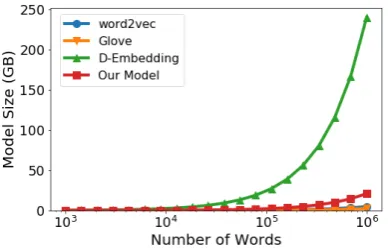
Figure 4: Scalability on embedding size against num-ber of words.
computation support is required to accommodate embeddings to applying neural models. Normally, the current most affordable GPUs typically have a memory size limitation around 10 GB. Thus, to ensure the learned embeddings can be used in downstream tasks, their size becomes an impor-tant concern when evaluating different embedding models, especially when there exist many different relations between words in our model.
Assuming that there are 20 relations among words, the size of all embedding models with the increasing word numbers in Figure 4. word2Vec and GloVe have the smallest size because they only train one embedding for each word while sac-rificing the relation-dependent information among them. As a comparison, D-embeddings are trained on multiple prototypes for each word to record re-lation information, thus their size dramatically ex-plodes with the increasing of the vocabulary. Con-sequently, it is easily computed for D-embeddings that 200,000 words will result in a 10GB model, which is unfeasible to be used in downstream tasks. Effectively with the small dimension for our local relational embeddings, relation information can be preserved in a small-sized model, which shows a compatible space requirement with the conventional embeddings.
5 Related Work
Learning word embeddings has become an impor-tant research topic in NLP (Bengio et al., 2003;
Turney and Pantel, 2010; Collobert et al., 2011;
Song and Shi,2018), with the capability of embed-dings demonstrated in different languages (Song et al.,2018a) and tasks such as parsing (Chen and Manning, 2014), machine translation (Zou et al.,
word co-occurrence patterns, resulting in a ma-jor limitation that they coalesce different relation-ships between words into a single vector space. To address this limitation, dependency-based embed-ding model (Levy and Goldberg, 2014) was pro-posed to represent each word with several separate embeddings, and then suffers from its sparseness and the huge size of the resulting embeddings. Al-ternatively, our MWE model uses a set of (con-strained and small) embeddings for each word to encode its general and relation-dependent seman-tics to resolve the sparseness and the size problem. Another line of work related to this paper is the research on SP, which is considered important in language understanding and has been proved helpful in various downstream tasks (Tang et al.,
2016; Resnik, 1997; Hobbs, 1978; Inoue et al.,
2016; Zapirain et al., 2013). Several studies at-tempted to acquire SP automatically from raw cor-pora (Resnik,1997;Rooth et al.,1999;Erk et al.,
2010;Santus et al.,2017). However, they are de-signed specifically for SP acquisition and are lim-ited in leveraging SP knowledge for downstream tasks. Compared to them, the learned embeddings from our model are useful resources that incorpo-rate SP knowledge and can be seamlessly lever-aged in other NLP models.
6 Conclusion
In this paper, we present a multiplex word embed-ding model encoembed-ding selectional preference infor-mation from word dependency relations. Differ-ent from convDiffer-entional embeddings, for each word, we proposed to use a set of embeddings to rep-resent its general (center embedding) and relation-dependent (local relational embedding) semantics, where their combination present the final embed-ding for each word under particular relations. Ex-periments on SP acquisition and word similarity measurement illustrated that our model better en-codes SP knowledge than different baselines with-out harming its capability in representing general semantics. Analysis is also conducted with respect to different settings and optimization strategies, as well as the effect of model size, which further il-lustrates the validity and effectiveness of the pro-posed model and its learning process.
Acknowledgements
This paper was supported by the Early Career Scheme (ECS, No. 26206717) from Research
Grants Council in Hong Kong and the Tencent AI Lab Rhino-Bird Focused Research Program.
References
Yoshua Bengio, R´ejean Ducharme, Pascal Vincent, and Christian Janvin. 2003. A neural probabilistic lan-guage model. Journal of Machine Learning Re-search, 3:1137–1155.
James C Bezdek and Richard J Hathaway. 2003. Con-vergence of alternating optimization. Neural, Paral-lel & Scientific Computations, 11(4):351–368.
Danqi Chen and Christopher Manning. 2014. A fast and accurate dependency parser using neural net-works. InProceedings of EMNLP, pages 740–750.
Ronan Collobert, Jason Weston, L´eon Bottou, Michael Karlen, Koray Kavukcuoglu, and Pavel Kuksa. 2011. Natural Language Processing (Almost) from Scratch. Journal of Machine Learning Research, 12:2493–2537.
Tim Van de Cruys. 2014. A neural network approach to selectional preference acquisition. In Proceedings of EMNLP, pages 26–35.
Jacob Devlin, Ming-Wei Chang, Kenton Lee, and Kristina Toutanova. 2019. BERT: pre-training of deep bidirectional transformers for language under-standing. In Proceedings of NAACL-HLT, pages 4171–4186.
Katrin Erk, Sebastian Pad´o, and Ulrike Pad´o. 2010. A flexible, corpus-driven model of regular and inverse selectional preferences. Computational Linguistics, 36(4):723–763.
Felix Hill, Roi Reichart, and Anna Korhonen. 2015. Simlex-999: Evaluating semantic models with (gen-uine) similarity estimation. Computational Linguis-tics, 41(4):665–695.
Jerry R Hobbs. 1978. Resolving pronoun references.
Lingua, 44(4):311–338.
Naoya Inoue, Yuichiroh Matsubayashi, Masayuki Ono, Naoaki Okazaki, and Kentaro Inui. 2016. Model-ing context-sensitive selectional preference with dis-tributed representations. In Proceedings of COL-ING, pages 2829–2838.
Frank Keller and Mirella Lapata. 2003. Using the web to obtain frequencies for unseen bigrams. Computa-tional Linguistics, 29(3):459–484.
Kenton Lee, Luheng He, and Luke Zettlemoyer. 2018. Higher-order coreference resolution with coarse-to-fine inference. In Proceedings of NAACL-HLT, pages 687–692.
Ken McRae, Michael J Spivey-Knowlton, and Michael K Tanenhaus. 1998. Modeling the influ-ence of thematic fit (and other constraints) in on-line sentence comprehension. Journal of Memory and Language, 38(3):283–312.
Tomas Mikolov, Ilya Sutskever, Kai Chen, Gregory S. Corrado, and Jeffrey Dean. 2013. Distributed repre-sentations of words and phrases and their composi-tionality. InProceedings of NIPS, pages 3111–3119.
Jeffrey Pennington, Richard Socher, and Christo-pher D. Manning. 2014. Glove: Global vectors for word representation. In Proceedings of EMNLP, pages 1532–1543.
Matthew E. Peters, Mark Neumann, Mohit Iyyer, Matt Gardner, Christopher Clark, Kenton Lee, and Luke Zettlemoyer. 2018. Deep contextualized word rep-resentations. InProceedings of NAACL-HLT, pages 2227–2237.
Philip Resnik. 1997. Selectional preference and sense disambiguation. Tagging Text with Lexical Seman-tics: Why, What, and How?
Alan Ritter, Mausam, and Oren Etzioni. 2010. A la-tent dirichlet allocation method for selectional pref-erences. InProceedings of ACL, pages 424–434.
Mats Rooth, Stefan Riezler, Detlef Prescher, Glenn Carroll, and Franz Beil. 1999. Inducing a semanti-cally annotated lexicon via em-based clustering. In
Proceedings of ACL, pages 104–111.
Enrico Santus, Emmanuele Chersoni, Alessandro Lenci, and Philippe Blache. 2017. Measuring the-matic fit with distributional feature overlap. In Pro-ceedings of EMNLP, pages 648–658.
Valery D Solovyev, Vladimir V Bochkarev, and Anna V Shevlyakova. 2017. Dynamics of core of language vocabulary. arXiv preprint:1705.10112.
Yan Song, Chia-Jung Lee, and Fei Xia. 2017. Learning word representations with regularization from prior knowledge. InProceedings of CoNLL, pages 143– 152.
Yan Song and Shuming Shi. 2018. Complementary learning of word embeddings. InProceedings of IJ-CAI, pages 4368–4374.
Yan Song, Shuming Shi, and Jing Li. 2018a. Joint learning embeddings for chinese words and their components via ladder structured networks. In Pro-ceedings of IJCAI, pages 4375–4381.
Yan Song, Shuming Shi, Jing Li, and Haisong Zhang. 2018b. Directional skip-gram: Explicitly distin-guishing left and right context for word embeddings. InProceedings of NAACL-HLT, pages 175–180.
Haiqing Tang, Deyi Xiong, Min Zhang, and Zhengxian Gong. 2016. Improving statistical machine transla-tion with selectransla-tional preferences. InProceedings of COLING, pages 2154–2163.
Peter D. Turney and Patrick Pantel. 2010. From Fre-quency to Meaning: Vector Space Models of Se-mantics. Journal of Artificial Intelligence Research, 37(1):141–188.
Yorick Wilks. 1975. A preferential, pattern-seeking, semantics for natural language inference. Artificial intelligence, 6(1):53–74.
Be˜nat Zapirain, Eneko Agirre, Llu´ıs M`arquez, and Mi-hai Surdeanu. 2013. Selectional preferences for se-mantic role classification. Computational Linguis-tics, 39(3):631–663.
Hongming Zhang, Hantian Ding, and Yangqiu Song. 2019a. SP-10K: A large-scale evaluation set for se-lectional preference acquisition. In Proceedings of ACL, pages 722–731.
Hongming Zhang, Liwei Qiu, Lingling Yi, and Yangqiu Song. 2018. Scalable multiplex network embedding. InProceedings of IJCAI, pages 3082– 3088.
Hongming Zhang, Yan Song, and Yangqiu Song. 2019b. Incorporating context and external knowl-edge for pronoun coreference resolution. In Pro-ceedings of NAACL-HLT, pages 872–881.
Hongming Zhang, Yan Song, Yangqiu Song, and Dong Yu. 2019c. Knowledge-aware pronoun coreference resolution. InProceedings of ACL, pages 867–876.