Proceedings of the 2019 Conference on Empirical Methods in Natural Language Processing and the 9th International Joint Conference on Natural Language Processing, pages 4164–4174,
4164
Learning to Ask for Conversational Machine Learning
Shashank Srivastava1∗ Igor Labutov2 Tom Mitchell3
1UNC Chapel Hill,2LAER AI
3Machine Learning Department, Carnegie Mellon University
[email protected], [email protected], [email protected]
Abstract
Natural language has recently been increas-ingly explored as a medium of supervision for training machine learning models. Here, we explore learning classification tasks using lan-guage in a conversational setting – where the automated learner does not simply receive lan-guage input from a teacher, but can proactively engage the teacher by asking template-based questions. We experiment with a reinforce-ment learning framework, where the learner’s actions correspond to question types and the reward for asking a question is based on how the teacher’s response changes performance of the resulting machine learning model on the learning task. In this framework, learning good question-asking strategies corresponds to asking sequences of questions that maximize the cumulative (discounted) reward, and hence quickly lead to effective classifiers. Empirical analysis shows that learned question-asking strategies can expedite classifier training by asking appropriate questions at different points in the learning process. The approach allows learning using a blend of strategies, including learning from observations, explanations and clarifications.
1 Introduction
The ability to learn new tasks and behaviors from language is characteristic of human intelligence. In recent years, the fields of machine learning and NLP have seen an renewed interest in incorpo-rating natural language supervision in models of
machine intelligence (Narasimhan et al.,2015;
El-hoseiny et al.,2013;Goldwasser and Roth,2014;
Andreas et al., 2018; Fried et al., 2018; Wang
et al.,2016). In particular, methods such as
Bab-bleLabble (Hancock et al.,2018) and LNL
(Srivas-tava et al., 2017) show progress towards realistic
∗
* Work done while the first and second authors were at CMU
Identify all important emails in my inbox
Can you give me an explanation of what important emails might look like?
Emails from nlp-corp.com are usually important
Did you mean that emails where the sender’s address has a string match with “nlp-corp.com” are usually important?
Yes, that’s right
Can you label this new email as important/not important?
This email is not important
Asking for Explanations
Requesting clarification
[image:1.595.307.525.222.407.2]Seeking labels
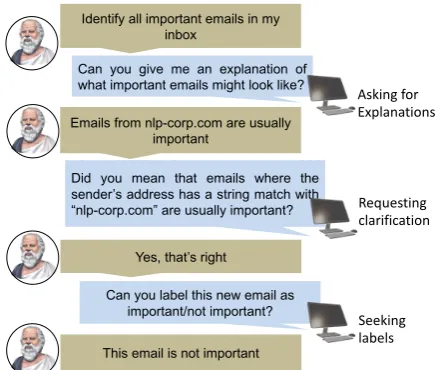
Figure 1: Question-Answer dialog can enable learning from a mix of strategies, including label observations (traditional supervised learning), explanations and clar-ifications (to overcome parsing limitations). The out-put from the teacher-learner interaction is a classifica-tion model (here, for important emails). We present a framework that (a) enables learning classifiers from a mix of such supervision; (b) learns to ask appropriate sequences of questions to accelerate this.
applications of supervised learning from language on tasks such as information extraction and email categorization. However, until now, such methods have been limited in two ways.
First, despite a body of work on leveraging lan-guage for tasks involving human robot
interac-tion (She and Chai, 2017;Cakmak and Thomaz,
2012;Krishnamurthy and Kollar,2013) and
inter-active learning in non-linguistic settings (see
Sec-tion 2), existing approaches for training machine
teacher.1 In comparison, when humans learn, they do not rely only on passively receiving instruc-tion from a teacher. Rather, the interacinstruc-tion takes the form of a mixed-initiative dialog, where they ask questions and proactively seek clarifications to simplify learning. These questions can generalize learning to novel situations, explore hypotheses, or fill information gaps. The ability to ask questions can, thus, fundamentally facilitate learning.
Second, existing approaches have focused on using language either as a standalone replacement
for labeled data (Hancock et al.,2018), or to drive
learning such as through specifying features for
learning tasks (Eisenstein et al.,2009). In contrast,
many realistic scenarios of learning from language would involve not learning from language alone, but learning from a mix of supervision, including both traditional labeled data, and natural language advice. Thus, automated learners should be capa-ble of learning from a capa-blend of observations, ex-planations and clarification.
In this work, we introduce a framework for learning from language in a conversational
set-ting (LiD, for Learning with Interactive Dialog),
which is a step towards alleviating these short-comings. Language provides a natural medium for conversational interactions between a learner and a teacher, specifically in the form of question-answer dialog. The premise driving our work is that the ability to ask questions can be leveraged by an automated learner to accelerate its learning. We explore a data-driven approach for learning ef-fective question-asking strategies in the specific context of learning classification tasks. The sig-nal for learning to ask questions is grounded in the learning task itself. i.e., the value of a ques-tion is evaluated in utilitarian terms of how it af-fects performance on a downstream classification task. This follows a Wittgensteinian view of
lan-guage as a cooperative game (Wittgenstein,1953)
between agents (here, the teacher and a learner) with a shared goal (here, building an effective clas-sifier). While the space of questions that an inter-active learner can ask can be vast in general, here we specifically focus on leveraging interactivity
for three specific aspects (highlighted in Figure1):
1. Seeking labels for specific examples.
1Zhang et al.(2018) diverge from prior work in this re-spect, and model language games between teachers and learn-ers. However, their learning tasks are toylike, and the method does not generalize to realistic scenarios.
2. Asking for explanations of a concept. 3. Requesting clarifications about explanations.
As illustrated in Figure1, these dimensions can
facilitate multiple aspects of the learning process: including learning from labeled examples (similar to traditional supervised learning), learning from natural language explanations (similar to recent work on learning from explanations) and allevi-ating limitations in the learner’s semantic parsing
abilities (in vein with work such as Labutov et al.
(2018)). Learning systems that reify these abilities can enable users to interactively teach new con-cepts using a blend of traditional and language-based supervision. Our contributions are:
• A reinforcement learning formulation to guide
question-asking strategies for learning from lan-guage.
• A method for interactively training classifiers
using a mix of labeled data, natural language explanations and clarifications. Our exploration highlights some of the challenges involved in in-teractive learning from language.
2 Challenges in Relation to Previous Work
From the perspective of traditional supervised learning, the problem of asking questions can be seen as cognate with active learning. Methods in active learning have explored various criteria for choosing which of a set of unlabeled examples to label next while training supervised machine
learning models (Settles, 2012; Collins et al.,
2008). This can be seen as asking a specific kind
of question (as illustrated in Figure1). Learning to
ask questions generalizes active learning in multi-ple ways by possibly soliciting a wider range of data measurements. These include feature labels (‘Are emails with subject “urgent” usually impor-tant?’), label proportions (‘Around what fraction of emails are important?’), constraints on model expectations (‘Are you more likely to reply to
im-portant emails?’), etc. Approaches such as
Srivas-tava et al.(2018) map such language to data
mea-surements that computational models can reason
over.2 Statistical frameworks such as Generalized
Expectation (Druck et al., 2008), Posterior
Reg-ularization (Ganchev et al., 2010) and Bayesian
Measurements (Liang et al.,2009) then allow for model training from a broad range of such data measurements in conjunction with unlabeled data, rather than using labeled examples. Other recent
approaches such as Huang et al. (2015) and
Sid-diquie and Gupta (2010) have expanded
pool-based active learning to learning from multiple types of queries, especially in the context of
multi-label and multi-class learning. Similarly, Parikh
and Grauman (2011) explore feature space
con-struction for visual tasks in an interactive setting. Although in principle soliciting different types of data measurements can help learning, each type requires its own interface. The advantage of using natural language as a medium is that it allows us to unify the different modes of supervision into a single, familiar user interface. However, using nat-ural language as a medium of supervision comes with its own set of challenges, as we discuss next.
2.1 Dependence on Language Interpreter
Since both generation and transmission of lan-guage advice can be noisy, the optimal question asking strategy may depend not only on the infor-mation content of data measurements, but also fac-tors such as the quality of the learner’s semantic
parsing model and the teacher’s skill.3 To explain,
while useful from an information theoretic sense, a teacher’s explanations may be too complex to han-dle for the learning agent’s parser, in which case it might be preferable to stick to asking about the teacher about instance labels (which would require minimal parsing). Thus, question-asking strate-gies need to be sensitive to the learner’s own se-mantic parsing ability, which may also change dur-ing the course of interactions with users.
2.2 Context Dependence
Rather than learning a static criterion for choosing what question to ask (as in active learning), our focus is on asking questions in conversational set-tings, which are inherently dynamic processes. To explain, asking a teacher to rephrase an explana-tion only makes sense in specific contexts (when the interpretation of something said previously is unclear). Further, the question to ask can depend on factors such as the task domain, supervision
3
In this work, we are not interested in learning seman-tic parsing models. We presume the existence of pretrained semantic parsers for learning agents. Our focus is rather on whether some question asking strategies may be more effec-tive than others for a learning agent with given capabilities.
previously received, etc. These factors motivated our choice of a reinforcement learning approach for learning question-asking strategies.
Relation to Question Generation approaches:
The problem of learning to ask questions has
pre-viously been explored by several approaches.
Van-derwende(2008) andOlney et al. (2012) explore
generating reading comprehension questions
con-ditioned on a given text. More recently, Romeo
et al. (2016) and Rao and Daum´e III (2018)
present neural network models that rank questions
in community QA forums, whereas Misra et al.
(2018) generate questions for visual scene un-derstanding. Our framework significantly differs from these in its sequential framework, and that the questions to be asked are grounded in quanti-tative performance on a downstream task.
3 Approach
In this section, we describe our framework for interactive learning from question-answer dialog. We first describe an approach to learn classifiers using a mix of explanations and labeled
exam-ples in Section 3.1. This is a preliminary
to-wards question-asking strategies that subsume ac-tive learning as well as language advice; and con-stitutes a subroutine that is repeatedly invoked in
our approach. Section3.2describes our
reinforce-ment learning formulation for learning question-asking strategies in simulated conversational set-tings. The space of actions consists of a vocabu-lary of question types that a learner can ask, and reward is based on improvements in the classifica-tion model that the teacher’s response to an asked question leads to.
3.1 Learning classifiers from a mix of observations and explanations
We base our learning framework on previous work
by Srivastava et al. (2018), who train loglinear
classifiers (with parameters θ) using natural
lan-guage explanations of the individual classes and unlabeled data. Further, they use the semantics of linguistic quantifiers (such as ‘usually’,‘always’, etc.) as priors in a Posterior Regularization objec-tive to drive the model training. In particular, their training objective takes the following form:
JQ(θ) = L(θ)
| {z }
Explain data −min
q∈QKL(q|pθ(Y|X))
| {z }
Emulate human advice
Identify all important emails in my inbox
Can you give me an explanation of what important emails might look like?
Emails from nlp-corp.com are usually important
Did you mean that emails where the sender’s address has a string match with
“nlp-corp.com” are usually important?
Yes, that’s right
Can you label this new email as important/not important?
This email is not important
r
t<latexit sha1_base64="Bmobwtq6d1VdnrQp0oh1JwbYUlg=">AAAB6nicbVBNS8NAEJ3Ur1q/oh69LBbBU0lE0GPRi8eK9gPaUDbbTbt0swm7E6GE/gQvHhTx6i/y5r9x2+agrQ8GHu/NMDMvTKUw6HnfTmltfWNzq7xd2dnd2z9wD49aJsk0402WyER3Qmq4FIo3UaDknVRzGoeSt8Px7cxvP3FtRKIecZLyIKZDJSLBKFrpQfex71a9mjcHWSV+QapQoNF3v3qDhGUxV8gkNabreykGOdUomOTTSi8zPKVsTIe8a6miMTdBPj91Ss6sMiBRom0pJHP190ROY2MmcWg7Y4ojs+zNxP+8bobRdZALlWbIFVssijJJMCGzv8lAaM5QTiyhTAt7K2EjqilDm07FhuAvv7xKWhc136v595fV+k0RRxlO4BTOwYcrqMMdNKAJDIbwDK/w5kjnxXl3PhatJaeYOYY/cD5/AGgYjd0=</latexit>
<latexit sha1_base64="Bmobwtq6d1VdnrQp0oh1JwbYUlg=">AAAB6nicbVBNS8NAEJ3Ur1q/oh69LBbBU0lE0GPRi8eK9gPaUDbbTbt0swm7E6GE/gQvHhTx6i/y5r9x2+agrQ8GHu/NMDMvTKUw6HnfTmltfWNzq7xd2dnd2z9wD49aJsk0402WyER3Qmq4FIo3UaDknVRzGoeSt8Px7cxvP3FtRKIecZLyIKZDJSLBKFrpQfex71a9mjcHWSV+QapQoNF3v3qDhGUxV8gkNabreykGOdUomOTTSi8zPKVsTIe8a6miMTdBPj91Ss6sMiBRom0pJHP190ROY2MmcWg7Y4ojs+zNxP+8bobRdZALlWbIFVssijJJMCGzv8lAaM5QTiyhTAt7K2EjqilDm07FhuAvv7xKWhc136v595fV+k0RRxlO4BTOwYcrqMMdNKAJDIbwDK/w5kjnxXl3PhatJaeYOYY/cD5/AGgYjd0=</latexit>
<latexit sha1_base64="Bmobwtq6d1VdnrQp0oh1JwbYUlg=">AAAB6nicbVBNS8NAEJ3Ur1q/oh69LBbBU0lE0GPRi8eK9gPaUDbbTbt0swm7E6GE/gQvHhTx6i/y5r9x2+agrQ8GHu/NMDMvTKUw6HnfTmltfWNzq7xd2dnd2z9wD49aJsk0402WyER3Qmq4FIo3UaDknVRzGoeSt8Px7cxvP3FtRKIecZLyIKZDJSLBKFrpQfex71a9mjcHWSV+QapQoNF3v3qDhGUxV8gkNabreykGOdUomOTTSi8zPKVsTIe8a6miMTdBPj91Ss6sMiBRom0pJHP190ROY2MmcWg7Y4ojs+zNxP+8bobRdZALlWbIFVssijJJMCGzv8lAaM5QTiyhTAt7K2EjqilDm07FhuAvv7xKWhc136v595fV+k0RRxlO4BTOwYcrqMMdNKAJDIbwDK/w5kjnxXl3PhatJaeYOYY/cD5/AGgYjd0=</latexit>
<latexit sha1_base64="Bmobwtq6d1VdnrQp0oh1JwbYUlg=">AAAB6nicbVBNS8NAEJ3Ur1q/oh69LBbBU0lE0GPRi8eK9gPaUDbbTbt0swm7E6GE/gQvHhTx6i/y5r9x2+agrQ8GHu/NMDMvTKUw6HnfTmltfWNzq7xd2dnd2z9wD49aJsk0402WyER3Qmq4FIo3UaDknVRzGoeSt8Px7cxvP3FtRKIecZLyIKZDJSLBKFrpQfex71a9mjcHWSV+QapQoNF3v3qDhGUxV8gkNabreykGOdUomOTTSi8zPKVsTIe8a6miMTdBPj91Ss6sMiBRom0pJHP190ROY2MmcWg7Y4ojs+zNxP+8bobRdZALlWbIFVssijJJMCGzv8lAaM5QTiyhTAt7K2EjqilDm07FhuAvv7xKWhc136v595fV+k0RRxlO4BTOwYcrqMMdNKAJDIbwDK/w5kjnxXl3PhatJaeYOYY/cD5/AGgYjd0=</latexit>
+2% 0%
+1%
Semantic
Parser
Example/Data measurement
Update classifier ( )
✓
Evaluate performance<latexit sha1_base64="0hx53wE9o81N9wB5RihMEgjgI3U=">AAAB7XicbVDLSgNBEJyNrxhfUY9eBoPgKeyKoMeAF48R8oJkCbOT3mTM7Mwy0yuEkH/w4kERr/6PN//GSbIHTSxoKKq66e6KUiks+v63V9jY3NreKe6W9vYPDo/KxyctqzPDocm11KYTMQtSKGiiQAmd1ABLIgntaHw399tPYKzQqoGTFMKEDZWIBWfopFYPR4CsX674VX8Buk6CnFRIjnq//NUbaJ4loJBLZm038FMMp8yg4BJmpV5mIWV8zIbQdVSxBGw4XVw7oxdOGdBYG1cK6UL9PTFlibWTJHKdCcORXfXm4n9eN8P4NpwKlWYIii8XxZmkqOn8dToQBjjKiSOMG+FupXzEDOPoAiq5EILVl9dJ66oa+NXg4bpSa+RxFMkZOSeXJCA3pEbuSZ00CSeP5Jm8kjdPey/eu/exbC14+cwp+QPv8wepYY86</latexit>
<latexit sha1_base64="0hx53wE9o81N9wB5RihMEgjgI3U=">AAAB7XicbVDLSgNBEJyNrxhfUY9eBoPgKeyKoMeAF48R8oJkCbOT3mTM7Mwy0yuEkH/w4kERr/6PN//GSbIHTSxoKKq66e6KUiks+v63V9jY3NreKe6W9vYPDo/KxyctqzPDocm11KYTMQtSKGiiQAmd1ABLIgntaHw399tPYKzQqoGTFMKEDZWIBWfopFYPR4CsX674VX8Buk6CnFRIjnq//NUbaJ4loJBLZm038FMMp8yg4BJmpV5mIWV8zIbQdVSxBGw4XVw7oxdOGdBYG1cK6UL9PTFlibWTJHKdCcORXfXm4n9eN8P4NpwKlWYIii8XxZmkqOn8dToQBjjKiSOMG+FupXzEDOPoAiq5EILVl9dJ66oa+NXg4bpSa+RxFMkZOSeXJCA3pEbuSZ00CSeP5Jm8kjdPey/eu/exbC14+cwp+QPv8wepYY86</latexit>
<latexit sha1_base64="0hx53wE9o81N9wB5RihMEgjgI3U=">AAAB7XicbVDLSgNBEJyNrxhfUY9eBoPgKeyKoMeAF48R8oJkCbOT3mTM7Mwy0yuEkH/w4kERr/6PN//GSbIHTSxoKKq66e6KUiks+v63V9jY3NreKe6W9vYPDo/KxyctqzPDocm11KYTMQtSKGiiQAmd1ABLIgntaHw399tPYKzQqoGTFMKEDZWIBWfopFYPR4CsX674VX8Buk6CnFRIjnq//NUbaJ4loJBLZm038FMMp8yg4BJmpV5mIWV8zIbQdVSxBGw4XVw7oxdOGdBYG1cK6UL9PTFlibWTJHKdCcORXfXm4n9eN8P4NpwKlWYIii8XxZmkqOn8dToQBjjKiSOMG+FupXzEDOPoAiq5EILVl9dJ66oa+NXg4bpSa+RxFMkZOSeXJCA3pEbuSZ00CSeP5Jm8kjdPey/eu/exbC14+cwp+QPv8wepYY86</latexit>
[image:4.595.87.508.61.294.2]<latexit sha1_base64="0hx53wE9o81N9wB5RihMEgjgI3U=">AAAB7XicbVDLSgNBEJyNrxhfUY9eBoPgKeyKoMeAF48R8oJkCbOT3mTM7Mwy0yuEkH/w4kERr/6PN//GSbIHTSxoKKq66e6KUiks+v63V9jY3NreKe6W9vYPDo/KxyctqzPDocm11KYTMQtSKGiiQAmd1ABLIgntaHw399tPYKzQqoGTFMKEDZWIBWfopFYPR4CsX674VX8Buk6CnFRIjnq//NUbaJ4loJBLZm038FMMp8yg4BJmpV5mIWV8zIbQdVSxBGw4XVw7oxdOGdBYG1cK6UL9PTFlibWTJHKdCcORXfXm4n9eN8P4NpwKlWYIii8XxZmkqOn8dToQBjjKiSOMG+FupXzEDOPoAiq5EILVl9dJ66oa+NXg4bpSa+RxFMkZOSeXJCA3pEbuSZ00CSeP5Jm8kjdPey/eu/exbC14+cwp+QPv8wepYY86</latexit>
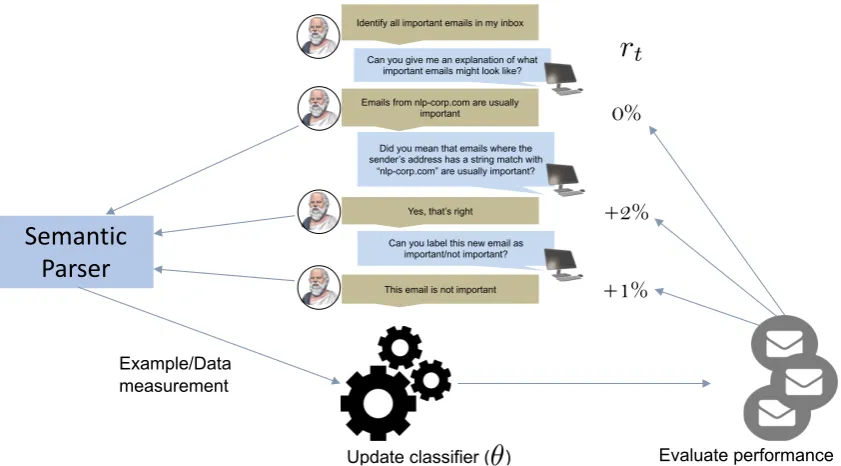
Figure 2: We assume that the dialog between the learner and the teacher is in the form of turn-wise conversations – consisting of a sequence of questions asked by the learner, and the teacher’s responses to those questions. At each step in this process, the teacher’s response is parsed by the learner (using a pre-trained semantic parser), and can be incorporated into the learner’s concept model as either a labeled example or a data measurement (the learner
can also choose to seek a clarification). A reward (denoted byrt) can be computed at each step, which denotes
the marginal change in classification performance on a held-out set of examples due to the last response. In this framework, learning good question-asking strategies corresponds to asking sequences of questions that maximize the cumulative (discounted) reward, and hence quickly lead to effective concept models. The framework also allows for asking sequences of multiple questions before seeing a major jump in model performance.
The objective reflects a tension between explain-ing the unlabeled data (likelihood term) and em-ulating the natural language advice provided by a teacher. The KL divergence represents difference between predictions from the trained model on
un-labeled datapθ(Y|X) and language advice (each
explanation is incorporated as a data measure-ment; the conjunction of these defines the ‘valid
set’ of posterior distributionsQthat perfectly
con-cur with the natural language advice). The second term essentially computes the minimum distance
between the model posterior and the setQ.
Here, we show that we can naturally extend this approach to learn classifiers from a mix of both labeled and unlabeled data, and natural language explanations. To do this, we simply append a log-likelihood term for the labeled examples to the
ob-jective in Equation1. The updated objective is:
JQ(θ) =Llabeled(θ)
+µLunlabeled(θ)−min
q∈QKL(q |pθ(Y|X))
(2)
Here, Llabeled(θ) denotes the log-likelihood
term for a set of nlabeled labeled examples
Xlabeled = {(xk, yk)}nlabeled (normalized by
nlabeled), whereas the other two terms are as
be-fore: Lunlabeled(θ)denoting log-likelihood over a
set ofnunlabeledunlabeled examples, and a
poste-rior regularizer term (KL-divergence) penalizing violations of the parse natural language advice. In the E-step of the Posterior Regularization
train-ing (Ganchev et al.,2010), the computation of the
posterior regularizer remains unchanged. How-ever, the M-step is modified so that the classifier
parameters θ are learned using both the inferred
labels for the unlabeled data, and provided labels for the labeled examples.
In Equation 2, µ > 0 determines the relative
weights of provided example labels and natural language advice in the optimization objective and is a hyper-parameter for the method. In learn-ing scenarios where there is little labeled data, we would like to rely primarily on constraints speci-fied from natural language explanations, and
un-labeled data. On the other hand, in scenarios
to primarily rely on it rather than explanations.4 While setting up the optimization problem, the
value of µ can be adapted to reflect this
intu-ition. In our experiments, we found setting µ =
1/max(nlabeled,1)to work well across settings.
3.2 RL formulation for learning to ask
Figure 2 illustrates our framework for learning
classification tasks in a question-answer dialog setting. We assume the presence of a teacher to answer questions posed by the learner. We restrict the structure of dialog to a sequence of questions (q1. . . qT) asked by the learner, and the teacher’s
responses (u1. . . uT) to them. We further assume
the presence of a held-out set of labeled examples of the concept, which can be used to evaluate the learner’s classification performance as the dialog
progresses. At each stept, the learner’s actionat
consists of choosing a question to ask the teacher. The teacher’s response to the learner’s question is parsed (in the form of a labeled example, or a data measurement), which is then incorporated into the learner’s concept model (by retraining with the ad-ditional labeled example or the new data
measure-ment). The classification performance, ct, of the
updated model is evaluated on the held-out set. The change in classification performance from the
previous step,rtapproximates the marginal value
of the question in learning the task, and constitutes the learner’s reward at that step.
Our approach for learning question asking strategies models the dialog as a simple Markov
Decision Process. Since our state and action
spaces are discrete (as described in the follow-ing sections), we can use a table-based SARSA-learning procedure (which allows for on-policy learning over Q-learning) to estimate the
state-action values Q(s, a) of different question types
in different contexts. We next describe the state-space, actions and rewards, and the learning pro-cedure.
3.2.1 Action Space
As mentioned earlier, there can be a multitude of questions that a learner can ask a teacher. Here, we are interested in exploring three specific types of questions that are specially germane for facili-tating learning from a mix of labeled examples and explanations. These consist of the following:
4In the asymptotic case of infinite data with labels, an in-ductively learned Bayes Classifier would be optimal.
1. Seeking labels for specific examples: This is similar to traditional active learning. In partic-ular, we can have a different action correspond-ing to every active learncorrespond-ing criterion, which chooses which example to label next. In our experiments, we use two active learning tech-niques (with a corresponding action for each):
• Random: Ask for class label for a randomly chosen unlabeled instance.
• Maximum Uncertainty: Ask for class label for the instance in the data for which the cur-rent concept model is most uncertain (high-est entropy). If there are multiple such in-stances, randomly pick one among them.
2. Asking for an explanation for the concept:
This action seeks out from the teacher a short natural language explanation of the concept. This is then incorporated in the concept model as a quantitative constraint. In general, this can encompass several types of questions:
• Asking for probability estimates about
spe-cific labels and features. e.g., ‘How often are emails about meetings important?’
• Asking for discriminative features for
partic-ular concept labels. e.g., ‘Can you think of a feature that if present always denotes that an email is important?’
• Asking about class probabilities. e.g.,
‘Around what fraction of emails in your in-box are important?’
In principle, each of the above provide ad-missible constraints which the classifier
train-ing procedure (from Section 3.1) can handle.
However, to simplify analysis, in our experi-ments, we conflate these actions into one cat-egory, and ask for general explanations of the
form ‘Can you give me an explanation of the
concept?’, which could return a variety of data
measurements (subsuming P(y),P(y|x) and
P(x|y), previously explored inSrivastava et al.
(2018)).
the learner’s semantic parser) was correct or not. To do this, we generate a question of the
form ‘Did you mean . . .’ using a synchronous
grammar which deterministically maps logical forms to natural language descriptions (see
Fig-ure 1 for an example). The teacher responds
with yes, if the parsed logical form matches the gold annotated logical form, and with no oth-erwise. In case the teacher responds with no, the current explanation is discarded (not used in model training), and the learner moves ahead to ask for a new label or explanation.
Simulating Interactions: We note that each of the question types described above – (1) asking for labels for examples, (2) asking for concept ex-planations, and (3) verifying interpretations of lan-guage explanations – can be simulated with corre-sponding statically collected data – consisting of (1) labeled examples for classification, (2) natu-ral language explanations of classes, and (3) anno-tations of those explanations with logical forms. This has a significant implication: rather than re-lying on questioning human users in real-time, we can simulate the conversational exchange by ask-ing questions to an oracle, which has access to pre-viously pre-collected data of the above-described form for each classification task. While this is a coarse approximation of actual dialog between an automated learner and human teachers, it can serve as a useful proof-of-concept, and allows for quick experimentation. We rely on this simulated setting for learning policies for question asking.
3.2.2 Rewards
The reward,rt, evaluates the change in
classifica-tion performance due to an asked quesclassifica-tion at each
steptof the dialog. The performance of the
clas-sification model is evaluated on a held out set of
nheldout = 50labeled examples for each learning
task. In our experiments, we use the model’s F1 score as the metric for classification performance,
ct. We define the reward as the absolute change in
model performance from the previous step:
rt=ct−ct−1 (3)
3.2.3 State-space
Next, we describe the featurized state space for our reinforcement learning formulation. The best question to ask at a particular point can likely
depend on the state of the conversation. This
could include factors such as the pedagogical
phase in the learning process (exploratory vs con-firmatory), previous questions asked, etc. Thus, defining a rich enough state space is an important consideration for a formulation of conversational learning. In our treatment, we assume a discrete state-space, which is defined as the cross product of the following (also discrete) features.
• Curricular stage in the Learning process:We use a discrete variable to model the curricular stage of the learner, approximating it by the number of steps (questions previously asked) in the interaction at any point. We cluster the num-ber of steps in the following five bins of values: BEGINNER (0 steps), NOVICE(1-5 steps), IN
-TERMEDIATE (6-10 steps), ADVANCED(11-15
steps) and MATURE(>15 steps).5
• Reward in the previous state: We discretize the value of reward as belonging to one of four
ranges (abstractly named GOOD, INCREASING,
FLAT, and DECREASING), with thresholds
cho-sen to correspond to the inter-quartile ranges for the value of rewards observed in evaluating a random policy.
• Velocity of reward: This is a ternary variable indicating whether the value of the discrete
vari-able for the reward (above) is BETTER,WORSE
or the SAMEthan the previous step.
• Type of the previous two actions: As men-tioned in the description of the action space.
• Domain of learning task: Indicates the
do-main of the current classification task. We
use datasets corresponding to three domains: EMAIL CATEGORIZATION, SHAPE CLASSIFI
-CATION and BIRD SPECIES IDENTIFICATION;
hence this variable can take these three values.
• Confidence of previous parse: We model the
learner’s confidence in parsing the responseut
from a teacher as the ratio of the probabil-ity of the highest probabilprobabil-ity (predicted) logi-cal form from the learner’s semantic parser and the next best logical form. We discretize this ratio into three values, corresponding to the
up-per (HIGH), lower (LOW) and middle two
inter-quartile ranges (MEDIUM) for the value of the
ratio over all explanations in our data.
While our state space captures several facets, it does not model some other important factors:
• Teacher behavior: Whether the teacher pro-vides correct information, and uses easily inter-pretable language.
• Task difficulty: This refers to how expressible a classification task is using language explana-tions. For example, some concept maybe sig-nificantly easier to explain using language than others, depending on the logical language
avail-able to the semantic parser. For example, it
maybe impossible to explain digit recognition using pixel level features using language.
3.3 Model training
Since the action and state-spaces are discrete and not prohibitively large, we use the on-policy SARSA learning algorithm for policy control
(Rummery and Niranjan,1994), where we
repre-sent the state-action Q-values for pairs of states
s and actions a as a table. We use an -greedy
strategy (= 0.20). i.e., the strategy balances
be-tween exploitation and exploration by picking the next action to be the estimated optimal one (hav-ing the maximum estimated Q-value for a state)
with probability1−, and choosing the next
ac-tion randomly with a probability of. The initial
policy is defined by uniform randomly initializing
Q(s, a)values between0and1.
4 Data
Our empirical analysis uses existing datasets for
learning classifiers from language. These are
datasets for email categorization from natural
lan-guage explanations fromSrivastava et al.(2017);
and bird species classification and synthetic shape
classification tasks from Srivastava et al. (2018).
In all, thesee consist of 67 classification tasks
be-longing to these three domains.6 For each task,
the corresponding data consisting of natural lan-guage explanations of classes as well as annotated logical forms for these explanations are available. For each task, we hold out a random sample of 50 examples for evaluating classifier performance. The rest of the examples (ranging between 50 and 100 for individual tasks) are considered as unla-beled data at the start of each interaction. At each step in a simulated interaction, either (1) the label
6The complexity of these problems varies considerably, ranging from marginally above chance to perfectly learnable.
for a new example from this set is revealed by the teacher, (2) a new data measurement is provided as a natural language explanation by the teacher, or (3) the learner seeks a clarification about the parse of the previous explanation. Thus, from the learner’s perspective, over time the size of the un-labeled data decreases, and the un-labeled examples
increase (see Equation2).
5 Experiments
In this section, we evaluate LiD’s performance
for three domains of classification tasks. As pre-viously mentioned, for policy learning we sim-ulate conversational interactions between teach-ers and learnteach-ers by asking questions to a ora-cle, which has access to previously collected data about each classification task. One limitation of learning question-asking strategies from simulated interactions is that for some classification tasks, we may run out of explanations in the course of model training (since the number of explanations of a concept are limited). In these cases, we end the interaction as soon as all explanations are al-ready provided to the learner.
5.1 Learned vs Random policy evaluation
First, we compare learned policies for question asking with a naive policy that randomly takes a new action at each step in the learning process.
Figure3shows averaged cumulative reward for
question asking strategies on 20 unseen classifica-tion tasks, after SARSA learning for 10 epochs on the remaining 37 classification tasks. In the fig-ure, the x-axis corresponds to the number of steps in a dialog, and the y-axis denotes the cumulative reward (averaged over 20 tasks) for a learned pol-icy vs a random polpol-icy. We note that polpol-icy learn-ing leads to consistently superior performance (on
average, LiD achieves any given level of
classifi-cation performance in fewer steps), which unam-biguously indicates value in asking the right se-quences of questions. We observed that the trend was also similar in most individual learning tasks. For example, the cumulative reward after 10 steps was higher for the learned policy than the random policy for 18 of the 20 learning tasks. The dif-ference in performance was statistically significant atp < 0.05using a signed permutation test. We characterize some learned behaviors that drive this
Figure 3: Cumulative Reward (averaged over 20 tasks) for interactive concept learning for learned question asking policy vs random policy.
Parsing Accuracy % of Actions seeking NL Explanations 0
0.2 0.4 0.6
0 0.25
0.5 0.75
1
Reliance on NL Explanations vs Parsing Accuracy
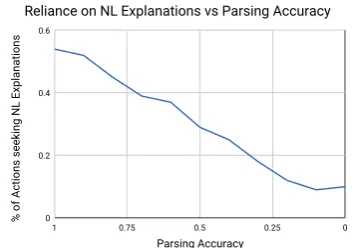
Figure 4: Fraction of actions seeking Natural Language Explanations vs competence of the learner’s semantic parser.
5.2 Reliance on NL vs Parsing accuracy
Intuitively, semantic parsing competence of a learner should be a significant consideration in whether it should rely on explanations. To test this, we simulate scenarios of learners with differ-ent levels of semantic parsing ability by choosing the true logical form for any explanation with the corresponding probability, and choosing an alter-native logical form from the remaining candidates
in the k-best list from the semantic parser
other-wise. Figure4depicts the effect of parsing
com-petence on learned question-asking strategies. The empirical behavior largely corroborates our expec-tation, as the learned strategies increasingly avoid seeking natural language explanations of concepts as the parsing performance worsens. In the base case where the learner has no parsing competence, the model learns to exclusively ask for labeled ex-amples only (In the figure, the fraction is seen to
converge close to 0.1 rather than 0 due to the
-greedy nature of the policy).
Rank (in sequence of instruction by human teacher)
Avg Reward per
0 0.01 0.02 0.03 0.04 0.05
Rank 1 Rank 2 Ranks 3-5 Rank>5
[image:8.595.346.488.66.144.2]Relative value of explanations
Figure 5: Average increase in classification perfor-mance from explanations of different positional orders.
5.3 Differential value of explanations
A notable issue in learning from explanations, which we do not model here is that a teacher’s multiple explanations of a concept can have a large variance in their utility to a learner. In particu-lar, we might expect that teachers would be more likely to provide the most useful explanations first, and minor explanations subsequently. From an ab-lation study, we observe that this is indeed a valid
concern. Figure5shows the average marginal
in-crease in classification performance over 50 vi-sual shape classification tasks from explanations with different rank (based on the actual order of providing from human users). This indicates that explanations from teachers provided later con-tribute significantly less towards classification per-formance.
5.4 Examples of Learned behavior
From a qualitative analysis, learned policies are seen to be intuitive and interpretable. In partic-ular, the policies overwhelmingly seek clarifica-tions when confidence in the parser is low. On the other hand, there are strong inclinations to con-tinue using an action type as long as it yields high returns. Interestingly, the optimal policy differs significantly in behavior across domains. As ex-ample, learned policies rely nearly twice as much on explanations for bird species identification as for email classification tasks. The probable reason is that parsing is harder for email explanations, as features in this domain are often compositional.
5.5 User study
[image:8.595.92.271.254.378.2]in-Avg. Reward Natural Avg. Rew(simulated)
LiD 0.524 3.2 0.607
[image:9.595.72.293.62.97.2]Random 0.493 2.9 0.551
Table 1: Human teacher evaluation for learned and ran-dom question asking policy.
teract with the learnedLiD policy to teach a
cho-sen email-classification task. For each task, the system asked a sequence of 10 questions, and the human teacher’s responses were incorporated into the system to update the classification model. The users were also asked to teach another task with
questions asked through a random policy. Table1
shows the average cumulative reward for humans
interacting with LiD vs a random policy for this
experiment. We note thatLiDleads to better
per-formance on average. This trend is the same as in the simulated analysis, although we note that the learning is slower with real teachers than in the simulated setting on the same tasks, and the gain in performance is substantially smaller. A contribut-ing reason for this is likely annotator bias (Geva
et al., 2019), since in the simulated testing
sce-narios, the teacher’s explanations can often likely come from a small set of turkers whose language explanations for teaching other tasks were used for training the learner’s semantic parsing model. We note that the learned policy was rated by human users as more natural than a random policy on a Likert scale (with range 1-5).
6 Conclusion
In this paper, we have provided a reinforcement learning formulation for learning to ask questions for interactive training of machine learning mod-els. This framework is attractive in grounding the value of questions asked in a measurable
down-stream task. Further, change in model
perfor-mance is a natural reward to drive this learning. While this provides a conceptually useful frame-work for framing question generation, in its cur-rent form the approach makes simplistic assump-tions on the types of quesassump-tions that can be asked, as well as on the structure of the dialog between
the teacher and the learner. While the system
outperforms a random policy on learning clas-sification tasks, the dialog looks contrived from
a human perspective. An interesting direction
could be to pair the framework with neural text generation methods to model fine-grained ques-tion types, and generate more natural-looking
in-teractions through dialog. An important
scien-tific question is to characterize learning tasks for which learning from language is likely to outper-form pure inductive learning. Future work can also extend the approach to other supervised learn-ing tasks, as well as bootstrap from natural dialog data.
References
Jacob Andreas, Dan Klein, and Sergey Levine. 2018.
Learning with latent language. In Proceedings of the 2018 Conference of the North American Chap-ter of the Association for Computational Linguistics: Human Language Technologies, Volume 1 (Long Pa-pers), pages 2166–2179. Association for Computa-tional Linguistics.
Maya Cakmak and Andrea L. Thomaz. 2012.
Design-ing robot learners that ask good questions. In Pro-ceedings of the Seventh Annual ACM/IEEE Inter-national Conference on Human-Robot Interaction, HRI ’12, pages 17–24, New York, NY, USA. ACM.
Brendan Collins, Jia Deng, Kai Li, and Li Fei-Fei. 2008. Towards scalable dataset construction: An
ac-tive learning approach. InEuropean conference on
computer vision, pages 86–98. Springer.
Gregory Druck, Gideon Mann, and Andrew
McCal-lum. 2008. Learning from labeled features using
generalized expectation criteria. In Proceedings of
the 31st annual international ACM SIGIR confer-ence on Research and development in information retrieval, pages 595–602. ACM.
Jacob Eisenstein, James Clarke, Dan Goldwasser, and Dan Roth. 2009. Reading to learn: Constructing
features from semantic abstracts. In Proceedings
of the 2009 Conference on Empirical Methods in Natural Language Processing: Volume 2-Volume 2, pages 958–967. Association for Computational Lin-guistics.
Mohamed Elhoseiny, Babak Saleh, and Ahmed Elgam-mal. 2013. Write a classifier: Zero-shot learning
us-ing purely textual descriptions. InThe IEEE
Inter-national Conference on Computer Vision (ICCV).
Daniel Fried, Ronghang Hu, Volkan Cirik, Anna Rohrbach, Jacob Andreas, Louis-Philippe Morency, Taylor Berg-Kirkpatrick, Kate Saenko, Dan Klein, and Trevor Darrell. 2018. Speaker-follower
mod-els for vision-and-language navigation. CoRR,
abs/1806.02724.
Kuzman Ganchev, Jo˜ao Grac¸a, Jennifer Gillenwater, and Ben Taskar. 2010. Posterior regularization for
structured latent variable models. The Journal of
Mor Geva, Yoav Goldberg, and Jonathan Berant. 2019. Are we modeling the task or the annotator? an inves-tigation of annotator bias in natural language
under-standing datasets. arXiv preprint arXiv:1908.07898.
Dan Goldwasser and Dan Roth. 2014. Learning from
natural instructions.Mach. Learn., 94(2):205–232.
Braden Hancock, Paroma Varma, Stephanie Wang, Martin Bringmann, Percy Liang, and Christopher
R´e. 2018. Training classifiers with natural
lan-guage explanations. InProceedings of the 56th An-nual Meeting of the Association for Computational Linguistics (Volume 1: Long Papers), pages 1884– 1895. Association for Computational Linguistics.
Sheng-Jun Huang, Songcan Chen, and Zhi-Hua Zhou.
2015. Multi-label active learning: Query type
mat-ters. InProceedings of the 24th International Con-ference on Artificial Intelligence, IJCAI’15, pages 946–952. AAAI Press.
Jayant Krishnamurthy and Thomas Kollar. 2013. Jointly learning to parse and perceive: Connecting
natural language to the physical world.Transactions
of Association for Computational Linguistics.
Igor Labutov, Bishan Yang, and Tom Mitchell. 2018. Learning to learn semantic parsers from natural
lan-guage supervision. InProceedings of the 2018
Con-ference on Empirical Methods in Natural Language Processing, pages 1676–1690.
Percy Liang, Michael I Jordan, and Dan Klein. 2009. Learning from measurements in exponential
fami-lies. In Proceedings of the 26th annual
interna-tional conference on machine learning, pages 641– 648. ACM.
Ishan Misra, Ross Girshick, Rob Fergus, Martial Hebert, Abhinav Gupta, and Laurens van der Maaten. 2018. Learning by asking questions. In
2018 IEEE/CVF Conference on Computer Vision and Pattern Recognition (CVPR), pages 11–20. IEEE.
Karthik Narasimhan, Tejas Kulkarni, and Regina Barzilay. 2015. Language understanding for text-based games using deep reinforcement learning. In
Proceedings of the 2015 Conference on Empirical Methods in Natural Language Processing, pages 1– 11.
Andrew M Olney, Arthur C Graesser, and Natalie K
Person. 2012. Question generation from concept
maps. Dialogue & Discourse, 3(2):75–99.
Devi Parikh and Kristen Grauman. 2011. Interactively building a discriminative vocabulary of nameable
at-tributes. InProceedings of the 2011 IEEE
Confer-ence on Computer Vision and Pattern Recognition, pages 1681–1688. IEEE Computer Society.
Sudha Rao and Hal Daum´e III. 2018. Learning to ask good questions: Ranking clarification questions us-ing neural expected value of perfect information. In
Proceedings of the 56th Annual Meeting of the As-sociation for Computational Linguistics (Volume 1: Long Papers), volume 1, pages 2737–2746.
Salvatore Romeo, Giovanni Da San Martino, Alberto Barr´on-Cedeno, Alessandro Moschitti, Yonatan Be-linkov, Wei-Ning Hsu, Yu Zhang, Mitra Mohtarami, and James Glass. 2016. Neural attention for learn-ing to rank questions in community question
answer-ing. InProceedings of COLING 2016, the 26th
In-ternational Conference on Computational Linguis-tics: Technical Papers, pages 1734–1745.
G. A. Rummery and M. Niranjan. 1994. On-line Q-learning using connectionist systems. Technical Re-port TR 166, Cambridge University Engineering De-partment, Cambridge, England.
Burr Settles. 2012. Active learning. Synthesis
Lec-tures on Artificial Intelligence and Machine
Learn-ing, 6(1):1–114.
Lanbo She and Joyce Chai. 2017. Interactive learning of grounded verb semantics towards human-robot
communication. InProceedings of the 55th Annual
Meeting of the Association for Computational Lin-guistics (Volume 1: Long Papers), volume 1, pages 1634–1644.
Behjat Siddiquie and Abhinav Gupta. 2010. Beyond active noun tagging: Modeling contextual
interac-tions for multi-class active learning. In2010 IEEE
Computer Society Conference on Computer Vision and Pattern Recognition, pages 2979–2986. IEEE.
Shashank Srivastava, Igor Labutov, and Tom Mitchell. 2017. Joint concept learning and semantic parsing
from natural language explanations. InProceedings
of the 2017 Conference on Empirical Methods in Natural Language Processing, pages 1527–1536.
Shashank Srivastava, Igor Labutov, and Tom Mitchell.
2018. Zero-shot learning of classifiers from
natu-ral language quantification. In Proceedings of the 56th Annual Meeting of the Association for Compu-tational Linguistics (Volume 1: Long Papers), pages 306–316. Association for Computational Linguis-tics.
Lucy Vanderwende. 2008. The importance of being
important: Question generation. In Proceedings
of the 1st Workshop on the Question Generation Shared Task Evaluation Challenge, Arlington, VA.
Sida I. Wang, Percy Liang, and Christopher D.
Man-ning. 2016. Learning language games through
in-teraction. InProceedings of the 54th Annual Meet-ing of the Association for Computational LMeet-inguis- Linguis-tics, ACL 2016, August 7-12, 2016, Berlin, Ger-many, Volume 1: Long Papers.
Ludwig Wittgenstein. 1953. Philosophical
Haichao Zhang, Haonan Yu, and Wei Xu. 2018. In-teractive language acquisition with one-shot visual concept learning through a conversational game. In