Proceedings of the 2019 Conference on Empirical Methods in Natural Language Processing
2485
Unicoder: A Universal Language Encoder by Pre-training with Multiple
Cross-lingual Tasks
Haoyang Huang§ Yaobo Liang§ Nan Duan§ Ming Gong† Linjun Shou† Daxin Jiang† Ming Zhou§
§Microsoft Research Asia, Beijing, China
†STCA NLP Group, Microsoft, Beijing, China
{haohua,yalia,nanduan,migon,lisho,djiang,mingzhou}@microsoft.com
Abstract
We present Unicoder, a universal language en-coder that is insensitive to different languages. Given an arbitrary NLP task, a model can be trained with Unicoder using training data in one language and directly applied to inputs of the same task in other languages. Com-paring to similar efforts such as Multilingual BERT (Devlin et al.,2018) and XLM ( Lam-ple and Conneau, 2019), three new cross-lingual pre-training tasks are proposed, in-cluding lingual word recovery, lingual paraphrase classification and cross-lingual masked language model. These tasks help Unicoder learn the mappings among dif-ferent languages from more perspectives. We also find that doing fine-tuning on multiple languages together can bring further improve-ment. Experiments are performed on two tasks: cross-lingual natural language infer-ence (XNLI) and cross-lingual question an-swering (XQA), where XLM is our baseline. On XNLI, 1.8% averaged accuracy improve-ment (on 15 languages) is obtained. On XQA, which is a new cross-lingual dataset built by us, 5.5% averaged accuracy improvement (on French and German) is obtained.
Introduction
Data annotation is expensive and time-consuming for most of NLP tasks. Recently, pre-trained mod-els, such as ELMo (Peters et al., 2018), BERT (Devlin et al., 2018) and GPT (Radford et al.,
2018), have shown strong capabilities of trans-ferring knowledge learned from large-scale text corpus to specific NLP tasks with limited or no training data. But they still cannot handle tasks when training and test instances are in different languages.
Motivated by this issue, some efforts have been made, such as Multilingual BERT (Devlin et al.,
2018) and XLM (Lample and Conneau, 2019),
for cross-lingual tasks. Multilingual BERT trains a BERT model based on multilingual Wikipedia, which covers 104 languages. As its vocabulary contains tokens from all languages, Multilingual BERT can be used to cross-lingual tasks directly. XLM further improves Multilingual BERT by in-troducing a translation language model (TLM). TLM takes a concatenation of a bilingual sentence pair as input and performs masked language model based on it. By doing this, it learns the mappings among different languages and performs good on the XNLI dataset.
bring further improvement. For the languages without training data, we use machine translated data from rich-resource languages.
Experiments are performed on cross-lingual natural language inference (XNLI) and cross-lingual question answering (XQA), where both Multilingual BERT and XLM are considered as our baselines. On XNLI, 1.8% averaged accuracy improvement (on 15 languages) is obtained. On XQA, which is a new cross-lingual dataset built by us, 5.5% averaged accuracy improvement (on French and German) is obtained.
In short, our contributions are 4-fold. First, 3 new cross-lingual pre-training tasks are pro-posed, which can help to learn a better language-independent encoder. Second, a cross-lingual question answering (XQA) dataset is built, which can be used as a new cross-lingual benchmark dataset. Third, we verify that by fine-tuning mul-tiple languages together, significant improvements can be obtained. Fourth, on the XNLI dataset, new state-of-the-art results are achieved.
Related work
Monolingual Pre-training Recently, pretrain-ing an encoder by language model (Radford et al.,
2018;Peters et al.,2018;Devlin et al.,2018) and machine translation (McCann et al., 2017) have shown significant improvement on various natu-ral language understanding (NLU) tasks, like tasks in GLUE (Wang et al., 2018). The application scheme is to fine-tune the pre-trained encoder on single sentence classification task or sequential la-beling task. If the tasks have multiple inputs, just concatenate them into one sentence. This ap-proach enables one model to be generalized to different language understanding tasks. Our ap-proach also is contextual pre-training so it could been applied to various NLU tasks.
Cross-lingual Pre-training Cross-lingual Pre-training is a kind of transfer learning with dif-ferent source and target domain (Pan and Yang,
2010). A high-quality cross-lingual representation space is assumed to effectively perform the cross-lingual transfer. Mikolov et al. (2013) has been applied small dictionaries to align word represen-tations from different languages and it is sufficient to align different languages with orthogonal trans-formation (Xing et al.,2015), even without paral-lel data (Lample et al.,2018). Following the line of previous work, the word alignment also could
be applied to multiple languages (Ammar et al.,
2016). Artetxe and Schwenk (2018) use multi-lingual machine translation to train a multimulti-lingual sentence encoder and use this fixed sentence em-bedding to classify XNLI. We take these ideas one step further by producing a pre-trained encoder in-stead of word embedding or sentence embedding. Our work is based on two recent pre-trained cross-lingual encoders: multilingual BERT1 ( De-vlin et al., 2018) and XLM (Lample and Con-neau, 2019). Multilingual BERT trains masked language model (MLM) with sharing vocabulary and weight for all 104 languages. But each train-ing sample is monoltrain-ingual document. Keeptrain-ing the same setting, XLM proposed a new task TLM, which uses a concatenation of the parallel sen-tences into one sample for masked language mod-eling. Besides these two tasks, we proposed three new cross-lingual pre-training tasks for building a better language-independent encoder.
Approach
This section will describe details of Unicoder, in-cluding tasks used in the pre-training procedure and its fine-tuning strategy.
Model Structure
Unicoder follows the network structure of XLM (Lample and Conneau, 2019). A shared vocab-ulary is constructed by running the Byte Pair En-coding (BPE) algorithm (Sennrich et al.,2016) on corpus of all languages. We also down sample the rich-resource languages corpus, to prevent words of target languages from being split too much at the character level.
Pre-training Tasks in Unicoder
Both masked language model and translation lan-guage model are used in Unicoder by default, as they have shown strong performance in XLM.
Motivated by Liu et al. (2019), which shows that pre-trained models can be further improved by involving more tasks in pre-training, we in-troduce three new cross-lingual tasks in Unicoder. All training data for these three tasks are acquired from the existing large-scale high-quality machine translation corpus.
Cross-lingual Word Recovery Similar to trans-lation language model, this task also aims to let the
1
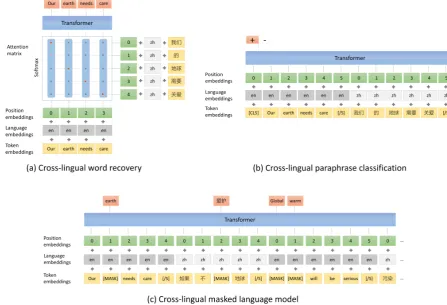
Figure 1: Unicoder consists of three cross-lingual pre-training tasks: (a) The cross-lingual word recovery model is to learn word relation from different languages (b) The cross-lingual paraphrase classification is to classify whether two sentences from different languages are paraphrase. (c) The cross-lingual masked language model is to train masked language model with cross-lingual document.
pre-trained model learn the underlying word align-ments between two languages. It is mainly mo-tivated by the attention matrix used in the neural machine translationBahdanau et al.(2014) task.
Formally, given a bilingual sentence pair (X, Y), where X = (x1, x2, ..., xm) is a
sen-tence with m words from language s, Y = (y1, y2, ..., yn) is a sentence with n words from
language t, this task first represents each xi as
xti ∈Rhby all word embeddings ofY:
xti= n X
j=1
sof tmax(Aij)ytj (1)
where xsi ∈ Rh and ytj ∈ Rh denote the word embeddings of xi and yj respevtively, h denotes
the word embedding dimension,A ∈Rm×nis an attention matrix calculated by:
Aij =W[xsi, yjt, xsi yjt] (2)
W ∈R3∗his a trainable weight andis element-wise multiplication. Then, Unicoder takesXt =
(xt1, xt2, ..., xtn) as input, and tries to predict the original word sequenceX.
Similar to translation language model in XLM, this task is based on the bilingual sentence pairs as well. However, as it doesn’t use the original words as input, we can train this task by recovering all words at the same time. The model structure of this task is illustrated in Figure 1.a.
Cross-lingual Paraphrase Classification This task takes two sentences from different languages as input and classifies whether they are with the same meaning. Like the next sentence prediction task in BERT, we concatenate two sentences as a sequence and input it to Unicoder. The represen-tation of the first token in the final layer will be used for the paraphrase classification task. This procedure is illustrated in Figure 1.b.
ran-dom sampled sentence from target language. But this will make the classification task too easy. So we introduce the hard negative samples followed
Guo et al. (2018). First, we train a light-weight paraphrase model with random negative samples. Then we use this model to select sentence with high similarity score toXbut doesn’t equal toY
as hard negative samples. We choose DAN (Iyyer et al.,2015) as the light model. We create positive and negative samples in 1:1.
Cross-lingual Masked Language Model
Pre-vious successful pre-training language model (Devlin et al., 2018; Radford et al., 2018) is conducted on document-level corpus rather than sentence-level corpus. The language model per-plexity on document also is much lower than sen-tence (Peters et al.,2018). So we propose cross-lingual masked language model, whose input is come from cross-lingual document.
Cross-lingual document is a sequence of sen-tences, and the sentences are written with different languages. In most case, people won’t write cross-lingual document. But we found that a large pro-portion of aligned sentence pairs in machine trans-lation are extracted from parallel documents, such as MultiUN corpus and OpenSubtitles corpus. In other words, these MT corpus are document-level corpus in which each sentence and its translation is well aligned. We construct cross-lingual doc-ument by replacing the sentences with even in-dex to its translation as illustrated in Figure 1.c. We truncate the cross-lingual document by 256 se-quence length and feed it to Unicoder for masked language modeling.
Multi-language Fine-tuning
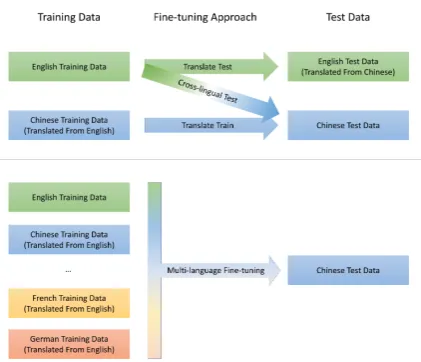
A typical setting of cross-lingual language under-standing is only one language has training data, but the test is conducted on other languages. We denote the language has training data as source language, and other languages as target languages. A scalable way (Conneau et al.,2018) to address this problem is through Cross-lingual TEST, in which a pre-trained encoder is trained on data in source language and directly evaluated on data in target languages.
There are two other machine translation meth-ods that make training and test belong to the same language. TRANSLATE-TRAIN translates the source language training data to a target lan-guage and fine-tunes on this pseudo training data.
TRANSLATE-TEST fine-tunes on source guage training data, but translates the target lan-guage test data to source lanlan-guage and test on it.
Inspired by multi-task learning (Liu et al.,
2018,2019) for improving pre-trained model, we propose a new fine-tuning strategy Multi-language Fine-tuning. We propose to fine-tune on both the source language training data and pseudo target language training data. If there are multiple tar-get languages, we will fine-tune on all of them at same time.
[image:4.595.312.523.302.483.2]Different languages may have totally different vocabulary and syntax. But our experiments show that in most cases, joint fine-tuning multiple lan-guages could bring huge improvement. Only in just a few cases, this may harm the performance.
Figure 2: Currently cross-lingual fine-tuning has three baseline approaches, they could be defined based on their training data and test data. Suppose we target to test on Chinese data, Translate-train is to train on Chinese training data which is translated from English and test on Chinese test data; Translate-Test is to train on English training data and test on English test data which is translated from Chinese; Cross-lingual test is to train in English training data and test on Chinese test data. Multi-language fine-tuning is to train on English training data and multiple other languages training data which are translated from English, then test on Chinese Test data.
Experiment
Data Processing
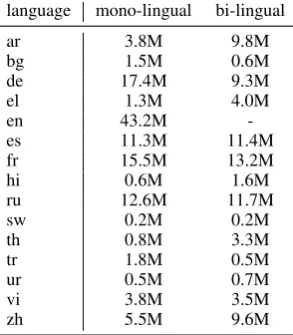
Our model is pre-trained on 15 languages, in-cluding English(en), French(fr), Spanish(es), Ger-man(de), Greek(el), Bulgarian(bg), Russian(ru), Turkish(tr), Arabic(ar), Vietnamese(vi), Thai(th), Chinese(zh), Hindi(hi), Swahili(sw) and Urdu(ur). For MLM, we use the Wikipedia from these lan-guages. The other four tasks need MT dataset. We use same MT dataset as Lample and Conneau
(2019) which are collected from MultiUN (Eisele and Chen,2010), IIT Bombay corpus ( Kunchukut-tan et al., 2017), OpenSubtitles 2018, EUbook-shop corpus and GlobalVoices. In the MT corpus, 13 of 14 languages (except IIT Bombay corpus) are from parallel document and could be used to train cross-lingual document language model. The number of data we used is reported at table 1.
For tokenization, we follows the line ofKoehn et al. (2007); Chang et al. (2008) for each lan-guage. We use byte-pair encoding (BPE) to pro-cess the corpus and build vocabulary.
language mono-lingual bi-lingual
ar 3.8M 9.8M
bg 1.5M 0.6M
de 17.4M 9.3M
el 1.3M 4.0M
en 43.2M
-es 11.3M 11.4M fr 15.5M 13.2M
hi 0.6M 1.6M
ru 12.6M 11.7M
sw 0.2M 0.2M
th 0.8M 3.3M
tr 1.8M 0.5M
ur 0.5M 0.7M
vi 3.8M 3.5M
[image:5.595.108.255.369.537.2]zh 5.5M 9.6M
Table 1: Sentence number we used in pre-training.
Training Details
Model Structure Our Unicoder is a 12-layer
transformer with 1024 hidden units, 16 heads, GELU activation (Hendrycks and Gimpel,2017). we set dropout to 0.1. The vocabulary size is 95,000.
Pre-training details To reduce pre-training
time, we initialize our model from XLM (Lample and Conneau, 2019). We pretrain Unicoder with five tasks including MLM\TLM and our three cross-lingual tasks. In each step, we iteratively train these five tasks. A batch for these tasks is
available in 15 languages, and we sample several languages with equal probability. And we use batch size 512 by gradient accumulation. We train our model with the Adam optimizer (Kingma and Ba,2015), and learning rate starts from1e−5with invert square root decay (Vaswani et al., 2017). We run our pretraining experiments on a single server with 8 V100 GPUs and use FP16 to save the memory.
The max sequence length of MLM and cross-lingual language model is 256. For the other three tasks with two sentences as input, we set the max sequence length to 128 so the sum of them is 256.
Fine-tuning details For fine-tuning stage, we use same optimizer and learning rate as pre-training. We set the batch size to 32.
Experimental evaluation
XNLI: Cross-lingual Natural Language In-ference Natural Language Inference(NLI) takes two sentences as input and determines whether one entails the other, contradicts it or neither (neu-tral). XNLI is NLI defined on 15 languages. Each language contains 5000 human annotated develop-ment and test set. Only English has training data, which is a crowd-sourced collection of 433k sen-tence pairs from MultiNLI (Williams et al.,2018). The performance is evaluated by classification ac-curacy.
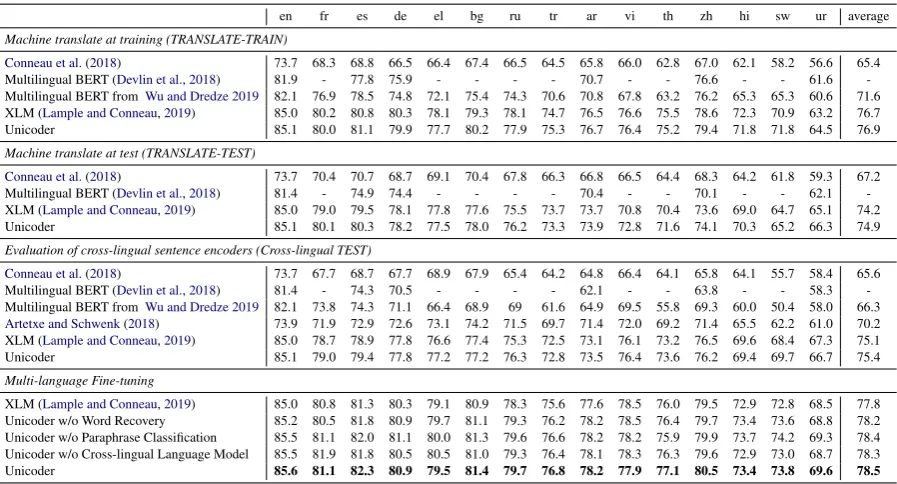
We report the results of XNLI in Table 2, by comparing our Unicoder model with four base-lines: Conneau et al.(2018) uses LSTM as sen-tence encoder and constraints bilingual sensen-tence pairs have similar embedding. The other base-lines are pre-training based approaches. Multilin-gual BERT (Devlin et al.,2018) is to train masked language model on multilingual Wikipedia. And
Artetxe and Schwenk (2018) is pre-trained with machine translation model and takes the MT en-coder to produce sentence embedding. XLM (Lample and Conneau, 2019) explores masked language model on multilingual Wikipedia, using translation language model on MT bilingual sen-tence pair for pre-training in addition.
outper-en fr es de el bg ru tr ar vi th zh hi sw ur average Machine translate at training (TRANSLATE-TRAIN)
Conneau et al.(2018) 73.7 68.3 68.8 66.5 66.4 67.4 66.5 64.5 65.8 66.0 62.8 67.0 62.1 58.2 56.6 65.4 Multilingual BERT (Devlin et al.,2018) 81.9 - 77.8 75.9 - - - - 70.7 - - 76.6 - - 61.6 -Multilingual BERT fromWu and Dredze 2019 82.1 76.9 78.5 74.8 72.1 75.4 74.3 70.6 70.8 67.8 63.2 76.2 65.3 65.3 60.6 71.6 XLM (Lample and Conneau,2019) 85.0 80.2 80.8 80.3 78.1 79.3 78.1 74.7 76.5 76.6 75.5 78.6 72.3 70.9 63.2 76.7 Unicoder 85.1 80.0 81.1 79.9 77.7 80.2 77.9 75.3 76.7 76.4 75.2 79.4 71.8 71.8 64.5 76.9 Machine translate at test (TRANSLATE-TEST)
Conneau et al.(2018) 73.7 70.4 70.7 68.7 69.1 70.4 67.8 66.3 66.8 66.5 64.4 68.3 64.2 61.8 59.3 67.2 Multilingual BERT (Devlin et al.,2018) 81.4 - 74.9 74.4 - - - - 70.4 - - 70.1 - - 62.1 -XLM (Lample and Conneau,2019) 85.0 79.0 79.5 78.1 77.8 77.6 75.5 73.7 73.7 70.8 70.4 73.6 69.0 64.7 65.1 74.2 Unicoder 85.1 80.1 80.3 78.2 77.5 78.0 76.2 73.3 73.9 72.8 71.6 74.1 70.3 65.2 66.3 74.9 Evaluation of cross-lingual sentence encoders (Cross-lingual TEST)
Conneau et al.(2018) 73.7 67.7 68.7 67.7 68.9 67.9 65.4 64.2 64.8 66.4 64.1 65.8 64.1 55.7 58.4 65.6 Multilingual BERT (Devlin et al.,2018) 81.4 - 74.3 70.5 - - - - 62.1 - - 63.8 - - 58.3 -Multilingual BERT fromWu and Dredze 2019 82.1 73.8 74.3 71.1 66.4 68.9 69 61.6 64.9 69.5 55.8 69.3 60.0 50.4 58.0 66.3
Artetxe and Schwenk(2018) 73.9 71.9 72.9 72.6 73.1 74.2 71.5 69.7 71.4 72.0 69.2 71.4 65.5 62.2 61.0 70.2 XLM (Lample and Conneau,2019) 85.0 78.7 78.9 77.8 76.6 77.4 75.3 72.5 73.1 76.1 73.2 76.5 69.6 68.4 67.3 75.1 Unicoder 85.1 79.0 79.4 77.8 77.2 77.2 76.3 72.8 73.5 76.4 73.6 76.2 69.4 69.7 66.7 75.4 Multi-language Fine-tuning
XLM (Lample and Conneau,2019) 85.0 80.8 81.3 80.3 79.1 80.9 78.3 75.6 77.6 78.5 76.0 79.5 72.9 72.8 68.5 77.8 Unicoder w/o Word Recovery 85.2 80.5 81.8 80.9 79.7 81.1 79.3 76.2 78.2 78.5 76.4 79.7 73.4 73.6 68.8 78.2 Unicoder w/o Paraphrase Classification 85.5 81.1 82.0 81.1 80.0 81.3 79.6 76.6 78.2 78.2 75.9 79.9 73.7 74.2 69.3 78.4 Unicoder w/o Cross-lingual Language Model 85.5 81.9 81.8 80.5 80.5 81.0 79.3 76.4 78.1 78.3 76.3 79.6 72.9 73.0 68.7 78.3 Unicoder 85.6 81.1 82.3 80.9 79.5 81.4 79.7 76.8 78.2 77.9 77.1 80.5 73.4 73.8 69.6 78.5
Table 2: Test accuracy on the 15 XNLI languages. This table is organized by fine-tuning and test approaches. TRANSLATE-TRAIN is to machine translate English training data to target language and fine-tune with this translated data; TRANSLATE-TEST is machine translate target language test data to English, the fine-tuning is conducted on English; Cross-lingual TEST is to fine-tune on English and directly test on target language; Multi-language Fine-tune is to fine-tune on machine translated training data on all Multi-languages.
forms XLM by 0.7%. By translating the En-glish training data to target language, both TRANSLATE-TRAIN and Multi-language Fine-tuning can outperform other fine-Fine-tuning ap-proaches on average no matter what encoder is used. Our Multi-language Fine-tuning approach is even better than TRANSLATE-TRAIN. With this approach, XLM is been improved by 1.1% and Unicoder is been improved by 1.6%.
By Combining Unicoder and Multi-language Fine-tuning, Unicoder achieves an new state of the art with 78.5%. It obtains 1.8% accuracy gain compared to previous state of the art, XLM fine-tuned with TRANSLATE-TRAIN.
XQA: Cross-lingual Question Answering We
proposed a new dataset XQA. Question Answer-ing takes a question and an answer as input, then classify whether the answer is relevant to ques-tion. Each answer is a short passage. XQA con-tains three languages including English, French and German. Only English have training data. The training data cover various domains, such as health, tech, sports, etc. The English training data contains millions of samples and each languages has 500 test data.
Keeping the same experimental setup as XNLI,
en fr de average
Machine translate at training (TRANSLATE-TRAIN)
XLM (Lample and Conneau,2019) 80.2 65.1 63.3 64.2
Unicoder 81.1 66.2 66.5 66.4
Evaluation of cross-lingual sentence encoders (Cross-lingual TEST)
XLM (Lample and Conneau,2019) 80.2 62.3 61.7 62.0
Unicoder 81.1 64.1 63.7 63.9
Multi-language Fine-tuning
BERT (Devlin et al.,2018) 76.4 61.6 64.6 63.1 XLM (Lample and Conneau,2019) 80.7 67.1 68.2 67.7
[image:6.595.75.524.61.303.2]Unicoder 81.4 69.3 70.1 69.7
Table 3: Results on the XQA. The average column is the average of fr and de result.
we also evaluate Unicoder on XQA and set XLM fine-tuned on our dataset as baseline with their published code. We split 5K data from training dataset as development data to do model selection. The results are shown in Table 3.
per-language XNLI-en XNLI-ar XNLI-es XNLI-fr XNLI-ru XNLI-zh average
number Acc[%] Acc[%] Acc[%] Acc[%] Acc[%] Acc[%] Acc[%]
1 85.1 76.7 81.1 80.0 77.9 79.4 80.0
2 85.2 77.5 81.5 80.0 77.6 80.0 80.3
6 85.3 77.9 81.5 80.4 78.8 79.9 80.6
15 85.6 78.2 82.3 81.1 79.7 80.5 81.2
Table 4: Experiments of fine-tuning on different number of languages. The model is evaluated on 6 languages, and the average result is at last column. The results in the last row correspond to the results in last row of Table 2.
formance 69.7% on XQA. Compared to XLM + TRANSLATE-TRAIN baseline, we have 5.5% gain.
Analysis
In this section, we provide ablation analysis for different variants of our approaches and elucidate some interesting aspects of Unicoder. Sec. 5.1 is the ablation study of each cross-lingual pre-training task. It also shows the impact of Multi-language Fine-tuning. Sec. 5.2 explores the im-pact of language numbers. Additionally, Sec. 5.3 analyzes the relation between English and other language by joint fine-tune on two languages. Then we further explore the relation between any language pair (Sec. 5.4).
Ablation Study
To examine the utility of our new cross-lingual pre-training tasks, we conducted ablation study on XNLI dataset. For these three cross-lingual pre-training tasks, we remove them and only pre-train on other tasks. To this end, we fine-tune the Uni-coder with Multi-language Fine-tuning. The re-sults are present at Table 2.
Ablation experiments for each factor showed that removing any tasks will lead to performance drop. Comparing Unicoder with XLM, We can draw several conclusions from the results in Ta-ble 2. First, the cross-lingual paraphrase clas-sification has least drop compared to others and removing the word recovery task hurts perfor-mance significantly. For example, in the case of XNLI, using just the Cross-lingual Language Model and Paraphrase Classification improves test accuracy on average by 0.4%. And integrating with Word Recovery model allows Unicoder to learn a better representation improves the average accuracy another 0.3%. Second, Multi-language fine-tuning is helpful to find the relation between
languages, we will analyze it below. Table 2
and Table 3 both show it can bring a significant boost in cross-lingual language understanding per-formance. With the help of Multi-language fine-tuning, Unicoder is been improved by 1.6% of ac-curacy on XNLI and 3.3% on XQA.
The relation between language number and fine-tuning performance
In Table 2, we proved that Multi-language Fine-tuning with 15 languages is better than TRANSLATE-TRAIN who only fine-tune on 1 language. In this sub-section, we try more setting to analysis the relation between language number and fine-tuning performance.
In this experiment, only English has human la-beled training data, the other languages use ma-chine translated training data from English. The experiment is conducted on 6 languages which are the languages of MT corpus Multilingual United Nations (MultiUN).
We have four settings: 1 language is equals to TRANSLATE-TRAIN, the pre-trained model is fine-tuned on target language. 2 languages is to fine-tune on English and target language. For En-glish, we report the average result when fine-tune with other 5 languages, respectively. 6 languages is to fine-tune on 6 selected languages of this ex-periment. 15 languagesis to fine-tune on all 15 languages our model support, and report the re-sults on 6 languages. This setting is equals to last row of Table 2.
The results are shown at Table 4. In most lan-guages, we could find that the more languages we used in fine-tuning, the better the performance. Chinese and Russian have two numbers don’t fol-low this trend. But 15 languages always outper-form 1 language for each languages.
Train Test
en fr es de el bg ru tr ar vi th zh hi sw ur average
en 85.1 79.0 79.4 77.8 77.2 77.2 76.3 72.8 73.5 76.4 73.6 76.2 69.4 69.7 66.7 75.4 fr 77.0 80.0 79.1 76.9 77.4 78.6 76.1 73.1 73.7 75.3 73.4 76.2 70.1 70.3 66.2 74.9 es 79.6 78.5 81.1 77.5 77.9 78.2 75.8 73.4 73.9 75.7 73.4 76.8 69.5 70.1 66.8 75.2 de 78.2 77.3 78.3 79.9 77.1 77.5 76.7 73.1 73.8 75.2 73.4 76.6 70.9 71.3 66.7 75.1 el 76.8 76.0 77.3 75.1 77.7 76.1 74.6 71.3 74.2 76.2 74.1 76.8 70.8 69.2 68.0 74.3 bg 75.7 78.7 78.4 78.0 77.9 80.2 77.2 74.0 74.4 75.5 73.4 76.6 70.1 71.0 67.3 75.2 ru 76.4 78.7 79.0 78.3 78.0 78.8 77.9 73.6 75.5 76.3 74.7 77.5 71.2 71.2 68.3 75.7
tr 75.4 75.7 76.3 75.3 76.2 76.0 74.8 75.3 73.0 73.2 72.1 75.0 69.7 70.0 65.6 73.6 ar 75.5 76.7 78.4 77.5 76.7 77.6 76.1 73.4 76.7 75.7 73.4 76.3 70.1 70.5 66.2 74.7 vi 75.1 77.0 78.6 77.1 77.2 78.1 76.2 73.1 74.0 76.4 73.6 76.1 70.5 71.0 66.9 74.7 th 75.8 76.0 76.8 74.3 75.7 76.5 74.8 74.8 73.1 75.4 75.2 76.1 68.7 69.1 67.0 74.0 zh 78.0 77.5 78.3 76.6 76.9 77.4 75.8 73.4 73.9 76.1 75.2 79.4 69.9 70.8 67.4 75.1 hi 76.4 76.5 77.5 75.9 76.4 74.9 72.7 72.9 73.1 74.3 72.6 75.7 71.8 70.1 67.8 73.9 sw 76.2 76.0 76.8 74.6 75.8 75.8 74.7 72.4 73.2 74.4 72.7 74.8 70.0 71.8 66.3 73.7 ur 72.1 70.5 71.0 70.5 70.5 70.2 69.9 66.9 67.7 68.8 69.2 71.5 67.2 66.9 64.5 69.2
Table 5: Accuracy on the XNLI test set of when fine-tuning Unicoder with one language and testing on other languages. The results in the diagonal correspond to the TRANSLATE-TRAIN accuracy reported in Table 2.
is source language and has human-labeled train-ing data. In next experiment, we will show that in 2 languages setting, the improvement on English is not stable and depends on the another language. But from 1 language to 6 languages and to 15 lan-guages, English has stable improvement.
language XNLI-en average
pairs Acc[%] Acc[%]
ar-en 84.8 76.0
bg-en 85.1 76.5
de-en 84.3 76.1
el-en 84.8 76.2
es-en 85.3 76.6
fr-en 85.4 76.8
hi-en 84.4 76.3
ru-en 85.2 76.2
sw-en 85.0 75.7
th-en 84.1 75.4
tr-en 85.0 75.5
ur-en 85.0 75.2
vi-en 84.4 75.2
zh-en 85.1 76.6
[image:8.595.109.258.438.673.2]en 85.1 75.3
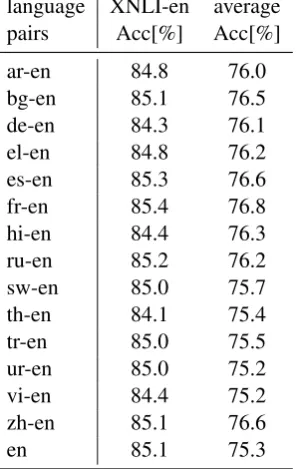
Table 6: Result of joint fine-tuning two languages. This table reports the result on English and average ac-curacy of 15 languages on XNLI. The last row means Unicoder only fine-tunes on English.
The relation between English and other languages
In this experiment, we joint fine-tune English and one language. With this experiment, we could test the relation between English and other languages since all languages have equal position in the pre-training and fine-tuning.
We report the performance on English and av-erage of 15 languages. First, we could find most of the average results are improved by joint fine-tuning two languages. Only Vietnamese(vi) and Urdu(ur) lead to performance drop. Secondly, the improvement on English is not stable. French(fr) and Spanish(es) could improve English perfor-mance. But Vietnamese(vi) and Thai(th) lead to a big drop.
The relation between different languages
So as to better understand the relation between dif-ferent languages, we fine-tune Unicoder on one language and test on all 15 languages. The results are shown in Table 5. The numbers in the diago-nal correspond to the TRANSLATE-TRAIN result reported in Table 2.
English.
We also could find that transfer between En-glish(en), Spanish(es) and French(fr) is easier that other languages. The MT system between these languages also outperform other languages ( Con-neau et al.,2018).
Conclusion
We have introduced the Unicoder which is insen-sitive to different languages. We pre-train Uni-coder with three new cross-lingual tasks, including cross-lingual word recovery, cross-lingual para-phrase classification and cross-lingual masked lan-guage model. We also proposed a new Multi-language Fine-tuning approach. The experiments on XNLI and XQA proved Unicoder could bring large improvements. and our approach become new state of the art on XNLI and XQA. We also did experiments to show that the more languages we used in fine-tuning, the better the results. Even rich-resource language also could been improved.
References
Waleed Ammar, George Mulcaire, Yulia Tsvetkov, Guillaume Lample, Chris Dyer, and Noah A Smith. 2016. Massively multilingual word embeddings. arXiv preprint arXiv:1602.01925.
Mikel Artetxe and Holger Schwenk. 2018. Mas-sively multilingual sentence embeddings for zero-shot cross-lingual transfer and beyond. arXiv preprint arXiv:1812.10464.
Dzmitry Bahdanau, Kyunghyun Cho, and Yoshua Ben-gio. 2014. Neural machine translation by jointly learning to align and translate. arXiv preprint arXiv:1409.0473.
Pichuan Chang, Michel Galley, and Christopher D Manning. 2008. Optimizing chinese word segmen-tation for machine translation performance. pages 224–232.
Alexis Conneau, Ruty Rinott, Guillaume Lample, Ad-ina Williams, Samuel Bowman, Holger Schwenk, and Veselin Stoyanov. 2018. Xnli: Evaluating cross-lingual sentence representations. InProceedings of the 2018 Conference on Empirical Methods in Nat-ural Language Processing, pages 2475–2485.
Jacob Devlin, Ming-Wei Chang, Kenton Lee, and Kristina Toutanova. 2018. BERT: pre-training of deep bidirectional transformers for language under-standing.CoRR, abs/1810.04805.
Andreas Eisele and Yu Chen. 2010. Multiun: A mul-tilingual corpus from united nation documents. In
Proceedings of the Seventh conference on Interna-tional Language Resources and Evaluation, pages 2868–2872. European Language Resources Associ-ation (ELRA).
Mandy Guo, Qinlan Shen, Yinfei Yang, Heming Ge, Daniel M Cer, Gustavo Hernandez Abrego, Keith Stevens, Noah Constant, Yunhsuan Sung, Brian Strope, et al. 2018. Effective parallel corpus mining using bilingual sentence embeddings. arXiv: Com-putation and Language, pages 165–176.
Dan Hendrycks and Kevin Gimpel. 2017. Bridging nonlinearities and stochastic regularizers with gaus-sian error linear units. arXiv: Learning.
Mohit Iyyer, Varun Manjunatha, Jordan Boyd-Graber, and Hal Daum´e III. 2015. Deep unordered com-position rivals syntactic methods for text classifica-tion. InProceedings of the 53rd Annual Meeting of the Association for Computational Linguistics and the 7th International Joint Conference on Natural Language Processing (Volume 1: Long Papers), vol-ume 1, pages 1681–1691.
Diederik P Kingma and Jimmy Ba. 2015. Adam: A method for stochastic optimization. international conference on learning representations.
Philipp Koehn, Hieu Hoang, Alexandra Birch, Chris Callisonburch, Marcello Federico, Nicola Bertoldi, Brooke Cowan, Wade Shen, Christine Corbett Moran, Richard Zens, et al. 2007. Moses: Open source toolkit for statistical machine translation. The Association for Computational Linguistics.
Anoop Kunchukuttan, Pratik Mehta, and Pushpak Bhattacharyya. 2017. The iit bombay english-hindi parallel corpus. language resources and evaluation.
Guillaume Lample and Alexis Conneau. 2019. Cross-lingual language model pretraining. CoRR, abs/1901.07291.
Guillaume Lample, Alexis Conneau, Ludovic Denoyer, Herv´e J´egou, et al. 2018. Word translation without parallel data.
Liyuan Liu, Jingbo Shang, Frank F Xu, Xiang Ren, Huan Gui, Jian Peng, and Jiawei Han. 2018. Em-power sequence labeling with task-aware neural lan-guage model. national conference on artificial intel-ligence, pages 5253–5260.
Xiaodong Liu, Pengcheng He, Weizhu Chen, and Jian-feng Gao. 2019. Improving multi-task deep neural networks via knowledge distillation for natural lan-guage understanding. arXiv: Computation and Lan-guage.
Tomas Mikolov, Quoc V Le, and Ilya Sutskever. 2013. Exploiting similarities among languages for ma-chine translation. arXiv: Computation and Lan-guage.
Sinno Jialin Pan and Qiang Yang. 2010. A survey on transfer learning. IEEE Transactions on Knowledge and Data Engineering, 22(10):1345–1359.
Matthew Peters, Mark Neumann, Mohit Iyyer, Matt Gardner, Christopher Clark, Kenton Lee, and Luke Zettlemoyer. 2018. Deep contextualized word repre-sentations. InProceedings of the 2018 Conference of the North American Chapter of the Association for Computational Linguistics: Human Language Technologies, Volume 1 (Long Papers), volume 1, pages 2227–2237.
Alec Radford, Karthik Narasimhan, Tim Salimans, and Ilya Sutskever. 2018. Improving language under-standing by generative pre-training. URL https://s3-us-west-2. amazonaws. com/openai-assets/research-covers/languageunsupervised/language under-standing paper. pdf.
Rico Sennrich, Barry Haddow, and Alexandra Birch. 2016. Neural machine translation of rare words with subword units. InProceedings of the 54th Annual Meeting of the Association for Computational Lin-guistics (Volume 1: Long Papers), volume 1, pages 1715–1725.
Ashish Vaswani, Noam Shazeer, Niki Parmar, Jakob Uszkoreit, Llion Jones, Aidan N Gomez, Łukasz Kaiser, and Illia Polosukhin. 2017. Attention is all you need. InAdvances in neural information pro-cessing systems, pages 5998–6008.
Alex Wang, Amanpreet Singh, Julian Michael, Felix Hill, Omer Levy, and Samuel R Bowman. 2018. Glue: A multi-task benchmark and analysis platform for natural language understanding. pages 353–355.
Adina Williams, Nikita Nangia, and Samuel R Bow-man. 2018. A broad-coverage challenge corpus for sentence understanding through inference. north american chapter of the association for computa-tional linguistics, 1:1112–1122.
Shijie Wu and Mark Dredze. 2019. Beto, bentz, be-cas: The surprising cross-lingual effectiveness of bert. arXiv preprint arXiv:1904.09077.