Proceedings of the 2019 Conference on Empirical Methods in Natural Language Processing and the 9th International Joint Conference on Natural Language Processing, pages 3884–3893,
3884
Combining Unsupervised Pre-training and Annotator Rationales to
Improve Low-shot Text Classification
Oren Melamud
IBM Research
Yorktown Heights, NY, USA [email protected]
Mihaela Bornea
IBM Research
Yorktown Heights, NY, USA [email protected]
Ken Barker
IBM Research
Yorktown Heights, NY, USA [email protected]
Abstract
Supervised learning models often perform poorly atlow-shot tasks, i.e. tasks for which little labeled data is available for training. One prominent approach for improving low-shot learning is to use unsupervised pre-trained neural models. Another approach is to ob-tain richer supervision by collecting anno-tator rationales (explanations supporting la-bel annotations). In this work, we com-bine these two approaches to improve low-shot text classification with two novel meth-ods: a simple bag-of-words embedding ap-proach; and a more complex context-aware method, based on the BERT model. In ex-periments with two English text classification datasets, we demonstrate substantial perfor-mance gains from combining pre-training with rationales. Furthermore, our investigation of a range of train-set sizes reveals that the sim-ple bag-of-words approach is the clear top performer when there are only a few dozen training instances or less, while more complex models, such as BERT or CNN, require more training data to shine.
1 Introduction
When trained on large amounts of labeled data, supervised machine learning models demonstrate impressive performance in various domains rang-ing from text classification to image recognition (Yogatama et al.,2017;Krizhevsky et al.,2012). In many domains, however, labeled data is diffi-cult to obtain. This might be due to annotation cost, or simply because there are no available in-stances to annotate before the system has to make the next classification decision. Imagine, for ex-ample, a personalized email tagger, where new tag types can be created and then used for annotation by the user at any time. When only little training is available, model performance drops dramatically.
Various methods have been proposed to opti-mize machine learning models trained on little data with the goal of improving performance for a given train set size or reducing the number of train-ing instances that need to be collected. One of the most prominent for text classification (and other NLP tasks) is transfer learning from unsupervised data, or unsupervised pre-training. This approach has been widely adopted with the introduction of pre-trained word embeddings (Mikolov et al.,
cause identifiers in aviation safety reports from the Aviation Safety Reporting System (ASRS).
In this work, we combine the power of unsu-pervised pre-training with the fine-grained guid-ance from rationales to propose two novel low-shot text classification methods. Both methods promote rationale-like features in the input to im-prove the classification outcome. The first method uses rationale supervision to bias a simple bag-of-words text embedding towards the more discrim-inative features. In the second method, we show how to fine-tune a pre-trained BERT model with both instance labels and rationales jointly. An in-vestigation across a range of train-set sizes on the IMDB and ASRS text classification datasets re-veals that our bag-of-words approach substantially outperforms all baselines for train sets of up to a few dozen instances. For larger sizes, our BERT-based model and a CNN baseline perform the best. Our code is publicly available.1
2 Related Work
As mentioned in the Introduction, Zaidan et al.
(2007) was the first work to show how manual ra-tionales annotated for movie reviews (Pang et al.,
2002) can be used to improve classifier accuracy. They also investigated the annotation effort rami-fications and found that the additional annotation of a few rationales per instance on top of the stan-dard label annotation roughly doubled annotation time. When enough instances are readily avail-able for annotation, this information is important to assess the trade-off between obtaining annota-tor rationales and obtaining standard labeled in-stances. However, we note that there are cases where more unlabeled instances may not be avail-able and then obtaining annotator rationales may be the only way to improve the classifier accuracy. The model most closely related to our rationale-biased bag-of-words is the one proposed by
Sharma and Bilgic (2018) (denoted RA-SVM in Section5.2). It biases the input representation by adjusting feature weights in a way that is agnos-tic to the type of classifier used. More specifically, it uses one-hot word features and performs sim-ple fixed discounting of non-rationale word fea-ture weights during training only. In contrast, our model learns a rationale-biased embedded repre-sentation of texts and this reprerepre-sentation is used
1 https://github.com/mihaela-bornea/
low-shot-text-classification
both at train and test time.
The model most closely related to our rationale-biased BERT model is the one proposed by
Zhang et al. (2016) (denoted RA-CNN in Sec-tion 5.2). This model uses a CNN sentence en-coder with pre-trained word embeddings. It fol-lows a two-step approach, where one sentence classifier is trained to identify sentences contain-ing rationales and weigh them higher in an overall ‘weighted-average-of-sentences’ document repre-sentation. Then a second classifier is trained to make the final label prediction based on that repre-sentation. They showed improved accuracy com-pared to non-rationale-augmented CNNs as well as to rationale-augmented SVM models. Our main contributions relative to that work are the introduc-tion of the joint-learning technique, which learns text classification and rationale words identifica-tion concurrently, and the adaptaidentifica-tion of the en-tire approach to BERT. The ability of our model to identify rationale spans within sentences also seems useful for interpretability. Tepper et al.
(2013) also chose a two-step approach similar to
Zhang et al.(2016) using more traditional classi-fiers with sparse features. They train one classifier to identify rationale-like pieces of text and then a second classifier is trained to label input instances taking only the rationale-like texts into account.
Finally, few-shot learning methods attempt to learn how to effectively train classifiers for new classes with only few labeled instances, using techniques commonly referred to asmeta-learning (Snell et al., 2017;Yu et al., 2018). Snell et al.
(2017), for example, learn an embedding func-tion that is used to represent the input instances such that simple nearest-prototype classifiers can be trained effectively to recognise instances of a new target class after being exposed to a small number of labeled examples. Although a new class is learned from few labeled instances as in our work, the preceding meta-learning process re-lies on a large number of labeled instances aggre-gated over many closely related classes or tasks. This is an important distinction from our low-shot setting.
3 Rationale-biased Bag-of-words
3.1 Rationale-biased representation
Let~vbe a vector representation of wordv (either one-hot or a low-dimensional embedding). We represent a text instancet= (v1, .., vn)as an
L2-normalized, weighted average of its words giving the text embedding function:
emb(t) =~t= 1
Z
X
vi∈t
wiv~i (1)
whereZis the normalization factor.
This embedding is a standard bag-of-words ap-proach to representing texts, where weights, such as TF-IDF, are typically used to bias the repre-sentation towards words that carry more impor-tant information. We hypothesize that since ra-tionales highlight support for annotator classifica-tion decisions, biasing this text embedding func-tion towards rationale-like words would expose the more discriminative features. To this end, given a rationale-bias function frb(v) that
esti-mates the similarity between a wordvand the an-notated rationale texts in the training dataset, the rationale biased representation could be computed using Eq. (1) withwi = frb(vi). The remainder
of this section describes how we computefrb(v).
Let the prototype representation of a collec-tion of text instancesT = (t1, .., tm) be the
L2-normalized centroid of its text instance vectors:
prot(T) = 1
Z
X
ti∈T
~
ti (2)
whereZis the normalization factor.
A rationale for a text instance t and class la-bel c is any word subsequence r of t that was annotated as evidence for the assignment of c to
t. A class rationale prototype R~i = prot(Ri)
is the prototype representation of the rationales
Ri = (r1, .., rl)annotated for classci, where each
rationale instance r is embedded using Eq. (1) with uniform weights. We define the following rationale-bias functionfrb(v):
frb(v) = (expsimrb(v))α (3)
simrb(v) = max
i∈{1..k}cosine(~v, ~Ri)
That is,simrb(v)is the maximum cosine
similar-ity of the word vector to any of the class ratio-nale prototypes, andfrb(v) is an always positive
derivative ofsimrb(v)that is controlled by the
hy-perparameter α ≥ 0. Higher values of α mean 0 0.05 0.1 0.15 0.2 0.25 0.3 0.35
despi te
those shor tcomi
ngs , this movieremain
s
intere sting and rare
comb inatio
n of actio
n thrille
[image:3.595.308.526.61.136.2]r and gritty
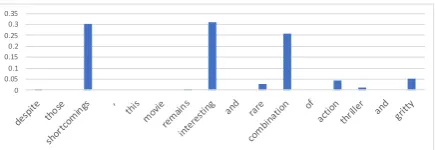
Figure 1: The bias weights generated by a rationale-biased model trained on 20 instances, to a snippet from an example movie review.
stronger magnification of the impact of the ratio-nale biases;α= 0means that the rationale bias is completely ignored. With this rationale-bias func-tion, we can now compute rationale-biased rep-resentations for text instances using Eq. (1), and these representations can be used as inputs to any classifier.
In early experiments, we noticed that many non-discriminating, common words in the target do-main (e.g., movie, certainly, guy) tended to get high rationale biases. This is presumably due to the fact that rationales in these datasets often have spans that include multiple rationale words along with other words. To compensate, we adjusted the class rationale prototype representation to:
adjusted(Ri) =prot(Ri)−prot(Tall) (4)
whereTallis the collection of all training instances
across all classes. That is, we subtract the entire training-set prototype vector from each class ra-tionale prototype. We L2-normalize this represen-tation as well.
Figure 1 is an example illustrating actual bias weights generated by our model. As can be seen in this case, the most positive and negative indica-tive words are ‘picked up’ as indicated by the high respective bias. However, it should also be noted that this model misses the sentiment polarity in-version expressed by the word despite, due to its simple sequence-agnostic nature.
3.2 Classifiers
that function to embed all of the dataset text in-stances and use these text embeddings as inputs to the classifiers. More specifically, for our nearest-prototype classifier, given a training set of text in-stance collections T1, .., Tk labeled with classes
c1, .., ck, we represent each class ci by the class
prototype T~i = prot(Ti). To classify a new text
instancet0we simply choose the closest class pro-totype using cosine similarity:
class(t0) = arg max
i∈{1..k}
cosine(~t0, ~T
i) (5)
Our hypothesis is that this proposed method would do comparatively well with very little train-ing data because (a) with the guidance of the ratio-nale bias it could pick up individual discriminative words more quickly (e.g., good orbadfor senti-ment tasks); (b) combining the use of pre-trained word embeddings as the underlying word repre-sentation with rationale bias would help generalize to words unseen in the training data (e.g. tobest fromgood) and would facilitate an effective ratio-nale bias similarity functionsimrb(v); and (c) the
training regimen is simple with a relatively small number of parameters to be learned compared to some more complex neural models such as the one discussed in the following section.
4 Rationale-biased BERT
BERT (Devlin et al.,2018) is a context-aware neu-ral network model that has shown excellent re-sults when used as a basis for various supervised NLP systems. Its power comes from transfer-ring context-aware language modeling informa-tion learned from unsupervised training over very large amounts of plain text. In this section, we show how we adapt BERT to handle long texts and then to incorporate rationale supervision together with standard instance labels.
4.1 Fine-tuning BERT
Presented with a sequence of word tokens2 s =
(a1, ..an)as input, a BERT model outputs
contex-tualized vector encodings for each tokenB(s) = (h0, h1, .., hn),3 where h0 is a special encoding for the entire sequence. Pre-trained versions of this model were trained by Devlin et al. (2018) against language modeling and sentence predic-tion objectives on large corpora of text allowing
2
BERT breaks words into subword units called word pieces(Wu et al.,2016).
3We refer here to the top-most output layer of BERT.
them to capture valuable contextualized informa-tion in these encodings. Devlin et al.(2018) ap-plied dropout followed by a simple linear layer,
Ltok(drop(B(s)i))wherei >0to perform
token-level classification and Ltext(drop(B(s)0)) for sentence-level classification. They fine-tuned the entire model on task-specific labels using a stan-dard cross-entropy loss function. With this ap-proach, they achieved state-of-the-art results on various NLP tasks, such as Named Entity Recog-nition (token-level) and single-sentence sentiment classification (sentence-level).
4.2 Averaged BERT classifier for long texts
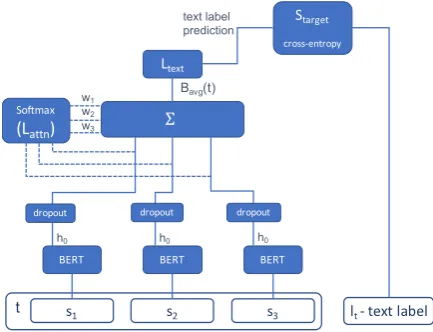
While BERT proved to be very effective for clas-sifying short texts such as individual sentences, its computational complexity is quadratic with the length of the input text yielding long run times for texts longer than a few sentences. Since our input texts may be long, we split them into sentences, apply BERT to each of the sentences separately and average the outputs as follows.
Given a text instance comprising the set of sentences t = (s1, ..., sm), we encode it as the
weighted average of the individual sentences:
Bavg(t) =~t=
X
i∈1..m
wi·drop(B(si)0) (6)
wherewiare the weights used in the weighted
av-erage. We experiment with uniform weights and also with learning weights as learned attention, us-ing a linear layerLattn:
wi=sof tmax(Lattn(drop(B(si)0))) (7)
Finally, similar to the original BERT approach, to fine tune a classifier for long text instances, we apply a linear layer to the text encoding
Ltext(Bavg(t))and train the whole model to
pre-dict the target labels with the loss function:
Starget(t, lt) =CE(Ltext(Bavg(t)), lt) (8)
whereltis the training label for text instancetand CE is the cross-entropy loss function. Figure 2
illustrates our architecture.
4.3 Rationale-biased BERT classifiers
s1 s2 s3
t
BERT
Σ
BERT BERT
h0 h0 h0
Starget
cross-entropy
Ltext Bavg(t)
text label prediction
lt- text label
dropout dropout dropout
Softmax (Lattn)
w1
w2
[image:5.595.309.525.60.223.2]w3
Figure 2: Averaged BERT model architecture. The three BERT boxes refer to the same single instance of the model. Lattnis the optional sentence attention learning component from Eq. (7).
BERT
Ltok
h1 h2 h3 h4
dropout
Saux
cross-entropy
tokens rationale label predictions
lr– tokens rationale
labels
tok1
si tok2 tok3 tok4
Σ
[image:5.595.71.288.70.236.2]wi
Figure 3: Rationale-bias auxiliary model component. The BERT model here is the same one used for the main target task. wi is the average probability that a token in the sentence is part of a rationale, which can be used as sentence attention in the averaged BERT.
with the main text label prediction task. The sec-ond extends the first by using rationale supervision to estimate the attention to each sentence. It then uses that attention (or importance measure) to in-form the weighted average from Eq. (6).
Simple joint learning. Figure3 illustrates the
auxiliary model added to the averaged BERT. The same BERT model is trained to perform two clas-sification tasks: (1) predicting the label of each text instance (target text classification task); and (2) predicting for every input token in every input sentence whether it is part of an annotated ratio-nale subsequence (auxiliary task). This is achieved by introducing the auxiliary loss function:
Saux(t, lr) = (9)
1 n
X
i,j
CE(Ltok(drop(B(si)j)), li,jr )
whereli,jr is the rationale label of tokenjin
sen-tencei,Ltok is a linear layer for learning to
clas-sify tokens andnis the total number of tokens in text t. Finally, the multi-task objective function per input texttis:
Sjoint(t, lt, lr) =Starget(t, lt) +Saux(t, lr) (10)
Our hypothesis is that the auxiliary task will infuse lower-level information regarding the rele-vance of input words into the BERT model, which will help boost the main task classifier.4
4In early experiments, we also tried infusing this
infor-mation to lower layers of the BERT model (i.e., to an inter-nal layer rather than the output layer) followingSøgaard and Goldberg(2016), but that did not improve the performance.
Rationale-biased Attention. The dotted lines
in Figure 3 illustrate our proposed approach to extend simple joint-learning by using the ratio-nale signal to learn how to identify the more im-portant sentences in the input text. To train this model, we use the same multi-task loss function in Eq. (10). However, this time, instead of using uniform weights in the averaged BERT, we con-sider the attention weight of a sentence to be the average of the probabilities that each of its tokens is in a rationale span. These weights are used to compute the final weighted average representation of the text input in Eq. (6). In our experiments, we found that it was better not to backpropagate the error from Starget towards the token-level
ratio-nale classifier (i.e. along the dotted lines). There-fore, the rationale classifier is still trained only based onSaux.
The hypothesis here is that this model could be successful by infusing more explicitly the induc-tive bias that sentences with rationale words are more important than others for the final classifica-tion task. Incorporating more inductive bias is par-ticularly important with little training data. Com-pared to the bag-of-words approach presented in the previous section, however, we presume that both BERT-based methods presented here might be more challenged with extremely little train-ing data because of the more complex underlytrain-ing models and training regimen.
0 0.1 0.2 0.3 0.4 0.5 0.6 0.7 0.8 0.9 1
none theles
s , " snatc
h " is terrifi
c
soph omore effort
, a dar
##n goodactio n
come dy Sentence attention = 0.1299
0 0.0005 0.001 0.0015 0.002
mean
while , acouple ofyoungtough … are
[image:6.595.72.291.60.217.2]trying tobreak in to theboxing gam e Sentence attention = 0.0001
Figure 4: Excerpts from the sentence that got the high-est attention (top) and lowhigh-est attention (bottom) in an IMDB movie review, by our rationale-biased attention BERT model. Bars indicate the probability the model assigns for every word of being part of a rationale.
Being context-aware, this model captures relevant sequences of words rather than just spotting key words. In addition to being useful for the classifi-cation task, these sentence and token weights also seem useful for model interpretability.
5 Experimental Settings
We conducted experiments with two English text classification datasets. Zaidan et al.(2007) added rationales supporting the positive/negative class labels on 1800 movie reviews from the Inter-net Movie Database (IMDB) dataset (Pang et al.
(2002)). We used 900 reviews for training, 450 for development and 450 for testing, and maintained the original even positive/negative balance in ev-ery split.
The Aviation Safety Reporting System (ASRS) dataset contains reports of aviation safety inci-dents. We used the version from Abedin et al.
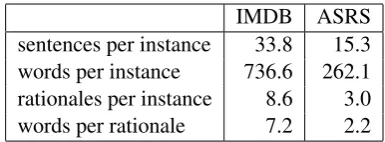
(2011), which has 1233 reports in the training set, 100 for development and 1000 for testing. Reports are labeled with one or more of 14 safety incident cause categories. To create a binary classification dataset comparable to the IMDB dataset, we ex-tracted a balanced subset of reports that were la-beled with the ‘Proficiency’ label or the ‘Physical Environment’ label (but not both). We chose these particular two labels because they have a similar number of instances and are among the top most frequent labels in the dataset. This resulted in 386 reports for training and 392 reports for testing. Ta-ble1provides some additional statistics regarding these two datasets.
IMDB ASRS
sentences per instance 33.8 15.3 words per instance 736.6 262.1 rationales per instance 8.6 3.0 words per rationale 7.2 2.2
Table 1: Dataset statistics
5.1 Experimental protocol
To test the hypothesis that our proposed rationale-biased methods can improve classification with lit-tle training data, we ran experiments varying the amount of training data used from 2 instances up to roughly 400. For each training sizen, we sam-pled n training instances to train the models and tested on the entire dev/test set. We repeated this experiment 30 times (for eachn) and report aver-age accuracies. We fixed all parameters based on tuning on only the IMDB development set prior to running on the IMDB and ASRS test data (no tuning was done on ASRS data).
5.2 Compared methods
RA-SVM is the Rationale-Augmented SVM by
Sharma and Bilgic (2018) that biases the text representation to rationales by discounting non-rationale word features by a fixed discount ratio during training. All words are TF-IDF weighted prior to discounting. We experimented with differ-ent discounts on the IMDB developmdiffer-ent set and found that 0.1 gave the best results. And while
Sharma and Bilgic(2018) use a one-hot word rep-resentation, we also experimented with giving it dense word embeddings, but this yielded degraded performance. We also report results with no ratio-nale discount - a plainSVMbaseline.
RA-CNNis the Rationale-Augmented CNN by
Zhang et al. (2016), described in section 2. We used the authors’ implementation with pre-trained word2vec Google News word embeddings with 300 dimensions for 3 million words.5 We tuned batch size, dropout, learning rate and number of epochs on our development set. We also report re-sults with no rationale weighting - a plain CNN baseline.
RB-BOW-SVM and RB-BOW-PROTO are the SVM and nearest-prototype classifiers running on top of our proposed rationale-biased bag-of-words (BOW) text representation (Section3). We tuned
5https://code.google.com/archive/p/
[image:6.595.319.512.61.132.2]the hyperparameter α on the dev set, obtaining the best results with α = 6 for both classifiers. BOW-PROTOis the prototype classifier based on a BOW with no rationale bias (α = 0). We tried both one-hot word representations and word em-beddings using the same word2vec emem-beddings as for CNN and RA-CNN.
AVG-BERT andATTN-WAVG-BERT are our proposed BERT-based models trained without ra-tionales using a uniform-weight average and an attention-based weighted average of sentences, respectively (Section 4.2). RB-AVG-BERT is the joint model that uses rationale prediction as an auxiliary task, and RB-WAVG-BERT is the method that also uses rationales to estimate sentence-level attention (Section 4.3). For all of the above, we used the pre-trained models ‘bert-base-uncased’ and ‘bert-base-cased’ for the IMDB and ASRS datasets, respectively. We used de-fault hyperparameters, except for using learning rate of 5e-6 and 10 epochs for fine-tuning, which we found to work better for AVG-BERT with light tuning. To fit the computation graphs into the GPU memory (NVIDIA Tesla V100) we trimmed sen-tences longer than 48 word pieces, and texts con-taining more than 64 sentences. We implemented our models using a PyTorch implementation of BERT.6
ULMFiT (Howard and Ruder, 2018) is a re-cent method achieving state-of-the-art text classi-fication results on several datasets. It is trained in three steps: (1) training a general-domain recur-rent neural network language model on a large cor-pus (WikiText-103); (2) fine-tuning the language model to the domain data of the target task disre-garding class labels; and (3) fine-tuning a classifier for the task using the encoder of the learned fine-tuned language model as a starting point. We used the fast.ai7 implementation of ULMFiT, tuning batch size, dropout multiplication factor, learning rates and number of epochs on our development set. ULMFiT does not currently have a rationale-augmented version.
6 Results
In this section, we start by investigating the perfor-mance of different variants of our proposed mod-els on the IMDB dev set. The most promising
con-6https://github.com/huggingface/
pytorch-pretrained-BERT
7https://www.fast.ai/
figurations are then evaluated on the IMDB and ASRS test sets. Since both of our datasets are bi-nary and balanced we note that the random base-line accuracy is 50%.
6.1 Development set investigation
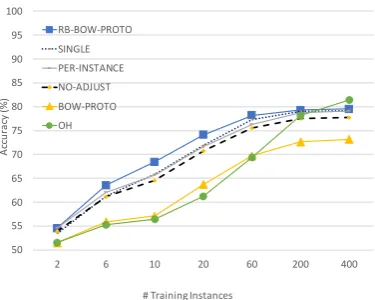
To demonstrate the contribution of various com-ponents of our rationale-biased bag-of-words approach, we performed several ablation ex-periments on the development set, shown in Figure 5. The compared variants include: RB-BOW-PROTO: our full method with pre-trained word embeddings; BOW-PROTO: no rationale-bias; OH: RB-BOW-PROTO with one-hot word representations instead of word embed-dings; NO-ADJUST: RB-BOW-PROTO without discounting common words by subtracting the general prototype vector (Eq. (4));SINGLE: RB-BOW-PROTO with just a single rationale proto-type representing all rationales instead of one ra-tionale prototype for each class (Eq. (3)); and IN-STANCE: RB-BOW-PROTO with a rationale pro-totype for every individual text instance instead of one per class. As can be seen, combining the use of pre-training and rationales is critical to the success of our full method. First, the im-portance of using pre-trained word embeddings is evident by the significant drop in performance when using one-hot encodings with train-sets with 60 instances or fewer. Second, the importance of rationale-biasing can be seen by the large perfor-mance drop with BOW-PROTO across all train-set sizes. With those two components in place, we see that the RB-BOW-PROTO is able to per-form significantly above the 50% random baseline with very few training instances. We note that RB-BOW-SVM demonstrated similar performance to RB-BOW-PROTO. For brevity, we don’t include a detailed report here, but do include RB-BOW-SVM in the test results section.
50 55 60 65 70 75 80 85 90 95 100
2 6 10 20 60 200 400
Ac
cu
rac
y
(%
)
# Training Instances RB-BOW-PROTO
[image:8.595.88.276.61.211.2]SINGLE PER-INSTANCE NO-ADJUST BOW-PROTO OH
Figure 5: Ablation experiments on the IMDB dev set.
50 55 60 65 70 75 80 85 90 95 100
2 6 10 20 60 200 400
Ac
cu
rac
y
(%
)
# Training Instances AVG-BERT
ATTN-WAVG-BERT
RB-AVG-BERT
RB-WAVG-BERT
[image:8.595.319.513.62.213.2]Figure 6: BERT-based models on the IMDB dev set.
Figure 7: Bag-of-words text embedding without ratio-nale bias (left) and with (right). +/o markers are posi-tive/negative dev text instances. Large markers are pos-itive/negative class prototypes learned during training.
two dimensions for visualization. The rationale-biased representation appears to discriminate bet-ter between positive and negative instances. In particular, we notice an increase in the distance between the representations of class prototypes and a clearer clustering of the development set in-stances around their respective class prototypes. For this data subset, the nearest prototype classi-fier achieves accuracy of 78.1% when using the rationale-biased embedding compared to 69.7% with an unbiased representation.
Next, we investigate the performance of the BERT-based models on the IMDB dataset. Fig-ure 6 shows the results on the dev set. First we note that unlike the simpler bag-of-words meth-ods, all of these models require at least 20 train-ing instances before they meantrain-ingfully improve on the random 50% baseline. On the other hand, with 200 training instances or more, all of the BERT-based models significantly outperform the bag-of-words methods. More specifically, we see that RB-AVG-BERT and RB-WAVG-BERT, which use rationale supervision, significantly
out-perform AVG-BERT and ATTN-WAVG-BERT, which only use text label supervision, by up to 10 accuracy points. Between RB-AVG-BERT and RB-WAVG-BERT, the latter, which incorporates more inductive bias, performs more robustly.
6.2 Test set results
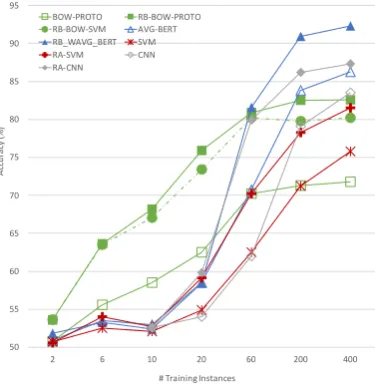
Figure8and Table2 show the IMDB test-set re-sults of our best rationale-biased methods and their non-rationale counterparts (chosen based on dev set performance), as well as all of the baselines.8 Our bag-of-words models, RB-BOW-PROTO and RB-BOW-SVM, which combine rationale-biasing with pre-trained word embeddings, outperform all other baselines by a large margin of up to more than 20 absolute accuracy points for training sets of size 20 or smaller. On these particularly small datasets, the other rationale-aware baselines, RA-SVM and RA-CNN, do not perform as well. For larger training sets of size 60 and more, all systems perform better, as expected. In particular, the more complex CNN and BERT-based models have sig-nificantly improved performance with more super-vision. Both RA-CNN and our RB-BERT, which combine pre-training with rationales, benefit sub-stantially from rationale supervision, with up to more than 30 absolute accuracy points improve-ment. In absolute terms, our BERT models out-perform their CNN counterparts and every other baseline in this training size range.
Finally, Figure9and Table3show results on the ASRS test set. The trends here are similar, show-ing the robust merit in our rationale-bias approach. The only striking difference is that in this dataset, the CNN methods outperform our BERT-based
8ULMFiT is not included in Figures 8and 9for better
[image:8.595.82.287.267.365.2]50 55 60 65 70 75 80 85 90 95
2 6 10 20 60 200 400
Ac
cu
rac
y
(%
)
[image:9.595.97.285.72.265.2]# Training Instances BOW-PROTO RB-BOW-PROTO RB-BOW-SVM AVG-BERT RB_WAVG_BERT SVM RA-SVM CNN RA-CNN
Figure 8: IMDB test set results
50 55 60 65 70 75 80 85 90 95
2 6 10 20 60 200 380
Ac
cu
rac
y
(%
)
[image:9.595.314.505.74.265.2]# Training Instances BOW-PROTO RB-BOW-PROTO RB-BOW-SVM AVG-BERT RB_WAVG_BERT SVM RA-SVM CNN RA-CNN
Figure 9: ASRS test set results
Number of Training Instances 2 6 10 20 60 200 400
RB-BOW-PROTO 53.6 63.6 68.2 75.9 80.9 82.5 82.6 RB-BOW-SVM 53.6 63.5 67.0 73.4 80.2 79.7 80.2 BOW-PROTO 50.8 55.6 58.5 62.5 70.2 71.3 71.8 RB-WAVG-BERT 51.8 53.2 52.3 58.4 81.6 90.9 92.2 AVG-BERT 50.9 53.5 52.9 58.5 70.7 83.8 86.2 RA-SVM 50.6 54 52.7 59.1 70.2 78.3 81.5 SVM 50.7 52.5 52.1 54.9 62.5 71.2 75.8 RA-CNN * * 52.6 59.8 79.9 86.2 87.3 CNN * * 52.6 54 62 79.1 83.5 ULMFiT * * * 54.7 62 71.3 78.8
Table 2: IMDB test set results.
Number of Training Instances 2 6 10 20 60 200 380
RB-BOW-PROTO 54.9 63.7 69.4 73.6 75.4 75.8 75.5 RB-BOW-SVM 54.9 61.9 68.4 73.5 76.1 76.7 76.5 BOW-PROTO 51.2 54.4 55.2 61.1 63.6 68.7 69.2 RB-WAVG-BERT 50.3 51.6 53.4 58.8 69.5 78.3 81.0 AVG-BERT 51.1 51.9 53.2 60.2 65.6 72.2 72.8 RA-SVM 52.2 52.4 55.6 58.1 62.7 62.2 63.2 SVM 51.2 51.3 52.8 55.3 62.1 69 70.9 RA-CNN * * 54.6 53 74.9 82.8 83.8 CNN * * 53.7 53 69.9 79.8 81.1 ULMFiT * * * 53.7 59.9 65.9 69.3
Table 3: ASRS test set results.
methods both in their rationale and non-rationale versions. We note that the RA-CNN baseline takes a similar approach to ours in the sense that it also combines pre-training (pre-trained word em-beddings) with rationales. The reasons for one method being better than the other on a particular dataset could be related to the compatibility be-tween the pre-training corpus and the test dataset or sensitivity to hyperparameter tuning (we did not do any tuning on the ASRS dev set).
7 Conclusions
In this work, we addressed an important chal-lenge in supervised machine learning, namely the dependency on large amounts of labeled training data. We demonstrated that substantial perfor-mance gains in low-shot text classification can be obtained by combining unsupervised pre-training with annotator rationales across various methods. To this end, we presented two novel methods that together provide strong results on a range of train set sizes. We performed experiments using
var-ious baselines, data sizes and ablations to help understand what works best for varying amounts of available training data. Most notably, we showed that simple bag-of-words methods with pre-trained word embeddings work best for very small train sets, while more complex methods based on pre-trained language models excel when more data is available.
References
Muhammad Arshad Ul Abedin, Vincent Ng, and Lati-fur Khan. 2011. Learning cause identifiers from an-notator rationales. InIJCAI, pages 1758–1763.
Jacob Devlin, Ming-Wei Chang, Kenton Lee, and Kristina Toutanova. 2018. Bert: Pre-training of deep bidirectional transformers for language understand-ing. InNAACL-HLT.
Jeremy Howard and Sebastian Ruder. 2018. Universal language model fine-tuning for text classification. In
ACL.
Tomas Mikolov. 2017. Bag of tricks for efficient text classification. InEACL.
Alex Krizhevsky, Ilya Sutskever, and Geoffrey E Hin-ton. 2012. Imagenet classification with deep con-volutional neural networks. In Advances in neural information processing systems, pages 1097–1105.
Oren Melamud, Jacob Goldberger, and Ido Dagan. 2016. context2vec: Learning generic context em-bedding with bidirectional lstm. InCoNLL.
Tomas Mikolov, Ilya Sutskever, Kai Chen, Greg S Cor-rado, and Jeff Dean. 2013. Distributed representa-tions of words and phrases and their compositional-ity. InAdvances in neural information processing systems, pages 3111–3119.
Bo Pang, Lillian Lee, and Shivakumar Vaithyanathan. 2002. Thumbs up?: sentiment classification using machine learning techniques. InEMNLP.
Matthew Peters, Mark Neumann, Mohit Iyyer, Matt Gardner, Christopher Clark, Kenton Lee, and Luke Zettlemoyer. 2018. Deep contextualized word rep-resentations. InNAACL.
Manali Sharma and Mustafa Bilgic. 2018. Learning with rationales for document classification. Ma-chine Learning, 107(5):797–824.
Jake Snell, Kevin Swersky, and Richard Zemel. 2017. Prototypical networks for few-shot learning. In Ad-vances in Neural Information Processing Systems.
Anders Søgaard and Yoav Goldberg. 2016. Deep multi-task learning with low level tasks supervised at lower layers. InACL.
Michael Tepper, Heather L Evans, Fei Xia, and Meliha Yetisgen-Yildiz. 2013. Modeling annotator ratio-nales with application to pneumonia classification. In Workshops at the Twenty-Seventh AAAI Confer-ence on Artificial IntelligConfer-ence.
Yonghui Wu, Mike Schuster, Zhifeng Chen, Quoc V Le, Mohammad Norouzi, Wolfgang Macherey, Maxim Krikun, Yuan Cao, Qin Gao, Klaus Macherey, et al. 2016. Google’s neural ma-chine translation system: Bridging the gap between human and machine translation. arXiv preprint arXiv:1609.08144.
Dani Yogatama, Chris Dyer, Wang Ling, and Phil Blun-som. 2017. Generative and discriminative text clas-sification with recurrent neural networks. arXiv preprint arXiv:1703.01898.
Mo Yu, Xiaoxiao Guo, Jinfeng Yi, Shiyu Chang, Saloni Potdar, Yu Cheng, Gerald Tesauro, Haoyu Wang, and Bowen Zhou. 2018. Diverse few-shot text clas-sification with multiple metrics. InNAACL.
Omar Zaidan, Jason Eisner, and Christine Piatko. 2007. Using annotator rationales to improve ma-chine learning for text categorization. InNAACL.