Using Content-level Structures for Summarizing Microblog Repost Trees
∗Jing Li1,2, Wei Gao3, Zhongyu Wei4, Baolin Peng1,2 and Kam-Fai Wong1,2
1The Chinese University of Hong Kong, Shatin, N.T., Hong Kong 2MoE Key Laboratory of High Confidence Software Technologies, China 3Qatar Computing Research Institute, Hamad Bin Khalifa University, Doha, Qatar
4The University of Texas at Dallas, Richardson, Texas, USA
{lijing,blpeng,kfwong}@se.cuhk.edu.hk1,2
[email protected], zywei@@hlt.utdallas.edu4
Abstract
A microblog repost tree provides strong clues on how an event described therein develops. To help social media users capture the main clues of events on mi-croblogging sites, we propose a novel re-post tree summarization framework by ef-fectively differentiating two kinds of mes-sages on repost trees called leaders and followers, which are derived from content-level structure information, i.e., contents of messages and the reposting relations. To this end, Conditional Random Fields (CRF) model is used to detect leaders across repost tree paths. We then present a variant of random-walk-based summariza-tion model to rank and select salient mes-sages based on the result of leader detec-tion. To reduce the error propagation cas-caded from leader detection, we improve the framework by enhancing the random walk with adjustment steps for sampling from leader probabilities given all the re-posting messages. For evaluation, we construct two annotated corpora, one for leader detection, and the other for repost tree summarization. Experimental results confirm the effectiveness of our method.
1 Introduction
Microblogging platforms have become the center for reporting, discussing, and disseminating
real-life issues, on which users usuallyrepost to share
microblog messages with their following users.
Also, users can repost with commentary for not
only further broadcasting but also extending the
∗This work is partially supported by General Research Fund of Hong Kong (417112), RGC Direct Grant (417613), and Huawei Noah’s Ark Lab, Hong Kong. We would like to thank anonymous reviewers for the useful comments.
original microblog post content. Because an in-dividual post is generally too short to cover the main clues of an event, microblogging users can-not easily capture the key information from ceived posts due to the lack of context. And re-posting messages, namely reposts, can provide valuable context information to the previous posts including their background, development, public opinions and so on. However, a popular post usu-ally attracts a large number of reposts. It is imprac-tical for users to read them all and fully understand their contents.
The task of microblog context summarization aims to produce succinct summaries to help users better understand the main clues by extracting salient information among massive reposts of the original posts. An intuitive approach is to directly apply existing extractive summarizers based on the unstructured, plain microblog contents. But such short and informal reposts render the lack of structures in each individual message, and it is difficult for conventional extractive summarizersto identify salient messages. Chang et al. (2013) pro-posed to summarize Twitter context trees by fo-cusing on modeling user influence. However, the reposts of influential users might not be salient summary candidates necessarily. For instance, celebrities might simply repost with nothing im-portant. Also, modeling user influence accurately needs tremendous historical user interaction data external to the tree being summarized while such kind of information cannot be utilized directly for summarizing the messages on the tree.
In this paper, we propose a novel mi-croblog context summarization framework based on content-level structures, i.e., message contents and reposting relations, rather than user-level in-fluence signals. The reposting relations connect the reposting messages and form a cohesive body
as a tree structure namedrepost tree. The root
rep-resents the original post and the edges denote
posting relations. Our idea is to exploit the struc-ture of repost tree together with content of
mes-sages to help distinguish two different messages
on repost tree, i.e., leaders and followers.
Specif-ically, leader is referred to as a message on
re-post tree covering salient new information, which can lead further comments or discussions in its
de-scendant reposts;followeris referred to as a
mes-sagethat contains no comment, simply repeats or
naively responds to its ancestor leader message, thus providing no important information. The ex-ample below illustrates a repost tree path, where
we use[O]and[Ri]to indicate the original post
and thei-th repost, respectively:
[O] @MAS: Malaysia Airlines has lost contact of MH17 from Amsterdam. The last known position was over Ukrainian airspace.
[R1] @Hanna: OMG... Poor on MH17... Preying...
[R2] @Victoria: OMG that’s horrible!!! I’m sorry to
hear that. God will bless u poor guys. Wish world can be peaceful. And no one will get hurt. [R3] @Dr.Dr: Six top HIV scientists are on MH17. They
go for AIDS and would NEVER come back!!! [R4] @TomyBlack: 6 experts died?! Terrible loss to HIV
research :(
[O]reports the news about MH17 missing, which
brings about further comments in [R1]and [R2].
[R3]does not continue commenting on that but
of-fers some new information and triggers shocking
reaction in [R4]. So [O]and[R3]act as leaders;
[R1],[R2]and[R4]are followers.
Intuitively, leaders would be more important than followers from the summarization’s perspec-tive since leaders are supposed to capture the main clues or aspects of event evolvement. The first step of our summarization system is to distinguish leaders and followers effectively. Leaders are de-tected across repost tree paths which provide rich context information owing to the tree structure. We utilize sequence tagging model Conditional Random Fields (CRF) to infer how likely it is each repost being a leader or follower. Then we incor-porate leader detection result into an unsupervised summarization model based on random walk. Our model uses content similarities between messages and consider their possibilities of being leaders to rank and select salient reposting messages that form summaries. Furthermore, we improve the framework by enhancing the random walk to re-duce the impact of errors cascaded from the leader detection module. Compared to the state-of-the-art baselines, the experimental results confirm the effectiveness of our proposed framework.
Our contributions are given as follows:
• We propose a novel microblog context
sum-marization framework, in which given reposting messages organized as a repost tree (obtaining repost tree is trivial using public microblogging toolkit (Ren et al., 2014)), we summarize the post trees based on content information and re-posting relations of messages.
• We identify a novel problem of leader
de-tection for summarization, which aims to reduce noise on repost trees, and present a CRF-based method for effectively detecting leaders by utiliz-ing the tree structure and message contents.
• We incorporate the leader detection result
into an unsupervised summarization model based on random walk and substantially enhance the model to reduce the impact of leader detection er-rors on summarization.
2 Related Work
The goal of text summarization is to automat-ically produce a succinct summary for one or more documents that preserves important infor-mation (Radev et al., 2002). Generally, text sum-marization techniques can be categorized into ex-tractive and absex-tractive methods (Das and Mar-tins, 2007). Extractive approaches focus on how to identify and distill salient contents from orig-inal texts whereas abstractive approaches aim at producing grammatical summaries by text genera-tion.
Recently, the development of social media has made microblog summarization a hot topic. Most prior works are on event-level or topic-level sum-marization. Typically, the first step is to clus-ter posts into sub-events (Chakrabarti and Punera, 2011; Duan et al., 2012; Shen et al., 2013) or sub-topics (Long et al., 2011; Rosa et al., 2011; Meng et al., 2012), and then the second step generates summary for each cluster.
Some works tried to apply conventional
extractive summarization models directly,
then considered social signals like user following relations and retweet count (Duan et al., 2012; Liu et al., 2012), and reported such features useful to help summarize microblog posts. Our work studies repost tree summarization by leverag-ing content-level structure to enrich context of messages, which is a different kind of signal.
Chang et al. (2013) proposed a task to summa-rize Twitter context trees consisting of an original tweet and all its reposts (i.e., replies and retweets). They combined user influence signals into a super-vised summarization framework. Our work is dif-ferent from theirs: 1) They simply treat a context tree as a tweets stream while we consider repost tree structures in summarization; 2) They rely on
user interactions to calculateuser influencefor
ex-tracting salient messages while we focus on how to utilize contents and repost tree structures to
dif-ferentiateleader and follower messagesfor
sum-marization; 3) Our summarization module is unsu-pervised, thus no need of ground-truth summaries.
3 Leader Detection Model
This section deals with how to differentiate leader and follower messages on a repost tree. Intu-itively, identifying leaders effectively makes one step closer to obtaining a good summary.
Figure 1 illustrates an example of a repost tree1.
As shown in the figure, a leader message contains contents that brings essential information increase,
such as a new clue about MH17 reported in[R6],
and potentially triggers a new round of informa-tion propagainforma-tion by attracting follower messages
to focus on the raised clue, like [R7], [R8] and
[R9]. As the repost tree grows, it also happens
that some new reposts join in, following the clue raised by one of their ancestors, but further ex-tend it by mentioning something new, thus some of these messages may evolve into new leaders, such as[R10].
A simple way to detect leaders on repost tree is to directly apply a binary classifier like SVM on each individual message. However, these mod-els assume reposts are independent without effec-tively leveraging abundant context along the re-post tree paths, such as the rere-posting relations among different reposts on a path. For instance,
[R2]covering rich content may be misclassified as
a leader if not leveraging context information. But
1The example in Section 1 actually denotes the left-most
path extracted from this tree
[O] MAS: Malaysia Airlines has lost contact of MH17 from Amsterdam. The last known position was over Ukrainian airspace. More details to follow.
[R1] Hanna: OMG…Poor on #MH17…Preying…
[R2]Victoria: OMG that’s horrible!!! I'm
sorry to hear that. God will all bless u poor guys. Wish world can be peaceful.
And no one will get hurt.
[R3] Dr.Dr: Six top HIV scientists are on MH17. They go for AIDS and
would NEVER come back!!!
[R4] TomyBlack: 6 experts died?! Terrible loss to HIV research :(
[R5] JustinBieber:
now i can’t listen to
#prey without crying
[R6] NajibRazak: I am shocked by reports that an MH plane crashed. We are launching an
immediate investigation.
[R7]MrsBig: RT
[R8] MrBig: That can’t be true. CRASHED…I
really feel pity for u
poor guys…
[R9] WindWolf:
eh…MH17 lost and now
a MH plane is found crashed. I feel terrible.
[R10] X-man: #MH17 must have crashed.
[image:3.595.311.523.63.204.2]MH370 has not been found, and now MH17’ s lost, here’s something suspicious.
Figure 1: An example of repost tree. [O]: the
original post; [Ri]: the i-th repost; Solid arrow
lines: reposting relationship; Dotted lines: hidden leader-follower relationship; Dark boxes: leaders to be detected.
if we look into its context, we can find that [R2]
talks about similar things as[R1], then[R1]
clas-sified as a follower indicates the higher chance of
[R2]being a follower rather than a leader.
There-fore, context information is important for indicat-ing the messages beindicat-ing leaders or followers.
We extract all root-to-leaf paths within a repost tree structure and detect leaders across each path. We formulate leader detection on repost tree paths as a sequence tagging problem by utilizing a state-of-the-art sequence learning model CRF (Lafferty et al., 2001), and taking advantage of its power in maximizing the likelihood of global label se-quences. We adopt CRF rather than other
compet-itive context senscompet-itive model like SVMhmm
(Al-tun et al., 2003) due to its probabilistic nature. The probability of prediction by CRF can pro-vide critical chances for the following summariza-tion procedure to reduce the impact of errors made by leader detection model on summarization (see Section 4.2).
We map a repost tree path with n microblogs
(m1, m2,· · ·, mn) to a training instance(X, Y).
Let X = (x1, x2,· · ·, xn) represents observed
sequence, where xi denotes the observed feature
vector extracted from thei-th microblogmi, and
Y = (y1, y2,· · · , yn)whereyiis the label
indicat-ing whethermiis a leader or not. CRF defines the
discriminative function as a joint distribution over
Y givenXas follows:
P(Y|X;θ)∝exp
X
i,j
λjfj(yi, yi−1, X) +X
i,k
µkgk(yi, X)
Feature category Feature name Feature description
Lexical # of termsPOS The number of terms inThe part-of-speech of each term inmi mi
Type of sentence Whethermicontains a question mark or an exclamation
Microblog-specific
# of emoticons The number of emoticons inmi
# of hashtags The number of hashtags inmi
# of urls The number of URLs inmi
# of mentions The number of mentions, or @UserName, inmi
Path-specific Similarity to neighbors Cosine similarity betweenmiandmi+dwhered∈ {±1,±2,±3}
Similarity to root Cosine similarity to the root microblog in repost tree path
Table 1: Features used for leader detection
θ = (λ1, λ2, ...;µ1, µ2, ...)are the parameters in-dicating the weights of features that can be esti-mated by maximum likelihood procedure in train-ing process. The prediction is done based on dy-namic programming. More details can be found in (Lafferty et al., 2001). Table 1 lists the features we use for leader detection.
CRF can utilize both historical and future infor-mation for prediction so as to maximize the likeli-hood of the global label sequences. But we would encounter the problem of label conflict, i.e., the predictions for the same repost in context of dif-ferent paths might be difdif-ferent. For this reason, we determine a repost as a leader if its average marginal probabilities being a leader in context of different paths exceeds 50%.
4 LeadSum Summarization Model
Let T = (V, E) represent a repost tree to be
summarized, where V is a set of nodes
cor-responding to microblog messages, and E =
{(u, v)|vis the repost ofu}is the edge set
denot-ing repostdenot-ing relations. This section describes
how to rank nodes in V to produce repost tree
summaries. Enlightened by the general random-walk-based ranking algorithm DivRank (Mei et al., 2010), we propose an unsupervised summa-rization model called LeadSum that aims to select true and salient leaders into summaries utilizing a variant of random walk based on content similari-ties and reposting relations of messages. We first present a basic LeadSum model, which assumes leader detection is perfect. Then, we enhance it to become a soft LeadSum model that reduces the impact of leader detection errors on the summa-rization.
4.1 Basic-LeadSum Model
Due to the nature of leaders, they generally cover more important contents than follows do. Thus
our first summarizer selects contents only from de-tected leaders. For the leaders dede-tected in a
re-post tree T, we build a similarity graph among
leaders denoted asGL = (VL, EL), whereVL =
{v ∈ V|vis a detected leader} is the vertex set
andEL={(u, v)|u∈VL, v ∈VL, andu6=v}is
the edge set. The weight for any edge(u, v)
rep-resents the content similarity betweenuandv, for
which we use cosine similarity.
DivRank (Mei et al., 2010) is a generic graph ranking model that aims to balance high informa-tion coverage and low redundancy in top ranking vertices, which are also two key requirements for choosing salient summarization sentences (Li et al., 2009; Liu et al., 2015). Based on that, we present a model to rank and select salient
mes-sages from leader setVLto form a summary. Since
this model simply assumes perfect leader detec-tion, it is therefore named Basic-LeadSum.
Similar as DivRank (Mei et al., 2010), the
tran-sition probability at the t-th iteration of random
walk is given as follows:
pt(u→v) = (1−µ)·p0(v)+µ·p0(u→Z(u)v)Nt−1(v) (1)
andZ(u)is the normalizing factor:
Z(u) = X
w∈VL
p0(u→w)Nt−1(w) (2)
wherep0(u → v) is the organic transition
prob-ability which represents the content similarity
be-tweenuandv;Nt−1(v)denotes the times vertex
vis visited up to the(t−1)-th iteration;p0(v) =
1
|VL| denotes random jumping probability similar
to that in PageRank; andµis the damping weight
set as 0.85 following most PageRank-based
mod-els. The probability of traveling to leader v can
For anyv∈VL, the update function for its
rank-ing score at thet-th iterationRt(v) is formulated
as:
Rt(v) = X u∈VL
pt(u→v)Rt−1(u) (3)
It has been proved that the Markov chain is er-godic, thus can converge to a stationary distribu-tion (Mei et al., 2010), which determines the final rankings for leaders.
4.2 Soft-LeadSum Model
As a two-step summarization system, the perfor-mance of LeadSum relies on the leader detection, which might be error-prone. Followers misiden-tified as leaders participating in leader ranking brings risks to extract real followers into summary. Also, leaders misclassified as followers may leave out strong summary candidates. To reduce such error propagation, we enhance Basic-LeadSum by using an even-length random walk with adjust-ment steps that sample from leader probabilities given all the reposting messages, which is referred to as Soft-LeadSum.
Different from Basic-LeadSum, every message
on repost treeT, no matter detected as a leader or
a follower, participates in ranking process of Soft-LeadSum. In other words, in the random walk,
visitor wanders on a complete graphG= (V, E0)
whose vertex set V is identical to repost tree T,
andE0 ={(u, v)|u ∈V, v ∈V, andu 6=v}
rep-resents the edge set. Therefore, this makes it pos-sible to include true leaders misclassified as fol-lowers by leader detection module into summary.
However, allowing all messages to participate in ranking also increases the risk of selecting real followers. To avoid this problem, Soft-LeadSum
is composed of two types of walks onG, namely
WALK-1 and WALK-2. In WALK-1, visitor moves based on content similarities between mes-sages, which follows transition probabilities simi-lar to equation (1), but is specifically given as:
pt(u→v) = (1−µ)·|V1|+µ·p0(u→Z(u)v)Nt−1(v) (4)
whereu, v∈V,p0(u→v)is proportional to
con-tent similarity betweenu andv similar to
Basic-LeadSum, andZ(u)is the normalizing factor.
WALK-2 attempts to avoid selecting true fol-lowers by adopting a sampling process, whose
re-sult determines the next vertex onGto be visited.
Suppose the current vertex being visited isu, then
we sample from pL(u), i.e., the probability of u
being a leader. Practically,pL(u)can be estimated
with the average ofu’s marginal probabilities as
a leader over all root-to-leaf paths passing u on
T output by the leader detection module. If uis
sampled to be a leader, we claim that leader
detec-tion is correct and the visitor stays; otherwise,uis
sampled as a follower, indicating that leader
detec-tion module misclassifiesu, so the visitor should
go tou’s leader. Here we assume that a follower
u’s leader is its nearest ancestor leader on T as
shown by the dotted lines in Figure 1. Based on such simplification, we let the visitor trace back
one by one along the path onT fromuto root and
sample from their leader probabilities until a node
vis sampled as a leader and then we determinev
asu’s leader.
So for any u’s ancestorv, the probability of v
beingu’s leader is:
P r{visu’s leader} =pL(v)(1−pL(u)− X
w∈P(v,u)
P r{wisu’s leader})
=pL(v) Y w∈P(v,u)S
{u}
(1−pL(w))
(5)
whereP(v, u)is the set of nodes betweenvandu
onv-to-upath of repost tree, i.e.,P(v, u) ={w∈
V|wisv’s descendant andu’s ancestor onT}. In
particular, we assume thatpL(r) = 1so as to stop
the sampling process when the visitor arrives at rootr.
Therefore, WALK-2’s transition probabilities can be calculated as follows:
q(u→v) = (p
L(v) ifv=u;
P r{visu’s leader} ifvisu’s ancestor;
0 otherwise (6)
Algorithm 1 shows the ranking process of
Soft-LeadSum, during which the visitor walks on G
following WALK-1 and WALK-2 alternately. The fact that WALK-1 is ergodic ensures the ergodicity and convergency of the algorithm. In
implemen-tation, we set max iterationN=1000 empirically
which is large enough to ensure convergence, or stop random walk process in advance when the condition of convergence is met, i.e., the change of Euclidean difference of ranking scores for three consecutive iterations are all less than 1e-6.
Algorithm 1Algorithm of Soft-LeadSum Input: T,G,µ=0.85, max iterationN, length cut-offn
Output: Summary withnmicroblog messages
1: For allv∈V, initializeR0(v) =p0(v) =|V1|
2: Initialize WALK-1’s transition probabilitiesp0(u→v)
with normalized cosine similarity betweenuandv. 3: Calculate WALK-2’s transition probabilitiesq(u→v)
by equation (5) and (6).
4: Initialize current walk=“WALK-1” 5: fort= 1toN and not converged do
6: for allv∈V do
7: ifcurrent walk==“WALK-1”then
8: Updatept(u→v)by equation (4)
9: UpdateRt(v)as follows:
Rt(v) =Pu∈VRt−1(u)·pt(u→v)
10: Set current walk=“WALK-2”
11: end if
12: ifcurrent walk==“WALK-2”then
13: UpdateRv(v)as follows:
Rt(v) =Pu∈VRt−1(u)·q(u→v)
14: Set current walk=“WALK-1”
15: end if
16: end for
17: end for
18: Sort allv∈V byRN(v)in descending order
19: Pick the top-nmessages as summary
WALK-2 sampling from leader probabilities, it also reduces the risk of including real followers into summary.
5 Experiments and Results
To evaluate the two modules in our repost tree summarization system, i.e., CRF-based model for leader detection and LeadSum model for summa-rization, we conducted two sets of experiments based on microblog posts data collected from Sina Weibo, which has a similar market penetration
as Twitter (Rapoza, 2011)2. Microblog messages
on Sina Weibo are in Chinese and we use Fu-danNLP (Qiu et al., 2013) for text preprocessing including word segmentation and POS tagging.
5.1 Experiment for Leader Detection
In this experiment, we evaluated the performance of CRF model for leader detection task.
5.1.1 Data Collection and Setup
We first crawled 1,300 different repost trees us-ing the public PKUVIS toolkit (Ren et al., 2014). Given an original microblog post, the toolkit can automatically crawl its complete repost tree. For each tree, we randomly selected one path and fur-ther formed a set with 1,300 repost tree paths,
2The datasets are available at http://www1.se.
cuhk.edu.hk/˜lijing/data/repost_tree_ summ.zip
Cross-validation Held-out Prec Rec F1 Prec Rec F1 Random 29.8 49.5 37.3 31.6 49.6 38.6
LR 70.5 66.3 68.4 70.4 66.2 68.2 SVM 70.9 66.9 68.8 68.9 66.2 67.5 SVMhmm 74.8 65.5 69.8 69.3 70.1 69.7
[image:6.595.308.526.62.134.2]CRF 75.5 72.0 73.7 71.1 70.7 70.9
Table 2: The performance of leader detection (%)
which ensures that paths have different roots and the dataset can cover a wide variety of context in-formation.
Then three annotators were invited to label each repost as a leader or a follower in the context of its repost tree path independently. The average Cohen’s Kappa of each two of the three annota-tors was 0.52, which is considered good agree-ment (Fleiss et al., 2013). Then, we used the labels agreed by at least two annotators as the ground truth. The training and test of the leader detection models were conducted on this corpus.
We compared the performance of CRF-based leader detection model with four baselines: Ran-dom Classifier (RC) as a weak baseline; two state-of-the-art point-wise supervised models Logis-tic Regression (LR) and Support Vector Machine (SVM); and an effective context sensitive model
SVMhmm. We applied LibLinear toolkit (Fan et
al., 2008) to implement LR and SVM with linear
kernel. SVMhmmwas implemented by SVMstruct
toolkit (Joachims et al., 2009). And CRF’s
im-plementation was based on CRF++3. For all the
baselines, we used features listed in Table 1. The hyper-parameters of all leader detection models were tuned to the same extent based on 5-fold cross validation (with 1 fold as development set). The evaluation metrics were precision, recall and F1 score for the detected leaders.
[image:6.595.78.289.108.344.2]5.1.2 Results
Table 2 shows the comparison result of 5-fold cross validation on 1,000 repost tree paths and held-out experiment on 300 complete fresh paths.
Among all baselines, SVMhmm performed the
best, which indicates the effectiveness of incor-porating structure information for leader detec-tion. And among context-sensitive models, both
SVMhmm and CRF were competitive. CRF
out-performed SVMhmmslightly with 5.6% and 1.7%
improved F1 score in cross validation and held-out
experiments, respectively. In spite of their compa-rable performance, our framework applies CRF
in-stead of SVMhmmfor leader detection because of
its probabilistic nature, which can be exploited by the sampling process in Soft-LeadSum to reduce the propagation of classification error to the sum-marization stage. Section 5.2.2 shows the relevant experiment.
5.2 Experiment for Summarization
In this experiment, we evaluated end-to-end per-formance of our basic and soft LeadSum summa-rization models by comparing them with state-of-the-art microblog summarizers.
5.2.1 Data Collection and Evaluation Metrics
There is no public editorial repost tree dataset. Therefore, we manually selected 10 hot events tak-ing place durtak-ing January 2nd – July 28th 2014, and then used the PKUVIS toolkit (Ren et al., 2014) to crawl the complete repost trees for all the events given the corresponding original posts. Table 3
shows the details about the repost tree corpus4.
Note that this repost tree corpus has no overlap with the repost tree path dataset for learning leader detection models in Section 5.1.1.
After that, we invited three experienced editors to write summaries for each repost tree. To en-sure the quality of reference summaries, we first extracted a list of frequent nouns from each repost tree and generalized 7 to 10 topics based on the nouns list, which provided a high-level overview of a repost tree to editors. Then, our guideline required editors to read all repost microblogs or-dered sequentially on a repost tree. For every mes-sage, its entire repost tree path was also provided as supplementary context information. When fin-ished reading, editors wrote down one or two sen-tences to summarize each topic in the list.
We utilized ROUGE-N metric (Lin, 2004) for benchmark, which is a standard for evaluating automatic summaries based on N-gram overlap-ping between a generated summary and a ref-erence. Specifically, ROUGE-1 and ROUGE-2 F1-measure were used as our evaluation metrics. Lin et al. (2004) has demonstrated that ROUGE-2 correlates well with humans in summarizing for-mal texts. And ROUGE-1 is a better alternative in evaluating summaries for short and informal
4All descriptions are English translations of the root
mi-croblogs originally in Chinese.
microblog messages (Inouye and Kalita, 2011; Chang et al., 2013).
In our human-generated summaries, the average inter-annotator-agreement by ROUGE-1 is 0.431, which means each pair of manual summaries have no more than 50% words overlap on average even written under topic constraints. This indicates that microblog repost tree summarization is generally a difficult task. The reason is that repost trees have complex structure, and editors could hardly reconstruct the repost trees even though they went through all the microblogs. Therefore, in eval-uation for each tree, we computed the average ROUGE F1 score between the model-generated summary and the three human-generated sum-maries.
5.2.2 Results
In each automatic summarizer, we selected the top-10 ranked reposts to form a summary. We compared the end-to-end performance with the following baseline systems:
• RandSum:RandSum is a weak baseline that randomly selects reposts into summaries.
• RepSum: RepSum ranks and selects mes-sages simply by their reposts count, i.e., the size of their subtrees, based on reposting relations.
• UserRankSum: UserRankSum ranks and selects reposts by their authors’ follower count based on user following relations.
• LeadProSum: LeadProSum ranks and se-lects reposting messages by their marginal prob-abilities as leaders determined by our CRF-based leader detection model.
• SVDSum: SVDSum adopts the Singular Value Decomposition (SVD) to discover hidden sub-topics for summarization (Gong and Liu, 2001). Reposting messages are ranked accord-ing to latent semantic analysis with SVD on term-message matrix.
• DivRankSum: DivRankSum directly ap-plies DivRank (Mei et al., 2010) algorithm to rank all messages unaware of leaders and followers. A similar model is also reported in Yan et al. (2011). Following their work, we set damping weight as 0.85.
fol-Name # of nodes # of nodes with comments Height Description
Tree (I) 21,353 15,409 16 HKU dropping out student wins the college entrance exam again. Tree (II) 9,616 6,073 11 German boy complains hard schoolwork in Chinese High School. Tree (III) 13,087 9,583 8 Movie Tiny Times 1.0 wins high grossing in criticism.
Tree (IV) 12,865 7,083 8 “I am A Singer” states that singer G.E.M asking for resinging conforms to rules. Tree (V) 10,666 7,129 8 Crystal Huang clarified the rumor of her derailment.
Tree (VI) 21,127 15,057 11 Germany routs Brazil 7:1 in World-Cup semi-final.
Tree (VII) 18,974 12,399 13 The pretty girl pregnant with a second baby graduated with her master degree. Tree (VIII) 2,021 925 18 Girls appealed for equality between men and women in college admission Tree (IX) 9,230 5,408 14 Violent terrorist attack in Kunming railway station.
[image:8.595.71.282.197.318.2]Tree (X) 10,052 4,257 25 MH17 crash killed many top HIV researchers.
Table 3: Description of repost tree summarization corpus consisting of 10 hot events
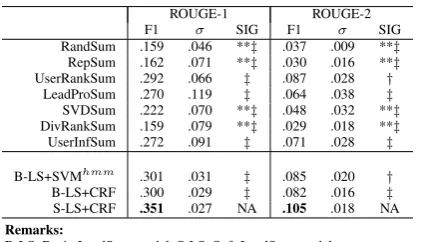
ROUGE-1 ROUGE-2 F1 σ SIG F1 σ SIG RandSum .159 .046 **‡ .037 .009 **‡
RepSum .162 .071 **‡ .030 .016 **‡
UserRankSum .292 .066 ‡ .087 .028 †
LeadProSum .270 .119 ‡ .064 .038 ‡
SVDSum .222 .070 **‡ .048 .032 **‡
DivRankSum .159 .079 **‡ .029 .018 **‡
UserInfSum .272 .091 ‡ .071 .028 ‡
B-LS+SVMhmm .301 .031 ‡ .085 .020 †
B-LS+CRF .300 .029 ‡ .082 .016 ‡
S-LS+CRF .351 .027 NA .105 .018 NA Remarks:
B-LS: Basic-LeadSum model; S-LS: Soft-LeadSum model F1: F1-measure of ROUGE-1 or ROUGE-2
σ: Standard deviation of F1-measure over 10 repost trees
SIG: Significance indicator of F1-measure based on one-tailed pairwise t-test: – Significantly different with B-LS+CRF: * (p <0.1); ** (p <0.05) – Significantly different with S-LS+CRF:†(p <0.1);‡(p <0.05)
Table 4: Comparison of different summarizers
lower count to approximate user influence. GBDT
implementation is based on RankLib5, and as a
supervised method, UserInfSum is evaluated with 10-fold cross validation.
In addition, we observed that SVMhmm is a
competitive baseline for leader detection (see Ta-ble 2). So we also study its impact on the
Basic-LeadSum model. Note that SVMhmm cannot be
combined with Soft-LeadSum since it is not prob-abilistic.
Table 4 shows the result of overall comparisons. We have the following observations:
• RepSum utilized trivial structure
informa-tion, i.e., the size of sub-tree, and its performance was poor, which was even worse than RandSum on ROUGE-2. This implies that messages with a lot of reposts may not be good candidates as other reasons may lead to their popularity, e.g., a good posting time or sense of humor.
• UserRankSum performed the best on
ROUGE-1&2 among all baseline summarizers, which confirms that user following relations can indeed be a strong signal in microblog summarization. UserRankSum is even slightly
5http://sourceforge.net/p/lemur/wiki/
RankLib/
better than Basic-LeadSum on ROUGE-2. But, it does not perform consistently well for all repost trees, evidenced as the large standard deviation on ROUGE-1&2. This suggests that the user following relations cannot always effectively indicate salient candidates. It may not work for repost trees where authors have similar number of following users, or reposts of influential users contain nothing salient.
• LeadProSum achieved the second best
per-formance among all unsupervised baselines, which indicates that the marginal probabilities as leaders can signal good summary candidates. This also confirms that leaders contain salient contents and should be distinguished from followers in summarization.
• Utilizing either SVMhmm or CRF as leader
detection model to filter out followers, Basic-LeadSum almost doubled the ROUGE-1 and tripled the ROUGE-2 scores compared to Di-vRankSum’s performance. This indicates that dif-ferentiating leaders and followers is very helpful to summarization.
• Basic-LeadSum performed better than all
baselines on ROUGE-1&2 except for a marginal drop compared to UserRankSum on ROUGE-2. But the differences with UserRankSum, LeadPro-Sum and UserInfLeadPro-Sum are not statistically signif-icant. This may be ascribed to the error propa-gated from leader detection module to summariza-tion process.
• Soft-LeadSum outperformed all the baselines
with a large margin on ROUGE-1&2, including supervised summarizer UserInfSum. The one-tailed pairwise t-test indicates that all the improve-ments over baselines are significant at the 95% confidence level except for UserRankSum with 90% confidence level on ROUGE-2. This con-firms the effectiveness of our framework for pro-ducing high-quality repost tree summaries.
0 0.1 0.2 0.3 0.4 0.5 0.6 0.7 0.8 0.9 1 0.29
0.3 0.31 0.32 0.33 0.34 0.35 0.36
α
ROUGE−1 F1−measure
[image:9.595.103.255.68.172.2]Basic−LeadSum Soft−LeadSum
Figure 2: The impact ofα on the ROUGE-1
F1-measure of combined models
perform quite well. The reason is that the model needs large amount of user interaction data exter-nal to the tree which are not readily available, and also it might be overfitting to the limited number of training instances.
• Basic-LeadSum with CRF and SVMhmm
had very close ROUGE-1&2 scores.
Basic-LeadSum+SVMhmm is even slightly better than
Basic-LeadSum+CRF. Though SVMhmm was
marginally worse in leader detection experiment
(Table 2), we can conclude that SVMhmm is
a comparable alternative as the leader detection module for Basic-LeadSum.
• Among our models, Soft-LeadSum
signif-icantly outperformed both Basic-LeadSum with
CRF and that with SVMhmm. This implies that
sampling steps in the enhanced random walk of Soft-LeadSum is effective in reducing the impact of leader detection error on summarization.
5.3 Discussion
From Table 4, we observed that user following re-lations used by UserRankSum is a strong signal for microblog summarization. A natural question is: “Can the user following relations commonly used for modeling user influence be complemen-tary to the content-level structure information used in our summariztaion models?”
We thus linearly combine the normalized rank-ing scores of LeadSum and UserRankSum usrank-ing
the formulaα∗u+(1−α)∗l, whereuandldenote
the UserRankSum and LeadSum ranking scores, respectively. Figure 2 demonstrates the impact of
αon our basic and soft LeadSum model with CRF.
Clearly, Basic-LeadSum can benefit from user influence information by incorporating User-RankSum scores into it. From the incremental trend of summarization performance with the
in-crease of α for α ∈ [0,0.9], we can conclude
that user influence is helpful to it. This is because Basic-LeadSum is not sufficiently robust to the er-rors cascaded from leader detection module, thus user-level structures can have the chance to com-pensate these errors for content-level structures.
Incorporating the same information into Soft-LeadSum cannot improve its performance
regard-less of the value ofα. This implies that
content-level structures, i.e., message content and repost-ing relations together, are better indicative of good summary candidates. When these features are ap-propriately modeled by Soft-LeadSum, user in-fluence, a traditionally well-known strong signal, cannot provide extra benefit at all.
6 Conclusion and Future Work
This work presents a study for microblog repost tree summarization, whose output can provide im-portant clues for event analysis on microblog-ging platforms. Conventional works considering only plain text streams is insufficient to summa-rize noisy repost trees. We propose a novel sum-marization system by effectively differentiating leader and follower messages on repost tree based on content-level structure information. Firstly, a leader detection model categorizes each repost on repost tree path as a leader or a follower. Then, a random-walk variant summarization model called LeadSum is proposed to rank and select salient microblog messages on the basis of leader de-tection result. To reduce errors cascaded from leader detection, we enhance LeadSum based on an even-length random walk by sampling from leader probabilities for improving summarization. Based on real-world microblog post dataset, the experimental results confirm that our proposed framework is effective for repost tree summariza-tion by the end-to-end comparison with the state-of-the-art baselines.
References
Yasemin Altun, Ioannis Tsochantaridis, and Thomas Hofmann. 2003. Hidden markov support vector
machines. In Proceedings of the Twentieth
Inter-national Conference on Machine Learning, ICML, pages 3–10.
Deepayan Chakrabarti and Kunal Punera. 2011. Event
summarization using tweets. InProceedings of the
Fifth International Conference on Weblogs and So-cial Media, pages 66–73.
Yi Chang, Xuanhui Wang, Qiaozhu Mei, and Yan Liu. 2013. Towards twitter context summarization
with user influence models. InSixth ACM
Interna-tional Conference on Web Search and Data Mining,
WSDM, pages 527–536.
Dipanjan Das and Andr´e FT Martins. 2007. A survey
on automatic text summarization. Literature Survey
for the Language and Statistics II course at CMU, 4:192–195.
Yajuan Duan, Zhimin Chen, Furu Wei, Ming Zhou, and Heung-Yeung Shum. 2012. Twitter topic summa-rization by ranking tweets using social influence and
content quality. In Proceedings of the 24th
Inter-national Conference on Computational Linguistics, COLING, pages 763–780.
G¨unes Erkan and Dragomir R. Radev. 2004. Lexrank: Graph-based lexical centrality as salience in text summarization. J. Artif. Intell. Res. (JAIR), 22:457– 479.
Rong-En Fan, Kai-Wei Chang, Cho-Jui Hsieh, Xiang-Rui Wang, and Chih-Jen Lin. 2008. LIBLINEAR: A library for large linear classification. Journal of Machine Learning Research, 9:1871–1874.
Joseph L Fleiss, Bruce Levin, and Myunghee Cho Paik. 2013. Statistical methods for rates and proportions. John Wiley & Sons.
Yihong Gong and Xin Liu. 2001. Generic text summa-rization using relevance measure and latent semantic analysis. InProceedings of the 24th Annual Interna-tional ACM Conference on Research and Develop-ment in Information Retrieval, SIGIR, pages 19–25. David Inouye and Jugal K. Kalita. 2011. Comparing twitter summarization algorithms for multiple post
summaries. In Privacy, Security, Risk and Trust
(PASSAT) and 2011 IEEE Third Inernational Con-ference on Social Computing (SocialCom), pages 298–306.
Thorsten Joachims, Thomas Finley, and Chun-Nam John Yu. 2009. Cutting-plane training of
structural svms.Machine Learning, 77(1):27–59.
John D. Lafferty, Andrew McCallum, and Fernando C. N. Pereira. 2001. Conditional random fields: Probabilistic models for segmenting and labeling se-quence data. InProceedings of the Eighteenth Inter-national Conference on Machine Learning, ICML, pages 282–289.
Liangda Li, Ke Zhou, Gui-Rong Xue, Hongyuan Zha, and Yong Yu. 2009. Enhancing diversity, cover-age and balance for summarization through structure
learning. In Proceedings of the 18th International
Conference on World Wide Web, WWW, pages 71– 80.
Chin-Yew Lin. 2004. Rouge: A package for
auto-matic evaluation of summaries. InProceedings of
the ACL-04 Workshop, pages 74–81.
Fei Liu, Yang Liu, and Fuliang Weng. 2011. Why is sxsw trending?: exploring multiple text sources for
twitter topic summarization. InProceedings of the
Workshop on Languages in Social Media, pages 66– 75. Association for Computational Linguistics. Xiaohua Liu, Yitong Li, Furu Wei, and Ming Zhou.
2012. Graph-based multi-tweet summarization us-ing social signals. InProceedings of the 24th Inter-national Conference on Computational Linguistics, pages 1699–1714.
He Liu, Hongliang Yu, and Zhi-Hong Deng. 2015. Multi-document summarization based on two-level
sparse representation model. InProceedings of the
Twenty-Ninth Conference on Artificial Intelligence,
AAAI, pages 196–202.
Rui Long, Haofen Wang, Yuqiang Chen, Ou Jin, and Yong Yu. 2011. Towards effective event detection, tracking and summarization on microblog data. In Web-Age Information Management - 12th Interna-tional Conference, WAIM, pages 652–663.
Qiaozhu Mei, Jian Guo, and Dragomir R. Radev. 2010. Divrank: the interplay of prestige and
di-versity in information networks. InProceedings of
the 16th ACM SIGKDD International Conference on Knowledge Discovery and Data Mining,KDD, pages 1009–1018.
Xinfan Meng, Furu Wei, Xiaohua Liu, Ming Zhou, Su-jian Li, and Houfeng Wang. 2012. Entity-centric topic-oriented opinion summarization in twitter. In Proceedings of the 18th ACM SIGKDD Interna-tional Conference on Knowledge Discovery and Data Mining, KDD, pages 379–387.
Thomas Mensink, Jakob J. Verbeek, and Gabriela Csurka. 2013. Tree-structured CRF models for in-teractive image labeling. IEEE Transactions on Pat-tern Analysis and Machine Intelligence, 35(2):476– 489.
Xipeng Qiu, Qi Zhang, and Xuanjing Huang. 2013. Fudannlp: A toolkit for chinese natural language
processing. In Proceedings of Annual Meeting of
the Association for Computational Linguistics, ACL, pages 49–54.
Dragomir R. Radev, Eduard H. Hovy, and Kathleen McKeown. 2002. Introduction to the special
is-sue on summarization. Computational Linguistics,
Dragomir R. Radev, Timothy Allison, Sasha Blair-Goldensohn, John Blitzer, Arda C¸elebi, Stanko Dimitrov, Elliott Dr´abek, Ali Hakim, Wai Lam, Danyu Liu, Jahna Otterbacher, Hong Qi, Horacio Saggion, Simone Teufel, Michael Topper, Adam Winkel, and Zhu Zhang. 2004. MEAD - A plat-form for multidocument multilingual text summa-rization. InProceedings of the Fourth International Conference on Language Resources and Evaluation, LREC.
Kenneth Rapoza. 2011. China’s weibos vs us’s twitter: And the winner is.
Donghao Ren, Xin Zhang, Zhenhuang Wang, Jing Li, and Xiaoru Yuan. 2014. Weiboevents: A crowd
sourcing weibo visual analytic system. In IEEE
Pacific Visualization Symposium, PacificVis, pages 330–334.
Kevin Dela Rosa, Rushin Shah, Bo Lin, Anatole Ger-shman, and Robert Frederking. 2011. Topical
clus-tering of tweets. Proceedings of the ACM SIGIR:
SWSM.
Beaux Sharifi, Mark-Anthony Hutton, and Jugal Kalita. 2010. Automatic summarization of twitter topics. InNational Workshop on Design and Analysis of Al-gorithm.
Chao Shen, Fei Liu, Fuliang Weng, and Tao Li. 2013. A participant-based approach for event summariza-tion using twitter streams. InProceedings of Human Language Technologies: Conference of the North American Chapter of the Association of Computa-tional Linguistics, HLT-NAACL, pages 1152–1162. Hiroya Takamura, Hikaru Yokono, and Manabu
Oku-mura. 2011. Summarizing a document stream. In Advances in Information Retrieval - 33rd European Conference on IR Research, ECIR, pages 177–188. Jie Tang, MingCai Hong, Juan-Zi Li, and Bangyong
Liang. 2006. Tree-structured conditional random
fields for semantic annotation. In The
Proceed-ings of 5th International Semantic Web Conference,
ISWC, pages 640–653.
Rui Yan, Liang Kong, Congrui Huang, Xiaojun Wan, Xiaoming Li, and Yan Zhang. 2011. Timeline gen-eration through evolutionary trans-temporal
summa-rization. In Proceedings of the Conference on
![Figure 1: An example of repost tree.[ O ] : theoriginal post; [ Ri] : the i-th repost; Solid arrowlines: reposting relationship; Dotted lines: hiddenleader-follower relationship; Dark boxes: leadersto be detected.](https://thumb-us.123doks.com/thumbv2/123dok_us/1363547.669219/3.595.311.523.63.204/theoriginal-arrowlines-reposting-relationship-hiddenleader-relationship-leadersto-detected.webp)