Real Time Study of a
n
−
out
−
of
−
n
System:
n
Identical Repairable Elements with Constant
Failure and Repair Rates
Mani Sharifi, Azizollah Memariani, Behnoush Kazemi Ahari
Abstract- Reliability models based on Markov chain (Except
in queuing systems) have extensive applications in electrical
and electronically devices. In this paper we consider a system
with n parallel and identical repairable elements with
constant failure and repair rates (failure and repair rates are
exponentially distributed. The failure rates increase when
some elements are failed. The system works until at least 1
elements work. The system of equations are established and
the exact equations are sought for the parameters like MTTF
and the probability that system working at the timet. A numerical example has been solved to demonstrate the
procedure which clarifies the theoretical development. It
seems that this model can tackle more realistic situations.
Keywords:
Markov chain, k−out−of−n models, Exponential distribution, Repairable elements.
Nomenclature
The notations used in this paper are as follows:
n: Number of elements,
i
λ : Failure rate of the elements in ist category,
μ: Repair rate of each elements in each category,
( )
tPi : Probability that the system is in state i at the time t,
Manuscript received December 12, 2008.
Mani Sharifi is a member of Industrial Engineering department, Islamic Azad University, Qazvin branch (corresponding author to provide phone: +98-912-2825776; fax: +98-281-3675787; e-mail: m.sharifi@ Qazviniau.ac.ir).
Azizollah Memariani is with the Industrial Engineering department, Bu Ali Sina University (e-mail: [email protected]).
Behnoush Kazemi Ahari is the IT Manager, British Council, Iran (e-mail: [email protected]).
( )
tR : Probability that system works at timet, MTTF : Mean time to failure of the system,
1. Introduction
n of out
k− − − models, are one of the most useful models
to calculate the reliability of electrical and electronically devices and systems. In the literature there are many studies in this area. We try to categorically classify them. At the first glance, they may be classified into two main groups namely k−out−of −n:Fand k−out−of −n:G
systems. If the failure of a system with n components is abandoned to the failure of at least k components
(
k≤n)
,then the system is calledk−out−of −n:F. On the other
hand, if the working of this system is abandoned to the working of at least k components
(
k≤n)
, then the systemis calledk−out−of −n:G. Both these systems can be
considered in steady state and real time situations. The elements in both situations may be repairable or non repairable. The failure rates of the elements may be constant, increasing or decreasing whereas the repair rate is constant. Each component can be expressed in binary or multiple states
Binary models: Boland and Papastavridis [2], study a situation where there are kdistinct components with
failure probabilities qi for i=1,2,...,k where the failure probability of the jth component
(
j=mk+i(
1≤i≤k)
)
isi
q . They obtained exact expressions for the failure
Gera [3], study the reliability of a consecutive
G n of out
k− − − : system is and the problem has been
solved via a matrix formulation using state space method. Lam and Tony N.G [5] introduce a general model for consecutive k−out−of −n:F repairable system with
exponential distribution and
(
k−1)
-step Markov dependence. Sarhan and Abouammoh [6], investigate the reliability of non repairable k−out−of −n system withnon identical elements subject to independent and common shock. Dutuit and Rauzy [7], study the performance of binary decision diagram for all k−out−of −n system
and proposed a new approximation scheme. Krishnamoorthy and Ushakumarti [8], obtain the system state distribution, system reliability and several other measures of performance for a k−out−of −n:G system
with repair under D-policy. Gupta [9], calculates reliability function and the failure rate of the k−out−of −n system,
with and without incorporating the environmental effect. Cui [10], presents a bound for nkfor which the system does not preserve IFR whenn>nk. Arulmozhi [11], propose an expression for reliability of k−out−of −n:G
system and developed an algorithm for computing reliability of k−out−of −nsystem. Yam and Zuo [12],
derive the state transition probabilities of the repairable circular consecutive k−out−of −n:F system with one
repairman. Milczek [13], presents a class of limit reliability functions of homogeneous series k−out−of−n systems.
Chen [14], develop a method for analyzing component reliability and system reliability of k−out−of −n
systems with independent and identically distributed components based on system lifetime data. [15], Koucky, deals with reliability of general k−out−of −n systems
whose component failures need not be independent and identically distributed and author gives the approximations for the system reliability. Arulmozhi [16], gives simple and efficient computational method for determining the system reliability of k−out−of −n systems having unequal and
equal reliabilities for components. Smith-Destombes [17], presents both an exact and an approximate approach to
analyze a k−out−of −n system with identical, repairable
components. Flynn and Chung [18], present a heuristic algorithm for determining replacement policies in a discrete-time, infinite horizon, dynamic programming model of a binary coherent system with n statistically independent components, and then specialized the algorithm to consecutive k−out−of −n systems. Hsieh
and Chen [19], present a simple formula for the reliability lower bound of the two-dimensional consecutive
F n of out
k− − − : system. Jalali and Hawkes [20], prove
two theorems for the optimal consecutive
G n of out
k− − − : line forn≤2k. Da Costa Bueno [21], define minimal standby redundancy and use the reverse rule of order 2
(
RR2)
property between compensatorprocesses to investigate the problem of where to allocate a spare in a k−out−of−n:F system of dependent components through minimal standby redundancy. Li and Zuo [23], derived formulas for various reliability indices of the k−out−of −n system with independent exponential components including mean time between failures and some other parameters. Guan and Wu [24], study a repairable consecutive k−out−of −n:Fsystem with fuzzy states.
Multi state models: Moustafa [1], using the markov method, develope a closed form availability solution for
two k−out−of−n systems with M failure modes. Huang and Zuo [4] investigate two types of multi-state
G n of out
k− − − : systems (i.e. increasing and decreasing systems). The authors developed an analytical model on the properties of the binary-state k−out−of −n system. Jenab and Dhillon [22] present a flow-graph-based approach to analyze a multi-state
/ / :G F n of out
k− − − load-sharing systems. The multi-state k−out−of −n:G/F/load-sharing systems comprise ‘n’ identical units, that are under state monitoring and recovery function.
repairman is unlimited. The system works until all elements fail (at least 1 element works). The paper is divided into four parts. The second part explores the models. Numerical examples are presented in the third part and the final section deals with the conclusion.
2.
ModelingAssume a system with n parallel and identical repairable elements. The system works until all elements fail. Therefore each element has two states and consequently
the system will have 2n states. Let
k A A
A1 2... be the state
where the elementsA1,A2, … Ak are working and other
(
n−k)
elements are failed. Also A1A2...Akηj is the state that the element ηjworks in addition to other kelements. The state O indicates that all the elements are failed.There is n i
C state that i,i=1,2,...,n,elements are working
and the probability of all states in category i are equal.
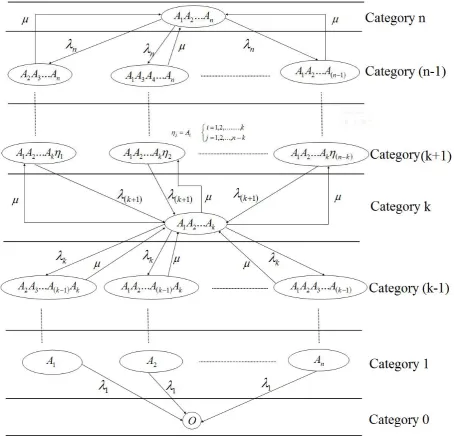
The state structure of the system is shown in figure 1. In this figure, the categoryi, i=0,1,2,...,n, indicates that
the states in this category are with i elements working and
(
n−i)
elements are failed. Each state is closely related tothe states in the antecedent and precedent category. i.e., if an element is failed in any state, then the state is transferred to the next category and if an element repairs in any state, then the state is transferred to the past category. In other words, if the system is in any states in categoryk,
with the failure of one element, the state will be in category
(
k−1)
and with the repair of one element, the state will be in category(
k+1)
.When some elements are failed, other elements work with more loads and therefore the failure rate is increased for the remaining elements. Then we have
( )1 ... λ1
λ
λn < n− < < . The system works if at least 1 elements work. Therefore we have:
( )
∑
( )
≤ < < < ≤ = = n n A A A i A A A i i t P t R ... 1 1 ... 2 1 21
( )
01We know that:
( )
0( )
1... 1 1 ... 2 1 2
1 + =
∑
≤ < < < ≤ = t P t P n n A A A i A A A ii
( )
02The first part of equation
( )
02 , is related to states with atleast 1 elements are working and the second part deals with the state with 0 element is working. In order to find R
( )
tfrom equation
( )
02 , we must calculate Pi( )
t for each states.From the state A1A2...Anthrough O in figure 1 we have:
(
)
( )
( )
( )
( )
( )
( )
t P t t P t t P t t P t t P t t P i k i j j k i j k k k k A A A A k i n k i A j A A A k n k i A j A A A A A A k i k A A A A A A ⎟⎟ ⎠ ⎞ ⎜⎜ ⎝ ⎛ = = ≠ = + = ≠ = =∑
∑
∑
∑
× Δ × + × Δ × + × Δ × − × Δ × − = Δ + ... 1 ,..., 2 , 1 1 ... 1 ,..., 2 , 1 1 ... ... 1 ... ... 2 1 2 1 2 1 2 1 2 1 2 1 μ λ μ λ η ηη
( )
03( )
t Pk
A A
A1 2... is the probability that the system be in the state
k A A
A1 2... at time t. Also
∑
( )( )
= ≠ = + × Δ × n k i A j A A A k i j j k t P t ,..., 2 , 1 1 ...
1 1 2
η
η
λ
is the transfer rate from states of category
(
k+1)
to this state and t P( )
tk A A A k i k ...
1 1 2
∑
=
× Δ ×
λ is the transfer rate from this state to the states of category
(
k−1)
,( )
t P t i k A A A A ki ⎟⎟⎠
⎞ ⎜⎜ ⎝ ⎛ =
∑
×Δ × ...1 1 2
μ is the transfer rate from states of
category
(
k−1)
to this state and∑
( )
= ≠ = × Δ × n k i A j A A A i j k t P t ,..., 2 , 1 1 ... 2 1 η μ
is the transfer rate from this state to the states of category
Figure 1: The structure of the model
The differential equation of equation
( )
03 is as follow:( )
{
(
)
} ( )
(
)
( )
( )
{
(
)
} ( )
(
)
( ) ( )( )( )
( )
⎪ ⎪ ⎪ ⎩ ⎪ ⎪ ⎪ ⎨ ⎧
= +
−
= −
+ + ′
= −
= −
+ + ′
− + +
n k
t P k
t P k n
t P k n k t P
k t
P n
t P n t
P
k k k
k k
k
..., , 3 , 2
1 1
1
1 1 1 2 2
1 1
1
μ λ
μ λ
λ
μ λ
( )
04And:
( )
t C P( )
tR
n
i i n i
∑
=
=
1
( )
05The MTTF of the system is also calculated as follows:
( )
∫
+∞
=
=
0
t
dt t R
MTTF
( )
06When a component fails in each category, the other component must work harder and the failure rate of these components increase. We can calculate the failure rate of each category as follows:
(
)
nk
k n n
n λ
γ λ
− −
=
( )
07where 0≤γ ≤1. If γ =0, then the failure rates are equal and constant and if γ =1 then k n
k
nλ
λ = .
3. Numerical
example
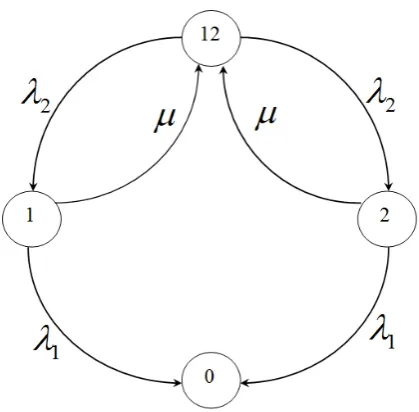
category 2 is λ2=0.001and then
(
)
2 21 3
4 1 2 5 . 0 2
2 λ λ
λ =
− − =
[image:5.595.55.265.134.340.2]and also repair rate isμ=0.0005. The figure 2, Show the states of this system.
Figure 2: the states of the system in example 3
The system of differential equation is as follow:
( ) (
) ( )
( )
( )
( )
( )
⎩ ⎨ ⎧
= +
′
= + + ′
t P t P t P
t P t P t
P
1 2 2 2
2 2 1 1 1
2 2λ μ
λ μ
λ
( )
08
Using Laplace transformation to solving the system of differential equation and using invlaplace command in Maple 10, we have:
( )
(
)
(
)
( )
(
)
⎪ ⎪ ⎩ ⎪ ⎪ ⎨ ⎧
=
⎭ ⎬ ⎫ ⎩
⎨ ⎧ + =
− −
t Sinh
e t
P
t Sinh
t Cosh
e t P
t t
001003466 .
0 996546
. 0
001003466 .
0 374351 . 108
001003466 .
0 145 00689655
. 0
6 00191 . 0 2
6 00191 . 0 1
( )
09And:
( )
t C P( )
t P t P( )
tR
i i
i 2 1
2
1
2 = ()+2
=
∑
=
( )
10Also the MTTF calculated as follow:
( )
{
( )
}
6 0
1 2 0
10 664062499 .
2
2 ) (
×
= +
= =
∫
∫
+∞
= +∞
= t
t
dt t P t P dt t R
MTTF
( )
11
4. Conclusion
A real time n−out−of −n system has been studied in which the failure rate of the elements is constant and the elements are repairable. That is by failure of one element, the load on the remaining elements, increases the chance of
failure of the remaining elements. Necessary relations have been developed for the failure rates. The ambiguity of the data for failure rates is demonstrated by fuzzy triangular numbers. It seems that this model provides more reliable solutions.
This model can be applied to a wide variety of complex industrial problems like the engines of an airplane. As an extension to this work, the failure rates may be considered different for each element. In that case either a system of
n of out
k− − − model should be taken into consideration or a certain policy should be developed when whole system fails. Hence, the cost for procurement, repair of the elements and the failure of the whole system may be taken into account in such a way that the optimum number of elements with minimum cost and maximum reliability will be determined. These variations could be studied for the systems with increasing failure rate of the elements too.
5. References
[1] M. S. Moustafa. Availability of k-out-of-n:G system with M failure models. Microelectronic reliability, 1996, 36, 385-389.
[2] P. J. Boland, S. Papastavridis. Consecutive k-out-of-n:F systems with cycle k. Statistics & Probability Letters, 1999, 44, 155-160.
[3] A. E. Gera. A Consecutive k-out-of-n system with dependent elements – A matrix formulation and solution. Reliability Engineering and System safety, 2000,68, 61-67.
[4] J. Huang, M. J. Zuo. Multi-state k-out-of-n system models and its application. Proceeding of the annual reliability and maintainability symposium, 2000, 264-268.
[5] Y. Lam, K. H. Tony N.G. A general model for consecutive k-out-of-n: F repairable system with exponential distribution and (k-1) - step Markov dependence. European Journal of Operation Research, 2001, 129, 663-682.
[6] A. M. Sarhan, A. M. Abouammoh. Reliability of k-out-of-n nonrepairable system with no independent components subject to common shocks. Microelectronic Reliability, 2001, 41, 617-621. [7] Y. Dutuit, A. Rauzy. New insights into the assessment o k-out-of-n and
related systems. Reliability engineering and system safety, 2001, 72, 303-314.
[8] A. Krishnamoorthy, P. V. Ushakumarti. K-out-of-n:G system with repair: The D-policy. Computer & Operations Research, 2001, 28, 973-981.
[9] R. C. Gupta. Reliability of a k-out-of-n system of components sharing a common environment. Applied mathematics letters, 2002,15, 837-844.
[11] G. Arulmozhi. Exact equation and an algorithm for reliability evaluation of k-out-of-n: G system. Reliability Engineering and System safety, 2002, 78, 87-91.
[12] R. C. M. Yam, M. J. Zuo, Y. L. Z. A method for evaluating of reliability indices for repairable circular consecutive k-out-of-n:F systems. Reliability engineering & System safety, 2003, 79, 1-9. [13] B. Milczek. On the class of limit reliability functions of homogeneous
series-"k-out-of-n" systems. Applied mathematics and computations, 2003, 137, 161-176.
[14] Z. Chen. Component reliability analysis of k-out-of-n systems with censored data. Journal of statistical planning and inference, 2003, 116, 305-315.
[15] M. Koucky. Exact reliability formula and bounds for general k-out-of-n systems. Reliability Ek-out-of-ngik-out-of-neerik-out-of-ng ak-out-of-nd System safety, 2003, 82, 229-231.
[16] G. Arulmozhi. Direct method for reliability computation of k-out-of-n: G systems. Applied mathematics and computation, 2003, 143, 421-429.
[17] K. D. de Smith-Destombes, M. C. van der Heijden, A. van Harten. On the reliability of k-out-of-n system given limited spares and repair capacity under a condition based maintenance strategy. Reliability engineering & System safety, 2004, 83, 287-300.
[18] J. Flynn, C. S. Chung. A heuristic algorithm for determining replacement policies in consecutive k-out-of-n systems. Computer & Operations Research, 2004, 31, 1335-1348.
[19] Y. C. Hsieh, T. C. Chen. Reliability lower bounds for two-dimensional consecutive k-out-of-n: F systems. Computers & Operations research, 2004, 31, 1259-1272.
[20] A. Jalali, A. G. Hawkes, L. R. Cui, F. K. Hwang. The optimal consecutive k-out-of-n:G line for n≤2k. Journal of statistical planning and inference, 2005, 128, 281-287.
[21] V. da Costa Bueno. Minimal standby redundancy allocation in a k-out-of-n:F system of dependent components. European journal of operation research, 2005, 165, 786-793.
[22] K. Jenab, B. S. Dhillon. Assessment of reversible multi-state k-out-of-n:G/F/Load sharing systems with flow-graph models. Reliability engineering & System safety, 2006, 91, 765-771.
[23] X. Li, M. J. Zuo, R. C. M. Yam. Reliability analysis of a repairable k-out-of-n system with some component being suspended when the system is down. Reliability engineering & System safety, 2006, 91,305-310.