Evaluating Distributional Models of Semantics for Syntactically
Invariant Inference
Jackie CK Cheung and Gerald Penn Department of Computer Science
University of Toronto Toronto, ON, M5S 3G4, Canada
{jcheung,gpenn}@cs.toronto.edu
Abstract
A major focus of current work in distri-butional models of semantics is to con-struct phrase representations composition-ally from word representations. However, the syntactic contexts which are modelled are usually severely limited, a fact which is reflected in the lexical-level WSD-like evaluation methods used. In this paper, we broaden the scope of these models to build sentence-level representations, and argue that phrase representations are best eval-uated in terms of the inference decisions that they support, invariant to the partic-ular syntactic constructions used to guide composition. We propose two evaluation methods in relation classification and QA which reflect these goals, and apply several recent compositional distributional models to the tasks. We find that the models out-perform a simple lemma overlap baseline slightly, demonstrating that distributional approaches can already be useful for tasks requiring deeper inference.
1 Introduction
A number of unsupervised semantic models (Mitchell and Lapata, 2008, for example) have re-cently been proposed which are inspired at least in part by the distributional hypothesis (Harris, 1954)—that a word’s meaning can be character-ized by the contexts in which it appears. Such models represent word meaning as one or more high-dimensional vectors which capture the lex-ical and syntactic contexts of the word’s occur-rences in a training corpus.
Much of the recent work in this area has, fol-lowing Mitchell and Lapata (2008), focused on
the notion of compositionality as the litmus test of a truly semantic model. Compositionality is a nat-ural way to construct representations of linguistic units larger than a word, and it has a long history in Montagovian semantics for dealing with argu-ment structure and assembling rich semantical ex-pressions of the kind found in predicate logic.
While compositionality may thus provide a convenient recipe for producing representations of propositionally typed phrases, it is not a nec-essary condition for a semantic representation. Rather, that distinction still belongs to the crucial ability to support inference. It is not the inten-tion of this paper to argue for or against composi-tionality in semantic representations. Rather, our interest is in evaluating semantic models in order to determine their suitability for inference tasks. In particular, we contend that it is desirable and arguably necessary for a compositional semantic representation to support inference invariantly, in the sense that the particular syntactic construction that guided the composition should not matter rel-ative to the representations of syntactically differ-ent phrases with the same meanings. For example, we can assert that John threw the ball and The ball
was thrown by John have the same meaning for
the purposes of inference, even though they differ syntactically.
An analogy can be drawn to research in image processing, in which it is widely regarded as im-portant for the representations of images to be in-variant to rotation and scaling. What we should want is a representation of sentence meaning that is invariant to diathesis, other regular syntactic al-ternations in the assignment of argument struc-ture, and, ideally, even invariant to other meaning-preserving or near-meaning-preserving paraphrases.
Existing evaluations of distributional semantic models fall short of measuring this. One evalua-tion approach consists of lexical-level word sub-stitution tasks which primarily evaluate a sys-tem’s ability to disambiguate word senses within a controlled syntactic environment (McCarthy and Navigli, 2009, for example). Another approach is to evaluate parsing accuracy (Socher et al., 2010, for example), which is really a formalism-specific approximation to argument structure analysis. These evaluations may certainly be relevant to specific components of, for example, machine translation or natural language generation sys-tems, but they tell us little about a semantic model’s ability to support inference.
In this paper, we propose a general framework for evaluating distributional semantic models that build sentence representations, and suggest two evaluation methods that test the notion of struc-turally invariant inference directly. Both rely on determining whether sentences express the same semantic relation between entities, a crucial step in solving a wide variety of inference tasks like recognizing textual entailment, information re-trieval, question answering, and summarization.
The first evaluation is a relation classification task, where a semantic model is tested on its abil-ity to recognize whether a pair of sentences both contain a particular semantic relation, such as
Company X acquires Company Y. The second task
is a question answering task, the goal of which is to locate the sentence in a document that contains the answer. Here, the semantic model must match the question, which expresses a proposition with a missing argument, to the answer-bearing sentence which contains the full proposition.
We apply these new evaluation protocols to several recent distributional models, extending several of them to build sentence representa-tions. We find that the models outperform a sim-ple lemma overlap model only slightly, but that combining these models with the lemma overlap model can improve performance. This result is likely due to weaknesses in current models’ abil-ity to deal with issues such as named entities, coreference, and negation, which are not empha-sized by existing evaluation methods, but it does suggest that distributional models of semantics can play a more central role in systems that re-quire deep, precise inference.
2 Compositionality and Distributional Semantics
The idea of compositionality has been central to understanding contemporary natural language se-mantics from an historiographic perspective. The idea is often credited to Frege, although in fact Frege had very little to say about compositional-ity that had not already been repeated since the time of Aristotle (Hodges, 2005). Our modern notion of compositionality took shape primarily with the work of Tarski (1956), who was actu-ally arguing that a central difference between for-mal languages and natural languages is that nat-ural language is not compositional. This in turn was the “the contention that an important theo-retical difference exists between formal and nat-ural languages,” that Richard Montague so fa-mously rejected (Montague, 1974). Composi-tionality also features prominently in Fodor and Pylyshyn’s (1988) rejection of early connection-ist representations of natural language semantics, which seems to have influenced Mitchell and La-pata (2008) as well.
Logic-based forms of compositional semantics have long strived for syntactic invariance in mean-ing representations, which is known as the doc-trine of the canonical form. The traditional justifi-cation for canonical forms is that they allow easy access to a knowledge base to retrieve some de-sired information, which amounts to a form of in-ference. Our work can be seen as an extension of this notion to distributional semantic models with a more general notion of representational similar-ity and inference.
There are many regular alternations that seman-tics models have tried to account for such as pas-sive or dative alternations. There are also many lexical paraphrases which can take drastically dif-ferent syntactic forms. Take the following exam-ple from Poon and Domingos (2009), in which the same semantic relation can be expressed by a tran-sitive verb or an attributive prepositional phrase:
(1) Utah borders Idaho.
Utah is next to Idaho.
in the context of their syntactic subject, and can-didate synonyms are ranked for their appropri-ateness. This method targets the fact that a syn-onym is appropriate for only some of the verb’s senses, and the intended verb sense depends on the surrounding context. For example, burn and
beam are both synonyms of glow, but given a
par-ticular subject, one of the synonyms (called the High similarity landmark) may be a more appro-priate substitution than the other (the Low similar-ity landmark). So, if the fire is the subject, glowed is the High similarity landmark, and beamed the Low similarity landmark.
Fundamentally, this method was designed as a demonstration that compositionality in com-puting phrasal semantic representations does not interfere with the ability of a representation to synthesize non-compositional collocation effects that contribute to the disambiguation of homo-graphs. Here, word-sense disambiguation is im-plicitly viewed as a very restricted, highly lexi-calized case of inference for selecting the appro-priate disjunct in the representation of a word’s meaning.
Kintsch (2001) was interested in sentence sim-ilarity, but he only conducted his evaluation on a few hand-selected examples. Mitchell and La-pata (2008) conducted theirs on a much larger scale, but chose to focus only on this single case of syntactic combination, intransitive verbs and their subjects, in order to “factor out inessential degrees of freedom” to compare their various al-ternative models more equitably. This was not necessary—using the same, sufficiently large, un-biased but syntactically heterogeneous sample of evaluation sentences would have served as an ade-quate control—and this decision furthermore pre-vents the evaluation from testing the desired in-variance of the semantic representation.
Other lexical evaluations suffer from the same problem. One uses the WordSim-353 dataset (Finkelstein et al., 2002), which contains hu-man word pair similarity judgments that sehu-man- seman-tic models should reproduce. However, the word pairs are given without context, and homography is unaddressed. Also, it is unclear how reliable the similarity scores are, as different annotators may interpret the integer scale of similarity scores differently. Recent work uses this dataset mostly for parameter tuning. Another is the lexical para-phrase task of McCarthy and Navigli (2009), in
which words are given in the context of the sur-rounding sentence, and the task is to rank a given list of proposed substitutions for that word. The list of substitutions as well as the correct rankings are elicited from annotators. This task was origi-nally conceived as an applied evaluation of WSD systems, not an evaluation of phrase representa-tions.
Parsing accuracy has been used as a prelimi-nary evaluation of semantic models that produce syntactic structure (Socher et al., 2010; Wu and Schuler, 2011). However, syntax does not always reflect semantic content, and we are specifically interested in supporting syntactic invariance when doing semantic inference. Also, this type of eval-uation is tied to a particular grammar formalism.
The existing evaluations that are most similar in spirit to what we propose are paraphrase detection tasks that do not assume a restricted syntactic con-text. Washtell (2011) collected human judgments on the general meaning similarity of candidate phrase pairs. Unfortunately, no additional guid-ance on the definition of “most similar in mean-ing” was provided, and it appears likely that sub-jects conflated lexical, syntactic, and semantic re-latedness. Dolan and Brockett (2005) define para-phrase detection as identifying sentences that are in a bidirectional entailment relation. While such sentences do support exactly the same inferences, we are also interested in the inferences that can be made from similar sentences that are not para-phrases according to this strict definition — a sit-uation that is more often encountered in end ap-plications. Thus, we adopt a less restricted notion of paraphrasis.
3 An Evaluation Framework
We now describe a simple, general framework for evaluating semantic models. Our framework consists of the following components: a seman-tic model to be evaluated, pairs of sentences that are considered to have high similarity, and pairs of sentences that are considered to have low simi-larity.
represen-tation from constituent represenrepresen-tations, and even to the actual representation used. The model is tested by applying it to each element in the fol-lowing two sets:
H ={(h, h′)|handh′are linguistic units (2)
with high similarity}
L={(l, l′)|landl′are linguistic units (3)
with low similarity}
The resulting sets of similarity scores are:
SH =
M(h, h′)|(h, h′)∈H (4)
SL=
M(l, l′)|(l, l′)∈L (5)
The semantic model is evaluated according to its ability to separate SH and SL. We will de-fine specific measures of separation for the tasks that we propose shortly. While the particular def-initions of “high similarity” and “low similarity” depend on the task, at the crux of both our evalu-ations is that two sentences are similar if they ex-press the same semantic relation between a given entity pair, and dissimilar otherwise. This thresh-old for similarity is closely tied to the argument structure of the sentence, and allows considerable flexibility in the other semantic content that may be contained in the sentence, unlike the bidirec-tional paraphrase detection task. Yet it ensures that a consistent and useful distinction for infer-ence is being detected, unlike unconstrained sim-ilarity judgments.
Also, compared to word similarity assessments or paraphrase elicitation, determining whether a sentence expresses a semantic relation is a much easier task cognitively for human judges. This bi-nary judgment does not involve interpreting a nu-merical scale or coming up with an open-ended set of alternative paraphrases. It is thus easier to get reliable annotated data.
Below, we present two tasks that instantiate this evaluation framework and choice of similar-ity threshold. They differ in that the first is tar-geted towards recognizing declarative sentences or phrases, while the second is targeted towards a question answering scenario, where one argument in the semantic relation is queried.
3.1 Task 1: Relation Classification
The first task is a relation classification task. Rela-tion extracRela-tion and recogniRela-tion are central to a va-riety of other tasks, such as information retrieval,
ontology construction, recognizing textual entail-ment and question answering.
In this task, the high and the low similarity sen-tence pairs are constructed in the following man-ner. First, a target semantic relation, such as
Com-pany X acquires ComCom-pany Y is chosen, and
enti-ties are chosen for each slot in the relation, such as
Company X=Pfizer and Company Y=Rinat Neu-roscience. Then, sentences containing these
enti-ties are extracted and divided into two subsets. In one of them, E, the entities are in the target se-mantic relation, while in the other,N E, they are not. The evaluation sets H and Lare then con-structed as follows:
H =E×E\ {(e, e)|e∈E} (6)
L=E×N E (7)
In other words, the high similarity sentence pairs are all the pairs where both express the tar-get semantic relation, except the pairs between a sentence and itself, while the low similarity pairs are all the pairs where exactly one of the two sen-tences expresses the target relation.
Several sentences expressing the relation Pfizer
acquires Rinat Neuroscience are shown in
Exam-ples 8 to 10. These sentences illustrate the amount of syntactic and lexical variation that the semantic model must recognize as expressing the same se-mantic relation. In particular, besides recognizing synonymy or near-synonymy at the lexical level, models must also account for subcategorization differences, extra arguments or adjuncts, and part-of-speech differences due to nominalization.
(8) Pfizer buys Rinat Neuroscience to extend
neuroscience research and in doing so acquires a product candidate for OA.
(lexical difference)
(9) A month earlier, Pfizer paid an estimated
several hundred million dollars for biotech firm Rinat Neuroscience. (extra argument,
subcategorization)
(10) Pfizer to Expand Neuroscience Research
With Acquisition of Biotech Company Rinat Neuroscience (nominalization)
the area under a ROC curve (AUC), which does not depend on choosing an arbitrary classification threshold. A ROC curve is a plot of the true pos-itive versus false pospos-itive rate of a binary classi-fier as the classification threshold is varied. The area under a ROC curve can thus be seen as the performance of linear classifiers over the scores produced by the semantic model. The AUC can also be interpreted as the probability that a ran-domly chosen positive instance will have a higher similarity score than a randomly chosen negative instance. A random classifier is expected to have an AUC of 0.5.
3.2 Task 2: Restricted QA
The second task that we propose is a restricted form of question answering. In this task, the sys-tem is given a questionq and a documentD con-sisting of a list of sentences, in which one of the sentences contains the answer to the question. We define:
H={(q, d)|d∈ Danddanswersq} (11)
L={(q, d)|d∈ Dandddoes not answerq} (12)
In other words, the sentences are divided into two subsets; those that contain the answer toq should be similar toq, while those that do not should be dissimilar. We also assume that only one sentence in each document contains the answer, soH con-tains only one sentence.
Unrestricted question answering is a difficult problem that forces a semantic representation to deal sensibly with a number of other semantic is-sues such as coreference and information aggre-gation which still seem to be out of reach for contemporary distributional models of meaning. Since our focus in this work is on argument struc-ture semantics, we restrict the question-answer pairs to those that only require dealing with para-phrases of this type.
To do so, we semi-automatically restrict the question-answer pairs by using the output of an unsupervised clustering semantic parser (Poon and Domingos, 2009). The semantic parser clus-ters semantic sub-expressions derived from a de-pendency parse of the sentence, so that those sub-expressions that express the same semantic re-lations are clustered. The parser is used to an-swer questions, and the output of the parser is
manually checked. We use only those cases that have thus been determined to be correct question-answer pairs. As a result of this restriction, this task is rather more like Task 1 in how it tests a model’s ability to recognize lexical and syntac-tic paraphrases. This task also involves recog-nizing voicing alternations, which were automati-cally extracted by the semantic parser.
An example of a question-answer pair involv-ing a voicinvolv-ing alternation that is used in this task is presented in Example 13.
(13) Q: What does il-2 activate? A: PI3K
Sentence: Phosphatidyl inositol 3-kinase
(PI3K) is activated by IL-2.
Since there is only one element inHand hence SH for each question and document, we measure
the separation betweenSH andSLusing the rank of the score of answer-bearing sentence among the scores of all the sentences in the document. We normalize the rank so that it is between 0 (ranked least similar) and 1 (ranked most simi-lar). Where ties occur, the sentence is ranked as if it were in the median position among the tied sentences. If the question-answer pairs are zero-indexed byi, answer(i)is the index of the sen-tence containing the answer for the ith pair, and length(i) is the number of sentences in the doc-ument, then the mean normalized rank score of a system is:
norm rank=E i
1− answer(i) length(i)−1
(14)
4 Experiments
We drew a number of recent distributional seman-tic models to compare in this paper. We first de-scribe the models and our reimplementation of them, before describing the tasks and the datasets used in detail and the results.
4.1 Distributional Semantic Models
operators. We do note, however, that component-wise operators have been popular in recent liter-ature, and have been applied across unrestricted syntactic contexts (Mitchell and Lapata, 2009), so there is value in evaluating the performance of these operators in itself. The models were trained on the Gigaword corpus (2nd ed., ~2.3B words). All models use cosine similarity to measure the similarity between representations, except for the baseline model.
Lemma Overlap This baseline simply repre-sents a sentence as the counts of each lemma present in the sentence after removing stop words. Let a sentence xconsist of lemma-tokens m1, . . . , m|x|. The similarity between two sen-tences is then defined as
M(x, x′) = #In(x, x′) + #In(x′, x) (15)
#In(x, x′) =
|x| X
i=1
1x′(mi) (16)
where 1x′(mi)is an indicator function that returns
1 if mi ∈ x′, and 0 otherwise. This definition
accounts for multiple occurrences of a lemma.
M&L Mitchell and Lapata (2008) propose a framework for compositional distributional se-mantics using a standard term-context vector space word representation. A phrase is repre-sented as a vector of context-word counts (actu-ally, pmi-scaled values), which is derived compo-sitionally by a function over constituent vectors, such as component-wise addition or multiplica-tion. This model ignores syntactic relations and is insensitive to word-order.
E&P Erk and Pad´o (2008) introduce a struc-tured vector space model which uses syntactic de-pendencies to model the selectional preferences of words. The vector representation of a word in context depends on the inverse selectional prefer-ences of its dependents, and the selectional pref-erences of its head. For example, suppose catch occurs with a dependent ball in a direct object relation. The vector for catch would then be in-fluenced by the inverse direct object preferences of ball (e.g. throw, organize), and the vector for
ball would be influenced by the selectional
pref-erences of catch (e.g. cold, drift). More formally, given words aand bin a dependency relation r,
a distributional representation ofa,va, the
repre-sentation ofain context,a′, is given by
a′ =va⊙Rb(r−1) (17)
Rb(r) =
X
c:f(c,r,b)>θ
f(c, r, b)·vc, (18)
where Rb(r) is the vector describing the
selec-tional preference of wordbin relationr,f(c, r, b)
is the frequency of this dependency triple, θis a frequency threshold to weed out uncommon de-pendency triples (10 in our experiments), and⊙ is a vector combination operator, here component-wise multiplication. We extend the model to com-pute sentence representations from the contextu-alized word vectors using component-wise addi-tion and multiplicaaddi-tion.
TFP Thater et al. (2010)’s model is also sensi-tive to selectional preferences, but to two degrees. For example, the vector for catch might contain a dimension labelled (OBJ,OBJ-1,throw), which indicates the strength of connection be-tween the two verbs through all of the co-occurring direct objects which they share. Unlike E&P, TFP’s model encodes the selectional prefer-ences in a single vector using frequency counts. We extend the model to the sentence level with component-wise addition and multiplication, and word vectors are contextualized by the depen-dency neighbours. We use a frequency threshold of 10 and a pmi threshold of 2 to prune infrequent word and dependencies.
D&L Dinu and Lapata (2010) (D&L) assume a global set of latent senses for all words, and models each word as a mixture over these latent senses. The vector for a wordti in the context of
a wordcjis modelled by
v(ti, cj) =P(z1|ti, cj), ...P(zK|ti, cj) (19)
where z1...K are the latent senses. By
mak-ing independence assumptions and decomposmak-ing probabilities, training becomes a matter of esti-mating the probability distributions P(zk|ti)and
P(cj|zk) from data. While Dinu and Lapata
Pfizer/Rinat N. Yahoo/Inktomi Besson/Paris Antoinette/Vienna Average
Overlap 0.7393 0.6007 0.7395 0.8914 0.7427
Models trained on the entire GigaWord
M&L add 0.6196 0.5387 0.5259 0.7275 0.6029
M&L mult 0.9036 0.6099 0.6443 0.8467 0.7511
D&L add 0.9214 0.8168 0.6989 0.8932 0.8326
D&L mult 0.7732 0.6734 0.6527 0.7659 0.7163
Models trained on the AFP section
E&P add 0.7536 0.4933 0.2780 0.6408 0.5414
E&P mult 0.5268 0.5328 0.5252 0.8421 0.6067
TFP add 0.4357 0.5325 0.8725 0.7183 0.6398
TFP mult 0.5554 0.5524 0.7283 0.6917 0.6320
M&L add 0.5643 0.5504 0.4594 0.7640 0.5845
M&L mult 0.8679 0.6324 0.4356 0.8258 0.6904
D&L add 0.8143 0.9062 0.6373 0.8664 0.8061
[image:7.595.89.501.72.290.2]D&L mult 0.8429 0.7461 0.645 0.5948 0.7072
Table 1: Task 1 results in AUC scores. The values in bold indicate the best performing model for a particular training corpus. The expected random baseline performance is 0.5.
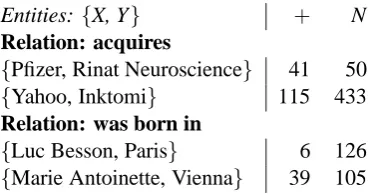
Entities: {X, Y} + N
Relation: acquires
{Pfizer, Rinat Neuroscience} 41 50 {Yahoo, Inktomi} 115 433
Relation: was born in
{Luc Besson, Paris} 6 126 {Marie Antoinette, Vienna} 39 105
Table 2: Task 1 dataset characteristics. N is the total number of sentences. +is the number of sentences that express the relation.
from the contextualized representations. We set the number of latent senses to 1200, and train for 600 Gibbs sampling iterations.
4.2 Training and Parameter Settings
We reimplemented these four models, following the parameter settings described by previous work where possible, though we also aimed for consis-tency in parameter settings between models (for example, in the number of context words). For the non-baseline models, we followed previous work and model only the 30000 most frequent lemmata. Context vectors are constructed using a symmet-ric window of 5 words, and their dimensions rep-resent the 3000 most frequent lemmatized context words excluding stop words. Due to resource lim-itations, we trained the syntactic models over the AFP subset of Gigaword (~338M words). We also trained the other two models on just the AFP
por-tion for comparison. Note that the AFP porpor-tion of Gigaword is three times larger than the BNC corpus (~100M words), on which several previ-ous syntactic models were trained. Because our main goal is to test the general performance of the models and to demonstrate the feasibility of our evaluation methods, we did not further tune the parameter settings to each of the tasks, as doing so would likely only yield minor improvements.
4.3 Task 1
We used the dataset by Bunescu and Mooney (2007), which we selected because it contains multiple realizations of an entity pair in a target semantic relation, unlike similar datasets such as the one by Roth and Yih (2002). Controlling for the target entity pair in this manner makes the task more difficult, because the semantic model cannot make use of distributional information about the entity pair in inference. The dataset is separated into subsets depending on the target binary rela-tion (Company X acquires Company Y or Person
X was born in Place Y) and the entity pair (e.g., Yahoo and Inktomi) (Table 2).
[image:7.595.88.276.339.436.2]Pure models Mixed models All Subset All Subset
Overlap 0.8770 0.7291 0.8770 0.7291
Models trained on the entire GigaWord
M&L add 0.7467 0.6106 0.8782 0.7523 M&L mult 0.5331 0.5690 0.8841 0.7678 D&L add 0.6552 0.5716 0.8791 0.7539 D&L mult 0.5488 0.5255 0.8841 0.7466
Models trained on the AFP section
E&P add 0.4589 0.4516 0.8748 0.7375 E&P mult 0.5201 0.5584 0.8882 0.7719 TFP add 0.6887 0.6443 0.8940 0.7871
[image:8.595.78.296.72.301.2]TFP mult 0.5210 0.5199 0.8785 0.7432 M&L add 0.7588 0.6206 0.8710 0.7371 M&L mult 0.5710 0.5540 0.8801 0.7540 D&L add 0.6358 0.5402 0.8713 0.7305 D&L mult 0.5647 0.5461 0.8856 0.7683
Table 3: Task 2 results, in normalized rank scores. Subset is the cases where lemma overlap does not achieve a perfect score. The two columns on the right indicate performance using the sum of the scores from the lemma overlap and the semantic model. The ex-pected random baseline performance is 0.5.
in this dataset.
The results for Task 1 indicate that the D&L ad-dition model performs the best (Table 1), though the lemma overlap model presents a surprisingly strong baseline. The syntax-modulated E&P and TFP models perform poorly on this task, even when compared to the other models trained on the AFP subset. The M&L multiplication model out-performs the addition model, a result which cor-roborates previous findings on the lexical substi-tution task. The same does not hold in the D&L latent sense space. Overall, some of the datasets (Yahoo and Antoinette) appear to be easier for the models than others (Pfizer and Besson), but more entity pairs and relations would be needed to in-vestigate the models’ variance across datasets.
4.4 Task 2
We used the question-answer pairs extracted by the Poon and Domingos (2009) semantic parser from the GENIA biomedical corpus that have been manually checked to be correct (295 pairs). Because our models were trained on newspaper text, they required adaptation to this specialized domain. Thus, we also trained the M&L, E&P and TFP models on the GENIA corpus,
back-ing off to word vectors from the GENIA corpus when a word vector could not be found in the Gigaword-trained model. We could not do this for the D&L model, since the global latent senses that are found by latent Dirichlet allocation train-ing do not have any absolute meantrain-ing that holds across multiple runs. Instead, we found the 5 words in the Gigaword-trained D&L model that were closest to each novel word in the GENIA corpus according to cosine similarity over the co-occurrence vectors of the words in the GENIA corpus, and took their average latent sense distri-butions as the vector for that word.
Unlike in Task 1, there is no control for the named entities in a sentence, because one of the entities in the semantic relation is missing. Also, distributional models have problems in dealing with named entities which are common in this corpus, such as the names of genes and proteins. To address these issues, we tested hybrid models where the similarity score from a semantic model is added to the similarity score from the lemma overlap model.
The results are presented in Table 3. Lemma overlap again presents a strong baseline, but the hybridized models are able to outperform simple lemma overlap. Unlike in Task 1, the E&P and TFP models are comparable to the D&L model, and the mixed TFP addition model achieves the best result, likely due to the need to more pre-cisely distinguish syntactic roles in this task. The D&L addition model, which achieved the best performance in Task 1, does not perform as well in this task. This could be due to the domain adap-tation procedure for the D&L model, which could not be reasonably trained on such a small, special-ized corpus.
5 Related Work
Turney and Pantel (2010) survey various types of vector space models and applications thereof in computational linguistics. We summarize below a number of other word- or phrase-level distribu-tional models.
of a word is encountered, it is represented as a combination of the prototype vectors, with the de-gree of influence from each prototype determined by the similarity of the new context to the exist-ing sense contexts. In contrast, the bottom-up
ex-emplar-based approach assumes that each
occur-rence of a word expresses a different sense of the word. The most similar senses of the word are ac-tivated when a new occurrence of it is encountered and combined, for example with a kNN algorithm (Erk and Pad´o, 2010).
The models we compared and the above work assume each dimension in the feature vector cor-responds to a context word. In contrast, Washtell (2011) uses potential paraphrases directly as di-mensions in his expectation vectors. Unfortu-nately, this approach does not outperform vari-ous context word-based approaches in two phrase similarity tasks.
In terms of the vector composition function, component-wise addition and multiplication are the most popular in recent work, but there ex-ist a number of other operators such as tensor product and convolution product, which are re-viewed by Widdows (2008). Instead of vector space representations, one could also use a matrix space representation with its much more expres-sive matrix operators (Rudolph and Giesbrecht, 2010). So far, however, this has only been ap-plied to specific syntactic contexts (Baroni and Zamparelli, 2010; Guevara, 2010; Grefenstette and Sadrzadeh, 2011), or tasks (Yessenalina and Cardie, 2011).
Neural networks have been used to learn both phrase structure and representations. In Socher et al. (2010), word representations learned by neu-ral network models such as (Bengio et al., 2006; Collobert and Weston, 2008) are fed as input into a recursive neural network whose nodes represent syntactic constituents. Each node models both the probability of the input forming a constituent and the phrase representation resulting from composi-tion.
6 Conclusions
We have proposed an evaluation framework for distributional models of semantics which build phrase- and sentence-level representations, and instantiated two evaluation tasks which test for the crucial ability to recognize whether sen-tences express the same semantic relation. Our
results demonstrate that compositional distribu-tional models of semantics already have some utility in the context of more empirically complex semantic tasks than WSD-like lexical substitution tasks, in which compositional invariance is a req-uisite property. Simply computing lemma over-lap, however, is a very competitive baseline, due to issues in these protocols with named entities and domain adaptivity. The better performance of the mixture models in Task 2 shows that such weaknesses can be addressed by hybrid seman-tic models. Future work should investigate more refined versions of such hybridization, as well as extend this idea to other semantic phenomena like coreference, negation and modality.
We also observe that no single model or com-position operator performs best for all tasks and datasets. The latent sense mixture model of Dinu and Lapata (2010) performs well in recognizing semantic relations in general web text. Because of the difficulty of adapting it to a specialized domain, however, it does less well in biomedi-cal question answering, where the syntax-based model of Thater et al. (2010) performs the best. A more thorough investigation of the factors that can predict the performance and/or invariance of a given composition operator is warranted.
In the future, we would like to evaluate other models of compositional semantics that have been recently proposed. We would also like to collect more comprehensive test data, to increase the ex-ternal validity of our evaluations.
Acknowledgments
We would like to thank Georgiana Dinu and Ste-fan Thater for help with reimplementing their models. Saif Mohammad, Peter Turney, and the anonymous reviewers provided valuable com-ments on drafts of this paper. This project was supported by the Natural Sciences and Engineer-ing Research Council of Canada.
References
Marco Baroni and Roberto Zamparelli. 2010. Nouns are vectors, adjectives are matrices: Representing adjective-noun constructions in semantic space. In Proceedings of the 2010 Conference on Empirical Methods in Natural Language Processing, pages 1183–1193.
2006. Neural probabilistic language models. In-novations in Machine Learning, pages 137–186. Razvan C. Bunescu and Raymond J. Mooney. 2007.
Learning to extract relations from the web using minimal supervision. In Proceedings of the 45th Annual Meeting of the Association for Computa-tional Linguistics, pages 576–583.
Ronan Collobert and Jason Weston. 2008. A unified architecture for natural language processing: Deep neural networks with multitask learning. In Pro-ceedings of the 25th International Conference on Machine Learning, page 160–167.
Georgiana Dinu and Mirella Lapata. 2010. Measuring distributional similarity in context. In Proceedings of the 2010 Conference on Empirical Methods in Natural Language Processing, pages 1162–1172. William B. Dolan and Chris Brockett. 2005.
Auto-matically constructing a corpus of sentential para-phrases. In Proceedings of the Third International Workshop on Paraphrasing, pages 9–16.
Katrin Erk and Sebastian Pad ´o. 2008. A structured vector space model for word meaning in context. In Proceedings of the Conference on Empirical Meth-ods in Natural Language Processing, pages 897– 906.
Katrin Erk and Sebastian Pad ´o. 2010. Exemplar-based models for word meaning in context. In Pro-ceedings of the ACL 2010 Conference Short Papers, pages 92–97.
Lev Finkelstein, Evgeniy Gabrilovich, Yossi Matias, Ehud Rivlin, Zach Solan, Gadi Wolfman, and Ey-tan Ruppin. 2002. Placing search in context: The concept revisited. ACM Transactions on Informa-tion Systems, 20(1):116–131.
Jerry A. Fodor and Zenon W. Pylyshyn. 1988. Con-nectionism and cognitive architecture: A critical analysis. Cognition, 28:3–71.
Edward Grefenstette and Mehrnoosh Sadrzadeh. 2011. Experimental support for a categorical com-positional distributional model of meaning. In Proceedings of the 2011 Conference on Empirical Methods in Natural Language Processing, pages 1394–1404.
Emiliano Guevara. 2010. A regression model of adjective-noun compositionality in distributional semantics. In Proceedings of the 2010 Workshop on GEometrical Models of Natural Language Seman-tics, pages 33–37.
Zeller S. Harris. 1954. Distributional structure. Word, 10(23):146–162.
Wilfred Hodges. 2005. The interplay of fact and the-ory in separating syntax from meaning. In Work-shop on Empirical Challenges and Analytical Al-ternatives to Strict Compositionality.
Walter Kintsch. 2001. Predication. Cognitive Sci-ence, 25(2):173–202.
Diana McCarthy and Roberto Navigli. 2009. The en-glish lexical substitution task. Language Resources and Evaluation, 43(2):139–159.
Jeff Mitchell and Mirella Lapata. 2008. Vector-based models of semantic composition. In Proceedings of ACL-08: HLT, pages 236–244.
Jeff Mitchell and Mirella Lapata. 2009. Language models based on semantic composition. In Pro-ceedings of the 2009 Conference on Empirical Methods in Natural Language Processing, pages 430–439.
Richard Montague. 1974. English as a formal lan-guage. Formal Philosophy, pages 188–221. Hoifung Poon and Pedro Domingos. 2009.
Unsuper-vised semantic parsing. In Proceedings of the 2009 Conference on Empirical Methods in Natural Lan-guage Processing, pages 1–10.
Joseph Reisinger and Raymond J. Mooney. 2010. Multi-prototype vector-space models of word meaning. In Human Language Technologies: The 2010 Annual Conference of the North American Chapter of the Association for Computational Lin-guistics.
Dan Roth and Wen-tau Yih. 2002. Probabilistic rea-soning for entity & relation recognition. In Pro-ceedings of the 19th International Conference on Computational Linguistics, pages 835–841. Sebastian Rudolph and Eugenie Giesbrecht. 2010.
Compositional matrix-space models of language. In Proceedings of the 48th Annual Meeting of the Association for Computational Linguistics, pages 907–916.
Richard Socher, Christopher D. Manning, and An-drew Y. Ng. 2010. Learning continuous phrase representations and syntactic parsing with recursive neural networks. Proceedings of the Deep Learn-ing and Unsupervised Feature LearnLearn-ing Workshop of NIPS 2010, pages 1–9.
Alfred Tarski. 1956. The concept of truth in formal-ized languages. Logic, Semantics, Metamathemat-ics, pages 152–278.
Stefan Thater, Hagen F¨urstenau, and Manfred Pinkal. 2010. Contextualizing semantic representations us-ing syntactically enriched vector models. In Pro-ceedings of the 48th Annual Meeting of the Associa-tion for ComputaAssocia-tional Linguistics, pages 948–957. Peter D. Turney and Patrick Pantel. 2010. From frequency to meaning: Vector space models of se-mantics. Journal of Artificial Intelligence Research, 37:141–188.
Justin Washtell. 2011. Compositional expectation: A purely distributional model of compositional se-mantics. In Proceedings of the Ninth International Conference on Computational Semantics (IWCS 2011), pages 285–294.
Stephen Wu and William Schuler. 2011. Structured composition of semantic vectors. In Proceedings of the Ninth International Conference on Computa-tional Semantics (IWCS 2011), pages 295–304. Ainur Yessenalina and Claire Cardie. 2011.