A Latent Variable Model for
Discourse-aware Concept and Entity Disambiguation
Angela Fahrni and Michael StrubeHeidelberg Institute for Theoretical Studies gGmbH Schloss-Wolfsbrunnenweg 35
69118 Heidelberg, Germany
(angela.fahrni|michael.strube)@h-its.org
Abstract
This paper takes a discourse-oriented per-spective for disambiguating common and proper noun mentions with respect to Wikipedia. Our novel approach mod-els the relationship between disambigua-tion and aspects of cohesion using Markov Logic Networks with latent variables. Considering cohesive aspects consistently improves the disambiguation results on various commonly used data sets.
1 Introduction
“I have to review apaper”, the super-visormoaned from the office. “Please don’t disturb me until I’m done with the review.” His student nodded, went to thecafeteria, sat down in thesunshine and started to read yesterday’spaper.
This text snippet illustrates two aspects that have been neglected by previous disambiguation ap-proaches. (1) The interpretation of different men-tions, i.e. common and proper nouns, is deter-mined by different notions of context: some men-tions depend more on a local sentence-level con-text (paper in read yesterday’s paper; the global context is misleading), some more on a global one (reviewinI’m done with the review; the local con-text is not discriminative), some on both global and local context (paper inreview a paper). (2) The context relevant to disambiguate a mention depends on how it is embedded into discourse and is not bound to the surface form of a mention ( pa-perin the first sentence vs.paperin the last one).
Starting from this observation, we argue that the context relevant to disambiguate a mention cor-relates with its cohesive scope, i.e. the text span within which a mention establishes cohesive re-lations. Therefore, we propose to disambiguate
mentions differently depending on their cohesive scopes (Section 2). We distinguish between three different cohesive scopes of mentions and model them as latent variables using Markov Logic Net-works (Section 3). The use of latent variables al-lows us to learn and predict the cohesive scope and the disambiguation of a mention jointly. This comes with the advantage that the learning of the scope assignment does not need annotated data by itself but is guided by the annotations available for the target prediction task, i.e. the disambiguation.
In this paper, we focus on concept and entity disambiguation1 with respect to an inventory
de-rived from Wikipedia and compare (1) to a state-of-the-art approach that treats all mentions alike and uses the same features for disambiguation, (2) to a pipeline-based approach, and (3) to other state-of-the-art approaches (Section 4).
While early work disambiguated concepts us-ing the local context (Csomai and Mihalcea, 2008), current research focuses on exploiting the global document context (Milne and Witten, 2008; Kulkarni et al., 2009; Ratinov et al., 2011; Fahrni and Strube, 2012; Cheng and Roth, 2013). Al-though such global approaches try to balance be-tween local and global context, they treat all men-tions alike, i.e., they apply the same model and the same weighting of local and global context fea-tures for disambiguating all mentions (Section 5).
2 Motivation
Halliday and Hasan (1976) definecohesionas “re-lations of meaning that exist within the text, and that define it as a text” (p. 4). Atieis one instance of such a cohesive relation between two items. Co-hesive ties occur on various linguistic levels, such as on the entity level (e.g. coreference and bridg-ing relations) or on the concept level (e.g. lexical
1In the following, we useconceptto refer to concepts and what is usually called entities (e.g. Ji et al. (2011)).
chains). In this paper, we focus on concept-level cohesion and assume that each concept referred to by a mention can exhibit cohesive ties with con-cepts from other lexical units. Thecohesive scope
of a mention is the text span within which a con-cept referred to by a mention shows such cohesive ties. We distinguish three broad categories of co-hesive scopes: (1) Mentions with local cohesive scope exhibit cohesive ties with lexical units in the same sentence; (2) mentions with intermedi-ate cohesive scopeshow cohesive ties both within the sentence and beyond; (3) mentions withglobal cohesive scope form cohesive ties with mentions across sentence boundaries.
The notion of scope is a means to define the ap-propriate context to disambiguate a mention. A mention of local scope does not exhibit relations with lexical units outside its sentence. Hence, the global context does not help to disambiguate it or can even lead to the wrong disambiguation. For a mention with global scope, the global context is crucial, while the local context is not discrimina-tive or even misleading. For a mention with in-termediate scope both local and global context are relevant. Hence, while the scope influences the ap-propriate disambiguation context, the disambigua-tion of a mendisambigua-tion influences its scope. In the ex-ample (Section 1), paper in read yesterday’s pa-perrefers to the concept NEWSPAPER. Its scope is local, as it lacks some cohesive ties with men-tions in other sentences. If it had been disam-biguated to SCHOLARLY PAPER, its scope would be global. This reciprocal relationship between discourse structure and meaning has also been dis-cussed by Asher and Lascarides (1995). They use rhetorical relations for structuring discourse while we rely on the notion of lexical cohesion and model scope assignment and disambiguation jointly.
Our notion of scope is related to work on lexical chains (Morris and Hirst, 1991; Nelken and Shieber, 2006; Mihalcea, 2006) and to work in content modeling, e.g. Haghighi and Vander-wende (2009) distinguish content vocabulary and document-specific vocabulary.
3 Approach
Given a set of features for disambiguation, we aim to weight them differently depending on the scope. To model the reciprocal relationship be-tween scope assignment and disambiguation, we
propose a latent variables based approach using Markov Logic Networks that allows us to learn the parameters for the scope assignment and the disambiguation tasks jointly and enables us to per-form joint inference.
Our approach isjointas we assign the scope s and predict the conceptcfor a mentionm simulta-neously. As during learning training data is avail-able for the disambiguation task but not for the scope assignment task, we face a problem with
latent variables. Latent variables represent miss-ing information in the input or a part of the out-put which is not relevant except for supporting the prediction of the target (Smith, 2011). In our ap-proach, the different cohesive scopes are modeled by latent variables. Each mention to be disam-biguated is assigned a scopes. All feature weights are parametrized by scopes. The parameters for the disambiguation and scope assignment tasks are learned jointly and are guided by the annotations available for the disambiguation task.
Markov Logic Networks can be represented as log-linear models, when grounded, and are there-fore straightforward to extend with latent variables (Smith, 2011; Poon and Domingos, 2008). In ad-dition, global features can be conveniently inte-grated.
3.1 Markov Logic Networks
Markov Logic(ML) incorporates first-order logic and probabilities (Domingos and Lowd, 2009). A Markov Logic Network (MLN) is a first-order knowledge base and consists of a set of pairs (Fi, wi), where Fi is a first-order formula and
wi ∈ Ris the weight of formulaFi. It is a
tem-plate for constructing a Markov Network. This Markov Network has a binary node for each pos-sible grounding for each predicate of the MLN. If the grounding of the predicate is true, the binary node’s value is set to1, otherwise to0. Further-more, it contains one feature2for each ground
for-mulaFi. If a ground formula is true, its feature’s
value is set to 1, otherwise to 0. The feature’s weight is provided bywi.
The probability distribution in the ground Markov Network is given by
P(X =x) = 1Zexp X i
wini(x) !
whereni(x)is the number of true groundings of
Fiinx. The normalization factorZis the partition
function.
To perform MAP inference we use thebeast3
which transforms the inference problem into an Integer Linear Program and solves it using cutting plane inference (Riedel, 2008).
3.1.1 Weight Learning with Latent Variables
Since no annotations are available for the scope distinction, we face a latent variable learning prob-lem. For learning weights in this situation we fol-low Poon and Domingos (2008). We split our hid-den predicates into two parts: V are the ones for which the ground truth is known (concepts) and U are the ones for which there is no annotation (scopes). Let O be the observed predicates. Let o and v be the values of O and V in the train-ing data. udenotes values assigned toU. Weight learning finds awthat maximizes the conditional log-likelihood
Lw(o, v) = logPw(V =v|O=o)
= logX u
Pw(V =v, U=u|O=o),
where the sum is over all possible values ofU. Although Lw(o, v) is not convex, a local
opti-mum can be found via gradient descent by itera-tively solving
wt+1=wt+η∇wLw(o, v),
where the gradient∇wLw(o, v)is given by
∂
∂wiLw(o, v) =Ew[ni(o, v, U)]−Ew[ni(o, V, U)].
Ew denotes the expectation according to Pw
and ni(o, v, u) is the number of true
ground-ings of formula Fi under the assignment
spec-ified by (o, v, u). We use a voted perceptron (Lowd and Domingos, 2007) which approximates the expectations via computing the MAP solution with (o, v) fixed (Ew[ni(o, v, U)]) and (o) fixed
(Ew[ni(o, V, U)]) respectively.
3.1.2 Scope-aware Concept Disambiguation
Both the scope assignment and the disambiguation task are performed jointly using Markov Logic Networks.
3http://code.google.com/p/thebeast.
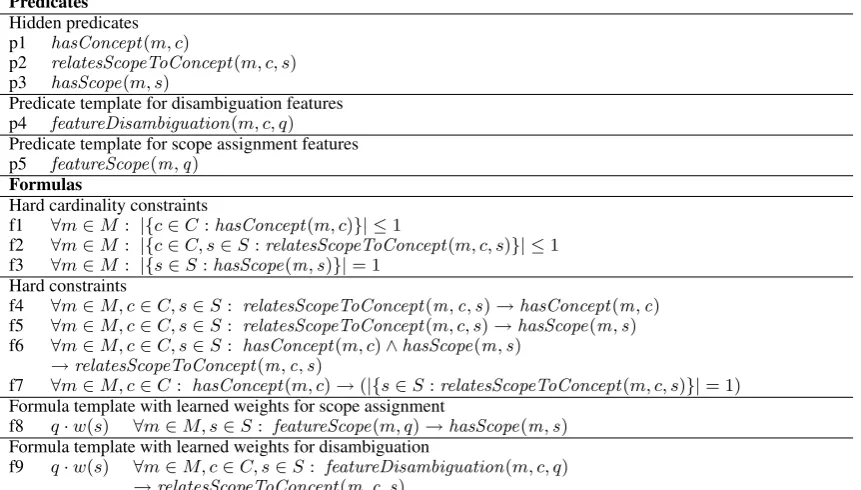
Table 1 shows the core of our proposed ap-proach in terms of predicates and first-order logic formulas. We build upon our previous approach for joint concept disambiguation and clustering (Fahrni and Strube, 2012). For brevity, we only discuss the scope-aware extension of the disam-biguation part. The extension for clustering is done analogously.
The purpose of assigning a scope to each mention m is to learn scope-specific weights for disambiguation to account for heteroge-nous scopes of mentions. The learned weights are parametrized by scopes. We indicate this parametrization of learned weights by w(s) (cf. Table 1,f8,f9).
For each relation to predict, a hidden predicate is defined. We are interested in predicting two relations: a relation between a mention m and a concept c (p1: hasConcept(m, c)) and a relation between a mention m and a scopes (p3: hasS-cope(m, s)). To bridge between the disambigua-tion and the scope assignment task a third hid-den predicaterelatesScopeToConcept(m, c, s)(p2) models a relation between a mentionm, a concept cand a scopes. This predicate together with For-mulasf4−f7 garantuees that the scope assign-ment and the selection of a concept for a assign-mention influence each other and that the ground hidden predicates are in accordance.4 Hard cardinality
constraints (f1, f2, f3) enforce that each mention mis assigned exactly one scopesand at most one conceptc.
The hidden predicates and formulas form the core. Features for the disambiguation and the scope assignment tasks are incorporated using lo-cal and global formulas with learned weights. The features are described in Section 3.2. Table 1 gives formula templates for both tasks (please note that these are templates not formulas (Section 3.2)): (1) a template for formulas that add information for scope assignment (f8) and (2) a template for formulas that add information for disambigua-tion (f9). All formulas with scope-parametrized weights that are relevant for the concept prediction task are defined for the predicate relatesScopeTo-Concept. This enables us to activate the relevant
4We also run experiments with just two hidden predi-cates, i.e.hasConcept(m, c)and hasScope(m, s). All for-mulas with learned weight were then defined in the fol-lowing, less efficient way: ∀m ∈ M, c ∈ C, s ∈ S :
featureDisambiguation(m, c, q) → hasConcept(m,c)∧
Predicates Hidden predicates p1 hasConcept(m, c)
p2 relatesScopeToConcept(m, c, s)
p3 hasScope(m, s)
Predicate template for disambiguation features p4 featureDisambiguation(m, c, q)
Predicate template for scope assignment features p5 featureScope(m,q)
Formulas
Hard cardinality constraints
f1 ∀m∈M: |{c∈C:hasConcept(m, c)}| ≤1
f2 ∀m∈M: |{c∈C, s∈S:relatesScopeToConcept(m, c, s)}| ≤1
f3 ∀m∈M: |{s∈S:hasScope(m,s)}|= 1
Hard constraints
f4 ∀m∈M, c∈C, s∈S: relatesScopeToConcept(m,c,s)→hasConcept(m,c)
f5 ∀m∈M, c∈C, s∈S: relatesScopeToConcept(m, c, s)→hasScope(m,s)
f6 ∀m∈M, c∈C, s∈S: hasConcept(m, c)∧hasScope(m,s) →relatesScopeToConcept(m,c,s)
f7 ∀m∈M, c∈C: hasConcept(m, c)→(|{s∈S :relatesScopeToConcept(m, c, s)}|= 1)
Formula template with learned weights for scope assignment
f8 q·w(s) ∀m∈M, s∈S: featureScope(m, q)→hasScope(m,s)
Formula template with learned weights for disambiguation
[image:4.595.86.517.66.311.2]f9 q·w(s) ∀m∈M, c∈C, s∈S : featureDisambiguation(m, c, q) →relatesScopeToConcept(m,c,s)
Table 1: Predicates and formulas used for scope distinction and disambiguation (mrepresents a mention, M sets of mentions,ca concept,Csets of concepts,sa scope,Ssets of scopes,qscores,wweights and w(s)a weight which is parametrized bys). The two template predicates and formulas are generalized patterns to integrate the features for the scope assignment and disambiguation task (Section 3.2).
scope-specific weightsw(s)which depend on the chosen scope s. The final weight for a formula can also include a scoreqdefined by the observed predicate.
3.2 Features
For disambiguation and clustering we build upon our previous work (Fahrni and Strube, 2012). We use the same features and formulas and adopt the latter to learn scope-specific weights. Given for example the local context similarity feature (pred-icatehasContextSimilarity(m, c, q)whereq is the similarity score) and the corresponding formula
∀m∈M, c∈Cm: hasContextSimilarity(m, c, q)
→hasConcept(m, c)
with weight (q·w) we adopt it in the following way (cf. Table 1, templatef9):
∀m∈M, s∈S, c∈Cm:
hasContextSimilarity(m, c, q) →relatesScopeToConcept(m, c, s)
with weight(q·w(s)).
In order to distinguish between the three pro-posed scopes, we use the features described in Ta-ble 2. The first column shows the predicate which can be used for templatef8in Table 1.
4 Experiments
We compare our novel scope-aware approach to our previous scope-ignorant approach (Fahrni and Strube, 2012) – which has achieved good results in the English monolingual and Chinese and Span-ish cross-lingual entity linking tasks at TAC 2012 and 2013 (Fahrni et al., 2014) – and a scope-aware pipeline-based approach using the same features and preprocessing to ensure a fair comparison. This allows us to identify the differences in the results that are due to scope-awareness and differ-ences in the results that are due to different learn-ing strategies (joint vs. pipeline-based). In addi-tion, we compare our joint scope-aware approach to state-of-the-art approaches using various data sets.
4.1 Data
con-Predicates Description
Mention-based Features
idfHead(m,q) The more frequent a mention is, the more likely it is to exert a local scope. This is inspired by work on indexing for IR. We use the idf score of the head of a mention according the English Gigaword Corpus (Parker et al., 2011).
propernoun(m) Proper nouns are usually more prominent than common nouns and are more likely to have an intermediate or global scope than common nouns.
singlewordNoun(m) Single word NPs are often less prominent than multi-word NPs and are more likely to be of local scope.
abbrev(m) Abbreviations with a terminal dot such asMr.orLtd.tend to have a local scope as they are usually local modifiers or specifications.
Features Based on Modification
isPreModified(m) If a mention is pre-modified, it tends to be more prominent than unmodified mentions. If a mention is more prominent, it is more likely to have a larger scope.
headOfRelClause(m) Mentions that are the head of a relative clause are usually more prominent and are more likely to have an intermediate or global scope.
Features Based on the Text Structure
inSubjPosition(m) Mentions in theme position, which is in English often the subject, tend to pick up what has already been mentioned before (Daneˇs, 1974). Since this is not just the case on the reference-level, but also on the concept-level, the mention in theme position tends to be related to other mentions in the text and tends to have an intermediate or global scope.
posInSentence(m,q) The earlier a mention appears in the sentence in English, the more thematic it is, and the more likely it has an intermediate or global scope.
focusingAdverb(m) Focusing adverbs in the text pattern<focusing adverb> <mention>– e.g. “particularlyJack” – indicate that the mention is thematic and therefore has larger scope.
modifiesArgument(m) A premodifier of a verbal argument is usually more likely to be of local scope.
passiveBy(m) A passive construction – e.g. “the thief was catched by the police” – is a way to reduce the prominency of the agent (e.g.police). The agent tends to be of local scope.
inConjunction(m) Conjunctions are often used for exemplifications. Therefore mentions in conjunctions are often less prominent.
inDepRelPP(m1,m2)
inDepRelGen(m1,m2)
In NPs with prepositional or genitive modifiers usually at most one part – either the modifying NP or the head – has intermediate or global scope.
morphoTiesHead(m,q) The more frequent the head of a mention appears in the text – also as a derivation, e.g. a verb, according to CatVar (Habash and Dorr, 2003) –, the more prominent it is.
[image:5.595.73.532.69.433.2]positionInText(m,q) The earlier a mention appears in text, the more likely it is to exhibit global cohesive scope (cf. the hard-to-be-beat lead baseline in summarization (Radev et al., 2003)).
Table 2: Features for cohesive scope distinction.m, m1, m2denote mentions,qa score. The predicates
are plugged in the template formulaf8in Table 1.
Data set No. of Men-tions
Non-NILs NILs Avg. Ambi-guity WP Training 56,372 53,097 3,275 2.31
WP Dev 9,992 9,375 617 2.28
ACE 2005 29,300 27,184 2,116 6.52
ACE 2004 306 257 49 5.04
TAC 2011 2,250 1,124 1,126 6.32
[image:5.595.74.283.490.581.2]MSNBC 756 629 127 5.29
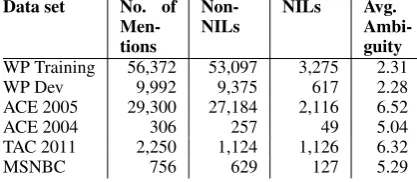
Table 3: Statistics for data sets.
cept). The average ambiguity of mentions is given by our lexicon (see Section 4.2).
Our system is exclusively trained on the internal hyperlinks in Wikipedia with the advantage that no manual annotation effort is needed. We use 500 ar-ticles for training and 100 arar-ticles for development (Fahrni and Strube, 2012). Each internal hyper-link is considered as an annotated mention. The pointer to the Wikipedia article serves as the cor-rect concept for this mention and all other
candi-date concepts we obtain from our lexicon as wrong concepts for this mention.
For the detailed analysis of our approach, we use a version of the ACE 2005 corpus which con-tains Wikipedia link annotations (Bentivogli et al., 2010). All ACE mentions, both common and proper nouns, are annotated with one or more links to the English Wikipedia or as NILs. If a men-tion is annotated with more than one link, we con-sider it as correctly disambiguated if one of the an-notated concepts has been chosen by our system. ACE 2005 consists of 597 texts from newswire re-ports, broadcast news, internet sources and tran-scribed audio data and contains more annotations than the other data sets we use for comparison.
4.2 Preprocessing
The training, development and testing data are all preprocessed in the same way. We perform POS tagging, syntactic parsing and named entity recog-nition using theStanford CoreNLPpipeline5. For
identifying mentions we extract all noun phrases (excluding discontinuous phrases and determin-ers) and look them up in our lexicon. Our lex-icon and also all other information we obtained from Wikipedia are extracted from the same En-glish Wikipedia dump.6 The lexicon consists of
anchor texts, article titles and redirects.
4.3 Settings
Upper bound:The upper bound shows the maxi-mum performance we can reach given our lexicon and preprocessing. If the correct concept is among the candidate concepts of a mention, it is consid-ered as correct.
First Concept: The first concept baseline is a strong baseline in disambiguation. It chooses for each mention its most frequent concept.
Scope-ignorant (Disambig.): Our previous MLN-based approach for concept disambiguation (Fahrni and Strube, 2012).
Scope-ignorant (Disambig. & Clust.): Our pre-vious MLN-based approach for joint disambigua-tion and clustering of concepts (Fahrni and Strube, 2012).
Pipeline-based Scope-aware (Disambig.): We compare our joint approach to a pipeline-based one in which the assignment of the cohesive scope is done before disambiguation. The features for the scope assignment and the disambiguation task are exactly the same as in the joint setting and implemented in Markov Logic. The weights for the scope assignment and disambiguation task are learned in a cascaded way. In contrast to the joint approach, thehasScope(m, s)predicate is ob-served during disambiguation.
Joint Scope-aware (Disambig.): This is our ap-proach as described in Section 3 for concept dis-ambiguation. As only local optimization is possi-ble, initialization is crucial. We use the same ini-tialization strategy as for the cascaded approach.
Joint Scope-aware (Disambig. & Clust.):This is our approach as described in Section 3 for disam-biguation and clustering of concepts.
5http://nlp.stanford.edu/software/
corenlp.shtml
6We use the English Wikipedia dump from Jan. 4, 2012.
4.4 Analysis of Scope-awareness on ACE 2005
In Table 4 we report precision (P), recall (R) and F-measure (F) for non-NILs and NILs for the ACE 2005 data. We also report overall accuracy (Acc) (aka micro-average) and calculate significance us-ing a paired t-test.
Differences in the results can be exclusively traced back to differences in the modeling (scope-ignorant vs. scope-aware) and learning (pipeline-based vs. joint). Learning scope-specific models (pipeline-based or joint) significantly improves the result withp <0.01while using the same features for disambiguation. Scope-aware joint approaches significantly outperform the other corresponding approaches (pipeline-based and scope-ignorant) that use the same features for disambiguation (and clustering) with p < 0.01. While the pipeline-based approach suffers from error propagation, the joint approach also benefits from the learn-ing strategy: learnlearn-ing weights for scope distinction can be guided by the training data available for the disambiguation task. Joint disambiguation and clustering of mentions improves the disambigua-tion results for both the scope-ignorant (Fahrni and Strube, 2012) and the scope-aware approach.
As Table 4 indicates, the gain of the joint scope-aware approach with respect to non-NILs is sub-stantial in both precision and recall. For NILs the recall improves while the precision decreases. This leads to a slightly worse F-Measure for the NILs. As NILs are much rarer than non-NILs in the corpus, the overall accurracy for which we op-timize is significantly higher for the scope-aware approaches.
re-Non-NILs NILs
P R F P R F Acc
Upper bound 94.8 91.8 93.3 71.3 100.0 83.3 92.4
First Concept 68.6 70.0 69.3 55.3 40.3 46.6 67.9
[image:7.595.84.515.64.165.2]Scope-ignorant (Disambig.) (Fahrni & Strube 2012) 77.3 76.0 76.6 44.7 54.2 49.0 74.4 Scope-ignorant (Disambig. & Clust.) (Fahrni & Strube 2012) 76.8 76.9 76.9 50.2 50.0 50.1 74.9 Pipeline-based Scope-aware (Disambig.) 80.1 75.8 77.9 37.3 63.4 47.0 74.9 Joint Scope-aware (Disambig.) 80.1 76.6 78.3 39.2 61.5 47.9 75.5 Joint Scope-aware (Disambig. & Clust.) 80.3 77.1 78.6 40.8 62.1 49.3 76.0
Table 4: Evaluation on ACE 2005 data
Scope-ignorant Approach (Disambig. & Clust.) (Fahrni & Strube 2012) (Acc)
Joint Scope-aware Approach
(Disambig. & Clust.) (Acc) Scope Distribution (%)
Global Scope 73.20 75.99 8.54 Intermediate Scope 76.34 76.64 31.05 Local Scope 75.57 76.84 60.40
[image:7.595.79.521.66.262.2]Total 75.61 76.71 100.00
Table 5: Evaluation on ACE 2005 data across induced scopes. The accurracy of the two compared systems is slightly higher than in Table 4 as we consider here only mentions that have been recognized by our mention identification strategy. In the evaluation in Table 4 mentions that have not been recognized are considered as wrong.
spectively. A comparison of the learned weights for the different scope-specific models shows that for mentions with local scope the local context has relatively more weight than for mentions with in-termediate scope. For mentions with global scope, it is striking that candidiate concepts that are not related to the global context are relatively higher punished than in the other two models.
To obtain some insights on the behaviour of the joint scope-aware approach, we investigate some examples. In a text on the 2004 US elections, the mentionKerryin “Kerrywas the clear winner, but victory was snatched from him” is wrongly disam-biguated to KERRY GAA, a branch of the Gaelic football association, by the scope-ignorant ap-proach, because the local context strongly prefers an interpretation in the domain of sports. In the joint scope-aware approach,Kerryis assigned global scope, and it is correctly disambiguated to JOHN KERRY, an American politician, as the global relatedness overrules the local context in this model. In another text on U.S. troops in Iraq, the scope-ignorant approach disambiguates
south in “Monday’s advances came one day af-ter British forces in thesouth made their deepest push into Iraq’s second largest city” to SOUTHERN UNITED STATES as concepts related to the USA are quite prominent in the text. In the scope-aware approach south is considered as being of local scope and is correctly disambiguated as SOUTH. In “we happen to be at a very nice spot by the
beach where this is a chance for people to get away from cnn coverage” spot is disambiguated as SPOT (SATELLITE) in the scope-ignorant ap-proach (misled by CNN), while it has been cor-rectly recognized as NIL by the scope-aware ap-proach in which it is considered as being of intmediate scope. The remaining disambiguation rors can be traced back to (1) scope assignment er-rors and (2) disambiguation erer-rors (e.g.Palmisano
(global scope) is disambiguated as SAMUEL J. PALMISANO, but the text refers to a different un-known Palmisano).
4.5 Comparison to State-of-the-art Approaches
Compared to the state-of-the-art for concept and entity disambiguation our approach performs fa-vorably (Table 6). On ACE 2004 (Ratinov et al., 2011) – which contains annotations for com-mon and proper nouns and fits our target scenario most – our scope-aware approach outperforms re-cent state-of-the-art approaches for concept and entity disambiguation, i.e. Ratinov et al. (2011) and Cheng and Roth (2013). We also ran Rati-nov et al.’s (2011) sytem on ACE 2005, but it seems that its mention recognition is not designed for ACE 2005.
System ACE 2004 MSNBC TAC 2011
BOC BOC Acc B3P B3R B3F1
Ratinov et al. 2011; Cogcomp 77.3 74.9 78.7 75.7 76.5 76.1
Cheng & Roth 2013 85.3 81.2 86.1 82.9 84.5 83.7
Monahan et al. 2011 (Best System at TAC 2011) 86.1 84.4 84.7 84.6
[image:8.595.65.523.62.136.2]Scope-ignorant (Disambig. & Clust.) (Fahrni & Strube 2012) 83.4 76.5 84.8 82.5 83.0 82.8 Joint Scope-aware (Disambig. & Clust.) 86.3 79.0 85.5 83.6 82.7 83.1 Table 6: Evaluation on various data sets using the respective standard evaluation metrics. BOCstands for Bag-of-Concepts. We use the code of Ratinov et al. (2011) to evaluate on ACE 2004 and MSNBC. For TAC 2011, we use the offical evaluation script and report the micro-average (Acc) and B3 scores.
Note that for TAC we use three additional disambiguation features – they measure the similarity of the article name to the context – both in the scope-ignorant and the scope-aware approach.
achieves competitive performance without train-ing on TAC data. On all data sets, the joint scope-aware approach consistently outperforms the scope-ignorant approach ceteris paribus.
5 Related Work
Joint approaches have been successful in the past in NLP (e.g. Meza-Ruiz and Riedel (2009)). The idea of augmenting a model with additional latent variables to increase its expressiveness is known as
hiddenor latent variable learning(Smith, 2011) and is a promising research direction with success-ful applications in e.g. syntactic parsing (Petrov et al., 2006), statistical machine translation (Blun-som et al., 2008) and sentiment analysis (Yesse-nalina et al., 2010; Trivedi and Eisenstein, 2013). For latent variable learning generative approaches (Petrov et al., 2006), large margin methods (Smith, 2011) and conditional log-linear models have been proposed. We focus here on conditional log-linear models due to their flexibility and their previous success for many tasks. Blunsom et al. (2008) for instance use latent variables in the context of discriminative machine translation and model the derivation as a latent variable. Chang et al. (2010) is close to our approach, as their latent variable ap-proach also uses ILP. Poon and Domingos (2008) also use latent variables with Markov Logic, al-though with a completely different aim, i.e. for un-supervised coreference resolution.
Most approaches that use Wikipedia as a re-source for disambiguation focus on named enti-ties (Bunescu and Pas¸ca, 2006; Cucerzan, 2007; Dredze et al., 2010; Ji and Grishman, 2011; Hachey et al., 2013; Hoffart et al., 2011), while only a few disambiguate common and proper nouns like us (Csomai and Mihalcea, 2008; Milne and Witten, 2008; Zhou et al., 2010; Ratinov et al., 2011; Cheng and Roth, 2013). We build upon our
previous Markov Logic based approach for joint concept disambiguation and clustering (Fahrni and Strube, 2012). In contrast to us, most approaches for lexical disambiguation use either one model for all mentions (Milne and Witten, 2008; Rati-nov et al., 2011) or a separate model for each men-tion or concept which requires a lot of training data (e.g. Bryl et al. (2010)). Only a few approaches try to learn specific models for groups of mentions, although none of them is discourse-motivated as ours: Mihalcea and Csomai (2005) learn a specific model for each POS, Ando (2006) uses alternating structure optimization to simultantanously learn a number of WSD problems and Dhillon and Ungar (2009) improve feature selection for WSD by in-tegrating knowledge from similar words.
6 Conclusions
In this paper, we discuss the relationship between cohesion and concept disambiguation and pro-pose a cohesive scope-aware disambiguation ap-proach. We distinguish between three different co-hesive scopes (local, intermediate and global) and model the scope assignment and the disambigua-tion jointly using latent variables in the framework of MLN. The joint scope-aware approach signifi-cantly improves over both a state-of-the-art and a pipeline-based approach using the same features for the disambiguation task.
For future work, we are planning to investigate the relation between discourse structure and co-hesive scope more deeply and to integrate scope-specific disambiguation features.
Acknowledgments
References
Rie Kubota Ando. 2006. Applying alternating struc-ture optimization to word sense disambiguation. In
Proceedings of the 10th Conference on Computa-tional Natural Language Learning,New York, N.Y., USA, 8–9 June 2006, pages 77–84.
Nicholas Asher and Alex Lascarides. 1995. Lexical disambiguation in a discourse context. Journal of Semantics, 12(1):69–108.
Luisa Bentivogli, Pamela Forner, Claudio Giu-liano, Alessandro Marchetti, Emanuele Pianta, and Kateryna Tymoshenko. 2010. Extending English ACE 2005 corpus annotation with ground-truth links to Wikipedia. In Proceedings of the 2nd Work-shop on The People’s Web: Colloboratively Con-structed Semantic Resources,Beijing, China, 28 Au-gust 2010, pages 19–27.
Phil Blunsom, Trevor Cohn, and Miles Osborne. 2008. A discriminative latent variable model for statisti-cal machine translation. InProceedings of the 46th Annual Meeting of the Association for Computa-tional Linguistics: Human Language Technologies,
Columbus, Ohio, 15–20 June 2008, pages 200–208.
Volha Bryl, Claudio Giuliano, Luciano Serafini, and Kateryna Tymoshenko. 2010. Supporting natu-ral language processing with background knowl-edge: Coreference resolution case. InProceedings of the 9th International Semantic Web Conference, Revised Selected Papers, Part I,Shanghai, China, 7-11 November 2010, pages 80–95.
Razvan Bunescu and Marius Pas¸ca. 2006. Using en-cyclopedic knowledge for named entity disambigua-tion. In Proceedings of the 11th Conference of the European Chapter of the Association for Compu-tational Linguistics, Trento, Italy, 3–7 April 2006, pages 9–16.
Ming-Wei Chang, Vivek Srikumar, Dan Goldwasser, and Dan Roth. 2010. Structured output learning with indirect supervision. In Proceedings of the 27th International Conference on Machine Learn-ing,Haifa, Israel, 21–24 June 2010, pages 199–206.
Xiao Cheng and Dan Roth. 2013. Relational infer-ence for Wikification. In Proceedings of the 2013 Conference on Empirical Methods in Natural Lan-guage Processing, Seattle, Wash., 18–21 October 2013, pages 1787–1796.
Andras Csomai and Rada Mihalcea. 2008. Linking documents to encyclopedic knowledge. IEEE Intel-ligent Systems, 23(5):34–41.
Silviu Cucerzan. 2007. Large-scale named entity disambiguation based on Wikipedia data. In Pro-ceedings of the 2007 Joint Conference on Empirical Methods in Natural Language Processing and Com-putational Language Learning, Prague, Czech Re-public, 28–30 June 2007, pages 708–716.
Frantiˇsek Daneˇs. 1974. Functional sentence perspec-tive and the organization of the text. In F. Daneˇs, editor, Papers on Functional Sentence Perspective, pages 106–128. Prague: Academia.
Paramveer S. Dhillon and Lyle H. Ungar. 2009. Trans-fer learning, feature selection and word sense dis-ambguation. In Proceedings of the ACL-IJCNLP 2009 Conference Short Papers,Singapore, 2–7 Au-gust 2009, pages 257–260.
Pedro Domingos and Daniel Lowd. 2009. Markov Logic: An Interface Layer for Artificial Intelligence. Morgan Claypool Publishers.
Mark Dredze, Paul McNamee, Delip Rao, Adam Ger-ber, and Tim Finin. 2010. Entity disambigua-tion for knowledge base populadisambigua-tion. In Proceed-ings of the 23rd International Conference on Com-putational Linguistics, Beijing, China, 23–27 Au-gust 2010, pages 277–285.
Angela Fahrni and Michael Strube. 2012. Jointly disambiguating and clustering concepts and entities with Markov logic. InProceedings of the 24th Inter-national Conference on Computational Linguistics,
Mumbai, India, 8–15 December 2012, pages 815– 832.
Angela Fahrni, Benjamin Heinzerling, Thierry G¨ockel, and Michael Strube. 2014. HITS’ monolin-gual and cross-linmonolin-gual entity linking system at TAC 2013. InProceedings of the Text Analysis Confer-ence, National Institute of Standards and Technol-ogy, Gaithersburg, Maryland, USA, 18–19 Novem-ber 2013.
Nizar Habash and Bonnie Dorr. 2003. A catego-rial variation database for English. In Proceed-ings of the Human Language Technology Confer-ence of the North American Chapter of the Associ-ation for ComputAssoci-ational Linguistics,Edmonton, Al-berta, Canada, 27 May –1 June 2003, pages 17–23. Ben Hachey, Will Radford, Joel Nothman, Matthew
Honnibal, and James R. Curran. 2013. Evaluat-ing entity linkEvaluat-ing with Wikipedia. Artificial Intel-ligence, 194:130–150.
Aria Haghighi and Lucy Vanderwende. 2009. Explor-ing content models for multi-document summariza-tion. InProceedings of Human Language Technolo-gies 2009: The Conference of the North American Chapter of the Association for Computational Lin-guistics,Boulder, Col., 31 May – 5 June 2009, pages 362–370.
M. A. K. Halliday and Ruqaiya Hasan. 1976. Cohe-sion in English. London, U.K.: Longman.
Processing, Edinburgh, Scotland, U.K., 27–29 July 2011, pages 782–792.
Heng Ji and Ralph Grishman. 2011. Knowledge base population: Successful approaches and challenges. InProceedings of the 49th Annual Meeting of the As-sociation for Computational Linguistics, Portland, Oreg., 19–24 June 2011, pages 1148–1158.
Heng Ji, Ralph Grishman, and Hoa Dang. 2011. Overview of the TAC 2011 knowledge base popula-tion track. InProceedings of the Text Analysis Con-ference,National Institute of Standards and Technol-ogy, Gaithersburg, Maryland, USA, 14–15 Novem-ber 2011.
Sayali Kulkarni, Amit Singh, Ganesh Ramakrishnan, and Soumen Chakrabarti. 2009. Collective anno-tation of Wikipedia entities in web text. In Pro-ceedings of the 15th ACM SIGKDD Conference on Knowledge Discovery and Data Mining, Paris, France, 28 June – 1 July 2009, pages 457–466. Daniel Lowd and Pedro Domingos. 2007. Efficient
weight learning for Markov logic networks. In
Proceedings of the 11th European Conference on Principles and Practices of Knowledge Discovery in Databases, Warsaw, Poland, 17–21 September 2007, pages 200–211.
Ivan Meza-Ruiz and Sebastian Riedel. 2009. Jointly identifying predicates, arguments and senses using Markov logic. InProceedings of Human Language Technologies 2009: The Conference of the North American Chapter of the Association for Computa-tional Linguistics, Boulder, Col., 31 May – 5 June 2009, pages 155–163.
Rada Mihalcea and Andras Csomai. 2005. Sense-Learner: Word sense disambiguation for all words in unrestricted text. InProceedings of the Interactive Poster and Demonstrations Sessions at the 43rd An-nual Meeting of the Association for Computational Linguistics, Ann Arbor, Mich., 25–30 June 2005, pages 53–56.
Rada Mihalcea. 2006. Knowledge-based methods for WSD. In E. Agirre and P.G. Edmonds, editors,
Word Sense Disambiguation: Algorithms and Appli-cations, pages 107–131. Springer, Heidelberg, Ger-many.
David Milne and Ian H. Witten. 2008. Learning to link with Wikipedia. In Proceedings of the ACM 17th Conference on Information and Knowledge Man-agement (CIKM 2008),Napa Valley, Cal., USA, 26– 30 October 2008, pages 1046–1055.
Jane Morris and Graeme Hirst. 1991. Lexical cohe-sion computed by thesaural relations as an indicator of the structure of text. Computational Linguistics, 17(1):21–48.
Rani Nelken and Stuart Shieber. 2006. Lexical chain-ing and word-sense-disambiguation. Technical Re-port TR-06-07, Computer Science Group, Harvard University, Cambridge, Mass.
Robert Parker, David Graff, Junbo Kong, Ke Chen, and Kazuaki Maeda. 2011. English Gigaword Fifth Edi-tion. LDC2011T07.
Slav Petrov, Leon Barrett, Romain Thibaux, and Dan Klein. 2006. Learning accurate, compact, and interpretable tree annotation. In Proceedings of the 21st International Conference on Computational Linguistics and 44th Annual Meeting of the Associ-ation for ComputAssoci-ational Linguistics, Sydney, Aus-tralia, 17–21 July 2006, pages 433–440.
Hoifung Poon and Pedro Domingos. 2008. Joint unsu-pervised coreference resolution with Markov Logic. InProceedings of the 2008 Conference on Empirical Methods in Natural Language Processing,Waikiki, Honolulu, Hawaii, 25–27 October 2008, pages 650– 659.
Dragomir R. Radev, Simone Teufel, Horacio Saggion, Wai Lam, John Blitzer, Hong Qi, Arda Celebi, Danyu Liu, and Elliott Drabek. 2003. Evaluation challenges in large-scale document summarization. InProceedings of the 41st Annual Meeting of the As-sociation for Computational Linguistics, Sapporo, Japan, 7–12 July 2003, pages 375–382.
Lev Ratinov, Dan Roth, Doug Downey, and Mike An-derson. 2011. Local and global algorithms for dis-ambiguation to Wikipedia. In Proceedings of the 49th Annual Meeting of the Association for Com-putational Linguistics, Portland, Oreg., 19–24 June 2011, pages 1375–1384.
Sebastian Riedel. 2008. Improving the accuracy and efficiency of MAP inference for Markov logic. In
Proceedings of the 24th Conference on Uncertainty in Artificial Intelligence, Helsinki, Finland, 9–12 July 2008, pages 468–475.
Noah A. Smith. 2011. Linguistic Structure Prediction. Morgan & Claypool Publishers.
Rakshit Trivedi and Jacob Eisenstein. 2013. Dis-course connectors for latent subjectivity in sentiment analysis. InProceedings of the 2013 Conference of the North American Chapter of the Association for Computational Linguistics: Human Language Tech-nologies, Atlanta, Georgia, 9–14 June 2013, pages 808–813.
Ainur Yessenalina, Yejin Choi, and Claire Cardie. 2010. Automatically generating annotator rationales to improve sentiment classification. InProceedings of the 48th Annual Meeting of the Association for Computational Linguistics, Uppsala, Sweden, 11– 16 July 2010, pages 336–341.