Zero subject detection for Polish
Mateusz Kope´c
Institute of Computer Science, Polish Academy of Sciences, Jana Kazimierza 5, 01-248 Warsaw, Poland
Abstract
This article reports on the first machine learning experiments on detection of null subjects in Polish. It emphasizes the role of zero subject detection as the part of mention detection – the initial step of end-to-end coreference resolution. Anaphora resolution is not studied in this article.
1 Introduction
Zero subject detection is an important issue for anaphora and coreference resolution for the null-subject languages, including all Balto-Slavic lan-guages and most Romance lanlan-guages. Their dis-tinctive feature is the possibility for an indepen-dent clause to lack an explicit subject. Person, number, and/or gender agreement with the refer-ent is indicated by the morphology of the verb: (1) Maria wróciła ju˙z z Francji. ØSp˛edziła tam
miesi ˛ac.
“Maria came back from France. ØHadsingular:femininespent
a month there.”
The recently created Polish Coreference Cor-pus1 (PCC) (Ogrodniczuk et al., 2013) contains
zero subject annotation. A markable representing the null subject is the verbal form following the position where the argument would have been ex-pected. As tested on the development part of the corpus (described in detail later), omitting a per-sonal pronoun is a frequent issue in the Polish lan-guage – about 30% of verbs do not have explicit subjects. Russo et al. (2012) reports similar fig-ures for Italian (30.42%) and Spanish (41.17%).
Moreover, these null subjects are often part of large coreference clusters – the average size of a non-singleton coreference cluster in the develop-ment subcorpus was 3.56 develop-mentions. At the same
1Publicly available at http://zil.ipipan.waw.
pl/PolishCoreferenceCorpus.
time, the non-singleton coreference cluster con-taining at least one zero subject had on average 5.89 mentions.
A mention detection module heavily influences the final coreference resolution score of an end-to-end coreference resolution system. In Ogrod-niczuk and Kope´c (2011a) the system working on gold mentions achieved 82.90% F1 BLANC (Re-casens and Hovy, 2011), whereas on system men-tions the result dropped to 38.13% (the zero sub-ject detection module was not implemented).
The aim of this paper is to find a method of au-tomatic zero subject detection to improve the ac-curacy of mention detection as the initial step of coreference resolution.
2 Related Work
We present some of the most recent articles about machine learning zero subject detection.
Rello et al. (2012b) describes a Brazilian Por-tuguese corpus with 5665 finite verbs total, out of which 77% have an explicit subject, 21% a zero pronoun and 2% are impersonal construc-tions. They extract various verb, clause and neigh-boring token features for each verb occurrence and classify it into one of these 3 classes, achieving 83.04% accuracy of a decision tree learning classi-fier, better than the baseline result of thePalavras parser. A very similar study is conducted also for Spanish (Rello et al., 2012a), with the best result of the lazy learning classifier K∗ (Cleary and Trigg, 1995) of 87.6% accuracy, outperform-ing the baseline ofConnexorparser.
Chinese zero pronoun detection and resolution is presented by Zhao and Ng (2007). Features for zero pronoun identification consider mainly the gold standard parse tree structure. Their training corpus contained only 343 zero pronouns, as com-pared to 10098 verbs with explicit subjects – for Chinese, the phenomenon is much less frequent than for Polish or Spanish. Therefore they weigh
positive and negative examples to get the balance between precision and recall – the best result of 50.9%F1 measure for positive to negative exam-ple weight ratio of 8:1 is reported.
A study for the Romanian language (Mihaila et al., 2011) describes a corpus consisting of 2741 sentences and 997 zero pronouns. Class imbalance is solved by training machine learning algorithms on all positive examples (zero pronouns) and the same number of negative examples (sampled from the corpus). Features used consider morphosyn-tactic information about the verb, precedence of the reflective pronoun “se” and the number of verbs in the sentence. Their best ensemble clas-sifier scored 74.5% accuracy.
Only a few studies (for example (Broda et al., 2012; Ogrodniczuk and Kope´c, 2011b; Kope´c and Ogrodniczuk, 2012)) consider the problem of rule-based or machine learning coreference resolution for the Polish language, however these attempts leave zero subject detection as a non-trivial task for further study.
3 Problem statement
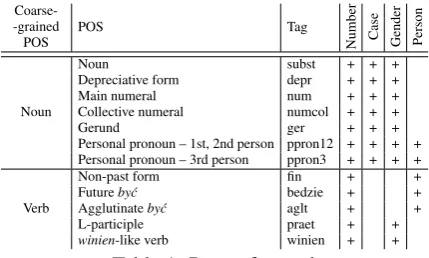
Table 1 presents part of speech definitions as-sumed in this article, based on the book about the National Corpus of Polish (Przepiórkowski et al., 2012). Coarse-grained POS indicates whether a word with a given part of speech may be a subject (Noun) or a verb (Verb) in a sentence. The last four columns present which morphosyntactic informa-tion is available for each part of speech. There are few differences in this definition with respect to the original approach in the book:
• We treat numerals, gerunds and pronouns as Nouns – because they are frequently sub-jects of the sentence and have the same morphosyntactic information as “standard” nouns.
• We do not consider siebie(“self”, tradition-ally treated as pronoun) as aNoun, as it can-not be a subject.
• Tags: impt, imps, inf, pcon, pant, pact, ppas, pred, which are traditionally considered verb tags, are not treated by us asVerbs, because they cannot have a subject.
With such a definition of parts of speech, our task may be stated as follows: given a clause with aVerb, decide whether the clause contains aNoun
Coarse--grained
POS POS Tag Number Case Gender Person
Noun
Noun subst + + +
Depreciative form depr + + +
Main numeral num + + +
Collective numeral numcol + + +
Gerund ger + + +
Personal pronoun – 1st, 2nd person ppron12 + + + + Personal pronoun – 3rd person ppron3 + + + +
Verb
Non-past form fin + +
Futureby´c bedzie + +
Agglutinateby´c aglt + +
L-participle praet + +
[image:2.595.308.523.61.190.2]winien-like verb winien + +
Table 1: Parts of speech
which is theVerb’sexplicit subject. From now on in this paper, the words “noun” and “verb” have the meaning of Noun and Verb, respectively. In this study, we do not try to handle the cases of subjects not being nouns, as judging from our ob-servations, it is very infrequent. We do take into account in our solution the cases of the subject not in thenominativecase, as in the example:
(2) Pieni˛edzynoun:genitivenie starczy dla
wszys-tkich.
“There wouldn’t be enough money for everyone.”
It is worth noting that Polish is a free-word-order language, therefore there are many possible places for the subject to appear, with respect to the position of the verb.
As the corpus has only automatic morphosyn-tactic information available (provided by the PAN-TERA tagger (Aceda´nski, 2010)), not corrected by the coreference annotators, the only verbs consid-ered in this study are the ones found by the tag-ger. If such a verb was marked as a mention by the coreference annotator (verb mention in table 2), it is a positive example for our machine learn-ing study, otherwise a negative one. Sentence and clause segmentation in the corpus was also auto-matic. We are aware that the corpus used for the study was not perfectly suited for the task – verbs with a zero subject are not marked there explicitly, but can only be found based on automatic tagging. However the tagging error of detecting verbs is re-ported as not higher than 0.04% (for the fin tag, see (Aceda´nski, 2010) for details), so we consider the resource sufficiently correct.
4 Development and evaluation data
Corpus # texts # sentences # tokens # verbs # mentions # verb mentions Development 390 6481 110379 10801 37250 3104 Evaluation 389 6737 110474 11000 37167 3106 Total 779 13218 220853 21801 74417 6210
Table 2: Zero subject study data statistics
of Polish (Przepiórkowski et al., 2012). At the time this study started, 779 out of 1773 texts (ran-domly chosen) of the Polish Coreference Corpus were already manually annotated. Annotated texts were randomly split into two equal-sized subcor-pora for development and evaluation. Their de-tailed statistics are presented in Table 2.
4.1 Inter-annotator agreement
210 texts of the Polish Coreference Corpus were annotated independently by two annotators. This part was analyzed for the inter-annotator agree-ment of deciding if a verb has a zero subject or not. In the data there were 5879 verbs total, for which observed agreement yielded 92.57%. Agreement expected by chance (assuming a per annotator chance annotation probability distribu-tion) equalled 57.52%, therefore chance-corrected Cohen’sκfor the task equalled 82.51%.
4.2 Results of full dependency parsing The first Polish dependency parser was recently developed and described by Wróblewska (2012). The author reports 71% LAS2 and 75.2% UAS3
performance of this parser. This parser was used to detect null subjects – every verb lacking the dependency relation of the subject type (subj) was marked as missing the subject. This base-line method achieved accuracy of 67.23%, preci-sion of 46.53%, recall of 90.47% andF1 equal to 61.45%. These results are worse than a simple ma-jority baseline classifier, therefore current state-of-the-art Polish dependency parsing is not a satisfac-tory solution to the task stated in this article.
5 Features
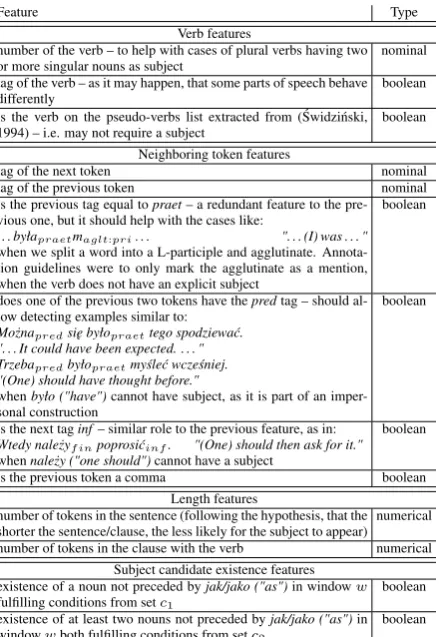
Based on a number of experiments on the develop-ment corpus, we chose a number of features pre-sented in table 3.
Subject candidate existence features from the bottom of the table 3 use variables: c1, c2 andw. Separate feature was generated for each combi-nation of these three variables. The variable w
2Labeled attachment score – the percentage of tokens that are assigned a correct head and a correct dependency type.
3Unlabeled attachment score – the percentage of tokens that are assigned a correct head.
represents the window around the verb, with fol-lowing values: the clause containing the verb, the sentence containing the verb, windows of 1 to 5 tokens before the verb, windows of 1 to 5 tokens after the verb, windows of 1 to 5 tokens both be-fore and after the verb. Variable c1 represents compatibility of noun and verb, with values be-ing any nonempty subset of the set of followbe-ing conditions: case of the noun equal to nominative (NOM), number agreement with the verb (NUM), person or gender agreement (POG), depending on which was available to check, see Table 1. Vari-ablec2is similar toc1, with the following values: {NOM}, {POG}, {NOM, POG}.
Feature Type
Verb features
number of the verb – to help with cases of plural verbs having two or more singular nouns as subject nominal tag of the verb – as it may happen, that some parts of speech behave
differently boolean
is the verb on the pseudo-verbs list extracted from (´Swidzi´nski, 1994) – i.e. may not require a subject boolean
Neighboring token features
tag of the next token nominal
tag of the previous token nominal
is the previous tag equal topraet– a redundant feature to the pre-vious one, but it should help with the cases like:
. . . byłapraetmaglt:pri. . . ". . . (I) was . . . "
when we split a word into a L-participle and agglutinate. Annota-tion guidelines were to only mark the agglutinate as a menAnnota-tion, when the verb does not have an explicit subject
boolean
does one of the previous two tokens have thepredtag – should al-low detecting examples similar to:
Mo˙znapredsi˛e byłopraettego spodziewa´c.
". . . It could have been expected. . . . " Trzebapredbyłopraetmy´sle´c wcze´sniej.
"(One) should have thought before."
whenbyło ("have")cannot have subject, as it is part of an imper-sonal construction
boolean
is the next taginf– similar role to the previous feature, as in: Wtedy nale˙zyfinpoprosi´cinf. "(One) should then ask for it."
whennale˙zy ("one should")cannot have a subject
boolean
is the previous token a comma boolean Length features
number of tokens in the sentence (following the hypothesis, that the shorter the sentence/clause, the less likely for the subject to appear) numerical number of tokens in the clause with the verb numerical
Subject candidate existence features existence of a noun not preceded byjak/jako ("as")in windoww fulfilling conditions from setc1
boolean
existence of at least two nouns not preceded byjak/jako ("as")in windowwboth fulfilling conditions from setc2
boolean
Table 3: Features
6 Evaluation
ac-True values null subject explicit subject Predictions explicit subjectnull subject 20931013 7079815
Table 4: Confusion matrix
curacy on the development data. The upper bound of the ITA (as stated earlier) is around 92.57% ac-curacy.
We used 10-fold cross-validation which was re-peated 10 times with different random seeds for training and train/test splits. The average from the total of 100 trials (each cross-validation split sep-arately) was equal to 82.74%, with standard devi-ation of 1.27%. As the Shapiro-Wilk (1965) test for normality for this data gives p-value of 0.38, it may be assumed that it follows the normal distri-bution. In that case, the 95% confidence interval for the accuracy is equal to [82.49%, 82.99%].
6.2 Accuracy on the evaluation corpus The evaluation corpus was used only for two ex-periments presented below: to calculate accuracy and learning curve of the developed solution.
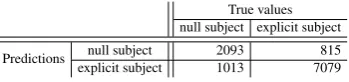
We used the model learnt on the development corpus and tested it on the evaluation corpus, achieving 83.38% accuracy. A majority classifier would achieve 71.76% accuracy on this corpus. The confusion matrix is depicted in Table 4. For finding the null subjects, recall of 67.39% and pre-cision of 71.97% givesF1measure of 69.60%.
6.3 Learning curve
To test how the number of training examples in-fluences the quality of the trained classifier, we used subsets of the development corpus of various sizes as training sets. The test set was the same in all cases (the evaluation corpus). Proportions of the examples used ranged from 5% to 100% of the development corpus, each proportion was tested 10 times to provide an estimation of vari-ance. For example, to evaluate the efficiency of the classifier trained on 5% of the training exam-ples, we randomly sampled 5% of the examexam-ples, trained the classifier and tested it on the full evalu-ation corpus. Then we repeated it another 9 times, randomly choosing a different 5% portion of the examples for training.
Again the Shapiro-Wilk test was taken to assess the normality of results for each proportion, out of 19 proportions tested (the proportion of 1 was of course not tested for normality), only 3 had
p-0.2 0.4 0.6 0.8 1.0
0.79
0.82
Proportion of training set used
Accur
acy on e
v
aluation cor
[image:4.595.95.270.62.103.2]pus
Figure 1: Learning curve
value less than 0.1, therefore we assumed that the data is distributed approximately normally. The 95% confidence intervals of the classifiers trained on a given proportion of the development corpus are shown in the Figure 1. The algorithm clearly benefits from having more training examples. We observe that the curve is generally of the desired shape, yet it flattens when approaching the full training set used. It may suggest that the devel-oped solution would not be able to significantly exceed 84%, even given more training examples.
7 Conclusions and future work
This article presented an efficient zero subject de-tection module for Polish. We highlighted some difficult examples to take into account and pro-posed a solution for the Polish language.
The achieved accuracy of 83.38% significantly exceeds the baseline of majority tagging, equal to 71.76%, but there is still room for improvement, as the upper bound of 92.57% was computed. The achieved result for the task of null subject detec-tion looks promising for the applicadetec-tion in mendetec-tion detection for coreference resolution.
The invented solution needs to be incorporated in a complete coreference resolver for Polish and evaluated for the extent to which using such an ad-vanced separate classifier for zero subject detec-tion improves the mendetec-tion detecdetec-tion and, further-more, end-to-end coreference resolution accuracy.
Acknowledgements
References
Szymon Aceda´nski. 2010. A Morphosyntactic Brill Tagger for Inflectional Languages. In Hrafn Lofts-son, Eiríkur RögnvaldsLofts-son, and Sigrún Helgadóttir, editors,Advances in Natural Language Processing, volume 6233 ofLecture Notes in Computer Science, pages 3–14. Springer.
Bartosz Broda, Łukasz Burdka, and Marek Maziarz. 2012. IKAR: An Improved Kit for Anaphora Res-olution for Polish. InCOLING (Demos), pages 25– 32.
John G. Cleary and Leonard E. Trigg. 1995. K*: An instance-based learner using an entropic distance measure. InIn Proceedings of the 12th International Conference on Machine Learning, pages 108–114. Morgan Kaufmann.
William W. Cohen. 1995. Fast effective rule induc-tion. InIn Proceedings of the Twelfth International Conference on Machine Learning, pages 115–123. Morgan Kaufmann.
Mark Hall, Eibe Frank, Geoffrey Holmes, Bernhard Pfahringer, Peter Reutemann, and Ian H. Witten. 2009. The WEKA data mining software: an update. SIGKDD Explor. Newsl., 11(1):10–18, November. Mateusz Kope´c and Maciej Ogrodniczuk. 2012.
Cre-ating a Coreference Resolution System for Pol-ish. In Proceedings of the Eighth International Conference on Language Resources and Evalua-tion, LREC 2012, pages 192–195, Istanbul, Turkey. ELRA.
Claudiu Mihaila, Iustina Ilisei, and Diana Inkpen. 2011. Zero Pronominal Anaphora Resolution for the Romanian Language. Research Journal on Com-puter Science and ComCom-puter Engineering with Ap-plications” POLIBITS, 42.
Maciej Ogrodniczuk and Mateusz Kope´c. 2011a. End-to-end coreference resolution baseline system for Polish. In Zygmunt Vetulani, editor,Proceedings of the 5th Language & Technology Conference: Hu-man Language Technologies as a Challenge for Computer Science and Linguistics, pages 167–171, Pozna´n, Poland.
Maciej Ogrodniczuk and Mateusz Kope´c. 2011b. Rule-based coreference resolution module for Pol-ish. InProceedings of the 8th Discourse Anaphora and Anaphor Resolution Colloquium (DAARC 2011), pages 191–200, Faro, Portugal.
Maciej Ogrodniczuk, Katarzyna Głowi´nska, Mateusz Kope´c, Agata Savary, and Magdalena Zawisławska. 2013. Polish coreference corpus. pages 494–498. Adam Przepiórkowski, Mirosław Ba´nko, Rafał L.
Górski, and Barbara Lewandowska-Tomaszczyk, editors. 2012. Narodowy Korpus J˛ezyka Polskiego [Eng.: National Corpus of Polish]. Wydawnictwo Naukowe PWN, Warsaw.
Marta Recasens and E. Hovy. 2011. BLANC: Imple-menting the Rand index for coreference evaluation. pages 485–510.
Luz Rello, Ricardo Baeza-Yates, and Ruslan Mitkov. 2012a. Elliphant: Improved Automatic Detection of Zero Subjects and Impersonal Constructions in Spanish. InProceedings of the 13th Conference of the European Chapter of the Association for Com-putational Linguistics, pages 706–715, Avignon, France, April. Association for Computational Lin-guistics.
Luz Rello, Gabriela Ferraro, and Iria Gayo. 2012b. A First Approach to the Automatic Detection of Zero Subjects and Impersonal Constructions in Por-tuguese. Procesamiento del Lenguaje Natural, 49:163–170.
Lorenza Russo, Sharid Loáiciga, and Asheesh Gulati. 2012. Improving machine translation of null sub-jects in Italian and Spanish. In Proceedings of the Student Research Workshop at the 13th Confer-ence of the European Chapter of the Association for Computational Linguistics, pages 81–89, Avignon, France, April. Association for Computational Lin-guistics.
S. S. Shapiro and M. B. Wilk. 1965. An analysis of variance test for normality (complete samples). Biometrika, 52(3/4):591–611, Dec.
Marek ´Swidzi´nski. 1994. Syntactic dictionary of pol-ish verbs.
Alina Wróblewska. 2012. Polish dependency bank. Linguistic Issues in Language Technology, 7(1). Shanheng Zhao and Hwee Tou Ng. 2007.