Improved Statistical Machine Translation for Resource-Poor Languages
Using Related Resource-Rich Languages
Preslav Nakov
Department of Computer Science National University of Singapore
13 Computing Drive Singapore 117417 [email protected]
Hwee Tou Ng
Department of Computer Science National University of Singapore
13 Computing Drive Singapore 117417 [email protected]
Abstract
We propose a novel language-independent approach for improving statistical ma-chine translation for resource-poor lan-guages by exploiting their similarity to resource-rich ones. More precisely, we improve the translation from a
resource-poor source languageX1 into a
resource-rich language Y given a bi-text
contain-ing a limited number of parallel sentences
for X1-Y and a larger bi-text for X2-Y
for some resource-rich language X2 that
is closely related to X1. The evaluation
for Indonesian→English (using Malay) and Spanish→English (using Portuguese and pretending Spanish is resource-poor) shows an absolute gain of up to 1.35 and 3.37 Bleu points, respectively, which is an improvement over the rivaling approaches, while using much less additional data.
1 Introduction
Recent developments in statistical machine
trans-lation (SMT),e.g., the availability of efficient
im-plementations of integrated open-source toolkits like Moses (Koehn et al., 2007), have made it pos-sible to build a prototype system with decent trans-lation quality for any language pair in a few days or even hours. In theory. In practice, doing so requires having a large set of parallel
sentence-aligned bi-lingual texts (a bi-text) for that
lan-guage pair, which is often unavailable. Large high-quality bi-texts are rare; except for Arabic, Chi-nese, and some official languages of the European Union (EU), most of the 6,500+ world languages remain resource-poor from an SMT viewpoint.
While manually creating a small bi-text could
be relatively easy, building a large one is hard,
e.g., because of copyright. Most bi-texts for SMT
come from parliament debates and legislation of
multi-lingual countries (e.g., French-English from
Canada, and Chinese-English from Hong Kong), or from international organizations like the United Nations and the European Union. For
exam-ple, the Europarl corpus of parliament
proceed-ings consists of about 1.3M parallel sentences (up to 44M words) per language for 11 languages
(Koehn, 2005), and the JRC-Acquis corpus
pro-vides a comparable amount of European legisla-tion in 22 languages (Steinberger et al., 2006).
The official languages of the EU are especially lucky in that respect; while this includes such “classic SMT languages” like English and French, and some important international ones like Span-ish and Portuguese, most of the rest have a limited number of speakers and were resource-poor until recently; this is changing quickly because of the increasing volume of EU parliament debates and the ever-growing European legislation. Thus, be-coming an official language of the EU has turned out to be an easy recipe for getting resource-rich in bi-texts quickly. Of course, not all languages are that ‘lucky’, but many can still benefit.
In this paper, we propose using bi-texts for resource-rich language pairs to build better SMT systems for resource-poor ones by exploiting the similarity between a resource-poor language and a resource-rich one.
The proposed method allows non-EU languages to benefit from being closely related to one or more official languages of the EU, the most obvious candidates being Norwegian (related to
Swedish), Moldavian1(related to Romanian), and
Macedonian2 (related to Bulgarian). After
Croa-tia joins the EU, Serbian, Bosnian and Montene-grin will be able to benefit from Croatian gradually turning resource-rich (all four split from Serbo-Croatian after the breakup of Yugoslavia). The newly-made EU-official (and thus not as
resource-1Not recognized by Romania.
2Not recognized by Bulgaria and Greece.
rich) Czech and Slovak are another possible pair of candidates. As we will see below, even such resource-rich languages like Spanish and Por-tuguese can benefit from the proposed method. Of course, many pairs of closely related languages can be also found outside of Europe, Malay and Indonesian being just one such example we will experiment with.
The remainder of the present paper is organized as follows: Section 2 presents our method, Sec-tion 3 describes the experiments, and SecSec-tion 4 discusses the results and the general applicability of the approach. Section 5 provides an overview of the related work. Finally, Section 6 concludes and suggests possible directions for future work.
2 Method
We propose a novel language-independent ap-proach for improving statistical machine trans-lation for resource-poor languages by exploiting their similarity to resource-rich ones. More pre-cisely, we improve the translation from a
resource-poor source languageX1 into a resource-rich
tar-get languageY given a bi-text containing a limited
number of parallel sentences forX1-Y and a much
larger bi-text forX2-Y for some resource-rich
lan-guageX2that is closely related toX1.
Our method exploits the similarity between re-lated languages with respect to word order, syntax, and, most importantly, vocabulary overlap – re-lated languages share a large number of cognates. Before we present the method, we will describe two simple strategies for integrating the bi-text for
X2-Y into a phrase-based SMT system forX1-Y.
2.1 Merging Bi-texts
We can simply concatenate the bi-texts forX1-Y
andX2-Y into one large bi-text and use it to train
an SMT system.
This offers several advantages. First, it can yield improved word alignments for the sentences
that came from the X1-Y bi-text, e.g., since the
additional sentences can provide new contexts for the rare words in that bi-text; rare words are hard to align, which could have a disastrous ef-fect on the subsequent phrase extraction stage. Second, it can provide new source-language side translation options, thus increasing the lexical coverage and reducing the number of unknown words at translation time; it can also provide new useful non-compositional phrases on the
source-language side, thus yielding more fluent transla-tion output. Third, it can offer new target-language side phrases for known source phrases, which could improve fluency by providing more trans-lation options for the language model (LM) to choose from. Fourth, bad phrases including words
fromX2that do not exist inX1will be effectively
ignored at translation time since they could never possibly match the input, while bad new target-language translations still have the chance to be filtered out by the language model.
However, simple concatenation can be problem-atic. First, when concatenating the small bi-text
forX1-Y with the much larger one forX2-Y, the
latter will dominate during word alignment and phrase extraction, thus hugely influencing both lexical and phrase translation probabilities, which can yield poor performance. This can be counter-acted by repeating the small bi-text several times so that the large one does not dominate. Sec-ond, since the bi-texts are merged mechanically, there is no way to distinguish between phrases
ex-tracted from the bi-text for X1-Y (which should
be good), from those coming from the bi-text for
X2-Y (whose quality might be questionable).
2.2 Combining Phrase Tables
An alternative way of making use of the additional
bi-text for X2-Y to train an improved SMT
sys-tem forX1 → Y is to build separate phrase
ta-bles from X1-Y and X2-Y, which can then be
(a) used together, e.g., as alternative decoding
paths, (b) merged, e.g., using one or more extra
features to indicate the bi-text each phrase came
from, or (c) interpolated,e.g., using simple linear
interpolation.
Building two separate phrase tables offers sev-eral advantages. First, the good phrases from the
bi-text forX1-Y are clearly distinguished from (or
given a higher weight in the linear interpolation compared to) the potentially bad ones from the
X2-Y bi-text. Second, the lexical and the phrase
translation probabilities are combined in a
princi-pled manner. Third, using anX2-Y bi-text that is
much larger than that forX1-Y is not problematic
any more. Fourth, as with bi-text merging, there are many additional source- and target-language phrases, which offer new translation options.
On the negative side, the opportunity is lost to obtain improved word alignments for the
2.3 Proposed Method
Taking into account the potential advantages and disadvantages of the above strategies, we pro-pose a method that tries to get the best of both: (i) increased lexical coverage by using additional
phrase pairs independently extracted fromX2-Y,
and (ii) improved word alignments for X1-Y by
biasing the word alignment process with
addi-tional sentence pairs fromX2-Y (possibly also
re-peatingX1-Y several times). A detailed
descrip-tion of the method follows:
1. Build a bi-text Bcat that is a concatenation
of the bi-texts forX1-Y andX2-Y.
Gener-ate word alignments forBcat, extract phrases,
and build a phrase tableTcat.
2. Build a bi-text Brep from the X1-Y bi-text
repeatedktimes followed by one copy of the
X2-Y bi-text. Generate word alignments for
Brep, then truncate them, only keeping word
alignments for one copy of theX1-Y bi-text.
Use these word alignments to extract phrases,
and build a phrase tableTrep trunc.
3. Produce a phrase table Tmerged by
combin-ingTcatandTrep trunc, giving priority to the
latter, and use it in anX1 →Y SMT system.
2.4 Transliteration
As we mentioned above, our method relies on the
existence of a large number of cognatesbetween
related languages. While linguists define cognates
as words derived from a common root3 (Bickford
and Tuggy, 2002), computational linguists
typi-cally ignore origin, defining them as words in dif-ferent languages that are mutual translations and have a similar orthography (Bergsma and Kon-drak, 2007; Mann and Yarowsky, 2001; Melamed, 1999). In this paper, we adopt the latter definition. Cognates between related languages often ex-hibit minor spelling variations, which can be
sim-ply due to different rules of orthography, (e.g.,
senhor vs. se˜nor in Portuguese and Spanish), but often stem from real phonological differences. For
example, the Portuguese suffix -c¸˜ao corresponds
to the Spanish suffix -ci´on, e.g., evoluc¸˜ao vs.
evoluci´on. Such correspondences can be quite
fre-quent and thus easy to learn automatically4. Even
3E.g., Latintu, Old Englishthou, Spanisht´u, Greeks´uand Germanduare all cognates meaning ‘2ndperson singular’.
4Not all such differences are systematic; many apply to a particular word only,e.g.,kerana vs. karenain Malay and Indonesian, ordizer vs. decirin Portuguese and Spanish.
more frequent can be the inflectional variations. For example, in Portuguese and Spanish
respec-tively, verb endings like-ouvs.-´o(for 3rd person
singular, simple past tense),e.g.,visitouvs.visit´o,
or-eivs. -´e(for 1st person singular, simple past
tense),e.g.,visiteivs.visit´e.
If such systematic differences exist between the
languagesX1 andX2, it might be useful to learn
and to use them as a pre-processing step in order
to transliterate the X2 side of the X2-Y bi-text
and thus increase its vocabulary overlap with the
source languageX1.
We will describe our approach to automatic transliteration in more detail in Section 3.4 below.
3 Experiments 3.1 Language Pairs
We experimented with two language pairs: the closely related Malay and Indonesian and the more dissimilar Spanish and Portuguese.
Malay and Indonesian are mutually intelligible, but differ in pronunciation and vocabulary. An
ex-ample follows5:
• Malay: Semua manusia dilahirkan bebas dan samarata dari segi kemuliaan dan hak-hak.
• Indonesian: Semua orang dilahirkan merdeka dan mempunyai martabat dan hak-hak yang sama.
Spanish and Portuguese also exhibit a notice-able degree of mutual intelligibility, but differ in pronunciation, spelling, and vocabulary. Unlike Malay and Indonesian, however, they also differ syntactically and have a high degree of spelling differences as demonstrated by the following
ex-amples6:
• Spanish:Se˜nora Presidenta, estimados cole-gas, lo que est´a sucediendo en Oriente Medio es una tragedia.
• Portuguese:Senhora Presidente, caros cole-gas, o que est´a a acontecer no Medio Oriente ´e uma trag´edia.
5In English:All human beings are born free and equal in dignity and rights.(from Article 1 of the Universal Declara-tion of Human Rights)
3.2 Datasets
In our experiments, we used the following number of training sentence pairs (number of words shown in parentheses) for English (en), Indonesian (in), Malay (ml), Portuguese(pt), and Spanish (es):
• Indonesian-English (in-en):
– 28,383 pairs (0.8M, 0.9M words);
– monolingual Englishenin: 5.1M words.
• Malay-English (ml-en):
– 190,503 pairs (5.4M, 5.8M words);
– monoling. Englishenml: 27.9M words.
• Spanish-English (es-en):
– 1,240,518 pairs (35.7M, 34.6M words);
– monolingual English enes:pt: 45.3M
words (the same as forpt-en).
• Portuguese-English (pt-en):
– 1,230,038 pairs (35.9M, 34.6M words).
– monolingual English enes:pt: 45.3M
words (the same as fores-en).
All of the above datasets contain sentences with up to 100 tokens. In addition, for each of the four language pairs, we have a development and a testing bi-text, each with 2,000 parallel sentence pairs. We made sure the development and the test-ing bi-texts shared no sentences with the traintest-ing bi-texts; we further excluded from the monolin-gual English data all sentences from the English sides of the training and the development bi-texts.
The training bi-text datasets fores-enandpt-en
were built from release v.3 of theEuroparlcorpus,
excluding the Q4/2000 portion out of which we created our testing and development datasets.
We built the in-en bi-texts from texts that we
downloaded from the Web. We translated the
In-donesian texts to English usingGoogle Translate,
and we matched7 them against the English texts
using a cosine similarity measure and heuristic constraints based on document length in words and in sentences, overlap of numbers, words in uppercase, and words in the title. Next, we ex-tracted pairs of sentences from the matched
doc-ument pairs usingcompetitive linking (Melamed,
2000), and we retained the ones whose similarity
was above a pre-specified threshold. The ml-en
was built in a similar manner.
7Note that the automatic translations were used for match-ing only; the final bi-text contained no automatic translations.
3.3 Baseline SMT System
In the baseline, we used the following setup: We first tokenized and lowercased both sides of the training bi-text. We then built separate directed
word alignments for English→XandX→English
(X∈{Indonesian, Spanish}) using IBM model 4
(Brown et al., 1993), combined them using the
in-tersect+grow heuristic(Och and Ney, 2003), and extracted phrase-level translation pairs of
maxi-mum length seven using the alignment template
approach(Och and Ney, 2004). We thus obtained a phrase table where each pair is associated with five parameters: forward and reverse phrase trans-lation probabilities, forward and reverse lexical translation probabilities, and phrase penalty.
We then trained a log-linear model using stan-dard SMT feature functions: trigram language
model probability, word penalty, distance-based8
distortion cost, and the parameters from the phrase table. We set all weights by optimizing Bleu (Pap-ineni et al., 2002) using minimum error rate train-ing (MERT) (Och, 2003) on a separate develop-ment set of 2,000 sentences (Indonesian or Span-ish), and we used them in a beam search decoder (Koehn et al., 2007) to translate 2,000 test sen-tences (Indonesian or Spanish) into English. Fi-nally, we detokenized the output, and we evaluated
it against a lowercased gold standard using Bleu9.
3.4 Transliteration
As was mentioned in Section 2, transliteration can be helpful for languages with regular spelling dif-ferences. Thus, we built a system for translitera-tion from Portuguese into Spanish that was trained on a list of automatically extracted likely cognates. The system was applied on the Portuguese side of thept-entraining bi-text.
Classic approaches to automatic cognate extrac-tion look for non-stopwords with similar spelling that appear in parallel sentences in a bi-text (Kon-drak et al., 2003). In our case, however, we need to extract cognates between Spanish and Portuguese
given pt-en and es-en bi-texts only, i.e., without
having apt-esbi-text. Although it is easy to
con-struct a pt-es bi-text from the Europarl corpus,
we chose not to do so since, in general,
synthe-8We also tried lexicalized reordering (Koehn et al., 2005). While it yielded higher absolute Bleu scores, the relative im-provement for a sample of our experiments was very similar to that achieved with distance-based re-ordering.
9We used version 11b of the NIST scoring tool:
sizing a bi-text forX1-X2 would be impossible:
e.g., it cannot be done forml-ingiven our training
datasets forin-enandml-ensince the English sides
of these bi-texts have no sentences in common. Thus, we extracted the list of likely cognates be-tween Portuguese and Spanish from the training
pt-enandes-enbi-texts using English as a pivot as follows: We started with IBM model 4 word align-ments, from which we extracted four conditional
lexical translation probabilities: Pr(pj|ei) and
Pr(ei|pj) for Portuguese-English, and Pr(sk|ei)
and Pr(ei|sk) for Spanish-English, where pj, ei
and sk stand for a Portuguese, an English and
a Spanish word respectively. Following Wu and Wang (2007), we then induced conditional lexical
translation probabilitiesPr(pj|sk) andPr(sk|pj)
for Portuguese-Spanish as follows:
Pr(pj|sk) =PiPr(pj|ei, sk)Pr(ei|sk)
Assumingpjis conditionally independent ofsk
givenei, we can simplify the above expression:
Pr(pj|sk) =PiPr(pj|ei)Pr(ei|sk)
Similarly, forPr(sk|pj), we obtain
Pr(sk|pj) =PiPr(sk|ei)Pr(ei|pj)
We excluded all stopwords, words of length less than three, and those containing digits. We further
calculated Prod(pj, sk) = Pr(pj|sk)Pr(sk|pj),
and we excluded all Portuguese-Spanish word
pairs (pj, sk) for which Prod(pj, sk) < 0.01.
From the remaining pairs, we extracted likely
cog-nates based on Prod(pj, sk) and on the
ortho-graphic similarity betweenpj andsk.
Following Melamed (1995), we measured the
orthographic similarity using thelongest common
subsequence ratio(LCSR), defined as follows: LCSR(s1, s2) = |LCS(s1,s2)|
max(|s1|,|s2|)
where LCS(s1, s2) is the longest common
subse-quenceofs1ands2, and|s|is the length ofs.
We retained as likely cognates all pairs for
which LCSR was 0.58 or higher; that value was
found by Kondrak et al. (2003) to be optimal for a
number of language pairs in theEuroparlcorpus.
Finally, we performed competitive linking
(Melamed, 2000), assuming that each Portuguese wordform had at most one Spanish best cognate
match. Thus, using the values of Prod(pj, sk),
we induced a fully-connected weighted bipartite graph. Then, we performed a greedy approxima-tion to the maximum weighted bipartite
match-ing in that graph (i.e., competitive linking) as
fol-lows: First, we accepted as cognates the
cross-lingual pair(pj, sk)with the highestProd(pj, sk)
in the graph, and we discardedpjandskfrom
fur-ther consideration. Then, we accepted the next highest-scored pair, and we discarded the involved wordforms and so forth. The process was repeated until there were no matchable pairs left.
As a result of the above procedure, we ended up with 28,725 Portuguese-Spanish cognate pairs, 9,201 (or 32%) of which had spelling differences. For each pair in the list of cognate pairs, we added spaces between any two adjacent letters for both wordforms, and we further appended the start and
the end charactersˆand$. For example, the
cog-nate pairevoluc¸˜ao–evoluci´onbecame
ˆe v o l u c¸ ˜a o$—ˆe v o l u c i ´o n$
We randomly split the resulting list into a train-ing (26,725 pairs) and a development dataset (2,000 pairs), and trained and tuned a character-level phrase-based monotone SMT system similar to (Finch and Sumita, 2008) to transliterate a Por-tuguese wordform into a Spanish wordform. We used a Spanish language model trained on 14M word tokens (obtained from the above-mentioned 45.3M-token monolingual English corpus after ex-cluding punctuation, stopwords, words of length less than three, and those containing digits): one per line and character-separated with added start and end characters as in the above example. We set both the maximum phrase length and the language model order to ten; this value was found by tun-ing on the development dataset. The system was tuned using MERT, and the feature weights were saved. The tuning Bleu was 95.22%, while the baseline Bleu, for leaving the Portuguese words intact, was 87.63%. Finally, the training and the tuning datasets were merged, and a new training round was performed. The resulting system was used with the saved feature weights to transliterate
the Portuguese side of the training pt-en bi-text,
which yielded a newptes-entraining bi-text.
We did the same for Malay into Indonesian. We extracted 5,847 cognate pairs, 844 (or 14.4%) of which had spelling differences, and we trained a transliteration system. The highest tuning Bleu was 95.18% (for maximum phrase size and LM order of 10), but the baseline was 93.15%. We then re-trained the system on the combination of the training and the development datasets, and we
transliterated the Malay side of the trainingml-en
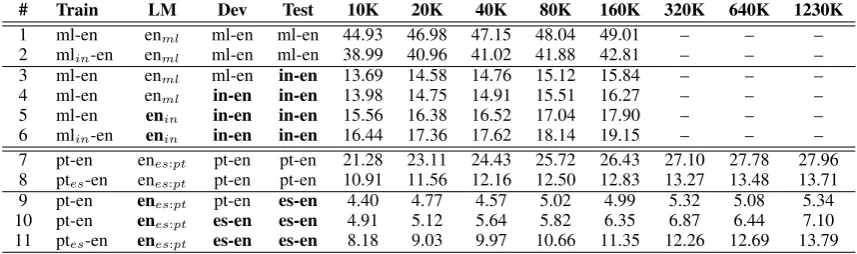
# Train LM Dev Test 10K 20K 40K 80K 160K 320K 640K 1230K 1 ml-en enml ml-en ml-en 44.93 46.98 47.15 48.04 49.01 – – –
2 mlin-en enml ml-en ml-en 38.99 40.96 41.02 41.88 42.81 – – –
3 ml-en enml ml-en in-en 13.69 14.58 14.76 15.12 15.84 – – –
4 ml-en enml in-en in-en 13.98 14.75 14.91 15.51 16.27 – – –
5 ml-en enin in-en in-en 15.56 16.38 16.52 17.04 17.90 – – –
6 mlin-en enin in-en in-en 16.44 17.36 17.62 18.14 19.15 – – –
7 pt-en enes:pt pt-en pt-en 21.28 23.11 24.43 25.72 26.43 27.10 27.78 27.96
8 ptes-en enes:pt pt-en pt-en 10.91 11.56 12.16 12.50 12.83 13.27 13.48 13.71
9 pt-en enes:pt pt-en es-en 4.40 4.77 4.57 5.02 4.99 5.32 5.08 5.34
10 pt-en enes:pt es-en es-en 4.91 5.12 5.64 5.82 6.35 6.87 6.44 7.10
[image:6.595.83.512.62.189.2]11 ptes-en enes:pt es-en es-en 8.18 9.03 9.97 10.66 11.35 12.26 12.69 13.79
Table 1: Cross-lingual SMT experiments (shown in bold). Columns 2-5 present the bi-texts used for
training, development and testing, and the monolingual data used to train the English language model. The following columns show the resulting Bleu (in %s) for different numbers of training sentence pairs.
3.5 Cross-lingual Translation
In this subsection, we study the similarity between the original and the additional source languages.
First, we measured the vocabulary overlap be-tween Spanish and Portuguese, which was
fea-sible since our training pt-en and es-en bi-texts
are from the same time span in theEuroparl
cor-pus and their English sides largely overlap. We found 110,053 Portuguese and 121,444 Spanish word types, and 44,461 (or 36.6%) of them were identical. Unfortunately, we could not do the same for Malay and Indonesian since the English sides
of thein-enandml-enbi-texts do not overlap.
Second, following the setup of the baseline sys-tem, we performed cross-lingual experiments. The results are shown in Table 1. As we can see, this yielded a huge decrease in Bleu compared to the baseline – three to five times – even for very large training datasets, and even when a proper English LM and development dataset were used: compare line 1 to lines 3-6, and line 7 to lines 9-11.
Third, we tried transliteration. Bleu doubled for Spanish (see lines 10-11), but improved far less for Indonesian (lines 5-6). Training on the translit-erated data and testing on Malay and Portuguese yielded about 10-12% relative decrease for Malay (lines 1-2) but 50% for Portuguese (lines
7-8).10 Thus, unlike Spanish and Portuguese, there
were far less systematic spelling variations be-tween Malay and Indonesian. A closer inspec-tion confirmed this: many extracted likely Malay-Indonesian cognate pairs with spelling differences were in fact forms of a word existing in both
lan-guages,e.g.,kataandberkata(‘to say’).
10However, as lines 8 and 11 show, a system trained on 1.23M ptes-en sentence pairs, performs equally well when
translating Portuguese and Spanish text: 13.71%vs.13.79%.
3.6 Using an Additional Language
We performed various experiments combining the original and an additional training bi-text:
Two-tables: We built two separate phrase tables for the two bi-texts, and we used them in the alter-native decoding path model of Birch et al. (2007).
Interpolation: We built two separate phrase tables for the original and for the additional bi-text, and we used linear interpolation to com-bine the corresponding conditional probabilities: Pr(e|s) = αProrig(e|s) + (1−α)Prextra(e|s).
We optimized the value ofα on the development
dataset, trying .5, .6, .7, .8 and .9; we used the
sameαfor all four conditional probabilities.
Merge: We built separate phrase tables, Torig
andTextra, for the original and for the additional
training bi-text. We then concatenated them
giv-ing priority toTorig: We kept all phrase pairs from
Torig, adding to them those ones fromTextra that
were not present in Torig. For each phrase pair
added, we retained its associated conditional prob-abilities and the phrase penalty. We further added three additional features to each entry in the new
table: F1, F2 and F3. The value of F1 was 1 if
the phrase pair came from Torig, and 0.5
other-wise. Similarly,F2=1 if the phrase pair came from
Textra, and F2=0.5 otherwise. The value of F3
was 1 if the pair came from bothTorigandTextra,
and 0.5 otherwise. We experimented using (1)
F1only, (2)F1andF2, (3)F1,F2, andF3. We set
all feature weights using MERT, and we optimized
the number of features on the development set.11
Concat×k: We concatenated k copies of the original and one copy of the additional training bi-text; we then trained and tuned an SMT system as
for the baseline. The value forkwas optimized on
the development dataset.
Concat×k:align: We concatenatedkcopies of the original and one copy of the additional train-ing bi-text. We then generated IBM model 4 word alignments, and we truncated them, only keeping them for one copy of the original training bi-text. Next, we extracted phrase pairs, thus buildng a phrase table, and we tuned an SMT system as for the baseline.
Our Method: Our method was described in
Section 2. We usedmergeto combine the phrase
tables forconcat×k:alignandconcat×1,
consid-ering the former asTorig and the latter as Textra.
We had two parameters to tune:kand the number
of extra features in the merged phrase table.
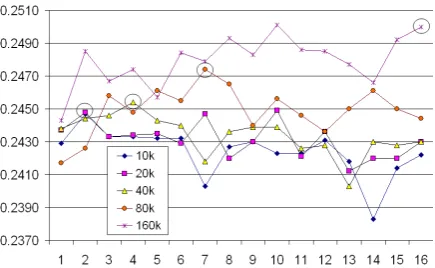
Figure 1: Impact ofkon Bleu forconcat×kfor
different number of extraml-ensentence pairs in Indonesian→English SMT.
4 Results and Discussion
First, we studied the impact of k on concat×k
for Indonesian→English SMT using Malay as an
additional language. We tried all values of k
such that 1≤k≤16 with10000nextra ml-en
sen-tence pairs, n∈{1,2,4,8,16}. As we can see in
Figure 1, the highest Bleu scores are achieved for (n;k)∈{(1;2),(2;2),(4;4),(8;7),(16;16)}, i.e.,
when k ≈ n. In order to limit the search space,
we used this relationship betweenkandnin our
experiments (also for Portuguese and Spanish). Table 2 shows the results for experiments on improving Indonesian→English SMT using 10K, 20K, . . ., 160K additional ml-en pairs of paral-lel sentences. Several observations can be made.
First, using more additional sentences yields bet-ter results. Second, with one exception, all ex-periments yield improvements over the baseline. Third, the improvements are always statistically
significant forour method, according to (Collins
et al., 2005)’s sign test. Overall, among the
dif-ferent bi-text combination strategies,our method
performs best, followed byconcat×k,merge, and
interpolate, which are very close in performance; these three strategies are the only ones to consis-tently yield higher Bleu as the number of
addi-tional ml-en sentence pairs grows. Methods like
concat×1, concat×k:align and two-tables are somewhat inconsistent in that respect. The latter method performs worst and is the only one to go
[image:7.595.74.292.336.470.2]below the baseline (for 10Kml-enpairs).
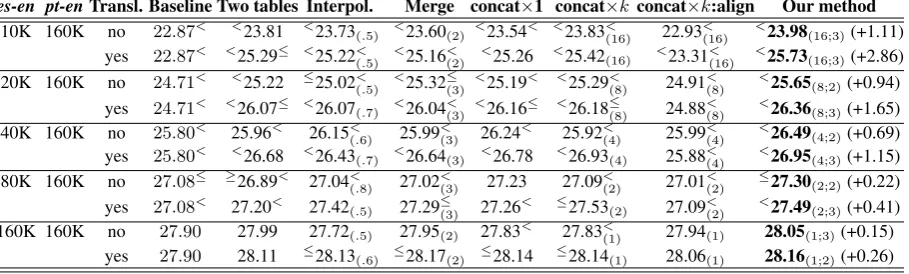
Table 3 shows the results when usingpt-endata
to improve Spanish→English SMT. Overall, the results and the conclusions that can be made are consistent with those for Table 2. We can further observe that, as the size of the original bi-text in-creases, the gain in Bleu dein-creases, which is to be expected. Note also that here transliteration is very important: it doubles the absolute gain in Bleu.
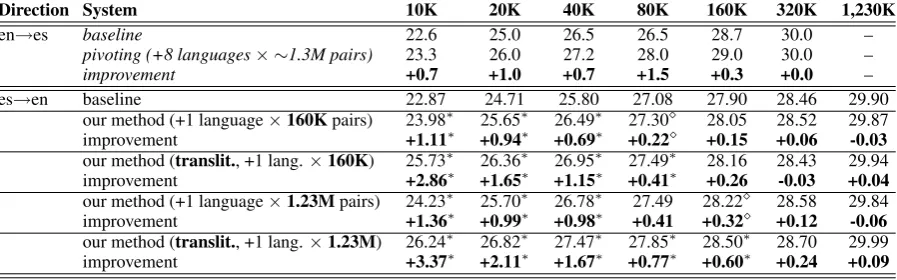
Finally, Table 4 shows a comparison to the piv-oting technique of Callison-Burch et al. (2006). for English→Spanish SMT. Despite using just Portuguese, we achieve an improvement that is, in five out of six cases, much better than what they
achieve witheightpivot languages (which include
not only Portuguese, but also two other Romance languages, French and Italian, which are closely related to Spanish). Moreover, our method yields improvements for very large original datasets – 1.2M pairs, while theirs stops improving at 160K. However, our improvements are only statistically significant for 160K original pairs or less. Finally, note that our translation direction is reversed.
Based on the experimental results, we can make several conclusions. First, we have shown that us-ing bi-text data from related languages improves SMT: we achieved up to 1.35 and 3.37
improve-ment in Bleu for in-en (+ml-en) and es-en(+
pt-en) respectively. Second, while simple
fea-in-en ml-en Baseline Two tables Interpol. Merge concat×1 concat×k concat×k:align Our method 28.4K 10K 23.80< ≥23.79< 23.89<
(.9) 23.97<(3) 24.29< 24.29<(1) 24.01<(1) <24.51(2;1)(+0.72) 28.4K 20K 23.80< 24.24< 24.22<
(.8) ≤24.46<(3) 24.37< ≤24.48(2) <24.35<(2) <24.70(2;2)(+0.90) 28.4K 40K 23.80< 24.27< 24.27<
(.8) 24.43≤(3) 24.38≤ ≤24.54(4) <24.39<(4) <24.73(4;2)(+0.93) 28.4K 80K 23.80< 24.11< ≤24.46<
(.8) <24.67(3) 24.17< ≤24.65<(8) 24.18<(8) <24.97(8;3)(+1.17) 28.4K 160K 23.80< <24.58< <24.58<
[image:8.595.74.529.221.358.2](.8) <24.79≤(3) ≤24.43< <25.00(16) ≤24.27<(16) <25.15(16;3)(+1.35)
Table 2: Improving Indonesian→English SMT usingml-endata. Shown are the Bleu scores (in %s)
for different methods. A subscript shows the best parameter value(s) found on the development set and used on the test set to produce the given result. Bleu scores that are statistically significantly better than
the baseline/our method are marked on the left/right side by<(forp <0.01) or≤(forp <0.05).
es-en pt-enTransl. Baseline Two tables Interpol. Merge concat×1 concat×k concat×k:align Our method
10K 160K no 22.87< <23.81 <23.73
(.5) <23.60(2) <23.54< <23.83<(16) 22.93<(16) <23.98(16;3)(+1.11) yes 22.87< <25.29≤ <25.22<
(.5) <25.16<(2) <25.26 <25.42(16) <23.31<(16) <25.73(16;3)(+2.86) 20K 160K no 24.71< <25.22 ≤25.02<
(.5) <25.32≤(3) <25.19< <25.29<(8) 24.91<(8) <25.65(8;2)(+0.94) yes 24.71< <26.07≤ <26.07
(.7) <26.04<(3) <26.16≤ <26.18≤(8) 24.88<(8) <26.36(8;3)(+1.65) 40K 160K no 25.80< 25.96< 26.15<
(.6) 25.99<(3) 26.24< 25.92<(4) 25.99<(4) <26.49(4;2)(+0.69) yes 25.80< <26.68 <26.43
(.7) <26.64(3) <26.78 <26.93(4) 25.88<(4) <26.95(4;3)(+1.15) 80K 160K no 27.08≤ ≥26.89< 27.04<
(.8) 27.02<(3) 27.23 27.09<(2) 27.01<(2) ≤27.30(2;2)(+0.22) yes 27.08< 27.20< 27.42
(.5) 27.29≤(3) 27.26< ≤27.53(2) 27.09<(2) <27.49(2;3)(+0.41) 160K 160K no 27.90 27.99 27.72(.5) 27.95(2) 27.83< 27.83<(1) 27.94(1) 28.05(1;3)(+0.15)
yes 27.90 28.11 ≤28.13
(.6) ≤28.17(2) ≤28.14 ≤28.14(1) 28.06(1) 28.16(1;2)(+0.26)
Table 3: Improving Spanish→English SMT using 160K additionalpt-ensentence pairs. Column
three shows whether transliteration was used; the following columns list the Bleu scores (in %s) for different methods. A small subscript shows the best parameter value(s) found on the development set and used on the test set to produce the given result. Bleu scores that are statistically significantly better
than the baseline/our method are marked on the left/right side by<(forp <0.01) or≤(forp <0.05).
tures is a good strategy. Fifth, part of the improve-ment when combining bi-texts is due to increased vocabulary coverage because of cognates, but an-other part comes from improved word alignments. Sixth, the best results are achieved when the latter two sources are first isolated and then combined (our method). Finally, transliteration can help a lot in case of systematic spelling variations between the original and the additional source languages.
5 Related Work
In this section, we describe two general lines of related previous research: using cognates between the source and the target language, and source-language side paraphrasing with a pivot source-language.
5.1 Cognates
Many researchers have used likely cognates to obtain improved word alignments and thus build better SMT systems. Al-Onaizan et al. (1999) extracted such likely cognates for Czech-English using one of the variations of LCSR (Melamed,
1995) described in (Tiedemann, 1999) as a simi-larity measure. They used these cognates to im-prove word alignments with IBM models 1-4 in three different ways: (1) by seeding the parameters of IBM model 1, (2) by constraining the word co-occurrences when training IBM models 1-4, and (3) by adding the cognate pairs to the bi-text as additional “sentence pairs”. The last approach per-formed best and was later used by Kondrak et al. (2003) who demonstrated improved SMT for nine European languages.
Unlike these approaches, which extract cog-nates between the source and the target language, we use cognates between the source and some other related language that is different from the target. Moreover, we only implicitly rely on the existence of such cognates; we do not try to ex-tract them at all, and we leave them in their
origi-nal sentence contexts.12
Direction System 10K 20K 40K 80K 160K 320K 1,230K
en→es baseline 22.6 25.0 26.5 26.5 28.7 30.0 –
pivoting (+8 languages× ∼1.3M pairs) 23.3 26.0 27.2 28.0 29.0 30.0 –
improvement +0.7 +1.0 +0.7 +1.5 +0.3 +0.0 –
es→en baseline 22.87 24.71 25.80 27.08 27.90 28.46 29.90
our method (+1 language×160Kpairs) 23.98∗ 25.65∗ 26.49∗ 27.30 28.05 28.52 29.87
improvement +1.11∗ +0.94∗ +0.69∗ +0.22 +0.15 +0.06 -0.03
our method (translit., +1 lang.×160K) 25.73∗ 26.36∗ 26.95∗ 27.49∗ 28.16 28.43 29.94
improvement +2.86∗ +1.65∗ +1.15∗ +0.41∗ +0.26 -0.03 +0.04
our method (+1 language×1.23Mpairs) 24.23∗ 25.70∗ 26.78∗ 27.49 28.22 28.58 29.84
improvement +1.36∗ +0.99∗ +0.98∗ +0.41 +0.32 +0.12 -0.06
our method (translit., +1 lang.×1.23M) 26.24∗ 26.82∗ 27.47∗ 27.85∗ 28.50∗ 28.70 29.99
[image:9.595.74.523.62.202.2]improvement +3.37∗ +2.11∗ +1.67∗ +0.77∗ +0.60∗ +0.24 +0.09
Table 4:Comparison to the pivoting technique of Callison-Burch et al. (2006) for English→Spanish.
Shown are Bleu scores (in %s) and absolute improvement over the baseline for training bi-texts with
different numbers of parallel sentences (10K, 20K, . . ., 1230K) and fixed amount of additional data:
(1) about 1.3M sentence pairs for each of eight additional languages in Callison-Burch et al. (2006)’s pivoting, and (2) 160K and 1,230K pairs for one language (Portuguese) for our method. Statistically
significant improvements over the baseline are marked with a∗(forp <0.01) and with a(forp <0.05).
5.2 Paraphrasing with a Pivot-Language
Another relevant line of research is on using multi-lingual parallel corpora to improve SMT using ad-ditional languages as pivots.
Callison-Burch et al. (2006) improved English→Spanish and English→French SMT using source-language paraphrases extracted with the pivoting technique of Bannard and Callison-Burch (2005) and eight additional languages from theEuroparl corpus(Koehn, 2005). For example, using German as a pivot, they extracted English paraphrases from a parallel English-German corpus by looking for English phrases that were
aligned to the same German phrase: e.g., ifunder
control and in check were aligned to unter con-trolle, they were hypothesized to be paraphrases with some probability. Such (English) paraphrases were added as additional entries in the phrase table of an English→Spanish/English→French phrase-based SMT system and paired with the foreign (Spanish/French) translation of the origi-nal (English) phrase. The system was then tuned with MERT using an extra feature penalizing low-probability paraphrases; this yielded up to 1.8% absolute improvement in Bleu.
Other important publications about pivoting ap-proaches for machine translation include (Wu and Wang, 2007), (Utiyama and Isahara, 2007), (Hajiˇc et al., 2000) and (Habash and Hu, 2009).
Unlike pivoting, which can only improve source-language lexical coverage, we augment both the source- and the target-language sides. Second, while pivoting ignores context when
ex-tracting paraphrases, we take it into account. Third, by using as an additional language one that is related to the source, we are able to get increase in Bleu that is comparable and even better than what pivoting achieves with eight pivot languages. On the negative side, our approach is limited in
that it requires thatX2be related toX1, while the
pivoting languageZdoes not need to be related to
X1 nor to Y. However, we only need one
addi-tional parallel corpus (for X2-Y), while pivoting
needs two: one for X1-Z and one for Z-Y.
Fi-nally, note that our approach is orthogonal to piv-oting, and thus the two can be combined.
6 Conclusion and Future Work
We have proposed a novel method for improving SMT for resource-poor languages by exploiting their similarity to resource-rich ones.
In future work, we would like to extend that ap-proach in several interesting directions. First, we want to make better use of multi-lingual parallel
corpora, e.g., while we had access to a
Spanish-Portuguese-English corpus, we used it as two separate bi-texts Spanish-English and Portuguese-English. Second, we would like to exploit multi-ple auxiliary rich languages the resource-poor source language is related to. Third, we could also experiment with using auxiliary languages
that are related to thetargetlanguage.
Acknowledgments
References
Yaser Al-Onaizan, Jan Curin, Michael Jahr, Kevin Knight, John Lafferty, Dan Melamed, Franz Joseph Och, David Purdy, Noah Smith, and David Yarowsky. 1999. Statistical machine translation. Technical report, CLSP, Johns Hopkins University, Baltimore, MD.
Colin Bannard and Chris Callison-Burch. 2005. Para-phrasing with bilingual parallel corpora. In Pro-ceedings of ACL’05, pages 597–604.
Shane Bergsma and Grzegorz Kondrak. 2007. Alignment-based discriminative string similarity. In Proceedings of ACL’07, pages 656–663.
Albert Bickford and David Tuggy. 2002. Electronic glossary of linguistic terms. http://www.sil.org/mexico/ling/glosario/E005ai-Glossary.htm.
Alexandra Birch, Miles Osborne, and Philipp Koehn. 2007. CCG supertags in factored statistical machine translation. InProceedings of WMT’2007, pages 9– 16.
Peter Brown, Vincent Della Pietra, Stephen Della Pietra, and Robert Mercer. 1993. The mathematics of statistical machine translation: parameter estima-tion. Computational Linguistics, 19(2):263–311. Chris Callison-Burch, Philipp Koehn, and Miles
Os-borne. 2006. Improved statistical machine trans-lation using paraphrases. In Proceedings of HLT-NAACL’06, pages 17–24.
Michael Collins, Philipp Koehn, and Ivona Kuˇcerov´a. 2005. Clause restructuring for statistical machine translation. InProceedings of ACL’05, pages 531– 540.
Andrew Finch and Eiichiro Sumita. 2008. Phrase-based machine transliteration. In Proceedings of WTCAST’08, pages 13–18.
Nizar Habash and Jun Hu. 2009. Improving Arabic-Chinese statistical machine translation using English as pivot language. InProceedings of the WMT’09, pages 173–181.
Jan Hajiˇc, Jan Hric, and Vladislav Kuboˇn. 2000. Ma-chine translation of very close languages. In Pro-ceedings of ANLP’00, pages 7–12.
Philipp Koehn, Amittai Axelrod, Alexandra Birch Mayne, Chris Callison-Burch, Miles Osborne, and David Talbot. 2005. Edinburgh system description for the 2005 IWSLT speech translation evaluation. InProceedings of IWSLT’05.
Philipp Koehn, Hieu Hoang, Alexandra Birch, Chris Callison-Burch, Marcello Federico, Nicola Bertoldi, Brooke Cowan, Wade Shen, Christine Moran, Richard Zens, Chris Dyer, Ondrej Bojar, Alexan-dra Constantin, and Evan Herbst. 2007. Moses:
Open source toolkit for statistical machine transla-tion. InProceedings of ACL’07. Demonstration ses-sion, pages 177–180.
Philipp Koehn. 2005. Europarl: A parallel corpus for evaluation of machine translation. InProceedings of MT Summit, pages 79–86.
Grzegorz Kondrak, Daniel Marcu, and Kevin Knight. 2003. Cognates can improve statistical translation models. InProceedings of NAACL’03, pages 46–48. Gideon Mann and David Yarowsky. 2001. Multipath translation lexicon induction via bridge languages. InProceedings of NAACL’01, pages 1–8.
Dan Melamed. 1995. Automatic evaluation and uni-form filter cascades for inducing N-best translation lexicons. InProceedings of WVLC’95, pages 184– 198.
Dan Melamed. 1999. Bitext maps and alignment via pattern recognition. Computational Linguistics, 25(1):107–130.
Dan Melamed. 2000. Models of translational equiv-alence among words. Computational Linguistics, 26(2):221–249.
Franz Josef Och and Hermann Ney. 2003. A sys-tematic comparison of various statistical alignment models. Computational Linguistics, 29(1):19–51. Franz Josef Och and Hermann Ney. 2004. The
align-ment template approach to statistical machine trans-lation.Computational Linguistics, 30(4):417–449. Franz Josef Och. 2003. Minimum error rate training
in statistical machine translation. InProceedings of ACL’03, pages 160–167.
Kishore Papineni, Salim Roukos, Todd Ward, and Wei-Jing Zhu. 2002. Bleu: a method for automatic evaluation of machine translation. In Proceedings of ACL’02, pages 311–318.
Ralf Steinberger, Bruno Pouliquen, Anna Widiger, Camelia Ignat, Tomaz Erjavec, Dan Tufis, and Daniel Varga. 2006. The JRC-Acquis: A multilin-gual aligned parallel corpus with 20+ languages. In Proceedings of LREC’2006, pages 2142–2147. Jorg Tiedemann. 1999. Automatic construction of
weighted string similarity measures. InProceedings of EMNLP-VLC’99, pages 213–219.
Masao Utiyama and Hitoshi Isahara. 2007. A com-parison of pivot methods for phrase-based statisti-cal machine translation. InProceedings of NAACL-HLT’07, pages 484–491.