Automatically Assessing Review Helpfulness
Soo-Min Kim
†, Patrick Pantel
†, Tim Chklovski
†, Marco Pennacchiotti
‡ †Information Sciences Institute
University of Southern California
4676 Admiralty Way
Marina del Rey, CA 90292
{skim,pantel,timc}@isi.edu
‡
ART Group - DISP
University of Rome “Tor Vergata”
Viale del Politecnico 1
Rome, Italy
[email protected]
Abstract
User-supplied reviews are widely and increasingly used to enhance e-commerce and other websites. Because reviews can be numerous and varying in quality, it is important to assess how helpful each review is. While review helpfulness is currently assessed manu-ally, in this paper we consider the task of automatically assessing it. Experi-ments using SVM regression on a vari-ety of features over Amazon.com product reviews show promising results, with rank correlations of up to 0.66. We found that the most useful features in-clude the length of the review, its uni-grams, and its product rating.
1
Introduction
Unbiased user-supplied reviews are solicited ubiquitously by online retailers like Ama-zon.com, Overstock.com, Apple.com and Epin-ions.com, movie sites like imdb.com, traveling sites like citysearch.com, open source software distributors like cpanratings.perl.org, and count-less others. Because reviews can be numerous and varying in quality, it is important to rank them to enhance customer experience.
In contrast with ranking search results, assess-ing relevance when ranking reviews is of little importance because reviews are directly associ-ated with the relevant product or service. Instead, a key challenge when ranking reviews is to de-termine which reviews the customers will find helpful.
Most websites currently rank reviews by their recency or product rating (e.g., number of stars in Amazon.com reviews). Recently, more sophis-ticated ranking schemes measure reviews by their
helpfulness, which is typically estimated by hav-ing users manually assess it. For example, on Amazon.com, an interface allows customers to vote whether a particular review is helpful or not. Unfortunately, newly written reviews and re-views with few votes cannot be ranked as several assessments are required in order to properly es-timate helpfulness. For example, for all MP3 player products on Amazon.com, 38% of the 20,919 reviews received three or fewer helpful-ness votes. Another problem is that low-traffic items may never gather enough votes. Among the MP3 player reviews that were authored at least three months ago on Amazon.com, still only 31% had three or fewer helpfulness votes.
It would be useful to assess review helpfulness automatically, as soon as the review is written. This would accelerate determining a review’s ranking and allow a website to provide rapid feedback to review authors.
In this paper, we investigate the task of auto-matically predicting review helpfulness using a machine learning approach. Our main contribu-tions are:
• A system for automatically ranking reviews according to helpfulness; using state of the art SVM regression, we empirically evaluate our system on a real world dataset collected from Amazon.com on the task of reconstructing the helpfulness ranking; and
• An analysis of different classes of features most important to capture review helpful-ness; including structural (e.g., html tags, punctuation, review length), lexical (e.g., n -grams), syntactic (e.g., percentage of verbs and nouns), semantic (e.g., product feature men-tions), and meta-data (e.g., star rating).
2
Relevant Work
The task of automatically assessing product re-view helpfulness is related to these broader areas
of research: automatic analysis of product re-views, opinion and sentiment analysis, and text classification.
In the thriving area of research on automatic analysis and processing of product reviews (Hu and Liu 2004; Turney 2002; Pang and Lee 2005), little attention has been paid to the important task studied here – assessing review helpfulness. Pang and Lee (2005) have studied prediction of prod-uct ratings, which may be particularly relevant due to the correlation we find between product rating and the helpfulness of the review (dis-cussed in Section 5). However, a user’s overall rating for the product is often already available. Helpfulness, on the other hand, is valuable to assess because it is not explicitly known in cur-rent approaches until many users vote on the helpfulness of a review.
In opinion and sentiment analysis, the focus is on distinguishing between statements of fact vs. opinion, and on detecting the polarity of senti-ments being expressed. Many researchers have worked in various facets of opinion analysis. Pang et al. (2002) and Turney (2002) classified sentiment polarity of reviews at the document level. Wiebe et al. (1999) classified sentence level subjectivity using syntactic classes such as adjectives, pronouns and modal verbs as features. Riloff and Wiebe (2003) extracted subjective expressions from sentences using a bootstrapping pattern learning process. Yu and Hatzivassi-loglou (2003) identified the polarity of opinion sentences using semantically oriented words. These techniques were applied and examined in different domains, such as customer reviews (Hu and Liu 2004) and news articles (TREC novelty track 2003 and 2004).
In text classification, systems typically use bag-of-words models, although there is some evidence of benefits when introducing relevant semantic knowledge (Gabrilovich and Mark-ovitch, 2005). In this paper, we explore the use of some semantic features for review helpfulness ranking. Another potential relevant classification task is academic and commercial efforts on de-tecting email spam messages1, which aim to cap-ture a much broader notion of helpfulness. For an SVM-based approach, see (Drucker et al 1999).
Finally, a related area is work on automatic es-say scoring, which seeks to rate the quality of an essay (Attali and Burstein 2006; Burstein et al. 2004). The task is important for reducing the human effort required in scoring large numbers
1
See http://www.ceas.cc/, http://spamconference.org/
of student essays regularly written for standard tests such as the GRE. The exact scoring ap-proaches developed in commercial systems are often not disclosed. However, more recent work on one of the major systems, e-rater 2.0, has fo-cused on systematizing and simplifying the set of features used (Attali and Burstein 2006). Our choice of features to test was partially influenced by the features discussed by Attali and Burstein. At the same time, due to differences in the tasks, we did not use features aimed at assessing essay structure such as discourse structure analysis fea-tures. Our observations suggest that even helpful reviews vary widely in their discourse structure. We present the features which we have used be-low, in Section 3.2.
3
Modeling Review Helpfulness
In this section, we formally define the learning task and we investigate several features for as-sessing review helpfulness.
3.1 Task Definition
Formally, given a set of reviews R for a particu-lar product, our task is to rank the reviews ac-cording to their helpfulness. We define a review helpfulness function, h, as:
(
)
( )
( )
( )
r rating r
rating
r rating R
r h
− +
+
+ =
∈ (1)
where rating+(r) is the number of people that will
find a review helpful and rating-(r) is the number
of people that will find the review unhelpful. For evaluation, we resort to estimates of h from man-ual review assessments on websites like Ama-zon.com, as described in Section 4.
3.2 Features
One aim of this paper is to investigate how well different classes of features capture the helpful-ness of a review. We experimented with various features organized in five classes: Structural, Lexical, Syntactic, Semantic, and Meta-data. Be-low we describe each feature class in turn.
Structural Features
• Length (LEN): The total number of tokens in a syntactic analysis2 of the review.
• Sentential (SEN): Observations of the sen-tences, including the number of sensen-tences, the average sentence length, the percentage of question sentences, and the number of excla-mation marks.
• HTML (HTM): Two features for the number of bold tags <b> and line breaks <br>.
Lexical Features
Lexical features capture the words observed in the reviews. We experimented with two sets of features:
• Unigram (UGR): The tf-idf statistic of each word occurring in a review.
• Bigram (BGR): The tf-idf statistic of each bi-gram occurring in a review.
For both unigrams and bigrams, we used lemma-tized words from a syntactic analysis of the re-views and computed the tf-idf statistic (Salton and McGill 1983) using the following formula:
( )
N idf tf
idf
tf = ×log
where N is the number of tokens in the review.
Syntactic Features
Syntactic features aim to capture the linguistic properties of the review. We grouped them into the following feature set:
• Syntax (SYN): Includes the percentage of parsed tokens that are open-class (i.e., nouns, verbs, adjectives and adverbs), the percentage of tokens that are nouns, the percentage of to-kens that are verbs, the percentage of toto-kens that are verbs conjugated in the first person, and the percentage of tokens that are adjectives or adverbs.
Semantic Features
Most online reviews are fairly short; their spar-sity suggests that bigram features will not per-form well (which is supported by our experiments described in Section 5.3). Although semantic features have rarely been effective in many text classification problems (Moschitti and Basili 2004), there is reason here to hypothesize that a specialized vocabulary of important words might help with the sparsity. We hypothesized
2
Reviews are analyzed using the Minipar dependency parser (Lin 1994).
that good reviews will often contain: i) refer-ences to the features of a product (e.g., the LCD and resolution of a digital camera), and ii) men-tions of sentiment words (i.e., words that express
an opinion such as “great screen”). Below we
describe two families of features that capture these semantic observations within the reviews:
• Product-Feature (PRF): The features of prod-ucts that occur in the review, e.g., capacity of
MP3 players and zoom of a digital camera.
This feature counts the number of lexical matches that occur in the review for each prod-uct feature. There is no trivial way of obtaining a list of all the features of a product. In Section 5.1 we describe a method for automatically ex-tracting product features from Pro/Con listings from Epinions.com. Our assumption is that pro/cons are the features that are important for customers (and hence should be part of a help-ful review).
• General-Inquirer (GIW): Positive and negative sentiment words describing products or prod-uct features (e.g., “amazing sound quality” and “weak zoom”). The intuition is that reviews that analyze product features are more helpful than those that do not. We try to capture this analysis by extracting sentiment words using the publicly available list of positive and nega-tive sentiment words from the General Inquirer Dictionaries3.
Meta-Data Features
Unlike the previous four feature classes, meta-data features capture observations which are in-dependent of the text (i.e., unrelated with linguis-tic features). We consider the following feature:
• Stars (STR): Most websites require reviewers to include an overall rating for the products that they review (e.g., star ratings in Ama-zon.com). This feature set includes the rating score (STR1) as well as the absolute value of the difference between the rating score and the average rating score given by all reviewers (STR2).
We differentiate meta-data features from seman-tic features since they require external knowl-edge that may not be available from certain review sites. Nowadays, however, most sites that collect user reviews also collect some form of product rating (e.g., Amazon.com, Over-stock.com, and Apple.com).
3
4
Ranking System
In this paper, we estimate the helpfulness func-tion in Equafunc-tion 1 using user ratings extracted from Amazon.com, where rating+(r) is the
num-ber of unique users that rated the review r as helpful and rating-(r) is the number of unique
users that rated r as unhelpful.
Reviews from Amazon.com form a gold stan-dard labeled dataset of {review, h(review)} pairs that can be used to train a supervised machine learning algorithm. In this paper, we applied an SVM (Vapnik 1995) package on the features ex-tracted from reviews to learn the function h.
Two natural options for learning helpfulness according to Equation 1 are SVM Regression and SVM Ranking (Joachims 2002). Though learning to rank according to helpfulness requires only SVM Ranking, the helpfulness function provides non-uniform differences between ranks in the training set. Also, in practice, many products have only one review, which can serve as train-ing data for SVM Regression but not SVM Rank-ing. Furthermore, in large sites such as Amazon.com, when new reviews are written it is inefficient to rank all previously ranked re-views. We therefore choose SVM Regression in this paper. We describe the exact implementation in Section 5.1.
After the SVM is trained, for a given product and its set of reviews R, we rank the reviews of R in decreasing order of h(r), r∈R.
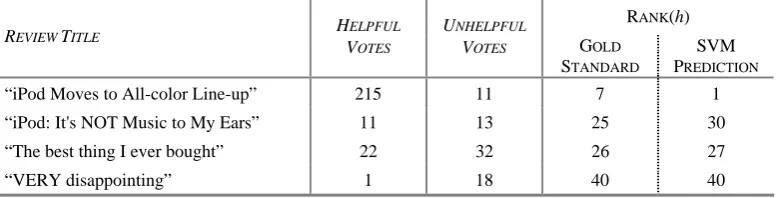
Table 1 shows four sample reviews for the iPod Photo 20GB product from Amazon.com, their total number of helpful and unhelpful votes, as well as their rank according to the helpfulness score h from both the gold standard from Ama-zon.com and using the SVM prediction of our best performing system described in Section 5.2.
5
Experimental Results
We empirically evaluate our review model and ranking system, described in Section 3 and Sec-tion 4, by comparing the performance of various feature combinations on products mined from Amazon.com. Below, we describe our experi-mental setup, present our results, and analyze system performance.
5.1 Experimental Setup
We describe below the datasets that we extracted from Amazon.com, the implementation of our SVM system, and the method we used for ex-tracting features of reviews.
Extraction and Preprocessing of Datasets
We focused our experiments on two products
from Amazon.com: MP3 Players and Digital
Cameras.
Using Amazon Web Services API, we
col-lected reviews associated with all products in the MP3 Players and Digital Cameras categories. For MP3 Players, we collected 821 products and
33,016 reviews; for Digital Cameras, we
col-lected 1,104 products and 26,189 reviews.
In most retailer websites like Amazon.com, duplicate reviews, which are quite frequent, skew statistics and can greatly affect a learning algo-rithm. Looking for exact string matches between reviews is not a sufficient filter since authors of duplicated reviews often make small changes to the reviews to avoid detection. We built a simple filter that compares the distribution of word bi-grams across each pair of reviews. A pair is deemed a duplicate if more than 80% of their bigrams match.
[image:4.595.107.496.128.227.2]Also, whole products can be duplicated. For different product versions, such as iPods that can come in black or white models, reviews on Ama-zon.com are duplicated between them. We filter
Table 1. Sample of 4 out of 43 reviews for the iPod Photo 20GB product from Ama-zon.com along with their ratings as well as their helpfulness ranks (from both the gold standard from Amazon.com and the SVM prediction of our best performing system de-scribed in Section 5.2).
RANK(h)
REVIEW TITLE HELPFUL
VOTES
UNHELPFUL
VOTES GOLD
STANDARD
SVM PREDICTION
“iPod Moves to All-color Line-up” 215 11 7 1
“iPod: It's NOT Music to My Ears” 11 13 25 30
“The best thing I ever bought” 22 32 26 27
out complete products where each of its reviews is detected as a duplicate of another product (i.e., only one iPod version is retained).
The filtering of duplicate products and dupli-cate reviews discarded 85 products and 12,097
reviews for MP3 Players and 38 products and
3,692 reviews for Digital Cameras.
In order to have accurate estimates for the helpfulness function in Equation 1, we filtered out any review that did not receive at least five user ratings (i.e., reviews where less than five users voted it as helpful or unhelpful are filtered out). This filtering was performed before dupli-cate detection and discarded 45.7% of the MP3 Players reviews and 32.7% of the Digital Cam-eras reviews.
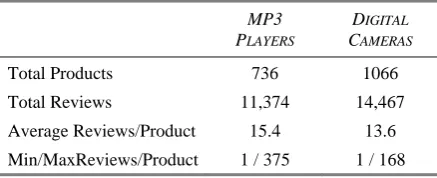
Table 2 describes statistics for the final data-sets after the filtering steps. 10% of products for both datasets were withheld as development cor-pora and the remaining 90% were randomly sorted into 10 sets for 10-fold cross validation.
SVM Regression
For our regression model, we deployed the state
of the art SVM regression tool SVMlight
(Joachims 1999). We tested on the development sets various kernels including linear, polynomial (degrees 2, 3, and 4), and radial basis function (RBF). The best performing kernel was RBF and we report only these results in this paper (per-formance was measured using Spearman’s corre-lation coefficient, described in Section 5.2).
We tuned the RBF kernel parameters C (the
penalty parameter) and γ (the kernel width hy-perparameter) performing full grid search over the 110 combinations of exponentially spaced parameter pairs (C,γ) following (Hsu et al. 2003).
Feature Extraction
To extract the features described in Section 3.2, we preprocessed each review using the Minipar dependency parser (Lin 1994). We used the parser tokenization, sentence breaker, and syn-tactic categorizations to generate the Length,
Sentential, Unigram, Bigram, and Syntax feature sets.
In order to count the occurrences of product features for the Product-Feature set, we devel-oped an automatic way of mining references to product features from Epinions.com. On this website, user-generated product reviews include explicit lists of pros and cons, describing the best and worst aspects of a product. For example, for MP3 players, we found the pro “belt clip” and the con “Useless FM tuner”. Our assumption is that the pro/con lists tend to contain references to the product features that are important to cus-tomers, and hence their occurrence in a review may correlate with review helpfulness. We fil-tered out all single-word entries which were in-frequently seen (e.g., hold, ever). After splitting and filtering the pro/con lists, we were left with a total of 9,110 unique features for MP3 Players and 13,991 unique features for Digital Cameras.
The Stars feature set was created directly from the star ratings given by each author of an Ama-zon.com review.
For each feature measurement f, we applied the following standard transformation:
(
1)
ln f +
and then scaled each feature between [0, 1] as suggested in (Hsu et al. 2003).
We experimented with various combinations of feature sets. Our results tables use the abbre-viations presented in Section 3.2. For brevity, we report the combinations which contributed to our best performing system and those that help assess the power of the different feature classes in cap-turing helpfulness.
5.2 Ranking Performance
Evaluating the quality of a particular ranking is difficult since certain ranking intervals can be more important than others (e.g., top-10 versus bottom-10) We adopt the Spearman correlation coefficient ρ (Spearman 1904) since it is the most commonly used measure of correlation be-tween two sets of ranked data points4.
For each fold in our 10-fold cross-validation experiments, we trained our SVM system using 9 folds. For the remaining test fold, we ranked each product’s reviews according to the SVM predic-tion (described in Secpredic-tion 4) and computed the ρ
4
[image:5.595.73.292.100.189.2]We used the version of Spearman’s correlation coeffi-cient that allows for ties in rankings. See Siegel and Cas-tellan (1988) for more on alternate rank statistics such as Kendall’s tau.
Table 2. Overview of filtered datasets extracted from Amazon.com.
MP3 PLAYERS
DIGITAL CAMERAS
Total Products 736 1066
Total Reviews 11,374 14,467
Average Reviews/Product 15.4 13.6
correlation between the ranking and the gold standard ranking from the test fold5.
Although our task definition is to learn review rankings according to helpfulness, as an interme-diate step the SVM system learns to predict the absolute helpfulness score for each review. To test the correlation of this score against the gold standard, we computed the standard Pearson cor-relation coefficient.
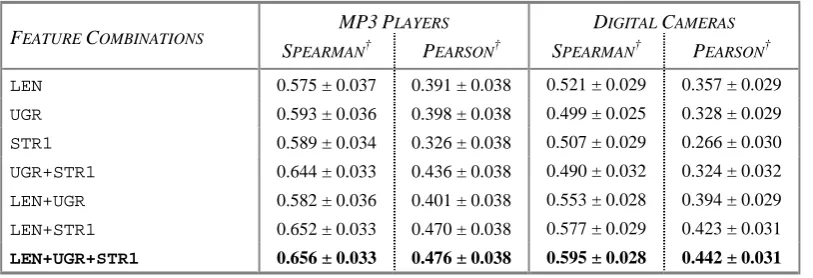
Results show that the highest performing fea-ture combination consisted of the Length, the Unigram, and the Stars feature sets. Table 3 re-ports the evaluation results for every combination of these features with 95% confidence bounds. Of the three features alone, neither was statisti-cally more significant than the others. Examining each pair combination, only the combination of length with stars outperformed the others. Sur-prisingly, adding unigram features to this combi-nation had little effect for the MP3 Players.
Given our list of features defined in Section 3.2, helpfulness of reviews is best captured with a combination of the Length and Stars features. Training an RBF-kernel SVM regression model does not necessarily make clear the exact rela-tionship between input and output variables. To investigate this relationship between length and helpfulness, we inspected their Pearson correla-tion coefficient, which was 0.45. Users indeed tend to find short reviews less helpful than longer ones: out of the 5,247 reviews for MP3 Players that contained more than 1000 characters, the average gold standard helpfulness score was 82%; the 204 reviews with fewer than 100 char-acters had on average a score of 23%. The ex-plicit product rating, such as Stars is also an
5
Recall that the gold standard is extracted directly from user helpfulness votes on Amazon.com (see Section 4).
indicator of review helpfulness, with a Pearson correlation coefficient of 0.48.
The low Pearson correlations of Table 3 com-pared to the Spearman correlations suggest that we can learn the ranking without perfectly learn-ing the function itself. To investigate this, we tested the ability of SVM regression to recover the target helpfulness score, given the score itself as the only feature. The Spearman correlation for this test was a perfect 1.0. Interestingly, the Pear-son correlation was only 0.798, suggesting that the RBF kernel does learn the helpfulness rank-ing without learnrank-ing the function exactly.
5.3 Results Analysis
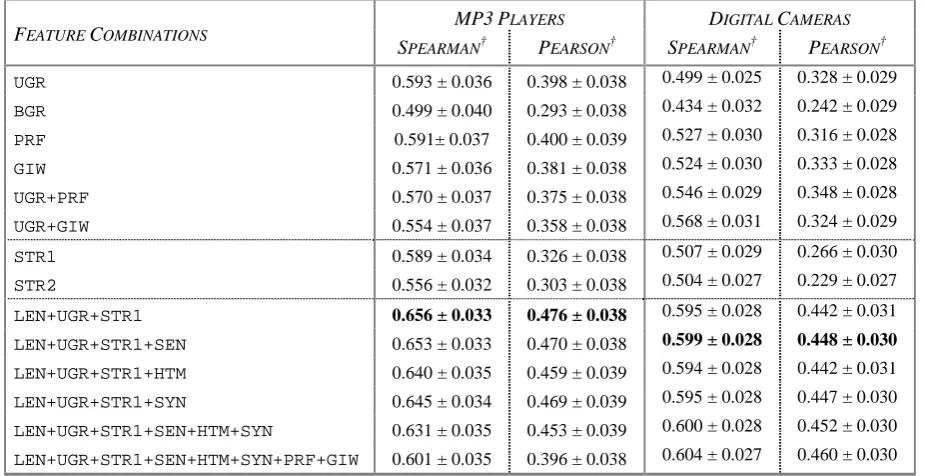
Table 3 shows only the feature combinations of our highest performing system. In Table 4, we report several other feature combinations to show why we selected certain features and what was the effect of our five feature classes presented in Section 3.2.
In the first block of six feature combinations in Table 4, we show that the unigram features out-perform the bigram features, which seem to be suffering from the data sparsity of the short re-views. Also, unigram features seem to subsume the information carried in our semantic features Product-Feature (PRF) and General-Inquirer
(GIW). Although both PRF and GIW perform
well as standalone features, when combined with unigrams there is little performance difference (for MP3 Players we see a small but insignificant
decrease in performance whereas for Digital
[image:6.595.100.507.112.251.2]Cameras we see a small but insignificant im-provement). Recall that PRF and GIW are simply subsets of review words that are found to be product features or sentiment words. The learn-ing algorithm seems to discover on its own which
Table 3. Evaluation of the feature combinations that make up our best performing system (in bold), for ranking reviews of Amazon.com MP3 Players and Digital Cameras accord-ing to helpfulness.
MP3PLAYERS DIGITAL CAMERAS
FEATURE COMBINATIONS
SPEARMAN† PEARSON† SPEARMAN† PEARSON†
LEN 0.575 ± 0.037 0.391 ± 0.038 0.521 ± 0.029 0.357 ± 0.029
UGR 0.593 ± 0.036 0.398 ± 0.038 0.499 ± 0.025 0.328 ± 0.029
STR1 0.589 ± 0.034 0.326 ± 0.038 0.507 ± 0.029 0.266 ± 0.030
UGR+STR1 0.644 ± 0.033 0.436 ± 0.038 0.490 ± 0.032 0.324 ± 0.032
LEN+UGR 0.582 ± 0.036 0.401 ± 0.038 0.553 ± 0.028 0.394 ± 0.029
LEN+STR1 0.652 ± 0.033 0.470 ± 0.038 0.577 ± 0.029 0.423 ± 0.031
LEN+UGR+STR1 0.656 ± 0.033 0.476 ± 0.038 0.595 ± 0.028 0.442 ± 0.031
words are most important in a review and does not use additional knowledge about the meaning of the words (at least not the semantics contained in PRF and GIW).
We tested two different versions of the Stars feature: i) the number of star ratings, STR1; and ii) the difference between the star rating and the average rating of the review, STR2. The second block of feature combinations in Table 4 shows that neither is significantly better than the other so we chose STR1 for our best performing sys-tem.
Our experiments also revealed that our struc-tural features Sentential and HTML, as well as our syntactic features, Syntax, did not show any significant improvement in system performance. In the last block of feature combinations in Table 4, we report the performance of our best per-forming features (Length, Unigram, and Stars) along with these other features. Though none of the features cause a performance deterioration, neither of them significantly improves perform-ance.
5.4 Discussion
In this section, we discuss the broader implica-tions and potential impacts of our work, and pos-sible connections with other research directions.
The usefulness of the Stars feature for deter-mining review helpfulness suggests the need for developing automatic methods for assessing pro-duct ratings, e.g., (Pang and Lee 2005).
Our findings focus on predictors of helpful-ness of reviews of tangible consumer products (consumer electronics). Helpfulness is also solic-ited and tracked for reviews of many other types of entities: restaurants (citysearch.com), films (imdb.com), reviews of open-source software modules (cpanratings.perl.org), and countless others. Our findings of the importance of Length, Unigrams, and Stars may provide the basis of comparison for assessing helpfulness of reviews of other entity types.
Our work represents an initial step in assessing helpfulness. In the future, we plan to investigate other possible indicators of helpfulness such as a reviewer’s reputation, the use of comparatives (e.g., more and better than), and references to other products.
Taken further, this work may have interesting connections to work on personalization, social networks, and recommender systems, for in-stance by identifying the reviews that a particular user would find helpful.
Our work on helpfulness of reviews also has potential applications to work on automatic
gen-Table 4. Performance evaluation of various feature combinations for ranking reviews of MP3 Players and Digital Cameras on Amazon.com according to helpfulness. The first six lines suggest that uni-grams subsume the semantic features; the next two support the use of the raw counts of product ratings (stars) rather than the distance of this count from the average rating; the final six investigate the impor-tance of auxiliary feature sets.
MP3PLAYERS DIGITAL CAMERAS
FEATURE COMBINATIONS
SPEARMAN† PEARSON† SPEARMAN† PEARSON†
UGR 0.593 ± 0.036 0.398 ± 0.038 0.499 ± 0.025 0.328 ± 0.029
BGR 0.499 ± 0.040 0.293 ± 0.038 0.434 ± 0.032 0.242 ± 0.029
PRF 0.591± 0.037 0.400 ± 0.039 0.527 ± 0.030 0.316 ± 0.028
GIW 0.571 ± 0.036 0.381 ± 0.038 0.524 ± 0.030 0.333 ± 0.028
UGR+PRF 0.570 ± 0.037 0.375 ± 0.038 0.546 ± 0.029 0.348 ± 0.028
UGR+GIW 0.554 ± 0.037 0.358 ± 0.038 0.568 ± 0.031 0.324 ± 0.029
STR1 0.589 ± 0.034 0.326 ± 0.038 0.507 ± 0.029 0.266 ± 0.030
STR2 0.556 ± 0.032 0.303 ± 0.038 0.504 ± 0.027 0.229 ± 0.027
LEN+UGR+STR1 0.656 ± 0.033 0.476 ± 0.038 0.595 ± 0.028 0.442 ± 0.031
LEN+UGR+STR1+SEN 0.653 ± 0.033 0.470 ± 0.038 0.599 ± 0.028 0.448 ± 0.030
LEN+UGR+STR1+HTM 0.640 ± 0.035 0.459 ± 0.039 0.594 ± 0.028 0.442 ± 0.031
LEN+UGR+STR1+SYN 0.645 ± 0.034 0.469 ± 0.039 0.595 ± 0.028 0.447 ± 0.030
LEN+UGR+STR1+SEN+HTM+SYN 0.631 ± 0.035 0.453 ± 0.039 0.600 ± 0.028 0.452 ± 0.030
LEN+UGR+STR1+SEN+HTM+SYN+PRF+GIW 0.601 ± 0.035 0.396 ± 0.038 0.604 ± 0.027 0.460 ± 0.030
LEN=Length; SEN=Sentential; HTM=HTML; UGR=Unigram; BGR=Bigram;
[image:7.595.70.534.139.377.2]eration of review information, by providing a way to assess helpfulness of automatically gener-ated reviews. Work on generation of reviews in-cludes review summarization and extraction of useful reviews from blogs and other mixed texts.
6
Conclusions
Ranking reviews according to user helpfulness is an important problem for many online sites such as Amazon.com and Ebay.com. To date, most websites measure helpfulness by having users manually assess how helpful each review is to them. In this paper, we proposed an algorithm for automatically assessing helpfulness and ranking reviews according to it. Exploiting the multitude of user-rated reviews on Amazon.com, we trained an SVM regression system to learn a helpfulness function and then applied it to rank unlabeled reviews. Our best system achieved Spearman correlation coefficient scores of 0.656 and 0.604 against a gold standard for MP3 play-ers and digital cameras.
We also performed a detailed analysis of dif-ferent features to study the importance of several feature classes in capturing helpfulness. We found that the most useful features were the length of the review, its unigrams, and its product rating. Semantic features like mentions of prod-uct features and sentiment words seemed to be subsumed by the simple unigram features. Struc-tural features (other than length) and syntactic features had no significant impact.
It is our hope through this work to shed some light onto what people find helpful in user-supplied reviews and, by automatically ranking them, to ultimately enhance user experience.
References
Attali, Y. and Burstein, J. 2006. Automated Essay Scoring With e-rater® V.2. Journal of Technology, Learning, and Assessment, 4(3).
Burstein, J., Chodorow, M., and Leacock, C. 2004. Automated essay evaluation: the criterion online writing service. AI Magazine. 25(3), pp 27–36.
Drucker,H., Wu,D. and Vapnik,V. 1999. Support vector machines for spam categorization. IEEE Trans. Neural Netw., 10, 1048–1054.
Gabrilovich, E. and Markovitch, S. 2005. Feature Generation for Text Categorization Using World Knowledge. In Proceedings of IJCAI-2005.
Hsu, C.-W.; Chang, C.-C.; and Lin, C.-J. 2003. A practical guide to SVM classification. Technical
report, Department of Computer Science and Information Technology, National Taiwan University.
Hu, M. and Liu, B. 2004. Mining and summarizing customer reviews. KDD’04. pp.168 – 177
Kim, S. and Hovy, E. 2004. Determining the Sentiment of Opinions. Proceedings of COLING-04.
Joachims, T. 1999. Making Large-Scale SVM Learning Practical. In B. Schölkopf, C. Burges, and A. Smola (eds), Advances in Kernel Methods: Support Vector Learning. MIT Press. Cambridge, MA.
Joachims, T. 2002. Optimizing Search Engines Using Clickthrough Data. In Proceedings of ACM KDD-02.
Moschitti, A. and Basili R. 2004. Complex Linguistic Features for Text Classification: A Comprehensive Study. In Proceedings of ECIR 2004. Sunderland, U.K.
Pang, B, L. Lee, and S. Vaithyanathan. 2001. Thumbs up? Sentiment Classification using Machine Learning Techniques. Proceedings of EMNLP 2002.
Pang, B. and Lee, L. 2005. Seeing stars: Exploiting class relationships for sentiment categorization with respect to rating scales. In Proceedings of the ACL, 2005.
Riloff , E. and J. Wiebe. 2003. Learning Extraction Patterns for Subjective Expressions. In Proc. of EMNLP-03.
Riloff, E., J. Wiebe, and T. Wilson. 2003. Learning Subjective Nouns Using Extraction Pattern Bootstrapping. Proceedings of CoNLL-03
Rose, C., Roque, A., Bhembe, D., and Vanlehn, K. 2003. A Hybrid Text Classification Approach for Analysis of Student Essays. In Proc. of the HLT-NAACL, 2003.
Salton, G. and McGill, M. J. 1983. Introduction to Modern Information Retrieval. McGraw Hill.
Siegel, S. and Castellan, N.J. Jr. 1988. Nonparametric Statistics for the Behavioral Sciences. McGraw-Hill.
Spearman C. 1904. The Proof and Measurement of Association Between Two Things. American Journal of Psychology, 15:72–101.
Turney, P. 2002. Thumbs Up or Thumbs Down? Semantic Orientation Applied to Unsupervised Classification of Reviews. Proceedings of the 40th Annual Meeting of the ACL, Philadelphia, 417–424.
Vapnik, V.N. 1995. The Nature of Statistical Learning Theory. Springer.
Wiebe, J, R. Bruce, and T. O’Hara. 1999. Development and use of a gold standard data set for subjectivity classifications. Proc. of the 37th Annual Meeting of the Association for Computational Linguistics(ACL-99),
246–253.
Yu, H. and Hatzivassiloglou, V. 2003. Towards Answering Opinion Questions: Separating Facts from Opinions and Identifying the Polarity of Opinion