Proceedings of the 9th Workshop on Computational Approaches to Subjectivity, Sentiment and Social Media Analysis, pages 167–175 167
Exploring and Learning Suicidal Ideation Connotations on Social Media
with Deep Learning
Ramit Sawhney1,Prachi Manchanda1,Puneet Mathur1,
Raj Singh1, andRajiv Ratn Shah4
1Netaji Subhas Institute of Technology, NSIT-Delhi
ramits.co,prachim.co,[email protected], [email protected]
2Indraprastha Institute of Information Technology, IIIT-Delhi
Abstract
The increasing suicide rates amongst youth and its high correlation with suicidal ideation expression on social media warrants a deeper investigation into models for the detection of suicidal intent in text such as tweets to en-able prevention. However, the complexity of the natural language constructs makes this task very challenging. Deep Learning architec-tures such as LSTMs, CNNs, and RNNs show promise in sentence level classification prob-lems. This work investigates the ability of deep learning architectures to build an accu-rate and robust model for suicidal ideation de-tection and compares their performance with standard baselines in text classification prob-lems. The experimental results reveal the merit in C-LSTM based models as compared to other deep learning and machine learn-ing based classification models for suicidal ideation detection.
1 Introduction
The Centre of Disease Control and Prevention[], in the US, reports that, overall, suicide is the eleventh leading cause of death for all US Americans, and is the third leading cause of death for young peo-ple 15-24 years. According to the World Health Organisation(WHO)[], in the last 45 years, sui-cide rates have increased by 60% worldwide. Sui-cide attempts are up to 20 times more frequent than completed suicides. Cases of suicide occur due to many complex sociocultural factors and is more likely to occur during periods of socioeco-nomic, family and individual crisis such as loss of a loved one, unemployment, sexual orienta-tion, difficulties with developing one’s identity, disassociation from one’s community or other so-cial/belief group, and honour.
The Internet is a powerful source that people turn to when seeking help while having any sui-cidal thoughts. Understanding how people inter-act with the Internet in such situations can go a long way in an attempt to prevent such suicides. The availability of suicide-related material on the Internet plays an important role in the process of suicide ideation. Due to this increasing availabil-ity of content on social media websites (such as Twitter, Facebook and Reddit etc.), there is an ur-gent need to identify affected individuals and offer help.
In the past, few attempts such as (O’Dea et al.,
2015), (Sueki,2015) and (Jashinsky et al.,2014) have been made to identify patterns in the lan-guage used on social media that express suici-dal ideation. However, very few attempts have been made to employ deep learning classifiers that separate text not related to suicide from text that clearly indicates the author exhibiting suicidal in-tent. In this paper, three deep learning based archi-tectures (Vanilla-RNN, LSTM, and C-LSTM) are compared in the task of sentence classification for the crucial task of detecting suicidal ideation.
The main contributions of this paper can be summarized as follows:
1. Generation of a lexicon of suicide-related words and phrases by scraping suicide web forums to gather tweets for dataset creation.
2. The creation of a labeled dataset for learn-ing the patterns in tweets exhibitlearn-ing suicidal ideation by manual annotation.
three baselines in terms of four evaluation metrics.
2 Related Work
Media communication can have both positive and negative influence on suicidal ideation. A sys-tematic review of all articles in PsycINFO, MED-LINE, EMBASE, Scopus, and CINAH from 1991 to 2011 for language constructs relating to self-harm or suicide byDaine et al.(2013) concluded that internet may be used as an intervention tool for vulnerable individuals under the age of 25. However, not all language constructs containing the word suicide indicate suicidal intent, specific semantic constructs may be used for predicting whether a sentence implies self-harm tendencies or not.
A suicide note analysis method for automated the identification of suicidal ideation was built using binary support vector machine classifiers by Desmet and Hoste (2013) using fine-grained emotion detection for classifier optimization with lexico-semantic features for optimization. In 2014,Huang et al.(2014) used rule-based methods with a hand-crafted unsupervised classification for developing a real-time suicidal ideation detection system deployed over Weibo1, a microblogging platform. By combining both machine learning and psychological knowledge, they reported an SVM classifier as having the best performance of different classifiers. Some semantic constructs are associated with lifetime suicidal ideation as com-pared to others. A cross-sectional study of suicidal intent in 220,848 Twitter users in their 20s in Japan (Sueki, 2015) concluded that language framing was important for identifying suicidal markers in the text. For example: want to suicidewas found to be associated more frequently with a lifetime suicidal intent than want to die in similar sen-tences. Several of these studies emphasized the in-fluencing power of social media and internet in the study of suicide ideation. (Sawhney et al.,2018a) demonstrated the use of ensembles to approach the detection of suicidal mentions on social media.
One of the most concerning issues with suicide-related content on Twitter is the propagation of harmful ideas through social network graphs. A study by Grandjean (2016) performed a classifi-cation of users by influence in digital communi-ties based on graph density and vectors of
cen-1http://www.scmp.com/topics/weibo
trality. The study primarily concluded that some users (nodes) in a social network graph had higher influence factor than others. Ueda et al. (2017) collected 1 million tweets following the suicides of 26 prominent figures in Japan between 2010 and 2014 and investigated if media coverage of suicides is correlated with an increase in the ac-tual number of suicides. The reciprocal connectiv-ity between authors of suicidal content suggested a ripple effect in tightly-coupled virtual commu-nities (Colombo et al., 2016) thereby concluding that Twitter is an effective source for investigation of virtual self-harm markers and appropriate inter-vention. Tweet mining has been successfully been applied in detecting social problems on the web as indicated byMathur et al.(2018a,b,c) andMahata et al.(2018).
3 Data
3.1 Data Collection
One of the foremost challenges in the domain of suicidal ideation detection is the lack of avail-ability of a public dataset due to privacy and anonymity concerns borne out of social stigma as-sociated with mental illness and suicide. Moti-vated by the need to create a fresh dataset, the primary requirement of developing a suicidal lan-guage for data collection was identified. Rather than developing a word list to represent this lan-guage, a corpus of words and phrases were devel-oped using anonymized data from known Suicide web forums (Burnap et al., 2015). These forums were identified byRecupero et al.(2008) as ded-icated for suicidal issues with related discussions in this subject. Between 3rd December 2017 and 31st January 2018, four of these Suicide forums were scraped for the user posts and human anno-tators were asked to identify if these posts had any suicidal intent. In addition to this, user posts (con-taining tags of ’suicide’) from the micro-blogging websites, Tumblr and Reddit were collected and added to this collection.
suicidal suicide not worth living slit my wrist
kill myself can’t go on ready to jump cut my wrist
my suicide note want to die sleep forever slash my wrist
my suicide letter be dead suicide plan do not want to be here
end my life better off without me bold want it to be over
never wake up better off dead bold want to be dead
suicide pact don’t want to be here tired of living nothing to live for
die alone go to sleep forever die now ready to die
wanna die wanna suicide commit suicide not worth living
why should I continue living take my own life thoughts of suicide I wish I were dead
[image:3.595.78.525.62.213.2]to take my own life suicide ideation depressed kill me now
Table 1: Words/Phrases linked with Suicidal Intent
Suicidal Non-suicidal
I want to kill myself Visit the #SuicideAwarenessCampaign this weekend I failed again. I can’t do this anymore. The movie was so bad, I wanted to kill myself. When did I get addicted? Kill me now! 1 girl commits suicide from EY Square Rooftop
My husband has Cancer. I want to die. Finish this sentence: Before I die I want to — My mental illness leaves me only to suicide An honest talk about the recent suicides in the city.
Suicide is my only really option... My friend attempted suicide. Weeks later I got this mail. Life sucks. #gonnasuicide #onthebridge Idk man. Social media is suicide. Please kill urself
Table 2: Examples of human annotation of tweets
H1 H2 H3
H1 − 0.61 0.48
H2 0.61 − 0.51
H3 0.48 0.51 −
Table 3: Cohen’s Kappa for three annotators H1, H2andH3
texts belonging to the suicidal ideation class and less frequently in the non-ideation class. These terms play a role in differentiating between the two classes. Finally, manual annotators were asked to remove any terms from this list which were not based on suicidal intent as well as duplicate terms. This gave a final lexicon of 108 terms consisting of but not limited to the phrases/words of Table 1. The public Streaming API 2offered by the mi-croblogging website Twitter allows programmatic collection of tweets as they occur, filtered by spe-cific criteria. Using the same, anonymized data was collected from Twitter. This content contained self-classified suicidal ideation (i.e. text posts tagged or ’hash-tagged’ with a word or phrase present in the generated corpus).
2https://developer.twitter.com/en/docs
The tweets retrieved from Twitter using the API contain extraneous information. It can be associ-ated with a URL, user mention, media files(image, audio, and video), timestamp, number of retweets. For the tasks in this paper, the text from each tweet was extracted while the rest of the infor-mation about the tweet was discarded. Although the tweets were collected from the ’Stream’ based on a suicidal language earlier developed, the exact sentiment of the tweets was unknown. Tweets con-sisting of suicidal terms could be related to other things as well. Eg. suicidal awareness campaign and prevention,a news report consisting of a third person’s suicide,sarcasmetc. This made a man-ual annotation of the dataset imperative for better accuracy.
3.2 Data Annotation
se-lect Suicidal in case of ambiguity. The suicidal criterion means that the tweet is a clear display of suicidal intent by the user. The suicide is im-minent and not conditional unless some event is a clear risk factor eg: depression, bullying, sub-stance abuse. On the other hand, the non-suicidal criteria is the default category for all the texts, i.e. they show no evidence or ambiguous evidence towards suicidal intent. They might include sar-casm, news reports or suicidal awareness texts. The classification is more clearly explained using examples in Table 2.
A satisfactory agreement between the annota-tors (e.g., 0.51 for H2 and H3) can be inferred
from Table 3.
As a result, 822 tweets in the dataset (ie., 15.76% of the dataset) were annotated to be sui-cidal while the rest were classified into ’Non-Suicidal’.
4 Methodology
4.1 Preprocessing
Preprocessing involves filtering the input text to improve the accuracy of the proposed methodol-ogy by eliminating redundant features and noise. This is achieved by applying a series of filters, based on Xiang et al. (2012), in the order given below to process the raw tweets prior to learning the word embeddings.
1. Removal of non-English tweets using Ling-Pipe (Baldwin and Carpenter, 2003) with Hadoop.
2. Removal of URLs in tweets.
3. Identification and elimination of user men-tions in tweet bodies having the format of @username as well as retweets in the format of RT.
4. Removal of all hashtags with length>10due to a great volume of hashtags being concate-nated words, which tends to amplify the vo-cabulary size inadvertently and leads to re-dundant features.
5. Condensation of three or more than three repetitive letters into a single letter, e.g.
dieeee to die. Similar heuristics have been used in other work such as (Go et al.,2009).
6. Stopword removal.
7. Removal of tokens that are not a sequence of letters, - or ’. This includes removal of num-bers, terms such ash31100oo, etc, which do not represent words.
4.2 Distributed Word Representation
A distributed language representationX consists of an embedding for every vocabulary word in space S with dimensionD, the dimension of the latent representation space. The embeddings are learned to optimize an objective function defined on the original text, such as the likelihood of word occurrences. An interesting implementation to get the word embeddings is the word2vec model (Mikolov et al.,2013a) which is used here.
word2vec is a group of related models that are used to produce word embeddings. These mod-els are shallow, two-layer neural networks that are trained to reconstruct linguistic contexts of words. word2vec takes as its input a large corpus of text and produces a vector space, typically of several hundred dimensions, with each unique word in the corpus being assigned a corresponding vector in the space. Word vectors are positioned in the vec-tor space such that words that share common con-texts in the corpus are located in close proximity to one another in the space.
Generating word embeddings from text corpus is an unsupervised process. To get high-quality embedding vectors, a large amount of training data is necessary. After training, each word, including all hashtags, is represented by a real-valued vec-tor which can be given as input to a deep learning based model.
4.3 Deep Learning Models
An efficient model to classify sequential informa-tion of arbitrary length is a Recurrent Neural Net-work(RNN) (Elman,1990) model.
However, the gradient vector of RNNs with transition functions of this form can grow or decay exponentially over long sequences (Hochreiter et al.,2001) which makes it difficult to learn long distance correlations.
Figure 1: The architecture of C-LSTM for sentence modeling taken from (Zhou et al.,2015). Blocks of the same color in the feature map layer and window feature sequence layer corresponds to fea-tures for the same window. The dashed lines con-nect the feature of a window with the source fea-ture map. The final output of the entire model is the last hidden unit of LSTM.
is to be sent to the next time step. The memory cell stores the data at each step and thus ensures long-distance correlations. The output at each time step depends on the input of that step, the output from the previous time step, the forget gates and the data in the memory cell.
The LSTM architecture is similar to a standard RNN. At each time step, the output of the module is controlled by a set of gates inRdas a function of the old hidden stateht1and the input at the
cur-rent time stepxt: the forget gateft, the input gate itand the output gateot. These gates collectively decide how to update the current memory cellCt and the current hidden stateht. We usedto denote the memory dimension in the LSTM and all vec-tors in this architecture share the same dimension. LSTMs are well-suited to classify, process and predict time series and capture long-term dependencies in sentences along with a relative insensitivity to gap length unlike alternative models such as RNNs and hidden Markov Models (Eddy, 1996) make it an excellent choice for the identification of suicidal ideation in tweets.
In a C-LSTM Model (Zhou et al.,2015), CNN and LSTM are stacked in a semantic sentence modelling. As is shown in Figure 1, the CNN is applied to text data and consecutive window fea-tures which are extracted are fed into the LSTM
model which enables it to learn long-range de-pendencies from higher-order sequential features. The one-dimensional convolution involves a filter vector sliding over a sequence and detecting fea-tures at different positions. The C-LSTM model uses multiple filters to generate multiple feature maps which are rearranged as feature representa-tions for each window. The new successive higher-order window representations then are fed into LSTM. The output of the hidden state at the last time step of the LSTM is regarded as the docu-ment representation. The efficient spatial encod-ing and automatic feature extraction by the CNN layer combined with the efficient text classifica-tion by LSTMs motivate this study to explore the C-LSTM model for suicidal ideation identifica-tion.
4.4 Classification
Suicidal Ideation detection is formulated as a su-pervised binary classification problem. For every tweetti ∈D, the dataset, a binary valued variable yi ∈ {0,1} is introduced, whereyi = 1denotes that the tweet ti exhibits Suicidal Ideation. To learn this, the classifier must determine whether any sentence inti possesses a certain structure or keywords that mark the existence of any possible Suicidal thoughts. The word embeddings derived from the previous step are used to train a classi-fication model to identify tweets exhibiting suici-dal ideation. Three Deep Learning based archi-tectures, namely, vanilla RNN, vanilla LSTM and C-LSTM, are explored for the suicidal ideation de-tection task. The architectural is presented in the following section.
The following steps are executed on every tweet ti∈D:
1. Word Embeddings.Top-N frequent words oc-curring in a tweet are encoded to form an em-bedding layer utilizing the 300-dimensional word2vec embeddings.
2. Sentence Embeddings. For the C-LSTM model, a one dimensional CNN and max-pooling layer are added after the embedding layer. These sentence embeddings are then fed into the LSTM layer.
3. Classification. Ultimately, the model feeds the learned sentence embeddings (C-LSTM)
or word embeddings(Vanilla RNN or LSTM)
Model Accuracy Precision Recall F1 Score
LR: Character n-grams 0.669 0.663 0.753 0.702
LR: TF-IDF 0.727 0.767 0.778 0.772
LR: Bag of Words 0.737 0.712 0.788 0.748
SVM: Character n-grams 0.682 0.676 0.763 0.713
SVM: TF-IDF 0.732 0.724 0.793 0.758
SVM: Bag of Words 0.730 0.712 0.801 0.733
RNN 0.737 0.720 0.817 0.753
LSTM 0.789 0.745 0.874 0.796
[image:6.595.138.462.61.203.2]C-LSTM 0.812 0.787 0.872 0.827
Table 4: Classification Results in terms of Evaluation metrics.
5 Experiment Settings
5.1 Baselines
In order to offer fair comparisons to other com-petitive models, and validate the proposed Deep Learning model, experiments are conducted with baselines. Hand-crafted features are extracted from tweets and are fed into a linear classifier. Multinomial logistic regression (B¨ohning, 1992) is used as a classifier with the three feature ex-traction models given below. Support Vector Machines have also been used for feature ex-traction based suicide-ideation classification prob-lems, and hence are also used as baselines to com-pare performance. 10-fold cross-validation is per-formed to report results in terms of the evaluation metrics presented in the following subsections.
1. Character n-grams. State-of-the-art method (Cavnar et al.,1994) for sentence level classi-fication using up to 3-grams from each tweet.
2. TF-IDF. Text Frequency - Inverse Document Frequency (TF-IDF) are commonly used fea-tures for text classification.
3. Bag of Words. A bag-of-words model (Sriram et al., 2010) is constructed by selecting the 50,000 most frequent words from the training tweets. The count of each word is used to create a feature vector for classification.
5.2 Model Architectures and Parameters
For the classification task, both a RNN and a LSTM are trained using 10-fold cross-validation to identify the best hyper-parameter settings. Pre-Trained word2vec word embeddings that were trained on 100 billion words from Google News are employed as features for classification. These
vectors have a dimensionality of 300 and were trained using the continuous bag-of-words archi-tecture (Mikolov et al., 2013b). The experiment settings pertaining to both are presented below:
1. RNN.Vanilla RNN with h = 128 units, 32 dense units, a dropout rate of0.1.
2. LSTM.Vanilla LSTM withh= 128memory units, 32 dense units, a dropout probability of 0.2.
3. C-LSTM. Convolution Layer (mask size = 5, filter maps= 128)→ Max-Pooling Layer (mask size = 2) → LSTM layer (h = 128) → Dropout Layer with dropout prob-ability =0.2.
ReLU (Nair and Hinton, 2010) was used for ac-tivation the CNN layers in C-LSTM, and Dense layer with single neuron and sigmoid activation was used for all the models. Dropout layers were added to all models to avoid over-fitting. A batch size of 64 was chosen, and the models were trained for a total of 10 epochs. The Adam Optimizer (Kingma and Ba,2014) was used to minimize log loss.
5.3 Evaluation Metrics
The Baselines and Deep learning models above are compared with each other in terms of the fol-lowing metrics:
1. Precision= tp
tp+fp
2. Recall= tp
tp+fn
3. F1 score= 2tp 2tp+fp+fn
4. Accuracy= tp+tn
where,tp is the number of true positives,tnis the number of true negatives,fpis the number of false positives, andfnis the number of false negatives.
5.4 Results and Analysis
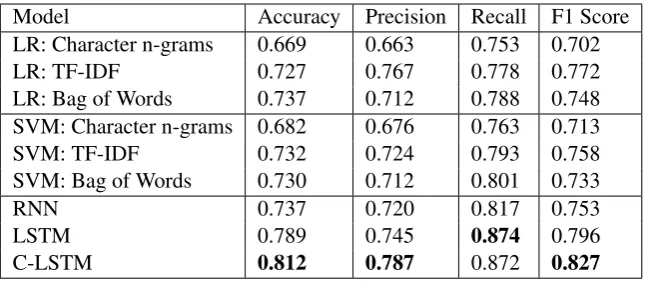
Table 4 shows the results of the baselines as well as deep learning models on the suicide ideation de-tection task in terms of the evaluation metrics. The first six rows show results for baseline methods, whereas the bottom three rows focus on proposed deep learning models. The results shown are ob-tained using 10-fold cross validation.
As the table shows, C-LSTM perform performs significantly better than the baseline methods as well as vanilla LSTM and RNN. This is attributed to the ability of LSTMs to learn how to forget past observations makes them more robust to noise, and better able to capture long-term dependcies in a tweet combined with the efficient en-coding of the one-dimensional spatial structure in the sequence of words for tweets which further serve as input to the LSTM layer. RNNs are com-parable to both TF-IDF and Bag of words mod-els with Multinomial logistic Regression and Sup-port Vector Machines. Among the baselines, the TF-IDF model combined with multinomial logis-tic regression is better than the others. Surpris-ingly, standard feature extraction methods coupled with a linear classifier perform comparatively well as compared to RNNs that involve a much larger amount of computation. However, there is a vast improvement with the incorporation of LSTM and C-LSTM which easily compensates for the addi-tional computation involved.
5.5 Error Analysis
A brief error analysis is presented in this subsec-tion to highlight some of the tweets both annota-tors and the proposed models that gave erroneous results.
• Subtle references Life is so meaningless to me right now, should prolly end itThe mod-els were unable to identify the subtle hints to-wards suicidal ideation.
• UncertaintyFriends are worrying about me committing suicide. It is unclear for both an-notators and the system to identify the nature of this tweet due to the lack of explicit suici-dal intent.
• Unfamiliarity I finally found a whole bot-tle full of pills, im sorry The current train-ing dataset lacks in terms of suicidal ideation phrases and would need updates to cover broader aspects and learn the context between topics such as pill overdose and suicides.
6 Conclusion and Future Work
In this paper, three Deep Learning based mod-els, particularly RNN, LSTM, and C-LSTM are employed for the task of suicidal ideation detec-tion in tweets. For this purpose, a lexicon of terms was first generated by scraping and manu-ally annotating anonymized data from known sui-cide Web forums. A dataset of tweets was col-lected using the Twitter REST API by using search queries corresponding to the generated lexicon. Human annotators labeled tweets with suicidal in-tent present or absent, which were then used to train both three machine learning-based baseline models as well as the three proposed deep learn-ing models. A quantitative comparison between the various models revealed the effectiveness of a C-LSTM based model in suicidal ideation detec-tion in tweets. This was attributed to the ability of CNNs to spatially encode the tweets into a one-dimensional structure to be fed into LSTMs along with the ability of LSTMs to capture long-term de-pendencies. In the future, this work can be ex-tended by investigating other deep learning based architectures for the tasks of suicidal ideation de-tection on Twitter as well as other Web forums and Social media. Also, nature-inspired heuristics can be explored for efficient feature selection as done bySawhney et al.(2018b,c).
References
Breck Baldwin and Bob Carpenter. 2003. Ling-pipe. Available from World Wide Web: http://alias-i. com/lingpipe.
Dankmar B¨ohning. 1992. Multinomial logistic regres-sion algorithm. Annals of the Institute of Statistical Mathematics, 44(1):197–200.
Pete Burnap, Walter Colombo, and Jonathan Scour-field. 2015. Machine classification and analysis of suicide-related communication on twitter. In Pro-ceedings of the 26th ACM conference on hypertext & social media, pages 75–84. ACM.
Gualtiero B Colombo, Pete Burnap, Andrei Hodorog, and Jonathan Scourfield. 2016. Analysing the con-nectivity and communication of suicidal users on twitter. Computer communications, 73:291–300.
Kate Daine, Keith Hawton, Vinod Singaravelu, Anne Stewart, Sue Simkin, and Paul Montgomery. 2013. The power of the web: a systematic review of stud-ies of the influence of the internet on self-harm and suicide in young people. PloS one, 8(10):e77555.
Bart Desmet and V´eRonique Hoste. 2013. Emotion de-tection in suicide notes. Expert Systems with Appli-cations, 40(16):6351–6358.
Sean R Eddy. 1996. Hidden markov models. Current opinion in structural biology, 6(3):361–365.
Jeffrey L Elman. 1990. Finding structure in time. Cog-nitive science, 14(2):179–211.
Alec Go, Richa Bhayani, and Lei Huang. 2009. Twit-ter sentiment classification using distant supervision.
CS224N Project Report, Stanford, 1(12).
Martin Grandjean. 2016. A social network analysis of twitter: Mapping the digital humanities community.
Cogent Arts & Humanities, 3(1):1171458.
Sepp Hochreiter, Yoshua Bengio, Paolo Frasconi, J¨urgen Schmidhuber, et al. 2001. Gradient flow in recurrent nets: the difficulty of learning long-term dependencies.
Sepp Hochreiter and J¨urgen Schmidhuber. 1997. Long short-term memory. Neural computation, 9(8):1735–1780.
Xiaolei Huang, Lei Zhang, David Chiu, Tianli Liu, Xin Li, and Tingshao Zhu. 2014. Detecting suici-dal ideation in chinese microblogs with psycholog-ical lexicons. InUbiquitous Intelligence and Com-puting, 2014 IEEE 11th Intl Conf on and IEEE 11th Intl Conf on and Autonomic and Trusted Comput-ing, and IEEE 14th Intl Conf on Scalable Computing and Communications and Its Associated Workshops (UTC-ATC-ScalCom), pages 844–849. IEEE.
Jared Jashinsky, Scott H Burton, Carl L Hanson, Josh West, Christophe Giraud-Carrier, Michael D Barnes, and Trenton Argyle. 2014. Tracking suicide risk fac-tors through twitter in the us. Crisis: The Jour-nal of Crisis Intervention and Suicide Prevention, 35(1):51.
Diederik P Kingma and Jimmy Ba. 2014. Adam: A method for stochastic optimization. arXiv preprint arXiv:1412.6980.
Debanjan Mahata, Jasper Friedrichs, Rajiv Ratn Shah, and Jing Jiang. 2018. Did you take the pill?-detecting personal intake of medicine from twitter.
arXiv preprint arXiv:1808.02082.
Puneet Mathur, Meghna Ayyar, Sahil Chopra, Simra Shahid, Laiba Mehnaz, and Rajiv Shah. 2018a. Identification of emergency blood donation request on twitter. In Proceedings of the Third Workshop On Social Media Mining for Health Applications.
Puneet Mathur, Ramit Sawhney, Meghna Ayyar, and Rajiv Shah. 2018b. Did you offend me? classifica-tion of offensive tweets in hinglish language. In Pro-ceedings of the Second Workshop on Abusive Lan-guage Online.
Puneet Mathur, Rajiv Shah, Ramit Sawhney, and De-banjan Mahata. 2018c. Detecting offensive tweets in hindi-english code-switched language. In Proceed-ings of the Sixth International Workshop on Natural Language Processing for Social Media, pages 18– 26.
Tomas Mikolov, Ilya Sutskever, Kai Chen, Greg S Cor-rado, and Jeff Dean. 2013a. Distributed represen-tations of words and phrases and their composition-ality. In C. J. C. Burges, L. Bottou, M. Welling, Z. Ghahramani, and K. Q. Weinberger, editors, Ad-vances in Neural Information Processing Systems 26, pages 3111–3119. Curran Associates, Inc.
Tomas Mikolov, Ilya Sutskever, Kai Chen, Greg S Cor-rado, and Jeff Dean. 2013b. Distributed representa-tions of words and phrases and their compositional-ity. InAdvances in neural information processing systems, pages 3111–3119.
Vinod Nair and Geoffrey E Hinton. 2010. Rectified linear units improve restricted boltzmann machines. InProceedings of the 27th international conference on machine learning (ICML-10), pages 807–814.
Bridianne O’Dea, Stephen Wan, Philip J Batterham, Alison L Calear, Cecile Paris, and Helen Chris-tensen. 2015. Detecting suicidality on twitter. In-ternet Interventions, 2(2):183–188.
Juan Ramos et al. 2003. Using tf-idf to determine word relevance in document queries. In Proceedings of the first instructional conference on machine learn-ing, volume 242, pages 133–142.
Patricia R Recupero, Samara E Harms, and Jeffrey M Noble. 2008. Googling suicide: surfing for suicide information on the internet. The Journal of clinical psychiatry.
Ramit Sawhney, Prachi Manchanda, Raj Singh, and Swati Aggarwal. 2018a. A computational approach to feature extraction for identification of suicidal ideation in tweets. InProceedings of ACL 2018, Stu-dent Research Workshop, pages 91–98.
Ramit Sawhney, Puneet Mathur, and Ravi Shankar. 2018b. A firefly algorithm based wrapper-penalty feature selection method for cancer diagnosis. In
Ramit Sawhney, Ravi Shankar, and Roopal Jain. 2018c. A comparative study of transfer functions in binary evolutionary algorithms for single objec-tive optimization. In International Symposium on Distributed Computing and Artificial Intelligence, pages 27–35. Springer.
Bharath Sriram, Dave Fuhry, Engin Demir, Hakan Fer-hatosmanoglu, and Murat Demirbas. 2010. Short text classification in twitter to improve information filtering. In Proceedings of the 33rd international ACM SIGIR conference on Research and develop-ment in information retrieval, pages 841–842. ACM.
Hajime Sueki. 2015. The association of suicide-related twitter use with suicidal behaviour: a cross-sectional study of young internet users in japan. Journal of affective disorders, 170:155–160.
Michiko Ueda, Kota Mori, Tetsuya Matsubayashi, and Yasuyuki Sawada. 2017. Tweeting celebrity sui-cides: Users’ reaction to prominent suicide deaths on twitter and subsequent increases in actual sui-cides. Social Science & Medicine, 189:158–166.
Guang Xiang, Bin Fan, Ling Wang, Jason Hong, and Carolyn Rose. 2012. Detecting offensive tweets via topical feature discovery over a large scale twit-ter corpus. In Proceedings of the 21st ACM inter-national conference on Information and knowledge management, pages 1980–1984. ACM.