Positional Language Models for Clinical Information Retrieval
Florian Boudin DIRO, Universit´e de Montr´eal
CP. 6128, succ. Centre-ville H3C 3J7 Montr´eal, Canada [email protected]
Jian-Yun Nie
DIRO, Universit´e de Montr´eal CP. 6128, succ. Centre-ville
H3C 3J7 Montr´eal, Canada [email protected]
Martin Dawes
Department of Family Medicine McGill University, 515 Pine Ave
H2W 1S4 Montr´eal, Canada [email protected]
Abstract
The PECO framework is a knowledge repre-sentation for formulating clinical questions. Queries are decomposed into four aspects, which are Patient-Problem (P), Exposure (E), Comparison (C) and Outcome (O). However, no test collection is available to evaluate such framework in information retrieval. In this work, we first present the construction of a large test collection extracted from system-atic literature reviews. We then describe an analysis of the distribution of PECO elements throughout the relevant documents and pro-pose a language modeling approach that uses these distributions as a weighting strategy. In our experiments carried out on a collection of 1.5 million documents and 423 queries, our method was found to lead to an improvement of 28% in MAP and 50% in P@5, as com-pared to the state-of-the-art method.
1 Introduction
In recent years, the volume of health and biomedi-cal literature available in electronic form has grown exponentially. MEDLINE, the authoritative reposi-tory of citations from the medical and bio-medical domain, contains more than 18 million citations. Searching for clinically relevant information within this large amount of data is a difficult task that med-ical professionals are often unable to complete in a timely manner. A better access to clinical evidence represents a high impact application for physicians.
Evidence-Based Medicine (EBM) is a widely ac-cepted paradigm for medical practice (Sackett et al., 1996). EBM is defined as the conscientious, explicit and judicious use of current best evidence in making
decisions about patient care. Practice EBM means integrating individual clinical expertise with the best available external clinical evidence from systematic research. It involves tracking down the best evi-dence from randomized trials or meta-analyses with which to answer clinical questions. Richardson et al. (1995) identified the following four aspects as the key elements of a well-built clinical question:
• Patient-problem: what are the patient charac-teristics (e.g. age range, gender, etc.)? What is the primary condition or disease?
• Exposure-intervention: what is the main in-tervention (e.g. drug, treatment, duration, etc.)?
• Comparison: what is the exposure compared to (e.g. placebo, another drug, etc.)?
• Outcome: what are the clinical outcomes (e.g. healing, morbidity, side effects, etc.)?
These elements are known as the PECO elements. Physicians are educated to formulate their clinical questions in respect to this structure. For example, in the following question: “In patients of all ages with Parkinson’s disease, does a Treadmill training com-pared to no training allows to increase the walking distance?” one can identify the following elements:
• P: Patients of all ages with Parkinson’s disease
• E: Treadmill training
• C: No treadmill training
• O: Walking distance
In spite of this well-defined question structure, physicians still use keyword-based queries when they search for clinical evidence. An explanation of
that is the almost total absence of PECO search in-terfaces. PubMed1, the most used search interface, does not allow users to formulate PECO queries yet. For the previously mentioned clinical question, a physician would use the query “Treadmill AND Parkinson’s disease”. There is intuitively much to gain by using a PECO structured query in the re-trieval process. This structure specifies the role of each concept in the desired documents, which is a clear advantage over a keyword-based approach. One can for example differentiate two queries in which a disease would be a patient condition or a clinical outcome. This conceptual decomposition of queries is also particularly useful in a sense that it can be used to balance the importance of each ele-ment in the search process.
Another important factor that prevented re-searchers from testing approaches to clinical infor-mation retrieval (IR) based on PECO elements is the lack of a test collection, which contains a set of documents, a set of queries and the relevance judg-ments. The construction of such a test collection is costly in manpower. In this paper, we take advan-tage of the systematic reviews about clinical ques-tions from Cochrane. Each Cochrane review ex-amines in depth a clinical question and survey all the available relevant publications. The reviews are written for medical professionals. We transformed them into a TREC-like test collection, which con-tains 423 queries and 8926 relevant documents ex-tracted from MEDLINE. In a second part of this pa-per, we present a model integrating the PECO frame-work in a language modeling approach to IR. An in-tuitive method would try to annotate the concepts in documents into PECO categories. One can then match the PECO elements in the query to the ele-ments detected in docuele-ments. However, as previous studies have shown, it is very difficult to automat-ically annotate accurately PECO elements in docu-ments. To by-pass this issue, we propose an alter-native that relies on the observed positional distri-bution of these elements in documents. We will see that different types of element have different distri-butions. By weighting words according to their posi-tions, we can indirectly weigh the importance of dif-ferent types of element in search. As we will show
1www.pubmed.gov
in this paper, this approach turns out to be highly effective.
This paper is organized as follows. We first briefly review the previous work, followed by a description of the test collection we have constructed. Next, we give the details of the method we propose and present our experiments and results. Lastly, we con-clude with a discussion and directions for further work.
2 Related work
The need to answer clinical questions related to a patient care using IR systems has been well stud-ied and documented (Hersh et al., 2000; Niu et al., 2003; Pluye et al., 2005). There are a limited but growing number of studies trying to use the PECO elements in the retrieval process. (Demner-Fushman and Lin, 2007) is one of the few such studies, in which a series of knowledge extractors is used to detect PECO elements in documents. These ele-ments are later used to re-rank a list of retrieved ci-tations from PubMed. Results reported indicate that their method can bring relevant citations into higher-ranking positions, and from these abstracts gener-ate responses that answer clinicians’ questions. This study demonstrates the value of the PECO frame-work as a method for structuring clinical questions. However, as the focus has been put on the post-retrieval step (for question-answering), it is not clear whether PECO elements are useful at the retrieval step. Intuitively, the integration of PECO elements in the retrieval process can also lead to higher re-trieval effectiveness.
of possible candidates for each element and one has to choose if it is a main element (i.e. playing a ma-jor role in the clinical study) or secondary elements. Second is the lack of sufficient annotated data that can be used to train automatic tagging tools.
Despite all these difficulties, several efficient detection methods have been proposed (Demner-Fushman and Lin, 2007; Chung, 2009). Nearly all of them are however restricted to a coarse-grain an-notation level (i.e. tagging entire sentences as de-scribing one element). This kind of coarser-grain identification is more robust and more feasible than the one at concept level, and it could be sufficient in the context of IR. In fact, for IR purposes, what is the most important is to correctly weight the words in documents and queries. From this perspective, an annotation at the sentence level may be suffi-cient. Notwithstanding, experiments conducted us-ing a collection of documents that were annotated at a sentence-level only showed a small increase in re-trieval accuracy (Boudin et al., 2010b) compared to a traditional bag-of-words approach.
More recently, Boudin et al. (2010a) proposed an alternative to the PECO detection issue that relies on assigning different weights to words according to their positions in the document. A location-based weighting strategy is used to emphasize the most informative parts of documents. They show that a large improvement in retrieval effectiveness can be obtained this way and indicate that the weights learned automatically are correlated to the observed distribution of PECO elements in documents. In this work, we propose to go one step further in this direc-tion by analyzing the distribudirec-tion of PECO elements in a large number of documents and define the posi-tional probabilities of PECO elements accordingly. These probabilities will be integrated in the docu-ment language model.
3 Construction of the test collection
Despite the increasing use of search engines by med-ical professionals, there is no standard test collection for evaluating clinical IR. Constructing such a re-source from scratch would require considerable time and money. One way to overcome this obstacle is to use already available systematic reviews. Sys-tematic reviews try to identify, appraise, select and
synthesize all high quality research evidence rele-vant to a clinical question. The best-known source of systematic reviews in the healthcare domain is the Cochrane collaboration2. It consists of a group of over 15,000 specialists who systematically identify and review randomized trials of the effects of treat-ments. In particular, a review contains a reference section, listing all the relevant studies to the clinical question. These references can be considered as rel-evant documents. In our work, we propose to use these reviews as a way to semi-automatically build a test collection. As the reviews are made by special-ists in the area independently from our study, we can avoid bias in our test collection.
We gathered a subset of Cochrane systematic re-views and asked a group of annotators, one professor and four Master students in family medicine, to cre-ate PECO-structured queries corresponding to the clinical questions. As clinical questions answered in these reviews cover various aspects of one topic, multiple variants of precise PECO queries were gen-erated for each review. Moreover, in order to be able to compare a PECO-based search strategy to a real world scenario, this group have also provided the keyword-based queries that they would have used to search with PubMed. Below is an example of queries generated from the systematic review about “Aspirin with or without an antiemetic for acute mi-graine headaches in adults”:
Keyword-based query
[aspirin and migraine]
PECO-structured queries
1. [adults 18 years or more with migraine]P [aspirin alone]E
[placebo]C [pain free]O
2. [adults 18 years or more with migraine]P [aspirin plus an antiemetic]E
[placebo]C [pain free]O
3. [adults 18 years or more with migraine]P [aspirin plus metoclopramide]E
[active comparator]C [use of rescue medication]O
All the citations included in the “References” sec-tion of the systematic review were extracted and selected as relevant documents. These citations were manually mapped to PubMed unique identi-fiers (PMID). This is a long process that was under-taken by two different workers to minimize the num-ber of errors. At this step, only articles published in journals referenced in PubMed are considered (e.g. conference proceedings are not included).
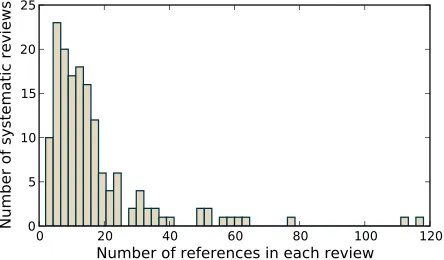
0 20 40 60 80 100 120
Number of references in each review
0 5 10 15 20 25
[image:4.612.76.298.190.320.2]Number of systematic reviews
Figure 1: Histogram of the number of queries versus the number of relevant documents.
We selected in sequential order from the set of new systematic reviews3 and processed 156 Cochrane reviews. There was no restriction about the topics covered or the number of included refer-ences. The resulting test collection is composed of 423 queries and 8926 relevant citations (2596 differ-ent citations). This number reduces to 8138 citations once we remove the citations without any text in the abstract (i.e. certain citations, especially old ones, only contain a title). Figure 1 shows the statistics derived from the number of relevant documents by query. In this test collection, the average number of documents per query is approximately 19 while the average length of a document is 246 words.
4 Distribution of PECO elements
The observation that PECO elements are not evenly distributed throughout the documents is not new. In fact, most existing tagging methods used location-based features. This information turns out to be very useful because of the standard structure of medical citations. Actually, many scientific journals explic-itly recommend authors to write their abstracts in
3
http://mrw.interscience.wiley.com/ cochrane/cochrane clsysrev new fs.html
compliance to the ordered rhetorical structure: In-troduction, Methods, Results and Discussion. These rhetorical categories are highly correlated to the dis-tributions of PECO elements, as some elements are more likely to occur in certain categories (e.g. clin-ical outcomes are more likely to appear in the con-clusion). The position is thus a strong indicator of whether a text segment contains a PECO element or not.
To the best of our knowledge, the first analysis of the distribution of PECO elements in documents was described in(Boudin et al., 2010a). A small col-lection of manually annotated abstracts was used to compute the probability that a PECO element oc-curs in a specific part of the documents. This study is however limited by the small number of anno-tated documents (approximately 50 citations) and the moderate agreement rate among human annota-tors. Here we propose to use our test collection to compute more reliable statistics.
The idea is to use the pairs of PECO-structured query and relevant document, assuming that if a doc-ument is relevant then it should contain the same elements as the query. Of course, this is obvi-ously not always the case. Errors can be introduced by synonyms or homonyms and relevant documents may not contain all of the elements described in the query. But, with more than 8100 documents, it is quite safe to say that this method produce fairly reli-able results. Moreover, a filtering process is applied to queries removing all non-informative words (e.g. stopwords, numbers, etc.) from being counted.
There are several ways to look at the distribution of PECO elements in documents. One can use the rhetorical structure of abstracts to do that. However, the high granularity level of such analysis would make it less precise for IR purposes. Furthermore, most of the citations available in PubMed are de-void of explicitly marked sections. It is possible to automatically detect these sections but only with a non-negligible error rate (McKnight and Srinivasan, 2003). In our study, we chose to use a fixed num-ber of partitions by dividing documents into parts of equal length. This choice is motivated by its repeata-bility and ease to implement, but also for compari-son with previous studies.
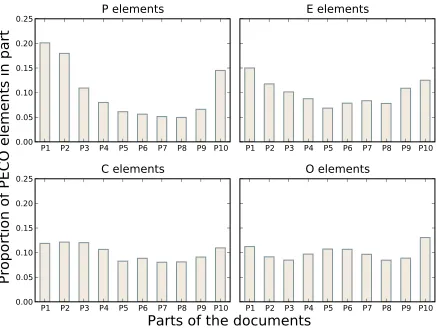
computed statistics on the number of query words that occur in each of these parts. For each PECO el-ement, the distribution of query words among the parts of the documents is not uniform (Figure 2). We observe distinctive distributions, especially for Patient-Problem and Exposure elements, indicating that first and last parts of the documents have higher chance to contain these elements. This gives us a clear and robust indication on which specific parts should be enhanced when searching for a given el-ement. Our proposed model will exploit the typical distributions of PECO elements in documents.
P1 P2 P3 P4 P5 P6 P7 P8 P9 P10 0.00
0.05 0.10 0.15 0.20
0.25 P elements
P1 P2 P3 P4 P5 P6 P7 P8 P9 P10 E elements
P1 P2 P3 P4 P5 P6 P7 P8 P9 P10
Parts of the documents0.00
0.05 0.10 0.15 0.20 0.25
Proportion of PECO elements in part
C elements
[image:5.612.78.297.228.392.2]P1 P2 P3 P4 P5 P6 P7 P8 P9 P10 O elements
Figure 2: Distribution of each PECO element throughout the different parts of the documents.
5 Retrieval Method
In this work, we use the language modeling ap-proach to information retrieval. This apap-proach as-sumes that queries and documents are generated from some probability distribution of text (Ponte and Croft, 1998). Under this assumption, ranking a doc-umentDas relevant to a queryQis seen as estimat-ingP(Q|D), the probability thatQwas generated by the same distribution asD. A typical way to score a document Das relevant to a query Qis to com-pute the Kullback-Leibler divergence between their respective language models:
score(Q, D) = X
w∈Q
P(w|Q)·logP(w|D) (1)
Under the traditional bag-of-words assumption, i.e. assuming that there is no need to model term
de-pendence, a simple estimate forP(w|Q)can be ob-tained by computing Maximum Likelihood Estima-tion (MLE). It is calculated as the number of times the wordw appears in the query Q, divided by its length:
P(w|Q) = count(w, Q)
|Q|
A similar method is employed for estimating
P(w|D). Bayesian smoothing using Dirichlet pri-ors is however applied to the maximum likelihood estimator to compensate for data sparseness (i.e. smoothing probabilities to remove zero estimates). Givenµthe prior parameter andCthe collection of documents,P(w|D)is computed as:
P(w|D) = count(w, D) +µ·P(w|C)
|D|+µ
5.1 Model definition
In our model, we propose to use the distribution of PECO elements observed in documents to empha-size the most informative parts of the documents. The idea is to get rid of the problem of precisely detecting PECO elements by using a positional lan-guage model. To integrate position, we estimate a series of probabilities that constraints the word counts to a specific part of the documents instead of the entire document. Each documentDis ranked by a weighted linear interpolation. Given a document
Ddivided in 10 partsp∈ [P1, P2· · ·P10],P(w|D) in equation 1 is redefined as:
P0(w|D) =α·P(w|D) +β·Ptitle(w|D)
+γ· X
pi∈D
σe·Ppi(w|D) (2)
where theσe weights for each type of elemente
are empirically fixed to the values of the distribution of PECO elements observed in documents. We then redefine the scoring function to integrate the PECO query formulation. The idea is to use the PECO structure as a way to balance the importance of each element in the retrieval step. The final scoring func-tion is defined as:
scorefinal(Q, D) = X
e∈PECO
In our model, there are a total of 7 weighting pa-rameters, 4 corresponding to the PECO elements in queries (δP,δE,δCandδO) and 3 for the document language models (α, β andγ). These parameters will be determined by cross-validation.
6 Results
In this section, we first describe the details of our experimental protocol. Then, we present the results obtained by our model on the constructed test col-lection.
6.1 Experimental settings
As a collection of documents, we gathered 1.5 mil-lions of citations from PubMed. We used the fol-lowing constraints: citations with an abstract, hu-man subjects, and belonging to one of the follow-ing publication types: randomized control trials, re-views, clinical trials, letters, editorials and meta-analyses. The set of queries and relevance judg-ments described in Section 3 is used to evaluate our model. Relevant documents were, if not al-ready included, added to the collection. Because each query is generated from a systematic literature review completed at a time t, we placed an addi-tional restriction on the publication date of the re-trieved documents: only documents published be-fore time t are considered. Before indexing, each citation is pre-processed to extract its title and ab-stract text and then converted into a TREC-like doc-ument format. Abstracts are divided into 10 parts of equal length (the ones containing less than 10 words are discarded). The following fields are marked in each document: title, P1, P2· · · P10. The following evaluation measures are used:
• Precision at rank n (P@n): precision computed on the n topmost retrieved documents.
• Mean Average Precision (MAP): average of precision measures computed at the point of each relevant document in the ranked list.
• Number of relevant documents retrieved
All retrieval tasks are performed using an “out-of-the-shelf” version of the Lemur toolkit4. We use the embedded tokenization algorithm along with the
4www.lemurproject.org
standard Porter stemmer. The number of retrieved documents is set to 1000 and the Dirichlet prior smoothing parameter toµ= 2000. In all our exper-iments, we use the KL divergence scoring function (equation 1) as baseline. Statistical significance is computed using the well-known Student’s t-test. To determine reasonable weights and avoid overtuning the parameters, we use a 10-fold cross-validation op-timizing the MAP values.
6.2 Experiments
We first investigated the impact of using PECO-structured queries on the retrieval performance. As far as we know, no quantitative evaluation of the increase or decrease of performance in comparison with a keyword-based search strategy has been re-ported. Schardt et al. (2007) presented a compari-son between PubMed and a PECO search interface but failed to demonstrate any significant difference between the two search protocols. The larger num-ber of words in PECO-structured queries, on aver-age 18.8 words per query compared to 4.3 words for keyword queries, should capture more aspects of the information need. But, it may also be a disadvan-tage due to the fact that more noise can be brought in, causing query-drift issues.
We propose two baselines using the keyword-based queries. The first baseline (named Baseline-1) uses keyword queries with the traditional lan-guage modeling approach. This is one of the state-of-the-art approaches in current IR research. This retrieval model considers each word in a query as an equal, independent source of information. In the second baseline (named Baseline-2), we consider multiword phrases. In our test collection, queries are often composed of multiword phrases such as “low back pain” or “early pregnancy”. It is clear that finding the exact phrase “heart failure” is a much stronger indicator of relevance than just find-ing “heart” and “failure” scattered within a docu-ment. The Indri operator #1 is used to perform phrase-based retrieval. Phrases are already indicated in queries by the conjunction and (e.g. vaccine and hepatitis B). A simple regular expression is used to recognize the phrases.
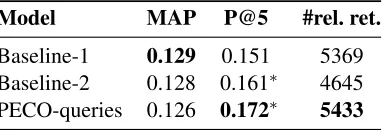
relevant documents retrieved is decreased. This is due to the fact that we use exact phrase matching that can reduce query coverage. One solution would be to use unordered window features (Indri operator
#uwn) that would require words to be close together but not necessarily in an exact sequence order (Met-zler and Croft, 2005).
The PECO queries use PECO-structured queries as a bag of words. We observe that PECO queries do not enhance the average precision but increase the P@5 significantly. The number of relevant doc-uments retrieved is also larger. These results indi-cate that formulating clinical queries according to the PECO framework enhance the retrieval effec-tiveness.
Model MAP P@5 #rel. ret.
Baseline-1 0.129 0.151 5369
Baseline-2 0.128 0.161∗ 4645
[image:7.612.91.284.270.335.2]PECO-queries 0.126 0.172∗ 5433
Table 1: Comparing the performance measures of
keyword-based and PECO-structured queries in terms of MAP, precision at 5 and number of relevant documents retrieved (#rel. ret.). (∗: t.test<0.05)
In a second series of experiments, we evaluated the model we proposed in Section 5 . We compared two variants of our model. The first variant (named Model-1) uses a globalσedistribution fixed accord-ing to the average distribution of all PECO elements (i.e. the observed probability that a PECO element occurs in a document’ part, no matter which element it is). The second variant (named Model-2) uses a differentiatedσedistribution for each type of PECO
element. The idea is to see if, given the fact that PECO elements have different distributions in docu-ments, using an adapted weight distribution for each element can improve the retrieval effectiveness.
Previous studies have shown that assigning a dif-ferent weight to each PECO element in the query leads to better results (Demner-Fushman and Lin, 2007; Boudin et al., 2010a). In order to compare our model with a similar method, we defined another baseline (named Baseline-3) by fixing the parame-tersβ= 0 andγ= 0 in equation 2. We performed a grid search (from 0 to 1 by step of 0.1) to find the optimalδweights. Regarding the last three
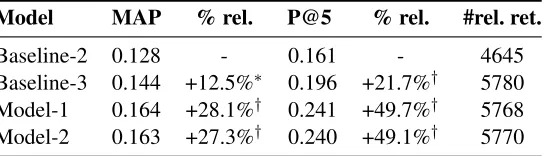
pa-rameters in our full models, namelyα,βandγ, we conducted a second grid search to find their optimal values. Performance measures obtained in 10-fold cross-validation (optimizing the MAP measure) by these models are presented in Table 2.
A significant improvement is obtained by the Baseline-3 over the keyword-based approach (Baseline-2). The PECO decomposition of queries is particularly useful to balance the importance of each element in the scoring function. We observe a large improvement in retrieval effectiveness for both models over the two baselines. This strongly indi-cates that a weighting scheme based on the word po-sition in documents is effective. These results sup-port our assumption that the distribution of PECO elements in documents can be used to weight words in the document language model.
However, we do not observe meaningful differ-ences between Model-1 and Model-2. This tend to suggest that a global distribution is likely more ro-bust for IR purposes than separate distributions for each type of element. Another possible reason is that our direct mapping from positional distribution to probabilities may not be the most appropriate. One may think about using a different transformation, or performing some smoothing. We will leave this for our future work.
7 Conclusion
This paper first presented the construction of a test collection for evaluating clinical information re-trieval. From a set of systematic reviews, a group of annotators were asked to generate structured clin-ical queries and collect relevance judgments. The resulting test collection is composed of 423 queries and 8926 relevant documents. This test collection provides a basis for researchers to experiment with PECO-structured queries in clinical IR. The test col-lection introduced in this paper, along with the man-ual given to the group of annotators, will be available for download5.
In a second step, this paper addressed the prob-lem of using the PECO framework in clinical IR. A straightforward idea is to identify PECO elements in documents and use the elements in the retrieval pro-cess. However, this approach does not work well
Model MAP % rel. P@5 % rel. #rel. ret.
Baseline-2 0.128 - 0.161 - 4645
Baseline-3 0.144 +12.5%∗ 0.196 +21.7%† 5780
Model-1 0.164 +28.1%† 0.241 +49.7%† 5768
[image:8.612.172.444.55.133.2]Model-2 0.163 +27.3%† 0.240 +49.1%† 5770
Table 2: 10-fold cross validation scores for the Baseline-2, Baseline-3 and the two variants of our proposed model (Model-1 and Model-2). Relative increase over the Baseline-2 is given, #rel. ret. is the number of relevant documents retrieved. (†: t.test<0.01,∗: t.test<0.05)
cause of the difficulty to automatically detect these elements. Instead, we proposed a less demanding approach that uses the distribution of PECO ele-ments in docuele-ments to re-weight terms in the doc-ument model. The observation of variable distribu-tions in our test collection led us to believe that the position information can be used as a robust indica-tor of the presence of a PECO element. This strategy turns out to be promising. On a data set composed of 1.5 million citations extracted with PubMed, our best model obtains an increase of 28% for MAP and nearly 50% for P@5 over the classical language modeling approach.
In future work, we intend to expand our analy-sis of the distribution of PECO elements to a larger number of citations. One way to do that would be to automatically extract PubMed citations that contain structural markers associated to PECO cate-gories (Chung, 2009).
References
Florian Boudin, Jian-Yun Nie, and Martin Dawes. 2010a. Clinical Information Retrieval using Document and
PICO Structure. In Proceedings of the HLT-NAACL
2010 conference, pages 822–830.
Florian Boudin, Lixin Shi, and Jian-Yun Nie. 2010b. Im-proving Medical Information Retrieval with PICO
El-ement Detection. In Proceedings of the ECIR 2010
conference, pages 50–61.
Grace Y. Chung. 2009. Sentence retrieval for abstracts of randomized controlled trials. BMC Medical Infor-matics and Decision Making, 9(1).
Thomas Owens Sheri Keitz Connie Schardt, Martha B Adams and Paul Fontelo. 2007. Utilization of the PICO framework to improve searching PubMed for clinical questions. BMC Medical Informatics and De-cision Making, 7(1).
Martin Dawes, Pierre Pluye, Laura Shea, Roland Grad, Arlene Greenberg, and Jian-Yun Nie. 2007. The
iden-tification of clinically important elements within med-ical journal abstracts: PatientPopulationProblem, Ex-posureIntervention, Comparison, Outcome, Duration and Results (PECODR). Informatics in Primary care, 15(1):9–16.
D. Demner-Fushman and J. Lin. 2007. Answering
clinical questions with knowledge-based and statistical techniques.Computational Linguistics, 33(1):63–103. William R. Hersh, Katherine Crabtree, David H. Hickam, Lynetta Sacherek, Linda Rose, and Charles P. Fried-man. 2000. Factors associated with successful an-swering of clinical questions using an information re-trieval system. Bulletin of the Medical Library Asso-ciation, 88(4):323–331.
Larry McKnight and Padmini Srinivasan. 2003. Catego-rization of sentence types in medical abstracts. Pro-ceedings of the AMIA annual symposium.
Donald Metzler and W. Bruce Croft. 2005. A Markov random field model for term dependencies. In Pro-ceedings of the SIGIR conference, pages 472–479. Yun Niu, Graeme Hirst, Gregory McArthur, and Patricia
Rodriguez-Gianolli. 2003. Answering clinical ques-tions with role identification. In Proceedings of the ACL 2003 Workshop on Natural Language Processing in Biomedicine, pages 73–80.
Pierre Pluye, Roland M. Grad, Lynn G. Dunikowski, and Randolph Stephenson. 2005. Impact of clinical information-retrieval technology on physicians: a lit-erature review of quantitative, qualitative and mixed methods studies. International Journal of Medical In-formatics, 74(9):745–768.
Jay M. Ponte and W. Bruce Croft. 1998. A language modeling approach to information retrieval. In Pro-ceedings of the SIGIR conference, pages 275–281. Scott W. Richardson, Mark C. Wilson, Jim Nishikawa,
and Robert S. Hayward. 1995. The well-built clini-cal question: a key to evidence-based decisions. ACP Journal Club, 123(3):A12–13.
David L. Sackett, William Rosenberg, J. A. Muir Gray, Brian Haynes, and W. Scott Richardson. 1996. Ev-idence based medicine: what it is and what it isn’t.