Generating Aspect-oriented Multi-Document Summarization with
Event-aspect model
Peng Li1 andYinglin Wang1andWei Gao2andJing Jiang3
1 Department of Computer Science and Engineering, Shanghai Jiao Tong University
2 Department of Systems Engineering and Engineering Management, Chinese University of Hong Kong 3 School of Information Systems, Singapore Management University
{lipeng, [email protected]} {[email protected]} {[email protected]}
Abstract
In this paper, we propose a novel approach to automatic generation of aspect-oriented sum-maries from multiple documents. We first de-velop an event-aspect LDA model to cluster sentences into aspects. We then use extend-ed LexRank algorithm to rank the sentences in each cluster. We use Integer Linear Pro-gramming for sentence selection. Key features of our method include automatic grouping of semantically related sentences and sentence ranking based on extension of random walk model. Also, we implement a new sentence compression algorithm which use dependency tree instead of parser tree. We compare our method with four baseline methods. Quantita-tive evaluation based on Rouge metric demon-strates the effectiveness and advantages of our method.
1 Introduction
In recent years, there has been much interest in the task of multi-document summarization. In this paper, we study the task of automatically generat-ing aspect-oriented summaries from multiple docu-ments. The goal of aspect-oriented summarization is to present the most important content to the us-er in a condensed form and a well-organized struc-ture to satisfy the user’s needs. A summary should follow a readable structure and cover all the aspect-s uaspect-seraspect-s are intereaspect-sted in. For example, a aspect-summary about natural disasters should include aspects about what happened, when/where it happened, reasons, damages, rescue efforts, etc. and these aspects may be scattered in multiple articles written by different news agencies. Our goal is to automatically collect
aspects and construct summaries from multiple doc-uments.
Aspect-oriented summarization can be used in many scenarios. First of all, it can be used to gener-ate Wikipedia-like summary articles, especially used to generate introduction sections that summarizes the subject of articles before the table of contents and other elaborate sections. Second, opinionat-ed text often contains multiple viewpoints about an issue generated by different people. Summarizing these multiple opinions can help people easily di-gest them. Furthermore, combined with search en-gines and question&answering systems, we can bet-ter organize the summary content based on aspects to improve user experience.
Despite its usefulness, the problem of modeling domain specific aspects for multi-document summa-rization has not been well studied. The most relevant work is by (Haghighi and Vanderwende, 2009) on exploring content models for multi-document sum-marization. They proposed a HIERSUM model for finding the subtopics or aspects which are combined by using KL-divergence criterion for selecting rel-evant sentences. They introduced a general con-tent distribution and several specific concon-tent distri-butions to discover the topic and aspects for a s-ingle document collection. However, the aspects may be shared not only across documents in a sin-gle collection, but also across documents in different topic-related collections. Their model is conceptual-ly inadequate for simultaneousconceptual-ly summarizing mul-tiple topic-related document collections. Further-more, their sentence selection method based on KL-divergence cannot prevent redundancy across differ-ent aspects.
In this paper, we study how to overcome these
limitations. We hypothesize that comparatively summarizing topics across similar collections can improve the effectiveness of aspect-oriented multi-document summarization. We propose a novel extraction-based approach which consists of four main steps listed below:
Sentence Clustering: Our goal in this step is to automatically identify the different aspects and clus-ter sentences into aspects (See Section 2). We sub-stantially extend the entity-aspect model in (Li et al., 2010) for generating general sentence clusters.
Sentence Ranking: In this step, we use an exten-sion of LexRank algorithm proposed by (Paul et al., 2010) to score representative sentences in each clus-ter (See Section 3).
Sentence Compression: In this step, we aim to improve the linguistic quality of the summaries by simplifying the sentence expressions. We prune sen-tences using grammatical relations defined on de-pendency trees for recognizing important clauses and removing redundant subtrees (See Section 4).
Sentence Selection: Finally, we select one com-pressed version of the sentences from each aspec-t clusaspec-ter. We use Integer Linear Programming (ILP) algorithm, which optimizes aglobalobjective function, for sentence selection (McDonald, 2007; Gillick and Favre, 2009; Sauper and Barzilay, 2009) (See Section 5).
We evaluate our method using TAC2010 Guided Summarization task data sets1(Section 6). Our
eval-uation shows that our method obtains better ROUGE recall score compared with four baseline methods, and it also achieve reasonably high-quality aspec-t clusaspec-ters in aspec-terms of puriaspec-ty.
2 Sentence Clustering
In this step, our goal is to discover event aspects con-tained in a document set and cluster sentences in-to aspects. Here we substantially extend the entity-aspect model in Li et al. (2010) and refer to it as event-aspect model. The main difference between our event-aspect model and entity-aspect model is that we introduce an additional layer of event topics and the separation of general and specific aspects.
1http://www.nist.gov/tac/2010/
Summarization/
Our extension is based upon the following ob-servations. For example, specific events like “Columbine Massacre” and “Malaysia Resort Ab-duction” can be related to the “Attack” topic. Each event consists of multiple articles written by dif-ferent news agencies. Interesting aspects may in-clude “what happened, when, where, perpetrators, reasons, who affected, damages and countermea-sures,” etc2. We compared the “Columbine
Mas-sacre” and “Malaysia Resort Abduction” data set-s and found 5 different kindset-s of wordset-s in the text: (1) stop words that occur frequently in any docu-ment collection; (2) general content words describ-ing “damages” or “countermeasures” aspect of at-tacks; (3) specific content words describing “what happened”, “who affected” or “where” aspect of the concrete event; (4) background words describing the general topic of “Attack”; (5) words that are local to a single document and do not appear across different documents. Table 1 shows four sentences related to two major aspects. We found that the entity-aspect model does not have enough capacity to cluster sen-tences into aspects (See Section 6). So we introduce additional layer to improve the effectiveness of sen-tence clustering. We also found that their one aspect per sentence assumption is not very strong in this scenario. Although a sentence may belong to a sin-gle general aspect, it still contains multiple specific aspect words like second sentence in Table 1. There-fore, We assume that each sentence belongs to both a general aspect and a specific aspect.
2.1 Event-Aspect Model
Stop words can be ignored by LDA model because they can be easily identified using a standard stop word list. Suppose that for a given event topic, there are in total C specific events for which we need to simultaneously generate summaries. We can assume four kinds of unigram language models (i.e. multi-nomial word distributions). For each event topic, there is a background modelϕBthat generates words commonly used in all documents, and there areAG
general aspect modelsϕga (1 ≤ ga ≤ AG), where AGis the number of general aspects. For each spe-cific event in a topic, there are AS specific aspect
2http://www.nist.gov/tac/2010/
countermeasures
Police/GA are/S close/B to/S identifying/GA someone/B responsible/GA for/S the/S attack/B .
Investigators/GA do/S not/S know/B how/S many/S suspects/SA they/S are/S looking/B for/S, but/S reported/B progress/B toward/S identifying/GA one/S of/S the/S bombers/SA .
what happened, when, where
During/S the/S morning/SA rush/D hour/D on/S July/SA 7/SA terrorists/B exploded/SA bombs/SA on/S three/D London/SA subway/D trains/SA and/S a/S double-decker/D bus/SA .
Four/D coordinated/B bombings/SA struck/B central/B London/SA on/SA July/SA 7/SA, three/D in/S subway/D cars/SA and/S one/D on/S a/S bus/SA .
Table 1: Four sentences on “COUNTERMEASURES” and “What, When, Where” aspects from the “Attack” topic. S: stop word. B: background word. GA: general aspect word. SA: specific aspect word. D: document word.
modelsϕsa(1 ≤sa ≤ AS), where AS is the
num-ber of specific aspects, and also there are D doc-ument models ϕd (1 ≤ d ≤ D), where D is the number of documents in this collection. We assume that these word distributions have a uniform Dirich-let prior with parameterβ.
We introduce a level distribution σ that control-s whether we choocontrol-se a word fromϕga or ϕsa. σ
is sampled fromBeta(δ0, δ1)distribution. We also
introduce an aspect distributionθthat controls how often a general or a specific aspect occurs in the col-lection, where θis sampled from another Dirichlet prior with parameterα. There is also a multinomi-al distributionπ that controls in each sentence how often we encounter a background word, a document word, or an aspect word.πhas a Dirichlet prior with parameterγ.
LetSd denote the number of sentences in
docu-mentd,Nd,sdenote the number of words (after stop
word removal) in sentence s of document d, and wd,s,n denote the n’th word in this sentence. We
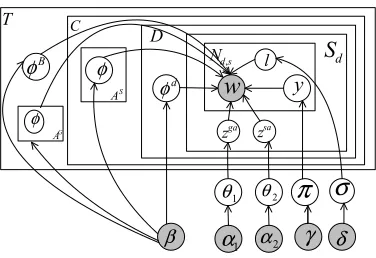
introduce hidden variableszgad,s andzsad,s to indicate that a sentence sof document dbelongs to which general or specific aspects . We introduce hidden variablesyd,s,n for each word to indicate whether a
word is generated from the background model, the document model, or the aspect model. We also intro-duce hidden variablesld,s,n to indicate whether the n’th word in sentencesof documentdis generated from the general aspect model. Figure 1 describes the process of generating the whole document col-lection. The plate notation of the model is shown in Figure 2. Note that the values ofδ0, δ1, α1,α2, β
andγ are fixed. The number of general and specific aspectsAGandASare also empirically set.
Given a document collection, i.e. the set of all wd,s,n, our goal is to find the most likely
assignmen-t of zgad,s, zsa
d,s, yd,s,n andld,s,n that maximizes
dis-tributionp(z,y,l|w;α, β, γ, δ), wherez,y,landw represent the set of allz,y,landwvariables, respec-tively. With the assignment, sentences are naturally clustered into aspects, and words are labeled as ei-ther a background word, a document word, a general aspect word or a specific aspect word.
Inference can be done with Gibbs sampling, which is commonly used in LDA models (Griffiths and Steyvers, 2004).
In our experiments, we set α1 = 5, α2 = 3, β = 0.01, γ = 20, δ1 = 10 and δ2 = 10. We
run 100 burn-in iterations through all documents in a collection to stabilize the distribution of z andy before collecting samples. We take 10 samples with a gap of 10 iterations between two samples, and av-erage over these 10 samples to get the estimation for the parameters.
After estimating all the distributions, we can find the values of each zd,sga and zsad,s that gives us sen-tences clustered into general and specific aspects.
3 Sentence Ranking
mod-1. Drawθ1 ∼Dir(α1), θ2 ∼Dir(α2), π ∼Dir(γ)
Drawσ∼Beta(δ0, δ1)
2. For each event topic, there is a background model ϕB, and there are general aspectga, where1 ≤
ga≤AG
(a) drawϕB∼Dir(β)
(b) drawϕga
∼Dir(β)
3. For each document collection, there are specific aspectsa, where1≤sa≤AS
(a) drawϕsa∼Dir(β)
4. For each documentd= 1, . . . , D,
(a) drawϕd
∼Dir(β)
(b) for each sentences= 1, . . . , Sd i. drawzga
∼Multi(θ1)
ii. drawzsa
∼Multi(θ2)
iii. for each wordn= 1, . . . , Nd,s A. drawld,s,n∼Binomial(σ)
B. drawyd,s,n∼Multi(π)
C. drawwd,s,n∼Multi(ϕB)ifyd,s,n=
1,wd,s,n ∼Multi(ϕd)ifyd,s,n= 2, wd,s,n ∼ Multi(ϕzd,ssa) if yd,s,n =
3 and ld,s,n = 1 or wd,s,n ∼
[image:4.612.341.529.44.173.2]Multi(ϕzd,sga) if yd,s,n = 3 and ld,s,n = 0
Figure 1: The document generation process.
el on top of a graph that represents sentences to be summarized as nodes and their similarities as edges. The LexRank score of a sentence gives the expected probability that a random walk will visit that sen-tence in the long run. A variant is called continu-ous LexRank improved LexRank by making use of the strength of the similarity links. The continuous LexRank score can be computed using the following formula:
L(u) = d
N + (1−d)
∑
v∈adj[u]
p(u|v)L(v)
whereL(u)is the LexRank value of sentenceu,Nis the total number of nodes in the graph,dis a damp-ing factor for the convergence of the method, and p(u|v)is the jumping probability between sentence uand its neighboring sentencev. p(u|v)is defined using content similarity functionsim(u, v)between two sentences:
T
y d
φ
d
S
D
s d ,
w
S A
φ
β
C
γ
π
σ
δ
ga z sa
z
l
φ
G
A B φ
1
θ θ2
1
α α2
Figure 2: The event-aspect model.
p(u|v) =∑ sim(u, v)
z∈adj[v]sim(z, v)
The major extension is to modify this jumping probability so as to favor visiting representative sen-tences. More specifically, we scalesim(u, v)by the likelihood that the two sentences represent the same general aspectgaor specific aspectsa:
sim′(u, v) =sim(u, v)[
AG
∑
ga=1
P(ga|u)P(ga|v)
+
AS
∑
sa=1
P(sa|u)P(sa|v)]
where the value P(ga|u) and P(sa|u) can be computed by our event-aspect model. We define sim(u, v) as the tf ∗idf weighted cosine similar-ity between two sentences.
We found that sentence ranking is better con-ducted before the compression because the pre-compressed sentences are more informative and the similarity function in LexRank can be better off with the complete information.
4 Sentence Compression
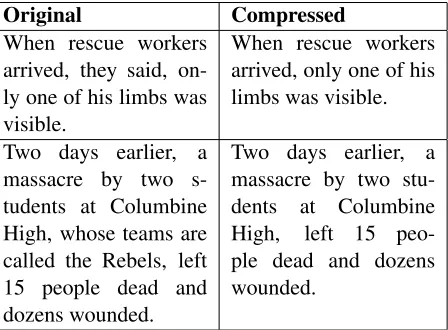
[image:4.612.88.314.47.376.2]clause, and will result in “whose children go to Columbine”, which is not adequate. Furthermore, some important temporal modifier, numeric modifier and clausal complement need to be retained because they reflect content aspects of the summary. There-fore, we propose the “dependency parse and trim” approach, which prunes sentences based on depen-dency tree representations, using English grammati-cal relations to recognize clauses and remove redun-dant structures. Table 2 shows two examples by re-moving redundant auxiliary clauses. Below is the sentence compression procedure:
1. Select possible subtree root nodes using gram-matical relations, such as clausal complement, complementizer, or parataxis3.
2. Decide which subtree root node can be the root of clause. If this root contains maximum num-ber of child nodes and the collection of all child edges include object or auxiliary relations, it is selected as the root node.
3. Remove redundant modifiers such as adverbial-s, relative clause modifiers and abbreviationadverbial-s, participials and infinitive modifiers.
4. Traverse the subtrees and generate all possible compression alternatives using the subtree root node, then keep the top two longest sub sen-tences.
5. Drop the sub sentences shorter than 5 words.
5 Sentence Selection
After sentence pruning, we prepare for the final event summary generation process. In this step, we select one compressed version of the sentence from each aspect cluster. To avoid redundancy between aspects, we use Integer Linear Programming to opti-mize a global objective function for sentence selec-tion. Inspired by (Sauper and Barzilay, 2009), we formulate the optimization problem based on sen-tence ranking information. More specifically, we
3The parataxis relation is a relation between the main verb of a clause and other sentential elements, such as a sentential parenthetical, colon, or semicolon
Original Compressed
When rescue workers arrived, they said, on-ly one of his limbs was visible.
When rescue workers arrived, only one of his limbs was visible.
Two days earlier, a massacre by two s-tudents at Columbine High, whose teams are called the Rebels, left 15 people dead and dozens wounded.
[image:5.612.326.550.47.212.2]Two days earlier, a massacre by two stu-dents at Columbine High, left 15 peo-ple dead and dozens wounded.
Table 2: Example compressed sentences.
would like to select exactly one compressed sen-tence which receives the highest possible ranking s-core from each aspect cluster subject to a series of constraints, such as redundancy and length. We em-ployed lp solver 4, an efficient mixed integer
pro-gramming solver using the Branch-and-Bound algo-rithm to select sentences.
Assume that there are in total K aspects in an event topic. For each aspect j, there are in totalR ranked sentences. The variablesSjlis a binary
indi-cator of the sentence. That is,Sjl= 1 if the sentence
is included in the final summary, andSjl= 0
other-wise. lis the ranked position of the sentence in this aspect cluster.
Objective Function
Top ranked sentences are the most relevant corre-sponding to the related aspects which we want to in-clude in the final summary. Thus we try to minimize the ranks of the sentences to improve the overall re-sponsiveness.
min(
K ∑
j=1 Rj
∑
l=1 l·Sjl)
Exclusivity Constraints
To prevent redundancy in each aspect, we just choose one sentence from each general or specific aspect cluster. The constraint is formulated as fol-lows:
Rj
∑
l=1
Sjl= 1 ∀j ∈ {1. . . K}
Redundancy Constraints
We also want to prevent redundancy across differ-ent aspects. If sdiffer-entence-similaritysim(sjl, sj′l′)
be-tween sentencesjl and sj′l′ is above 0.5, then we
drop the pair and choose one sentence ranked higher from the pair otherwise. This constraint is formulat-ed as follows:
(Sjl+Sj′l′)·sim(sjl, sj′l′)≤0.5 ∀j, j′ ∈ {1. . . K}∀l∈ {1. . . Rj}∀l′ ∈ {1. . . Rj′}
Length Constraints
We add this constraint to ensure that the length of the final summary is limited toLwords.
K
∑
j=1
Rj
∑
l=1
lenjl·Sjl≤L
wherelenjlis the length ofSjl.
6 Evaluation
In order to systematically evaluate our method, we want to check (1) whether the whole system is effec-tive, which means to quantitatively evaluate summa-ry quality, and (2) whether individual components like clustering and compression algorithms are use-ful.
6.1 Data
We use TAC2010 Summarization task data set for the summary content evaluation. This data set pro-vides 46 events. Each event falls into a predefined event topic. Each specific event includes an even-t seven-taeven-temeneven-t and 20 relevaneven-t newswire areven-ticles which have been divided into 2 sets: Document Set A and Document Set B. Each document set has 10 docu-ments, and all the documents in Set A chronologi-cally precede the documents in Set B. We just use document Set A for our task. Assessors wrote mod-el summaries for each event, so we can compare our automatic generated summaries with the model summaries. We combine topic related data sets to-gether, then these data sets simultaneously annotated by our Event-aspect model. After labeling process, we run sentence ranking, compression and selection module to get final aspect-oriented summarizations.
6.2 Quality of summary
We use the ROUGE (Lin and Hovy, 2003) metric for measuring the summarization system performance. Ideally, a summarization criterion should be more recall oriented. So the average recall of ROUGE-1, ROUGE-2, ROUGE-SU4, ROUGE-W-1.2 and L were computed by running ROUGE-1.5.5 with stemming but no removal of stop word-s. We compare our method with the following four baseline methods.
Baseline 1
In this baseline, we try to compare different sen-tence clustering algorithms in the multi-document summarization scenario. First, we use CLUTO5 to
do K-means clustering. Then we try entity-aspect model proposed by Li et al. (2010) to do sentence clustering. Entity-aspect model is similar with “HI-ERSUM” content model proposed by Haghighi and Vanderwende (2009). We use the same ranking, compression, and selection components to generate aspect-oriented summaries for comparison.
Baseline 2
In this baseline, we compare our method with traditional ranking and selection summary genera-tion framework (Erkan and Radev, 2004; Nenkova and Vanderwende, 2005) to show that our sentence clustering component is necessary in aspect-oriented summarization system. Also we want check whether sentence ranking combined with greedy based sen-tence selection can prevent redundancy effective-ly. We follow LexRank based sentence ranking combined with greedy sentence selection methods. We implement two greedy algorithms (Zhang et al., 2008; Paul et al., 2010). One is to select the top ranked sentence simultaneously by removing 10 re-dundant neighbor sentences from the sentence sim-ilarity graph if the summary length is less then 100 words. This is repeated until the graph cannot be partitioned. The similarity graph building threshold is 0.3, damping factor is 0.2 and error tolerance for Power Method in LexRank is 0.1. The other is to se-lect top ranked sentences as long as the redundancy score (similarity) between a candidate sentence and
5http://glaros.dtc.umn.edu/gkhome/cluto/
current summary is under 0.5. This is repeated until the summary reaches a 100 word length limit.
Baseline 3
In this baseline, we compare our ILP based sen-tence selection with KL-divergence based sensen-tence selection. The KL-divergence formula we use is be-low,
KL(PS||QD) = ∑
w
P(w) logP(w) Q(w)
whereP(S)is the empirical unigram distribution of the candidate summary S, andQ(D)is the unigram distribution of document collection D. We only re-placed our selection method with the KL-divergence selection method. Other parts are the same. After ranking sentences for each aspect, we add the sen-tence with the highest ranking score from each as-pect sentence cluster as long as the KL-divergence between candidate and current summary does not decrease. This is repeated until the summary reach-es a 100 word length limit. To our knowledge, this is the first work to directly compare Integer Lin-ear Programming based sentence selection with KL-divergence based sentence selection in summariza-tion generasummariza-tion framework.
Baseline 4
In this baseline, we directly compare our method with “HIERSUM” proposed by (Haghighi and Van-derwende, 2009). As in Baseline 1, we use entity-aspect model to approximate “HIERSUM” mod-el. We replace unigram distribution of P(w) in KL-divergence with learned distribution estimated by “HIERSUM” model. The KL-divergence based greedy sentence selection algorithm is similar to Baseline 3.
For fair comparison, Baselines 1, 2, 3 and 4 use the same sentence compression algorithm and have the summary length no more then 100 words. In Table 3, we show the average ROUGE recall of 46 summaries generated by our method and four base-line methods. We can see that our method gives better Rouge recall measures then the four baseline methods. For BL-1, we can see that LDA-based sen-tence clustering is better then k-means. For BL-2, we can see that traditional ranking plus greedy selec-tion summary generaselec-tion framework is not suitable
for the aspect-oriented summarization task. More specifically, greedy-based sentence selection can not prevent redundancy effectively. BL-3 evaluation re-sults showed that ILP-based sentence selection is better then KL-divergence selection in terms of pre-venting redundancy across different aspects. The measurement performance between 3 and BL-4 is close. They use the same KL-divergence based sentence selection, but topic model they use are d-ifferent, and also BL-3 has a sentence ranking pro-cess. The Rouge recall of our method is better than BL-4. It is expected because our event-aspect mod-el can better find the aspects and also prove that our LexRank based sentence ranking combined with ILP-based sentence selection can prevent redundan-cy.
Due to TAC2010 summarization community just compute ROUGE-2 and ROUGE-SU4 metrics for participants, our ROUGE-2 metric ranked 11 out of 23, ROUGE-SU4 metric ranked 12 out of 23. They use MEAD6 as their baseline approach. The
ROUGE-2 score of our approach achieve 0.06508 higher than MEAD’s 0.05929. The ROUGE-SU4 s-core of our approach achieve 0.10146 higher than MEAD’s 0.09112. Many systems that get high-er phigh-erformances levhigh-erage domain knowledge bases like Wikipedia or training data, but we didn’t. The advantage of our method is that we generate sum-maries with totally unsupervised framework and this approach is domain adaptive.
6.3 Quality of aspect-oriented sentence clusters
To judge the quality of the aspect-oriented sentence clusters, we ask the human judges to group the ground truth sentences based on the aspect related-ness in each event topic. We then compute the pu-rity of the automatically generated clusters against the human judged clusters. The results are shown in Table 4. In our experiments, we set the number of general aspect clusters AG is 5 and specific as-pect clustersAS is 3. We can see from Table 4 that
our generated aspect clusters can achieve reasonably good performance.
Rouge Average Recall
Method ROUGE-1 ROUGE-2 ROUGE-SU4 ROUGE-W-1.2 ROUGE-L
BL-1 k-means 0.21895 0.03689 0.06644 0.06683 0.19208
entity-aspect 0.26082 0.05082 0.08286 0.08055 0.22976
BL-2 greedy 1 0.27802 0.04872 0.08302 0.08488 0.24426
greedy 2 0.27898 0.04723 0.08275 0.08500 0.24430
BL-3 KL-Div 0.29286 0.05369 0.09117 0.08827 0.25100
BL-4 HIERSUM 0.28736 0.05502 0.08932 0.08923 0.25285
Without compression 0.30563 0.05983 0.09513 0.09468 0.25487
[image:8.612.94.533.45.188.2]Our Method 0.32641 0.06508 0.10146 0.09998 0.28610
Table 3: ROUGE evaluation results on TAC2010 Summarization data sets
Category A Purity
Accidents and Natural Disasters 7 0.613
Attacks 8 0.658
Health and Safety 5 0.724
[image:8.612.89.303.219.304.2]Endangered Resources 4 0.716 Investigations and Trials 6 0.669 Table 4: The true numbers of aspects as judged by the human annotator (A), and the purity of the clusters.
Category Average Score
Accidents and Natural Disasters 2.4
Attacks 2.3
Health and Safety 2.6
Endangered Resources 2.5
Investigations and Trials 2.4 Table 5: The average score of each event topic.
6.4 Quality of sentence compression
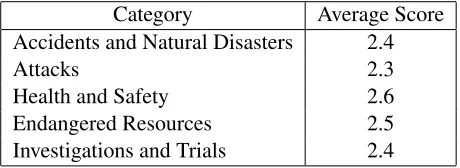
To judge the quality of the dependency tree based sentence compression algorithm, we ask the human judges to choose 20 sentences from each event top-ic then score them. The judges follow 3-point scale to score each compressed sentence: 1 means poor, 2 means barely acceptable, and 3 means good. We then compute the average scores. The results are shown in Table 5. To evaluate the effectiveness of sentence compression component, we conduct the system without sentence compression component, then compare it with our system. In Table 3, we can see that sentence compression can improve the system performance.
7 Related Work
Our event-aspect model is related to a number of previous extensions of LDA models. Chemudugun-ta et al. (2007) proposed to introduce a background topic and document-specific topics. Our background and document language models are similar to theirs. However, they still treat documents as bags of words rather then sets of sentences as in our models. Titov and McDonald (2008) exploited the idea that a short paragraph within a document is likely to be about the same aspect. The way we separate words in-to sin-top words, background words, document word-s and aword-spect wordword-s bearword-s word-similarity to that uword-sed in (Daum´e III and Marcu, 2006; Haghighi and Van-derwende, 2009). Paul and Girju (2010) proposed a aspect model for simultaneously finding topic-s and atopic-specttopic-s. The motopic-st related extentopic-sion itopic-s entity-aspect model proposed by Li et al. (2010). The main difference between event-aspect model and entity-aspect model is our model further consider entity-aspect granularity and add a layer to model topic-related events.
Filippova and Strube (2008) proposed a depen-dency tree based sentence compression algorithm. Their approach need a large corpus to build language model for compression, whereas we prune depen-dency tree using grammatical rules.
Paul et al. (2010) proposed to modify LexRank algorithm using their topic-aspect model. But their task is to summarize contrastive viewpoints in opin-ionated text. Furthermore, they use a simple greedy approach for constructing summary.
[image:8.612.80.310.357.441.2]sum-marization. And Sauper and Barzilay (2009) use in-teger linear programming framework to automatical-ly generate Wikipedia articles. There is a fundamen-tal difference between their method and ours. They used trained perceptron algorithm for ranking ex-cerpts, whereas we give an extended LexRank with integer linear programming to optimize sentence se-lection for our aspect-oriented multi-document sum-marization.
8 Conclusions and Future Work
In this paper, we study the task of automatically generating aspect-oriented summary from multiple documents. We proposed an event-aspect model that can automatically cluster sentences into aspect-s. We then use an extension of the LexRank algo-rithm to rank sentences. We took advantage of the output generated by the event-aspect model to mod-ify jumping probabilities so as to favor visiting rep-resentative sentence. We also proposed dependen-cy tree compression algorithm to prune sentence for improving linguistic quality of the summaries. Fi-nally we use Integer Linear Programming Frame-work to select aspect relevant sentences. We con-ducted quantitative evaluation using standard test data sets. We found that our method gave overal-l better ROUGE scores than four baseoveral-line methods, and the new sentence clustering and compression al-gorithm are robust.
There are a number of directions we plan to pur-sue in the future in order to improve our method. First, we can possibly apply more linguistic knowl-edge to improve the quality of sentence compres-sion. Currently the sentence compression algorith-m algorith-may generate algorith-meaningless subtrees. It is rela-tively hard to decide which clause is redundant in terms of summarization. Second, we may explore more domain knowledge to improve the quality of aspect-oriented summaries. For example, we know that the “who-affected” aspect is related to person, and “when, where” are related to Time and Location. we can import Name Entity Recognition to anno-tate these phrases and then help locate relevant sen-tences. Third, we want to extend our event-aspect model to simultaneously find topics and aspects.
Acknowledgments
This work was supported by the National Nat-ural Science Foundation of China (NSFC No. 60773088), the National High-tech R&D Program of China (863 Program No. 2009AA04Z106), and the Key Program of Basic Research of Shanghai Municipal S&T Commission (No. 08JC1411700).
References
Chaitanya Chemudugunta, Padhraic Smyth, and Mark Steyvers. 2007. Modeling general and specific aspects of documents with a probabilistic topic model. In Ad-vances in Neural Information Processing Systems 19, pages 241–248.
Hal. Daum´e III and Daniel. Marcu. 2006. Bayesian query-focused summarization. InProceedings of the 21st International Conference on Computational Lin-guistics and the 44th annual meeting of the Associ-ation for ComputAssoci-ational Linguistics, pages 305–312. Association for Computational Linguistics.
G¨unes. Erkan and Dragomir Radev. 2004. LexRank: Graph-based lexical centrality as salience in text sum-marization. Journal of Artificial Intelligence Re-search, 22(1):457–479.
K. Filippova and M. Strube. 2008. Dependency tree based sentence compression. InProceedings of the Fifth International Natural Language Generation Conference, pages 25–32. Association for Computa-tional Linguistics.
Dan Gillick and Benoit Favre. 2009. A scalable global model for summarization. InProceedings of the Work-shop on Integer Linear Programming for Natural Lan-gauge Processing, pages 10–18.
Dan Gillick, Benoit Favre, D. Hakkani-Tur, B. Bohnet, Y. Liu, and S. Xie. 2010. The icsi/utd summarization system at tac 2009. InProceedings of the Second Text Analysis Conference, Gaithersburg, Maryland, USA: National Institute of Standards and Technology. Thomas L. Griffiths and Mark Steyvers. 2004.
Find-ing scientific topics. Proceedings of the National A-cademy of Sciences of the United States of America, 101(Suppl. 1):5228–5235.
A. Haghighi and L. Vanderwende. 2009. Exploring con-tent models for multi-document summarization. In
Peng Li, Jing Jiang, and Yinglin Wang. 2010. Gen-erating templates of entity summaries with an entity-aspect model and pattern mining. InProceedings of the Joint Conference of the 48th Annual Meeting of the ACL. Association for Computational Linguistics. C.Y. Lin and E. Hovy. 2003. Automatic evaluation
of summaries using n-gram co-occurrence statistics. In Proceedings of the 2003 Conference of the North American Chapter of the Association for Computa-tional Linguistics on Human Language Technology-Volume 1, pages 71–78. Association for Computation-al Linguistics.
Ryan McDonald. 2007. A study of global inference algo-rithms in multi-document summarization.Advances in Information Retrieval, pages 557–564.
A. Nenkova and L. Vanderwende. 2005. The impact of frequency on summarization. Microsoft Research, Redmond, Washington, Tech. Rep. MSR-TR-2005-101. Michael J. Paul and Roxana Girju. 2010. A two-dimensional topic-aspect model for discovering multi-faceted topics. InIn AAAI-2010: Twenty-Fourth Con-ference on Artificial Intelligence.
Michael J. Paul, ChengXiang Zhai, and Roxana Girju. 2010. Summarizing contrastive viewpoints in opin-ionated text. InProceedings of the 2010 Conference on Empirical Methods in Natural Language Process-ing, EMNLP ’10, pages 66–76, Morristown, NJ, USA. Association for Computational Linguistics.
Christina Sauper and Regina Barzilay. 2009. Automati-cally generating wikipedia articles: A structure-aware approach. InProceedings of the Joint Conference of the 47th Annual Meeting of the ACL and the 4th Inter-national Joint Conference on Natural Language Pro-cessing of the AFNLP, pages 208–216, Suntec, Singa-pore, August. Association for Computational Linguis-tics.
Ivan Titov and Ryan McDonald. 2008. Modeling online reviews with multi-grain topic models. InProceeding of the 17th International Conference on World Wide Web, pages 111–120.
D. Zajic, B.J. Dorr, J. Lin, and R. Schwartz. 2007. Multi-candidate reduction: Sentence compression as a tool for document summarization tasks. Information Pro-cessing & Management, 43(6):1549–1570.