A Probabilistic Forest-to-String Model for Language Generation from
Typed Lambda Calculus Expressions
Wei Lu and Hwee Tou Ng
Department of Computer Science School of Computing National University of Singapore
{luwei,nght}@comp.nus.edu.sg
Abstract
This paper describes a novel probabilistic ap-proach for generating natural language sen-tences from their underlying semantics in the form of typed lambda calculus. The approach is built on top of a novel reduction-based weighted synchronous context free grammar formalism, which facilitates the transforma-tion process from typed lambda calculus into natural language sentences. Sentences can then be generated based on such grammar rules with a log-linear model. To acquire such grammar rules automatically in an unsuper-vised manner, we also propose a novel ap-proach with a generative model, which maps from sub-expressions of logical forms to word sequences in natural language sentences. Ex-periments on benchmark datasets for both En-glish and Chinese generation tasks yield sig-nificant improvements over results obtained by two state-of-the-art machine translation models, in terms of both automatic metrics and human evaluation.
1 Introduction
This work focuses on the task of generating natu-ral language sentences from their underlying mean-ing representations in the form of formal logical ex-pressions (typed lambda calculus). Many early ap-proaches to generation from logical forms make use of rule-based methods (Wang, 1980; Shieber et al., 1990), which concern surface realization (ordering and inflecting of words) but largely ignore lexical ac-quisition. Recent approaches start to employ corpus-based probabilistic methods, but many of them as-sume the underlying meaning representations are of
specific forms such as variable-free tree-structured representations (Wong and Mooney, 2007a; Lu et al., 2009) or database entries (Angeli et al., 2010).
While these algorithms usually work well on spe-cific semantic formalisms, it is unclear how well they could be applied to a different semantic formal-ism. In this work, we propose a general probabilis-tic model that performs generation from underlying formal semantics in the form of typed lambda calcu-lus expressions (we refer to them as λ-expressions throughout this paper), where both lexical acquisi-tion and surface realizaacquisi-tion are integrated in a single framework.
One natural proposal is to adopt a state-of-the-art statistical machine translation approach. However, unlike text to text translation, which has been ex-tensively studied in the machine translation commu-nity, translating from logical forms into text presents additional challenges. Specifically, logical forms such as λ-expressions may have complex internal structures and variable dependencies across sub-expressions. Problems arise when performing auto-matic acquisition of a translation lexicon, as well as performing lexical selection and surface realization during generation.
In this work, we tackle these challenges by mak-ing the followmak-ing contributions:
• A novel forest-to-string generation algorithm:
Inspired by the work of Chiang (2007), we in-troduce a novel reduction-based weighted bi-nary synchronous context-free grammar for-malism for generation from logical forms (λ -expressions), which can then be integrated with a probabilistic forest-to-string generation
rithm.
• A novel grammar induction algorithm: To au-tomatically induce such synchronous grammar rules, we propose a novel generative model that establishes phrasal correspondences be-tween logical sub-expressions and natural lan-guage word sequences, by extending a previ-ous model proposed for parsing natural language into meaning representations (Lu et al., 2008). To our best knowledge, this is the first probabilis-tic model for generating sentences from the lambda calculus encodings of their underlying formal mean-ing representations, that concerns both surface real-ization and lexical acquisition. We demonstrate the effectiveness of our model in Section 5.
2 Related Work
The task of language generation from logical forms has a long history. Many early works do not rely on probabilistic approaches. Wang (1980) presented an approach for generation from an extended predicate logic formalism using hand-written rules. Shieber et al. (1990) presented a semantic head-driven ap-proach for generation from logical forms based on rules written in Prolog. Shemtov (1996) presented a system for generation of multiple paraphrases from ambiguous logical forms. Langkilde (2000) pre-sented a probabilistic model for generation from a packed forest meaning representation, without con-cerning lexical acquisition. Specifically, we are not aware of any prior work that handles both automatic unsupervised lexical acquisition and surface realiza-tion for generarealiza-tion from logical forms in a single framework.
Another line of research efforts focused on the task of language generation from other meaning rep-resentation formalisms. Wong and Mooney (2007a) as well as Chen and Mooney (2008) made use of synchronous grammars to transform a variable-free tree-structured meaning representation into sen-tences. Lu et al. (2009) presented a language gener-ation model using the same meaning representgener-ation based on tree conditional random fields. Angeli et al. (2010) presented a domain-independent proba-bilistic approach for generation from database en-tries. All these models are probabilistic models.
Recently there are also substantial research efforts on the task of mapping natural language to meaning
representations in various formalisms – the inverse task of language generation calledsemantic parsing. Examples include Zettlemoyer and Collins (2005; 2007; 2009), Kate and Mooney (2006), Wong and Mooney (2007b), Lu et al. (2008), Ge and Mooney (2009), as well as Kwiatkowski et al. (2010).
Of particular interest is our prior work Lu et al. (2008), in which we presented a joint generative pro-cess that produces a hybrid tree structure containing words, syntactic structures, and meaning represen-tations, where the meaning representations are in a variable-free tree-structured form. One important property of the model in our prior work is that it induces a hybrid tree structure automatically in an unsupervised manner, which reveals the correspon-dences between natural language word sequences and semantic elements. We extend our prior model in the next section, so as to supportλ-expressions. The model in turn serves as the basis for inducing the synchronous grammar rules later.
3 λ-Hybrid Tree
In Lu et al. (2008), a generative model was pre-sented to model the process that jointly generates both natural language sentences and their underly-ing meanunderly-ing representations of a variable-free tree-structured form. The model was defined over a
hybrid tree, which consists of meaning representa-tion tokens as internal nodes and natural language words as leaves. One limitation of the hybrid tree model is that it assumes a single fixed tree struc-ture for the meaning representation. However, λ -expressions exhibit complex structures and variable dependencies, and thus it is not obvious how to rep-resent them in a single tree structure.
In this section, we present a novel λ-hybrid tree model that provides the following extensions over the model of Lu et al. (2008):
1. The internal nodes of a meaning representation tree involveλ-expressions which are not neces-sarily of variable-free form;
2. The meaning representation has a packed forest representation, rather than a single determinis-tic tree structure.
3.1 Packedλ-Meaning Forest
for-est). Multiple different meaning representation trees (calledλ-meaning trees) can be extracted from the sameλ-meaning forest, but they all convey equiva-lent semantics via reductions, as discussed next.
Constructing a λ-meaning forest for a given λ -expression requires decomposition of a completeλ -expression into semantically complete and syntacti-cally correct sub-expressions in a principled man-ner. This can be achieved with a process called higher order unification (Huet, 1975). The process was known to be very complex and was shown to be undecidable in unrestricted form (Huet, 1973). Re-cently a restricted form of higher order unification was applied to a semantic parsing task (Kwiatkowski et al., 2010). In this work, we employ a similar tech-nique for building theλ-meaning forest.
For a givenλ-expressione, our algorithm finds ei-ther two expressionshandfsuch that(h f)≡e, or three expressionsh, f, andgsuch that((h f)g) ≡
e, where the symbol≡is interpreted asα-equivalent afterreductions1(Barendregt, 1985). We then build theλ-meaning forest based on the expressionsh, f, andg. In practice, we develop a BUILDFOREST(e)
procedure which recursively buildsλ-forests by ap-plying restricted higher-order unification rules on top of theλ-expressione. Each node of theλ-forest is called aλ-production, to which we will give more details in Section 3.2. For example, once a candi-date triple (h, f, g) as in ((h f) g) ≡ ehas been identified, the procedure creates aλ-forest with the root node being aλ-production involvingh, and two sets of child λ-forests given by BUILDFOREST(f)
and BUILDFOREST(g) respectively. For restricted
higher-order unification, besides the similar assump-tions made by Kwiatkowski et al. (2010), we also impose one additional assumption: limited free vari-able, which states that the expressionhmust contain no more than one free variable. Note that this pro-cess provides a semantically equivalent packed for-est representation of the originalλ-expression, with-out altering its semantics in any way.
For better readability, we introduce the symbol
as an alternative notation for functional
appli-cation. In other words, h f refers to (h f) or
h(f), and hf g refers to ((h f) g). For
ex-1In this work, for reductions, we consider α-conversions
(changing bound variables) andβ-conversions (applying
func-tors to their arguments).
ample, the expressionλx.state(x)∧loc(boston, x)
can be represented as the functional application form of[λf.λx.f(x)∧loc(boston, x)]λx.state(x).2
Such a packed forest representation contains ex-ponentially many tree structures which all convey the same semantics. We believe such a semantic representation is more advantageous than the sin-gle fixed tree-structured representation. In fact, one could intuitively regard a different decomposition path as a different way of interpreting the same se-mantics. Thus, such a representation could poten-tially accommodate a wider range of natural lan-guage expressions, which all share the same seman-tics but with very different word choices, phrase or-derings, and syntactic structures (like paraphrases). It may also alleviate the non-isomorphism issue that was commonly faced by researchers when mapping meaning representations and sentences (Wong and Mooney, 2007b). We will validate our belief later through experiments.
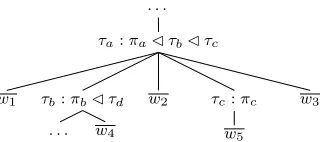
3.2 The Joint Generative Process
. . .
τa:πaτbτc
w1 τb:πbτd
. . . w4
w2 τc:πc
w5
[image:3.612.346.506.358.429.2]w3
Figure 1: The joint generative process of bothλ-meaning tree and its corresponding natural language sentence, which results in aλ-hybrid tree.
The generative process for a sentence together with its correspondingλ-meaning tree is illustrated in Figure 1, which results in aλ-hybrid tree. Internal nodes of a λ-hybrid tree are called λ-productions, which are building blocks of a λ-forest. Each λ-production in turn has at most two child λ -productions. Aλ-production has the formτa:πa
τb, whereτa is the expectedtype3 after type
evalu-ation of the terms to its right, πa is aλ-expression
(serves as the functor), andτb are types of the child
λ-productions (as the arguments). The leave nodes
2Throughout this paper, we abuse this notation a bit by
al-lowing the arguments to be types rather than actual expressions, such asλy.λx.loc(y, x))e, which indicates that the functor λy.λx.loc(y, x)expects an expression of typeeto serve as its argument.
3This work considers basic types: e(entities) andt(truth
r:he, ti1
he, ti1 :λg.λf.λx.g(x)∧f(x)he, ti1 he, ti2
he, ti2 :λf.λg.λx.∃y.g(y)∧(f(x)y)he,he, tii1 he, ti2
he, ti2 :λg.λf.λx.g(x)∧f(x)he, ti1 he, ti2
he, ti1 :λy.λx.loc(y, x)e1
runs through
e1 :miss r
the mississippi that
he, ti2 :λx.state(x)
states
he,he, tii1 :λy.λx.next to(x, y)
bordering
he, ti1 :λx.state(x)
[image:4.612.95.518.62.208.2]the states give me
Figure 2: One exampleλ-hybrid tree for the sentence “give me the states bordering states that the mississippi runs through” together
with its logical form “λx0.state(x0)∧ ∃x1.[loc(miss r, x1)∧state(x1)∧next to(x1, x0)]”.
w are contiguous word sequences. The model re-peatedly generatesλ-hybrid sequences, which con-sist of words intermixed with λ-productions, from eachλ-production at different levels.
Consider part of the exampleλ-hybrid tree in Fig-ure 2. The probability associated with generation of the subtree that spans the sub-sentence “that the mis-sissippi runs through” can be written as:
Pλx.loc(miss r, x),that the mississippi runs through
=φ(m→wYw|p1)×ψ(thate1 runs through|p1) ×ρ(p2|p1,arg1)×φ(m→w|p2)×ψ(the mississippi|p2)
wherep1=he, ti:λy.λx.loc(y, x)e1, andp2=
e:miss r.
Following the work of Lu et al. (2008), the gener-ative process involves three types of parametersθ¯=
{φ, ψ, ρ}: 1) pattern parameters φ, which model in what way the words and childλ-productions are in-termixed; 2) emission parameters ψ, which model the generation process of words fromλ-productions, where either a unigram or a bigram assumption can be made (Lu et al., 2008); and 3) meaning repre-sentation (MR) model parameters ρ, which model the generation process from oneλ-production to its child λ-productions. An analogous inside-outside algorithm (Baker, 1979) used there is employed here. Since we allow a packedλ-meaning forest rep-resentation rather than a fixed tree structure, the MR model parametersρin this work should be estimated with the inside-outside algorithm as well, rather than being estimated directly from the training data by simple counting, as was done in Lu et al. (2008).
4 The Language Generation Algorithm Now we present the algorithm for language gener-ation. We introduce the grammar first, followed by the features we use. Next, we present the method for grammar induction, and then discuss the decoder.
4.1 The Grammar
We use a weighted synchronous context free gram-mar (SCFG) (Aho and Ullman, 1969), which was previously used in Chiang (2007) for hierarchical phrase-based machine translation. The grammar is defined as follows:
τ → hpλ, hw,∼i (1)
whereτ is the type associated with theλ-production pλ4, andhw is a sequence consisting of natural
lan-guage words intermixed with types. The symbol
∼denotes the one-to-one correspondence between nonterminal occurrences (i.e., in this case types of λ-expressions) in bothpλandhw.
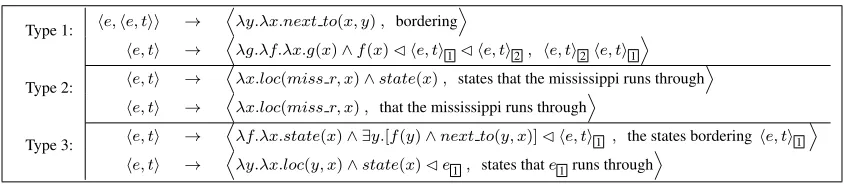
We allow a maximum of two nonterminal sym-bols in each synchronous rule, as was also assumed in Chiang (2007), which makes the grammar a bi-nary SCFG. Two example rules are:
he, ti → Dλy.λx.loc(y, x)e1 , thate1 runs throughE
e → Dmiss r, the mississippiE
where the boxed indices give the correspondences between nonterminals.
A derivation with the above two synchronous rules results in the following λ-expression paired with its natural language counterpart:
4Since type is already indicated byτ, we avoid redundancy
Type 1: he,he, tii →
D
λy.λx.next to(x, y), borderingE
he, ti → Dλg.λf.λx.g(x)∧f(x)he, ti1 he, ti2 , he, ti2 he, ti1
E
Type 2: he, ti →
D
λx.loc(miss r, x)∧state(x), states that the mississippi runs throughE
he, ti → Dλx.loc(miss r, x), that the mississippi runs throughE
Type 3: he, ti →
D
λf.λx.state(x)∧ ∃y.[f(y)∧next to(y, x)]he, ti1 , the states borderinghe, ti1
E
[image:5.612.95.517.58.150.2]he, ti → Dλy.λx.loc(y, x)∧state(x)e1 , states thate1 runs throughE
Figure 3: Example synchronous rules that can be extracted from theλ-hybrid tree of Figure 2.
he, ti →Dλx.loc(miss r, x),that the mississippi runs throughE
where the source side λ-expression is constructed from the applicationλy.λx.loc(y, x)miss r fol-lowed by a reduction (β-conversion). Assuming the λ-expression to be translated isλx.loc(miss r, x),
the above rule in fact gives one candidate translation “that the mississippi runs through”.
4.2 Features
Following the work of Chiang (2007), we assign scores to derivations with a log-linear model, which are essentially weighted products of feature values.
For generality, we only consider the following four simple features in this work:
1. p˜(hw|pλ): the relative frequency estimate of a
hybrid sequencehwgiven theλ-productionpλ;
2. p˜(pλ|hw, τ): the relative frequency estimate of
aλ-productionpλ given the phrasehw and the
typeτ;
3. exp(−wc(hw)): the number of words
gener-ated, where wc(hw) refers to the number of
words inhw(i.e., word penalty); and
4. pLM(ˆs): the language model score of the
gen-erated sentencesˆ.
The first three features, which are also widely used in state-of-the-art machine translation models (Koehn et al., 2003; Chiang, 2007), are rule-specific and thus can be computed before decoding. The last feature is computed during the decoding phase in combination with the sibling rules used.
We score a derivationDwith a log-linear model:
w(D) = Y r∈D
Y
i
fi(r)wi
!
×pLM(ˆs)wLM (2)
where r ∈ D refers to a rule r that appears in the derivationD, sˆis the target side (sentence)
as-sociated with the derivation D, and fi is a
rule-specific feature (one of features 1–3 above) which
is weighted withwi. The language model feature is
weighted withwLM.
Once the feature values are computed, our goal is to find the optimal weight vectorw¯∗ that maximizes
a certain evaluation metric when used for decoding, as we will discuss in Section 4.4.
Following popular approaches to learning feature weights in the machine translation community (Och and Ney, 2004; Chiang, 2005), we use the minimum error rate training (MERT) (Och, 2003) algorithm to learn the feature weights that directly optimize cer-tain automatic evaluation metric. Specifically, the Z-MERT (Zaidan, 2009) implementation of the al-gorithm is used in this work.
4.3 Grammar Induction
Tree fragment :
he, ti2 :λg.λf.λx.g(x)∧f(x)he, ti1 he, ti2
he, ti1 :λy.λx.loc(y, x)e1
runs through
e1 :. . .
that
he, ti2 :λx.state(x)
states
Source : (substitution) λy0.hλg.λf.λx.g(x)∧f(x)[λy.λx.loc(y, x)y0]λx.state(x)ie 1
(twoβ-conversions)⇒λy0.[λf.λx.loc(y0, x)∧f(x)λx.state(x)]e1
(β-conversion)⇒λy0.λx.loc(y0, x)∧state(x)e1
(α-conversion)⇒λy.λx.loc(y, x)∧state(x)e1
Target : “states thate1 runs through”
[image:6.612.106.503.57.210.2]Rule : he, ti →Dλy.λx.loc(y, x)∧state(x)e1 , states thate1 runs throughE
Figure 4: Construction of a two-levelλ-hybrid sequence rule via substitution and reductions from a tree fragment. Note that the subtree rooted bye1 :miss rgets “abstracted” by its typee. The auxiliary variabley0of typeeis thus introduced to facilitate the
construction process.
based on the learned parameters of the generativeλ -hybrid tree model.
Next, we extract grammar rules on top of these λ-hybrid trees. Specifically, we extract the follow-ing three types of synchronous grammar rules, with examples given in Figure 3:
1. λ-hybrid sequence rules: They are the conven-tional rules constructed from oneλ-production and its correspondingλ-hybrid sequence. 2. Subtree rules: These rules are constructed from
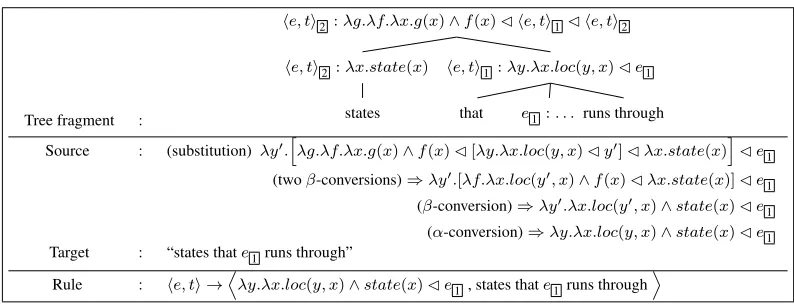
a complete subtree of theλ-hybrid tree. Each rule provides a mapping between a complete sub-expression and a contiguous sub-sentence. 3. Two-levelλ-hybrid sequence rules: These rules are constructed from a tree fragment with one of its grandchild subtrees (the subtree rooted by one of its grandchild nodes) being abstracted with its type only. These rules are constructed via substitution and reductions.
Figure 4 gives an example based on a tree frag-ment of theλ-hybrid tree in Figure 2. Note that the first step makes use of the auxiliary vari-able y0 of type e to represent the grandchild subtree. λy0 is introduced so as to allow any λ-expression of type e serving as this expres-sion’s argument to replace y0. In fact, if the semantics conveyed by the grandchild subtree serves as its argument, we will obtain the exact complete semantics of the current subtree. As we can see, the resulting rule is more general, and is able to capture longer structural depen-dencies. Such rules are thus potentially more useful.
The overall algorithm for learning the grammar rules is sketched in Figure 5.
4.4 Decoding
Our goal in decoding is to find the most probable sentencesˆfor a givenλ-expressione:
ˆ
s=s arg max Ds.t.e(D)≡ew
(D)
!
(3)
wheree(D)refers to the source side (λ-expression) of the derivation D, and s(D) refers to the target
side (natural language sentence) ofD.
Procedures
• f←BUILDFOREST(e)
It takes in a λ-expression e and outputs its λ
-meaning forestf. (Sec. 3.1)
• θ¯←TRAINGENMODEL(f,s)
It takes in λ-meaning forest-sentence pairs(f,s), performs EM training of the generative model, and outputs the parametersθ¯. (Sec. 3.2)
• h←FINDHYBRIDTREE(f, s,θ¯)
It finds the most probableλ-hybrid treeh contain-ing the givenf-spair, under the generative model parametersθ¯. (Sec. 4.3)
• Γh←EXTRACTRULES(h)
It takes in aλ-hybrid treeh, and extracts a set of grammar rulesΓhout of it. (Sec. 4.3)
Algorithm
1. Inputs and initializations:
• A training set(e,s), an empty rule setΓ =∅
2. Learn the grammar:
• For eachei ∈ e, find itsλ-meaning forest:
fi = BUILDFOREST(ei). This gives the set (f,s).
• Learn the generative model parameter :
¯
θ∗=TRAINGENMODEL(f,s).
• For each(fi, si)∈(f,s), find the most
proba-bleλ-hybrid treehi, and then extract the
gram-mar rules from it:
hi=FINDHYBRIDTREE(fi, si,θ¯∗) Γ = Γ∪EXTRACTRULES(hi)
3. Output the learned grammar rule setΓ.
Figure 5: The algorithm for learning the grammar rules
5 Experiments
For experiments, we evaluated on the GEOQUERY dataset, which consists of 880 queries on U.S. geog-raphy. The dataset was manually labeled with λ -expressions as their semantics in Zettlemoyer and Collins (2005). It was used in many previous re-search efforts on semantic parsing (Zettlemoyer and Collins, 2005; Wong and Mooney, 2006; Zettle-moyer and Collins, 2007; Kwiatkowski et al., 2010). The original dataset was annotated with English sen-tences only. In order to assess the generation per-formance across different languages, in our work the entire dataset was also manually annotated with Chinese by a native Chinese speaker with linguistics background5.
For all the experiments we present in this sec-tion, we use the same split as that of Kwiatkowski
5The annotator created annotations with bothλ-expressions
and corresponding English sentences available as references.
et al. (2010), where 280 instances are used for test-ing, and the remaining instances are used for learn-ing. We further split the learning set into two por-tions, where 500 instances are used for training the models, which includes induction of grammar rules, training a language model, and computing feature values, and the remaining 100 instances are used for tuning the feature weights.
As we have mentioned earlier, we are not aware of any previous work that performs generation from formal logical forms that concerns both lexical ac-quisition and surface realization. The recent work by Angeli et al. (2010) presented a generation sys-tem from database records with an additional focus on content selection (selection of records and their subfields for generation). It is not obvious how to adopt their algorithm in our context where content selection is not required but the more complex log-ical semantic representation is used as input. Other earlier approaches such as the work of Wang (1980) and Shieber et al. (1990) made use of rule-based approaches without automatic lexical acquisition.
We thus compare our system against two state-of-the-art machine translation systems: a phrase-based translation system, implemented in the Moses toolkit (Koehn et al., 2007)6, and a hierarchical phrase-based translation system, implemented in the Joshua toolkit (Li et al., 2009), which is a reim-plementation of the original Hiero system (Chiang, 2005; Chiang, 2007). The state-of-the-art unsuper-vised Berkeley aligner (Liang et al., 2006) with de-fault setting is used to construct word alignments. We train a trigram language model with modified Kneser-Ney smoothing (Chen and Goodman, 1996) from the training dataset using the SRILM toolkit (Stolcke, 2002), and use the same language model for all three systems. We use ann-best list of size 100 for all three systems when performing MERT.
5.1 Automatic Evaluation
For automatic evaluation, we measure the original IBM BLEU score (Papineni et al., 2002) (4-gram precision with brevity penalty) and the TER score (Snover et al., 2006) (the amount of edits required to change a system output into the reference)7. Note that TERmeasures the translation error rate, thus a
6We used the default settings, and enabled the default
lexi-calized reordering model, which yielded better performance.
smaller score indicates a better result. For clarity, we report 1−TERscores. Following the tuning pro-cedure as conducted in Galley and Manning (2010), we perform MERTusing BLEUas the metric.
We compare our model against state-of-the-art statistical machine translation systems. As a base-line, we first conduct an experiment with the fol-lowing naive approach: we treat the λ-expressions as plain texts. All the bound variables (e.g., x in λx.state(x)) which do not convey semantics
are removed, but free variables (e.g., state in λx.state(x)) which might convey semantics are left
intact. Quantifiers and logical connectives are also left intact. While this naive approach might not ap-pear very sensible, we merely want to treat it as our simplest baseline.
Alternatively, analogous to the work of Wong and Mooney (2007a), we could first parse the λ -expressions into binary tree structures with a deter-ministic procedure, and then linearize the tree struc-ture as a sequence. Since there exists different ways to linearize a binary tree, we consider preorder, in-order, and postorder traversal of the trees, and lin-earize them in these three different ways.
As for our system, during the grammar learning phase, we initialize the generative model parame-ters with output from the IBM alignment model 1 (Brown et al., 1993)8, and run theλ-hybrid tree gen-erative model with the unigram emission assumption for 10 iterations, followed by another 10 iterations with the bigram assumption. Grammar rules are then extracted based on theλ-hybrid trees obtained from such learned generative model parameters.
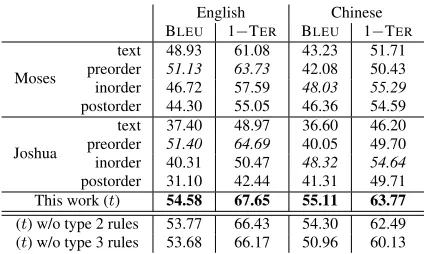
Since MERTis prone to search errors, we run each experiment 5 times with randomly initialized fea-ture weights, and report the averaged scores. Ex-perimental results for both English and Chinese are presented in Table 1. As we can observe, the way that a meaning representation tree is linearized has a significant impact on the translation performance. Interestingly, for both Moses and Joshua, the pre-order setting yields the best performance for En-glish, whereas it is inorder that yields the best per-formance for Chinese. This is perhaps due to the fact that Chinese presents a very different syntactic structure and word ordering from English.
8We assume word unigrams are generated from free
vari-ables, quantifiers, and logical connectives in IBM model 1.
Our system, on the other hand, employs a packed forest representation forλ-expressions. Therefore, it eliminates the ordering constraint by encompass-ing exponentially many possible tree structures dur-ing both the alignment and decoddur-ing stage. As a result, our system obtains significant improvements in both BLEU and 1−TER using the significance test under the paired bootstrap resampling method of Koehn (2004). We obtainp < 0.01for all cases, except when comparing against Joshua-preorder for English, where we obtainp <0.05for both metrics.
English Chinese BLEU 1−TER BLEU 1−TER
Moses
text 48.93 61.08 43.23 51.71 preorder 51.13 63.73 42.08 50.43 inorder 46.72 57.59 48.03 55.29 postorder 44.30 55.05 46.36 54.59
Joshua
text 37.40 48.97 36.60 46.20 preorder 51.40 64.69 40.05 49.70 inorder 40.31 50.47 48.32 54.64 postorder 31.10 42.44 41.31 49.71 This work (t) 54.58 67.65 55.11 63.77
[image:8.612.319.531.217.344.2](t) w/o type 2 rules 53.77 66.43 54.30 62.49 (t) w/o type 3 rules 53.68 66.17 50.96 60.13
Table 1: Performance on generating English and Chinese from
λ-expressions with automatic evaluation metrics (we report per-centage scores).
5.2 Human Evaluation
We also conducted human evaluation with 5 eval-uators each on English and Chinese. We randomly selected about 50% (139) test instances and obtained output sentences from the three systems. Moses and Joshua were run with the top-performing settings in terms of automatic metrics (i.e., preorder for En-glish and inorder for Chinese). Following Angeli et al. (2010), evaluators are instructed to give scores based on language fluency and semantic correctness, on the following scale:
Score Language Fluency Semantic Correctness 5 Flawless Perfect
4 Good Near Perfect
3 Non-native Minor Errors 2 Disfluent Major Errors 1 Gibberish Completely Wrong
out-English FJudge E1 Judge E2 Judge E3 Judge E4 Judge E5 Average LU SEM FLU SEM FLU SEM FLU SEM FLU SEM FLU SEM Moses preorder 4.56 4.57 4.58 4.54 4.52 4.52 4.48 4.14 4.28 4.22 4.48±0.12 4.40±0.20 Joshua preorder 4.50 4.43 4.49 4.29 4.44 4.36 4.46 4.04 4.12 4.06 4.40±0.16 4.24±0.18 This work 4.76 4.73 4.73 4.70 4.68 4.60 4.64 4.37 4.49 4.44 4.66±0.10 4.57±0.16
Chinese FJudge C1 Judge C2 Judge C3 Judge C4 Judge C5 Average LU SEM FLU SEM FLU SEM FLU SEM FLU SEM FLU SEM Moses inorder 4.38 4.22 3.95 3.99 4.01 3.80 4.27 4.19 4.09 4.01 4.14±0.18 4.04±0.17 Joshua inorder 4.32 4.04 3.74 3.91 3.76 3.55 4.21 4.04 3.96 3.97 4.00±0.26 3.90±0.21 This work 4.61 4.47 4.53 4.43 4.50 4.31 4.71 4.55 4.57 4.32 4.59±0.08 4.42±0.10 Table 2: Human evaluation results on English and Chinese generation. FLU: language fluency; SEM: semantic correctness.
put, but also minimizes bias associated with scor-ing different outputs for the same input. The de-tailed and averaged results (with one standard devi-ation) for human evaluation are presented in Table 2 for English and Chinese respectively. For both lan-guages, our system achieves a significant improve-ment over Moses and Joshua (p < 0.01with paired
t-tests), in terms of both language fluency and se-mantic correctness. This set of results is important, as it demonstrates that our system produces more fluent texts with more accurate semantics when per-ceived by real humans.
5.3 Additional Experiments
We also performed the following additional experi-ments. First, we attempted to increase the number of EM iterations (to 100) when training the model with the bigram assumption, so as to assess the ef-fect of the number of EM iterations on the final gen-eration performance. We observed similar perfor-mance. Second, in order to assess the importance of the two types of novel rules – subtree rules (type 2) and two-levelλ-hybrid sequence rules (type 3), we also conducted experiments without these rules for generation. Experiments show that these two types of rules are important. Specifically, type 3 rules, which are able to capture longer structural depen-dencies, are of particular importance for generating Chinese. Detailed results for these additional exper-iments are presented in Table 1.
5.4 Experiments on Variable-free Meaning Representations
Finally, we also assess the effectiveness of our model on an alternative meaning representation for-malism in the form of variable-free tree structures. Specifically, we tested on the ROBOCUP dataset (Kuhlmann et al., 2004), which consists of 300 English instructions for coaching robots for
soc-cer games, and a variable-free version of the GEO -QUERY dataset. These are the standard datasets used in the generation tasks of Wong and Mooney (2007a) and Lu et al. (2009). Similar to the tech-nique introduced in Kwiatkowski et al. (2010), our proposed algorithm could still be applied to such datasets by writing the tree-structured representa-tions as function-arguments forms. The higher order unification-based decomposition algorithm could be applied on top of such forms accordingly. For exam-ple,midf ield(opp) ≡λx.midf ield(x)opp. See Kwiatkowski et al. (2010) for more details. How-ever, since such forms present monotonous struc-tures, and thus give less alternative options in the higher-order unification-based decomposition pro-cess, it prevents the algorithm from creating many disjunctive nodes in the packed forest. It is thus hy-pothesized that the advantages of the packed forest representation could not be fully exploited with such a meaning representation formalism.
Variable-present dataset
λ-expression : argmax(x, river(x)∧ ∃y.[state(y)∧next to(y, india s)∧loc(x, y)], len(x))
Reference : what is the longest river that flows through a state that borders indiana Moses : what is the states that border long indiana
Joshua : what is the longest river surrounding states border indiana This work : what is the longest river in the states that border indiana
λ-expression : density(ιx.loc(argmax(y, loc(y, usa co)∧river(y), size(y)), x)∧state(x))
Reference : which is the density of the state that the largest river in the united states runs through Moses : what is the population density in lie on the state with the smallest state in the us Joshua : what is the population density of states lie on the smallest state in the us This work : what is the population density of the state with the largest river in the us
Variable-free datasets
λ-expression : population(largest one density(state all))
Reference : what is the population of the state with the highest population density This work : how many people live in the state with the largest population density
λ-expression : rule(and(bpos(f rom goal line(our, jnum(n0.0, n32.0))), not(bpos(lef t(penalty area(our))))),
-dont(player our(n3), intercept))
Reference : player 3 should not intercept the ball if the ball is within 32 meters of our goal line and not in our left penalty area This work : if the ball is within 32 meters from our goal line and not on the left side of our penalty area then player 3 should not
[image:10.612.73.538.58.251.2]intercept it
Figure 6: Sample English outputs for various datasets. For the variable-present dataset, we also show outputs from Moses and Joshua.
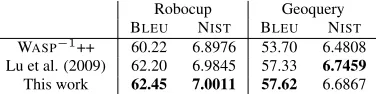
that the algorithm of Lu et al. (2009) is capable of modeling dependencies over phrases, which gives global optimization over the sentence generated, and works by building conditional random fields (Laf-ferty et al., 2001) over trees. But the algorithm of Lu et al. (2009) is also limited to handling tree-structured meaning representation, and is therefore unable to accept inputs such as the variable ver-sion of λ-expressions. Our algorithm works well by introducing additional new types of synchronous rules that are able to capture longer range depen-dencies. WASP−1++, on the other hand, also makes use of a synchronous parsing-based statistical ma-chine translation approach. Their system, however, requires linearization of the tree structure for both alignment and translation. In contrast, our model directly performs alignment and translation from a packed forest representation to a sentence. As a result, though WASP−1++ made use of additional features (lexical weights), our system yielded bet-ter performance. Sample English output sentences are given in Figure 6.
Robocup Geoquery BLEU NIST BLEU NIST WASP−1++ 60.22 6.8976 53.70 6.4808
Lu et al. (2009) 62.20 6.9845 57.33 6.7459 This work 62.45 7.0011 57.62 6.6867 Table 3: Performance on variable-free representations
6 Conclusions and Future Work
In this work, we presented a novel algorithm for gen-erating natural language sentences from their
under-lying semantics in the form of typed lambda calcu-lus. We tackled the problem by introducing a novel reduction-based weighted synchronous context-free grammar formalism, which allows sentence genera-tion with a log-linear model. In addigenera-tion, we pro-posed a novel generative model that jointly gener-ates lambda calculus expressions and natural lan-guage sentences. The model is then used for auto-matic grammar induction. Empirical results show that our model outperforms state-of-the-art machine translation models, for both English and Chinese, in terms of both automatic and human evaluation. Furthermore, we have demonstrated that the model can also effectively handle inputs with a variable-free version of meaning representation.
We believe the algorithm used for inducing the reduction-based synchronous grammar rules may find applications in other research problems, such as statistical machine translation and phrasal syn-chronous grammar induction. We are interested in exploring further along such directions in the future.
Acknowledgments
[image:10.612.90.278.593.640.2]References
A.V. Aho and J.D. Ullman. 1969. Syntax directed trans-lations and the pushdown assembler. Journal of Com-puter and System Sciences, 3(1):37–56.
G. Angeli, P. Liang, and D. Klein. 2010. A simple domain-independent probabilistic approach to gener-ation. InProc. EMNLP, pages 502–512.
J. K. Baker. 1979. Trainable grammars for speech recog-nition.The Journal of the Acoustical Society of Amer-ica, 65:S132.
H. P. Barendregt. 1985.The Lambda Calculus, Its Syntax and Semantics (Studies in Logic and the Foundations of Mathematics, Volume 103). Revised Edition. North-Holland.
P. F. Brown, V. J. Della Pietra, S. A. Della Pietra, and R. L. Mercer. 1993. The mathematics of statistical machine translation: Parameter estimation. Computa-tional Linguistics, 19:263–311.
S. F. Chen and J. Goodman. 1996. An empirical study of smoothing techniques for language modeling. InProc. ACL, pages 310–318.
D. L. Chen and R. J. Mooney. 2008. Learning to sportscast: a test of grounded language acquisition. In Proc. ICML, pages 128–135.
D. Chiang. 2005. A hierarchical phrase-based model for statistical machine translation. In Proc. ACL, pages 263–270.
D. Chiang. 2007. Hierarchical phrase-based translation. Computational Linguistics, 33:201–228.
G. Doddington. 2002. Automatic evaluation of machine translation quality using n-gram co-occurrence statis-tics. InProc. HLT, pages 138–145.
M. Galley and C. D. Manning. 2010. Accurate non-hierarchical phrase-based translation. In Proc. HLT/NAACL, pages 966–974.
R. Ge and R. J. Mooney. 2009. Learning a compositional semantic parser using an existing syntactic parser. In Proc. ACL/IJCNLP, pages 611–619.
G. P. Huet. 1973. The undecidability of unification in third order logic. Information and Control, 22(3):257– 267.
G. P. Huet. 1975. A unification algorithm for typedλ -calculus.Theoretical Computer Science, 1(1):27–57. R. J. Kate and R. J. Mooney. 2006. Using string-kernels
for learning semantic parsers. InProc. COLING/ACL, pages 913–920.
P. Koehn, F. J. Och, and D. Marcu. 2003. Statistical phrase-based translation. InProc. NAACL/HLT, pages 48–54.
P. Koehn, H. Hoang, A. Birch, C. Callison-Burch, M. Federico, N. Bertoldi, B. Cowan, W. Shen, C. Moran, R. Zens, C. Dyer, O. Bojar, A. Constantin, and E. Herbst. 2007. Moses: open source toolkit for
statistical machine translation. InProc. ACL (Demon-stration Sessions), pages 177–180.
P. Koehn. 2004. Statistical significance tests for machine translation evaluation. InProc. EMNLP, pages 388– 395.
G. Kuhlmann, P. Stone, R. Mooney, and J. Shavlik. 2004. Guiding a reinforcement learner with natural language advice: Initial results in RoboCup soccer. In Proc. AAAI Workshop on Supervisory Control of Learning and Adaptive Systems.
T. Kwiatkowski, L. Zettlemoyer, S. Goldwater, and M. Steedman. 2010. Inducing probabilistic CCG grammars from logical form with higher-order unifi-cation. InProc. EMNLP, pages 1223–1233.
J. D. Lafferty, A. McCallum, and F. C. N. Pereira. 2001. Conditional random fields: Probabilistic models for segmenting and labeling sequence data. In Proc. ICML, pages 282–289.
I. Langkilde. 2000. Forest-based statistical sentence gen-eration. InProc. NAACL, pages 170–177.
Z. Li, C. Callison-Burch, C. Dyer, J. Ganitkevitch, S. Khudanpur, L. Schwartz, W. N. G. Thornton, J. Weese, and O. F. Zaidan. 2009. Joshua: an open source toolkit for parsing-based machine translation. InProc. WMT, pages 135–139.
P. Liang, B. Taskar, and D. Klein. 2006. Alignment by agreement. InProc. HLT/NAACL, pages 104–111. W. Lu, H. T. Ng, W. S. Lee, and L. Zettlemoyer. 2008.
A generative model for parsing natural language to meaning representations. In Proc. EMNLP, pages 783–792.
W. Lu, H. T. Ng, and W. S. Lee. 2009. Natural lan-guage generation with tree conditional random fields. InProc. EMNLP, pages 400–409.
F. J. Och and H. Ney. 2004. The alignment template approach to statistical machine translation. Computa-tional Linguistics, 30(4):417–449.
F. J. Och. 2003. Minimum error rate training in statistical machine translation. InProc. ACL, pages 160–167. K. Papineni, S. Roukos, T. Ward, and W. J. Zhu. 2002.
BLEU: a method for automatic evaluation of machine
translation. InProc. ACL, pages 311–318.
H. Shemtov. 1996. Generation of paraphrases from am-biguous logical forms. InProc. COLING, pages 919– 924.
S. M. Shieber, G. van Noord, F. C. N. Pereira, and R. C. Moore. 1990. Semantic-head-driven generation. Computational Linguistics, 16(1):30–42.
M. Snover, B. Dorr, R. Schwartz, L. Micciulla, and J. Makhoul. 2006. A study of translation edit rate with targeted human annotation. In Proc. AMTA, pages 223–231.
S. Vogel, H. Ney, and C. Tillmann. 1996. HMM-based word alignment in statistical translation. In Proc. COLING, pages 836–841.
J. Wang. 1980. On computational sentence generation from logical form. InProc. COLING, pages 405–411. Y. W. Wong and R. J. Mooney. 2006. Learning for se-mantic parsing with statistical machine translation. In Proc. HLT/NAACL, pages 439–446.
Y. W. Wong and R. J. Mooney. 2007a. Generation by in-verting a semantic parser that uses statistical machine translation. InProc. NAACL/HLT, pages 172–179. Y. W. Wong and R. J. Mooney. 2007b. Learning
syn-chronous grammars for semantic parsing with lambda calculus. InProc. ACL, pages 960–967.
O. F. Zaidan. 2009. Z-MERT: A fully configurable open source tool for minimum error rate training of machine translation systems. The Prague Bulletin of Mathe-matical Linguistics, 91:79–88.
L. Zettlemoyer and M. Collins. 2005. Learning to map sentences to logical form: Structured classifica-tion with probabilistic categorial grammars. InProc. UAI, pages 658–666.
L. Zettlemoyer and M. Collins. 2007. Online learning of relaxed CCG grammars for parsing to logical form. In Proc. EMNLP-CoNLL, pages 678–687.
![Figure 2: One example λ-hybrid tree for the sentence “give me the states bordering states that the mississippi runs through” togetherwith its logical form “λx0.state(x0) ∧ ∃x1.[loc(miss r, x1) ∧ state(x1) ∧ next to(x1, x0)]”.](https://thumb-us.123doks.com/thumbv2/123dok_us/1371374.670546/4.612.95.518.62.208/figure-example-hybrid-sentence-bordering-mississippi-togetherwith-logical.webp)