Proceedings of the 3rd Workshop on Neural Generation and Translation (WNGT 2019), pages 15–22 15
Hello, It’s GPT-2 - How Can I Help You?
Towards the Use of Pretrained Language Models
for Task-Oriented Dialogue Systems
Paweł Budzianowski1,2,3 and Ivan Vuli´c2,3 1Engineering Department, Cambridge University, UK 2Language Technology Lab, Cambridge University, UK
3PolyAI Limited, London, UK
[email protected],[email protected]
Abstract
Data scarcity is a long-standing and crucial challenge that hinders quick development of task-oriented dialogue systems across multiple domains: task-oriented dialogue models are expected to learn grammar, syntax, dialogue reasoning, decision making, and language gen-eration from absurdly small amounts of task-specific data. In this paper, we demonstrate that recent progress in language modeling pre-training and transfer learning shows promise to overcome this problem. We propose a task-oriented dialogue model that operates solely on text input: it effectively bypasses ex-plicit policy and language generation modules. Building on top of the TransferTransfo frame-work (Wolf et al.,2019) and generative model pre-training (Radford et al., 2019), we vali-date the approach on complex multi-domain task-oriented dialogues from the MultiWOZ dataset. Our automatic and human evaluations show that the proposed model is on par with a strong task-specific neural baseline. In the long run, our approach holds promise to miti-gate the data scarcity problem, and to support the construction of more engaging and more eloquent task-oriented conversational agents.
1 Introduction
Statistical conversational systems can be roughly clustered into two main categories: 1) task-oriented modular systems and 2) open-domain chit-chat neural models. The former typically con-sist of independently trained constituent modules such as language understanding, dialogue manage-ment, and response generation. The main goal of such systems is to provide meaningful system re-sponses which are invaluable in building conversa-tional agents of practical value for restricted do-mains and tasks. However, data collection and annotation for such systems is complex, time-intensive, expensive, and not easily transferable
(Young et al., 2013). On the other hand, open-domain conversational bots (Li et al.,2017;Serban et al.,2017) can leverage large amounts of freely available unannotated data (Ritter et al., 2010;
Henderson et al., 2019a). Large corpora allow for training end-to-end neural models, which typ-ically rely on sequence-to-sequence architectures (Sutskever et al., 2014). Although highly data-driven, such systems are prone to producing unre-liable and meaningless responses, which impedes their deployment in the actual conversational ap-plications (Li et al.,2017).
Due to the unresolved issues with the end-to-end architectures, the focus has been extend-to-ended to retrieval-based models. Here, the massive datasets can be leveraged to aid task-specific applications (Kannan et al., 2016; Henderson et al., 2017,
2019b). The retrieval systems allow for the full control over system responses, but the behaviour of the system is often highly predictable. It also depends on the pre-existing set of responses, and the coverage is typically insufficient for a mul-titude of domains and tasks. However, recent progress in training high-capacity language mod-els (e.g., GPT, GPT-2) (Radford et al.,2018,2019) on large datasets reopens the question of whether such generative models can support task-oriented dialogue applications. Recently,Wolf et al.(2019) andGolovanov et al.(2019) showed that the GPT model, once fine-tuned, can be useful in the do-main of personal conversations. In short, their approach led to substantial improvements on the Persona-Chat dataset (Zhang et al., 2018), show-casing the potential of exploiting large pretrained generative models in the conversational domain.1
In this paper, we demonstrate that large gener-ative models pretrained on large general-domain
1E.g., TransferTransfo (Wolf et al.,2019) yields gains in
Figure 1: Dialogue-context-to-text task.
corpora can supporttask-oriented dialogue appli-cations. We first discuss how to combine a set of diverse components such as word tokenization, multi-task learning, and probabilistic sampling to support task-oriented applications. We then show how to adapt the task-oriented dialogue framework to operate entirely on text input, effectively by-passing an explicit dialogue management module and a domain-specific natural language generation module. The proposed model operates entirely in the sequence-to-sequence fashion, consuming only simple text as input. The entire dialogue con-text, which includes the belief state, the database state and previous turns, is provided to the decoder as raw text. The proposed model follows the re-cently proposed TransferTransfo framework (Wolf et al.,2019), and relies on pretrained models from the GPT family (Radford et al.,2018,2019).
Our results in the standard Dialogue-Context-to-Text task (see Figure1) on the multi-domain Multi-WOZ dataset (Budzianowski et al.,2018b) suggest that our GPT-based task-oriented dialogue model learns to generate and understand domain-specific tokens, which in turn leads to a seamless adapta-tion to particular focused domains. While auto-matic evaluation indicates that our framework still falls slightly short of a strong task-specific neural baseline, it also hints at the main advantage of our framework: it is widely portable and easily adapt-able to a large number of domains, bypassing the intricate modular design only at a small cost in per-formance. Furthermore, user-centered evaluations suggest that there is no significant difference be-tween the two models.
2 From Unsupervised Pretraining to Dialogue Modeling
Task-oriented dialogue modeling requires substan-tial amounts of domain-specific manually labeled
data. A natural question to ask is: Can we leverage transfer learning through generative pretraining on large unlabelled corpora to enable task-oriented di-alogue modeling. In this work, we rely on the stan-dard language modeling (LM) pretraining, where the task is to predict the next word given the pre-ceding word sequence (Bengio et al.,2003). The objective maximizes the likelihood over the word sequenceS={w1, ..., w|S|}:
L1(S) =
|S|
∑
i=1
logP(wi|w0, w1, ..., wi−1). (1)
Transfer learning based on such LM pretraining combined with the Transformer decoder model (Vaswani et al., 2017) resulted in significant progress across many downstream tasks (Rei,
2017; Howard and Ruder, 2018; Radford et al.,
2018,2019).
2.1 TransferTransfo Framework
Golovanov et al. (2019) and Wolf et al. (2019) achieved a first successful transfer of a genera-tive pretrained GPT model to an open-domain di-alogue task. The pretrained GPT model is fine-tuned in a multi-task learning fashion following the original work (Radford et al.,2018). The LM objective from Eq. (1) is combined with the next utterance classification task:
p(c, a) =softmax(hl∗Wh). (2)
cand arepresent the context of the conversation (c) and a proposed answer (a),hlis the last hidden state of the transformer decoder, andWh is learnt during the fine-tuning phase. The model signifi-cantly improves upon previous baselines over all automatic dialogue evaluation metrics as well as in evaluation with human subjects when evaluated on the Persona-Chat dataset (Zhang et al.,2018).
The GPT input consists of token embeddings and positional embeddings. In order to move from a single-speaker setting to a setting with two inter-locutors, Wolf et al. (2019) introduced dialogue-stateembeddings. These embeddings inform the model whether the current token comes from an utterance of the first speaker or an utterance of the second speaker. The dialogue-state embeddings are learned during the fine-tuning phase.
3 Domain Transfer for (Task-Oriented) Dialogue Modeling
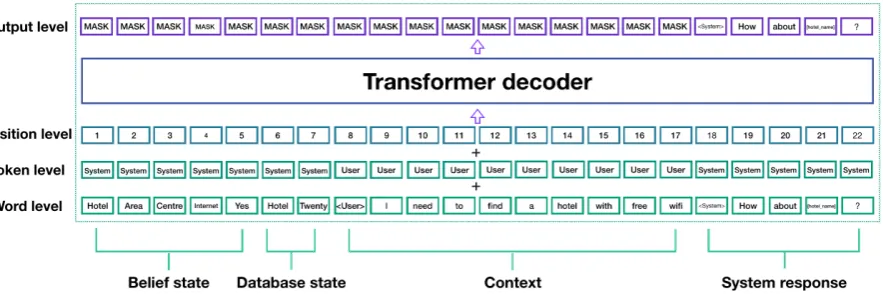
Figure 2: The framework for modeling task-oriented conversations based on a pretrained GPT model which uses only unstructured simple text as input. The context, belief state, and database state are joined together without explicit standalone dialogue policy and generation modules. The token-level (i.e., dialogue-state) embeddings are learned followingWolf et al.(2019).
of pretrained generative models in task-oriented di-alogue modeling. To the best of our knowledge, this work is first to combine these existing compo-nents to enable task-oriented dialogue modeling.
3.1 Domain Adaptation and Delexicalization
Dealing with out-of-vocabulary (OOV) words has been a long-standing challenge in dialogue mod-eling, e.g., it is crucial for task-oriented genera-tion where the generated output is often delexical-ized (Wen et al.,2015). Delexicalization replaces slot values by their corresponding (generic) slot tokens and it allows learning value-independent parameters. Recently, owing to subword-level to-kenisation (Sennrich et al.,2016), language mod-els are now able to deal with OOVs and domain-specific vocabularies more effectively (Radford et al.,2018).
3.2 Simple Text-Only Input
There have been some empirical validations re-cently which suggest that posing NLP tasks in the form of simple text can yield improvements with unsupervised architectures (Wolf et al.,2019; Rad-ford et al., 2019). For instance, in task-oriented dialogue modeling the Sequicity model (Lei et al.,
2018) sees the classification over the belief state as a generation problem. That way, the entire dia-logue model pipeline is based on the sequence-to-sequence architecture: the output from one model is the input to the subsequent recurrent model. We follow this approach by providing both the belief state and the knowledge base state in a simple text format to the generator. This significantly simpli-fies the paradigm of building task-oriented mod-els: any new source of information can be simply
added to as another part of the text-only input pro-vided in “natural language”.
3.3 Transferring Language Generation Capabilities
Transformer architecture shows ability to learn new (i.e., domain-specific) token embeddings in the fine-tuning phase (Radford et al.,2018;Wolf et al.,2019). This means that the GPT models can adapt through special tokens to particular tasks. By providing the input representation as text with domain-specific tokens, we can use off-the-shelf architectures and adapt to the domaspecific in-put without the need of training new dialogue sub-modules. As mentioned in §2.1, the token level layer (Figure2) informs the transformer decoder what part of the input comes from the system side or from the user side. In our framework, we create two task-oriented specific tokens (System and
Usertokens) that are learned during fine-tuning.
3.4 Generation Quality
Finally, the long-standing problem of dull and repetitive response generation (Li et al.,2017) has been in the focus of recent work (Kulikov et al.,
chooses the most probable word as :
arg max wi
= logP(wi|w0, w1, ..., wi−1).
On the other hand, nucleus sampling is restricted only to words from thep-th percentile of the dis-tribution during generation. The probabilities of words for which the cumulative sum exceeds the percentile are rescaled and the sequence is sam-pled from this subset. We probe the ability of such large pretrained models to generate more varied and semantically richer responses relying on nu-cleus sampling in lieu of greedy sampling without hurting the actual performance.
4 Fine-Tuning GPT on MultiWOZ
To evaluate the ability of transferring the GPT gen-eration capability to constrained/focused dialogue tasks and domains, we rely on the multi-domain MultiWOZ dataset (Budzianowski et al., 2018b). MultiWOZ consists of7 domains and10,438 di-alogues and it is substantially larger than previ-ous available datasets (Wen et al., 2017; El Asri et al., 2017). The conversations are natural as they were gathered through human-human inter-actions. However, the dialogues are based on domain-specific vocabulary such as booking IDs or telephone numbers that need to be delexicalized as they are entirely database-dependent.
Natural Language as (the Only) Input. GPT operates solely on the text input. This is in oppo-sition to the standard task-oriented dialogue archi-tectures (Wen et al.,2017;Zhao et al.,2017) where the belief state and the database state are encoded in a numerical form. For example, the database state is typically defined asn-bin encodings repre-senting a number of available entities at the current state of the conversation (Wen et al.,2017). There-fore, we transform the belief state and the knowl-edge base representation to a simple text represen-tation. The belief state takes the following form:
Domain1 Slot1 Value1 Slot2 Value2 Domain2 Slot1 ...
and the database representation is provided as:
Domain1 # of entities Domain2 # of entities ...
This is also similar in spirit to the Sequicity archi-tecture (Lei et al., 2018) where the second recur-rent model takes as input the belief state in the nat-ural language (i.e., simple text-only) form. In this
work, we also transform the knowledge base state to a similar natural language format. These two pieces of information are then concatenated with the history of the conversation forming the full di-alogue context, see Figure2. FollowingWolf et al.
(2019), we add new token embeddings for two par-ties involved in the conversation to inform the at-tention layers what part of the context comes from the user, and what part is related to the system. Fig-ure2presents the final architecture.
Training Details. We use the open-source im-plementation of the GPT architecture that provides both GPT and GPT-2 fine-tunable checkpoints.2 Following previous work (Radford et al., 2018;
Wolf et al., 2019), we set the weight on the lan-guage model loss to be two times higher than the one for the response prediction. The parameters for the batch size (24), learning rate (1e-5) and the number of candidates per sequence (2) were cho-sen based on the grid search.3
5 Results and Analysis
Following prior work (Budzianowski et al.,2018b;
Zhao et al., 2019; Chen et al., 2019), our evalu-ation task is the dialogue-context-to-text genera-tion task (see Figure1). Given a dialogue history, the oracle belief state and the database state, the model needs to output the adequate response. By relying on the oracle belief state, prior work has bypassed the possible errors originating from nat-ural language understanding (Budzianowski et al.,
2018b).
The main evaluation is based on the comparison between the following two models: 1) the base-line is a neural response generation model with an oracle belief state obtained from the wizard anno-tations as in (Budzianowski et al.,2018a); 2) the model proposed in §4and shown in Figure2that works entirely with text-only format as input (see §4). We test all three available pretrained GPT models - the original GPT model (Radford et al.,
2018). and two GPT-2 models referred to as small (GPT2) and medium (GPT2-M) (Radford et al.,
2019).
2https://github.com/huggingface/
transfer-learning-conv-ai
3We searched over the following values: learning rates∈
Baseline GPT GPT2-S GPT2-M
[image:5.595.304.524.63.170.2]Inform (%) 76.7 71.53 66.43 70.96 Success (%) 64.63 55.36 55.16 61.36 BLEU (%) 18.05 17.80 18.02 19.05
Table 1: Evaluation on MultiWOZ with the greedy sampling procedure.
Baseline GPT GPT2-S GPT2-M
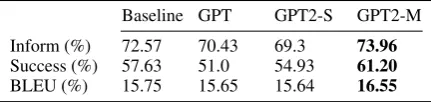
Inform (%) 72.57 70.43 69.3 73.96
Success (%) 57.63 51.0 54.93 61.20
BLEU (%) 15.75 15.65 15.64 16.55
Table 2: Evaluation on MultiWOZ with the nucleus sampling procedure.
5.1 Evaluation with Automatic Measures
We report scores with three standard automatic evaluation measures. Two of them relate to the dialogue task completion: whether the system has provided an appropriate entity (Inform) and then answered all requested attributes (Success rate). Finally, fluency is measured by the BLEU score (Papineni et al.,2002).
First, three versions of GPT were fine-tuned on MultiWOZ and evaluated with greedy sampling. The results are summarized in Table 1). They show that the baseline obtains the highest score on task-related metrics while the highest BLUE score was achieved by GPT2-M. Although the results are lower for the GPT-based methods, we note the design simplicity of the GPT-based task-oriented dialogue models. Further, the gap in performance might be partially attributed to the chosen greedy sampling procedure which puts too much focus on the properties of the original pretraining phase (Holtzman et al.,2019).
Therefore, we also report the results with the nucleus sampling method in Table 2. The scores confirm the importance of choosing the correct sampling method. The GPT2 models improve the score on Inform and Success metrics. It is worth noting the consistent drop in BLUE scores across all models. This comes from the fact that nucleus sampling allows for increased variability: this might reduce the probability of generating domain-specific tokens.
We have also qualitatively analyzed a sample of successful dialogues. Only around50% of di-alogues are successful both with the baseline and with the GPT-based models. Moreover, there are no clearly observed distinct patterns between suc-cessful dialogues for the two model types. This
Model 1 vs Model 2
GPT 59 % 41% Baseline
GPT 46 % 54 % Target
GPT2 46 % 54 % Target
GPT2 45 % 55 % Baseline
Baseline 43 % 57 % Target
[image:5.595.73.289.156.207.2]GPT2 51 % 49 % GPT
Table 3: Human ranking of responses between all pairs of four analyzed models and the original responses.
suggests that they might be effectively ensembled using a ranking model to evaluate the score of each response (Henderson et al.,2019b). We will inves-tigate the complementarity of the two approaches along with ensemble methods in future work.
5.2 Human Evaluation
In another, now user-centered experiment, the goal was to analyze the generation quality. Turkers, na-tive speakers of English, were asked to rate their binary preference when presented with one-turn responses from the baseline, GPT, GPT2-M and the original dialogues (Target). The turkers were required to choose what response they prefer when presented with two responses from two different models, resulting in more than300scores per each model pair.
The results are summarized in Table 3, while some example dialogues with responses are pro-vided in Figure3. As expected, the original re-sponses are ranked higher than all neural models with the largest difference observed between the oracle and the baseline model. Although the gen-erated output from the GPT is strongly preferred against the neural baseline, interestingly the oppo-site is observed with the GPT2 model. These in-conclusive results call for further analyses in fu-ture work, and also show that there are no sub-stantial differences in the quality of generated re-sponses when comparing the strong neural base-line and the GPT-based models.
6 Conclusion
vo-cabularies. We hope that this framework will in-form and guide future research in hope of simulta-neously improving and simplifying the design of task-oriented conversational systems.
References
Yoshua Bengio, Réjean Ducharme, Pascal Vincent, and Christian Jauvin. 2003. A neural probabilistic lan-guage model.Journal of machine learning research, 3(Feb):1137–1155.
Paweł Budzianowski, Iñigo Casanueva, Bo-Hsiang Tseng, and Milica Gaši´c. 2018a. Towards end-to-end multi-domain dialogue modelling. Tech. Rep. CUED/F-INFENG/TR.706, University of Cam-bridge, Engineering Department.
Paweł Budzianowski, Tsung-Hsien Wen, Bo-Hsiang Tseng, Iñigo Casanueva, Stefan Ultes, Osman Ra-madan, and Milica Gasic. 2018b. MultiWOZ-A Large-scale multi-domain wizard-of-oz dataset for task-oriented dialogue modelling. InProceedings of EMNLP, pages 5016–5026.
Wenhu Chen, Jianshu Chen, Pengda Qin, Xifeng Yan, and William Yang Wang. 2019. Semantically conditioned dialog response generation via hierar-chical disentangled self-attention. arXiv preprint arXiv:1905.12866.
Layla El Asri, Hannes Schulz, Shikhar Sharma, Jeremie Zumer, Justin Harris, Emery Fine, Rahul Mehrotra, and Kaheer Suleman. 2017. Frames: A corpus for adding memory to goal-oriented dialogue systems. InProceedings of SIGDIAL, pages 207– 219.
Sergey Golovanov, Rauf Kurbanov, Sergey Nikolenko, Kyryl Truskovskyi, Alexander Tselousov, and Thomas Wolf. 2019. Large-scale transfer learning for natural language generation. InProceedings of the 57th Annual Meeting of the Association for Com-putational Linguistics, pages 6053–6058, Florence, Italy. Association for Computational Linguistics.
Matthew Henderson, Rami Al-Rfou, Brian Strope, Yun-hsuan Sung, Laszlo Lukacs, Ruiqi Guo, Sanjiv Ku-mar, Balint Miklos, and Ray Kurzweil. 2017. Effi-cient natural language response suggestion for smart reply.arXiv preprint arXiv:1705.00652.
Matthew Henderson, Paweł Budzianowski, Iñigo Casanueva, Sam Coope, Daniela Gerz, Girish Ku-mar, Nikola Mrkši´c, Georgios Spithourakis, Pei-Hao Su, Ivan Vuli´c, and Tsung-Hsien Wen. 2019a.
A repository of conversational datasets. In Pro-ceedings of the Workshop on NLP for Conversa-tional AI. Data available at github.com/PolyAI-LDN/conversational-datasets.
Matthew Henderson, Ivan Vuli´c, Daniela Gerz, Iñigo Casanueva, Paweł Budzianowski, Sam Coope, Georgios Spithourakis, Tsung-Hsien Wen, Nikola
Mrksi’c, and Pei-Hao Su. 2019b. Training neural re-sponse selection for task-oriented dialogue systems. InProceedings of ACL.
Ari Holtzman, Jan Buys, Maxwell Forbes, and Yejin Choi. 2019. The curious case of neural text degener-ation.arXiv preprint arXiv:1904.09751.
Jeremy Howard and Sebastian Ruder. 2018. Universal language model fine-tuning for text classification. In Proceedings of the 56th Annual Meeting of the As-sociation for Computational Linguistics (Volume 1: Long Papers), pages 328–339.
Anjuli Kannan, Karol Kurach, Sujith Ravi, Tobias Kaufmann, Andrew Tomkins, Balint Miklos, Greg Corrado, Laszlo Lukacs, Marina Ganea, Peter Young, et al. 2016. Smart reply: Automated re-sponse suggestion for email. InProceedings of the 22nd ACM SIGKDD International Conference on Knowledge Discovery and Data Mining, pages 955– 964. ACM.
Ilya Kulikov, Alexander H Miller, Kyunghyun Cho, and Jason Weston. 2018. Importance of a search strategy in neural dialogue modelling. arXiv preprint arXiv:1811.00907.
Wenqiang Lei, Xisen Jin, Min-Yen Kan, Zhaochun Ren, Xiangnan He, and Dawei Yin. 2018. Sequicity: Simplifying task-oriented dialogue systems with sin-gle sequence-to-sequence architectures. In Proceed-ings of ACL, pages 1437–1447.
Jiwei Li, Will Monroe, Tianlin Shi, Sébastien Jean, Alan Ritter, and Dan Jurafsky. 2017. Adversarial learning for neural dialogue generation. In Proceed-ings of the 2017 Conference on Empirical Methods in Natural Language Processing, pages 2157–2169.
Kishore Papineni, Salim Roukos, Todd Ward, and Wei-Jing Zhu. 2002. BLEU: A method for automatic evaluation of machine translation. InProceedings of ACL, pages 311–318.
Alec Radford, Karthik Narasimhan, Tim Salimans, and Ilya Sutskever. 2018. Improving language under-standing by generative pre-training.
Alec Radford, Jeffrey Wu, Rewon Child, David Luan, Dario Amodei, and Ilya Sutskever. 2019. Language models are unsupervised multitask learners.OpenAI Blog, 1(8).
Marek Rei. 2017. Semi-supervised multitask learn-ing for sequence labellearn-ing. In Proceedings of the 55th Annual Meeting of the Association for Compu-tational Linguistics (Volume 1: Long Papers), pages 2121–2130.
Rico Sennrich, Barry Haddow, and Alexandra Birch. 2016.Neural machine translation of rare words with subword units. InProceedings of the 54th Annual Meeting of the Association for Computational Lin-guistics (Volume 1: Long Papers), volume 1, pages 1715–1725.
Iulian Vlad Serban, Alessandro Sordoni, Ryan Lowe, Laurent Charlin, Joelle Pineau, Aaron Courville, and Yoshua Bengio. 2017. A hierarchical latent variable encoder-decoder model for generating dialogues. In Proceedings of AAAI, pages 3295–3301.
Ilya Sutskever, Oriol Vinyals, and Quoc V Le. 2014.
Sequence to sequence learning with neural networks. InProceedings of NeurIPS, pages 3104–3112.
Ashish Vaswani, Noam Shazeer, Niki Parmar, Jakob Uszkoreit, Llion Jones, Aidan N Gomez, Łukasz Kaiser, and Illia Polosukhin. 2017. Attention is all you need. In Advances in neural information pro-cessing systems, pages 5998–6008.
Tsung-Hsien Wen, Milica Gaši´c, Nikola Mrkši´c, Pei-Hao Su, David Vandyke, and Steve Young. 2015. Se-mantically conditioned lstm-based natural language generation for spoken dialogue systems. In Proceed-ings of the 2015 Conference on Empirical Methods in Natural Language Processing (EMNLP).
Tsung-Hsien Wen, David Vandyke, Nikola Mrkši´c, Milica Gaši´c, Lina M Rojas-Barahona, Pei-Hao Su, Stefan Ultes, and Steve Young. 2017. A network-based end-to-end trainable task-oriented dialogue system. InProceedings of EACL, pages 438–449.
Thomas Wolf, Victor Sanh, Julien Chaumond, and Clement Delangue. 2019. Transfertransfo: A transfer learning approach for neural network based conversational agents. arXiv preprint arXiv:1901.08149.
Steve Young, Milica Gaši´c, Blaise Thomson, and Ja-son D. Williams. 2013. POMDP-based statistical spoken dialog systems: A review. Proceedings of the IEEE, 101(5):1160–1179.
Saizheng Zhang, Emily Dinan, Jack Urbanek, Arthur Szlam, Douwe Kiela, and Jason Weston. 2018. Per-sonalizing dialogue agents: I have a dog, do you have pets too? In Proceedings of the 56th An-nual Meeting of the Association for Computational Linguistics (Volume 1: Long Papers), pages 2204– 2213.
Tiancheng Zhao, Kaige Xie, and Maxine Eskenazi. 2019. Rethinking action spaces for reinforcement learning in end-to-end dialog agents with latent vari-able models. In Proceedings of the 2019 Confer-ence of the North American Chapter of the Associ-ation for ComputAssoci-ational Linguistics: Human Lan-guage Technologies, Volume 1 (Long and Short Pa-pers), pages 1208–1218.