Proceedings of the 3rd Workshop on Neural Generation and Translation (WNGT 2019), pages 241–248 Hong Kong, China, November 4, 2019. c2019 Association for Computational Linguistics
241
Learning to Generate Word- and Phrase-Embeddings
for Efficient Phrase-Based Neural Machine Translation
Chan Young Park Yulia Tsvetkov Language Technologies Institute
Carnegie Mellon University
{chanyoun,ytsvetko}@cs.cmu.edu
Abstract
Neural machine translation (NMT) often fails in one-to-many translation, e.g., in the trans-lation of multi-word expressions, compounds, and collocations. To improve the translation of phrases, phrase-based NMT systems have been proposed; these typically combine word-based NMT with external phrase dictionaries or with phrase tables from phrase-based sta-tistical MT systems. These solutions intro-duce a significant overhead of additional re-sources and computational costs. In this pa-per, we introduce a phrase-based NMT model built upon continuous-output NMT, in which the decoder generates embeddings of words or phrases. The model uses a fertility mod-ule, which guides the decoder to generate em-beddings of sequences of varying lengths. We show that our model learns to translate phrases better, performing on par with state of the art phrase-based NMT. Since our model does not resort to softmax computation over a huge vo-cabulary of phrases, its training time is about 112x faster than the baseline.
1 Introduction
Despite the successes of neural machine transla-tion (Wu et al.,2016;Vaswani et al.,2017;Ahmed et al., 2018), state of the art NMT systems are still challenged by translation of typologically di-vergent language pairs, especially when languages are morphologically rich (Burlot and Yvon,2017). One of the reasons lies in increased sparsity of word types, which leads to the demand for (of-ten unavailable) significantly larger training cor-pora (Koehn and Knowles, 2017). Another rea-son is an implicit assumption of sequence to se-quence (seq2seq) models that input sese-quences are translated into a target language word-by-word or subword-by-subword (Sennrich et al.,2016).
This is not the case for typologically diver-gent language pairs, for example when
translat-ing into English from agglutinative languages with high rates of morphemes per word (e.g., Turk-ish and Quechua) or languages with productive compounding processes like German or Finnish (Matthews et al., 2016). Another ubiquitous source of one-to-many correspondences is a trans-lation of idiomatic phrases and multi-word expres-sions (Rikters and Bojar,2017).
While outperformed by NMT overall, transla-tion models in traditransla-tional statistical phrase-based approaches (Koehn, 2009, SMT) provide an in-ventory of phrase translations, which can be used to address the above challenges. To combine the benefits of NMT and based SMT, phrase-based NMT systems have been proposed (Huang et al.,2017;Lample et al.,2018) which combine word-based NMT with external phrase memories (Tang et al.,2016;Dahlmann et al.,2017). How-ever, prior approaches to phrase-based NMT in-troduced a significant overhead of additional re-sources and computation.
We introduce a phrase-based continuous-output NMT (PCoNMT) model built upon continuous-output NMT (Kumar and Tsvetkov, 2019), in which the decoder generates embeddings of words or phrases (§2). The model extracts phrases in the target language from one-to-many word align-ments and pre-computes word and phrase embed-dings which constitute the output space of our model (§2.2). A fertility module guides the de-coder, providing the probability of generating a word or a phrase at each time step (§2.3). Experi-mental results show that the proposed model out-performs the conventional attention-based NMT systems (Bahdanau et al., 2014) by up to 4.8 BLEU, and the baseline continuous-output mod-els by up to 1.6 BLEU, and beat the state-of-the-art phrase-based NMT system in translation from German and Turkish into English.
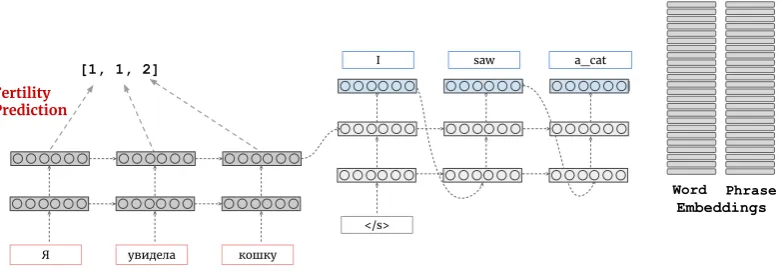
Figure 1: Phrase-based neural machine translation architectures generate word- and phrase embeddings at each step of decoding. The PCoNMT models are guided by on the fertility prediction and the attention.
computation over a huge vocabulary, it also main-tains the computational efficiency of continuous-output NMT, even with additional ngram embed-ding tables, and is faster than the state-of-the-art baseline by 112x (§3), making our models energy-efficient (Strubell et al.,2019).
The key contributions of our work are twofold: (1) we develop a phrase-based NMT model that outperforms existing baselines and better trans-lates phrases, while (2) maintaining the computa-tional efficiency of NMT end-to-end approaches.1
2 Phrase-based Continuous-output NMT
2.1 Embedding output layer
Kumar and Tsvetkov (2019) introduced continuous-output machine translation (CoNMT) which replaces the softmax layer in the con-ventional seq2seq models with a continuous embeddings layer. The model predicts the embed-ding of the target word instead of its probability. It is trained to maximize the von Mises-Fisher (vMF) probability density of the pretrained target-language embeddings given the embeddings predicted by the model at every step; at inference time, predicted embedding is compared to the embeddings in the pre-trained embedding table, and the closest embedding is selected as an output word. While maintaining the translation quality of traditional seq2seq approaches, CoNMT approach alleviates the computational bottleneck of the softmax layer: it is substantially more efficient to train and the models are more compact, without limiting the output vocabulary size.
1Our code and data are available athttps://github. com/chan0park/PCoNMT
Extending the CoNMT approach, we pro-pose phrase-based continuous-output NMT (PCoNMT). As depicted in Figure1, we augment the original model with (1) additional embedding tables for phrases, and (2) a fertility module that guides the choice of embedding table to look-up in (described in §2.3). Having additional large embedding tables, which significantly increase the vocabulary size, could be a considerable overhead to a word-based model with the softmax layer. However, since we generate embeddings in the final layer and do not resort to the softmax computation, our models maintain the compu-tational efficiency of continuous-output models (§3) during the training time. At inference time, the only overhead incurred by our model is getting another set of vMF scores for the phrase embedding table for each output step. This is almost negligible compared to the computation of the entire network.
In addition to efficiency benefits, since the PCoNMT approach enables us to pre-compute embeddings of less frequent phrases and phrases that do not have a literal translation, e.g., multi-word expressions, it facilitates better translations specifically where the translation is notoriously challenging for NMT.
2.2 Output embedding tables
To construct embedding tables for target-language phrases, we first extract the list of output phrases from parallel corpora. Following Tang et al.
com-s1
e
1s2 …
Decoder
o
1y1
Attn
sword
y1
gen
!
α1
< s >
Word Table
Phrase Table s1
x1 x2 x3
h3
h2
h1 …… Encoder
xn
hn λe,3
λe,2
λe,1 λe,n
Encoder Fertilities
…
Fertility Prediction
λd,word
λd,phrase
[image:3.595.118.483.60.269.2]sphrase
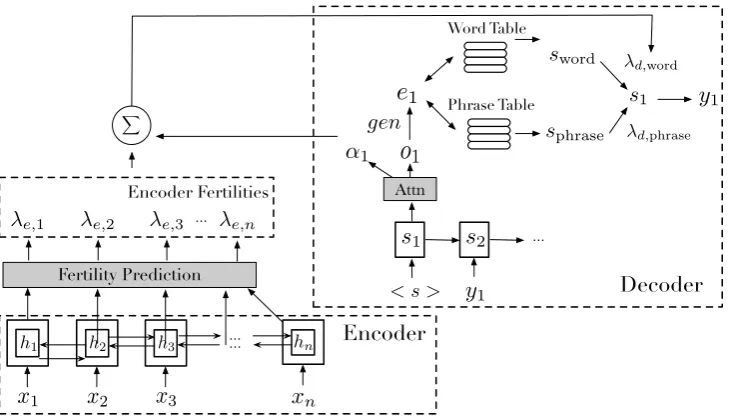
Figure 2: The detailed architecture of our model which consist of three components (encoder, fertility module, and decoder), described in§2. Given an input sentence{x1, x2. . . xn}, our model generates the output sentence {y1, y2. . . ym}, whereyicorresponds to words or phrases, e.g.quality of life. At each step, the decoder generates an embedding ei, then the fertility module guides it to generate a word or a phrase, via the word- or phrase-embedding table, respectively.
pounds to English, e.g.,Lebensqualit¨atin German is translated asquality of life. We extract all such one-to-many word alignments from the parallel corpora using Fastalign (Dyer et al.,2013). There are several standard approaches to extract mean-ingful phrases from a monolingual corpus, such as using scores like pointwise mutual information (PMI) (Mikolov et al., 2013). However, for our model, we utilize word-alignment results to con-struct a phrase list since we are particularly inter-ested in multi-word translation cases. Note that with this approach, phrases in target-side embed-ding tables can be different depenembed-ding on which language pair and which corpus are being used.
After extracting all noisy one-to-many align-ments from the parallel corpus, we filter our phrase list in order to keep only the useful phrases and to remove potential erroneous phrases coming from alignment errors. We filter according to the fol-lowing heuristics: (1) a phrase should appear at least twice in the parallel corpus; (2) it should not contain any punctuation; (3) PMI of the phrase should be positive; (4) a bigram phrase should not repeat the same word; and (5) the phrase should not contain only stopwords.
We train embeddings for the resulting list of words and phrases as follows. First, we preprocess the target language’s large monolingual corpus to concatenate words to match the longest phrase in the extracted phrase list. For example, the
sen-tence ‘I went to a graduate school’ will be con-verted into ‘I went to a graduate school’ if we have went to and graduate school in our phrase list. This concatenated corpus is then used to train fastText (Peters et al.,2018) embeddings for both phrases and words simultaneously. We use fast-Text because it encodes subword-level informa-tion which may provide a signal about each word in a phrase. From this training, we obtain both the word- and phrase-tables, which are of the same di-mension.
2.3 Fertility module
We introduce a fertility module, similar to the fer-tility concept in SMT (Brown et al., 1993). The fertility indicates how many target words each source word should produce in the output. The SMT models keep the fertility probabilities over fertility count, typically from zero to four, and use it to produce probability over words. We integrate this fertility concept into our PCoNMT model.
Our fertility module predicts the fertility proba-bilityφe = [φe0, ..., φeN], whereφei indicates the
scalar probability of the source word at position
ebeing translated intoiwords. This is predicted based on the word embedding and encoder’s out-put of the word: φe = FFNN(xe;he). FFNN
is the feed-forward neural network, and (xe;he)
denotes the concatenation of xe and he, which
source word, respectively. The dimension of fer-tility vectorφ, N, can be arbitrarily large, but in this paper we explore two different variants; the first one isFertility4 where each dimension cor-responds to zero to three words to produce re-spectively (N ∈ {0,1,2,3}), and the second one isFertility2 which simplifies the fertility predic-tion into binary classificapredic-tion by settingN=1 as a cut-off point, i.e., whether the model should gen-erate a word (N ≤ 1) or a phrase (N > 1). Therefore, φe becomes a four-dimensional
vec-tor of[φe0, φe1, φe2, φe3]forFertility4, and
two-dimensional vector of[P1n=0φen,P∞n=2φen]for Fertility2.
At decoding time, we combine this fertility probability of each source word and the attention to guide the decoder to generate a phrase or a word. To get the probability of producing a word
λd,word for timestepd, we use attention given to
each source word as a weight to its fertility proba-bility and sum over the entire source sentence:
λd,word=
(P
ead,e(φe0+φe1) (dim = 4)
P
ead,e[φe]0 (dim = 2)
λd,phrase= 1−λd,word,
wheread,e is a scalar value of attention assigned
for source word e at timestep d and [φe]0 is the
0th element ofφe, which basically is the same as (φe0+φe1)inFertility4. We use thisλd,wordand
λd,phraseto weight the scores in word table and in
phrase table, respectively:
sword =λd,word·Score(ed, Tword)
sphrase =λd,phrase·Score(ed, Tphrase)
yd= arg max(sword;sphrase),
wheresword is a vector of scores for word in the
word embedding tableTword, andScoreis a score
function to measure how similar the predicted em-bedding ed and the embeddings in T. For the Score function, we use vMF as proposed in Ku-mar and Tsvetkov(2019). Finally, we get an out-put,yd for the timestepdby doingarg maxover
weighted scores from both word and phrase tables.
2.4 Model Training
The training of PCoNMT model is achieved by two separate steps. First, we only train the seq2seq modules as CoNMT does. We use vMF loss to op-timize the embedding prediction. Once we find the optimal parameters for the CoNMT components,
IWSLT IWSLTMWT
Attn 23.83
-NPMT 27.27
-CoNMT 27.07 24.98
PCoNMT 28.69 28.89
+Fertility4 28.04 24.93
+Fertility2 28.29 25.12
Table 1: Evaluation results (BLEU) on IWSLT 2014 De–En task.
WMT WMTMWT
NPMT 3.58
-CoNMT 7.44 7.67
[image:4.595.335.496.63.171.2]PCoNMT 8.87 7.70 +Fertility4 8.12 8.53 +Fertility2 8.39 8.61
Table 2: Evaluation results (BLEU) on WMT 2017 Tr– En task.
we freeze those parameters, and separately train parameters of the fertility module.2 During the preprocessing, we extract the actual fertility value for each source word using the word-alignment model and the filtered phrase list, then set it as a gold label for the fertility prediction training.
3 Experiments
In this section, we evaluate our model in terms of translation quality and training efficiency. We used IWSLT 2014 dataset for De–En machine translation task, following the same preprocess-ing and splits as in Ranzato et al. (2016). For the Tr–En task, we used WMT 17 train and test dataset (Bojar et al., 2018). The training cor-pora size for IWSLT 2014 and WMT 17 is about 153K and 200K sentences, respectively. All re-sults are reported with case-sensitive BLEU-4 ( Pa-pineni et al., 2002). In addition to the two of-ficial datasets, we subset the given test sets to sentences that actually contain multi-word transla-tion (MWT) cases by running the word-alignment model. The size of extracted MWT subsets for IWSLT 2014 and WMT 17 are 335 (5%) and 116
speed↓
(samples/sec)
convergence↑
(epochs)
total time↑
(hours)
NPMT 15.4 40 110
CoNMT 256.0 6 1.00
PCoNMT 261.0 6 0.98
Table 3: Training efficiency results on IWSLT 2014 De–En dataset.
(4%), respectively. Also note that following Ku-mar and Tsvetkov(2019), in this paper, we only used greedy decoding.
We compared our proposed model with three baselines: (1) Attn: Standard attention-based NMT model as in Wiseman and Rush (2016); (2) CoNMT: RNN-based Continuous-output NMT systems (Kumar and Tsvetkov, 2019); (3) NPMT: The state of the art phrase-based NMT model proposed by Huang et al. (2017). For NPMT, we ran its released code with the same pre-processed data we are using without changing any hyperparameters they set.3 For both De–En and Tr–En CoNMT models, we used the best hyperpa-rameter settings reported byKumar and Tsvetkov
(2019) for De–En. For our model, PCoNMT, we only changed the batch size from the original set-ting in CoNMT and chose other additional param-eters based on the performance on the validation set.
Although we use recurrent architectures in this paper to make our findings comparable to prior work that uses the same setting, we be-lieve using multi-layer self-attention mechanism (Vaswani et al., 2017) as a base of our model has further potential to improve the performance. Even with Transformers, the conventional token-by-token generation scheme will be still prone to mistakes in multi-word generations. Therefore, explicitly handling the phrase generation as we propose is likely to be helpful, which we leave it as future work.
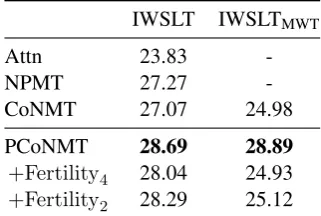
Translation quality De–En and Tr–En transla-tion results are summarized in Tables 1 and 2. PCoNMT significantly outperforms both the con-ventional attention-based model (by >4 BLEU) and its base CoNMT model (by 1.6 BLEU), and also performs better than NPMT (by 1.4 BLEU). The fertility module is shown to be relatively
3The number we got from the experiment is different from the one reported in the original paper, which possibly is root-ing from slightly different preprocessroot-ing steps.
Class De–En Tr–En
Tot. P R F-1 Tot. P R F-1
N≤1 97% 0.97 0.96 0.97 97% 0.97 0.95 0.96
[image:5.595.309.523.64.112.2]N >1 3% 0.33 0.28 0.31 3% 0.17 0.1 0.13
Table 4: The Precision, Recall, and F1 evaluation re-sults on the fertility prediction of Fertility2. ”Tot.” is
the percentage for the number of occurrences of each label in the gold label.
Class De–En Tr–En
Total P R F-1 Total P R F-1
N= 0 10% 0.59 0.09 0.15 14% 0.56 0.30 0.39
N= 1 86% 0.88 0.95 0.91 83% 0.86 0.91 0.89
N= 2 4% 0.27 0.35 0.31 3% 0.12 0.19 0.14
N= 3 0% 0.16 0.14 0.15 0% 0 0 0
Table 5: The Precision, Recall, and F1 evaluation re-sults on the fertility prediction of Fertility4. ”Tot.” is
the percentage for the number of occurrences of each label in the gold label.
more helpful in Tr–En task, while showing less impact in De–En task. We also observed that
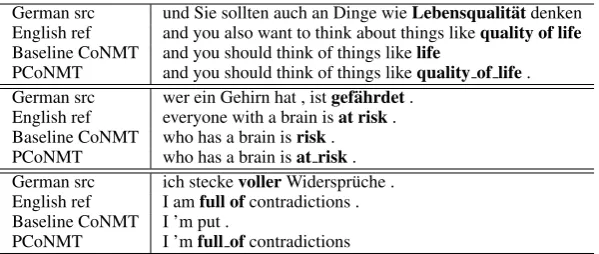
Fertility2 consistently generates better transla-tions thanFertility4. On the more difficult MWT subset containing multi-word phrases, PCoNMT obtains large absolute gains in BLEU, confirming their effectiveness in phrase translations. Exam-ples of translations are shown in Table7.
Computational efficiency We report the train-ing efficiency of models in three metrics: speed, number of training epochs till convergence, and total training time. All results were measured on the same machine with the same batch size. The machine was a single-node local machine with NVIDIA GTX 1080 Ti. During the training, no other process was executed except for the training for the fair comparison.
Table3 shows that CoNMT and PCoNMT can process 28 times faster than NPMT, and converge six times faster, i.e., reducing the entire training time by 112x. Somewhat surprisingly, PCoNMT further accelerates the CoNMT as it can reduce the timestep needed for a sample by generating phrases. This result proves that additional phrase embeddings of PCoNMT has little impact on com-putational efficiency while training.
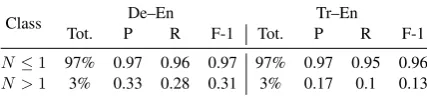
[image:5.595.309.524.182.253.2]with the gold label obtained from the word align-ment model in Table5and Table4.
In both datasets, we observe that the data is highly skewed toward word-level classes as most translations are word-to-word generation. This re-sults in Fertility4 not to predict N = 3 classes
at all in the Tr–En dataset. The comparison be-tween Table5and Table4shows that the Fertility2
has slighly higher F-1 score than Fertility4in both
datasets. It implies that aggregating the classes into two made the prediction task easier for the model, which thus led to the improved translation quality shown in the previous results.
Analysis on Generated Phrases Table 6
presents further analysis of the generated phrases. We first see in which category of phrases our model performs well compared to the baseline, CoNMT, to know from where the improvement of our model is coming. As for the phrase categories, we consider three categories, compound nouns (CNs, e.g., thought experiment), verb phrases (VPs, e.g., grow apart), and collocations (COs, e.g., at risk). We randomly sampled a hundred generated phrases from the De–En test set, and manually annotate the category of phrases and whether it is the correct translation. We also look at the output of CoNMT baseline for the same test samples, and also annotate if the sampled phrases are well translated in the CoNMT output.
The results in Table 6 show that the most fre-quently generated phrases are collocations (56%) followed by verb phrases (28%) and compound nouns (16%). Among the entire sampled phrases, 64 percent of phrases were correct in PCoNMT output while CoNMT had 50 percent of them cor-rect. Specifically, our model significantly outper-formed the baseline in compound word generation cases while performs worse in verb phrases gen-eration. By looking into the instances of wrong verb phrase generation, we found that a significant amount of those errors are related to the tense of the verb.
4 Related Work
Multi-word Expressions for NMT There have been several studies that incorporate multi-word phrases into supervised NMT (Tang et al., 2016;
Wang et al.,2017;Dahlmann et al.,2017). Most approaches rely on pre-defined phrase dictionar-ies obtained from methods such as phrase-based Stastitical MT (Koehn et al., 2003) or
word-Category Total PCoNMT CoNMT
CNs 16% 0.63 0.25
VPs 28% 0.5 0.57
COs 56% 0.71 0.54
[image:6.595.318.513.65.153.2]Sum 100% 0.64 0.50
Table 6: Percentages of categories of randomly sam-pled 100 phrases generated by PCoNMT on IWSLT 2014 De–En test set and the accuracy of PCoNMT and CoNMT phrase translations, respectively.
alignment. Tang et al. (2016) use a method that combines phrase probability and word probabil-ity obtained from a softmax layer enabling the decoder to decide to switch between phrase gen-eration and word gengen-eration based on context.
Dahlmann et al.(2017) use a separate SMT model to generate phrases along with an NMT model.
Wang et al. (2017) proposed a similar approach to have an SMT model run in parallel, where an additional module decide whether to use a phrase generator from the SMT model or the neural de-coder.
Recent works have also explored using an ad-ditional RNN to compute phrase generation prob-abilities. Huang et al. (2017) proposed Neu-ral Phrase MT (NPMT) that is built upon Sleep-WAke Network (SWAN), a segmentation-based sequence modeling technique, which automati-cally discovers phrases given the data and appends the special symbol $ to the source and target data. The model gets these segmented word/phrase se-quences as input and keeps two levels of RNNs to encode and decode phrases. NPMT established state of the art results for phrase-based NMT, but at a price of significant computational overhead.
The main differences between previous studies and our work are: (1) we do not rely on SMT model and adapt in an end-to-end manner only re-quiring some preprocessing using word-alignment models; and (2) we use phrase embedding ta-bles to represent phrases instead of keeping exter-nal phrase memory and its generation probability. By using the phrase embeddings along with the continuous-output layer, we significantly reduce the computational complexity and propose an ap-proach to overcome the phrase generation bottle-neck.
German src und Sie sollten auch an Dinge wieLebensqualit¨atdenken English ref and you also want to think about things likequality of life Baseline CoNMT and you should think of things likelife
PCoNMT and you should think of things likequality of life. German src wer ein Gehirn hat , istgef¨ahrdet.
English ref everyone with a brain isat risk. Baseline CoNMT who has a brain isrisk. PCoNMT who has a brain isat risk. German src ich steckevollerWiderspr¨uche . English ref I amfull ofcontradictions . Baseline CoNMT I ’m put .
[image:7.595.150.450.61.188.2]PCoNMT I ’mfull ofcontradictions
Table 7: Translation output examples from CoNMT and PCoNMT systems.
models (Koehn et al., 2003). Fertility gives the likelihood of each source word of being translated into n words. Fertility helps in deciding which phrases should be stored in the phrase tables. Tu et al. (2016) revisited fertility to model coverage in NMT to address the issue of under-translation. They used a fertility vector to express how many words should be generated per source word and a coverage vector to keep track of words translated so far. We use a very similar concept in this work but the fertility module is introduced with a pur-pose to guide the decoder to switch over generat-ing phrases and words.
5 Conclusion
We proposed PCoNMT, a phrase-based NMT sys-tem built upon continuous-output NMT models. We also introduced a fertility module that guides the decoder by providing the probabilities of gen-erating a phrase and a word by leveraging the attention mechanism. Our experimental results showed that our model outperforms the state of the art phrase NMT systems, and also speeds up the computation by 112x.
Acknowledgments
We gratefully acknowledge Sachin Kumar and our anonymous reviewers for the helpful feedback. This material is based upon work supported by NSF grant IIS1812327 and an Amazon MLRA award.
References
Karim Ahmed, Nitish Shirish Keskar, and Richard Socher. 2018. Weighted transformer network for machine translation. InProc. ICLR.
Dzmitry Bahdanau, Kyunghyun Cho, and Yoshua
Ben-gio. 2014. Neural machine translation by jointly learning to align and translate. InProc. of ICLR.
Ondˇrej Bojar, Christian Federmann, Mark Fishel, Yvette Graham, Barry Haddow, Philipp Koehn, and Christof Monz. 2018. Findings of the 2018 confer-ence on machine translation (wmt18). In Proceed-ings of the Third Conference on Machine Transla-tion: Shared Task Papers, pages 272–303.
Peter F Brown, Vincent J Della Pietra, Stephen A Della Pietra, and Robert L Mercer. 1993. The mathemat-ics of statistical machine translation: Parameter esti-mation. Computational linguistics, 19(2):263–311.
Franck Burlot and Franc¸ois Yvon. 2017. Evaluating the morphological competence of machine transla-tion systems. InProc. of WMT, pages 43–55.
Leonard Dahlmann, Evgeny Matusov, Pavel Petrushkov, and Shahram Khadivi. 2017. Neu-ral machine translation leveraging phrase-based models in a hybrid search. InProc. of EMNLP.
Chris Dyer, Victor Chahuneau, and Noah A. Smith. 2013. A simple, fast, and effective reparameteriza-tion of IBM Model 2. InProc. of NAACL.
Po-Sen Huang, Chong Wang, Sitao Huang, Dengyong Zhou, and Li Deng. 2017. Towards neural phrase-based machine translation. InProc. of ICLR.
Philipp Koehn. 2009. Statistical machine translation. Cambridge University Press.
Philipp Koehn and Rebecca Knowles. 2017. Six chal-lenges for neural machine translation. In Proc. of WNGT.
Philipp Koehn, Franz Josef Och, and Daniel Marcu. 2003. Statistical phrase-based translation. In Pro-ceedings of the 2003 Conference of the North Amer-ican Chapter of the Association for Computational Linguistics on Human Language Technology - Vol-ume 1, NAACL ’03, pages 48–54, Stroudsburg, PA, USA. Association for Computational Linguistics.
Guillaume Lample, Myle Ott, Alexis Conneau, and Lu-dovic Denoyer. 2018. Phrase-based & neural unsu-pervised machine translation. InProc. of EMNLP, pages 5039–5049.
Austin Matthews, Eva Schlinger, Alon Lavie, and Chris Dyer. 2016. Synthesizing compound words for ma-chine translation. In Proc. of ACL, pages 1085– 1094.
Tomas Mikolov, Ilya Sutskever, Kai Chen, Greg S Cor-rado, and Jeff Dean. 2013. Distributed representa-tions of words and phrases and their compositional-ity. InAdvances in neural information processing systems, pages 3111–3119.
Kishore Papineni, Salim Roukos, Todd Ward, and Wei-Jing Zhu. 2002. BLEU: a method for automatic evaluation of machine translation. InProc. of ACL, pages 311–318.
Matthew Peters, Mark Neumann, Mohit Iyyer, Matt Gardner, Christopher Clark, Kenton Lee, and Luke Zettlemoyer. 2018. Deep contextualized word rep-resentations. In Proceedings of the 2018 Confer-ence of the North American Chapter of the Associ-ation for ComputAssoci-ational Linguistics: Human Lan-guage Technologies, Volume 1 (Long Papers), pages 2227–2237.
Marc’Aurelio Ranzato, Sumit Chopra, Michael Auli, and Wojciech Zaremba. 2016. Sequence level train-ing with recurrent neural networks.
Matss Rikters and Ondej Bojar. 2017. Paying attention to multi-word expressions in neural machine trans-lation. InProc. of Machine Translation Summit.
Rico Sennrich, Barry Haddow, and Alexandra Birch. 2016. Neural machine translation of rare words with subword units. InProc. of ACL.
Emma Strubell, Ananya Ganesh, and Andrew McCal-lum. 2019. Energy and policy considerations for deep learning in nlp. InProc. of ACL.
Yaohua Tang, Fandong Meng, Zhengdong Lu, Hang Li, and Philip LH Yu. 2016. Neural machine transla-tion with external phrase memory. arXiv preprint arXiv:1606.01792.
Zhaopeng Tu, Zhengdong Lu, Yang Liu, Xiaohua Liu, and Hang Li. 2016. Modeling coverage for neural machine translation. InProceedings of the 54th An-nual Meeting of the Association for Computational Linguistics (Volume 1: Long Papers), volume 1, pages 76–85.
Ashish Vaswani, Noam Shazeer, Niki Parmar, Jakob Uszkoreit, Llion Jones, Aidan N Gomez, Łukasz Kaiser, and Illia Polosukhin. 2017. Attention is all you need. InAdvances in neural information pro-cessing systems, pages 5998–6008.
Xing Wang, Zhaopeng Tu, Deyi Xiong, and Min Zhang. 2017. Translating phrases in neural machine translation. InProc. of EMNLP, pages 1421–1431.
Sam Wiseman and Alexander M Rush. 2016. Sequence-to-sequence learning as beam-search opti-mization. InProceedings of the 2016 Conference on Empirical Methods in Natural Language Process-ing, pages 1296–1306.