Proceedings of the First Workshop on Aggregating and Analysing Crowdsourced Annotations for NLP, pages 48–52 48
CoSSAT: Code-Switched Speech Annotation Tool
Sanket Shah Pratik Joshi Sebastin Santy Sunayana Sitaram
Microsoft Research, Bangalore, India
{t-sansha, t-prjos, t-sesan, susitara}@microsoft.com
Abstract
Code-switching refers to the alternation of two or more languages in a conversation or ut-terance and is common in multilingual com-munities across the world. Building code-switched speech and natural language pro-cessing systems are challenging due to the lack of annotated speech and text data. We present a speech annotation interface CoS-SAT, which helps annotators transcribe code-switched speech faster, more easily and more accurately than a traditional interface, by dis-playing candidate words from monolingual speech recognizers. We conduct a user study on the transcription of Hindi-English coswitched speech with 10 annotators and de-scribe quantitative and qualitative results.
1 Introduction
Code-switching is a phenomenon that occurs in multilingual societies wherein speakers who are fluent in two or more languages switch between these languages in the same conversation or an ut-terance. Code-switching is a challenging problem for speech and natural language processing sys-tems to handle due to the lack of manually an-notated data and resources. However, due to the ubiquitous nature of code-switching in speech and text produced by multilingual speakers, it is an im-portant problem for speech and NLP systems to tackle.
Automatic Speech Recognition (ASR) is used by a variety of systems to convert speech to text for further processing. Deep Neural Network (DNN) based systems have increased the accu-racy of ASR systems to match human-level per-formance. However, these gains are only obtained in high-resource languages that have thousands of hours of manually transcribed speech data. Code-switched languages suffer from a lack of manually annotated training data, as described in (Sitaram
et al., 2019), with the largest publicly available speech corpus in Mandarin-English being 63 hours long (Lyu et al.,2015).
In cases where the two languages being mixed are in different scripts, the transcriber needs to switch between two scripts while annotating an utterance. This paper introduces an interface which assists in the transcription of code-switched Hindi-English speech data by displaying candidate words generated by monolingual Hindi and En-glish speech recognizers, without the need for a code-switched ASR. We present quantitative and qualitative results from a user study with 10 users who use our proposed interface as well as a tradi-tional typing-only interface for transcribing code-switched speech.
2 Related Work
Using hypotheses produced by an ASR system is a common approach used to reduce human effort in transcribing speech (Sperber et al.,2016). How-ever, this approach often induces a bias amongst the annotators while transcribing text (Levit et al.,
ASR hypothesis nor do any post-processing on the ASR hypothesis, but rather use the output of the two recognizers to display candidate words for an-notation purposes.
3 Methodology
Given a speech utterance, we generate an ordered sequence of candidate code-switched words using monolingual speech recognizers. Our method con-sists of two main steps, (1) Dynamic Audio Seg-mentation, (2) Combining ASR hypotheses.
3.1 Dynamic Audio Segmentation
Due to the low accuracy of the monolingual speech recognizers on code-switched input, it is important to find segments in the audio where the monolin-gual recognizers have high confidence. To enable this, we automatically segment the audio accord-ing to ASR confidence. This audio segmentation task can be formulated as an optimization problem for a given set of possible boundaries. We try to optimize the segment size based on the confidence scores of the monolingual ASRs on code-switched speech. We start with a segment of size 0.5 sec-onds from the beginning of the audio, and pass this audio segment through the monolingual Hindi and English ASRs. Each ASR provides an utter-ance (or audio chunk, in this case) level confidence value in the range of 0-1.
If the confidence values given by both recog-nizers are less than 0.3, we increase the segment size for that particular segment by 0.25 seconds at the beginning and end of the audio. We repeat the process until one of the recognizers outputs a confidence score of more than 0.3. We then select the next segment of 0.5 seconds having an overlap of 0.25 seconds with the current optimal segment. The entire process is repeated until the entire au-dio is segmented. At the end, we combine all the hypotheses generated for each chunk to create an utterance level hypotheses for each ASR.
3.2 Combining ASR hypothesis
We use off-the-shelf monolingual Hindi and Indian English ASRs for decoding speech. To measure the performance of the ASRs on code-switched speech, we test them on an in-house conversational speech corpus consisting of 52k Hindi-English mixed utterances. The corpus is transcribed us-ing the Devanagari script for Hindi words and the Latin script for English words. The English ASR
gives a Word Error Rate (WER) of 80% and Hindi ASR gives a WER of 48% on the corpus. The high error rate of both ASRs can be attributed to the difference in script between the reference and hypotheses words as well as the poor performance of monolingual ASRs at code-switch points.
We hypothesize that each ASR will recog-nize a set of words in the given audio segment, and the collection of the sets will contain all the words present in that particular audio seg-ment. We conduct a quantitative evaluation on 10k code-switched utterances by passing them through both monolingual ASRs and checking whether the ground truth words are present in either of the recognition hypotheses. We obtain a recall of 0.84, which indicates that most words present in the utterance are also present in the output of the two recognizers. We pass each segment obtained through dynamic chunking through Hindi and En-glish monolingual ASRs respectively to obtain two ASR hypotheses for each segment, which we then combine to form utterance level hypotheses.
4 Interface Overview
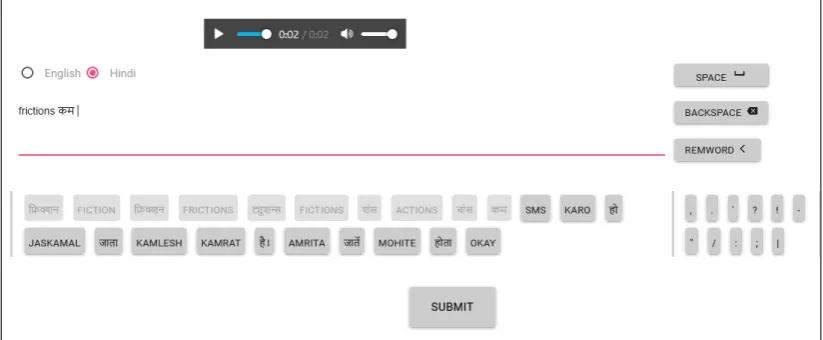
The annotation interface as shown in figure2 con-sists of a button to play audio and a text box. We display the predicted words in a time-linear fash-ion as clickable blocks. As the user clicks on each word button, all the buttons before and including it becomes disabled, to allow the user to easily focus on the progression of the transcriptions. If the user presses the backspace or attempts to remove cer-tain words, the respective disabled word buttons appear again. Users also have an option of typ-ing out the transcription if they wish to, in both the languages.1
If the user wishes to use the keyboard, we also provide quick keyboard shortcuts to improve the efficiency of transcription. These shortcuts allow the user to play/pause the audio, and toggle scripts easily. More details about the interface can be found in the appendix section.
5 Experiments
5.1 Setup
We performed a user study to evaluate the efficacy of our system. We measured transcription qual-ity, annotator effort and the net time taken to tran-scribe utterances. We compared our annotation
Figure 1: CoSSAT (Code-Switched Speech Annotation Tool)
tool (CoSSAT) against a baseline system, where no ASR hypothesis is shown and the annotators are expected to type out the entire transcription. 10 users annotated 14 code-switched speech utter-ances. All participants were Hindi-English bilin-guals and had no knowledge about the system be-fore conducting the study.
We implemented multiple measures to reduce biases during the annotation task. 4 utterances out of 14 that each user is shown were practice exer-cises for the annotators to get used to the interface and were not used for the final evaluation. The sequence of the interface (baseline vs. CoSSAT) displayed changed for each user such that each ut-terance and interface was paired at least five times. Users were asked to listen to the audio displayed on the page and could play the audio as many times as they wanted. They were asked to transcribe all audible words in the audio sample except speech fillers (e.g., “uh” and “eh”). The users were re-quired to enter the tokens in the script to which they belong - Hindi in Devanagari script and English in Latin script, although this distinction was difficult to make sometimes due to the prevalence of bor-rowing between the two languages. We did this instead of having all tokens in one script to ensure correctness of transcribed Hindi and English to-kens. Often, the transcribing of tokens in a differ-ent script can cause certain tokens to be transcribed in different ways (for example), which would have resulted in a cumbersome and misleading evalua-tion process, even with post-transliteraevalua-tion.
5.2 Quantitative Evaluation
To evaluate our system, we used the following three metrics (1) Transcription Quality (2)
Anno-tation Speed (3) AnnoAnno-tation Effort. For every ut-terance, we had10transcriptions,5transcriptions from our proposed interface, and5from the base-line interface.
5.2.1 Transcription Quality
Transcription quality was determined by comput-ing word error rate (WER) uscomput-ing a standard pro-cedure2, using the transcriptions present in our in-house dataset as the gold standard. We calculated WER for the transcriptions created by users using our system as well as for the transcriptions cre-ated using the baseline approach. From table 1
we see that transcriptions created using our sys-tem have a WER of 19.7%, while the number is much higher for the baseline at 34.74%. After analysing transcripts which had high WER, we noticed that for words where the ASR hypoth-esis was not present, errors could be attributed to spelling variants, spelling errors, hyphenated words, and grammatical errors. Besides these er-rors, in the baseline method users made errors in phonetically similar phrases like “of score” instead of “of course”.
Another major source of errors was the use of a different script for transcribing a borrowed word, which meant that the annotator used the Hindi script to transcribe a word that was in the Latin script in the reference transcription or vice versa. This is a very challenging problem for transcrip-tion of code-switched speech where the two lan-guages are written in different scripts, as it is dif-ficult to make the distinction between loan words and code-switching (Bali et al.,2014).
To make the comparison fair, we also com-puted a relaxed WER by converting the tran-scriptions into phoneme sequences by running a Grapheme to Phoneme (g2p) system on all words and post-processing phoneme sequences. We di-vided phonemes into classes based on phonetic features and treated each phoneme in a single class as equivalent. If the phoneme classes of all phonemes in a word was the same as those in the reference word, it was treated as a match. This helped take care of minor spelling errors and vari-ants such as long/short vowels and nasalization. Relaxed WER for both systems are reported in ta-ble1. We observe that the relaxed WER numbers for both techniques are significantly lower than the baseline. Crucially, the CoSSAT WER is even lower than the relaxed WER of the baseline, which shows that our interface helps even if we discount the fact that it helps users select the correct spelling variation of a word.
Metrics CoSSAT Baseline
WER 19.7% 34.74%
Relaxed WER 9.3% 25.6%
Table 1: WER and relaxed WER for measuring Quality of Transcriptions
5.2.2 Annotation Speed
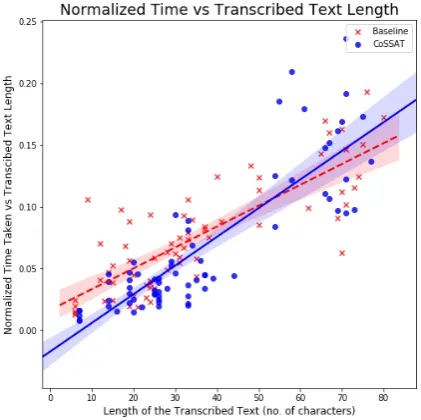
In the case for transcription task using CoSSAT, we recorded time taken by the user to transcribe from the moment the user clicks on the first word or clicks on the text-box provided to the moment the user clicks submit. In case of the baseline system, we recorded time from the moment the user clicks on the text-box to the moment the user clicks submit. We normalized the time recorded for each audio using the formula (A).
Normalized Time(N T)=(T Tt )——– (A)
wheretis the time taken for transcribing the au-dio by user X andT T is the total time taken by userXto transcribe all utterances. Figure2shows a plot ofN T v/s utterance length. We observe that for utterance having ground truth transcriptions of 50 characters or less, CoSSAT takes less time for transcription but for longer utterances, the baseline system is faster. This might be attributed to the fact that longer utterances led to a larger set of word hypothesis resulting in more time for visual search
[image:4.595.311.522.126.336.2]of the tokens across the interface. We intend to address this issue by weeding out improbable sug-gestions based on confidence and language model scores in future work.
Figure 2: Annotation Speed Plot for each audio. Y axis is the Normalized Time Taken for the utterance. X axis is number of characters present in the utterance. Red colour (cross) is the Baseline system. Blue (dots) colour is CoSSAT.
5.2.3 Annotation Effort
One way to measure annotation effort is to mea-sure the number of keystrokes and mouse clicks. The CoSSAT system resulted in 8 keystrokes and 8 mouse clicks on average, while the baseline system had 57.1 keystrokes and 5.4 mouse clicks. This is explained by the fact that the annotators relied on typing for the baseline interface and clicking on candidate words for the CoSSAT interface, how-ever, overall, the total annotation effort was much lower for the CoSSAT system.
5.3 Qualitative Evaluation
prefer using as a potential speech annotator tool. 7 out of 10 annotators said they preferred CoSSAT over the baseline system.
We also asked annotators for feedback and sug-gestions. One suggestion was to put larger sized or bold buttons for words that had higher probability according to the ASR confidence. Another sugges-tion was to show candidate words incrementally, rather than all at once. We plan to take this feed-back into account while creating the next version of our tool.
6 Conclusion
In this paper, we propose an annotation tool for transcribing code-switched speech, which makes use of dynamic audio chunking and combines ASR hypotheses from two monolingual ASR systems to present candidate words to annotators. We com-pare our tool to a baseline system where the user has to type the entire transcription using two scripts and find that our proposed system performs better in terms of transcription quality, speed and annota-tion effort in a user study conducted with 10 anno-tators. Annotators report that our system is faster, easier to use, more user-friendly and more robust to annotation errors.
In this work, we present the hypotheses from both monolingual ASRs as two-word streams. In future work, we plan to create an aligned structure such as a word lattice and show candidate words to users as they are annotating the utterance in-stead of all at once. We also plan to collapse cross-transcribed borrowed words in both languages into a single variant using statistics from corpora, so that annotators can be more consistent in annotat-ing such words.
Since our system does not rely on the existence of a code-switched ASR system, it can be used to bootstrap data collection for a code-switched language pair for which monolingual ASRs ex-ist. This can help collect transcribed speech data faster, which can, in turn, help build better code-switched ASR systems.
7 Acknowledgments
We would like to thank all the reviewers’ for their valuable comments. We would also like to thank all the users who participated in the user-study.
References
Kalika Bali, Jatin Sharma, Monojit Choudhury, and Yo-garshi Vyas. 2014. “i am borrowing ya mixing?” an analysis of english-hindi code mixing in facebook.
InProceedings of the First Workshop on
Computa-tional Approaches to Code Switching, pages 116–
126.
Michael Levit, Yan Huang, Shuangyu Chang, and Yifan Gong. 2017. Don’t count on asr to transcribe for you: Breaking bias with two crowds. InProc. Interspeech 2017, pages 3941–3945.
Dau-Cheng Lyu, Tien-Ping Tan, Eng-Siong Chng, and Haizhou Li. 2015. Mandarin–english code-switching speech corpus in south-east asia: Seame.
Language Resources and Evaluation, 49(3):581–
600.
Sanket Shah and Sunayana Sitaram. 2019. Using monolingual speech recognition for spoken term de-tection in code-switched hindi-english speech. In
ICDM 2019 Workshop on Multilingual Cognitive Services.
Shan-Ruei You, Shih-Chieh Chien, Chih-Hsing Hsu, Ke-Shiu Chen, Jia-Jang Tu, Jeng Shien Lin, and Sen-Chia Chang. 2004. Chinese-english mixed-lingual keyword spotting. In 2004 International Symposium on Chinese Spoken Language Process-ing, pages 237–240.
Sunayana Sitaram, Khyathi Raghavi Chandu, Sai Kr-ishna Rallabandi, and Alan W Black. 2019. A sur-vey of code-switched speech and language process-ing.arXiv preprint arXiv:1904.00784.
Matthias Sperber, Graham Neubig, Satoshi Nakamura, and Alex Waibel. 2016. Optimizing computer-assisted transcription quality with iterative user in-terfaces. InProceedings of the Tenth International Conference on Language Resources and Evaluation
(LREC 2016), pages 1986–1992, Portorož, Slovenia.