Using Mined Coreference Chains as a Resource for a Semantic Task
Heike Adel and Hinrich Sch¨utze
Center for Information and Language Processing University of Munich
Germany
Abstract
We propose to use coreference chains ex-tracted from a large corpus as a resource for semantic tasks. We extract three mil-lion coreference chains and train word embeddings on them. Then, we com-pare these embeddings to word vectors de-rived from raw text data and show that coreference-based word embeddings im-proveF1 on the task of antonym classifi-cation by up to .09.
1 Introduction
After more than a decade of work on coreference resolution, coreference resolution systems have reached a certain level of maturity (e.g., Recasens et al. (2010)). While accuracy is far from perfect and many phenomena such as bridging still pose difficult research problems, the quality of the out-put of these systems is high enough to be useful for many applications.
In this paper, we propose to run coreference res-olution systems on large corpora, to collect the coreference chains found and to use them as a re-source for solving semantic tasks. This amounts to using mined coreference chains as an automat-ically compiled resource similar to the way cooc-currence statistics, dependency pairs and aligned parallel corpora are used in many applications in NLP. Coreference chains have interesting comple-mentary properties compared to these other re-sources. For example, it is difficult to distinguish true semantic similarity (e.g., “cows” – “cattle”) from mere associational relatedness (e.g., “cows” – “milk”) based on cooccurrence statistics. In con-trast, coreference chains should be able to make that distinction since only “cows” and “cattle” can occur in the same coreference chain, not “cows” and “milk”.
As a proof of concept we compile a resource of mined coreference chains from the Gigaword
corpus and apply it to the task of identifying antonyms. We induce distributed representations for words based on (i) cooccurrence statistics and (ii) mined coreference chains and show that a com-bination of both outperforms cooccurrence statis-tics on antonym identification.
In summary, we make two contributions. First, we propose to use coreference chains mined from large corpora as a resource in NLP and publish the first such resource. Second, in a proof of concept study, we show that they can be used to solve a se-mantic task – antonym identification – better than is possible with existing resources.
We focus on the task of finding antonyms in this paper since antonyms usually are distributionally similar but semantically dissimilar words. Hence, it is often not possible to distinguish them from synonyms with distributional models only. In con-trast, we expect that the coreference-based repre-sentations can provide useful complementary in-formation to this task. In general, coreference-based similarity can however be used as an addi-tional feature for any task that distribuaddi-tional simi-larity is useful for. Thus, our coreference resource can be applied to a variety of NLP tasks, e.g. find-ing alternative names for entities (in a way similar to Wikipedia anchors) for tasks in the context of knowledge base population.
The remainder of the paper is organized as fol-lows. In Section 2, we describe how we create word embeddings and how our antonym classi-fier works. The word embeddings are then eval-uated qualitatively, quantitatively and for the task of antonym detection (Section 3). Section 4 dis-cusses related work and Section 5 concludes.
2 System description
2.1 Coreference-based embeddings
Standard word embeddings derived from text data may not be able to distinguish between semantic
text-based coref.-based
his my, their, her, your, our he, him, himself, zechariah, ancestor woman man, girl, believer, pharisee, guy girl, prostitute, lupita, betsy, lehia
Table 1: Nearest neighbors of “his” / “woman” for text-based & coreference-based embeddings
association and true synonymy. As a result, syn-onyms and antsyn-onyms may be mapped to similar word vectors (Yih et al., 2012). For many NLP tasks, however, information about true synonymy or antonymy may be important.
In this paper, we develop two different word embeddings: embeddings calculated on raw text data and embeddings derived from automatically extracted coreference chains. For the calcula-tion of the vector representacalcula-tions, the word2vec toolkit1 by Mikolov et al. (2013) is applied. We
use the skip-gram model for our experiments be-cause its results for semantic similarity are better according to Mikolov et al. (2013). We train a first model on a subset of English Gigaword data.2
In the following sections, we call the resulting embeddings text-based. To improve the seman-tic similarities of the vectors, we prepare another training text consisting of coreference chains. We use CoreNLP (Lee et al., 2011) to extract coref-erence chains from the Gigaword corpus. Then we build a skip-gram model on these coreference chains. The extracted coreference chains are pro-vided as an additional resource to this paper3.
Al-though they have been developed using only a publicly available toolkit, we expect this resource to be helpful for other researchers since the pro-cess to extract the coreference chains of such a large text corpus takes several weeks on multi-core machines. In total, we extracted 3.1M coreference chains. 2.7M of them consist of at least two differ-ent markables. The median (mean) length of the chains is 3 (4.0) and the median (mean) length of a markable is 1 (2.7). To train word embeddings, the markables of each coreference chain are con-catenated to one text line. These lines are used as input sentences for word2vec. We refer to the re-sulting embeddings ascoreference-based.
2.2 Antonym detection
In the following experiments, we use word em-beddings to discriminate antonyms from non-antonyms. We formalize this as a supervised
clas-1https://code.google.com/p/word2vec 2LDC2012T21, Agence France-Presse 2010 3https://code.google.com/p/cistern
sification task and apply SVMs (Chang and Lin, 2011).
The following features are used to represent a pair of two wordswandv:
1. cosine similarity of the text-based embed-dings ofwandv;
2. inverse rank of v in the nearest text-based neighbors ofw;
3. cosine similarity of the coreference-based embeddings ofwandv;
4. inverse rank ofv in the nearest coreference-based neighbors ofw;
5. difference of (1) and (3); 6. difference of (2) and (4).
We experiment with three different subsets of these features: text-based (1 and 2), coreference-based (3 and 4) and all features.
3 Experiments and results
3.1 Qualitative analysis of word vectors Table 1 lists the five nearest neighbors based on cosine similarity of text-based and coreference-based word vectors for “his” and “woman”.
We see that the two types of embeddings cap-ture different notions of similarity. Unlike the text-based neighbors, the coreference-text-based neighbors have the same gender. The text-based neighbors are mutually substitutable words, but substitution seems to change the meaning more than for the coreference-based neighbors.
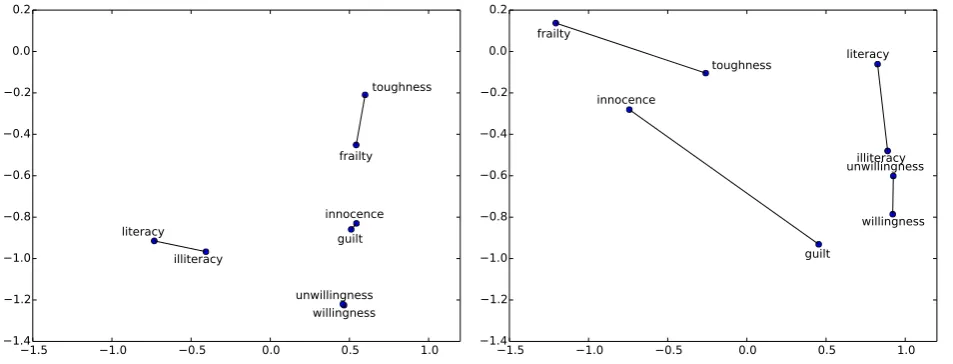
In Figure 1, we illustrate the vectors for some antonyms (connected by lines).
For reducing the dimensionality of the vector space to 2D, we applied the t-SNE toolkit4. It uses
stochastic neighbor embedding with a Student’s t-distribution to map high dimensional vectors into a lower dimensional space (Van der Maaten and Hinton, 2008). The Figure shows that the coreference-based word embeddings are able to
1.5 1.0 0.5 0.0 0.5 1.0 1.4
1.2 1.0 0.8 0.6 0.4 0.2 0.0 0.2
willingness innocence
guilt literacy
unwillingness toughness
illiteracy
frailty
1.5 1.0 0.5 0.0 0.5 1.0
1.4 1.2 1.0 0.8 0.6 0.4 0.2 0.0 0.2
willingness innocence
guilt
unwillingness frailty
toughness literacy
[image:3.595.80.557.64.246.2]illiteracy
Figure 1: 2D-positions of words in the text-based (top) and coreference-based embeddings (bottom)
enlarge the distance between antonyms (especially forguiltvs. innocenceandtoughness vs. frailty) compared to text-based word vectors.
3.2 Quantitative analysis of word vectors To verify that coreference-based embeddings bet-ter represent semantic components relevant to coreference, we split our coreference resource into two parts (about 85% and 15% of the data), trained embeddings on the first part and computed the co-sine similarity – both text-based and coreference-based – for each pair of words occurring in the same coreference chain in the second part. The statistics in Table 2 confirm that coreference-based vectors have higher similarity within chains than text-based vectors.
3.3 Experimental setup
We formalize antonym detection as a binary classi-fication task. Given a target wordwand one of its nearest neighborsv, the classifier decides whether
vis an antonym ofw. Our data set is a set of pairs, each consisting of a target word w and a candi-date v. For all word types of our vocabulary, we search for antonyms using the online dictionary Merriam Webster.5 The resulting list is provided
as an additional resource6. It contains 6225 words
with antonyms. Positive training examples are col-lected by checking if the 500 nearest text-based neighbors ofwcontain one of the antonyms listed by Webster. Negative training examples are cre-ated by replacing the antonym with a random word from the 500 nearest neighbors that is not listed as
5http://www.merriam-webster.com 6https://code.google.com/p/cistern
an antonym. By selecting both the positive and the negative examples from the nearest neighbors of the word vectors, we intend to develop a task which is hard to solve: The classifier has to find the small portion of semantically dissimilar words (i.e., antonyms) among distributionally very simi-lar words. The total number of positive and nega-tive examples is 2337 each. The data are split into training (80%), development (10%) and test (10%) sets.
In initial experiments, we found only a small difference in antonym classification performance between text-based and coreference-based fea-tures. When analyzing the errors, we realized that our rationale for using coreference-based embed-dings only applies to nouns, not to other parts of speech. This will be discussed in detail below. We therefore run our experiments in two modes: all word classification (all pairs are considered) and noun classification (only pairs are considered for which the target word is a noun). We use the Stan-ford part-of-speech tagger (Toutanova et al., 2003) to determine whether a word is a noun or not.
Our classifier is a radial basis function (rbf) sup-port vector machine (SVM). The rbf kernel per-formed better than a linear kernel in initial exper-iments. The SVM parameters C and γ are opti-mized on the development set. The representation of target-candidate pairs consists of the features described in Section 2.
all word classification noun classification development set test set development set test set
feature set P R F1 P R F1 P R F1 P R F1
[image:4.595.82.510.61.146.2]text-based .83 .66 .74 .74 .55 .63 .91 .61 .73 .74 .51 .60 coreference-based .67 .42 .51 .65 .43 .52 .86 .47 .61 .77 .45 .57 text+coref .79 .65 .72 .75 .58 .66 .88 .70 .78 .79 .61 .69
Table 3: Results for different feature sets. Best result in each column in bold.
minimum maximum median text-based vectors -0.350 0.998 0.156 coref.-based vectors -0.318 0.999 0.161
Table 2: Cosine similarity of words in the same coreference chain
results for development and test sets.
For all word classification, coreference-based features do not improve performance on the de-velopment set (e.g.,F1is .74 for text-based vs .72
for text+coref). On the test set, however, the com-bination of all features (text+coref) has better per-formance than text-based alone: .66 vs .63.
For noun classification, using coreference-based features in addition to text-coreference-based features improves results on development set (F1is .78 vs
.73) and test set (.69 vs .60).
These results show that mined coreference chains are a useful resource and provide infor-mation that is complementary to other methods. Even though adding coreference-based embed-dings improves performance on antonym classi-fication, the experiments also show that using only coreference-based embeddings is almost al-ways worse than using only text-based embed-dings. This is not surprising given that the amount of training data for the word embeddings is differ-ent in the two cases. Coreference chains provide only a small subset of the word-word relations that are given to the word2vec skip-gram model when applied to raw text. If the sizes of the training data sets were similar in the two cases, we would ex-pect performance to be comparable.
In the beginning, our hypothesis was that coref-erence information should be helpful for antonym classification in general. When we performed an error analysis for our initial results, we realized that this hypothesis only holds for nouns. Other types of words cooccurring in coreference chains are not more likely to be synonyms than words cooccurring in text windows. Two contexts that illustrate this point are “bright sides, but also
dif-ficult and dark ones” and “a series of black and white shots” (elements of coreference chains in italics). Thus, adjectives with opposite meanings can cooccur in coreference chains just as they can cooccur in window-based contexts. For nouns, it is much less likely that the same coreference chain will contain both a noun and its antonym since – by definition – markables in a coreference chain refer to the same identical entity.
4 Related work
val-ues representing antonyms are negated.
There has been a great deal of work on apply-ing the vector space model and cosine similarity to find synonyms or antonyms. Hagiwara et al. (2006) represent each word as a vector with cooc-currence frequencies of words and contexts as el-ements, normalized by the inverse document fre-quency. The authors investigate three types of con-textual information (dependency, sentence cooc-currence and proximity) and find that a combi-nation of them leads to the most stable results. Schulte im Walde and K¨oper (2013) build a vector space model on lexico-syntactic patterns and ap-ply a Rocchio classifier to distinguish synonyms from antonyms, among other tasks. Van der Plas and Tiedemann (2006) use automatically aligned translations of the same text in different languages to build context vectors. Based on these vectors, they detect synonyms.
In contrast, there are also studies using linguis-tic knowledge from external resources: Senellart and Blondel (2008) propose a method for syn-onym detection based on graph similarity in a graph generated using the definitions of a mono-lingual dictionary. Harabagiu et al. (2006) rec-ognize antonymy by generating antonymy chains based on WordNet relations. Mohammad et al. (2008) look for the word with the highest degree of antonymy to a given target word among five candi-dates. For this task, they use thesaurus information and the similarity of the contexts of two contrast-ing words. Lin et al. (2003) use Hearst patterns to distiguish synonyms from antonyms. Work by Turney (2008) is similar except that the patterns are learned.
Except for the publicly available coreference resolution system, our approach does not need ex-ternal resources such as dictionaries or bilingual corpora and no human labor is required. Thus, it can be easily applied to any corpus in any lan-guage as long as there exists a coreference resolu-tion system in this language. The pattern-based approach (Lin et al., 2003; Turney, 2008) dis-cussed above also needs few resources. In contrast to our work, it relies on patterns and might there-fore restrict the number of recognizable synonyms and antonyms to those appearing in the context of the pre-defined patterns. On the other hand, pat-terns could explicitely distinguish contexts typical for synonyms from contexts for antonyms. Hence, we plan to combine our coreference-based method
with pattern-based methods in the future. 5 Conclusion
In this paper, we showed that mined corefer-ence chains can be used for creating word em-beddings that capture a type of semantic sim-ilarity that is different from the one captured by standard text-based embeddings. We showed that coreference-based embeddings improve per-formance of antonym classification by .09 F1
compared to using only text-based embeddings. We achieved precision values of up to .79, recall values of up to .61 andF1scores of up to .69.
Acknowledgments
This work was supported by DFG (grant SCHU 2246/4-2).
References
Jacob Andreas and Dan Klein. 2014. How much do
word embeddings encode about syntax? In ACL,
pages 822–827.
Marco Baroni, Georgiana Dinu, and Germ´an
Kruszewski. 2014. Don’t count, predict! a
systematic comparison of context-counting vs. context-predicting semantic vectors. InACL, pages 238–247.
Chih-Chung Chang and Chih-Jen Lin. 2011.
LIB-SVM: a library for support vector machines. ACM
Transactions on Intelligent Systems and Technology (TIST), 2(3):27.
Masato Hagiwara, Yasuhiro Ogawa, and Katsuhiko Toyama. 2006. Selection of effective contextual information for automatic synonym acquisition. In
COLING/ACL, pages 353–360.
Sanda Harabagiu, Andrew Hickl, and Finley Lacatusu. 2006. Negation, contrast and contradiction in text
processing. InAAAI, volume 6, pages 755–762.
Heeyoung Lee, Yves Peirsman, Angel Chang, Nathanael Chambers, Mihai Surdeanu, and Dan Ju-rafsky. 2011. Stanford’s multi-pass sieve corefer-ence resolution system at the CoNLL-2011 shared
task. InCoNLL: Shared Task, pages 28–34.
Omer Levy and Yoav Goldberg. 2014.
Dependency-based word embeddings. InACL, pages 302–308.
Dekang Lin, Shaojun Zhao, Lijuan Qin, and Ming Zhou. 2003. Identifying synonyms among distribu-tionally similar words. InIJCAI, pages 1492–1493. Tomas Mikolov, Kai Chen, Greg Corrado, and Jeffrey
Saif Mohammad, Bonnie Dorr, and Graeme Hirst.
2008. Computing word-pair antonymy. InEMNLP,
pages 982–991.
Marta Recasens, Llu´ıs M`arquez, Emili Sapena, M Ant`onia Mart´ı, Mariona Taul´e, V´eronique Hoste,
Massimo Poesio, and Yannick Versley. 2010.
Semeval-2010 task 1: Coreference resolution in
multiple languages. In 5th International Workshop
on Semantic Evaluation, pages 1–8.
Sabine Schulte im Walde and Maximilian K¨oper. 2013. Pattern-based distinction of paradigmatic relations
for German nouns, verbs, adjectives. InLanguage
Processing and Knowledge in the Web, pages 184– 198. Springer.
Pierre Senellart and Vincent D Blondel. 2008. Auto-matic discovery of similar words. InSurvey of Text Mining II, pages 25–44. Springer.
Kristina Toutanova, Dan Klein, Christopher Manning, and Yoram Singer. 2003. Feature-rich part-of-speech tagging with a cyclic dependency network. InNAACL-HLT, pages 252–259.
Joseph Turian, Lev Ratinov, and Yoshua Bengio. 2010. Word representations: a simple and general method
for semi-supervised learning. InACL, pages 384–
394.
Peter D. Turney. 2008. A uniform approach to analo-gies, synonyms, antonyms, and associations. In
COLING, pages 905–912.
Laurens Van der Maaten and Geoffrey Hinton. 2008.
Visualizing data using t-SNE. Journal of Machine
Learning Research, 9(11):2579–2605.
Lonneke Van der Plas and J¨org Tiedemann. 2006. Finding synonyms using automatic word alignment
and measures of distributional similarity. In
COL-ING/ACL, pages 866–873.
Wen-tau Yih, Geoffrey Zweig, and John C Platt. 2012. Polarity inducing latent semantic analysis. In