Resolving Shell Nouns
Varada Kolhatkar Department of Computer Science
University of Toronto Toronto, ON, M5S 3G4, Canada
Graeme Hirst
Department of Computer Science University of Toronto Toronto, ON, M5S 3G4, Canada
Abstract
Shell nouns, such asfactandproblem, oc-cur frequently in all kinds of texts. These nouns themselves are unspecific, and can only be interpreted together with theshell content. We propose a general approach to automatically identify shell content of shell nouns. Our approach exploits lexico-syntactic knowledge derived from the lin-guistics literature. We evaluate the ap-proach on a variety of shell nouns with a variety of syntactic expectations, achiev-ing accuracies in the range of 62% (base-line = 33%) to 83% (base(base-line = 74%) on crowd-annotated data.
1 Introduction
Shell nounsare abstract nouns, such asfact,issue,
idea, and problem, which facilitate efficiency by avoiding repetition of long stretches of text. The
shellmetaphor comes from Schmid (2000), and it captures the various functions of these nouns in a discourse: containment, signalling, pointing, and encapsulating. Shell nouns themselves are unspe-cific, and can only be interpreted together with their shell content, i.e., the propositional content they encapsulate in the given context. The process of identifying this content in the given context is referred to as shell noun resolutionor interpreta-tion. Examples (1), (2), and (3) show usages of the shell nounsfactandissue. The shell noun phrases are resolved to the postnominal that clause, the complementwhclause, and the immediately
pre-ceding clause, respectively.1,2
(1) The fact that a major label hadn’t been at liberty to exploit and repackage the material on CD meant that prices on the vintage LP market were soaring.
(2) The issue that this country and Congress must address is how to provide optimal care for all without limiting access for the many.
(3) Living expenses are much lower in rural India than in New York, but this factis not fully captured if prices are converted with currency exchange rates.
Observe that the relation between shell noun phrases and their shell content is similar to the relation of abstract anaphora (or cataphora) (Asher, 1993) with backward- or forward-looking abstract-object antecedents. For anaphoric shell noun examples, the shell content precedes the shell noun phrase, and for cataphoric shell noun examples the shell content follows the shell noun phrase.3
Shell nouns as a group occur frequently in argu-mentative texts (Schmid, 2000; Flowerdew, 2003; Botley, 2006). They play an important role in or-ganizing a discourse and maintaining its coher-ence (Schmid, 2000; Flowerdew, 2003), and re-solving them is an important component of var-ious computational linguistics tasks that rely on
1Note that the postnominalthat-clause in (1) is not a
rela-tive clause: the fact in question is not an argument ofexploit and repackage.
2All examples in this paper are from the New
York Times corpus (https://catalog.ldc.upenn.edu/ LDC2008T19)
3We use the terms cataphoric shell noun and anaphoric
shell noun for lack of better alternatives.
discourse structure. Accordingly, identifying shell content can be helpful in summarization, informa-tion retrieval, and ESL learning (Flowerdew, 2003; Hinkel, 2004).
Despite their importance in discourse, under-standing of shell nouns from a computational lin-guistics perspective is only in the preliminary stage. Recently, we proposed an approach to anno-tate and resolve anaphoric cases of six typical shell nouns:fact,reason,issue,decision,question, and
possibility (Kolhatkar et al., 2013b). This work drew on the observation that shell nouns following cataphoric constructions are easy to resolve. We manually developed rules to identify shell content for such cases. Later, we used these cataphoric ex-amples and their shell content as training data to resolve harder anaphoric examples.
In this paper, we propose a general algorithm to resolve cataphoric shell noun examples. Our long-term goal is to build an end-to-end shell-noun res-olution system. If we want to go beyond the six shell nouns from our previous work, and general-ize our approach to other shell nouns, first we need to develop an approach to resolve cataphoric shell noun examples. A number of challenges are asso-ciated with this seemingly easy task. The primary challenges is that this resolution is in many cru-cial respects a semantic phenomenon. To obtain the required semantic knowledge, we exploit the properties of shell nouns and their categorization described in the linguistics literature. We evalu-ate our method using crowdsourcing, and demon-strate how far one can get with simple, determin-istic shell content extraction.
2 Related work
Shell-nounhood is a well-established concept in linguistics (Vendler, 1968; Ivanic, 1991; Asher, 1993; Francis, 1994; Schmid, 2000, inter alia). However, understanding of shell nouns from a computational linguistics perspective is only in the preliminary stage.
Shell nouns take a number of semantic argu-ments. In this respect, they are similar to the gen-eral class of argument-taking nominals as given in the NomBank (Meyers et al., 2004). Simi-larly, there is a small body of literature that ad-dresses nominal semantic role labelling (Gerber et al., 2009) and nominal subcategorization frames (Preiss et al., 2007). That said, the distinguishing property of shell nouns is that one of their
seman-tic arguments is the shell content, but the literature in computational linguistics does not provide any method that is able to identify the shell content. The focus of our work is to rectify this.
Shell content represents complex and abstract objects. So traditional linguistic and psycholin-guistic principles used in pronominal anaphora resolution (see the survey by Poesio et al. (2011)), such as gender and number agreement, are not ap-plicable in resolving shell nouns. That said, there is a line of literature on annotating and resolving personal and demonstrative pronouns, which typi-cally refer to similar kinds of non-nominal abstract entities (Passonneau, 1989; Eckert and Strube, 2000; Byron, 2003; Müller, 2008; Hedberg et al., 2007; Poesio and Artstein, 2008; Navarretta, 2011, inter alia). Also, there have been attempts at annotating the shell content of anaphoric occur-rences of shell nouns (e.g., Botley (2006), Kol-hatkar et al. (2013a)). However, none of these approaches attempt to annotate and resolve cat-aphoric examples such (1) and (2).
3 Challenges
A number of challenges are associated with the task of resolving cataphoric shell noun examples, especially when it comes to developing a holistic approach for a variety of shell nouns.
First, each shell noun has idiosyncrasies. Dif-ferent shell nouns have difDif-ferent semantic and syn-tactic expectations, and hence they take different types of one or more semantic arguments: one in-troducing the shell content, and others expressing circumstantial information about the shell noun. For instance, fact typically takes a single factual clause as an argument, which is its shell content, as we saw in example (1), whereasreasonexpects two arguments: the cause and the effect, with the content introduced in the cause, as shown in exam-ple (4).4Similarly,decisiontakes an agent making the decision and the shell content is represented as an action or a proposition, as shown in (5).5
(4) One reason[that 60 percent of New York City public-school children read below grade level]effectis [that many elementary schools don’t have libraries]cause.
4Observe that the postnominalthatclause in (4) is not a
relative clause, and still it is not the shell content because it is not the cause argument of the shell nounreason.
5Observe that this aspect of shell nouns of taking different
(5) I applaud loudly the decision of [Greenburgh]agent to ban animal per-formances.
Second, the relation between a shell noun and its content is in many crucial respects a seman-tic phenomenon. For instance, resolving the shell nounreasonto its shell content involves identify-ing a) thatreasongenerally expects two semantic arguments: cause and effect, b) that the cause ar-gument (and not the effect arar-gument) represents the shell content, and c) that a particular con-stituent in the given context represents the cause argument.
Third, at the conceptual level, once we know which semantic argument represents shell content, resolving examples such as (4) seems straightfor-ward using syntactic structure, i.e., by extracting the complement clause. But at the implementa-tion level, this is a non-trivial problem for two rea-sons. The first reason is that examples contain-ing shell nouns often follow syntactically complex constructions, including embedded clauses, coor-dination, and sentential complements. An auto-matic parser is not always accurate for such ex-amples. So the challenge is whether the avail-able tools in computational linguistics such as syn-tactic parsers and discourse parsers are able to provide us with the information that is necessary to resolve these difficult cases. The second rea-son is that the shell content can occur in many different constructions, such as apposition (e.g., parental ownership of children, a concept that allows . . .), postnominal and complement clause constructions, as we saw in examples (1) and (2), and modifier constructions (e.g.,the liberal trade policythat . . .). Moreover, in some constructions, the content is indefinite (e.g.,A bad ideadoes not harm until someone acts upon it.) or None be-cause the example is a non-shell noun usage (e.g., this week’s issue of Sports Illustrated), and the challenge is to identify such cases.
Finally, whether the postnominal clause intro-duces the shell content or not is dependent on the context of the shell noun phrase. The reso-lution can be complicated by complex syntactic constructions. For instance, when the shell noun follows verbs such asexpect, it becomes difficult for an automatic system to identify whether the postnominal or the complement clause is of the verb or of the shell noun (e.g.,they did not expect
the decisionto reignite tension in Crown Heights
vs.no one expected the decision to call an elec-tion). Similarly, shell noun phrases can be ob-jects of prepositions, and whether the postnomi-nal clause introduces the shell content or not is de-pendent on this preposition. For instance, for the pattern reason that, the postnominal that clause does not generally introduce the shell content, as we saw in (4); however, this does not hold when the shell noun phrase containing reason follows the prepositionfor, as shown in (6).
(6) Low tax rates give people an incentive to work, forthe simple reason that they get to keep more of what they earn.
4 Linguistic framework
Linguists have studied a variety of shell nouns, their classification, different patterns they follow, and their semantic and syntactic properties in de-tail (Vendler, 1968; Ivanic, 1991; Asher, 1993; Francis, 1994; Schmid, 2000, inter alia). Schmid points out that being a shell noun is a property of a specific usage of the noun rather than an inher-ent property of the word. He provides a list of 670 English nouns that tend to occur as shell nouns. A few frequently occurring ones are: problem, no-tion, concept, issue, fact, belief, decision, point,
idea, event,possibility,reason, trouble, question,
plan,theory,aim, andprinciple. 4.1 Lexico-syntactic patterns
Precisely defining the notion of shell-nounhood is tricky. A necessary property of shell nouns is that they are capable of taking clausal arguments, primarily with two lexico-syntactic constructions:
Noun + postnominal clauseandNoun + be + com-plement clause(Vendler, 1968; Biber et al., 1999; Schmid, 2000; Huddleston and Pullum, 2002). Schmid exploits these lexico-syntactic construc-tions to identify shell noun usages. In particular, he provides a number of typical lexico-syntactic patterns that are indicative of either anaphoric or cataphoric shell noun occurrences. Table 1 shows these patterns with examples.
Cataphoric These patterns primarily follow two constructions.
N-be-clause In this construction, the shell noun phrase occurs as the subject in a subject-verb-clause construction, with the linking verbbe, and the shell content embedded as a wh clause,
Cataphoric
1 N-be-to Our plan istohire and retain the best managers we can.
2 N-be-that The major reason isthatdoctors are uncomfortable with uncertainty.
3 N-be-wh Of course,the central, and probably insoluble, issue iswhetheranimal testing is cruel. 4 N-to The decisiontodisconnect the ventilatorcame after doctors found no brain activity. 5 N-that Mr. Shoval left openthe possibilitythatIsrael would move into other West Bank cities. 6 N-wh If there ever isany doubtwhethera plant is a poppy or not, break off a stem and squeeze it. 7 N-of The concept ofhaving an outsider as Prime Ministeris outdated.
Anaphoric
8 th-N Living expenses are much lower in rural India than in New York, but this factis not fully captured if prices are converted with currency exchange rates.
9 th-be-N People change.This is a fact.
[image:4.595.78.521.69.255.2]10 Sub-be-N If the money is available, however,cutting the sales taxis a good idea.
Table 1: Lexico-grammatical patterns of shell nouns (Schmid, 2000). Shell noun phrases are underlined, the pattern is marked in boldface, and the shell content is marked in italics.
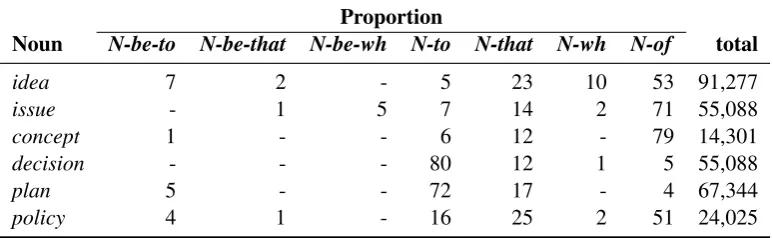
Proportion
Noun N-be-to N-be-that N-be-wh N-to N-that N-wh N-of total
idea 7 2 - 5 23 10 53 91,277
issue - 1 5 7 14 2 71 55,088
concept 1 - - 6 12 - 79 14,301
decision - - - 80 12 1 5 55,088
plan 5 - - 72 17 - 4 67,344
policy 4 1 - 16 25 2 51 24,025
Table 2: Distribution of cataphoric patterns for six shell nouns in the New York Times corpus. Each column shows the percentage of instances following that pattern. The last column shows the total number of cataphoric instances of each noun in the corpus.
verbbeindicates the semantic identity between the shell noun and its content in the given context. The construction follows the patterns in rows 1, 2, and 3 of Table 1.
N-clause This construction includes the cat-aphoric patterns 4–7 in Table 1. For these patterns the link between the shell noun and the content is much less straightforward: whether the post-nominal clause expresses the shell content or not is dependent on the shell noun and the syntac-tic structure under consideration. For instance, for the shell noun fact, the shell content is em-bedded in the postnominalthat clause, as shown in (1), but this does not hold for the shell noun
reason in example (4). The N-of pattern is dif-ferent from other patterns: it follows the con-struction N-prepositional phrase rather than N-clause, and since a prepositional phrase can take different kinds of embedded constituents such as a
noun phrase, a sentential complement, and a verb phrase, the pattern offers flexibility in the syntactic type of the shell content.
Anaphoric For these patterns, the link between the shell noun and the content is created using linguistic elements such as the, this, that, other,
same, andsuch. For the patterns 8 and 9 the shell content does not typically occur in the sentence containing the shell noun phrase. For the pattern 10, the shell content is the subject in a subject-verb-N construction.
[image:4.595.106.493.309.428.2]fol-Ideafamily
Semantic features: [mental], [conceptual]
Frame: mental; focus on propositional content of IDEA
Nouns:idea,issue,concept,point,notion,theory, . . .
Patterns:N-be-that/of,N-that/of
Planfamily
Semantic features: [mental], [volitional], [manner]
Frame: mental; focus on IDEA
Nouns:decision,plan,policy,idea, . . .
Patterns:N-be-to/that,N-to/that
Troublefamily
[image:5.595.76.518.66.283.2]Semantic features: [eventive], [attitudinal], [manner], [deontic]
Frame: general eventive
Nouns:problem,trouble,difficulty,dilemma,snag
Patterns:N-be-to
Problemfamily
Semantic features: [factual], [attitudinal], [impeding]
Frame: general factual
Nouns:problem,trouble,difficulty,point,thing,snag, dilemma, . . .
Patterns:N-be-that/of
Thingfamily
Semantic features: [factual]
Frame: general factual
Nouns:fact,phenomenon,point,case,thing,business
Patterns:N-that,N-be-that
Reasonfamily
Semantic features: [factual], [causal]
Frame: causal; attentional focus on CAUSE
Nouns:reason,cause,ground,thing
Patterns:N-be-that/why,N-that/why
Table 3: Example families from Schmid (2000). The nouns in boldface are used to evaluate this work.
lowing Schmid’s cataphoric patterns, 80% of the instances follow the patternN-to.6
4.2 Categorization of shell nouns
Schmid classifies shell nouns at three levels. At the most abstract level, he classifies shell nouns into six semantic classes:factual,linguistic, men-tal,modal,eventive, andcircumstantial. Each se-mantic class indicates the type of experience the shell noun is intended to describe. For instance, the mental class describes ideas and cognitive states, whereas thelinguisticclass describes utter-ances, linguistic acts, and products thereof.
The next level of classification includes more-detailed semantic features. Each broad semantic class is sub-categorized into a number of groups. A group of an abstract class tries to capture the semantic features associated with the fine-grained differences between different usages of shell nouns in that class. For instance, groups associated with thementalclass are: conceptual,
creditive,dubiative,volitional, andemotive. The third level of classification consists of fam-ilies. A family groups together shell nouns with similar semantic features. Schmid provides 79 dis-tinct families of 670 shell nouns. Each family is named after the primary noun in that family. Table 3 shows six families: Idea, Plan, Trouble, Prob-lem, Thing, and Reason. A shell noun can be
6Table 2 does not include anaphoric patterns, as this
pa-per is focused on cataphoric shell noun examples. Anaphoric patterns are common for all shell nouns: among all instances of a shell noun, approximately 50 to 80% are anaphoric.
a member of multiple families. The nouns sub-sumed in a family share semantic features. For instance, all nouns in theIdea family are mental
and conceptual. They are mental because ideas are only accessible through thoughts, and concep-tual because they represent reflection or an appli-cation of a concept. Each family activates a se-mantic frame. The idea of these semantic frames is similar to that of frames in Frame semantics (Fill-more, 1985) and in semantics of grammar (Talmy, 2000). In particular, Schmid follows Talmy’s con-ception of frames. A semantic frame describes conceptual structures, its elements, and their in-terrelationships. For instance, theReason family invokes the causal frame, which has cause and ef-fect as its elements with the attentional focus on the cause. According to Schmid, the nouns in a family also share a number of lexico-syntactic fea-tures. Thepatternsattribute in Table 3 shows pro-totypical lexico-syntactic patterns, which attract
the members of the family. Schmid defines attrac-tion as the degree to which a lexico-grammatical pattern attracts a certain noun. For instance, the patternsN-toandN-thatattract the shell nouns in thePlanfamily, whereas theN-thatpattern attracts the nouns in theThingfamily. The patternN-of is restricted to a smaller group of nouns such as con-cept,problem, andissue.7,8
7Schmid used the British section of COBUILD’SBank of
Englishfor his classification.
8Schmid’s families could help enrich resources such as
5 Resolution algorithm
With this exposition, the problem of shell noun resolution is identifying the appropriate seman-tic argument of the shell noun representing its shell content. This section describes our algorithm to resolve shell nouns following cataphoric pat-terns. The algorithm addresses the primary chal-lenge of idiosyncrasies of shell nouns by exploit-ing Schmid’s semantic families (see Section 4.2). The input of the algorithm is a shell noun instance following a cataphoric pattern, and the output is its shell content orNoneif the shell content is not present in the given sentence. The algorithm fol-lows three steps. First, we parse the given sentence using the Stanford parser.9 Second, we look for the noun phrase (NP), where the head of the NP is the shell noun to be resolved.10Finally, we extract the appropriate shell content, if it is present in the given sentence.
5.1 Identifying potentially anaphoric shell-noun constructions
Before starting the actual resolution, first we iden-tify whether the shell content occurs in the given sentence or not. According to Schmid, the lexico-syntactic patterns signal the position of the shell content. For instance, if the pattern is of the form
N-be-clause, the shell content is more likely to occur in the complement clause in the same sen-tence. That said, although on the surface level, the shell noun seems to follow a cataphoric pattern, it is possible that the shell content is not given in a postnominal or a complement clause, as shown in (7).
(7) Just as weekend hackers flock to the golf ball most used by PGA Tour players, recreational skiers, and a legion of youth league racers, gravitate to the skis worn by Olympic champions. It isthe reason that top racers are so quick flash their skis for the cameras in the finish area.
Here, the shell noun and its content are linked via the pronoun it. For such constructions, the shell noun phrase and shell content do not occur in the same sentence. Shell content occurs in the preced-ing discourse, typically in the precedpreced-ing sentence.
9http://nlp.stanford.edu/software/
lex-parser.shtml
10We extract the head of an NP following the heuristics
proposed by Collins (1999, p. 238).
We identify such cases, and other cases where the shell content is not likely to occur in the postnom-inal or complements clauses, by looking for the patterns below in the given order, returning the shell content when it occurs in the given sentence. Sub-be-N This pattern corresponds to the lexico-grammatical pattern in Figure 1(a). If this pattern is found, there are three main possibilities for thesubject. First, if an existentialthereoccurs at the subject position, we move to the next pat-tern. Second, if the subject isit(example (7)),this
or that, we return None, assuming that the con-tent is not present in the given sentence. Finally, if the first two conditions are not satisfied, i.e., if the subject is neither a pronoun not an existential
there, we assume that subject contains a valid shell content, and return it. An example is shown in (8). Note that in such cases, unlike other patterns, the shell content is expressed as a noun phrase.
(8) Strict liability is the biggest issue when considering what athletes put in their bod-ies.
Apposition Another case where shell content does not typically occur in the postnominal or complement clause is the case of apposition. In-definite shell noun phrases often occur in apposi-tion construcapposi-tions, as shown in (9).
(9) The LH lineup, according to Gale, will feature“cab-forward” design,a concept that particularly pleases him.
In this step, we check for this construction and re-turn the sentential, verbal, or nominal left sibling of the shell noun phrase.
Modifier For shell nouns such as issue, phe-nomenon, and policy, often the shell content is given in the modifier of the shell noun, as shown in (10).
(10) But in the 18th century, Leipzig’s central location in German-speaking Europe and the liberal trade policyof the Saxon court fostered publishing.
Parent
NP Subject
VP
VB* form ofbe
NP/NN head = shell
(a)Sub-be-Npattern
Parent
NP/NN head = shell
VP
VB* form ofbe
SBAR/S IN that/wh
S clause
(b)N-be-clausepattern
Parent
NP/NN head = shell
SBAR/S IN that/wh
S clause
[image:7.595.105.495.71.177.2](c)N-that/whpattern
Figure 1: Lexico-syntactic patterns for shell nouns
issue), we extract a list of modifiers for a num-ber of shell nouns and create a stoplist of modi-fiers. If any of the words in the modifier phrases is a pronoun or occurs in the stoplist, we move to the next pattern. If the modifier phrase passes the stoplist test, to distinguish between non-shell con-tent and shell concon-tent modifiers, we examine the hypernym paths of the words in the modifier phrase in WordNet (Fellbaum, 1998). If the synset
abstraction.n.06 occurs in the path, we consider the modifier phrase to be valid shell content, as-suming that the shell content of shell nouns most typically represents an abstract entity.
5.2 Resolving remaining instances
At this stage we are assuming that the shell con-tent occurs either in the postnominal clause or the complement clause. So we look for the patterns below, returning the shell content when found. N-be-clause The lexico-grammatical pattern corresponding to the patternN-be-clauseis shown in Figure 1(b). This is one of the more reliable patterns for shell content extraction, as thebeverb suggests the semantic identity between the shell noun and the complement clause. The be-verb does not necessarily have to immediately follow the shell noun. For instance, in example (2), the head of the NP The issue that this country and Congress must addressis the shell nounissue, and hence it satisfies the construction in Figure 1(b). N-clause Finally, we look for this pattern. An example of this pattern is shown in Figure 1(c). This is the most common (see Table 2) and tricki-est pattern in terms of resolution, and whether the shell content is given in the postnominal clause or not is dependent on the properties of the shell noun under consideration and the syntactic construction of the example. For instance, for the shell noun
decision, the postnominalto-infinitive clause
typi-cally represents shell content. But this did not hold for the shell nounreason, as shown in (11).
(11) The reason to resist becoming a partici-pant is obvious.
Here, Schmid’s semantic families come in the picture. We wanted to examine a) the extent to which the previous steps help in resolution, and b) whether knowledge extracted from Schmid’s fam-ilies add value to the resolution. So we employ two versions of this step.
Include Schmid’s cues (+SC) This version exploits the knowledge encoded in Schmid’s se-mantic families (Section 4.2), and extracts post-nominal clauses only if Schmid’s pattern cues are satisfied. In particular, given a shell noun, we de-termine the families in which it occurs and list all possible patterns of these families as shell content cues. The postnominal clause is a valid shell con-tent only if it satisfies these cues. For instance, the shell nounreason occurs in only one family:
Reason, with the allowed shell content patterns N-thatandN-why. Schmid’s patterns suggest that the postnominal to-infinitive clauses are not allowed as shell content for this shell noun, and thus this step will returnNone. This version helps correctly resolving examples such as (11) toNone.
Exclude Schmid’s cues (–SC) This version does not enforce Schmid’s cues in extracting the postnominal clauses. For instance, the Problem
family does not include N-that/wh/to/of patterns, but in this condition, we nonetheless allow these patterns in extracting the shell content of the nouns from this family.
6 Evaluation data
nouns is extremely time-consuming, and is there-fore not pursued further in the current study. In-stead we create a sample of representative evalua-tion data to examine how well the algorithm works a) on a variety of shell nouns, b) for shell nouns within a family, c) for shell nouns across families with completely different semantic and syntactic expectations, and d) for a variety of shell patterns from Table 1.
6.1 Selection of nouns
Recall that each shell noun has its idiosyncrasies. So in order to evaluate whether our algorithm is able to address these idiosyncrasies, the evalua-tion data must contain a variety of shell nouns with different semantic and syntactic expectations. To examine a), we consider the six families shown in Table 3. These families span three abstract cat-egories: mental, eventive, and factual, and five distinct groups: conceptual, volitional, factual,
causal, and attitudinal. Also, the families have considerably different syntactic expectations. For instance, the nouns in the Idea family can have their content inthat orof clauses occurring in N-clauseorN-be-clause constructions, whereas the
Trouble and Problem families do not allow N-clausepattern. The shell content of the nouns in the Planfamily is generally represented with to -infinitive clauses. To examine b) and c), we choose three nouns from each of the first four families from Table 3. To add diversity, we also include two shell nouns from theThingfamily and a shell noun from the Reason family. So we selected a total of 12 shell nouns for evaluation: idea,issue,
concept, decision, plan, policy,problem, trouble,
difficulty,reason,fact, andphenomenon. 6.2 Selection of instances
Recall that the shell content varies based on the shell noun and the pattern it follows. Moreover, shell nouns have pattern preferences, as shown in Table 2. To examine d), we need shell noun exam-ples following different patterns from Table 1. We consider the New York Times corpus as our base corpus, and from this corpus extract all sentences following the lexico-grammatical patterns in Ta-ble 1 for the twelve selected shell nouns. Then we arbitrarily pick 100 examples for each shell noun, making sure that the selection contains examples of each cataphoric pattern from Table 1. These examples consist of 70% examples of each of the seven cataphoric patterns, and the remaining 30%
of the examples are picked randomly from the dis-tribution of patterns for that shell noun.
6.3 Crowdsourcing annotation
We designed a crowdsourcing experiment to ob-tain the annotated data for evaluation. We parse each sentence using the Stanford parser, and ex-tract all possible candidates, i.e., arguments of the shell noun from the parser’s output. Since our ex-amples include embedding clauses and sentential complements, the parser is often inaccurate. For instance, in example (12), the parser attaches only the first clause of the coordination (that people were misled) to the shell nounfact.
(12) The fact that people were misled and in-formation was denied, that’s the reason that you’d wind up suing.
To deal with such parsing errors, we consider the 30-best parses given by the parser. From these parses, we extract a list of eligible candidates. This list includes the arguments of the shell noun given in the appositional clauses, modifier phrases, post-nominalthat,wh, orto-infinitive clauses, comple-ment clauses, objects of postnominal prepositions of the shell noun, and subject if the shell noun fol-lowssubject-be-Nconstruction. On average, there were three candidates per instance.
After extracting the candidates, we present the annotators with the sentence, with the shell noun highlighted, and the extracted candidates. We ask the annotators to choose the option that provides the correct interpretation of the highlighted shell noun. We also provide them the option None of the above, and ask them to select it if the shell con-tent is not present in the given sentence or the shell content is not listed in the list of candidates. CrowdFlower We used CrowdFlower11 as our crowdsourcing platform, which in turn uses vari-ous worker channels such as Amazon Mechanical Turk12. CrowdFlower offers a number of features. First, it provides a quiz mode which facilitates filtering out spammers by requiring an annotator to pass a certain number of test questions before starting the real annotation. Second, during an-notation, it randomly presents test questions with known answers to the annotators to keep them on their toes. Based on annotators’ responses to the test questions, each annotator is assigned a trust
11http://crowdflower.com/
≥5 ≥4 ≥3 <3
idea 53 67 95 5
issue 44 65 95 5
concept 40 56 96 4
decision 50 72 98 2
plan 41 55 95 5
policy 42 61 94 6
problem 52 70 100 0
trouble 44 69 99 1
difficulty 45 61 96 4
reason 48 60 93 7
fact 52 68 98 2
phenomenon 39 56 95 5
[image:9.595.94.269.62.221.2]all 46 63 96 4
Table 4: Annotator agreement on shell content. Each column shows the percentage of instances on which at leastn or fewer thann annotators agree on a single answer.
score: an annotator performing well on the test questions gets a high trust score. Finally, Crowd-Flower allows the user to select the permitted de-mographic areas and skills required.
Settings We asked for at least 5 annotations per instance by annotators from the English-speaking countries. The evaluation task contained a total of 1200 instances, 100 instances per shell noun. To maintain the annotation quality, we included 105 test questions, distributed among different swers. We paid 2.5 cents per instance and the an-notation task was completed in less than 24 hours. Results Table 4 shows the agreement of the crowd. In most cases, at least 3 out of 5 anno-tators agreed on a single answer. We took this an-swer as the gold standard in our evaluation, and discard the instances where fewer than three anno-tators agreed. The optionNone of the abovewas annotated for about 30% of the cases. We include these cases in the evaluation. In total we had 1,257 instances (1,152 instances where at least 3 annota-tors agreed + 105 test questions).
7 Evaluation results
Baseline We evaluate our algorithm against crowd-annotated data using a lexico-syntactic clause (LSC) baseline. Given a sentence con-taining a shell instance and its parse tree, this baseline extracts the postnominal or complement clause from the parse tree depending only upon the lexico-syntactic pattern of the shell noun. For instance, for theN-thatandN-be-topatterns, it
ex-Nouns LSC A–SC A+SC
1 idea 74 82 83
2 issue 60 75 77
3 concept 51 67 68
4 decision 70 71 73
5 plan 51 63 62
6 policy 58 70 52
7 problem 66 69 59
8 trouble 63 68 50
9 difficulty 68 75 49
10 reason 43 53 77
11 fact 43 55 68
12 phenomenon 33 62 50
[image:9.595.315.520.62.270.2]13 all 57 69 64
Table 5: Shell noun resolution results. Each col-umn shows the percent accuracy of resolution with the respective method. Boldface is best in row.
tracts the postnominalthatclause and the comple-mentto-infinitive clause, respectively.13
Results Table 5 shows the evaluation results for the LSC baseline, the algorithm without Schmid’s cues (A–SC), and the algorithm with Schmid’s cues (A+SC). The A–SC condition in all cases and the A+SC condition in some cases outperform the LSC baseline, which proves to be rather low, espe-cially for the shell nouns with strict syntactic ex-pectations (e.g.,factandreason). Thus we see that our algorithm is adding value.
That said, we observe a wide range of per-formance for different shell nouns. On the up side, adding Schmid’s cues helps resolving the shell nouns with strict syntactic expectations. The A+SC results for the shell nounsidea,issue, con-cept, decision, reason, and fact outperform the baseline and the A–SC results. In particular, the A+SC results for the shell nouns fact and rea-sonare markedly better than the baseline results. These nouns have strict syntactic expectations for the shell content clauses they take: the families
Thing andCertainty of the shell noun factallow only a that clause, and the Reason family of the shell noun reason allows only that and because
clauses for the shell content. These cues help in correctly resolving examples such as (11) to
None, where the postnominal to-infinitive clause
13Note that we only extract subordinating clauses (e.g.,
describes the purpose or the goal for the reason, but not the shell content itself.
On the down side, adding Schmid’s cues hurts the performance of more versatile nouns, which can take a variety of clauses. Although the A–SC results for the shell nouns plan, policy, problem,
trouble,difficulty, andphenomenonare well above the baseline, the A+SC results are markedly be-low it. That is, Schmid’s cues were deleterious. Our error analysis revealed that these nouns are versatile in terms of the clauses they take as shell content, and Schmid’s cues restrict these clauses to be selected as shell content. For instance, the shell nounproblemoccurs in two semantic fami-lies withN-be-that/of andN-be-toas pattern cues (Table 3), and postnominal clauses are not allowed for this noun. Although these cues help in filtering some unwanted cases, we observed a large number of cases where the shell content is given in post-nominal clauses, as shown in (13).
(13) I was trying to addressthe problemof un-reliable testimony by experts in capital cases.
Similarly, the Plan family does not allow the N-of pattern. This cue works well for the shell noun
decisionfrom the same family because often the postnominal of clause is the agent for this shell noun and not the shell content. However, it hurts the performance of the shell noun policy, as N-of is a common pattern for this shell noun (e.g.,
. . . officials in Rwanda have establisheda policyof
refusing to protect refugees. . .). Other failures of the algorithm are due to parsing errors and lack of inclusion of context information.
8 Discussion and conclusion
In this paper, we proposed a general method to re-solve shell nouns following cataphoric construc-tions. This is a first step towards end-to-end shell noun resolution. In particular, this method can be used to create training data for any given shell noun, which can later be used to resolve harder anaphoric cases of that noun using the method that we proposed earlier (Kolhatkar et al., 2013b).
The first goal of this work was to point out the difficulties associated with the resolution of cat-aphoric cases of shell nouns. The low resolution results of the LSC baseline demonstrate the diffi-culties of resolving such cases using syntax alone,
suggesting the need for incorporating more lin-guistic knowledge in the resolution.
The second goal of this work was to examine to what extent knowledge derived from the linguis-tics literature helps in resolving shell nouns. We conclude that Schmid’s pattern and clausal cues are useful for resolving nouns with strict syntac-tic expectations (e.g.,fact,reason); however, these cues are defeasible: they miss a number of cases in our corpus. It is possible to improve on Schmid’s cues using crowdsourcing annotation and by ex-ploiting lexico-syntactic patterns associated with different shell nouns from a variety of corpora.
One limitation of our approach is that in our res-olution framework, we do not consider the prob-lem of ambiguity of nouns that might not be used as shell nouns. The occurrence of nouns with the lexical patterns in Table 1 does not always guaran-tee shell noun usage. For instance, in our data, we observed a number of instances of the nounissue
with the publication sense (e.g.,this week’s issue of Sports Illustrated).
Our algorithm is able to deal with only a re-stricted number of shell noun usage constructions, but the shell content can be expressed in a variety of other constructions. A robust machine learning approach that incorporates context and deeper se-mantics of the sentence, along with Schmid’s cues, could mitigate this limitation.
This work opens a number of new research di-rections. Our next planned task is clustering dif-ferent shell nouns based on the kind of comple-ments they take in different usages similar to verb clustering (Merlo and Stevenson, 2000; Schulte im Walde and Brew, 2002).
Acknowledgements
We thank the anonymous reviewers for their com-ments. We also thank Suzanne Stevenson, Gerald Penn, Heike Zinsmeister, Kathleen Fraser, Aida Nematzadeh, and Ryan Kiros for their feedback. This research was financially supported by the Natural Sciences and Engineering Research Coun-cil of Canada and by the University of Toronto.
References
Nicholas Asher. 1993. Reference to Abstract Objects
in Discourse. Kluwer Academic Publishers, Dor-drecht, Netherlands.
Collin F. Baker, Charles J. Fillmore, and John B. Lowe.
Proceed-ings of the 17th International Conference on Com-putational Linguistics, volume 1 of COLING ’98, pages 86–90, Stroudsburg, PA, USA. Association for Computational Linguistics.
Douglas Biber, Stig Johansson, Geoffrey Leech,
Su-san Conrad, and Edward Finegan. 1999. Longman
Grammar of Spoken and Written English. Pearson ESL, November.
Simon Philip Botley. 2006. Indirect anaphora: Testing
the limits of corpus-based linguistics. International
Journal of Corpus Linguistics, 11(1):73–112. Donna K. Byron. 2003. Annotation of pronouns and
their antecedents: A comparison of two domains. Technical report, University of Rochester. Computer Science Department.
Michael Collins. 1999. Head-Driven Statistical
Mod-els for Natural Language Parsing. Ph.D. thesis, University of Pennsylvania.
Miriam Eckert and Michael Strube. 2000. Dialogue acts, synchronizing units, and anaphora resolution. Journal of Semantics, 17:51–89.
Christiane Fellbaum. 1998. WordNet: An Electronic
Lexical Database. Bradford Books.
Charles J. Fillmore. 1985. Frames and the semantics of
understanding. Quaderni di Semantica, 6(2):222–
254.
John Flowerdew. 2003. Signalling nouns in discourse. English for Specific Purposes, 22(4):329–346. Gill Francis. 1994. Labelling discourse: An aspect of
nominal group lexical cohesion. In M. Coulthard,
editor,Advances in written text analysis, pages 83–
101. Routledge, London.
Matthew Gerber, Joyce Chai, and Adam Meyers. 2009. The role of implicit argumentation in nominal srl. In Proceedings of Human Language Technologies: The 2009 Annual Conference of the North American Chapter of the Association for Computational Lin-guistics, pages 146–154, Boulder, Colorado, June. Association for Computational Linguistics.
Nancy Hedberg, Jeanette K. Gundel, and Ron Zacharski. 2007. Directly and indirectly anaphoric demonstrative and personal pronouns in newspaper
articles. In Proceedings of DAARC-2007 8th
Dis-course Anaphora and Anaphora Resolution Collo-quium, pages 31–36.
Eli Hinkel. 2004. Teaching Academic ESL
Writ-ing: Practical Techniques in Vocabulary and Gram-mar (ESL and Applied Linguistics Professional). Lawrence Erlbaum, Mahwah, NJ, London.
Rodney D. Huddleston and Geoffrey K. Pullum. 2002. The Cambridge Grammar of the English Language. Cambridge University Press, April.
Roz Ivanic. 1991. Nouns in search of a context: A study of nouns with both open- and closed-system
characteristics. International Review of Applied
Lin-guistics in Language Teaching, 29:93–114.
Varada Kolhatkar, Heike Zinsmeister, and Graeme Hirst. 2013a. Annotating anaphoric shell nouns
with their antecedents. In Proceedings of the 7th
Linguistic Annotation Workshop and Interoperabil-ity with Discourse, pages 112–121, Sofia, Bulgaria, August. Association for Computational Linguistics. Varada Kolhatkar, Heike Zinsmeister, and Graeme Hirst. 2013b. Interpreting anaphoric shell nouns us-ing antecedents of cataphoric shell nouns as trainus-ing
data. InProceedings of the 2013 Conference on
Em-pirical Methods in Natural Language Processing, pages 300–310, Seattle, Washington, USA, October. Association for Computational Linguistics.
Paola Merlo and Suzanne Stevenson. 2000. Automatic verb classification based on statistical distributions
of argument structure. Computational Linguistics,
27(3):373–408.
Adam Meyers, Ruth Reeves, Catherine Macleod, Rachel Szekely, Veronika Zielinska, Brian Young, and Ralph Grishman. 2004. The nombank project:
An interim report. In In Proceedings of the
NAACL/HLT Workshop on Frontiers in Corpus An-notation.
Christoph Müller. 2008.Fully Automatic Resolution of
It, This and That in Unrestricted Multi-Party Dialog. Ph.D. thesis, Universität Tübingen.
Costanza Navarretta. 2011. Antecedent and referent
types of abstract pronominal anaphora. In
Proceed-ings of the Workshop Beyond Semantics: Corpus-based investigations of pragmatic and discourse phenomena, Göttingen, Germany, Feb.
Rebecca J. Passonneau. 1989. Getting at discourse
ref-erents. InProceedings of the 27th Annual Meeting
of the Association for Computational Linguistics, pages 51–59, Vancouver, British Columbia, Canada. Association for Computational Linguistics.
Massimo Poesio and Ron Artstein. 2008. Anaphoric
annotation in the ARRAU corpus. InProceedings
of the Sixth International Conference on Language Resources and Evaluation (LREC’08), Marrakech, Morocco, May. European Language Resources As-sociation (ELRA).
Massimo Poesio, Simone Ponzetto, and Yannick Vers-ley. 2011. Computational models of anaphora reso-lution: A survey. Unpublished.
Judita Preiss, Ted Briscoe, and Anna Korhonen. 2007. A system for large-scale acquisition of verbal, nom-inal and adjectival subcategorization frames from
corpora. InProceedings of the 45th Annual
Hans-Jörg Schmid. 2000. English Abstract Nouns As Conceptual Shells: From Corpus to Cognition. Top-ics in English LinguistTop-ics 34. Mouton de Gruyter, Berlin.
Sabine Schulte im Walde and Chris Brew. 2002. In-ducing German semantic verb classes from purely
syntactic subcategorisation information. In
Pro-ceedings of the 40th Annual Meeting of the Associa-tion for ComputaAssocia-tional Linguistics, pages 223–230, Philadelphia, PA.
Leonard Talmy. 2000. The windowing of attention. In Toward a Cognitive Semantics, volume 1, pages 257–309. The MIT Press.
Zeno Vendler. 1968. Adjectives and Nominalizations.