Review Article
The efficacy of resistance training for non-alcoholic
fatty-liver disease: a meta-analysis of
randomized controlled trials
Yi Ye1, Linglong Chen2, Xiaoping Yang3
Departments of 1Gastroenterology, 2Emergency, Wenzhou People’s Hospital, Wenzhou 325000, Zhejiang
Province, China; 3Department of Gastroenterology, The First Affiliated Hospital of Wenzhou Medical University,
Wenzhou, Zhejiang Province, China
Received March 30, 2018; Accepted February 12, 2019; Epub December 15, 2019; Published December 30, 2019
Abstract: Introduction: The efficacy of resistance training to treat non-alcoholic fatty-liver disease (NAFLD) remains controversial. In this study, a systematic review and meta-analysis was performed to explore the influence of re-sistance training on NAFLD. Methods: PubMed, EMbase, Web of science, EBSCO, and Cochrane library databases were search for dates through March 2018 for randomized controlled trials (RCTs) assessing the effect of resistance training on liver function of NAFLD. Meta-analysis was performed using the random-effect model. Results: Four RCTs involving 133 patients are included in the meta-analysis. Overall, compared with control group (i.e. usual activities or aerobic activities) for NAFLD, resistance training can significantly reduce alanine transferase (ALT) (mean dif-ference (MD) = -6.63; 95% confidence interval (CI) = -12.87 to -0.40; P = 0.04), aspartate transferase (AST) (MD = -1.17; 95% CI = -1.82 to -0.52; P = 0.0004), gamma-glutamyl transferase (GGT) (MD = -2.87; 95% CI = -5.20 to -0.54; P = 0.02), cholesterol (MD = -8.76; 95% CI = -13.08 to -4.44; P < 0.0001), low-density lipoprotein (LDL) (MD = -5.06; 95% CI = -6.25 to -3.87; P < 0.00001), but has no remarkable influence on glycosylated hemoglobin (HbA1C) (MD = -0.01; 95% CI = -0.08 to 0.06; P = 0.81). Conclusions: Resistance exercise has an important ability to reduce ALT, AST, GGT, cholesterol, and LDL in patients with NAFLD, but shows no influence on HbA1C.
Keywords: Resistance training, non-alcoholic fatty-liver disease (NAFLD), liver function, randomized controlled tri-als, meta-analysis
Introduction
Non-alcoholic fatty liver disease (NAFLD) is de-
fined as a wide spectrum of disorders ranging
from simple steatosis to progressive
nonalco-holic ste atohepatitis, hepatic fibrosis, and cir -rhosis [1-3]. NAFLD causes elevated liver en- zymes including alanine amino transferase (ALT) and aspartate amino transferase (AST) and build-up of fat within liver cells [4-7]. The incidence of NAFLD is about 20%-35% in the Western population, 19%-32% in Asian popula-tion, and 70%-90% in obese individuals [8, 9]. The severity of fatty liver is positively related to anthropometric mea surements including body mass index, waist and hip circumference, sub-cutaneous adipose tissue thick ness and hyper-triglyceridaemia [10, 11].
There is no specific drug therapy approved for
are to treat “metabolic syndrome” rather than NAFLD as an individual entity [12-15]. Lifestyle change and physical activities are currently the main recommendation for people with NAFLD [16]. Exercise training is a major component of treatment for NAFLD as recommended by the American Gastroenterological Association [17, 18]. Exercise training is reported to reduce the risk of insulin resistance, aminotransferase lev-els, dyslipidemia, liver fat and impaired fasting
glucose and benefits to glucose-lipid metabo -lism [19]. Twelve studies are involved in one meta-analysis regarding exercise therapy ver-sus control in NAFLD, and the results reveals
the the benefit of exercise therapy on liver fat
but not alanine transferase (ALT) levels [20]. Moderate intensity progress resistance training
is associated with significant improvement in
resolved by consensus. The corresponding au- thor was also contacted to obtain the data
when necessary. No simplifications and
ass-umptions are made. The primary outcomes are ALT and aspartate transferase (AST) change. Secondary outcomes include the change of gamma-glutamyl transferase (GGT), cholester-ol, low-density lipoprotein (LDL), and
glycosyl-ated hemoglobin (HbA1C).
Quality assessment in individual studies
Methodological quality of the included studies was independently evaluated using the
modi-fied Jadad scale [25]. There are 3 items for
Jadad scale: randomization (0-2 points), blind-ing (0-2 points), dropouts and withdrawals (0-1 points). The score of Jadad Scale varies from 0
to 5 points. An article with Jadad score ≤ 2 is
considered to be of low quality. If the Jadad
score ≥ 3, the study is thought to be of high
quality [26].
Statistical analysis
The mean difference (MD) was estimated with
95% confidence interval (CI) for continuous out
-comes (ALT, AST, GGT, cholesterol, LDL, and
Hb-A1C). A random-effects model was used
regard-less of heterogeneity. Heterogeneity is reported
using the I2 statistic, and I2 > 50% indicates sig-nificant heterogeneity [27]. Whenever signifi -cant heterogeneity is present, potential sourc-es of heterogeneity were searched via omitting one study in turn for the meta-analysis or per-forming subgroup analysis. Publication bias is not evaluated because of the limited number (< 10) of included studies. All statistical analyses are performed using Review Manager Version 5.3 (The Cochrane Collaboration, Software Up- date, Oxford, UK).
Results
Literature search, study characteristics and
quality assessment
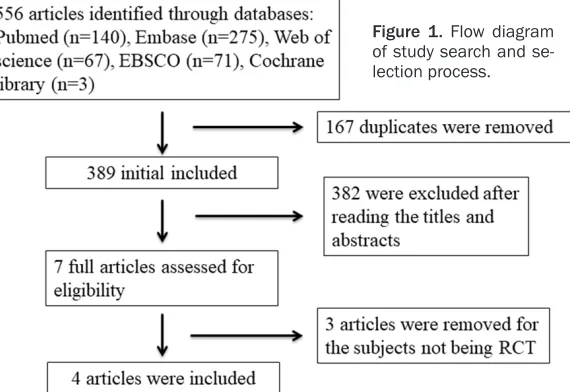
A detailed flowchart of the search and selection
results is shown in Figure 1. 556 potentially
rel-evant articles are identified initially. Finally, four
RCTs that meet the inclusion criteria are includ-ed in the meta-analysis [21-23, 28].
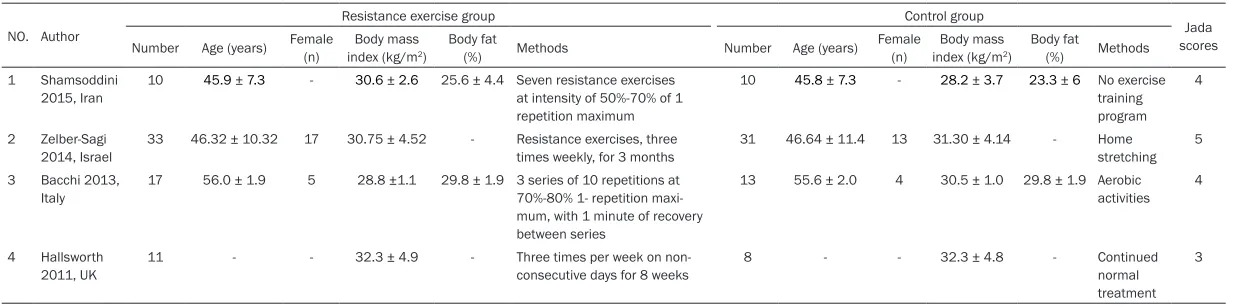
The baseline characteristics of the four eligible RCTs in the meta-analysis are summarized in Table 1. The four studies are published between One recent meta-analysis compared aerobic
with resistance exercise for NAFLD, and the results found that both exercise programs are able to reduce hepatic steatosis in NAFLD with similar frequency, duration, and period of
exer-cise, but significantly lower intensity and energy
consumption are needed for resistance exer-cise than that for aerobic exerexer-cise. These data suggest that resistance exercise may be pre-ferred over aerobic exercise for NAFLD patients
with poor cardiorespiratory fitness [16]. The
use of resistance exercise on NAFLD still has not been well established. Recently, several RCTs on the topic have been published, and the
results have been conflicting [21-23]. With
accumulating evidence, a systematic review and meta-analysis of RCTs was performed to
investigate the efficacy of resistance exercise
on NAFLD.
Materials and methods
Ethics approval and patient consent are not required because this is a systematic review and meta-analysis of previously published stud-ies. The systematic review and meta-analysis are conducted and reported in adherence to PRISMA (Preferred Reporting Items for Syste- matic Reviews and Meta-Analyses) [24].
Search strategy and study selection
Two investigators independently searched the following databases (inception to March 2018): PubMed, EMbase, Web of science, EBSCO, and Cochrane library databases. The electronic se- arch strategy was conducted using the follow-ing keywords: resistance trainfollow-ing or resistance exercise, and non-alcoholic, and liver disease. Reference lists of the screened full-text studies were also searched to identify other potentially eligible trials.
The inclusive selection criteria are as follows: (i) population: patients with non-alcoholic fatty-liver disease; (ii) intervention: resistance exer-cise; (iii) comparison: usual activities or aerobic activities; (iv) study design: RCT.
Data extraction and outcome measures
ysis results in significant
he-terogeneity. When perform-ing sensitivity analysis via omitting one study in turn,
there was still significant
he-terogeneity.
Secondary outcomes
Compared to the control gr- oup for non-alcoholic fatty-liver disease, resistance ex- ercise was able to substan-tially reduce GGT (MD = -2.87; 95% CI = -5.20 to -0.54; P = 0.02; Figure 4), ch- olesterol (MD = -8.76; 95% CI = -13.08 to -4.44; P < 0.0001; Figure 5), LDL (MD 2011 and 2015, and sample sizes range from
19 to 64 with a total of 133. The detailed inten-sity of resistance exercise were different in each RCT. The intervention treatments in con-trol group included usual activities [21, 22, 28] and aerobic activities [23].
Among the four studies included here, three studies report ALT and AST [21-23], and two st-
udies report GGT, cholesterol, LDL, and HbA1C
[22, 23]. Jadad scores of the four included studies vary from 3 to 5, and all four studies are considered to be high-quality ones according to quality assessment.
Primary outcomes: ALT and AST change
These outcome data are analyzed with the ran-dom-effects model, and the pooled estimate of the three included RCTs suggested that com-pared to control group for non-alcoholic
fatty-liver disease, resistance exercise can signifi -cantly reduce ALT (MD = -6.63; 95% CI = -12.87
to -0.40; P = 0.04), with significant heterogene -ity among the studies (I2 = 79%, heterogeneity
P = 0.008) (Figure 2).
Consistently, resistance exercise was associat-ed with substantially decreasassociat-ed AST for non-alcoholic fatty-liver disease (MD = -1.17; 95% CI = -1.82 to -0.52; P = 0.0004), with low hetero-geneity among the studies (I2 = 4%,
heteroge-neity P = 0.35) (Figure 3).
Sensitivity analysis
Low heterogeneity was observed among the included studies for AST analysis, but ALT
anal-= -5.06; 95% CI anal-= -6.25 to -3.87; P < 0.00001; Figure 6), but showed no significant influence on HbA1C (MD = -0.01; 95% CI = -0.08 to 0.06;
P = 0.81; Figure 7). Discussion
The American Heart Association has recom -mended resistance exercise as a complement to aerobic exercise [29]. Resistance exercise is
reported to significantly reduce steatosis as
measured by an objective ultrasonographic tool [28]. The meta-analysis reported here suggests that resistance exercise is able to substantially reduce ALT, AST, and GGT for patients with NA-
FLD, but has no important influence on HbA1C.
It is important to understand whether resis-tance or aerobic training is superior in inducing changes in hepatic fat liver enzymes and body composition in NAFLD. The mechanisms under-lying the change in hepatic fat by exercise train-ing have some association with changes in insulin sensitivity, circulatory lipids and energy balance [28]. Insulin sensitivity is very impor-tant for internal hepatic lipid homeostasis. Exercise training can increase body glucose disposal partly due to increased expression of GLUT4 in skeletal muscles, insulin receptor and glycogen storage [30]. An 8-week resistance exercise program reveals reduction in liver lipid
and HOMA-IR for NAFLD independent of any
change in body weight [28]. Another RCT reports that resistance exercise and aerobic exercise are equally effective to decrease hepatic fat content and liver enzyme levels for NAFLD. In addition, aerobic exercise results in
[image:3.612.98.383.75.271.2]Table 1. Characteristics of included studies
NO. Author
Resistance exercise group Control group
Jada scores Number Age (years) Female (n) index (kg/mBody mass 2)
Body fat
(%) Methods Number Age (years) Female
(n)
Body mass index (kg/m2)
Body fat
(%) Methods 1 Shamsoddini
2015, Iran 10 45.9 ± 7.3 - 30.6 ± 2.6 25.6 ± 4.4 Seven resistance exercises at intensity of 50%-70% of 1 repetition maximum
10 45.8 ± 7.3 - 28.2 ± 3.7 23.3 ± 6 No exercise training program
4
2 Zelber-Sagi 2014, Israel
33 46.32 ± 10.32 17 30.75 ± 4.52 - Resistance exercises, three times weekly, for 3 months
31 46.64 ± 11.4 13 31.30 ± 4.14 - Home
stretching 5
3 Bacchi 2013,
Italy 17 56.0 ± 1.9 5 28.8 ±1.1 29.8 ± 1.9 3 series of 10 repetitions at 70%-80% 1- repetition maxi-mum, with 1 minute of recovery between series
13 55.6 ± 2.0 4 30.5 ± 1.0 29.8 ± 1.9 Aerobic activities 4
4 Hallsworth
2011, UK 11 - - 32.3 ± 4.9 - Three times per week on non-consecutive days for 8 weeks 8 - - 32.3 ± 4.8 - Continued normal treatment
Table 1. Characteristics of included studies
NO. Author
Resistance exercise group Control group
Jada scores Number Age (years) Female (n) index (kg/mBody mass 2)
Body fat
(%) Methods Number Age (years) Female
(n)
Body mass index (kg/m2)
Body fat
(%) Methods 1 Shamsoddini
2015, Iran 10 45.9 ± 7.3 - 30.6 ± 2.6 25.6 ± 4.4 Seven resistance exercises at intensity of 50%-70% of 1 repetition maximum
10 45.8 ± 7.3 - 28.2 ± 3.7 23.3 ± 6 No exercise training program
4
2 Zelber-Sagi 2014, Israel
33 46.32 ± 10.32 17 30.75 ± 4.52 - Resistance exercises, three times weekly, for 3 months
31 46.64 ± 11.4 13 31.30 ± 4.14 - Home
stretching 5
3 Bacchi 2013,
Italy 17 56.0 ± 1.9 5 28.8 ±1.1 29.8 ± 1.9 3 series of 10 repetitions at 70%-80% 1- repetition maxi-mum, with 1 minute of recovery between series
13 55.6 ± 2.0 4 30.5 ± 1.0 29.8 ± 1.9 Aerobic activities 4
4 Hallsworth
2011, UK 11 - - 32.3 ± 4.9 - Three times per week on non-consecutive days for 8 weeks 8 - - 32.3 ± 4.8 - Continued normal treatment
[image:5.612.93.521.79.525.2]3
[image:5.612.91.525.189.264.2]Figure 2. Forest plot for the meta-analysis of ALT change (U/L).
Figure 3. Forest plot for the meta-analysis of AST change (U/L).
Figure 4. Forest plot for the meta-analysis of GGT change (U/L).
Figure 5. Forest plot for the meta-analysis of cholesterol change (mg/dL).
Figure 6. Forest plot for the meta-analysis of LDL change (mg/dL).
[image:5.612.93.518.422.489.2] [image:5.612.99.521.532.601.2] [image:5.612.98.522.642.711.2]special improvement for NAFLD independent of any change in body weight [21].
Liver steatosis is associated with insulin resis-tance and lipid abnormalities [31, 32]. Increa- sed insulin resistance contributes to the shift in cholesterol metabolism independent of body weight [33, 34]. Resistance training is found to improve insulin resistance including hepatic insulin resistance, and results in decreased sy- nthesis of hepatic cholesterol [35, 36]. The pre-cise mechanisms involving these processes remain elusive [37]. Lipid markers (i.e.
choles-terol and LDL) is significantly decreased by
resistance training in patients with NAFLD ba- sed on the results of our meta-analysis. There
was still significant heterogeneity after per -forming sensitivity analysis via omitting one study in turn, and the possible explanations include the different methods and duration of resistance exercise, methods of control group and patients with various body mass index. This meta-analysis has several potential limita-tions that should be taken into account. First, analysis is based on only four RCTs and all of them have a relatively small sample size (n < 100). More RCTs with large samples should be
conducted to confirm this issue. Next, there is significant heterogeneity when performing sen -sitivity analysis, different methods and dura-tion of resistance exercise and patient
popula-tions may have an influence on the pooling
results. Finally, the diagnosis of is not based on histology in included RCTs, and the fat content is not measured by biopsy.
Conclusions
Resistance exercise can provide important be-
nefits to patients with NAFLD, and should be
recommended in clinical work. Disclosure of conflict of interest None.
Address correspondence to: Xiaoping Yang, Depart- ment of Gastroenterology, The First Affiliated Hos- pital of Wenzhou Medical University, No. 318 Ch- aowang Road, Hangzhou 310005, Zhejiang Province, China. Tel: 0086057483870999; Fax: 008605748- 3870999; E-mail: [email protected]
References
[1] Ghamar-Chehreh ME, Khedmat H, Amini M and Taheri S. Predictive factors for
ultrasono-graphic grading of nonalcoholic fatty liver dis-ease. Hepat Mon 2012; 12: e6860.
[2] Francque S, Lanthier N, Verbeke L, Reynaert H, Van Steenkiste C, Vonghia L, Kwanten WJ, Weyler J, Trépo E, Cassiman D, Smets F, Kom- uta M, Driessen A, Dirinck E, Danse E, Op de Beeck B, van Craenenbroeck E, Van Nieu- wenhove Y, Hubens G, Geerts A and Moreno C. The belgian association for study of the liver guidance document on the management of adult and paediatric non-alcoholic fatty liver disease. Acta Gastroenterol Belg 2018; 81: 55-81.
[3] Atay K, Canbakan B, Koroglu E, Hatemi I, Canbakan M, Kepil N, Tuncer M and Senturk H. Apoptosis and disease severity is associated with insulin resistance in non-alcoholic fatty liver disease. Acta Gastroenterol Belg 2017; 80: 271-277.
[4] St George A, Bauman A, Johnston A, Farrell G, Chey T and George J. Independent effects of physical activity in patients with nonalcoholic fatty liver disease. Hepatology 2009; 50: 68-76.
[5] Patel S, Lawlor DA, Callaway M, Macdonald-Wallis C, Sattar N and Fraser A. Association of maternal diabetes/glycosuria and pre-preg-nancy body mass index with offspring indica-tors of non-alcoholic fatty liver disease. BMC Pediatr 2016; 16: 47.
[6] Alexander KS, Zakai NA, Lidofsky SD, Callas PW, Judd SE, Tracy RP and Cushman M. Non-alcoholic fatty liver disease, liver biomarkers and stroke risk: the reasons for geographic and racial differences in stroke cohort. PLoS One 2018; 13: e0194153.
[7] Botero P, Hoy EM, Jimenez MC, Koru-Sengul T and Messiah SE. Predictors of non-alcoholic liver disease in ethnically diverse overweight children and adolescents. Curr Pediatr Rev 2018; 14: 130-135.
[8] Chitturi S, Wong VW and Farrell G. Nonalcoholic fatty liver in Asia: firmly entrenched and rapidly gaining ground. J Gastroenterol Hepatol 2011; 26 Suppl 1: 163-72.
[9] Damor K, Mittal K, Bhalla AS, Sood R, Pandey RM, Guleria R, et al. Effect of progressive resis-tance exercise training on hepatic fat in Asian Indians with non-alcoholic fatty liver disease. British J Med Res 2014; 4: 114-24.
[10] Alavian SM, Mohammad-Alizadeh AH, Esna-Ashari F, Ardalan G and Hajarizadeh B. Non-al- coholic fatty liver disease prevalence among school-aged children and adolescents in Iran and its association with biochemical and an-thropometric measures. Liver Int 2009; 29: 159-63.
adipose distribution and adipocytokines influ-ence adolescent nonalcoholic fatty liver dis-ease. Hepatology 2011; 53: 800-9.
[12] Tolman KG and Dalpiaz AS. Treatment of non-alcoholic fatty liver disease. Ther Clin Risk Manag 2007; 3: 1153-63.
[13] Saleh DA, Ismail MA and Ibrahim AM. Non al-coholic fatty liver disease, insulin resistance, dyslipidemia and atherogenic ratios in epilep-tic children and adolescents on long term anti-epileptic drug therapy. Pak J Biol Sci 2012; 15: 68-77.
[14] Amano Y, Tsuchiya S, Imai M, Tohyama K, Mat- sukawa J, Isono O, Yasuno H, Enya K, Koumura E and Nagabukuro H. Combination effects of alogliptin and pioglitazone on steatosis and hepatic fibrosis formation in a mouse model of non-alcoholic steatohepatitis. Biochem Bio- phys Res Commun 2018; 497: 207-213. [15] Zhong S, Fan Y, Yan Q, Fan X, Wu B, Han Y,
Zhang Y, Chen Y, Zhang H and Niu J. The thera-peutic effect of silymarin in the treatment of nonalcoholic fatty disease: a meta-analysis (PRISMA) of randomized control trials. Me- dicine 2017; 96: e9061.
[16] Hashida R, Kawaguchi T, Bekki M, Omoto M, Matsuse H, Nago T, Takano Y, Ueno T, Koga H, George J, Shiba N and Torimura T. Aerobic vs. resistance exercise in non-alcoholic fatty liver disease: a systematic review. J Hepatol 2017; 66: 142-152.
[17] Kistler KD, Brunt EM, Clark JM, Diehl AM, Sallis JF, Schwimmer JB; NASH CRN Research Group. Physical activity recommendations, ex-ercise intensity, and histological severity of nonalcoholic fatty liver disease. Am J Gastr- oenterol 2011; 106: 460-8; quiz 9.
[18] American Gastroenterological Association. Am- erican gastroenterological association medi-cal position statement: nonalcoholic fatty liver disease. Gastroenterology 2002; 123: 1702-4.
[19] Sreenivasa Baba C, Alexander G, Kalyani B, Pandey R, Rastogi S, Pandey A and Choudhuri G. Effect of exercise and dietary modification on serum aminotransferase levels in patients with nonalcoholic steatohepatitis. J Gastroen- terol Hepatol 2006; 21: 191-8.
[20] Keating SE, Hackett DA, George J and Johnson NA. Exercise and non-alcoholic fatty liver dis-ease: a systematic review and meta-analysis. J Hepatol 2012; 57: 157-66.
[21] Shamsoddini A, Sobhani V, Ghamar Chehreh ME, Alavian SM and Zaree A. Effect of aerobic and resistance exercise training on liver en-zymes and hepatic fat in iranian men with non-alcoholic fatty liver disease. Hepat Mon 2015; 15: e31434.
[22] Zelber-Sagi S, Buch A, Yeshua H, Vaisman N, Webb M, Harari G, Kis O, Fliss-Isakov N, Izk- hakov E, Halpern Z, Santo E, Oren R and Shibolet O. Effect of resistance training on non-alcoholic fatty-liver disease a randomized-clinical trial. World J Gastroenterol 2014; 20: 4382-92.
[23] Bacchi E, Negri C, Targher G, Faccioli N, Lanza M, Zoppini G, Zanolin E, Schena F, Bonora E and Moghetti P. Both resistance training and aerobic training reduce hepatic fat content in type 2 diabetic subjects with nonalcoholic fatty liver disease (the RAED2 randomized trial). Hepatology 2013; 58: 1287-95.
[24] Moher D, Liberati A, Tetzlaff J, Altman DG; PRISMA Group. Preferred reporting items for systematic reviews and meta-analyses: the PRISMA statement. J Clin Epidemiol 2009; 62: 1006-12.
[25] Jadad AR, Moore RA, Carroll D, Jenkinson C, Reynolds DJ, Gavaghan DJ, Gavaghan DJ and McQuay HJ. Assessing the quality of reports of randomized clinical trials: is blinding neces-sary? Control Clin Trials 1996; 17: 1-12. [26] Kjaergard LL, Villumsen J and Gluud C.
Reported methodologic quality and discrepan-cies between large and small randomized tri-als in meta-analyses. Ann Intern Med 2001; 135: 982-9.
[27] Higgins JP and Thompson SG. Quantifying het-erogeneity in a meta-analysis. Stat Med 2002; 21: 1539-58.
[28] Hallsworth K, Fattakhova G, Hollingsworth KG, Thoma C, Moore S, Taylor R, Day CP and Trenell MI. Resistance exercise reduces liver fat and its mediators in non-alcoholic fatty liver dis-ease independent of weight loss. Gut 2011; 60: 1278-83.
[29] Williams MA, Haskell WL, Ades PA, Amsterdam EA, Bittner V, Franklin BA, Gulanick M, Laing ST, Stewart KJ; American Heart Association Council on Clinical Cardiology; American Heart Association Council on Nutrition, Physical Ac- tivity, and Metabolism. Resistance exercise in individuals with and without cardiovascular disease: 2007 update: a scientific statement from the American heart association council on clinical cardiology and council on nutrition, physical activity, and metabolism. Circulation 2007; 116: 572-84.
[30] Jensen J, Rustad PI, Kolnes AJ and Lai YC. The role of skeletal muscle glycogen breakdown for regulation of insulin sensitivity by exercise. Front Physiol 2011; 2: 112.
the early stage of obesity. Metabolism 2008; 57: 980-5.
[32] Kim LJ, Nalls MA, Eiriksdottir G, Sigurdsson S, Launer LJ, Koster A, Chaves PH, Jonsdottir B, Garcia M, Gudnason V, Harris TB; AGES-Rey- kjavik Study Investigators. Associations of vis-ceral and liver fat with the metabolic syndrome across the spectrum of obesity: the AGES-Reykjavik study. Obesity 2011; 19: 1265-71. [33] Simonen P, Kotronen A, Hallikainen M, Seva-
stianova K, Makkonen J, Hakkarainen A, Lun- dbom N, Miettinen TA, Gylling H and Yki-Järvinen H. Cholesterol synthesis is increased and absorption decreased in non-alcoholic fatty liver disease independent of obesity. J Hepatol 2011; 54: 153-9.
[34] Flannery C, Dufour S, Rabol R, Shulman GI and Petersen KF. Skeletal muscle insulin resis-tance promotes increased hepatic de novo li-pogenesis, hyperlipidemia, and hepatic steato-sis in the elderly. Diabetes 2012; 61: 2711-7.
[35] Brooks N, Layne JE, Gordon PL, Roubenoff R, Nelson ME and Castaneda-Sceppa C. Strength training improves muscle quality and insulin sensitivity in Hispanic older adults with type 2 diabetes. Int J Med Sci 2006; 4: 19-27. [36] Van Der Heijden GJ, Wang ZJ, Chu Z, Toffolo G,
Manesso E, Sauer PJ and Sunehag AL. Strength exercise improves muscle mass and hepatic insulin sensitivity in obese youth. Med Sci Sports Exerc 2010; 42: 1973-80.