Proceedings of the First Workshop on Fact Extraction and VERification (FEVER), pages 10–15 10
The Data Challenge in Misinformation Detection:
Source Reputation vs. Content Veracity
Fatemeh Torabi Asr Discourse Processing Lab
Simon Fraser University Burnaby, BC, Canada [email protected]
Maite Taboada Discourse Processing Lab
Simon Fraser University Burnaby, BC, Canada [email protected]
Abstract
Misinformation detection at the level of full news articles is a text classification problem. Reliably labeled data in this domain is rare. Previous work relied on news articles collected from so-called “reputable” and “suspicious” websites and labeled accordingly. We leverage fact-checking websites to collect individually-labeled news articles with regard to the verac-ity of their content and use this data to test the cross-domain generalization of a classifier trained on bigger text collections but labeled according to source reputation. Our results suggest that reputation-based classification is not sufficient for predicting the veracity level of the majority of news articles, and that the system performance on different test datasets depends on topic distribution. Therefore col-lecting well-balanced and carefully-assessed training data is a priority for developing robust misinformation detection systems.
1 Introduction
Automatic detection of fake from legitimate news in different formats such as headlines, tweets and full news articles has been approached in recent Natural Language Processing literature (Vlachos and Riedel,2014;Vosoughi,2015;Jin et al.,2016;
Rashkin et al., 2017;Volkova et al.,2017;Wang,
2017; Pomerleau and Rao, 2017; Thorne et al.,
2018). The most important challenge in automatic misinformation detection using modern NLP tech-niques, especially at the level of full news arti-cles, is data. Most previous systems built to iden-tify fake news articles rely on training data la-beled with respect to the general reputation of the sources, i.e., domains/user accounts (Fogg et al.,
2001; Lazer et al., 2017; Rashkin et al., 2017). Even though some of these studies try to identify fake news based on linguistic cues, the question is whether they learn publishers’ general writ-ing style(e.g., common writing features of a few
clickbaity websites) or deceptive style (similari-ties among news articles that contain misinforma-tion).
In this study, we collect two new datasets that include the full text of news articles and individ-ually assigned veracity labels. We then address the above question, by conducting a set of cross-domain experiments: training a text classification system on data collected in a batch manner from suspicious and reputable websites and then test-ing the system on news articles that have been as-sessed in a one-by-one fashion. Our experiments reveal that the generalization power of a model trained on reputation-based labeled data is not im-pressive on individually assessed articles. There-fore, we propose to collect and verify larger col-lections of news articles with reliably assigned la-bels that would be useful for building more robust fake news detection systems.
2 Data Collection
Most studies on fake news detection have exam-ined microblogs, headlines and claims in the form of short statements. A few recent studies have amined full articles (i.e., actual ‘fake news’) to ex-tract discriminative linguistic features of misinfor-mation (Yang et al., 2017; Rashkin et al., 2017;
annotators and determined to contain false infor-mation. Currently, there exists only small col-lections of reliably-labeled news articles (Rubin et al., 2016;Allcott and Gentzkow, 2017; Zhang et al.,2018;Baly et al.,2018) because this type of annotation is laborious. The Liar dataset (Wang,
2017) is the first large dataset collected through re-liable annotation, but it contains only short state-ments. Another recently published large dataset is FEVER (Thorne et al., 2018), which contains both claims and texts from Wikipedia pages that support or refute those claims. This dataset, how-ever, has been built to serve the slightly different purpose of stance detection (Pomerleau and Rao,
2017; Mohtarami et al., 2018), the claims have been artificially generated, and texts are not news articles.
Our objective is to elaborate on the distinc-tion between classifying reputation-based la-beled news articles and individually-assessed
news articles. We do so by collecting and using datasets of the second type in evaluation of a text classifier trained on the first type of data. In this section, we first introduce one large collection of news text from previous studies that has been la-beled according to the list of suspicious websites, and one small collection that was labeled manu-ally for each and every news article, but only con-tains satirical and legitimate instances. We then introduce two datasets that we have scraped from the web by leveraging links to news articles men-tioned by fact-checking websites (Buzzfeed and Snopes). The distinguishing feature of these new collections is that they contain not only the full text of real news articles found online, but also individually assigned veracity labels indicative of their misinformative content.
Rashkin et al. dataset: Rashkin et al. (2017) published a collection of roughly 20k news ar-ticles from eight sources categorized into four classes: propaganda (The Natural News and Ac-tivist Report), satire (The Onion, The Borowitz Report, and Clickhole), hoax (American News and DC Gazette) and trusted (Gigaword News). This dataset is balanced across classes, and since the articles in their training and test splits come from different websites, the accuracy of the trained model on test data should be demonstrative of its understanding of the general writing style of each target class rather than author-specific cues. How-ever, we suspect that the noisy strategy to label
all articles of a publisher based on its reputation highly biases the classifier decisions and limits its power to distinguish individual misinformative from truthful news articles.
Rubin et al. dataset: As part of a study on satir-ical cues, Rubin et al. (2016) published a dataset of 360 news articles. This dataset contains balanced numbers of individually evaluatedsatiricaland le-gitimate texts. Even though small, it is a clean data to test the generalization power of a system trained on noisy data such as the above explained dataset. We use this data to make our point about the need for careful annotation of news articles on a one-by-one fashion, rather than harvesting from websites generally knows as hoax, propaganda or satire publishers.
BuzzfeedUSE dataset: The first source of in-formation that we used to harvest full news arti-cles with veracity labels is from the Buzzfeed fact-checking company. Buzzfeed has published a col-lection of links to Facebook posts, originally com-piled for a study around the 2016 US election ( Sil-verman et al.,2016). Each URL in this dataset was given to human experts so they can rate the amount of false information contained in the linked arti-cle. The links were collected from nine Facebook pages (three right-wing, three left-wing and three mainstream publishers).1 We had to follow the facebook URLs and then the link to the original news articles to obtain the news texts. We scraped the full text of each news article from its original source. The resulting dataset includes a total of 1,380 news articles on a focused topic (US elec-tion and candidates). Veracity labels come in a 4-way classification scheme including 1,090mostly true, 170mixture of true and false, 64mostly false
and 56 articlescontaining no factual content.
Snopes312 dataset: The second source of infor-mation that we used to harvest full news articles with veracity labels is Snopes, a well-known ru-mor debunking website run by a team of expert editors. We scraped the entire archive of fact-checking pages. On each page they talk about a claim, cite the sources (news articles, forums or social networks where the claim was distributed) and provide a veracity label for the claim. We automatically extracted all links mentioned on a Snopes page, followed the link to each original
Table 1: Results of the manual assessment of Snopes312 collection for items of each veracity label
Assessment / Veracity label false mixture mostly false mostly true true All
ambiguous 2 0 1 0 0 3
context 19 31 17 32 26 125
debunking 0 1 0 0 0 1
irrelevant 9 10 7 2 10 38
supporting 21 30 28 37 29 145
[image:3.595.75.521.209.301.2]All 51 72 53 71 65 312
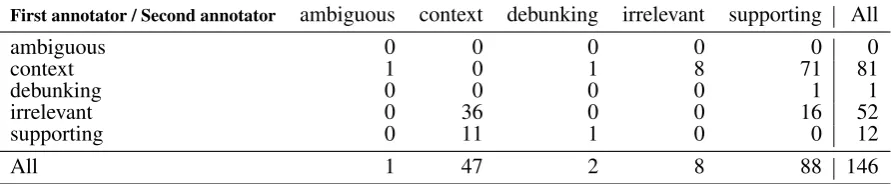
Table 2: Contingency table on disagreements between the first and second annotator in Snopes312 dataset
First annotator / Second annotator ambiguous context debunking irrelevant supporting All
ambiguous 0 0 0 0 0 0
context 1 0 1 8 71 81
debunking 0 0 0 0 1 1
irrelevant 0 36 0 0 16 52
supporting 0 11 1 0 0 12
All 1 47 2 8 88 146
news article, and extracted the text. The resulting datafile includes roughly 4,000 rows, each con-taining a claim discussed by Snopes annotators, the veracity label assigned to it, and the text of a news article related to the claim. The main chal-lenge in using this data for training/testing a fake news detector is that some of the links on a Snopes page that we collect automatically do not actually point to the discussed news article, i.e., the source of the claim. Many links are to pages that pro-vide contextual information for the fact-checking of the claim. Therefore, not all the texts in our automatically extracted dataset are reliable or sim-ply the “supporting” source of the claim. To come up with a reliable set of veracity-labeled news arti-cles, we randomly selected 312 items and assessed them manually. Two annotators performed inde-pendent assessments on the 312 items. A third an-notator went through the entire list of items for a final check and resolving disagreements. Snopes has a fine-grained veracity labeling system. We selected[fully] true, mostly true, mixture of true and false, mostly false, and [fully] false stories. Table 1 shows the distribution of these labels in the manually assessed 312 items, and how many from each category of news articles were veri-fied to be the “supporting” source (distributing the discussed claim), “context” (providing back-ground or related information about the topic of the claim), “debunking” (against the claim), “irrel-evant” (completely unrelated to the claim or dis-torted text) and ambiguous (not sure how it related
to the claim). Table2provides information on the confusing choices: About 50% of the items re-ceived different category labels from the two first annotators. The first annotator had a more conser-vative bias, trying to avoid mistakes in the “sup-porting” category, whereas the second annotator often assigned either “supporting” or “context”, and rarely “irrelevant”. For the disagreed items, the third annotator (who had access to all outputs) chose the final category. Results in Table 1 are based on this final assessment. We use the “sup-porting” portion of the data (145 items) in the fol-lowing experiments.
3 Experiments
In text classification, Convolutional Neural Net-works (CNNs) have been competing with the TF-IDF model, a simple but strong baseline using scored n-grams (Le and Mikolov, 2014; Zhang et al., 2015; Conneau et al., 2017; Medvedeva et al., 2017). These methods have been used for fake news detection in previous work (Rashkin et al.,2017;Wang,2017). For our experiments, we trained and tuned different architectures of CNN and several classic classifiers (Naive Bayes and Support Vector Machines) with TF-IDF features on Rashkin et al.’s dataset. The best results on the development data were obtained from a Support Vector Machine (SVM) classifier using unigram TF-IDF features with L2 regularization.2
There-2We used the same train/dev/test split as in Rashkin’s
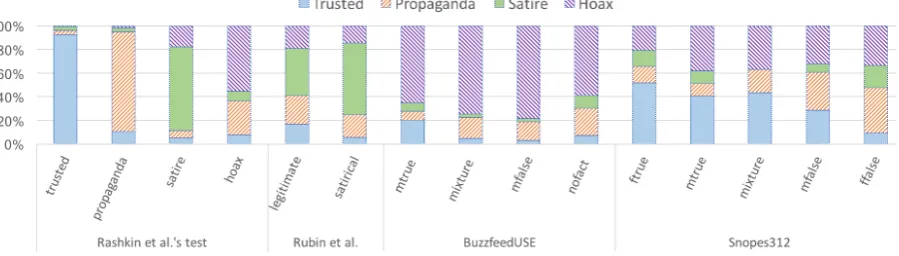
classi-Figure 1: Classification of news articles from four test datasets by a model trained on Rashkin et al.’s training data. Labels assigned by the classifier are Capitalized (plot legend), actual labels of test items are in lowercase (x-axis).
fore, we use this model to demonstrate how a clas-sifier trained on data labeled according to pub-lisher’s reputation would identify misinformative news articles.
It is evident in the first section of Figure1, that the model performs well on similarly collected test items, i.e.,Hoax,Satire,PropagandaandTrusted
news articles within Rashkin et al.’s test dataset. However, when the model is applied to Rubin et al.’s data, which was carefully assessed for satiri-cal cues in each and every article, the performance drops considerably (See the second section of the figure). Although the classifier detects more of the satirical texts in Rubin et al.’s data, the dis-tribution of the given labels is not very different to that of legitimatetexts. One important feature of Rubin et al.’s data is that topics of the legitimate instances were matched and balanced with topics of the satirical instances. The results here suggest that similarities captured by the classifier can be very dependent on the topics of the news articles.
Next we examine the same model on our col-lected datasets, BuzzfeedUSE and Snopes312, as test material. The BuzzfeedUSE data comes with 4 categories (Figure1). The classifier does seem to have some sensitivity to true vs. false infor-mation in this dataset, as more of themostly true
articles were labeled as Trusted. The difference with mostly false articles, however, is negligible. The most frequent label assigned by the classi-fier was Hoax in all four categories, which sug-gests that most BuzzfeedUSE articles looked like
Hoax in Rashkin’s data. Finally, the last section of 1 shows the results on the Snopes312 plotted
fier was significantly better on both dev and test sets: 0.96 and 0.75 F1-score, respectively, compared to 0.91 and 0.65 reported in their paper. Source code will be made available at https://github.com/sfu-discourse-lab/Misinformation_detection
along the 6-category distinction. A stronger corre-lation can be observed between the classifier deci-sions and the veracity labels in this data compared to BuzzfeedUSE. This suggests that distinguishing between news articles with true and false informa-tion is a more difficult task when topics are the same (BuzzfeedUSE data is all related to the US election). In Snopes312, news articles come from a variety of topics. The strong alignment between the classifier’sPropagandaandHoax labels with themostly falseand[fully] falsecategories in this dataset reveals that most misinformative news ar-ticles indeed discuss the topics or use the language of generally suspicious publishers. This is an en-couraging result in the sense that, with surface fea-tures such as n-grams and approximate reputation-based training data, we already can detect some of the misinformative news articles. Observing clas-sification errors across these experiments, how-ever, indicates that the model performance varies a lot with the type of test material: In a focused topic situation, it fails to distinguish between categories (false vs. true, or satirical vs. legitimate arti-cles). While a correlation is consistently observed between labels assigned by the classifier and the actual labels of target news articles,3 reputation-based classification does not seem to be sufficient for predicting the veracity level of the majority of news articles.
4 Conclusion
We found that collecting reliable data for auto-matic misinformation detection at the level of full news articles is a challenging but necessary task for building robust models. If we want to benefit
3A chi-square test indicates a significant correlation (p <
[image:4.595.77.527.65.193.2]from state-of-the-art text classification techniques, such as CNNs, we require larger datasets than what is currently available. We took the first steps, by scraping claims and veracity labels from fact-checking websites, extracting and cleaning of the original news articles’ texts (resulting in roughly 4,000 items), and finally manual assessment of a subset of the data to provide reliable test mate-rial for misinformation detection. Our future plan is to crowd-source annotators for the remaining scraped texts and publish a large set of labeled news articles for training purposes.
Acknowledgement
This project was funded by a Discovery Grant from the Natural Sciences and Engineering Re-search Council of Canada. We gratefully acknowl-edge the support of NVIDIA Corporation with the donation of the Titan Xp GPU used for this re-search. We would like to thank members of the Discourse Processing Lab at SFU, especially Ya-jie Zhou and Jerry Sun for their help checking the datasets.
References
Hunt Allcott and Matthew Gentzkow. 2017. Social me-dia and fake news in the 2016 election. Journal of Economic Perspectives, 31:211–236.
Ramy Baly, Mitra Mohtarami, James Glass, Llu´ıs M`arquez, Alessandro Moschitti, and Preslav Nakov. 2018. Integrating stance detection and fact checking in a unified corpus. InProceedings of the 2018 Con-ference of the North American Chapter of the Asso-ciation for Computational Linguistics: Human Lan-guage Technologies, Volume 2 (Short Papers), vol-ume 2, pages 21–27.
Alexis Conneau, Holger Schwenk, Loc Barrault, and Yann LeCun. 2017. Very deep convolutional net-works for text classification. InProceedings of the 15th Conference of the European Chapter of the Association for Computational Linguistics, pages 1107–1116, Valencia.
B. J. Fogg, Jonathan Marshall, Othman Laraki, Alex Osipovich, Chris Varma, Nicholas Fang, Jyoti Paul, Akshay Rangnekar, John Shon, Preeti Swani, and Marissa Treinen. 2001. What makes web sites cred-ible? A report on a large quantitative study. In Pro-ceedings of the SIGCHI Conference on Human Fac-tors in Computing Systems, CHI ’01, pages 61–68, New York.
Benjamin D Horne and Sibel Adali. 2017. This just in: Fake news packs a lot in title, uses simpler, repetitive content in text body, more similar to satire than real news. arXiv preprint arXiv:1703.09398.
Zhiwei Jin, Juan Cao, Yongdong Zhang, and Jiebo Luo. 2016. News verification by exploiting conflicting social viewpoints in microblogs. InProceedings of the Thirtieth AAAI Conference on Artificial Intelli-gence, pages 2972–2978, Phoenix.
David Lazer, Matthew Baum, Nir Grinberg, Lisa Fried-land, Kenneth Joseph, Will Hobbs, and Carolina Mattsson. 2017. Combating fake news: An agenda for research and action. Harvard Kennedy School, Shorenstein Center on Media, Politics and Public Policy, 2.
Quoc Le and Tomas Mikolov. 2014. Distributed repre-sentations of sentences and documents. In Proceed-ings of the 31st International Conference on Ma-chine Learning, pages II–1188–II–1196, Beijing.
Alexios Mantzarlis. 2017. Not fake news, just plain wrong: Top media corrections of 2017. Poyn-ter News. Https://www.poynPoyn-ter.org/news/not-fake- Https://www.poynter.org/news/not-fake-news-just-plain-wrong-top-media-corrections-2017.
Maria Medvedeva, Martin Kroon, and Barbara Plank. 2017. When sparse traditional models outperform dense neural networks: The curious case of discrim-inating between similar languages. InProceedings of the 4th Workshop on NLP for Similar Languages, Varieties and Dialects (VarDial), pages 156–163, Valencia.
Mitra Mohtarami, Ramy Baly, James Glass, Preslav Nakov, Llus Mrquez, and Alessandro Moschitti. 2018. Automatic stance detection using end-to-end memory networks. InProceedings of the 2018 Con-ference of the North American Chapter of the Asso-ciation for Computational Linguistics: Human Lan-guage Technologies, Volume 1 (Long Papers), pages 767–776, New Orleans, LA.
Dean Pomerleau and Delip Rao. 2017. Fake news chal-lenge. Http://fakenewschalchal-lenge.org/.
Hannah Rashkin, Eunsol Choi, Jin Yea Jang, Svitlana Volkova, and Yejin Choi. 2017. Truth of varying shades: Analyzing language in fake news and polit-ical fact-checking. InProceedings of the 2017 Con-ference on Empirical Methods in Natural Language Processing, pages 2921–2927, Copenhagen.
Victoria L Rubin, Niall J Conroy, Yimin Chen, and Sarah Cornwell. 2016. Fake news or truth? Using satirical cues to detect potentially misleading news. In Proceedings of NAACL-HLT, pages 7–17, San Diego.
James Thorne, Andreas Vlachos, Christos Christodoulopoulos, and Arpit Mittal. 2018. FEVER: A large-scale dataset for Fact Extraction and VERification. In Proceedings of the 2018 Conference of the North American Chapter of the Association for Computational Linguistics: Human Language Technologies, Volume 1 (Long Papers), pages 809–819, New Orleans, LA.
Andreas Vlachos and Sebastian Riedel. 2014. Fact checking: Task definition and dataset construction. InProceedings of the ACL 2014 Workshop on Lan-guage Technologies and Computational Social Sci-ence, pages 18–22.
Svitlana Volkova, Kyle Shaffer, Jin Yea Jang, and Nathan Hodas. 2017. Separating facts from fiction: Linguistic models to classify suspicious and trusted news posts on Twitter. InProceedings of the 55th Annual Meeting of the Association for Computa-tional Linguistics, volume 2, pages 647–653, Van-couver.
Soroush Vosoughi. 2015. Automatic detection and ver-ification of rumors on Twitter. Ph.D. thesis, Mas-sachusetts Institute of Technology.
William Yang Wang. 2017. ‘Liar, liar pants on fire’: A new benchmark dataset for fake news detection. In Proceedings of the 55th Annual Meeting of the As-sociation for Computational Linguistics, volume 2, pages 422–426, Vancouver.
Fan Yang, Arjun Mukherjee, and Eduard Dragut. 2017. Satirical news detection and analysis using attention mechanism and linguistic features. InProceedings of the 2017 Conference on Empirical Methods in Natural Language Processing, pages 1979–1989.
Amy X Zhang, Aditya Ranganathan, Sarah Emlen Metz, Scott Appling, Connie Moon Sehat, Norman Gilmore, Nick B Adams, Emmanuel Vincent, Jen-nifer Lee, Martin Robbins, et al. 2018. A struc-tured response to misinformation: Defining and an-notating credibility indicators in news articles. In Companion of the The Web Conference 2018 on The Web Conference 2018, pages 603–612. International World Wide Web Conferences Steering Committee.