102
An Interface for Annotating Science Questions
Michael Boratko, Harshit Padigela, Divyendra Mikkilineni, Pritish Yuvraj, Rajarshi Das, Andrew McCallum
College of Information and Computer Sciences University of Massachusetts, Amherst MA
Maria Chang, Achille Fokoue, Pavan Kapanipathi, Nicholas Mattei, Ryan Musa, Kartik Talamadupula, Michael Witbrock
IBM Research, Yorktown Heights NY
Abstract
Recent work introduces the AI2 Reasoning Challenge (ARC) and the associated ARC dataset that partitions open domain, complex science questions into an Easy Set and a Chal-lenge Set. That work includes an analysis of 100 questions with respect to the types of knowledge and reasoning required to answer them. However, it does not include clear def-initions of these types, nor does it offer infor-mation about the quality of the labels or the annotation process used. In this paper, we in-troduce a novel interface for human annotation of science question-answer pairs with their re-spective knowledge and reasoning types, in order that the classification of new questions may be improved. We build on the classifi-cation schema proposed by prior work on the ARC dataset, and evaluate the effectiveness of our interface with a preliminary study involv-ing 10 participants.
1 Introduction
Recent work by Clark et al. (2018) introduces the AI2 Reasoning Challenge (ARC)1 and the asso-ciated ARC dataset. This dataset contains science questions from standardized tests that are sepa-rated into an Easy Set and a Challenge Set. The Challenge Set comprises questions that are an-swered incorrectly by two solvers based on Point-wise Mutual Information (PMI) Information Re-trieval (IR). In addition to this division, a survey of the various types of knowledge as well as the types of reasoning that are required to answer var-ious questions in the ARC dataset was presented. This survey was based on an analysis of 100 ques-tions chosen at random from the Challenge Set. However, very little detail is provided about the questions chosen, the annotations provided, or the methodology used. These questions surround the
1http://data.allenai.org/arc/
very core of the paper, since the main contribution is a dataset that contains complex questions.
In this work, in order to overcome some of the limitations of Clark et al. (2018) described above, we present a detailed annotation interface for the ARC dataset that allows a distributed set of annotators to label the knowledge and rea-soning types (Boratko et al., 2018). Following an annotation round involving over ten people at two institutions, we measure and report statistics such as inter-rater agreement, and the distribu-tion of knowledge and reasoning type labels in the dataset.
2 Annotation Interface
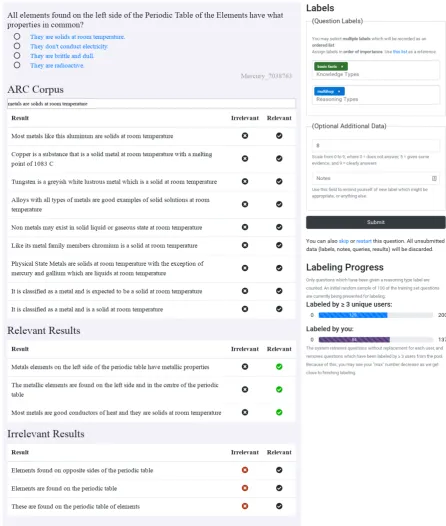
The annotation interface introduced in this paper is shown in Figure 1. The text of the science question is displayed at the top of the left side, followed by the answer options. Each of the answer options is preceded by a radio button: each button is initially transparent, but the annotator can click on a but-ton to check whether the corresponding option is the answer to the question. This facility is to help annotators with extra information if it is needed in labeling the question; however, we leave it blank initially to avoid biasing the annotations.
Figure 1: A screenshot of the interface to our annotation system, described in Section 2.
2.1 Question Annotation
The right hand side of the interface deals with the annotation of a given question. There are two boxes for annotating knowledge and reasoning types respectively. The labels are populated from the knowledge and reasoning type tables in Bo-ratko et al. (2018) (more on these types in Sec-tion 3). The annotator can also provide opSec-tional information on the quality of the retrieved search
results if they choose to run a query. Finally, the annotator can use the optional field below quality to enter additional notes about the question; these notes are stored and can be retrieved for subse-quent discussion and refinement of the labels.
2.2 Search Result Retrieval & Annotation
an-other capability of our interface: given a corpus of knowledge, we are able to retrieve and display search results that may be relevant to the ques-tion (and its corresponding opques-tions) at hand. This is useful because it gives a solution technique an additional signal as it tries to identify the cor-rect answer to a given question. In open-domain question answering, the retriever plays as impor-tant a role as the machine reader (Chen et al., 2017). In the past few years, there has been a lot of effort in designing sophisticated neural archi-tectures for reading a small piece of text (e.g. para-graph) (Wang and Jiang, 2016; Xiong et al., 2016; Seo et al., 2016; Lee et al., 2016, inter alia). How-ever, most work in open domain settings (Chen et al., 2017; Clark and Gardner, 2017; Wang et al., 2018) only uses simple retrievers (such as TF-IDF based ones). As a result, there is a notable decrease in the performance of the QA system. One road-block for training a sophisticated retriever is the lack of available training data which annotates the relevance of a retrieved context with respect to the question. We believe our annotated retrieval data can be used to train a better ranker/retriever with-out obliging annotators to explicitly connect the supporting passages (Jansen et al., 2018).
The underlying retriever in our interface is a simple Elasticsearch, similar to the one used by Clark et al. (2018). The interface is populated by default with the top ranked sentences that are re-trieved with the given question as the input query. However, we noticed that results thus retrieved were often irrelevant to answering the question. To address this, our labeling interface also al-lows annotators to input their own custom queries. We found that reformulating the initial query sig-nificantly improved the quality of the retrieved context (results). We encouraged the annotators to mark the contexts (results) that they thought were relevant to answering the question at hand. For example, in Figure 1, the annotator came up with a novel query – ‘metals are solid at room temperatures’– and also marked the relevant sentences which are needed to answer this question. Note that sometimes we need to rea-son over multiple sentences to arrive at the answer. For example, the question in Figure 1 can be an-swered by combining the first and third sentences in the ‘Relevant Results’ tab.
3 Knowledge & Reasoning Types
In previous work (Clark et al., 2018), the stan-dardized test questions under consideration were split into various categories based on the kinds of knowledge and reasoning that are needed to answer those questions. The idea of classifying questions by these two types is central to the no-tion of standardized testing, which endeavors to test students on various kinds of knowledge, as well as various problem types and solution tech-niques. These categories allow for the classifica-tion of quesclassifica-tions, which makes it easier to particlassifica-tion them into subsets to measure performance and im-prove solution strategies.
3.1 Knowledge Types
In most question-answering (QA) scenarios, the knowledge that is present with the system (or the agent) determines whether a given question can be answered. The full list of the revised knowledge labels (types) – along with the instructions given to annotators and respective exemplars from the ARC question set – can be found in our comple-mentary work (Boratko et al., 2018). For the an-notation of knowledge types using our interface, annotators were given the following instructions:
You are to answer the question, “In a perfect world given an ideal knowledge source, what types of knowledge would you as a human need to answer this question?” You are allowed to se-lectmultiple labels for this type which will be recorded as an ordered list. You are to assign la-belsin the order of importanceto answering the questions at hand.
In order to level the field among annotators, we in-cluded phrasing about anideal knowledge source. Additionally, displaying the retrieved search re-sults in the interface provides another way for the annotators to share some common ground with re-spect to the typical kind of knowledge that is likely to be available. We also provide instruction-based definitions for each class, as opposed to the sin-gle exemplars provided previously. We believe this greatly simplifies the annotation task for new an-notators, since they no longer need to perform a preliminary manual analysis of the QA set in order to understand the distinctions between the classes.
3.2 Reasoning Types
were given the following instructions when anno-tating the reasoning types:
You are to answer the question, “What types of reasoning or problem solving would a competent student with access to Wikipedia need to answer this question?” You are allowed to selectmultiple labelsfor this type which will be recorded as an ordered list. You are to assign labelsin the order of importanceto answering the questions at hand.
You may use the search results to help dif-ferentiate between the linguistic and multi-hop reasoning types. Any label other than these should take precedence if they apply. For example, a question that requires using a mathe-matical formula along with linguistic matching should be labeledalgebraic, linguistic.
Notice that the instructions in this case refer to be-ing able to access a specific knowledge corpus, and allow for the selection of multiple labels in decreasing order of applicability. We also provide specific instructions on the order of precedence as relates to linguistic and multi-hop reasoning types: this is based on our empirical observation that many questions can be classified trivially into these reasoning categories, and we would prefer (for downstream application use) a clean split into as many distinct categories as possible.
4 Results
Members of the annotation group were given ac-cess to the annotation interface (which includes the question, answers, query search results and more information as described above). Each anno-tator was shown the questions in a random order, and was allowed to skip or pass any question.
Statistics. We collected labels from at least 3
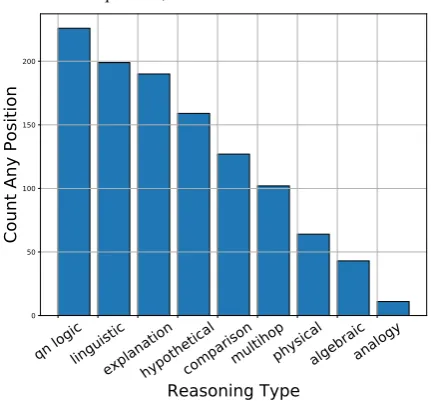
unique annotators (out of the possible 10) for 192 distinct questions. This annotation process pro-duced 1.42 knowledge type labels and 1.7 reason-ing type labels per question. Figure 2 and Figure 3 shows the distribution of annotation labels by all raters at any position. While Basic Facts domi-nates the knowledge type labels, there is no clear cut consensus for the reasoning type. Indeed, qn logic,linguistic, and explanationoccur most fre-quently.
4.1 Inter-Rater Agreement
A comprehensive look at the labels and inter-rater agreement can be found in Table 1 and Table 2. Fleiss’κis often used to measure inter-rater agree-ment (Cohen, 1995). Informally, this measures the
basic facts causes definitionexperimentsphysical purpose algebraic
Knowledge Type
0 50 100 150 200 250 300 350
[image:4.595.307.524.61.264.2]Total Count
Figure 2: Histogram of the first (most important) knowledge label for each question; the Y-axis refers to annotations.
qn logiclinguisticexplanation
hypotheticalcomparisonmultihopphysicalalgebraicanalogy
Reasoning Type
0 50 100 150 200
Count Any Position
Figure 3: Histogram of the first (most important) reasoning label for each question; the Y-axis refers to annotations.
amount of agreement, beyond chance, based on the number of raters, objects and classes.κ>0.2 is typically taken to denote good agreement be-tween raters, while a negative value means that there was little to no agreement. Since Fleiss’ κ
is only defined for a single set of labels, we con-sider only the first (most important) label for each question in the statistic we report.
In addition to Fleiss’κ we also use the Kemeny
[image:4.595.308.524.295.496.2]ground truth. This method of thinking is largely credited to Condorcet (de Caritat, 1785; Young, 1988) and there is recent work in characterizing other voting rules as maximum likelihood estima-tors (MLEs) (Conitzer et al., 2009). The Kemeny voting rule is the MLE of the Condorcet Noise Model, in which pairwise inversions of the pref-erence order happen uniformly at random (Young, 1988, 1995). Hence, if we assume all annotators make pairwise errors uniformly at random then Kemeny is the MLE of label orders they report.
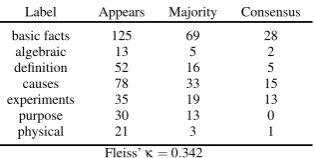
Label Appears Majority Consensus basic facts 125 69 28
algebraic 13 5 2 definition 52 16 5
causes 78 33 15
experiments 35 19 13
purpose 30 13 0
physical 21 3 1
Fleiss’κ=0.342
Table 1: Pairwise inter-rater agreement for Knowledge La-bels, along with the mean and Fleiss’κfor survey responses.
Label Appears Majority Consensus linguistic 66 31 8 algebraic 15 8 3 explanation 80 22 4 hypothetical 62 21 6
multihop 45 6 0
comparison 46 13 3 qn logic 78 33 2
physical 18 3 0
analogy 4 1 1
[image:5.595.104.262.221.300.2]Fleiss’κ=−0.683
Table 2: Pairwise inter-rater agreement for Reasoning La-bels, along with the mean and Fleiss’κfor survey responses.
4.1.1 Knowledge Labels
We achieveκ=0.342, which means that our raters
did a reasonable job of independently agreeing on the types of knowledge required to answer the questions. The mean Kemeny score of the con-sensus ranking for each question is 2.57, meaning that on average there are less than three flips re-quired to get from the consensus ranking to each of the annotators’ rankings. The most frequent label in the first position was basic facts, followed by
causes. Overall, there was a reasonable amount of consensus between the raters for knowledge type: 64/192 questions had a consensus amongst all the raters. Taken together, our results on knowledge type indicate that most questions deal with basic facts,causes, anddefinitions; and that labeling can be done reliably.
4.1.2 Reasoning Labels
The inter-rater agreement score for the reasoning labels tells a very different story from the
knowl-edge labels. The agreement was κ = −0.683, which indicates that raters did not agree above chance on their labels. Strong evidence for this comes from the fact that only27/192questions had a consensus label. This may be due to the fact that we allow multiple labels, and the annotators sim-ply disagree on theorder of the labels. However, the score of the consensus ranking for each ques-tion is 6.57, which indicates that on average the ordering of the labels is quite far apart.
Considering the histogram in Figure 3, we see that qn logic, linguistic, and explanation are the most frequent label types; this may indicate that getting better at understanding the questions them-selves could lead to a big boost for reasoners. For Figure 4, we have merged the first and second la-bel (if present) for all annotators. Now, the set of all possible labels is all singletons as well as all pairs of labels. Comparing this histogram to the one in Figure 3, we see that whilelinguistic and
explanationremain somewhat unchanged, the qn logic label becomes very spread out across the types. This is more support for our hypothesis that annotators may be disagreeing on the ordering of the labels, rather than the content itself.
linguistic explanation hypothetical/qn logic explanation/qn logic comparison comparison/qn logic linguistic/qn logic multihop explanation/hypothetical qn logic hypothetical explanation/linguistic hypothetical/multihop algebraic multihop/qn logic
Reasoning Type
0 Count 1st/2nd Combined20 40 60 80
Figure 4: Histogram of the reasoning labels when we com-bine the first and (if present) second label of every annotator. The count refers to annotations.
4.2 Search Results
[image:5.595.309.525.411.592.2]question plus given options as input queries. Since
DrQA returns a span from the input sentences, we picked the multiple choice option that maxi-mally overlapped with the returned answer span. Our baseline results are 7 correct out of 47 ques-tions. With the annotated context, the performance increased to 27 correctly answered questions - a 42% increase in accuracy. Encouraged by these re-sults, we posit that the community should focus a lot of attention on improving the retrieval portions of the various QA systems available; we think that annotated context will certainly help in training a better ranker. We conclude that the community should focus on improving the retrieval portion of their QA system and we think that the annotated context would help in training a better ranker.
5 Conclusion & Future Work
In this paper, we introduce a novel annotation in-terface and define annotation instructions for the knowledge and reasoning type labels that are used for question analysis for standardized tests. We an-notate approximately 200 questions from the ARC Challenge Set shared by AI2 with the types of knowledge and reasoning required to answer the respective questions. Each question has at least 3 annotators, with high agreement on the require-ments for knowledge type. We will leverage the knowledge and reasoning type annotations, as well as the search annotations, to improve the perfor-mance of QA systems. We will also release these annotations to the community to complement the ARC Dataset, and make our annotation interface available to interested researchers for use with other question-answering (QA) tasks.
References
Michael Boratko, Harshit Padigela, Divyendra Mikki-lineni, Pritish Yuvraj, Rajarshi Das, Andrew McCal-lum, Maria Chang, Achille Fokoue-Nkoutche, Pavan Kapanipathi, Nicholas Mattei, Ryan Musa, Kartik Talamadupula, and Michael Witbrock. 2018. A Sys-tematic Classification of the Knowledge, Reasoning, and Context within the ARC Dataset. In Proceed-ings of the ACL 2018 Workshop on Machine Read-ing for Question AnswerRead-ing (MRQA). Association for Computational Linguistics.
M. J. A. N. de Caritat. 1785. Essai sur l’application de l’analyse `a la probabilit´e des d´ecisions: rendues `a la pluralit´e des voix. Paris: L’Imprimerie Royale.
Danqi Chen, Adam Fisch, Jason Weston, and
An-toine Bordes. 2017. Reading wikipedia to
an-swer open-domain questions. arXiv preprint
arXiv:1704.00051.
Christopher Clark and Matt Gardner. 2017. Simple and effective multi-paragraph reading comprehen-sion.arXiv preprint arXiv:1710.10723.
P. Clark, I. Cowhey, O. Etzioni, T. Khot, A. Sabhar-wal, C. Schoenick, and O. Tafjord. 2018. Think you have solved question answering? Try ARC, the AI2 Reasning Challenge. InArXiv e-prints 1803.05457.
P. R. Cohen. 1995. Empirical Methods for Artificial Intelligence. MIT Press.
V. Conitzer, M. Rognlie, and L. Xia. 2009. Preference functions that score rankings and maximum likeli-hood estimation. InProceedings of the 21st Inter-national Joint Conference on Artificial Intelligence (IJCAI), pages 109–115.
Peter Jansen, Elizabeth Wainwright, Steven Mar-morstein, and Clayton Morrison. 2018. WorldTree: A Corpus of Explanation Graphs for Elementary Science Questions supporting Multi-hop Inference. InProceedings of the Eleventh International Confer-ence on Language Resources and Evaluation (LREC 2018).
J. G. Kemeny. 1959. Mathematics without numbers. Daedalus, 88(4):577–591.
M. G. Kendall. 1938. A new measure of rank correla-tion. Biometrika, 30(1/2):81–93.
Kenton Lee, Shimi Salant, Tom Kwiatkowski, Ankur Parikh, Dipanjan Das, and Jonathan Berant. 2016. Learning recurrent span representations for
ex-tractive question answering. arXiv preprint
arXiv:1611.01436.
Minjoon Seo, Aniruddha Kembhavi, Ali Farhadi, and Hannaneh Hajishirzi. 2016. Bi-directional attention flow for machine comprehension. arXiv preprint arXiv:1611.01603.
Shuohang Wang and Jing Jiang. 2016. Machine com-prehension using match-lstm and answer pointer. arXiv preprint arXiv:1608.07905.
Shuohang Wang, Mo Yu, Xiaoxiao Guo, Zhiguo Wang, Tim Klinger, Wei Zhang, Shiyu Chang, Gerald Tesauro, Bowen Zhou, and Jing Jiang. 2018. R3: Reinforced ranker-reader for open-domain question answering.
Caiming Xiong, Victor Zhong, and Richard Socher. 2016. Dynamic coattention networks for question answering. arXiv preprint arXiv:1611.01604.
H. P. Young. 1988. Condorcet’s theory of voting. The American Political Science Review, 82(4):1231 – 1244.