MultiWOZ - A Large-Scale Multi-Domain Wizard-of-Oz Dataset for
Task-Oriented Dialogue Modelling
PawełBudzianowski1, Tsung-Hsien Wen2⇤, Bo-Hsiang Tseng1, I˜nigo Casanueva1, Stefan Ultes1, Osman Ramadan1 and Milica Gaˇsi´c1
1Department of Engineering, University of Cambridge, UK,2PolyAI, UK
{pfb30,mg436}@cam.ac.uk
Abstract
Even though machine learning has become the major scene in dialogue research commu-nity, the real breakthrough has been blocked by the scale of data available. To address this fundamental obstacle, we introduce the Multi-Domain Wizard-of-Oz dataset (MultiWOZ), a fully-labeled collection of human-human writ-ten conversations spanning over multiple do-mains and topics. At a size of10k dialogues, it is at least one order of magnitude larger than all previous annotated task-oriented corpora. The contribution of this work apart from the open-sourced dataset labelled with dialogue belief states and dialogue actions is two-fold: firstly, a detailed description of the data collec-tion procedure along with a summary of data structure and analysis is provided. The pro-posed data-collection pipeline is entirely based on crowd-sourcing without the need of hir-ing professional annotators; secondly, a set of benchmark results of belief tracking, dialogue act and response generation is reported, which shows the usability of the data and sets a base-line for future studies.
1 Introduction
Conversational Artificial Intelligence (Conversa-tional AI) is one of the long-standing challenges in computer science and artificial intelligence since the Dartmouth Proposal (McCarthy et al., 1955). As human conversation is inherently complex and ambiguous, learning an open-domain conversa-tional AI that can carry on arbitrary tasks is still very far-off (Vinyals and Le,2015). As a conse-quence, instead of focusing on creating ambitious conversational agents that can reach human-level intelligence, industrial practice has focused on building task-oriented dialogue systems (Young et al.,2013) that can help with specific tasks such as flight reservation (Seneff and Polifroni, 2000)
⇤The work was done while at the University of Cam-bridge.
or bus information (Raux et al.,2005). As the need of hands-free use cases continues to grow, build-ing a conversational agent that can handle tasks across different application domains has become more and more prominent (Ram et al.,2018).
Dialogues systems are inherently hard to build because there are several layers of complexity: the noise and uncertainty in speech recognition (Black et al., 2011); the ambiguity when understand-ing human language (Williams et al., 2013); the need to integrate third-party services and dialogue context in the decision-making (Traum and Lars-son,2003;Paek and Pieraccini,2008); and finally, the ability to generate natural and engaging re-sponses (Stent et al., 2005). These difficulties have led to the same solution of using statistical framework and machine learning for various sys-tem components, such as natural language under-standing (Henderson et al., 2013; Mesnil et al., 2015; Mrkˇsi´c et al., 2017a), dialogue manage-ment (Gaˇsi´c and Young,2014;Tegho et al.,2018), language generation (Wen et al., 2015; Kiddon et al.,2016), and even end-to-end dialogue mod-elling (Zhao and Eskenazi,2016;Wen et al.,2017; Eric et al.,2017).
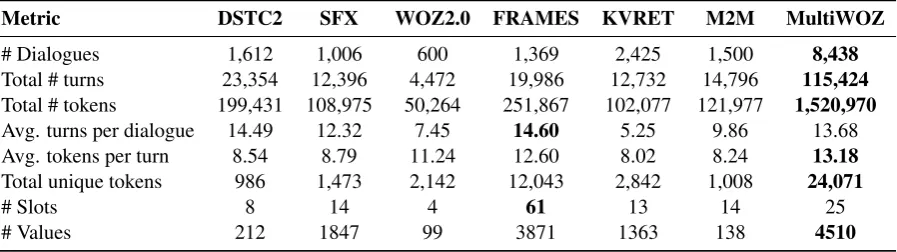
negli-Metric DSTC2 SFX WOZ2.0 FRAMES KVRET M2M MultiWOZ # Dialogues 1,612 1,006 600 1,369 2,425 1,500 8,438 Total # turns 23,354 12,396 4,472 19,986 12,732 14,796 115,424 Total # tokens 199,431 108,975 50,264 251,867 102,077 121,977 1,520,970 Avg. turns per dialogue 14.49 12.32 7.45 14.60 5.25 9.86 13.68 Avg. tokens per turn 8.54 8.79 11.24 12.60 8.02 8.24 13.18 Total unique tokens 986 1,473 2,142 12,043 2,842 1,008 24,071
# Slots 8 14 4 61 13 14 25
[image:2.595.77.526.64.190.2]# Values 212 1847 99 3871 1363 138 4510
Table 1: Comparison of our corpus to similar data sets. Numbers in bold indicate best value for the respective metric. The numbers are provided for the training part of data except for FRAMES data-set were such division was not defined.
gible linguistic variability.
This paper introduces the Multi-Domain Wizard-of-Oz (MultiWOZ) dataset, a large-scale multi-turn conversational corpus with dialogues spanning across several domains and topics. Each dialogue is annotated with a sequence of dia-logue states and corresponding system diadia-logue acts (Traum, 1999). Hence, MultiWOZ can be used to develop individual system modules as sep-arate classification tasks and serve as a benchmark for existing modular-based approaches. On the other hand, MultiWOZ has around10k dialogues,
which is at least one order of magnitude larger than any structured corpus currently available. This significant size of the corpus allows re-searchers to carry on end-to-end based dialogue modelling experiments, which may facilitate a lot of exciting ongoing research in the area.
This work presents the data collection approach, a summary of the data structure, as well as a se-ries of analyses of the data statistics. To show the potential and usefulness of the proposed Mul-tiWOZ corpus, benchmarking baselines of belief tracking, natural language generation and end-to-end response generation have been conducted and reported. The dataset and baseline models will be freely available online.1
2 Related Work
Existing datasets can be roughly grouped into three categories: machine-to-machine, human-to-machine, and human-to-human conversations. A detailed review of these categories is presented be-low.
1http://dialogue.mi.eng.cam.ac.uk/ index.php/corpus/
Machine-to-Machine Creating an environment
with a simulated user enables to exhaustively generate dialogue templates. These templates can be mapped to a natural language by either pre-defined rules (Bordes et al., 2017) or crowd workers (Shah et al., 2018). Such approach ensures a diversity and full coverage of all possi-ble dialogue outcomes within a certain domain. However, the naturalness of the dialogue flows relies entirely on the engineered set-up of the user and system bots. This poses a risk of a mis-match between training data and real interactions harming the interaction quality. Moreover, these datasets do not take into account noisy conditions often experienced in real interactions (Black et al., 2011).
Human-to-Machine Since collecting dialogue
corpus for a task-specific application from scratch is difficult, most of the task-oriented dialogue corpora are fostered based on an existing dia-logue system. One famous example of this kind is the Let’s Go Bus Information System which offers live bus schedule information over the phone (Raux et al., 2005) leading to the first Di-alogue State Tracking Challenge (Williams et al., 2013). Taking the idea of the Let’s Go system forward, the second and third DSTCs ( Hender-son et al., 2014b,c) have produced bootstrapped human-machine datasets for a restaurant search domain in the Cambridge area, UK. Since then, DSTCs have become one of the central research topics in the dialogue community (Kim et al., 2016,2017).
develop-ment, it is only possible with a provision of an existing working system. Therefore, this chicken (system)-and-egg (data) problem limits the use of this type of data collection to existing system improvement instead of developing systems in a completely new domain. What is even worse is that the capability of the initial system introduces additional biases to the collected data, which may result in a mismatch between the training and testing sets (Wen et al., 2016). The limited understanding capability of the initial system may prompt the users to adapt to simpler input examples that the system can understand but are not necessarily natural in conversations.
Human-to-Human Arguably, the best strategy
to build a natural conversational system may be to have a system that can directly mimic human behaviors through learning from a large amount of real human-human conversations. With this idea in mind, several large-scale dialogue corpora have been released in the past, such as the Twitter (Ritter et al.,2010) dataset, the Reddit conversations (Schrading et al., 2015), and the Ubuntu technical support corpus (Lowe et al., 2015). Although previous work (Vinyals and Le, 2015) has shown that a large learning system can learn to generate interesting responses from these corpora, the lack of grounding conversations onto an existing knowledge base or APIs limits the usability of developed systems. Due to the lack of an explicit goal in the conversation, recent studies have shown that systems trained with this type of corpus not only struggle in generating consistent and diverse responses (Li et al.,2016) but are also extremely hard to evaluate (Liu et al.,2016).
In this paper, we focus on a particular type of human-to-human data collection. The Wizard-of-Oz framework (WOZ) (Kelley,1984) was first proposed as an iterative approach to improve user experiences when designing a conversational sys-tem. The goal of WOZ data collection is to log down the conversation for future system develop-ment. One of the earliest dataset collected in this fashion is the ATIS corpus (Hemphill et al.,1990), where conversations between a client and an air-line help-desk operator were recorded.
[image:3.595.325.510.63.273.2]More recently, Wen et al. (2017) have shown that the WOZ approach can be applied to collect high-quality typed conversations where a machine
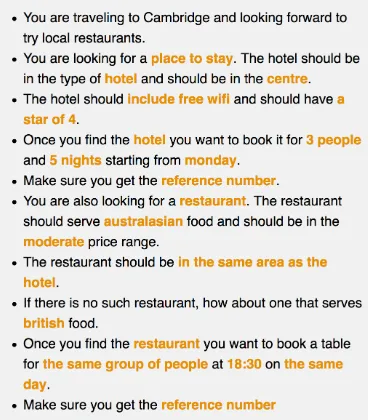
Figure 1: A sample task template spanning over three domains - hotels, restaurants and booking.
learning-based system can learn from. By modify-ing the original WOZ framework to make it suit-able for crowd-sourcing, a total of676dialogues
was collected via Amazon Mechanical Turk. The corpus was later extended to additional two lan-guages for cross-lingual research (Mrkˇsi´c et al., 2017b). Subsequently, this approach is followed byAsri et al.(2017) to collect the Frame corpus in a more complex travel booking domain, andEric et al. (2017) to collect a corpus of conversations for in-car navigation. Despite the fact that all these datasets contain highly natural conversations com-paring to other human-machine collected datasets, they are usually small in size with only a limited domain coverage.
3 Data Collection Set-up
Following the Wizard-of-Oz set-up (Kelley, 1984), corpora of annotated dialogues can be gath-ered at relatively low costs and with a small time effort. This is in contrast to previous ap-proaches (Henderson et al.,2014a) and such WOZ set-up has been successfully validated by Wen et al.(2017) andAsri et al.(2017).
Therefore, we follow the same process to create a large-scale corpus of natural human-human con-versations. Our goal was to collect multi-domain dialogues. To overcome the need of relying the data collection to a small set of trusted workers2,
Table 2: Full ontology for all domains in our data-set. The upper script indicates which domains it belongs to. *: universal, 1: restaurant, 2: hotel, 3: attraction, 4: taxi, 5: train, 6: hospital, 7: police.
act type inform
⇤/ request⇤/ select123/ recommend/123/ not found123
request booking info123/ offer booking1235/ inform booked1235/ decline booking1235 welcome⇤/greet⇤/ bye⇤ / reqmore⇤
slots
address⇤/ postcode⇤/ phone⇤ / name1234/ no of choices1235/ area123/
pricerange123/ type123/ internet2/ parking2/ stars2 / open hours3 / departure45 destination45/ leave after45/ arrive by45/ no of people1235/ reference no.1235/ trainID5/ ticket price5/ travel time5/ department7/ day1235/ no of days123
easy-to-operate system interface for the Wizards and easy-to-follow goals for the users. This re-sulted in a bigger diversity and semantical richness of the collected data (see Section4.3). Moreover, having a large set of workers mitigates the prob-lem of artificial encouragement of a variety of be-havior from users. A detailed explanation of the data-gathering process from both sides is provided below. Subsequently, we show how the crowd-sourcing scheme can also be employed to annotate the collected dialogues with dialogue acts.
3.1 Dialogue Task
The domain of a task-oriented dialogue system is often defined by an ontology, a structured repre-sentation of the back-end database. The ontology defines all entity attributes called slots and all pos-sible values for each slot. In general, the slots may be divided into informable slots and requestable slots. Informable slots are attributes that allow the user to constrain the search (e.g., area or price range). Requestableslots represent additional in-formation the users can request about a given en-tity (e.g., phone number). Based on a given on-tology spanning several domains, a task template was created for each task through random sam-pling. This results in single and multi-domain di-alogue scenarios and domain specific constraints were generated. In domains that allowed for that, an additional booking requirement was sampled with some probability.
To model more realistic conversations, goal changes are encouraged. With a certain proba-bility, the initial constraints of a task may be set to values so that no matching database entry ex-ists. Once informed about that situation by the system, the users only needed to follow the goal which provided alternative values.
3.2 User Side
To provide information to the users, each task tem-plate is mapped to natural language. Using heuris-tic rules, the task is then gradually introduced to the user to prevent an overflow of information. The goal description presented to the user is de-pendent on the number of turns already performed. Moreover, if the user is required to perform a sub-task (for example - booking a venue), these sub-goals are shown straight-away along with the main goal in the given domain. This makes the dialogues more similar to spoken conversations.3
Figure1 shows a sampled task description span-ning over two domains with booking requirement. Natural incorporation of co-referencing and lex-ical entailment into the dialogue was achieved through implicit mentioning of some slots in the goal.
3.3 System Side
The wizard is asked to perform a role of a clerk by providing information required by the user. He is given an easy-to-operate graphical user inter-face to the back-end database. The wizard conveys the information provided by the current user input through a web form. This information is persis-tent across turns and is used to query the database. Thus, the annotation of a belief state is performed implicitly while the wizard is allowed to fully fo-cus on providing the required information. Given the result of the query (a list of entities satisfy-ing current constraints), the wizard either requests more details or provides the user with the adequate information. At each system turn, the wizard starts with the results of the query from the previous turn.
To ensure coherence and consistency, the wiz-ard and the user alike first need to go through the 3However, the length of turns are significantly longer
Figure 2: Dialogue length distribution (left) and distribution of number of tokens per turn (right).
dialogue history to establish the respective con-text. We found that even though multiple workers contributed to one dialogue, only a small margin of dialogues were incoherent.
3.4 Annotation of Dialogue Acts
Arguably, the most challenging and time-consuming part of any dialogue data collection is the process of annotating dialogue acts. One of the major challenges of this task is the definition of a set and structure of dialogue acts (Traum and Hinkelman,1992;Bunt,2006). In general, a dia-logue act consists of the intent (such as request or inform) and slot-value pairs. For example, the act inform(domain=hotel,price=expensive) has the intentinform, where the user is informing the system to constrain the search to expensive hotels.
Expecting a big discrepancy in annotations be-tween annotators, we initially ran three trial tests over a subset of dialogues using Amazon Mechan-ical Turk. Three annotations per dialogue were gathered resulting in around750turns. As this
re-quires a multi-annotator metric over a multi-label task, we used Fleiss’ kappa metric (Fleiss,1971) per single dialogue act. Although the weighted kappa value averaged over dialogue acts was at a high level of 0.704, we have observed many
cases of very poor annotations and an unsatisfac-tory coverage of dialogue acts. Initial errors in annotations and suggestions from crowd workers gradually helped us to expand and improve the fi-nal set of dialogue acts from8 to 13 - see Table 2.
The variation in annotations made us change the initial approach. We ran a two-phase trial to first
identify set of workers that perform well. Turk-ers were asked to annotate an illustrative, long di-alogue which covered many problematic examples that we have observed in the initial run described above. All submissions that were of high quality were inspected and corrections were reported to annotators. Workers were asked to re-run a new trial dialogue. Having passed the second test, they were allowed to start annotating real dialogues. This procedure resulted in a restricted set of an-notators performing high quality annotations. Ap-pendix A contains a demonstration of a created system.
3.5 Data Quality
Data collection was performed in a two-step pro-cess. First, all dialogues were collected and then the annotation process was launched. This setup allowed the dialogue act annotators to also report errors (e.g., not following the task or confusing utterances) found in the collected dialogues. As a result, many errors could be corrected. Finally, additional tests were performed to ensure that the provided information in the dialogues match the pre-defined goals.
To estimate the inter-annotator agreement, the averaged weighted kappa value for all dialogue acts was computed over 291 turns. With = 0.884, an improvement in agreement between
an-notators was achieved although the size of action set was significantly larger.
4 MultiWOZ Dialogue Corpus
Figure 3: Dialogue acts frequency (left) and number of dialogue acts per turn (right) in the collected corpus.
city. We considered various possible dialogue sce-narios ranging from requesting basic information about attractions through booking a hotel room or travelling between cities. In total, the presented corpus consists of7domains -Attraction,
Hospi-tal, Police, Hotel, Restaurant, Taxi, Train. The lat-ter four are extended domains which include the sub-taskBooking. Through a task sampling pro-cedure (Section3.1), the dialogues cover between
1and5domains per dialogue thus greatly varying
in length and complexity. This broad range of do-mains allows to create scenarios where dodo-mains are naturally connected. For example, a tourist needs to find a hotel, to get the list of attractions and to book a taxi to travel between both places. Table2presents the global ontology with the list of considered dialogue acts.
4.1 Data Statistics
Following data collection process from the previ-ous section, a total of10,438dialogues were
col-lected. Figure 2 (left) shows the dialogue length distribution grouped by single and multi domain dialogues. Around 70% of dialogues have more
than 10turns which shows the complexity of the
corpus. The average number of turns are8.93and 15.39 for single and multi-domain dialogues
re-spectively with 115,434turns in total. Figure 2
(right) presents a distribution over the turn lengths. As expected, the wizard replies are much longer -the average sentence lengths are11.75and15.12
for users and wizards respectively. The responses are also more diverse thus enabling the training of more complex generation models.
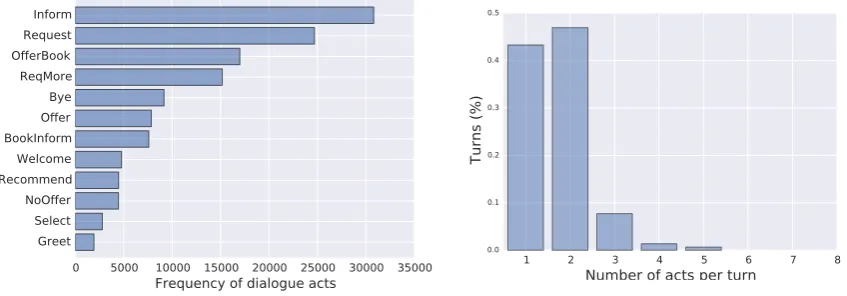
Figure3(left) shows the distribution of dialogue acts annotated in the corpus. We present here a summarized list where different types of actions
likeinformare grouped together. The right graph
in the Figure3presents the distribution of number of acts per turn. Almost60% of dialogues turns
have more than one dialogue act showing again the richness of system utterances. These create a new challenge for reinforcement learning-based models requiring them to operate on concurrent actions.
In total, 1,249workers contributed to the
cor-pus creation with only few instances of intentional wrongdoing. Additional restrictions were added to automatically discover instances of very short utterances, short dialogues or missing single turns during annotations. All such cases were corrected or deleted from the corpus.
4.2 Data Structure
There are3,406single-domain dialogues that
in-clude booking if the domain allows for that and
7,032 multi-domain dialogues consisting of at
least2up to5domains. To enforce
reproducibil-ity of results, the corpus was randomly split into a train, test and development set. The test and de-velopment sets contain 1k examples each. Even
though all dialogues are coherent, some of them were not finished in terms of task description. Therefore, the validation and test sets only con-tain fully successful dialogues thus enabling a fair comparison of models.
set of dialogue acts with slots per turn. Addition-ally, the task description in natural language pre-sented to turkers working from the visitor’s side is added.
4.3 Comparison to Other Structured Corpora
To illustrate the contribution of the new corpus, we compare it on several important statistics with the DSTC2 corpus (Henderson et al.,2014a), the SFX corpus (Gaˇsi´c et al.,2014), the WOZ2.0
cor-pus (Wen et al.,2017), the FRAMES corpus (Asri et al.,2017), the KVRET corpus (Eric et al.,2017), and the M2M corpus (Shah et al.,2018). Figure1 clearly shows that our corpus compares favorably to all other data sets on most of the metrics with the number of total dialogues, the average number of tokens per turn and the total number of unique tokens as the most prominent ones. Especially the latter is important as it is directly linked to linguis-tic richness.
5 MultiWOZ as a New Benchmark The complexity and the rich linguistic variation in the collected MultiWOZ dataset makes it a great benchmark for a range of dialogue tasks. To show the potential usefulness of the Multi-WOZ corpus, we break down the dialogue mod-elling task into three sub-tasks and report a bench-mark result for each of them: dialogue state track-ing, act-to-text generation, and dialogue-context-to-text generation. These results illus-trate new challenges introduced by the MultiWOZ dataset for different dialogue modelling problems.
5.1 Dialogue State Tracking
A robust natural language understanding and dia-logue state tracking is the first step towards build-ing a good conversational system. Since multi-domain dialogue state tracking is still in its infancy and there are not many comparable approaches available (Rastogi et al.,2017), we instead report our state-of-the-art result on the restaurant subset of the MultiWOZ corpus as the reference baseline. The proposed method (Ramadan et al., 2018) ex-ploits the semantic similarity between dialogue ut-terances and the ontology terms which allows the information to be shared across domains. Further-more, the model parameters are independent of the ontology and belief states, therefore the number of the parameters does not increase with the size of
the domain itself.4
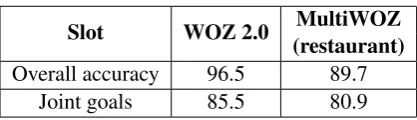
Slot WOZ 2.0 MultiWOZ(restaurant)
Overall accuracy 96.5 89.7
[image:7.595.312.521.83.143.2]Joint goals 85.5 80.9
Table 3: The test set accuraciesoveralland forjoint
goalsin the restaurant sub-domain.
The same model was trained on both the WOZ2.0 and the proposed MultiWOZ datasets, where the WOZ2.0 corpus consists of 1200
sin-gle domain dialogues in the restaurant domain. Although not directly comparable, Table3shows that the performance of the model is consecutively poorer on the new dataset compared to WOZ2.0.
These results demonstrate how demanding is the new dataset as the conversations are richer and much longer.
5.2 Dialogue-Context-to-Text Generation
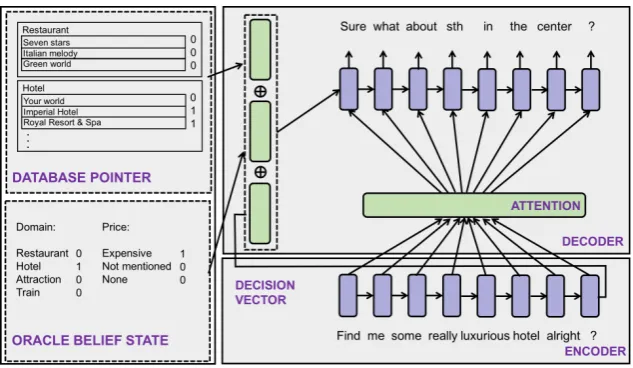
After a robust dialogue state tracking module is built, the next challenge becomes the dia-logue management and response generation com-ponents. These problems can either be addressed separately (Young et al., 2013), or jointly in an end-to-end fashion (Bordes et al.,2017;Wen et al., 2017;Li et al.,2017). In order to establish a clear benchmark where the performance of the compos-ite of dialogue management and response genera-tion is completely independent of the belief track-ing, we experimented with a baseline neural re-sponse generation model with an oracle belief-state obtained from the wizard annotations as dis-cussed in Section3.3.5
FollowingWen et al. (2017) which frames the dialogue as a context to response mapping prob-lem, a sequence-to-sequence model (Sutskever et al., 2014) is augmented with a belief tracker and a discrete database accessing component as additional features to inform the word decisions in the decoder. Note, in the original paper the belief tracker was pre-trained while in this work the annotations of the dialogue state are used as an oracle tracker. Figure 4presents the architecture of the system (Budzianowski et al.,2018).
4The model is publicly available at https://github.com/osmanio2/
multi-domain-belief-tracking
Figure 4: Architecture of the multi-domain response generator. The attention is conditioned on the oracle belief state and the database pointer.
Training and Evaluation Since often times the
evaluation of a dialogue system without a direct interaction with the real users can be mislead-ing (Liu et al., 2016), three different automatic metrics are included to ensure the result is better interpreted. Among them, the first two metrics relate to the dialogue task completion - whether the system has provided an appropriate entity (In-form rate) and then answered all the requested at-tributes (Success rate); while fluency is measured via BLEU score (Papineni et al.,2002). The best models for both datasets were found through a grid search over a set of hyper-parameters such as the size of embeddings, learning rate and different re-current architectures.
We trained the same neural architecture (taking into account different number of domains) on both MultiWOZ and Cam676 datasets. The best results on the Cam676 corpus were obtained with bidirec-tional GRU cell. In the case of MultiWOZ dataset, the LSTM cell serving as a decoder and an en-coder achieved the highest score with the global type of attention (Bahdanau et al.,2014). Table4 presents the results of a various of model architec-tures and shows several challenges. As expected, the model achieves almost perfect score on the In-form metric on the Cam676 dataset taking the ad-vantage of an oracle belief state signal. However, even with the perfect dialogue state tracking of the user intent, the baseline models obtain almost30%
lower score on the Inform metric on the new cor-pus. The addition of the attention improves the score on the Success metric on the new dataset by less than 1%. Nevertheless, as expected, the
best model on MultiWOZ is still falling behind by a large margin in comparison to the results on the Cam676 corpus taking into account both In-form and Success metrics. As most of dialogues span over at least two domains, the model has to be much more effective in order to execute a suc-cessful dialogue. Moreover, the BLEU score on the MultiWOZ is lower than the one reported on the Cam676 dataset. This is mainly caused by the much more diverse linguistic expressions ob-served in the MultiWOZ dataset.
5.3 Dialogue-Act-to-Text Generation
Natural Language Generation from a structured meaning representation (Oh and Rudnicky,2000; Bohus and Rudnicky,2005) has been a very pop-ular research topic in the community, and the lack of data has been a long standing block for the field to adopt more machine learning methods. Due to the additional annotation of the system acts, the MultiWOZ dataset serves as a new benchmark for studying natural language generation from a struc-tured meaning representation. In order to verify the difficulty of the collected dataset for the lan-guage generation task, we compare it to the SFX dataset (see Table1), which consists of around5k
dia-Cam676 MultiWOZ
w/o attention w/ attention w/o attention w/ attention
Inform (%) 99.17 99.58 71.29 71.33
Success (%) 75.08 73.75 60.29 60.96
[image:9.595.133.463.61.130.2]BLEU 0.219 0.204 0.188 0.189
Table 4: Performance comparison of two different model architectures using a corpus-based evaluation.
logue turns. To give more statistics about the two datasets: the SFX corpus has9different act types
with12slots comparing to12acts and14slots in
our corpus. The best model for both datasets was found through a grid search over a set of hyper-parameters such as the size of embeddings, learn-ing rate, and number of LSTM layers.6
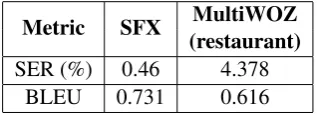
Table 5 presents the results on two metrics: BLEU score (Papineni et al.,2002) and slot error rate (SER) (Wen et al., 2015). The significantly lower metrics on the MultiWOZ corpus showed that it is much more challenging than the SFX restaurant dataset. This is probably due to the fact that more than60%of the dialogue turns are
com-posed of at least two system acts, which greatly harms the performance of the existing model.
Metric SFX (restaurant)MultiWOZ
SER (%) 0.46 4.378
[image:9.595.102.261.385.442.2]BLEU 0.731 0.616
Table 5: The test set slot error rate (SER) and BLEU on the SFX dataset and the MultiWOZ restaurant subset.
6 Conclusions
As more and more speech oriented applications are commercially deployed, the necessity of build-ing an entirely data-driven conversational agent becomes more apparent. Various corpora were gathered to enable data-driven approaches to di-alogue modelling. To date, however, the avail-able datasets were usually constrained in linguis-tic variability or lacking multi-domain use cases. In this paper, we established a data-collection pipeline entirely based on crowd-sourcing en-abling to gather a large scale, linguistically rich corpus of human-human conversations. We hope that MultiWOZ offers valuable training data and a new challenging testbed for existing modular-based approaches ranging from belief tracking to 6The model is publicly available at https://github.com/andy194673/
nlg-sclstm-multiwoz
dialogue acts generation. Moreover, the scale of the data should help push forward research in the end-to-end dialogue modelling.
Acknowledgments
This work was funded by a Google Faculty Re-search Award (RG91111), an EPSRC studentship (RG80792), an EPSRC grant (EP/M018946/1) and by Toshiba Research Europe Ltd, Cam-bridge Research Laboratory (RG85875). The authors thank many excellent Mechanical Turk contributors for building this dataset. The au-thors would also like to thank Thang Minh Luong for his support for this project ad Nikola Mrkˇsi´c and anonymous reviewers for their constructive feedback. The data is
avail-able at http://dialogue.mi.eng.cam.
ac.uk/index.php/corpus/.
References
Layla El Asri, Hannes Schulz, Shikhar Sharma, Jeremie Zumer, Justin Harris, Emery Fine, Rahul Mehrotra, and Kaheer Suleman. 2017. Frames: A corpus for adding memory to goal-oriented dialogue systems. Proceedings of SigDial.
Dzmitry Bahdanau, Kyunghyun Cho, and Yoshua Ben-gio. 2014. Neural machine translation by jointly learning to align and translate. ICLR.
Alan W Black, Susanne Burger, Alistair Conkie, He-len Hastie, Simon Keizer, Oliver Lemon, Nicolas Merigaud, Gabriel Parent, Gabriel Schubiner, Blaise Thomson, et al. 2011. Spoken dialog challenge 2010: Comparison of live and control test results. In Proceedings of the SIGDIAL 2011 Conference, pages 2–7. Association for Computational Linguis-tics.
Dan Bohus and Alexander I Rudnicky. 2005. Sorry, i didn’t catch that! - an investigation of non-understanding errors and recovery strategies. In6th SIGdial workshop on discourse and dialogue.
Antoine Bordes, Y-Lan Boureau, and Jason Weston. 2017. Learning end-to-end goal-oriented dialog.
Paweł Budzianowski, I˜nigo Casanueva, Bo-Hsiang Tseng, and Milica Gaˇsi´c. 2018. Towards end-to-end multi-domain dialogue modelling. Tech. Rep. CUED/F-INFENG/TR.706, University of Cam-bridge, Engineering Department.
Harry Bunt. 2006. Dimensions in dialogue act annota-tion. InProc. of LREC, volume 6, pages 919–924.
Mihail Eric, Lakshmi Krishnan, Francois Charette, and Christopher D Manning. 2017. Key-value retrieval networks for task-oriented dialogue. InProceedings of the 18th Annual SIGdial Meeting on Discourse and Dialogue, pages 37–49.
Joseph L Fleiss. 1971. Measuring nominal scale agree-ment among many raters. Psychological bulletin, 76(5):378.
Milica Gaˇsi´c, Dongho Kim, Pirros Tsiakoulis, Cather-ine Breslin, Matthew Henderson, Martin Szummer, Blaise Thomson, and Steve Young. 2014. Incre-mental on-line adaptation of pomdp-based dialogue managers to extended domains. InInterspeech.
Milica Gaˇsi´c and Steve Young. 2014. Gaussian pro-cesses for pomdp-based dialogue manager optimiza-tion. TASLP, 22(1):28–40.
Charles T Hemphill, John J Godfrey, and George R Doddington. 1990. The atis spoken language sys-tems pilot corpus. InSpeech and Natural Language: Proceedings of a Workshop Held at Hidden Valley, Pennsylvania.
M. Henderson, B. Thomson, and J. Williams. 2014a. The second dialog state tracking challenge. In Pro-ceedings of SIGdial.
M. Henderson, B. Thomson, and S. J. Young. 2014b. Word-based Dialog State Tracking with Recurrent Neural Networks. InProceedings of SIGdial.
Matthew Henderson, Blaise Thomson, and Jason D Williams. 2014c. The third dialog state tracking challenge. InSpoken Language Technology Work-shop (SLT), 2014 IEEE, pages 324–329. IEEE.
Matthew Henderson, Blaise Thomson, and Steve Young. 2013. Deep neural network approach for the dialog state tracking challenge. In Proceedings of the SIGDIAL 2013 Conference, pages 467–471.
John F Kelley. 1984. An iterative design methodol-ogy for user-friendly natural language office infor-mation applications. ACM Transactions on Infor-mation Systems (TOIS), 2(1):26–41.
Chlo´e Kiddon, Luke Zettlemoyer, and Yejin Choi. 2016. Globally coherent text generation with neural checklist models. InProceedings of the 2016 Con-ference on Empirical Methods in Natural Language Processing, pages 329–339.
Seokhwan Kim, Luis Fernando D’Haro, Rafael E Banchs, Jason D Williams, Matthew Henderson, and Koichiro Yoshino. 2016. The fifth dialog state tracking challenge. InSpoken Language Technology Workshop (SLT), 2016 IEEE, pages 511–517. IEEE.
Seokhwan Kim, Luis Fernando DHaro, Rafael E Banchs, Jason D Williams, and Matthew Henderson. 2017. The fourth dialog state tracking challenge. In Dialogues with Social Robots, pages 435–449. Springer.
Jiwei Li, Michel Galley, Chris Brockett, Jianfeng Gao, and Bill Dolan. 2016. A diversity-promoting ob-jective function for neural conversation models. In
NAACL-HLT, pages 110–119, San Diego, Califor-nia. Association for Computational Linguistics.
Xiujun Li, Yun-Nung Chen, Lihong Li, Jianfeng Gao, and Asli Celikyilmaz. 2017. End-to-end task-completion neural dialogue systems. InProceedings of the Eighth International Joint Conference on Nat-ural Language Processing (Volume 1: Long Papers), volume 1, pages 733–743.
Chia-Wei Liu, Ryan Lowe, Iulian Serban, Mike Nose-worthy, Laurent Charlin, and Joelle Pineau. 2016. How not to evaluate your dialogue system: An em-pirical study of unsupervised evaluation metrics for dialogue response generation. InProceedings of the 2016 Conference on Empirical Methods in Natural Language Processing, pages 2122–2132.
Ryan Lowe, Nissan Pow, Iulian V Serban, and Joelle Pineau. 2015. The ubuntu dialogue corpus: A large dataset for research in unstructured multi-turn di-alogue systems. In 16th Annual Meeting of the Special Interest Group on Discourse and Dialogue, page 285.
J. McCarthy, M. L. Minsky, N. Rochester, and C. E. Shannon. 1955. A proposal for the dartmouth sum-mer research project on artificial intelligence.
Gr´egoire Mesnil, Yann Dauphin, Kaisheng Yao, Yoshua Bengio, Li Deng, Dilek Hakkani-Tur, Xi-aodong He, Larry Heck, Gokhan Tur, Dong Yu, et al. 2015. Using recurrent neural networks for slot fill-ing in spoken language understandfill-ing. IEEE/ACM Transactions on Audio, Speech, and Language Pro-cessing, 23(3):530–539.
Nikola Mrkˇsi´c, Diarmuid ´O S´eaghdha, Tsung-Hsien Wen, Blaise Thomson, and Steve Young. 2017a. Neural belief tracker: Data-driven dialogue state tracking. InProceedings of the 55th Annual Meet-ing of the Association for Computational LMeet-inguistics (Volume 1: Long Papers), volume 1, pages 1777– 1788.
monolingual and cross-lingual constraints. Transac-tions of the Association of Computational Linguis-tics, 5(1):309–324.
Alice H Oh and Alexander I Rudnicky. 2000. Stochas-tic language generation for spoken dialogue sys-tems. In Proceedings of the 2000 ANLP/NAACL Workshop on Conversational systems-Volume 3, pages 27–32. Association for Computational Lin-guistics.
Tim Paek and Roberto Pieraccini. 2008. Automating spoken dialogue management design using machine learning: An industry perspective. Speech commu-nication, 50(8-9):716–729.
Kishore Papineni, Salim Roukos, Todd Ward, and Wei-Jing Zhu. 2002. Bleu: a method for automatic eval-uation of machine translation. In Proceedings of the 40th annual meeting on association for compu-tational linguistics, pages 311–318. Association for Computational Linguistics.
Ashwin Ram, Rohit Prasad, Chandra Khatri, Anu Venkatesh, Raefer Gabriel, Qing Liu, Jeff Nunn, Behnam Hedayatnia, Ming Cheng, Ashish Nagar, et al. 2018. Conversational ai: The science behind the alexa prize.arXiv preprint arXiv:1801.03604.
Osman Ramadan, Paweł Budzianowski, and Milica Gaˇsi´c. 2018. Large-scale multi-domain belief track-ing with knowledge shartrack-ing. InProceedings of the 56th Annual Meeting of the Association for Compu-tational Linguistics, volume 2, pages 432–437.
Abhinav Rastogi, Dilek Hakkani-Tur, and Larry Heck. 2017. Scalable multi-domain dialogue state track-ing. arXiv preprint arXiv:1712.10224.
Antoine Raux, Brian Langner, Dan Bohus, Alan W Black, and Maxine Eskenazi. 2005. Let’s go pub-lic! taking a spoken dialog system to the real world. In Ninth European Conference on Speech Commu-nication and Technology.
Alan Ritter, Colin Cherry, and Bill Dolan. 2010. Un-supervised modeling of twitter conversations. In
Human Language Technologies: The 2010 Annual Conference of the North American Chapter of the Association for Computational Linguistics, pages 172–180.
Nicolas Schrading, Cecilia Ovesdotter Alm, Ray Ptucha, and Christopher Homan. 2015. An analysis of domestic abuse discourse on reddit. In Proceed-ings of the 2015 Conference on Empirical Methods in Natural Language Processing, pages 2577–2583.
Stephanie Seneff and Joseph Polifroni. 2000. Dia-logue management in the mercury flight reservation system. InProceedings of the 2000 ANLP/NAACL Workshop on Conversational Systems - Volume 3, ANLP/NAACL-ConvSyst ’00, pages 11–16, Stroudsburg, PA, USA. Association for Computa-tional Linguistics.
P Shah, D Hakkani-Tur, G Tur, A Rastogi, A Bapna, N Nayak, and L Heck. 2018. Building a conversa-tional agent overnight with dialogue self-play. arXiv preprint arXiv:1801.04871.
Amanda Stent, Matthew Marge, and Mohit Singhai. 2005. Evaluating evaluation methods for generation in the presence of variation. In International Con-ference on Intelligent Text Processing and Compu-tational Linguistics, pages 341–351. Springer.
Ilya Sutskever, Oriol Vinyals, and Quoc V Le. 2014. Sequence to sequence learning with neural net-works. InAdvances in neural information process-ing systems, pages 3104–3112.
Christopher Tegho, PawełBudzianowski, and Milica Gaˇsi´c. 2018. Benchmarking uncertainty estimates with deep reinforcement learning for dialogue pol-icy optimisation. InIEEE ICASSP.
David R. Traum. 1999. Foundations of Rational Agency, chapter Speech Acts for Dialogue Agents. Springer.
David R Traum and Elizabeth A Hinkelman. 1992. Conversation acts in task-oriented spoken dialogue.
Computational intelligence, 8(3):575–599.
David R Traum and Staffan Larsson. 2003. The in-formation state approach to dialogue management. InCurrent and new directions in discourse and dia-logue, pages 325–353. Springer.
Oriol Vinyals and Quoc Le. 2015. A neural conversa-tional model. arXiv preprint arXiv:1506.05869.
Tsung-Hsien Wen, Milica Gaˇsi´c, Nikola Mrksic, Lina M Rojas-Barahona, Pei-Hao Su, David Vandyke, and Steve Young. 2016. Multi-domain neural network language generation for spoken di-alogue systems.ACL.
Tsung-Hsien Wen, Milica Gaˇsi´c, Nikola Mrkˇsi´c, Pei-Hao Su, David Vandyke, and Steve Young. 2015. Semantically conditioned lstm-based natural lan-guage generation for spoken dialogue systems. In Proceedings of the 2015 Conference on Em-pirical Methods in Natural Language Processing (EMNLP).
Tsung-Hsien Wen, David Vandyke, Nikola Mrksic, Milica Gaˇsi´c, Lina M Rojas-Barahona, Pei-Hao Su, Stefan Ultes, and Steve Young. 2017. A network-based end-to-end trainable task-oriented dialogue system. EACL.
Jason Williams, Antoine Raux, Deepak Ramachan-dran, and Alan Black. 2013. The dialog state track-ing challenge. InProceedings of the SIGDIAL 2013 Conference, pages 404–413.