Proceedings of the Second Workshop on Abusive Language Online (ALW2), pages 138–148
138
Did you offend me?
Classification of Offensive Tweets in Hinglish Language
Puneet Mathur NSIT-Delhi
Ramit Sawhney NSIT-Delhi
Meghna Ayyar IIIT-Delhi
Rajiv Ratn Shah IIIT-Delhi
Abstract
The use of code-switched languages (e.g., Hinglish, which is derived by the blending of Hindi with the English language) is get-ting much popular on Twitter due to their ease of communication in native languages. However, spelling variations and absence of grammar rules introduce ambiguity and make it difficult to understand the text automati-cally. This paper presents the Multi-Input Multi-Channel Transfer Learning based model (MIMCT) to detect offensive (hate speech or abusive) Hinglish tweets from the proposed Hinglish Offensive Tweet (HOT) dataset us-ing transfer learnus-ing coupled with multiple feature inputs. Specifically, it takes multi-ple primary word embedding along with sec-ondary extracted features as inputs to train a multi-channel CNN-LSTM architecture that has been pre-trained on English tweets through transfer learning. The proposed MIMCT model outperforms the baseline supervised classification models, transfer learning based CNN and LSTM models to establish itself as the state of the art in the unexplored domain of Hinglish offensive text classification.
1 Introduction
Increasing penetration of social media websites such as Twitter in linguistically distinct demo-graphic regions has led to a blend of natively spoken languages with English, known as code-switched languages. Social media is rife with such offensive content that can be broadly classified as abusive and hate-inducing on the basis of sever-ity and target of the discrimination. Hate speech (Davidson et al.,2017) is an act of offending a per-son or a group as a whole on the basis of certain key attributes such as religion, race, sexual ori-entation, gender, ideological background, mental and physical disability. On the other hand, abu-sive speech is offenabu-sive speech with a vague
tar-get and mild intention to hurt the sentiments of the receiver. Most social media platforms delete such offensive content when: (i) either someone reports manually or (ii) an offensive content classi-fier automatically detects them. However, people often use such code-switched languages to write offensive content on social media so that English trained classifiers can not detect them automati-cally, necessitating an efficient classifier that can detect offensive content automatically from code-switched languages. In 2015, India ranked fourth on the Social Hostilities Index with an index value of 8.7 out of 10 (Grim and Cooperman, 2014), making it imperative to filter the tremendously high offensive online content in Hinglish.
We present deep learning techniques that clas-sify the input tweets in Hinglish as: (i) non-offensive, (ii) abusive and (iii) hate-inducing. Since transfer learning can act as an effective strat-egy to reuse already learned features in learning a specialized task through cross domain knowledge transfer, hate speech classification on a large En-glish corpus can act as source tasks to help in ob-taining pre-trained deep learning classifiers for the target task of classifying tweets translated in En-glish from HinEn-glish language.
Representation vectors constructed by CNN consider local relationship values while the feature vectors constructed by LSTM stress on overall de-pendencies of the whole sentence. The proposed MIMCT model employs both CNN and LSTM as concurrent information channels that benefit from local as well as overall semantic relationship and is further supported by primary features (multi-ple word embeddings) and secondary external fea-tures (LIWC feature, profanity vector and senti-ment score), as described in Section 3.3. The complete MIMCT model is pre-trained on En-glish Offensive Tweet (EOT) dataset, which is an open source dataset of annotated English tweets that was obtained from CrowdFlower1 and is an abridged version of the original dataset created by Davidson et al.(2017), followed by re-training on the proposed HOT dataset.
The main contributions of our work can be sum-marized as follows:
• Building an annotated Hinglish Offensive Tweet (HOT) dataset2.
• We ascertain the usefulness of transfer learn-ing for classifylearn-ing offensive Hlearn-inglish tweets.
• We build a novel MIMCT model that outper-forms the baseline models on HOT.
The remainder of this paper is organized as fol-lows. Sections 2 and3 discuss the related work and methodologies in detail, respectively. Discus-sions and evaluations are done in Section 4 fol-lowed by conclusion and future work in Section5.
2 Related Work
One of the earliest works on code switched languages was presented by Bhatia and Ritchie
1
https://www.crowdflower.com/
2The dataset and source code is available for
re-search purposes at www.github.com/pmathur5k10/ Hinglish-Offensive-Text-Classification
(2008) demonstrating cross-linguistic interaction on a semantic level. Several attempts to trans-late the Hindi-English mixed language into pure English have been made previously, but a major hindrance to this progress has been the fact that the structure of language varies due to relative discrepancies in grammatical features (Bhargava et al.,1988). Ravi and Ravi(2016) proved that a combination of TF-IDF features, gain ratio based feature selection, and Radial Basis Function Neu-ral Network work best for sentiment classification in Hinglish text.Joshi et al.(2016) used sub-word level LSTM models for Hinglish sentiment analy-sis. Efforts to detect offensive text in online textual content have been undertaken previously for other languages as well like German (Ross et al.,2017) and Arabic (Mubarak et al.,2017).
Gamb¨ack and Sikdar (2017) used a multi-channel HybridCNN architecture to arrive at promising results for hate speech detection in En-glish tweets. Badjatiya et al. (2017) presented a gradient boosted LSTM model with random em-beddings to outperform state of the art hate speech detection techniques. Vo et al. (2017) demon-strated the use of multi-channel CNN-LSTM model for Vietnamese sentiment analysis. The use of transfer learning enables the application of feature-based knowledge transference in domains with disparate feature spaces and data distribution (Pan and Yang, 2010). Pan et al. (2012) gave a detailed explanation about the application of transfer learning for cross-domain, instance-based and feature-based text classification. An impor-tant work in this direction of Hinglish offensive text classification was done by by Mathur et al. (2018b) by effectively employing transfer learn-ing.
3 Methodology
3.1 Pre-processing
The tweets obtained from data sources were chan-neled through a pre-processing pipeline with the aim to transform them into semantic feature vec-tors. The transliteration process was broken into intermediate steps:
Step 1: The first pre-processing step was the removal of punctuations, URLs, user mentions
NLTK was used to eliminate most unproductive words which provide little information about in-dividual tweets. This was followed by translitera-tion and then translatranslitera-tion of each word in Hinglish tweet into the corresponding English word using the Hinglish-English dictionary mentioned in Sec-tion 4.1. At this step, the syntax and grammatical notions of the target language were ignored and the resultant tweet was treated as an assortment of isolated words and phrases to make them eligible for conversion into word vector representation.
Step 2: We used multiple word embedding representations such as Glove (Pennington et al., 2014), Twitter word2vec (Godin et al.,2015), and FastText (Bojanowski et al.,2016) embeddings for creating the word embedding layers and to ob-tain the word sequence vector representations of the processed tweets. Finally, the train-test split of both the datasets was been kept in the ratio of 80:20 for all experiments described in this paper.
3.2 Transfer Learning based Offensive Text Classification
Recently, Badjatiya et al.(2017) performed state of the art classification of tweets in English lan-guage as racist, sexist or neither using multiple deep learning techniques motivating exploration of similar models for our task. The problem of hate speech classification in Hinglish language is similar to that in English due to the semantic par-allelism but suffers from the drawback of syntac-tic disassociation when Hinglish is translated into English. The proposal to apply transfer learning is inspired by the fact that despite having a small-sized dataset, it provides relative performance in-crease at a reduced storage and computational cost (Bengio,2012). Deep learning models pre-trained on EOT learn the low-level features of the English language tweets. The weights of initial convolu-tional layers are frozen while the last few layers are kept trainable such that when the model is re-trained on the HOT dataset, it learns to extract high level features corresponding to syntax variations in translated Hinglish language.
One major drawback of CNN models is the fact that it finds only the local optimum in weighted layers. This disadvantage is somewhat overcome by LSTM’s since they are well-suited to clas-sify, process and capture long term dependencies in text. This makes them an excellent choice to learn long-range dependencies from higher-order
sequential features. The aim of three-label offen-sive tweet classification is achieved by using both CNN and LSTM models, respectively. In the first stage of experiments, the respective models are trained and tested on HOT to serve as a bench-mark. The same models are reinitialized and run from scratch on the EOT dataset followed by re-training on the HOT dataset by keeping only the last dense layers as trainable. The models are fi-nally then tested on the testing section of HOT and results compiled in Table7. We hypothesize that the performance of both CNN and LSTM should comparatively enhance due to transfer learning as compared to the benchmark due to syntactical degradation of tweets during the pre-processing step. If this process leads to an overall enhance-ment of model performance on HOT dataset, then the intuition to use transfer learning for transfer-ring pre-learnt semantic features between two syn-tactically obscure language would hold ground. As per (Park and Fung,2017), proposed CNN and LSTM architecture for these experiments were de-signed to have shallow layers as the small size of our dataset runs the risk of overfitting on the data.
3.3 MIMCT Model
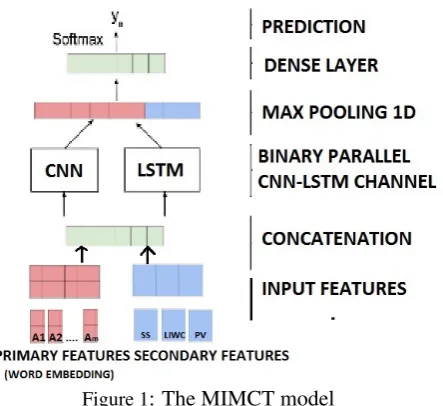
[image:3.595.312.534.509.712.2]The architecture of the MIMCT model is shown in Figure1, consisting of two main components: (i) primary and secondary inputs and (ii) CNN-LSTM binary channel neural network. The fol-lowing subsection describes the application of pri-mary and secondary inputs in MIMCT.
Figure 1: The MIMCT model
3.3.1 Primary and Secondary Inputs
differ-ent embeddings induced using differdiffer-ent models, corpora, and processing steps encode different as-pects of the language. While bag of words statis-tics based embeddings stress on word associations (doctor-hospital), those based on dependency-parses focus on similarity in terms of use (doctor-surgeon). Inspired by the works of (Mahata et al., 2018b), it is natural to consider how these em-beddings might be combined to obtain the set of most promising word embeddings amongst Glove, Twitter Word2vec and FastText. Assuming
m word embeddings with corresponding dimen-sionsd1,d2, ...dm are independently fed into the
MIMCT model as primary inputs. Thus the input to MIMCT will comprise of multiple sentence ma-tricesA1,A2, ...Am, where eachAl ∈Rs∗dl
hav-ingsas zero-padded sentence length anddlas
di-mensionality of the embedding. Keeping the em-bedding dimension constant to 200 in each case, we obtained independent feature vectors for each set of embeddings that are known as primary in-puts. Apart from the regular embedding inputs, additional hierarchical contextual features are also required so as to complement the overall classi-fication of the textual data. These features addi-tionally focus on the sentiment and tailor-made abuses that may not be present in regular dictio-nary corpus. This helps to overcome a serious bottleneck in the classification task and could be one of the prominent reasons for high misclassifi-cation of abusive and hate-inducing class in base-line and basic transfer learning approaches. The multiple modalities added to the MIMCT model as secondary inputs are:
• Sentiment Score (SS): We have used tweet sentiment score evaluated using SentiWord-Net (Baccianella et al.,2010) as a feature to stress on polarity of the tweets. The SS in-put will be a unidimensional vector denoted by +1 for positive, 0 for neutral and -1 for negative sentiment.
• LIWC Features: Inspired by (Sawhney et al., 2018a), Linguistic Inquiry and Word Count (Pennebaker et al.,2007) throws light on various language modalities expressing the linguistic statistical make-up of each text. Table 1 portrays the cumulative linguistic attributes calculated by LIWC2007 to form a LIWC attribute vector of 67 dimension (67D). Moreover, we have excluded numbers
and punctuation in LIWC features as these are removed in pre-processing steps.
• Profanity Vector: Swearing is a form of ex-pressing emotions, especially anger and frus-tration (Jay and Janschewitz,2008). Section 4.1describes the Hinglish Profanity list with corresponding English translation. An inte-ger vector of dimension 210 (210D) is con-structed for each tweet such that the presence of a particular bad word is demarcated by its corresponding profanity score while its ab-sence is demarcated by null value to empha-size the presence of contextually subjective swear words.
4 Evaluation
We provide an extensive description of the sources, ground truth annotation scheme and statistics of the proposed Hinglish Offensive Tweets (HOT) dataset in Section 4.1. Next, we discuss implementation details of baseline, trans-fer learning and MIMCT model in Section4.2 fol-lowed by results analysis in Section4.3.
4.1 Dataset
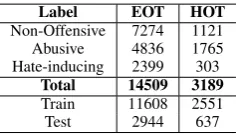
Table2spells out tweet distributions across EOT and HOT datasets. HOT is a manually annotated dataset that was created using the Twitter Stream-ing API3 by selecting tweets having more than 3 Hinglish words. The tweets were collected dur-ing the interval of 4 months of November 2017 to February 2018. The tweets were mined by imposing geo-location restriction such that tweets originating only in the Indian subcontinent were made part of the corpus. Inspired by the work of Rudra et al. (2016), tweets were mined from popular Twitter hashtags of viral topics popular across the news feed. Bali et al. (2014) pointed out that Indian social media users have high ac-tivity on Facebook pages of a few listed promi-nent public entities. Hence, we crawled tweets and responses from Twitter handles of sports-persons, political figures, news channels and movie stars. The collected corpus of tweets initially had 25667 tweets which was filtered down to remove tweets containing only URL’s, only images and videos, having less than 3 words, English and non-Hinglish scripts and duplicates. The annotation of
LIWC Categories Attributes
Linguistic Statistics word count (mean), words per sentence, dictionary words, total pronouns, words>6 letters, total functional words, personal pronouns
Grammatical Structures
1st person singular, 1st person plural,2nd person, 3rd person singular, 3rd person plural, impersonal pronouns, articles, common verbs, auxiliary verbs, past, present and future tense, adverbs, prepositions, conjunctions, negotiations, quantifiers, swear words
Textual Category sexual, body, health, ingestion, relativity, motion, space, time,
Psychological Processes
social processes, family, friends, humans, effective processes, negative and positive emotions, anxiety, anger, sadness, cognitive processes, insight, causation, discrepancy, tentativeness, certainty, inhibition, inclusive, exclusive, perceptual processes, see, hear feel, biological processes, Current Concerns work, achievement, leisure, home, money, religion, death
[image:5.595.74.527.64.167.2]Spoken Categories assent, non-fluencies, fillers
Table 1: LIWC linguistic attributes used in the MIMCT model
Label EOT HOT
Non-Offensive 7274 1121 Abusive 4836 1765 Hate-inducing 2399 303
Total 14509 3189 Train 11608 2551
[image:5.595.325.505.209.300.2]Test 2944 637
Table 2: Tweet distributions in EOT and HOT.
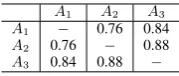
HOT tweets were done by three annotators hav-ing sufficient background in NLP research. The tweets were labeled as hate speech if they satis-fied one or more of the conditions: (i) tweet used sexist or racial slur to target a minority, (ii) undig-nified stereotyping or (iii) supporting a problem-atic hashtags such as #ReligiousSc*m. The la-bel chosen by at least two out of three indepen-dent annotators was taken as final ground truth for each tweet. In case of conflict amongst the annotators, an NLP expert would finally assign the ground truth annotation for ambiguous tweets. In this way, 386 tweets needed expert annotation, while 2803 tweets were labeled through consen-sus of annotators with an average value of Cohen Kappa’s inter-annotator agreementκ = 0.83. Ta-ble 5 shows the internal agreement between our annotators.
A curated list of profane words was extracted to form the Hinglish profanity list4, which was created by accumulating Hinglish swear words from curated social media blog posts (Rizwan, 2016) and dedicated swear word forums5. Each swear word was assigned an integer score on the scale of (1-10) based on the degree of profanity. This assignment of profanity scores was accom-plished through discussion amongst four indepen-dent code-switching linguistic experts having an extensive background in social media analysis.
The task of transliterating Hinglish words into
4
www.github.com/pmathur5k10/
Hinglish-Offensive-Text-Classification
5http://www.hindilearner.com/hindi_
words_phrases/hindi_bad_words1.php
Tweet Label (i) Tum ussey pyar kyun nahin karti? (ii) Why don’t you love him? (iii) you him love why no
Non-offensive
(i) Ch*d! Yeh sab ch*tiye hain! :/ (ii) F**k! They all are c*nts! :/ (iii) F**k they all c*nts are
Abusive
(i) M*d*rch*d Mus*lm**n sE nafrat (ii) m*therf*ck*r m*sl*m hate (iii) m*therf*ck*r m*s*l*m**n hate
Hate-inducing
Table 3: Examples of tweets in the HOT dataset. Categories (i), (ii) and (iii) denote the Hinglish tweet, its corresponding English meaning and its transliterated and translated version. The authors have modified some bad words in original tweets with ’*’ to not offend the readers.
Devanagari Hindi was achieved using datasets provided by Khapra et al. (2014). The words so obtained were further translated into Roman script using a Hindi-English dictionary consist-ing of 136110 word pairs mined from CFILT, IIT Bombay6. Additionally, the English transla-tions present of the words in Hinglish Profanity list were added to form a map based Hinglish-English dictionary. A pertinent challenge in deal-ing with Hdeal-inglish language was the presence of spelling variants, homophones and homonyms that are used frequently in a loose context. Thus the spelling variations of various popular Hinglish words were added to the corpus. The Hinglish-English dictionary thus formed, comprising of 7193 word pairs, was used as the basis for all further Hinglish to English tweet conversions. Table 4 gives detailed examples of word pairs in Hinglish-English dictionary along with a few swear words and their profanity scores.
Approximately, 29% of the tokens in pre-processed tweets are in Hinglish, a whopping 65% of the tokens are in English, while the remaining are Hinglish named entities like persons, events, organizations or places. The higher instances of
6
[image:5.595.121.240.210.277.2]Hinglish English Tag
acha neeche abhi aur nahin ghar ek saath tum pyar
good under now and no home one with you love
adjective adposition adverb conjunction determiner noun numeral particle pronoun verb
s**la k*tta s**ver har**mi ch*tiya bh*dve g**nd r*ndi b*h*nch*d m*d*rch*d
blo*dy dog pig bast*rd f*cker p*mp a*s ho*oker s*sterf*ck*r m*therf*ck*r
swear (1) swear (2) swear (3) swear (4) swear (5) swear (6) swear (7) swear (8) swear (8) swear (10)
Table 4: Examples of word pairs in Hinglish-English dictionary and Hinglish Profanity List with their profanity score
[image:6.595.95.266.60.276.2]the named-entities in the HOT dataset is a result of the way the data is sourced. Around 1.4% of Hinglish words in HOT share the same spellings with some English words because of transliter-ation of Hindi text to Roman script. The t-SNE (Maaten and Hinton,2008) plot of the HOT dataset shows the probability distribution of words in terms of the tokens used in tweets as represented by Figure 2. We also computed a few metrics to understand code-switching patterns in our dataset, so as to rationalize the performance of the classifi-cation models.
Figure 2: T-SNE plot of the HOT dataset
Multilingual Index (Mi): It is a
word-count-based measure that quantifies the inequality of the
A1 A2 A3 A1 − 0.76 0.84
A2 0.76 − 0.88
[image:6.595.370.460.61.99.2]A3 0.84 0.88 −
Table 5: Cohen’s Kappa for three annotators
A1, A2andA3
language tags distribution in a corpus of at least two languages (Barnett et al.,2000). Letkbe the total number of languages andpj is the total
num-ber of words in the languagejover the total num-ber of words in the corpus. The value ofMiranges
between 0 and 1 where, a value of 0 corresponds to a monolingual corpus and 1 corresponds to a corpus with equal number of tokens from each lan-guage. Equation1depicts theMiwhich is
approx-imately equal to 0.601, indicating that a majority of words are in Hinglish.
Integration Index (Ii): Integration Index is the
approximate probability that any given token in the corpus is a switch point (Guzm´an et al., 2017). This metric quantifies the frequency of code-switching in a corpus. Given a corpus com-posed of tokens tagged by language{lj},iranges
from 1 to n−1, wherenthe size of the corpus. S(li, lj ) = 1 ifli = lj and 0 otherwise in
Equa-tion 2. The value ofIi computed is
approxima-teedly 0.079 portraying a high frequency of code-switching points.
Mi =
1−P
p2j
(k−1)P
p2
j
(1)
Ii =
1
n−1
X
1<=i<j−1<=n−1
S(li, lj) (2)
4.2 Implementation Details
4.2.1 Baseline
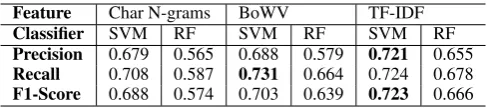
[image:6.595.77.292.519.702.2]Words Vector (BoWV) and (iii) TF-IDF count vec-tor and the results have been summarized in Table 6.
4.2.2 Transfer Learning
The number of trainable and static layers were toyed with to get the best combination giving suit-able results. For the classification task, both CNN and LSTM models are trained using 10-fold cross validation to identify the best hyper-parameter set-tings as presented below:
• CNN: Convolutional 1D layer (filter size=15, kernel size=3) → Convolutional 1D (filter size=12, kernel size=3)→ Convolutional 1D (filter size=10, kernel size=3) → Dropout (0.2) → Flatten Layer → Dense Layer (64 units, activation = ’relu’) → Dense Layer (3 units, activation = ’softmax’)
• LSTM : LSTM layer(h=64, dropout=0.25, recurrent dropout=0.3) → Dense (64 units, activation = ’relu’) → Dense (3 units, acti-vation = ’sigmoid’)
The final layer of both CNN and LSTM models is the compile layer with categorical cross-entropy as the loss function,Adamas the optimizer, learn-ing rate kept at 0.001 and L2 regularization with strength of 1E-6. The CNN and LSTM models were tested using three flavors of word embed-dings : (i) Glove, (ii) Twitter word2vec and (iii) FastText separately. The dimensions of input word embeddings were kept constant at 200 as for con-sistency across all embeddings. The hyper param-eters were chosen by grid search by running the experiments over a wide range. The batch size was experimented from size 8 to 128. Similarly, the number of epochs were limited at point were the model training loss plateaued by exploring differ-ent values from 10 to 50 in intervals of 5. The epochs and batch size were fixed to 20 and 64 respectively so as to maintain consistency in per-formance evaluation in each case without compro-mising on the optimality of the results correspond-ing to each configuration as summarized in Table 7.
4.2.3 MIMCT Model
Distinct word embedding representation are gen-erated from each participant embedding layer that are concatenated along with secondary features
Feature Char N-grams BoWV TF-IDF
Classifier SVM RF SVM RF SVM RF
Precision 0.679 0.565 0.688 0.579 0.721 0.655
Recall 0.708 0.587 0.731 0.664 0.724 0.678
[image:7.595.307.551.62.116.2]F1-Score 0.688 0.574 0.703 0.639 0.723 0.666
Table 6: Baseline results for non-offensive, abu-sive, hate-inducing tweet classification on HOT
and fed to the MIMCT model as independent in-puts to both CNN and LSTM channels. The fea-tures after passing through both the channels are merged and passed to the Max-pooling 1D layer. The resultant vector is reshaped and fed into a final softmax layer to perform tertiary classifica-tion. The architecture of CNN channel comprises of three successive Convolutional-1D layers with filter size chosen as 20, 15 and 10 respectively. This is followed by a dropout layer of value 0.25 and flatten layer. This is immediately followed by a single dense layer of 3 units with softmax ac-tivation. The LSTM channel is simply a layered structure comprising of a LSTM layer (128 units and dropout value of 0.2) and a dense layer (3 units andsoftmaxactivation). The MIMCT model uses Adam optimizer (Kingma and Ba, 2014) along with L2 regularization to prevent overfitting in the model. MIMCT was initially trained on the EOT dataset and the complete model is re-trained on the HOT dataset so as to benefit from the transfer of learnt features in the last stage. The model hyper-parameters were experimentally selected by trying out a large number of combinations through grid search.
4.3 Results and Discussion
Table 6 clearly show that SVM model supple-mented with TF-IDF features gives peak perfor-mance in terms of F1-score and precision when compared to other configurations of baseline su-pervised classifiers. The general inference that can be drawn at this stage is that the SVM clas-sifier outperforms Random Forest. Another use-ful observation is that TF-IDF is the most effec-tive feature for semantically representing Hinglish text and gives better performance than both Bag of Words Vector and Character N-grams on respec-tive classifiers. These observations are in agree-ment with the results presented byBadjatiya et al. (2017) who also used supervised classification for offensive tweet classification in English.
Embedding Glove Twitter Word2vec FastText
Model CNN LSTM CNN LSTM CNN LSTM
Data EOT HOT TFL EOT HOT TFL EOT HOT TFL EOT HOT TFL EOT HOT TFL EOT HOT TFL Precision 0.843 0.734 0.789 0.819 0.753 0.802 0.856 0.762 0.793 0.821 0.756 0.810 0.800 0.730 0.758 0.799 0.746 0.823 Recall 0.841 0.804 0.820 0.834 0.764 0.819 0.861 0.811 0.817 0.835 0.779 0.846 0.820 0.805 0.827 0.807 0.677 0.838 F1-Score 0.841 0.755 0.801 0.816 0.752 0.813 0.857 0.799 0.815 0.835 0.765 0.830 0.811 0.772 0.793 0.800 0.755 0.823
Table 7: Results for non-offensive, abusive, hate-inducing tweet classification on EOT, HOT and the HOT dataset with transfer learning (TFL) for Glove, Twitter Word2vec and FastText embeddings
of transfer learning on CNN and LSTM models. Macro metrics are preferred in experimentation evaluation as the class imbalance is not severe enough to skew the outcomes. Training and test-ing the same models from scratch on HOT without transfer learning reports a sharp downfall in per-formance of CNN and LSTM, which is quite ex-pected as the Hinglish tweets in the HOT dataset suffer from syntactic degradation after transliter-ation and transltransliter-ation. But following the transfer learning methodology, the model performances on HOT improve significantly strengthening the ar-gument that there was a positive transfer of fea-tures from English to Hinglish tweet data. A rel-ative comparison between several configurations of CNN and LSTM with corresponding word em-beddings reflects that LSTM’s are slightly better in each case relative to the corresponding CNN mod-els and the Twitter word2vec outperforms its con-temporary embeddings in most cases.
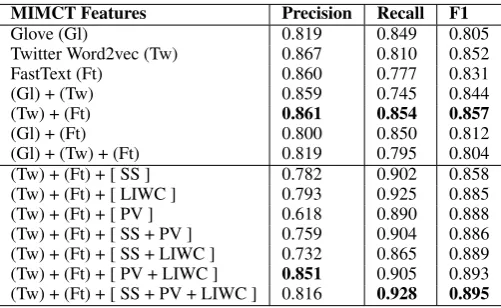
Lastly, the observation of the MIMCT model gives us useful insights to examine the effects of using multiple inputs. While the combination of Twitter word2vec (Tw) and FastText (Ft) shows superior performance than other embedding com-binations, the addition of sentiment score has little affect on the overall classification performance. In contrast, the usage of profanity vector and LIWC features boosts the metric values and the best clas-sifier performance is recorded when all the sec-ondary features are used together in conjugation with Twitter word2vec and FastText embeddings. MIMCT shows significant performance improve-ment over the baselines presented in our work to emerge as the current state of the art in the task of Hinglish offensive tweet detection. MIMCT model (Tw + Ft + SS + PV + LIWC) out per-forms SVM supplemented with TF-IDF features and the Twitter-LSTM transfer learning model by 0.166 and 0.165 F1 points, respectively.
4.4 Error Analysis
Some categories of error that occur in MIMCT:
MIMCT Features Precision Recall F1
Glove (Gl) 0.819 0.849 0.805 Twitter Word2vec (Tw) 0.867 0.810 0.852 FastText (Ft) 0.860 0.777 0.831 (Gl) + (Tw) 0.859 0.745 0.844 (Tw) + (Ft) 0.861 0.854 0.857
[image:8.595.74.565.63.123.2](Gl) + (Ft) 0.800 0.850 0.812 (Gl) + (Tw) + (Ft) 0.819 0.795 0.804 (Tw) + (Ft) + [ SS ] 0.782 0.902 0.858 (Tw) + (Ft) + [ LIWC ] 0.793 0.925 0.885 (Tw) + (Ft) + [ PV ] 0.618 0.890 0.888 (Tw) + (Ft) + [ SS + PV ] 0.759 0.904 0.886 (Tw) + (Ft) + [ SS + LIWC ] 0.732 0.865 0.889 (Tw) + (Ft) + [ PV + LIWC ] 0.851 0.905 0.893 (Tw) + (Ft) + [ SS + PV + LIWC ] 0.816 0.928 0.895
Table 8: Results of the MIMCT model with various input features HOT compared to previous base-line. Primary inputs are enclosed within parenthe-ses, e.g., (Tw), and secondary inputs are enclosed within square brackets, e.g. [ LIWC ].
1. Creative word morphing: Human annota-tors as well as the classifier misidentified the tweet’chal bhaag m*mdi’, which trans-lates in English as ’go run m*mdi’, as non-offensive instead of hate-inducing. Here ’m*mdi’is an indigenous way of referring to a particular minority that has been morphed to escape possible identification.
2. Indirect hate: The tweet ’Bas kar ch*tiye m***rsa educated’ was correctly identified by our annotators as hate-inducing but the classifier identified it as abusive. This is be-cause pre-processing of this tweet as’Limit it m*ther f*cking religious school educated’ leads to lose in its contextual reference to cus-toms and traditions of a particular commu-nity.
[image:8.595.308.559.181.335.2]transliteration process.
4. Analysis of code-mixed words: It has been shown in previous research (Singh, 1985) that bilingual languages tend to be biased in favour of code-mixing of certain words at specific locations in text. Contextual inves-tigation in this direction can be a useful to eliminate the subjective problem of Hinglish to English transliteration in future work.
5. Possible overfitting on homogenous data: The data usually present on the social media portals tend to be noisy and often repetetive in content. The skew in the class balance of dataset coupled with training on deep layered model may lead to overfitting of the data and may possibly induce large variation between expected and real-world results. We suspect this might be inherent in present experiments and can be overcome by extracting data from heterogenous sources to model a real-life sce-nario.
5 Conclusion and Future Work
We introduced a novel HOT dataset for multi-class labeling of offensive textual tweets in Hindi-English code switched language. The tweets in Hinglish language are transformed into semanti-cally analogous English text followed by exper-imental validation of transfer learning for clas-sifying cross-linguistic tweets. We propose the MIMCT model that uses multiple embeddings and secondary semantic features in a CNN-LSTM par-allel channel architecture to outperform the base-lines and naive transfer learning models. Finally, a brief analysis of the HOT dataset and its associated errors in classification has been provided. Pos-sible future enhancements include applying fea-ture selection methods to choose the most promi-nent features amongst those presented similar to the work done by (Sawhney et al., 2018b,c), ex-tending MIMCT to other switched and code-mixed languages and exploring GRU-based mod-els. Also, stacked ensemble of shallow convolu-tional neural networks can be explored for Twitter data as shown byMahata et al.(2018a).
References
Stefano Baccianella, Andrea Esuli, and Fabrizio Sebas-tiani. 2010. Sentiwordnet 3.0: an enhanced lexical
resource for sentiment analysis and opinion mining. InLREC, volume 10, pages 2200–2204.
Pinkesh Badjatiya, Shashank Gupta, Manish Gupta, and Vasudeva Varma. 2017. Deep learning for hate speech detection in tweets. In Proceedings of the 26th International Conference on World Wide Web Companion, pages 759–760. International World Wide Web Conferences Steering Committee.
Kalika Bali, Jatin Sharma, Monojit Choudhury, and Yogarshi Vyas. 2014. ” i am borrowing ya mix-ing?” an analysis of english-hindi code mixing in facebook. In Proceedings of the First Workshop on Computational Approaches to Code Switching, pages 116–126.
Ruthanna Barnett, Eva Cod´o, Eva Eppler, Montse Forcadell, Penelope Gardner-Chloros, Roeland van Hout, Melissa Moyer, Maria Carme Torras, Maria Teresa Turell, Mark Sebba, et al. 2000. The lides coding manual: A document for preparing and analyzing language interaction data version 1.1– july 1999. International Journal of Bilingualism, 4(2):131–271.
Yoshua Bengio. 2012. Deep learning of representa-tions for unsupervised and transfer learning. In Pro-ceedings of ICML Workshop on Unsupervised and Transfer Learning, pages 17–36.
Hemant K Bhargava, Michael Bieber, and Steven O Kimbrough. 1988. Oona, max and the wywwywi principle: generalized hypertext and model manage-ment in a symbolic programming environmanage-ment. In
ICIS, page 23.
Tej K Bhatia and William C Ritchie. 2008. The bilin-gual mind and linguistic creativity. Journal of Cre-ative Communications, 3(1):5–21.
Piotr Bojanowski, Edouard Grave, Armand Joulin, and Tomas Mikolov. 2016. Enriching word vectors with subword information. corr abs/1607.04606.
Thomas Davidson, Dana Warmsley, Michael Macy, and Ingmar Weber. 2017. Automated hate speech detection and the problem of offensive language.
arXiv preprint arXiv:1703.04009.
Bj¨orn Gamb¨ack and Utpal Kumar Sikdar. 2017. Us-ing convolutional neural networks to classify hate-speech. In Proceedings of the First Workshop on Abusive Language Online, pages 85–90.
Fr´ederic Godin, Baptist Vandersmissen, Wesley De Neve, and Rik Van de Walle. 2015. Multimedia lab@acl wnut ner shared task: Named entity recog-nition for twitter microposts using distributed word representations. InProceedings of the Workshop on Noisy User-generated Text, pages 146–153.
Gualberto Guzm´an, Joseph Ricard, Jacqueline Serigos, Barbara E Bullock, and Almeida Jacqueline Toribio. 2017. Metrics for modeling code-switching across corpora. Proc. Interspeech 2017, pages 67–71.
Timothy Jay and Kristin Janschewitz. 2008. The prag-matics of swearing. Journal of Politeness Research. Language, Behaviour, Culture, 4(2):267–288.
Aditya Joshi, Ameya Prabhu, Manish Shrivastava, and Vasudeva Varma. 2016. Towards sub-word level compositions for sentiment analysis of hindi-english code mixed text. InProceedings of COLING 2016, the 26th International Conference on Computational Linguistics: Technical Papers, pages 2482–2491.
Mitesh M Khapra, Ananthakrishnan Ramanathan, Anoop Kunchukuttan, Karthik Visweswariah, and Pushpak Bhattacharyya. 2014. When translitera-tion met crowdsourcing: An empirical study of transliteration via crowdsourcing using efficient, non-redundant and fair quality control. In LREC, pages 196–202.
Diederik P Kingma and Jimmy Ba. 2014. Adam: A method for stochastic optimization. arXiv preprint arXiv:1412.6980.
Laurens van der Maaten and Geoffrey Hinton. 2008. Visualizing data using t-sne. Journal of machine learning research, 9(Nov):2579–2605.
Debanjan Mahata, Jasper Friedrichs, Rajiv Ratn Shah, and Jing Jiang. 2018a. Did you take the pill?-detecting personal intake of medicine from twitter.
arXiv preprint arXiv:1808.02082.
Debanjan Mahata, Jasper Friedrichs, Rajiv Ratn Shah, et al. 2018b. # phramacovigilance-exploring deep learning techniques for identifying mentions of medication intake from twitter. arXiv preprint arXiv:1805.06375.
Puneet Mathur, Meghna Ayyar, Sahil Chopra, Simra Shahid, Laiba Mehnaz, and Rajiv Shah. 2018a. Identification of emergency blood donation request on twitter. In Proceedings of the Third Workshop On Social Media Mining for Health Applications.
Puneet Mathur, Rajiv Shah, Ramit Sawhney, and De-banjan Mahata. 2018b. Detecting offensive tweets in hindi-english code-switched language. In Pro-ceedings of the Sixth International Workshop on Natural Language Processing for Social Media, pages 18–26.
Hamdy Mubarak, Kareem Darwish, and Walid Magdy. 2017. Abusive language detection on arabic social media. In Proceedings of the First Workshop on Abusive Language Online, pages 52–56.
Sinno Jialin Pan and Qiang Yang. 2010. A survey on transfer learning. IEEE Transactions on knowledge and data engineering, 22(10):1345–1359.
Weike Pan, Erheng Zhong, and Qiang Yang. 2012. Transfer learning for text mining. In Mining Text Data, pages 223–257. Springer.
Ji Ho Park and Pascale Fung. 2017. One-step and two-step classification for abusive language detection on twitter. arXiv preprint arXiv:1706.01206.
James W Pennebaker, Roger J Booth, and Martha E Francis. 2007. Liwc2007: Linguistic inquiry and word count. Austin, Texas: liwc. net.
Jeffrey Pennington, Richard Socher, and Christopher Manning. 2014. Glove: Global vectors for word representation. InProceedings of the 2014 confer-ence on empirical methods in natural language pro-cessing (EMNLP), pages 1532–1543.
Kumar Ravi and Vadlamani Ravi. 2016. Sentiment classification of hinglish text. InRecent Advances in Information Technology (RAIT), 2016 3rd Inter-national Conference on, pages 641–645. IEEE.
Sahil Rizwan. 2016. This Reddit Thread On The Best Indian Gaalis Will Increase Your Vocabulary, If Nothing Else. https://www.buzzfeed. com/sahilrizwan/speak-no-evil?utm_
term=.kgPxblYyl#.suP6XO4VO. [Online;
accessed 19-May-2018].
Bj¨orn Ross, Michael Rist, Guillermo Carbonell, Ben-jamin Cabrera, Nils Kurowsky, and Michael Wo-jatzki. 2017. Measuring the reliability of hate speech annotations: The case of the european refugee crisis.arXiv preprint arXiv:1701.08118.
Koustav Rudra, Shruti Rijhwani, Rafiya Begum, Ka-lika Bali, Monojit Choudhury, and Niloy Ganguly. 2016. Understanding language preference for ex-pression of opinion and sentiment: What do hindi-english speakers do on twitter? In Proceedings of the 2016 Conference on Empirical Methods in Nat-ural Language Processing, pages 1131–1141.
Ramit Sawhney, Prachi Manchanda, Raj Singh, and Swati Aggarwal. 2018a. A computational approach to feature extraction for identification of suicidal ideation in tweets. InProceedings of ACL 2018, Stu-dent Research Workshop, pages 91–98.
Ramit Sawhney, Puneet Mathur, and Ravi Shankar. 2018b. A firefly algorithm based wrapper-penalty feature selection method for cancer diagnosis. In
International Conference on Computational Science and Its Applications, pages 438–449. Springer.
Ramit Sawhney, Ravi Shankar, and Roopal Jain. 2018c. A comparative study of transfer functions in binary evolutionary algorithms for single objec-tive optimization. In International Symposium on Distributed Computing and Artificial Intelligence, pages 27–35. Springer.