Abstract—Virtual communities are not only used to share information among their members with common interests, but also an avenue of entertainments, networking with friends, and shopping. Recently, the main research topics on them include social networking, success factors, reasons for participating, and consequences from joining in virtual communities. Relative few works to discuss what important quality factors are for attracting customers to join the virtual community websites. From the viewpoint of increasing margin of websites, to identify important quality characteristics for attracting more internet customers in virtual community is crucial for website enterprisers. In this study, we attempt to define the quality factors of virtual communities and then identify the key factors for attracting new members by using a feature selection technique. In addition, the importance–satisfaction model was also implemented for analyzing the collected data further. Finally, a real case study of “Facebook” has been provided to evaluate the effectiveness of the used methods.
Index Terms—Feature Selection, Quality Factors, Virtual Community, Customer Needs.
I. INTRODUCTION
The virtual community has a 30-year history from the early Bulletin Board System (BBS) to Web 2.0 such as Twitter, Facebook, and My space. In 1993, the term “Virtual Community” was first wrote by Howard Rheingold who considered virtual community was a certain social group of people came from internet. Illum et al. [10] think that an online virtual community is defined as a group of people trying to achieve certain purposes, with a similar interest, interested in relationship building, transaction, and fantasy under certain rules by using new information technology as their means.
Virtual communities can be used for commercial purposes which include helping enterprisers to create new types of services, enhancing existing products and creating new divisions and capabilities [13], strengthening their positive image, establishing relationships with their customers and contributing to customer loyalty and sales [12]. Business potential is mainly used to create increased trust among a virtual community members combined with quality services that may improve customer loyalty [2].
Nowadays, the internet increasingly changing people’s
Manuscript received December 8, 2009. This work was supported in part by the National Science Council of Taiwan, R.O.C. (Grant No. NSC 98-2410-H-324-007-MY2).
*L.-S. Chen is with the Chaoyang University of Technology, Taichung 41349, Taiwan (phone: 886-4-23323000ext7752; fax: 886-4-23304902; e-mail: [email protected]).
P.-C. Chang is with the Chaoyang University of Technology, Taichung 41349, Taiwan (e-mail: [email protected]).
real lives from different aspects, especially the virtual community whose come forth broken through past conception of space and connected thousands of people from different place by the computer screen near at hand [3]. Some famous examples of virtual communities could be found in many websites such as “Facebook”, “Plurk”, “My space”, “LinkedIn” and “Twitter.” According to the official report of “Facebook”, more than 300 million users who ever visited their website or used their service until September, 2009. 57% users are male. The firstly heavy users belong to the young students whose ages are between 18 and 25 years old (32.8%). The second place is office workers whose ages are between 26 and 34 years old (18.4%). Therefore, virtual communities are not only used to share information among their members with common interests, but also an avenue of entertainments, networking with friends, and shopping.
Recently, virtual communities have been the object of research since their emergence. Major research topics on them include social networking, reasons for participating, and consequences from joining in virtual communities [10]. Spaulding [11] also indicated that success in virtual communities depends on an attitude of contribution, dedication of resources, building a critical mass, and matching community and business needs [11]. However, relative few works to discuss what important quality factors are for attracting customers to join the virtual community websites. From the viewpoint of increasing margin of websites, to identify important quality characteristics for attracting more internet customers in virtual community is crucial for website enterprisers.
In addition, we observed that users have some movements among different virtual communities. If a new virtual community website can create some innovative functions or applications, it will become popular immediately and attract lots of internet users to join. For example, to provide the function of posting home made video, YouTube attract lots of users from those traditional text or photo based blogs websites. Therefore, to identify important quality characteristics of virtual community websites are crucial for survival in commercial competitions. In this study, we attempt to define the quality factors of virtual communities and then identify the key factors for attracting new members. Decision tree (C4.5) has been employed to be the tool of feature selection. Importance–satisfaction model was also implemented for analyzing the collected data further. Finally, a real case study of “Facebook” has been provided to evaluate the effectiveness of the used methods.
Identifying Crucial Website Quality Factors of
Virtual Communities
II. LITERATURE REVIEW
A. Website Quality Models
[image:2.595.306.544.317.645.2]Due to the rapid development of Web 2.0 service, the innovative website quality elements have become one of key factors for attracting internet customers. It’s especially true in virtual community websites. Therefore, website service providers need to identify important e-service quality factors and keep improving them to increase customer satisfaction. In related works, researchers developed some models for measuring e-service quality of websites. In this section, we will introduce some famous models.
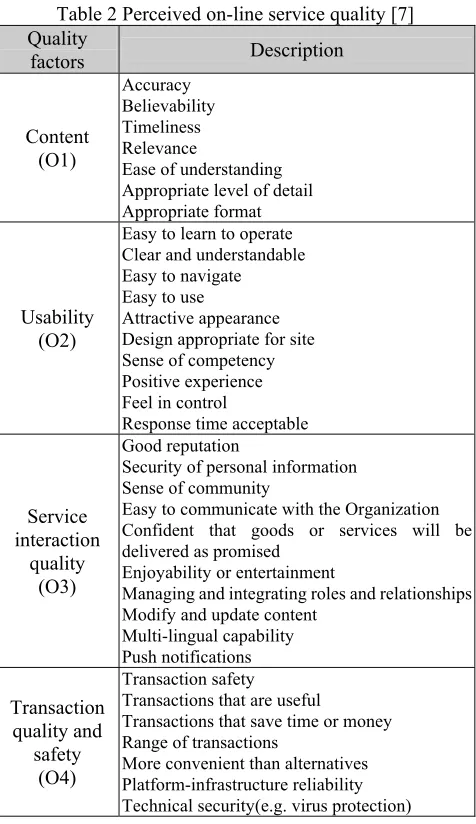
Table 1 WebQual 4.0 Model e-service
quality model Dimension Item Content Usability
Usability
Site design Information
quality Information Trust WebQual 4.0
[9]
Service interaction
quality Empathy
The main change is an increased emphasis on usability rather than site quality. The focus is on user experience rather than site characteristics. Table 2 Perceived on-line service quality [7] Quality
factors Description
Content (O1)
Accuracy Believability Timeliness Relevance
Ease of understanding Appropriate level of detail Appropriate format
Usability (O2)
Easy to learn to operate Clear and understandable Easy to navigate Easy to use
Attractive appearance Design appropriate for site Sense of competency Positive experience Feel in control
Response time acceptable
Service interaction
quality (O3)
Good reputation
Security of personal information Sense of community
Easy to communicate with the Organization Confident that goods or services will be delivered as promised
Enjoyability or entertainment
Managing and integrating roles and relationships Modify and update content
Multi-lingual capability Push notifications
Transaction quality and
safety (O4)
Transaction safety Transactions that are useful
Transactions that save time or money Range of transactions
More convenient than alternatives Platform-infrastructure reliability Technical security(e.g. virus protection)
WebQual model was firstly developed by Barnes & Vidgen in 1998. At first, they designed WebQual 1.0 for measuring the data and information quality in websites. Then, focusing on different considerations, several versions such as WebQual 2.0 (2000), WebQual 3.0 (2001) and WebQual 4.0 (2002) [7] have been created. Table 1 summarizes the dimensions and items of WebQual 4.0. Compared with versions 1.0~3.0, the main change in version 4.0 is an increased emphasis on usability rather than site quality. The focus is on user experience rather than site characteristics.
In 2007, Tate et al. also defined perceived e-service quality factors including content, usability, service interaction quality, transaction quality and safety. Table 2 provides these four main quality factors and detailed sub-items.
However, the first 2 models don’t focus on virtual community websites. Therefore, eQual model which was developed by Barnes & Richard [9] in 2005 has been introduced. In eQqual model as described in Table 3, four dimensions which involve 23 question items have been defined to measure e-service quality [9].
Table 3 The eQual Model
Category No Questions
1 I find the site easy to learn to operate
2 My interaction with the site is clear and understandable 3 I find the site easy to navigate
4 I find the site easy to use
5 The site has an attractive appearance 6 The design is appropriate to the type of site 7 The site conveys a sense of competency Usability
8 The site creates a positive experience for me 9 Provides accurate information
10 Provides believable information 11 Provides timely information 12 Provides relevant information
13 Provides easy to understand information 14 Provides information at the right level of detail Information
Quality
15Presents the information in an appropriate format
16 Has a good reputation
17 It feels safe to complete transactions 18 My personal information feels secure 19 Creates a sense of personalization 20 Conveys a sense of community
21Makes it easy to communicate with the organization Service
Interaction
22I feel confident that goods/services will be delivered as promised
Overall 23 Overall view of the Web site
[image:2.595.51.289.362.774.2]Table 4 Descriptions of defined functions of virtual communities
No. Defined functions of virtual communities V1 Help users to find their own strings people
V2 Help users to create the management of the relevant contact people V3 Remind the updates of the contacts
V4 Remind the users of the act which has direct connection to themselves V5 Providing the webpage game which promotes cooperation or conflicts to the users V6 Providing the professional application
V7 Providing with other application
B. Feature Selection
Feature selection is often applied in pattern classification, data mining, and machine learning. Reduction of pattern dimensionality via feature selection belongs to the most fundamental steps in data processing [8]. The main purpose of feature selection is to remove irrelevant or redundant attributes and improve the performance of data mining. Among many feature selection methods, GA, rough sets and decision trees have attracted much attention, and have become popular techniques for feature selection. In this study, decision tree algorithm has been employed for selecting important website quality factors.
A common understanding is that some learning algorithms have built-in feature selection, for example, ID3 [5], FRINGE and C4.5 [6]. When decision tree induction is used for feature selection, a tree is constructed from the given data. All attributes that don’t appear in the tree are assumed to be irrelevant. The set of attributes appearing in the tree form the reduced subset of attributes [4].
C. Importance-Satisfaction Analysis (I-S Model)
The importance–satisfaction model (I-S Model) shown as Figure 1 [1] is a very easy business model for providing enterprisers a brief analysis. In this model, the horizontal dimension and the vertical dimension shows the degree of importance the satisfaction level of the quality factors, respectively. Then, the order pair (importance scale, satisfaction scale) can be located on the coordinates. The means of the importance scale and the satisfaction scale can be used to divide the coordinate into four areas:
(I)Excellent area
The quality factors located in this area are those that customers considered to be important, and for which the performance is satisfactory to customers. These quality factors are the major weapons for e-service providers.
(II)To be improved area
The quality factors listed in this area are those considered as important to customers but for which the performances have not met with expectation. The websites managers must focus on these factors and improve them immediately.
(III) Surplus area
The quality factors located at this area are not very important to customers, but the perceptions of customers are quite satisfactory. Therefore, the company can relocate the resources from surplus area to other areas. If the company
needs to cut costs, these attributes can be eliminated without incurring a significant negative impact.
(IV) Care-free area
These quality factors are those which customers have a lower satisfaction level and they also think they are not important. Therefore, enterprisers needn’t to care about this kind of quality factors.
Although the importance–satisfaction model is a simple structure, it can provide much useful information about a company’s quality performance. Therefore, the model has been employed in this study.
III. RESEARCH PROCEDURE
The procedure of this study can be illustrated as Figure 2. It contains 6 steps and they are defining quality factors of virtual community websites, designing questionnaire, collecting data, analyzing data, identifying crucial quality factors and drawing conclusions. In first step, we attempt to define the quality factors of virtual community websites based on related works such as eQual model [9]. If we define inappropriate quality factors, we cannot identify the crucial quality factors of customers. Then, we can design questionnaire according to these defined quality factors. In this step, every factor will expand to two questions to survey the perceived satisfaction and importance. In step 3, we
Low High
IV Care-free
II Surplus
I Excellent III
To be improved
[image:3.595.316.531.215.323.2]High Importance
Figure 1 Importance-Satisfaction Model Satisfaction
Low
Figure 2 Research procedure 1. Define quality elements of virtual
community website
2. Design questionnaire
3. Collect data
4. Analyze data - Importance-Satisfaction Analysis
[image:3.595.322.498.373.587.2]sample some representative customers to collect data. The purpose of step 4 is to analyze the collected data by applying I-S analysis. The results of I-S analysis can tell us the quality factors belong to which area in Figure 1.
In step 5, we implement feature selection technique to identify the crucial quality factors. In this step, the decision tree (DT) algorithm has been employed to select important quality attributes. DT is one of the most popular knowledge acquisition algorithms, and has been successfully applied in many areas. There are more than one decision tree algorithms, such as ID3 [5] and C4.5 [6]. This study uses C4.5. The core of C4.5 contains recursive partitioning of the training examples. Whenever a node is added to a tree, some subsets of the input features are used to pick the logical test at that node. The feature that results in the maximum information gain is selected for testing at that node. In other words, the algorithm chooses the “best” attribute to partition the data into individual classes at each node. After the test has been determined it is used to partition the examples, and the process is continued recursively until each subset contains examples of one class or satisfies some statistical criteria [14]. Finally, in step 6, we can draw some conclusions according to the results of steps 4~5.
IV. IMPLEMENTATIONS
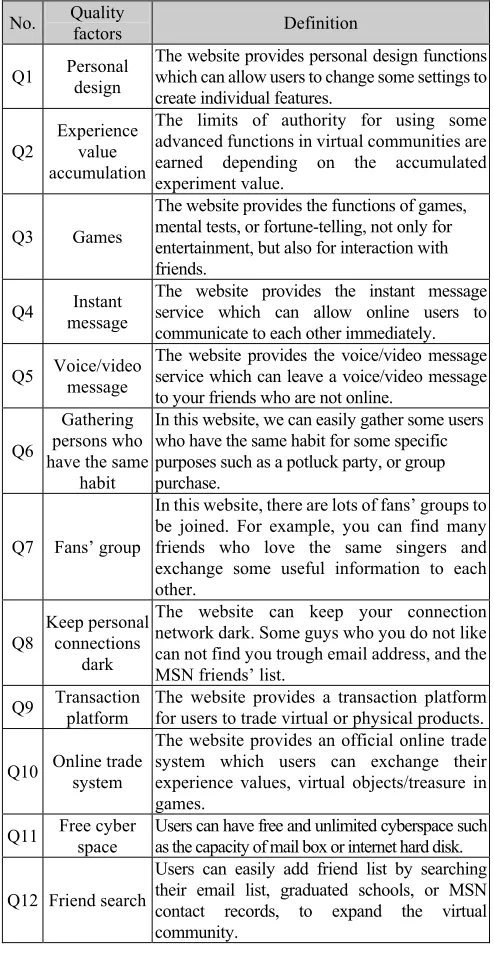
[image:4.595.303.550.247.725.2]Firstly, we need to define the quality factors of virtual community websites. Based on eQual model and other 2 models including “perceived on-line service quality” and “the functions of virtual communities”, 12 quality factors for virtual community websites have been defined. As shown in Table 5, they are “personal design”, “experience value accumulation”, “games”, “instant message”, “voice/video message”, “gathering persons who have the same habits”, “aficionado group”, “keep personal connection dark”, “transaction platform”, “online trade system”, “free cyberspace”, and “friend search”. Table 6 provides the detailed definitions of these 12 quality factors.
Table 5 The defined quality factors of virtual community websites
No eQual
Perceived on-line Service Quality
The functions of virtual communities
Defined quality factors
1 - Personal design
2 O2 V5 Experience value accumulation
3
Usability
O3 V5 Games 4 Information quality O1 V3 Instant message
5 V7 Voice/video message
6
Gathering persons who have the same
habit 7
V1
Fans’ group 8
O3
V1、V2 Keep personal connections dark
9 Transaction platform
10
Service interaction
quality
O4 V6
Online trade system
11 V6 Free cyber space
12 - O1 V1、V2 Friend search
Secondly, for each defined quality factor, a pair of
question items has been developed. Take quality factor Q1 for example, a pair of questions can be shown as bellow. Quality factor 1: personal design
The website provides personal design functions which can allow users to change some settings to create individual features.
(1)If the website provides this quality, how would you feel?
(A)Very satisfied (B) Satisfied (C) Neutral (D) Not satisfied (E) Not very satisfied (2)Do you think the importance of this quality?
(A)Very important (B) Important (C) Neutral (D) Not important (E) Not very important Table 6 The description of defined quality factors
No. Quality factors Definition
Q1 Personal design
The website provides personal design functions which can allow users to change some settings to create individual features.
Q2 Experience value accumulation
The limits of authority for using some advanced functions in virtual communities are earned depending on the accumulated experiment value.
Q3 Games
The website provides the functions of games, mental tests, or fortune-telling, not only for entertainment, but also for interaction with friends.
Q4 message Instant
The website provides the instant message service which can allow online users to communicate to each other immediately.
Q5 Voice/video message
The website provides the voice/video message service which can leave a voice/video message to your friends who are not online.
Q6
Gathering persons who have the same
habit
In this website, we can easily gather some users who have the same habit for some specific purposes such as a potluck party, or group purchase.
Q7 Fans’ group
In this website, there are lots of fans’ groups to be joined. For example, you can find many friends who love the same singers and exchange some useful information to each other.
Q8
Keep personal connections
dark
The website can keep your connection network dark. Some guys who you do not like can not find you trough email address, and the MSN friends’ list.
Q9 Transaction platform The website provides a transaction platform for users to trade virtual or physical products.
Q10 Online trade system
The website provides an official online trade system which users can exchange their experience values, virtual objects/treasure in games.
Q11 Free cyber space Users can have free and unlimited cyberspace such as the capacity of mail box or internet hard disk.
Q12 Friend search
Users can easily add friend list by searching their email list, graduated schools, or MSN contact records, to expand the virtual community.
[image:4.595.47.292.541.777.2]data. Table 7 listed the results of importance-satisfaction analysis. From this Table, 5 quality factors are categorized into excellent. They are “experience value accumulation”, “gathering persons who have the same habit”, “fan’s group”, “transaction platform”, and “online trade system. It means customers think these four quality factors are satisfied and important.
Only one factor “free cyber space” is categorized as “Surplus”. That means customers are satisfied, but consider this service is not very important. The company can relocate the resources from this quality factor to someone else which has been considered important and has low level of satisfaction.
Others 6 quality factors such as “personal design”, “games”, “instant message”, “voice/video message”, “keep personal connections dark”, and “friend search” are considered as “care-free”. That means that customers have a lower satisfaction level and they also think they are not important. Therefore, enterprisers needn’t to care about this kind of quality factors.
[image:5.595.46.291.321.495.2]
Table 7 The results of Importance-Satisfaction Analysis
No. Quality factors Analysis I-S No. Quality factors I-S Analysis 1 Personal design Care-free 7 Fans’ group Excellent
2
Experience value
accumulation Excellent 8
Keep personal connections
dark Care-free
3 Games Care-free 9 Transaction platform Excellent
4 message Instant Care-free 10 Online trade system Excellent
5 Voice/video message Care-free 11 Free cyber space Surplus
6
Gathering persons who have the same
habit
Excellent 12 Friend search Care-free
Table 8 The results of decision tree algorithm Accuracy Extracted factors Fold 1 64.3% Q1, Q2, Q3, Q5, Q9 Fold 2 61.5% Q1, Q2, Q5, Q9 Fold 3 57.1% Q1, Q2, Q5, Q8, Q9 Fold 4 69.2% Q1, Q2, Q3, Q5, Q9, Q11
Mean 63.03% S. D. 5.07%
Q1, Q2, Q3, Q5, Q8, Q9, Q11
Table 9 The results of decision tree algorithm
Factors Tree 1 Tree 2 Tree 3 Tree 4 Analysis I-S
Q1 X X X X Care-free
Q2 X X X X Excellent
Q3 X X Care-free
Q4 Care-free
Q5 X X X X Care-free
Q6 Excellent
Q7 Excellent
Q8 X Care-free
Q9 X X X X Excellent
Q10 Excellent
Q11 X Surplus
Q12 Care-free
Note: “X” denotes the important attributes in a tree. Next, we implement decision tree algorithm to extract important factors. We use the importance of 12 quality factors as input variables and the overall satisfaction toward surveyed website is the class label. 4-fold cross validation experiment has been employed. Therefore, 4 decision trees will be constructed. Table 8 provides the results of decision tree, including the classification accuracy and the extracted important attributes. In Table 8, the average classification accuracy is 63.3% and the standard deviation is 5.07%.
From Table 9, we can find different attributes are extracted by different trees. We summarize the results of these four trees and then 7 important quality factors have been extracted. They are “”personal design”, “experience value”, “games”, “voice/video message”, “keep personal connections dark”, “transaction platform”, and “free cyber space”. According to the occurrence frequency, the top 4 are “personal design”, “experience value accumulation”, “voice/video message”, and “transaction platform”. Compared with the results of I-S analysis, 2 of 4 extracted factors are categorized as “excellent” and others are “care-free”.
V. CONCLUSIONS
In this study, we apply feature selection technique and I-S analysis to identify important quality characteristics of virtual community websites. A real case study of “Facebook” has been provided to evaluate the effectiveness of the used methods. Depending on the discovered results, we draw some interesting conclusions. Firstly, I-S analysis is an easy tool which can provides useful information, but it needs both importance and satisfaction points in the same time. Feature selection techniques are powerful methods to extract important attributes based on the assumption of maximizing the overall classification accuracy. In other words, the extracted attributes are crucial for classifying data. Besides, feature selecting techniques cannot tell more useful information. Hence, if it’s possible, we suggest use both methods for getting better understanding of collected data.
Secondly, half of defined quality factors (6 quality characteristics) are categorized as “care-free” in I-S analysis. Some quality factors such as “games” and “friend search” are considered as successful factors of Facebook. But, the results indicated they are carefree by customers. It might be the potential direction of future research to discuss this issue.
REFERENCES
[1] C. C. Yang, “The Refined Kano’s Model and its Application,” Total
Quality Management, vol. 16, Dec, 2005, pp. 1127–1137.
[2] D. K. Kardaras, B. Karakostas, “Exploring the potential of virtual communities as a business model in banking: the customers’ view,”
International Journal of Web Based Communities, vol. 3. 2007, pp.
316–331.
[3] G. Deng, H. Zhou, P. Zhang, “Study of Incentive Mechanism and Internet Behavior of Virtual Communities,” 1st IEEE Symposium on
Web Society, Aug. 2009, pp. 213–218.
[4] J. Ham, M. Kamber, Data Mining: Concepts and Techniques. San Diego: Academic Press, 2001.
[5] J. R. Quinlan, “Induction of Decision Trees,” Machine Learning, vol. 1, Mar. 1986, pp. 81–106.
[7] M. Tate, J. Evermann, B. Hope, S. Barnes, “Perceived Service Quality in a University Web Portal: Revising the E-Qual Instrument,” 40th
Annual Hawaii International Conference on System Sciences, Jan.
2007, pp. 147b–147b.
[8] R. W. Swiniarski & A. Skowron, “Rough set methods in feature selection and recognition,” Pattern Recognition Letters, vol. 24, Mar. 2003, pp. 833–849.
[9] S. Barnes & R. Videgen, “Data Triangulation in Action: Using Comment Analysis to Refine Web Quality Metrics,” 13th European
Conference on Information System, May. 2005, pp. 92–103.
[10] S. F. Illum, S. H. Ivanov, Y. Liang, Using virtual communities in tourism research, Tourism Management (2009), doi:10.1016/j.tourman.2009.03.012
[11] T. J. Spaulding, How can virtual communities create value for business? Electron. Comm. Res. Appl. (2009), doi:10.1016/j.elerap.2009.07.004 [12] W. G. Kim, C. Lee, S. J. Hiemstra, “Effects of an online virtual
community on customer loyalty and travel product purchases,”
Tourism Management, vol. 25, Jun. 2004, pp. 343–355.
[13] Y. Wang, Q. Yu, D. R. Fesenmaier, “Defining the virtual tourist community: implications for tourism marketing,” Tourism
Management, vol. 23, Aug. 2002, pp. 407–417.
![Figure 1 [1] is a very easy business model for providing The importance–satisfaction model (I-S Model) shown as enterprisers a brief analysis](https://thumb-us.123doks.com/thumbv2/123dok_us/1305104.660336/3.595.322.498.373.587/figure-business-providing-importance-satisfaction-model-enterprisers-analysis.webp)