Abstract—Vehicular Ad Hoc Network (VANETs) could achieve flexible communication among vehicles and with infrastructure. VANET provides multi-hop transmission to cover all intended receivers. This multi -hop capability has the potential to increase safety, efficiency and convenience of transportation system. Multi-hop transmission enhances a range of applications including traffic safety and comfort of every day road travel. In most of the envisioned applications, information to all or specific group vehicles inside a certain region is needed to be delivered. These applications rely on unicast, broadcast and geocast approaches. This study presents a review of recent routing protocols for both text and video data transmission. In particular, this paper focuses on quality based comparison of routing protocols for video data streaming over VAN ET. S ome of routing challenges for video streaming and text dissemination over VAN ET are also discussed.
Index Terms—multi-hop transmission, routing protocols, Vehicular Ad-Hoc Network (VANET), video streaming
I. INTRODUCTION
The continuous increase in the number of vehicles in the transportation system ca lls for an improve ment of t raffic safety and effic iency of the overa ll transportation infrastructure. To achieve th is demand, the vehicular communicat ions have been considered to enable various road traffic applicat ions ranging from tra ffic safety to pleasant driving applicat ions . Effective imp le mentation of vehicular communicat ion could also improve traffic manage ment system. This effect iveness could be achieved by designing efficient vehicula r network protocols. Therefore , vehicu lar communicat ion networks not only could provide scalable connectivity between vehicles on the road but also can establish better coordination between road mobile users. This will a lso ensure an effic ient vehicular communications, which could enable the Intelligent Transportation Systems (ITS). Many automobile manufacturers around the world are in d iffe rent stages of integrating wire less communicat ion devices in their production. This technology could improve traffic safety, driving assistance, entertainment, and mobile comme rce. In the near future, the nu mber of vehic les equipped with commun ication device is going to increase; this allo ws the scalable VANET to be materialised. A nu mber of research projects around the world, e.g. [1] in Europe, [2] in US and [3] in Japan are engaged in researching and
Manuscript received October 9, 2009.
Kayhan Zrar Koyee and Kamalrulnizam Abu Bakar are with the Faculty of Computer Science & Information Systems, Universiti Teknologi Malaysia, 81310 UTM Skudai, Johor D. T, Malaysia (phone: 0127792943;e-mail: [email protected]; [email protected])
developing the infrastructure of VANET and ITS.
The routing protocols in VANET are quite different fro m routing in mobile ad hoc network (MA NET) due to several reasons including high mobility, frequent topology frag mentation, frequent disconnection, a mple power require ments, etc. Therefore, routing protocols designed for VA NET must be highly scalable, robust and easy to deploy. In addition, the frequent arrival and departure of v ehicles brings many challenges in routing research. VANET vehic les move ment is restricted as it is bidirectional at the highway or urban area. Furthermore, vehic les require a mp le power for process computation and storage [4].
Thus, analysing the existing VA NET protocol designs and describing the effect of these designs on communicat ion potency have become integral in the global transportation system. Even though there is an e xtensive a mount of recent work on VANET applications and routing protocols for VA NETs, fe w surveys exist in VA NET about routing protocols of simple te xt propagation while none of the m looks into the v ideo streaming. Issues that have been investigated regarding VA NET include mostly routing protocols for video streaming and simple te xt trans mission, security problems, and suitable applications.
In this paper, the broadcast, geocast, and unicast routing approaches in VA NET are revie wed in terms of simp le te xt data and video data transmission. In particular, it focuses on quality based comparison of routing protocols for video data streaming over VANET. There fore, the Section II of this paper describes the IVC routing protocols for te xt propagation. This is fo llo wed with a discussion on the video communicat ion over VANET in section III. A compa rison of IVC protocols for video transmission is discussed and a number of routing challenges are highlighted in section IV. Finally, this paper ends with a conclusion of the study in section V.
II. IVCPROTOCOLSFORTEXTDISSEM INATION Taking into consideration all the above mentioned unique characteristics, a different type of routing method is required in order to cope with the VA NET environ ment. Each of the e xisting protocols found in the literature has different architectural design, regarding to the data link, network, and transport layers of OSI model. Hence, a good design decision has a positive effect on mult idimensional aspects of VA NET communicat ion services. In addition to that, there is a trade-off between metrics for instance, increasing delay for higher throughput which need to be tackled during the designing process. Figure 1 shows a tree structure of classified IVC protocols used for unicasting, geocasting and broadcasting information.
Inter-Vehicle Communication Protocols for
Multimedia Transmission
.
In the following sections the types of IVC protocols are discussed.
A. Broadcast Protocols
The objective of broadcasting in VA NET is to disseminate informat ion fro m one source to many destinations. In the other words, broadcasting is a method of informat ion dissemination wh ich is frequently used in VANET. Severa l applications that rely on broadcast include emergency data dissemination, road traffic data sharing among vehicles, and delivering advertisement and announcement [5]. Broadcasting in the mobile wire less networks of (n) nodes costs (n) transmissions. Therefore, it offers more overhead and bandwidth utilisation for imp roved reliability. So me authors [6] have proposed the method for restrict ing the rebroadcasting nodes while maintain ing rad io coverage. The Urban Mult i-hop Broadcast protocol (UM B) in [5] introduces a new request-to-send and clear-to-send handshake for IEEE 802.11 that enables the farthest node from a transmitter to retransmit packets. However, the potential relay nodes wait for the longest time before retransmitting. This mechanism may lead to long latency, especially fo r high node densities. Some authors [7] have proposed a solution of UMB by designing a position–aware routing protocol, named Smart Broadcast, for fast and reliable message propagation in VA NET. It ma kes use of position information provided by a GPS-like system to speed up the message propagation along the network, by a llo wing farthest nodes to attempt transmission first.
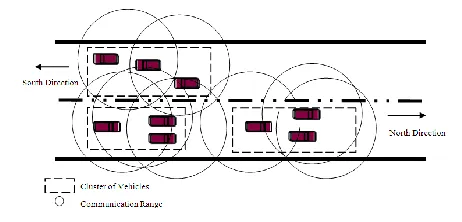
In addition, the high velocity and limited co mmunication range of the vehic les incur frequent link disconnection and even network partition. It takes time for vehic le to catch up with other vehicles ahead and reconnect the network. Th is amount of time is called as catch-up delay [8]. During the catch-up phase, the routing protocol uses the store-and-forward scheme to buffer the packet and send it in the next chance [9]. So me authors in [10] have designed Directional Propagation Protocol (DPP) for data dissemination in VA NET using opportunistic forwarding. Figure 2 illustrates the formation of c lusters and how Directional Propagation Protocol (DPP) can provide communicat ion between vehicles whenever clusters are fully connected. Thus, in VA NET, the opportunistic flooding is used for packet d issemination over intermittent connectivity. This type of packet dissemination often leads to a higher proportion of delivered messages and lowers transmissions, but message propagation may be relat ively slow. A vehicle may use GPS to dec ide whether a rebroadcast will advance stored messages following a period of mot ion. Authors in [11] have presented a broadcast routing protocol. This broadcast approach adapts with different vehicu lar t raffic conditions. The protocol could achieve less number of transmissions while ma ximis ing reliability.
In the given scenario illustrated in Figure 3, vehic le A is a source of broadcast message which is received by B, C, and D. After that receivers set up a defer time which is shorter if the vehicles belong to the computed Connected Dominating Set (CDS). If D belongs in the CDS, it retransmits first. As a result, D covers all neighbours causing B and C to cancel their transmission. All covered intended receivers will then acknowledge the reception of the message.The lack of acknowledg ment means the receivers are not fu lly covered. Some authors [12] have proposed reliable and effic ient mu lti-hop broadcast protocol RB-MP for VA NET. Firstly, the protocol divides the neighbours in the base of their direction. Then the rebroadcast node is selected by using the position and velocity information.
The mobility-centric data dissemination (MDDV) protocol [13] uses opportunistic forwa rding to propagate a message along a tra jectory and deliver it to geographical destination region by a deadline. Opportunistic forwa rding targets networks in an end-to-end path cannot be assumed to e xist. Messages are stored and forwarded to another node; a copy may re ma in with the orig inal and be forwa rded again later to improve reliability. Figure 4 shows the concept of opportunistic forward ing in M DDV.
B. Geocast Protocols
[image:2.596.318.549.47.158.2]Efficient message deliveries in VA NET to a group of intended receivers are ach ieved by using group communicat ion. The deliveries to the group of intended receivers could be more effect ive if it is designed as narrowly as possible. In order to ma ximise the performance of the protocol and preserve the network resources, the set of intended receivers can be identified by geographical coordinates. The objective of using geographic coordinates is to constrain the scope of message forwarding to a set of receivers; this technique is called geocast [14]. Many VA NET applicat ions will benefit fro m geocast routing. For e xa mple , a source vehicle wants to disseminate informat ion such as emergency warning messages, advertisement or important information to a set of intended receivers within the relevance zone. The authors [15] have proposed an Inter-Veh icles Geocast protocol, called IVG, to broadcast an alarm message to all the vehicles if being in risk area.
Fig.1. Taxonomy of Inter-Vehicle Communication protocols.
Inter-Vehicle Communication Protocols
Broadcasting Approach
Geocasting Approach Unicasting
Approach
[image:2.596.58.287.55.115.2]Fig. 2. Illustration of multi-hop routing between clusters.
[image:2.596.324.540.699.764.2]The node which receives an a larm message or wa rning should not rebroadcast it immed iately but has to wait for some time, ca lled defer time, to take a decision about rebroadcast. When this defer time e xp ires and if it does not receive the same ala rm message from another node behind it, it deduces that there is no relay node behind it. Thus, it has to designate itself as a relay and broadcasting alarm messages to inform the vehicles which might be behind it. Hence, a broadcast storm is avoided and the forwa rding is optimis ed around the initiating vehicle.
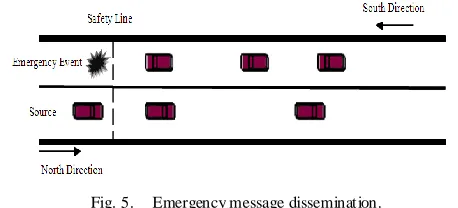
Besides, in classical geocast routing, recently, abiding geocast is introduced to disseminate in formation to a group of nodes in an area for specific t ime interval as discussed in [16]. When a vehicle enters such an area, the virtual warn ing sign displayed for the driver; it e mp loys periodic flooding or epidemic dissemination. The authors [17] have proposed a system of ab iding geocast for disseminating warn ing messages in VA NETs. Two strategies are used to improve the efficiency of disseminating i.e. vehic les travelling in opposite direction are used as preferred re lays to overcome frag mentation and reduce broadcasting. Figure 5 shows the illustration of abiding geocast, in which the vehic le in the problem a rea inform all vehic les moving left before they pass the safety line during the life time of the event, at the same time vehic les broadcast as few messages as possible.
C. Unicast Protocols
Geographic unicast provides information delivery between two nodes via mult iple wire less hops. Unicast communicat ion between vehicles is mo re co mplicated due to frequent topology fragmentation and bipola r t raffic conditions: sparse and dense scenarios. Some research has been done to enhance the unicast routing protocols which are designed for MANET such as [16]. Authors in [18] have proposed Ve locity-Headed based Routing Protocol (VHRP). This method uses GPS informat ion to predict the path disconnection and take pre-emptive act ion.
In VANET, geographical routing has been known as more promising routing paradig m. A position based routing consists of some co mponents such as beaconing, location service, and forward ing scheme. Beaconing is utilised to get topology informat ion of the network whereas the location service is used to obtain the location of the receivers. Furthermore, a forwa rding scheme selects the next hop based on geographical in formation of the current node. The routing discovery strategy of position based forwarding algorith ms based on location information. For instance, Greedy Perimeter Stateless Routing (GPSR) selects the node that is geographically c losest to the destination [19]. It co mbines greedy routing with perimeter backtracking. The perimeter backtracking is used to get out of the local optimu m where greedy routing fails.
Also the graph which is used in GPSR position based routing must be planar. Thus, some authors in [20] proposed Greedy Perimeter Coordinator Routing (GPCR). It utilises the concept of junction nodes to control the next road segments that packet should follo w. However, in mob ile urban environment, the concept of junction nodes is an issue and hard to maintain. So me authors in [21] have proposed Gpsrj+. The enhancement is based on a prediction method to select a road segment on which its neighbouring junction node will forwa rd the packet to. In addition, to address the issue of high mobile and route breakage, authors in [22] proposed Vehic le Assisted Data Delivery (VADD). The idea of carrying and forwa rding approaches with vehicle mobility prediction is adopted. Furthermo re, authors in [23] have proposed a distributed protocol for mult i-hop data dissemination. The protocol achieves ma ximu m pac ket delivery under a wide range of network condit ions in vehicular networks.
III. VIDEOCOMMUNICATIONOVERVA NET Real-time co mmun ication across wire less automobile networks provides more co mprehensive informat ion via mu ltimed ia such as video which can help drivers to make more suitable decision within disaster area.
[image:3.596.302.531.46.150.2]The provision of video streaming to driving vehicles can achieve very attractive applications. For instance, in highway safety system, the transmitted eme rgency message allows responders better understanding of the nature of the proble m about the disaster area. In this type of application the video source can be a vehicle or a base station (access point) with appropriate capability while the video receivers are vehicles that are travelling in the vicinity zone. Thus, there are two approaches for video streaming in VA NET : (1) infrastructure based approach which relies on deployed access points ; and (2) infrastructure-free approach wh ich forwards video file to vehicles in vicin ity zone. The first approach costs too much due to high base station deployment and maintenance services. Furthermo re, in vehicle to vehic le co mmunications approach it totally relies on the infrastructure-less vehicular network and it supports video applications over vehicle to vehicle commun ication. This is a more challenging task due to the lack of a pre -installed in frastructure to provide centralised control for the entire networks. On the other hand, the advancement of wire less technology and video compression techniques gives a practical solution for v ideo streaming through VA NET. Veh icles have embedded with large storage power and provide high computation capability. Therefore, vehic les have an efficient capability to forward continuous video data to other vehicles by using the IEEE 802.11 standard which supports up to 54Mbps transmission rate.
Fig. 5. Emergency message dissemination. Fig. 4. Opportunistic forwarding: vehicle Z stores transmitted message
[image:3.596.51.251.48.126.2]IV. IVCPROTOCOLSFORVIDEOCOMM UNICATION: ACOMPA RISON&DISCUSSION
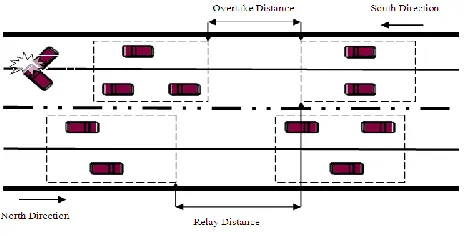
The e xisting advancement of wire less local area network LAN technology (IEEE 802.11) and the e merging research interests improve the VANET for the first responders who are involved in e mergency services for the disaster recovery. However, the acco mplishment of these real time applications is not easy due to high mobility of vehicles and lac k of pre-e xisting infrastructure. On the other hand, video applications have rigid require ments of bandwidth, delay, and jitter. There is fe w literature on video streaming applications in VANET and more generally in ad hoc networks. The authors [24] have investigated architecture for video streaming over VANET whereas no real video data are used in their simulat ion, and only the delay is reported in the e xperimental test bed study. Some authors [25] have discussed two routing protocols: Source Based Forward ing and Receiver Based Forwarding. The real v ideo data are used to simulate video streaming over VANET. In addition to that, diffe rent traffic conditions and data forwarding are studied to evaluate video streaming between platoons of vehicles. Authors [25] have changed the traffic density fro m sparse to dense. As a result, the quality of transmitted video is changed fro m bad to e xce llent as shown in Tab le 1. However, the Source Based Method requires the ma intenance of neighbours set by all the vehic les. In other words, each node periodically broadcasts its location, velocity and driv ing direction info rmation. The ma intenance of this list would generate a significant overload in the network that could increase packet delay and pac ket loss during transmission of the mu ltimed ia informat ion. Thus, the performance of Receiver Based Forward ing is better than the Source Based Forwa rding. In addition, the challenge of video streaming over VANET can be interpreted by the high dynamics of the vehicles. The high velocity and limited commun ication range of the vehicles incur frequent link disconnection and uneven network partit ion. Authors in [27] have combined data mu lling technique with three strategies, network coding [26], erasure coding, and repetition coding. Specially, vehicles in the opposite direction are e xplo ited as data mules to relay mu ltimed ia data to other vehicles to overcome intermittent connectivity in sparse vehicular ad hoc network. Ho wever, the analysis of the delay for re laying mu lt imedia data is based on the theoretical mathe matica l model (rea l video data are not used). Figure 6 de monstrates the proposed scenario for delay analysis.
Some authors [28] have proposed an adaptive Forward Error Correction (FEC) with interleaving technique to reduce the length of burst loss and retrieve fro m packet lo ss in VA NET. The adaptive based technique can transmit optimised multimedia sequences over VA NET. Moreover, it was based on the Forward Error Correction (FEC) and interleaving between packets. This method has used the Real Time Control Protocol (RTCP) to adaptively monitor the channel condition of the wire less network environ ment.
The adjustment of the amount of FEC is based on the reported packet loss which was known by RTCP. The combined FEC with packet interleav ing imp roves the value of Pea k Signal to Noise Ratio (PSNR is a metrics to assess the application leve l quality of service of v ideo transmissions).
However, this method has extra overhead due to several aspects: (1) the bandwidth redundancy created by the FEC; and (2) the feedback of RTCP for mon itoring the packet loss. In addition to this, the authors in [29] have investigated the eme rgency warning video dissemination to a platoon of vehicles following an accident area . The networ k coding algorith m was applied for the video d issemination. The evaluation performance reveals the fact that network coding is more benefic ia l for video dissemination over VA NET especially in high mobility and high channel loss. In addition, authors analytically have shown that network coding reduces delay in delivery across platoons via data mulling.
The review results as summaris ed in Table 1 could offer suggestions in the future research area:
1) The design of robust and reliable protocol for video transmission over VA NET needs to be exp lored.
2) Changing the FEC fro m the source to adapt with pac ket loss in the high erasure channel and mobility environ ment should be looked into as suggested by authors in [28].
3) It is essential fo r mu ltimedia applicat ion to know the error characteristics of wire less channel for an environ ment that change dynamica lly with time and speed. Thus, in order to find a suitable FEC rate at the source node, a model is needed to be explo red to determine an adequate level of FEC. 4) Network coding has emerged as an alternative to traditional routing algorithms in co mmun ication systems. In this technique, network nodes can combine the packets they receive before forward ing the m to downstream nodes. This technique can be used to increase throughput for video streaming in wire less environment. However, it introduces a decoding delay. Therefore , investigation into the tradeoffs between throughput and decoding delay still is an open research issue.
V. CONCLUSION
[image:4.596.313.546.51.169.2]In this paper, a comprehensive comparison of recent routing protocols has been discussed for video and text transmission over VA NET. In addition to this, some of routing challenges for video streaming and te xt dissemination over VANET are proposed. Furthermore, the co mparison results conclude that for mu ltimed ia applicat ions, this critical environment could negatively affect the performance of the network. In this situation, the ma jor concern is to design and develop an efficient routing protocol for multimedia communicat ion in such harsh environment which has very rapid changes. All these changes must be synchronised with the software and hardware environ ment for the effic ient
control and improve ment.
ACKNOW LEDGM ENT
The authors would like to thank to the admin istration of FSKSM and UTM for encouragement and generous support .
REFERENCES
[1] “ Car-to-Car communication,” [Online]. Available: http://www.car-to-car.org.[Accessed : 15 November,2009].
[2] “US department of transportation: Intelligent transportation systems,” [Online]. Available: http://www.its.dot.gov.[Accessed: 10 November,2009].
[3] “Ahsra: Advance cruise-assist highway system research association,” [Online]. Available: http://www.ahsra.or.jp. .[Accessed : 15 November,2009].
[4] L. Fan, and W. YU, “Routing in vehicular ad hoc networks: a survey,” IEEE Vehicular Technology Magazine, pp. 12-22, 2007.
[5] G. Korkmaz et al., "Urban Multi-hop Broadcast protocol for intervehicle Communication systems, " in 1st ACM International Workshop on Vehicular Ad Hoc Networks, Philadelphia, PA, USA, 2004, pp. 76-85.
[6] X. Yang et al., "A vehicle-to-vehicle communication protocol for cooperative collision warning,” in 1st Annu. Int. Conf. Mobile Ubiquitous Syst.: Netw. Services, 2004, pp. 114-123.
[7] E. Fasolo, R. Furiato and A. Zanella, "Smart Broadcast for inter–vehicular communications," in Proc. of WPMC05, Sep.2005, Alborg Denmark.
[8] X. Zhang, F. Xie, W. Wang, and M. Chatterjee, "TCP throughput for Vehicle-to-Vehicle Communications," in Proceedings of the 1st International Conference on Communications and Networking in China (ChinaCOM) 2006, pp. 1-5. Oct. 2006.
[9] Z. Chen, H. Kung and D. Vlah, "Ad hoc relay wireless networks over moving vehicles on highways," in Proceedings of Mobihoc 2001, pp. 247– 250.
[10] T.D.C. Little and A. Agarwal, "An information propagation scheme for VANET s," In Proceedings 8th International IEEE Conference on Intelligent Transportation Systems (IT SC 2005), 2005, pp. 155-160. [11] R. Francisco J., R., Pedro M., and S. Ivan, "Reliable and efficient
broadcasting in vehicular ad hoc networks" In IEEE 69th Vehicular Technology Conferenc, Barcelona, Spain, 2009.
[12] L. Peiyuan, W. Xinhong, L. Ning, and L. Fuqiang, "A reliable broadcast routing scheme based on mobility prediction for VANET" in Proceedings of the 2009 International Conference on Intillegent Vehicles, p.p 1083-1087, 2009.
[13] H. Wu et al., "MDDV: a mobility-centric data dissemination algorithm for vehicular networks," in 1st ACM International Workshop on Vehicular Ad Hoc Networks (VANET‟04), Philadelphia, PA, USA, 2004, pp. 47-56.
[14] C. Maihöfer, "A survey of geocast routing protocols," IEEE Commun. Surveys T utorials, vol. 6, pp. 32-42, 2004.
[15] A. Bachir,Abderrahim Benslimane, "A multicast protocol in ad hoc networks intervehicle geocast," in Proceedings of the 57th IEEE Semiannual Vehicular T echnology Conference, vol. 4, pp. 2456–2460, 2003.
[16] C. Maihöfer, T. Leinmüller, and E. Schoch, "Abiding geocast: time–stable geocast for ad hoc networks," in Proceedings of the 2nd ACM international workshop on Vehicular ad hoc networks (VANET ‟05), pp. 20–29, 2005.
[17] Y. Qiangyuan, H. Geert, "Abiding geocast for warning message dissemination in vehicular ad hoc networks," Proc.IEEE International Conference on Communications, Beijing, China, pp. 400-404,2008. [18] T. Taleb, M. Ochi, N. Kato, and Y. Nemoto, "An efficient
vehicle-heading based routing protocol for VANET networks," in Proc. IEEE Wireless Communications and Networking Conference, WCNC 2006.
[19] B. Karp and H.T. Kung, „„GPSR: Greedy perimeter stateless routing for wireless networks,‟‟ in Proceedings of the ACM/IEEE International Conference on Mobile Computing and Networking (MobiCom), 2000. [20] C. Lochert, M. Mauve, H. Füßler, and H. Hartenstein„„Geographic routing in city scenarios,‟‟ In ACM SIGMOBILE Mobile Computing and Communications Review (MC2R), vol. 9, no. 1, pp. 69–72, January 2005.
[21] K. C. Lee, J. Haerri, U Lee, and M. Gerla, “ Enahanced perimeter routing for geographic routing protocols in urban vehicular scenarios,” In IEEE Autonet workshop,2007.
[22] J. Zhao and G. Cao, “ VADD: Vehicle-assisted data delivery in vehicular ad hoc networks,” in Proc of IEEE Infocom,2006.
[23] K. R. Guha, and W. Chen, “Achieving High-Rate Multi-hop Data Delivery in Vehicular Networks,” In Proceedings IEEE 69th Vehicular Technology Conference,2009.
[24] M. Gao, M.H. Ammar, E.W. Zegura, "V3: a Vehicle-to-Vehicle Live Video Streaming Architecture," Proc. 3rd IEEE International Conference on Pervasive Computing and Communications, Kauai, HI, Mar 2005.
[25] F. Xie, K. A. Hua, W. Wang, and Y. H. Ho, "Performance study of live video streaming over highway vehicular Ad hoc networks," In international IEEE Vehicular Technology Conference,USA, 2007,pp. 2121-2125.
[26] R. Ahlswede, N. Cai, S.-Y.R. Li, and R.W. Yeung, "Network information flow," IEEE Trans. Inf. Theory, vol.46, no.4, pp.1204–1216, July 2000.
[27] J. Park,U. Lee, S. Oh, M. Gerla, "Delay analysis of car-to-car reliable data delivery strategies based on data mulling with network coding," The IEICE TRANS. INF. & SYST ., Vol.E91–D, No.10, pp.2524-2527,October 2008.
[28] M. Pasin, M. Petracca, P. Bucciol, A. Servetti, J. De Martin, "Error resilient real-time multimedia streaming over vehicular networks," In-Vehicle Systems and Safety, Dallas, TX, USA, 2009.
[29] P. Joon Sang, L. Uichin , O. Soon Y., G. Mario, L. Desmond S., "Emergency related video streaming in VANET using network coding," In Third ACM International Workshop on Vehicular Ad Hoc Networks,USA,2006.
TABLE1. COMP ARISON OF EXISTING P ROTOCOLS FOR VIDEO STREAMING