The CoNLL-2010 Shared Task: Learning to Detect Hedges and their
Scope in Natural Language Text
Rich´ard Farkas1,2, Veronika Vincze1, Gy¨orgy M´ora1, J´anos Csirik1,2, Gy¨orgy Szarvas3 1 University of Szeged, Department of Informatics
2Hungarian Academy of Sciences, Research Group on Artificial Intelligence 3Technische Universit¨at Darmstadt, Ubiquitous Knowledge Processing Lab
{rfarkas,vinczev,gymora,csirik}@inf.u-szeged.hu, [email protected]
Abstract
The CoNLL-2010 Shared Task was dedi-cated to the detection of uncertainty cues and their linguistic scope in natural lan-guage texts. The motivation behind this task was that distinguishing factual and uncertain information in texts is of essen-tial importance in information extraction. This paper provides a general overview of the shared task, including the annota-tion protocols of the training and evalua-tion datasets, the exact task definievalua-tions, the evaluation metrics employed and the over-all results. The paper concludes with an analysis of the prominent approaches and an overview of the systems submitted to the shared task.
1 Introduction
Every year since 1999, the Conference on Com-putational Natural Language Learning (CoNLL) provides a competitive shared task for the Com-putational Linguistics community. After a five-year period of multi-language semantic role label-ing and syntactic dependency parslabel-ing tasks, a new task was introduced in 2010, namely the detection of uncertainty and its linguistic scope in natural language sentences.
In natural language processing (NLP) – and in particular, in information extraction (IE) – many applications seek to extract factual information from text. In order to distinguish facts from unre-liable or uncertain information, linguistic devices such as hedges (indicating that authors do not or cannot back up their opinions/statements with facts) have to be identified. Applications should handle detected speculative parts in a different manner. A typical example is proteprotein in-teraction extraction from biological texts, where the aim is to mine text evidence for biological enti-ties that are in a particular relation with each other.
Here, while an uncertain relation might be of some interest for an end-user as well, such information must not be confused with factual textual evidence (reliable information).
Uncertainty detection has two levels. Auto-matic hedge detectors might attempt to identify sentences which contain uncertain information and handle whole sentences in a different man-ner or they might attempt to recognize in-sentence spans which are speculative. In-sentence uncer-tainty detection is a more complicated task com-pared to the sentence-level one, but it has bene-fits for NLP applications as there may be spans containing useful factual information in a sentence that otherwise contains uncertain parts. For ex-ample, in the following sentence the subordinated clause starting withalthough contains factual in-formation while uncertain inin-formation is included in the main clause and the embedded question.
Although IL-1 has been reported to con-tribute to Th17 differentiation in mouse and man, it remains to be determined
{whether therapeutic targeting of IL-1 will substantially affect IL-17 in RA}.
Both tasks were addressed in the CoNLL-2010 Shared Task, in order to provide uniform manu-ally annotated benchmark datasets for both and to compare their difficulties and state-of-the-art so-lutions for them. The uncertainty detection prob-lem consists of two stages. First, keywords/cues indicating uncertainty should be recognized then either a sentence-level decision is made or the lin-guistic scope of the cue words has to be identified. The latter task falls within the scope of semantic analysis of sentences exploiting syntactic patterns, as hedge spans can usually be determined on the basis of syntactic patterns dependent on the key-word.
2 Related Work
The term hedging was originally introduced by Lakoff (1972). However, hedge detection has re-ceived considerable interest just recently in the NLP community. Light et al. (2004) used a hand-crafted list of hedge cues to identify specula-tive sentences in MEDLINE abstracts and several biomedical NLP applications incorporate rules for identifying the certainty of extracted information (Friedman et al., 1994; Chapman et al., 2007; Ara-maki et al., 2009; Conway et al., 2009).
The most recent approaches to uncertainty de-tection exploit machine learning models that uti-lize manually labeled corpora. Medlock and Briscoe (2007) used single words as input features in order to classify sentences from biological ar-ticles (FlyBase) as speculative or non-speculative based on semi-automatically collected training ex-amples. Szarvas (2008) extended the methodology of Medlock and Briscoe (2007) to use n-gram fea-tures and a semi-supervised selection of the key-word features. Kilicoglu and Bergler (2008) pro-posed a linguistically motivated approach based on syntactic information to semi-automatically re-fine a list of hedge cues. Ganter and Strube (2009) proposed an approach for the automatic detec-tion of sentences containing uncertainty based on Wikipedia weasel tags and syntactic patterns.
The BioScope corpus (Vincze et al., 2008) is manually annotated with negation and specula-tion cues and their linguistic scope. It consists of clinical free-texts, biological texts from full pa-pers and scientific abstracts. Using BioScope for training and evaluation, Morante and Daelemans (2009) developed a scope detector following a su-pervised sequence labeling approach while ¨Ozg¨ur and Radev (2009) developed a rule-based system that exploits syntactic patterns.
Several related works have also been published within the framework of The BioNLP’09 Shared Task on Event Extraction (Kim et al., 2009), where a separate subtask was dedicated to predicting whether the recognized biological events are un-der negation or speculation, based on the GENIA event corpus annotations (Kilicoglu and Bergler, 2009; Van Landeghem et al., 2009).
3 Uncertainty Annotation Guidelines
The shared task addressed the detection of uncer-tainty in two domains. As unceruncer-tainty detection is extremely important for biomedical information
extraction and most existing approaches have tar-geted such applications, participants were asked to develop systems for hedge detection in bio-logical scientific articles. Uncertainty detection is also important, e.g. in encyclopedias, where the goal is to collect reliable world knowledge about real-world concepts and topics. For exam-ple, Wikipedia explicitly declares that statements reflecting author opinions or those not backed up by facts (e.g. references) should be avoided (see 3.2 for details). Thus, the community-edited en-cyclopedia, Wikipedia became one of the subjects of the shared task as well.
3.1 Hedges in Biological Scientific Articles
In the biomedical domain, sentences were manu-ally annotated for both hedge cues and their lin-guistic scope. Hedging is typically expressed by using specific linguistic devices (which we refer to as cues in this article) that modify the meaning or reflect the author’s attitude towards the content of the text. Typical hedge cues fall into the following categories:
• auxiliaries: may, might, can, would, should,
could, etc.
• verbs of hedging or verbs with speculative
content:suggest, question, presume, suspect, indicate, suppose, seem, appear, favor, etc.
• adjectives or adverbs:probable, likely, possi-ble, unsure, etc.
• conjunctions: or, and/or, either . . . or, etc.
However, there are some cases where a hedge is expressed via a phrase rather than a single word. Complex keywords are phrases that express un-certainty together, but not on their own (either the semantic interpretation or the hedging strength of its subcomponents are significantly different from those of the whole phrase). An instance of a com-plex keyword can be seen in the following sen-tence:
Mild bladder wall thickening {raises
the question ofcystitis}.
During the annotation process, a min-max strat-egy for the marking of keywords (min) and their scope (max) was followed. On the one hand, when marking the keywords, the minimal unit that ex-presses hedging and determines the actual strength of hedging was marked as a keyword. On the other hand, when marking the scopes of speculative key-words, the scope was extended to the largest syn-tactic unit possible. That is, all constituents that fell within the uncertain interpretation were in-cluded in the scope. Our motivation here was that in this way, if we simply disregard the marked text span, the rest of the sentence can usually be used for extracting factual information (if there is any). For instance, in the example above, we can be sure that the symptom mild bladder wall thickeningis exhibited by the patient but a diagnosis ofcystitis would be questionable.
The scope of a speculative element can be de-termined on the basis of syntax. The scopes of the BioScope corpus are regarded as consecutive text spans and their annotation was based on con-stituency grammar. The scope of verbs, auxil-iaries, adjectives and adverbs usually starts right with the keyword. In the case of verbal elements, i.e. verbs and auxiliaries, it ends at the end of the clause or sentence, thus all complements and juncts are included. The scope of attributive ad-jectives generally extends to the following noun phrase, whereas the scope of predicative adjec-tives includes the whole sentence. Sentential ad-verbs have a scope over the entire sentence, while the scope of other adverbs usually ends at the end of the clause or sentence. Conjunctions generally have a scope over the syntactic unit whose mem-bers they coordinate. Some linguistic phenomena (e.g. passive voice or raising) can change scope boundaries in the sentence, thus they were given special attention during the annotation phase.
3.2 Wikipedia Weasels
The chief editors of Wikipedia have drawn the at-tention of the public to uncertainty issues they call weasel1. A word is considered to be a weasel
word if it creates an impression that something im-portant has been said, but what is really commu-nicated is vague, misleading, evasive or ambigu-ous. Weasel words do not give a neutral account of facts, rather, they offer an opinion without any
1http://en.wikipedia.org/wiki/Weasel_
word
backup or source. The following sentence does not specify the source of information, it is just the vague termsome peoplethat refers to the holder of this opinion:
Some peopleclaim that this results in a better taste than that of other diet colas (most of which are sweetened with as-partame alone).
Statements with weasel words usually evoke ques-tions such as Who says that?, Whose opinion is this?andHow many people think so?.
Typical instances of weasels can be grouped in the following way (we offer some examples as well):
• Adjectives and adverbs
– elements referring to uncertainty: prob-able, likely, possible, unsure, often, pos-sibly, allegedly, apparently, perhaps, etc.
– elements denoting generalization: widely, traditionally, generally, broadly-accepted, widespread, etc.
– qualifiers and superlatives: global, su-perior, excellent, immensely, legendary, best, (one of the) largest, most promi-nent, etc.
– elements expressing obviousness: clearly, obviously, arguably, etc.
• Auxiliaries
– may, might, would, should, etc.
• Verbs
– verbs with speculative content and their passive forms: suggest, question, pre-sume, suspect, indicate, suppose, seem, appear, favor, etc.
– passive forms with dummy subjects: It is claimed that . . . It has been men-tioned . . . It is known . . .
– there is / there areconstructions: There is evidence/concern/indication that. . .
• Numerically vague expressions / quantifiers
• Nouns
– speculation, proposal, consideration, etc. Rumour has it that . . . Common sense insists that . . .
However, the use of the above words or grammat-ical devices does not necessarily entail their being a weasel cue since their use may be justifiable in their contexts.
As the main application goal of weasel detec-tion is to highlight articles which should be im-proved (by reformulating or adding factual is-sues), we decided to annotate only weasel cues in Wikipedia articles, but we did not mark their scopes.
During the manual annotation process, the fol-lowing cue marking principles were employed. Complex verb phrases were annotated as weasel cues since in some cases, both the passive con-struction and the verb itself are responsible for the weasel. In passive forms with dummy subjects and there is / there are constructions, the weasel cue included the grammatical subject (i.e.itandthere) as well. As for numerically vague expressions, the noun phrase containing a quantifier was marked as a weasel cue. If there was no quantifier (in the case of a bare plural), the noun was annotated as a weasel cue. Comparatives and superlatives were annotated together with their article. Anaphoric pronouns referring to a weasel word were also an-notated as weasel cues.
4 Task Definitions
Two uncertainty detection tasks (sentence clas-sification and in-sentence hedge scope detec-tion) in two domains (biological publications and Wikipedia articles) with three types of submis-sions (closed, cross and open) were given to the participants of the CoNLL-2010 Shared Task.
4.1 Detection of Uncertain Sentences
The aim of Task1 was to develop automatic proce-dures for identifying sentences in texts which con-tain unreliable or uncercon-tain information. In par-ticular, this task is a binary classification problem, i.e. factual and uncertain sentences have to be dis-tinguished.
As training and evaluation data
• Task1B: biological abstracts and full articles (evaluation data contained only full articles) from the BioScope corpus and
• Task1W: paragraphs from Wikipedia possi-bly containing weasel information
were provided. The annotation of weasel/hedge cues was carried out on the phrase level, and sen-tences containing at least one cue were considered as uncertain, while sentences with no cues were considered as factual. The participating systems had to submit a binary classification (certain vs. uncertain) of the test sentences while marking cues in the submissions was voluntary (but participants were encouraged to do this).
4.2 In-sentence Hedge Scope Resolution
For Task2, in-sentence scope resolvers had to be developed. The training and evaluation data con-sisted of biological scientific texts, in which in-stances of speculative spans – that is, keywords and their linguistic scope – were annotated manu-ally. Submissions to Task2 were expected to auto-matically annotate the cue phrases and the left and right boundaries of their scopes (exactly one scope must be assigned to a cue phrase).
4.3 Evaluation Metrics
The evaluation for Task1 was carried out at the sentence level, i.e. the cue annotations in the sen-tence were not taken into account. TheFβ=1
mea-sure (the harmonic mean of precision and recall) of the uncertain class was employed as the chief evaluation metric.
The Task2 systems were expected to mark cue-and corresponding scope begin/end tags linked to-gether by using some unique IDs. A scope-level Fβ=1 measure was used as the chief evaluation
metric where true positives were scopes which ex-actly matched the gold standard cue phrases and gold standard scope boundaries assigned to the cue word. That is, correct scope boundaries with in-correct cue annotation and in-correct cue words with bad scope boundaries were both treated as errors.
Another questionable issue is the strict bound-ary matching requirement. For example, includ-ing or excludinclud-ing punctuations, citations or some bracketed expressions, like (see Figure 1) from a scope is not crucial for an otherwise accurate scope detector. On the other hand, the list of such ignorable phenomena is arguable, especially across domains. Thus, we considered the strict boundary matching to be a straightforward and un-ambiguous evaluation criterion. Minor issues like those mentioned above could be handled by sim-ple post-processing rules. In conclusion we think that the uncertainty detection community may find more flexible evaluation criteria in the future but the strict scope-level metric is definitely a good starting point for evaluation.
4.4 Closed and Open Challenges
Participants were invited to submit results in dif-ferent configurations, where systems were allowed to exploit different kinds of annotated resources. The three possible submission categories were:
• Closed, where only the labeled and
unla-beled data provided for the shared task were allowed, separately for each domain (i.e. biomedical train data for biomedical test set and Wikipedia train data for Wikipedia test set). No further manually crafted resources of uncertainty information (i.e. lists, anno-tated data, etc.) could be used in any domain. On the other hand, tools exploiting the man-ual annotation of linguistic phenomena not related to uncertainty (such as POS taggers and parsers trained on labeled corpora) were allowed.
• Cross-domain was the same as the closed one
but all data provided for the shared task were allowed for both domains (i.e. Wikipedia train data for the biomedical test set, the biomedical train data for Wikipedia test set or a union of Wikipedia and biomedical train data for both test sets).
• Open, where any data and/or any additional manually created information and resource (which may be related to uncertainty) were allowed for both domains.
The motivation behind the cross-domain and the open challenges was that in this way, we could
assess whether adding extra (i.e. not domain-specific) information to the systems can contribute to the overall performance.
5 Datasets
Training and evaluation corpora were annotated manually for hedge/weasel cues and their scope by two independent linguist annotators. Any dif-ferences between the two annotations were later resolved by the chief annotator, who was also re-sponsible for creating the annotation guidelines and training the two annotators. The datasets are freely available2for further benchmark
experi-ments athttp://www.inf.u-szeged.hu/
rgai/conll2010st.
Since uncertainty cues play an important role in detecting sentences containing uncertainty, they are tagged in the Task1 datasets as well to enhance training and evaluation of systems.
5.1 Biological Publications
The biological training dataset consisted of the bi-ological part of the BioScope corpus (Vincze et al., 2008), hence it included abstracts from the GE-NIA corpus, 5 full articles from the functional ge-nomics literature (related to the fruit fly) and 4 ar-ticles from the open access BMC Bioinformatics website. The automatic segmentation of the doc-uments was corrected manually and the sentences (14541 in number) were annotated manually for hedge cues and their scopes.
The evaluation dataset was based on 15 biomed-ical articles downloaded from the publicly avail-able PubMedCentral database, including 5 ran-dom articles taken from the BMC Bioinformat-icsjournal in October 2009, 5 random articles to which the drosophila MeSH term was assigned and 5 random articles having the MeSH terms human, blood cells andtranscription factor (the same terms which were used to create the Genia corpus). These latter ten articles were also pub-lished in 2009. The aim of this article selection procedure was to have a theme that was close to the training corpus. The evaluation set contained 5003 sentences, out of which 790 were uncertain. These texts were manually annotated for hedge cues and their scope. To annotate the training and the evaluation datasets, the same annotation prin-ciples were applied.
2under the Creative Commons Attribute Share Alike
For both Task1 and Task2, the same dataset was provided, the difference being that for Task1, only hedge cues and sentence-level uncertainty were given, however, for Task2, hedge cues and their scope were marked in the text.
5.2 Wikipedia Datasets
2186 paragraphs collected from Wikipedia archives were also offered as Task1 training data (11111 sentences containing 2484 uncertain ones). The evaluation dataset contained 2346 Wikipedia paragraphs with 9634 sentences, out of which 2234 were uncertain.
For the selection of the Wikipedia paragraphs used to construct the training and evaluation datasets, we exploited the weasel tags added by the editors of the encyclopedia (marking unsup-ported opinions or expressions of a non-neutral point of view). Each paragraph containing weasel tags (5874 different ones) was extracted from the history dump of English Wikipedia. First, 438 ran-domly selected paragraphs were manually anno-tated from this pool then the most frequent cue phrases were collected. Later on, two other sets of Wikipedia paragraphs were gathered on the ba-sis of whether they contained such cue phrases or not. The aim of this sampling procedure was to provide large enough training and evaluation sam-ples containing weasel words and also occurrences of typical weasel words in non-weasel contexts.
Each sentence was annotated manually for weasel cues. Sentences were treated as uncer-tain if they conuncer-tained at least one weasel cue, i.e. the scope of weasel words was the entire sentence (which is supposed to be rewritten by Wikipedia editors).
5.3 Unlabeled Data
Unannotated but pre-processed full biological arti-cles (150 artiarti-cles from the publicly available Pub-MedCentral database) and 1 million paragraphs from Wikipedia were offered to the participants as well. These datasets did not contain any manual annotation for uncertainty, but their usage permit-ted data sampling from a large pool of in-domain texts without time-wasting pre-processing tasks (cleaning and sentence splitting).
5.4 Data Format
Both training and evaluation data were released in a custom XML format. For each task, a sep-arate XML file was made available containing the
whole document set for the given task. Evaluation datasets were available in the same format as train-ing data without any sentence-level certainty, cue or scope annotations.
The XML format enabled us to provide more detailed information about the documents such as segment boundaries and types (e.g. section titles, figure captions) and it is the straightforward for-mat to represent nested scopes. Nested scopes have overlapping text spans which may contain cues for multiple scopes (there were 1058 occur-rences in the training and evaluation datasets to-gether). The XML format utilizes id-references to determine the scope of a given cue. Nested constructions are rather complicated to represent in the standard IOB format, moreover, we did not want to enforce a uniform tokenization.
To support the processing of the data files, reader and writer software modules were devel-oped and offered to the participants for the uCom-pare (Kano et al., 2009) framework. uComuCom-pare provides a universal interface (UIMA) and several text mining and natural language processing tools (tokenizers, POS taggers, syntactic parsers, etc.) for general and biological domains. In this way participants could configure and execute a flexible chain of analyzing tools even with a graphical UI.
6 Submissions and Results
Participants uploaded their results through the shared task website, and the official evaluation was performed centrally. After the evaluation period, the results were published for the participants on the Web. A total of 23 teams participated in the shared task. 22, 16 and 13 teams submitted output for Task1B, Task1W and Task2, respectively.
6.1 Results
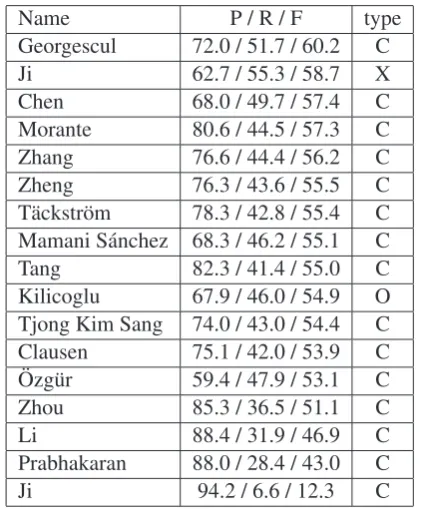
Tables 1, 2 and 3 contain the results of the submit-ted systems for Task1 and Task2. The last name of the first author of the system description pa-per (published in these proceedings) is used here as a system name3. The last column contains the
type of submission. The system of Kilicoglu and Bergler (2010) is the only open submission. They adapted their system introduced in Kilicoglu and Bergler (2008) to the datasets of the shared task.
Regarding cross submissions, Zhao et al. (2010) and Ji et al. (2010) managed to achieve a no-ticeable improvement by exploiting cross-domain
Name P / R / F type
Georgescul 72.0 / 51.7 / 60.2 C
Ji 62.7 / 55.3 / 58.7 X
Chen 68.0 / 49.7 / 57.4 C
Morante 80.6 / 44.5 / 57.3 C
Zhang 76.6 / 44.4 / 56.2 C
Zheng 76.3 / 43.6 / 55.5 C
T¨ackstr¨om 78.3 / 42.8 / 55.4 C Mamani S´anchez 68.3 / 46.2 / 55.1 C
Tang 82.3 / 41.4 / 55.0 C
Kilicoglu 67.9 / 46.0 / 54.9 O
Tjong Kim Sang 74.0 / 43.0 / 54.4 C
Clausen 75.1 / 42.0 / 53.9 C
¨Ozg¨ur 59.4 / 47.9 / 53.1 C
Zhou 85.3 / 36.5 / 51.1 C
Li 88.4 / 31.9 / 46.9 C
Prabhakaran 88.0 / 28.4 / 43.0 C
[image:7.595.314.519.57.431.2]Ji 94.2 / 6.6 / 12.3 C
Table 1: Task1 Wikipedia results (type ∈ {Closed(C), Cross(X), Open(O)}).
data. Zhao et al. (2010) extended the biological cue word dictionary of their system – using it as a feature for classification – by the frequent cues of the Wikipedia dataset, while Ji et al. (2010) used the union of the two datasets for training (they have reported an improvement from 47.0 to 58.7 on the Wikipedia evaluation set after a post-challenge bugfix).
Name P / R / F type
Morante 59.6 / 55.2 / 57.3 C
Rei 56.7 / 54.6 / 55.6 C
Velldal 56.7 / 54.0 / 55.3 C Kilicoglu 62.5 / 49.5 / 55.2 O
Li 57.4 / 47.9 / 52.2 C
Zhou 45.6 / 43.9 / 44.7 O
Zhou 45.3 / 43.6 / 44.4 C
Zhang 46.0 / 42.9 / 44.4 C Fernandes 46.0 / 38.0 / 41.6 C Vlachos 41.2 / 35.9 / 38.4 C
Zhao 34.8 / 41.0 / 37.7 C
Tang 34.5 / 31.8 / 33.1 C
Ji 21.9 / 17.2 / 19.3 C
T¨ackstr¨om 2.3 / 2.0 / 2.1 C
Table 2: Task2 results (type ∈ {Closed(C),
Open(O)}).
Each Task2 and Task1W system achieved a
Name P / R / F type
Tang 85.0 / 87.7 / 86.4 C
Zhou 86.5 / 85.1 / 85.8 C
Li 90.4 / 81.0 / 85.4 C
Velldal 85.5 / 84.9 / 85.2 C
Vlachos 85.5 / 84.9 / 85.2 C
T¨ackstr¨om 87.1 / 83.4 / 85.2 C
Shimizu 88.1 / 82.3 / 85.1 C
Zhao 83.4 / 84.8 / 84.1 X
¨Ozg¨ur 77.8 / 91.3 / 84.0 C
Rei 83.8 / 84.2 / 84.0 C
Zhang 82.6 / 84.7 / 83.6 C
Kilicoglu 92.1 / 74.9 / 82.6 O
Morante 80.5 / 83.3 / 81.9 X
Morante 81.1 / 82.3 / 81.7 C
Zheng 73.3 / 90.8 / 81.1 C
Tjong Kim Sang 74.3 / 87.1 / 80.2 C
Clausen 79.3 / 80.6 / 80.0 C
Szidarovszky 70.3 / 91.0 / 79.3 C Georgescul 69.1 / 91.0 / 78.5 C
Zhao 71.0 / 86.6 / 78.0 C
Ji 79.4 / 76.3 / 77.9 C
Chen 74.9 / 79.1 / 76.9 C
Fernandes 70.1 / 71.1 / 70.6 C
Prabhakaran 67.5 / 19.5 / 30.3 X
Table 3: Task1 biological results (type ∈ {Closed(C), Cross(X), Open(O)}).
higher precision than recall. There may be two reasons for this. The systems may have applied only reliable patterns, or patterns occurring in the evaluation set may be imperfectly covered by the training datasets. The most intense participation was on Task1B. Here, participants applied vari-ous precision/recall trade-off strategies. For in-stance, Tang et al. (2010) achieved a balanced pre-cision/recall configuration, while Li et al. (2010) achieved third place thanks to their superior preci-sion.
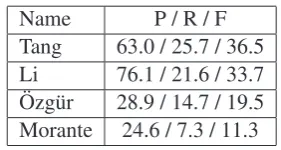
Tables 4 and 5 show the cue-level performances, i.e. the F-measure of cue phrase matching where true positives were strict matches. Note that it was optional to submit cue annotations for Task1 (if participants submitted systems for both Task2 and Task1B with cue tagging, only the better score of the two was considered).
[image:7.595.76.289.61.325.2] [image:7.595.91.276.491.704.2]com-pared to Zhou et al. (2010), while on the scope-level the difference is 13% in the reverse direc-tion), which indicates that the real strength of the system of Morante et al. (2010) is the accurate de-tection of scope boundaries.
Name P / R / F
[image:8.595.110.251.139.214.2]Tang 63.0 / 25.7 / 36.5 Li 76.1 / 21.6 / 33.7 ¨Ozg¨ur 28.9 / 14.7 / 19.5 Morante 24.6 / 7.3 / 11.3
Table 4: Wikipedia cue-level results.
Name P / R / F type
Tang 81.7 / 81.0 / 81.3 C
Zhou 83.1 / 78.8 / 80.9 C
Li 87.4 / 73.4 / 79.8 C
Rei 81.4 / 77.4 / 79.3 C
Velldal 81.2 / 76.3 / 78.7 C Zhang 82.1 / 75.3 / 78.5 C
Ji 78.7 / 76.2 / 77.4 C
Morante 78.8 / 74.7 / 76.7 C Kilicoglu 86.5 / 67.7 / 76.0 O Vlachos 82.0 / 70.6 / 75.9 C
Zhao 76.7 / 73.9 / 75.3 X
Fernandes 79.2 / 64.7 / 71.2 C
Zhao 63.7 / 74.1 / 68.5 C
T¨ackstr¨om 66.9 / 58.6 / 62.5 C ¨Ozg¨ur 49.1 / 57.8 / 53.1 C
Table 5: Biological cue-level results (type ∈ {Closed(C), Cross(X), Open(O)}).
6.2 Approaches
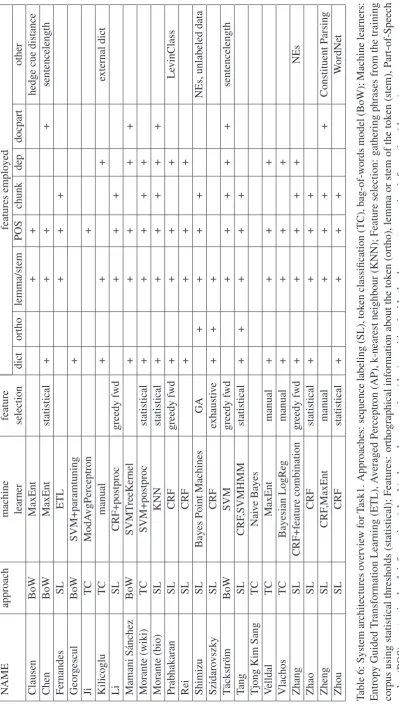
The approaches to Task1 fall into two major cat-egories. There were six systems which handled the task as a classical sentence classification prob-lem and employed essentially a bag-of-words fea-ture representation (they are marked as BoW in Table 6). The remaining teams focused on the cue phrases and sought to classify every token if it was a part of a cue phrase, then a sentence was predicted as uncertain if it contained at least one recognized cue phrase. Five systems followed a pure token classification approach (TC) for cue de-tection while others used sequential labeling tech-niques (usually Conditional Random Fields) to identify cue phrases in sentences (SL).
The feature set employed in Task1 systems typ-ically consisted of the wordform, its lemma or
stem, POS and chunk codes and about the half of the participants constructed features from the de-pendency and/or constituent parse tree of the sen-tences as well (see Table 6 for details).
It is interesting to see that the top ranked sys-tems of Task1B followed a sequence labeling ap-proach, while the best systems on Task1W applied a bag-of-words sentence classification. This may be due to the fact that biological sentences have relatively simple patterns. Thus the context of the cue words (token classification-based approaches used features derived from a window of the token in question, thus, they exploited the relationship among the tokens and their contexts) can be uti-lized while Wikipedia weasels have a diverse na-ture. Another observation is that the top systems in both Task1B and Task1W are the ones which did not derive features from syntactic parsing.
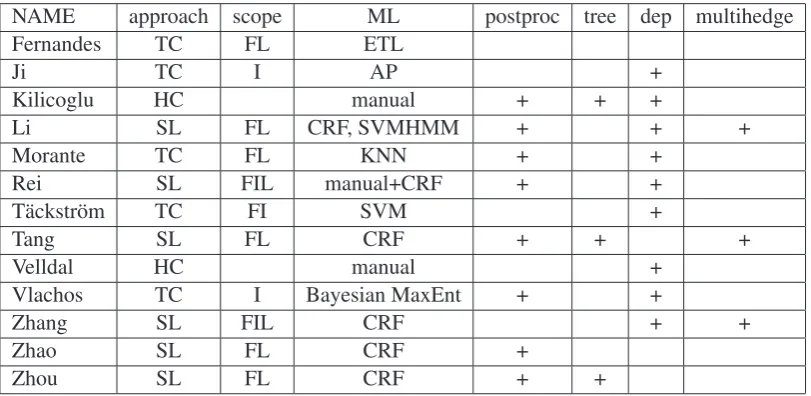
Each Task2 system was built upon a Task1 sys-tem, i.e. they attempted to recognize the scopes for the predicted cue phrases (however, Zhang et al. (2010) have argued that the objective functions of Task1 and Task2 cue detection problems are different because of sentences containing multiple hedge spans).
Most systems regarded multiple cues in a sen-tence to be independent from each other and formed different classification instances from them. There were three systems which incor-porated information about other hedge cues (e.g. their distance) of the sentence into the feature space and Zhang et al. (2010) constructed a cas-cade system which utilized directly the predicted scopes (it processes cue phrases from left to right) during predicting other scopes in the same sen-tence.
[image:8.595.93.274.247.481.2]NAME approach scope ML postproc tree dep multihedge
Fernandes TC FL ETL
Ji TC I AP +
Kilicoglu HC manual + + +
Li SL FL CRF, SVMHMM + + +
Morante TC FL KNN + +
Rei SL FIL manual+CRF + +
T¨ackstr¨om TC FI SVM +
Tang SL FL CRF + + +
Velldal HC manual +
Vlachos TC I Bayesian MaxEnt + +
Zhang SL FIL CRF + +
Zhao SL FL CRF +
[image:10.595.97.503.62.260.2]Zhou SL FL CRF + +
Table 7: System architectures overview for Task2. Approaches: sequence labeling (SL), token clas-sification (TC), hand-crafted rules (HC); Machine learners: Entropy Guided Transformation Learning (ETL), Averaged Perceptron (AP), k-nearest neighbour (KNN); The way of identifying scopes: predict-ing first/last tokens (FL), first/inside/last tokens (FIL), just inside tokens (I); Multiple Hedges: the system applied a mechanism for handling multiple hedges inside a sentence
and token classification (TC) approaches (see Ta-ble 7). The feature sets used here are the same as for Task1, extended by several features describ-ing the relationship between the cue phrase and the token in question mostly by describing the depen-dency path between them.
7 Conclusions
The CoNLL-2010 Shared Task introduced the novel task of uncertainty detection. The challenge consisted of a sentence identification task on un-certainty (Task1) and an in-sentence hedge scope detection task (Task2). In the latter task the goal of automatic systems was to recognize speculative text spans inside sentences.
The relatively high number of participants in-dicates that the problem is rather interesting for the Natural Language Processing community. We think that this is due to the practical importance of the task for (principally biomedical) applica-tions and because it addresses several open re-search questions. Although several approaches were introduced by the participants of the shared task and we believe that the ideas described in this proceedings can serve as an excellent starting point for the development of an uncertainty de-tector, there is a lot of room for improving such systems. The manually annotated datasets and software tools developed for the shared task may act as benchmarks for these future experiments
(they are freely available athttp://www.inf. u-szeged.hu/rgai/conll2010st).
Acknowledgements
The authors would like to thank Joakim Nivre and Llu´ıs M´arquez for their useful suggestions, comments and help during the organisation of the shared task.
This work was supported in part by the National Office for Research and
Technol-ogy (NKTH, http://www.nkth.gov.hu/)
of the Hungarian government within the frame-work of the projects TEXTREND, BELAMI and MASZEKER.
References
Eiji Aramaki, Yasuhide Miura, Masatsugu Tonoike, Tomoko Ohkuma, Hiroshi Mashuichi, and Kazuhiko Ohe. 2009. TEXT2TABLE: Medical Text Summa-rization System Based on Named Entity Recogni-tion and Modality IdentificaRecogni-tion. InProceedings of the BioNLP 2009 Workshop, pages 185–192, Boul-der, Colorado, June. Association for Computational Linguistics.
Wendy W. Chapman, David Chu, and John N. Dowl-ing. 2007. ConText: An Algorithm for Identifying Contextual Features from Clinical Text. In Proceed-ings of the ACL Workshop on BioNLP 2007, pages 81–88.
Text Mining System. InProceedings of the BioNLP 2009 Workshop, pages 142–143, Boulder, Colorado, June. Association for Computational Linguistics.
Carol Friedman, Philip O. Alderson, John H. M. Austin, James J. Cimino, and Stephen B. Johnson. 1994. A General Natural-language Text Processor for Clinical Radiology. Journal of the American Medical Informatics Association, 1(2):161–174.
Viola Ganter and Michael Strube. 2009. Finding Hedges by Chasing Weasels: Hedge Detection Us-ing Wikipedia Tags and Shallow LUs-inguistic Features. In Proceedings of the ACL-IJCNLP 2009 Confer-ence Short Papers, pages 173–176, Suntec, Singa-pore, August. Association for Computational Lin-guistics.
Feng Ji, Xipeng Qiu, and Xuanjing Huang. 2010. De-tecting Hedge Cues and their Scopes with Average Perceptron. InProceedings of the Fourteenth Con-ference on Computational Natural Language Learn-ing (CoNLL-2010): Shared Task, pages 139–146, Uppsala, Sweden, July. Association for Computa-tional Linguistics.
Yoshinobu Kano, William A. Baumgartner, Luke McCrohon, Sophia Ananiadou, Kevin B. Cohen, Lawrence Hunter, and Jun’ichi Tsujii. 2009. U-Compare: Share and Compare Text Mining Tools with UIMA. Bioinformatics, 25(15):1997–1998, August.
Halil Kilicoglu and Sabine Bergler. 2008. Recogniz-ing Speculative Language in Biomedical Research Articles: A Linguistically Motivated Perspective. In Proceedings of the Workshop on Current Trends in Biomedical Natural Language Processing, pages 46–53, Columbus, Ohio, June. Association for Com-putational Linguistics.
Halil Kilicoglu and Sabine Bergler. 2009. Syn-tactic Dependency Based Heuristics for Biological Event Extraction. In Proceedings of the BioNLP 2009 Workshop Companion Volume for Shared Task, pages 119–127, Boulder, Colorado, June. Associa-tion for ComputaAssocia-tional Linguistics.
Halil Kilicoglu and Sabine Bergler. 2010. A High-Precision Approach to Detecting Hedges and Their Scopes. In Proceedings of the Fourteenth Confer-ence on Computational Natural Language Learning (CoNLL-2010): Shared Task, pages 103–110, Upp-sala, Sweden, July. Association for Computational Linguistics.
Jin-Dong Kim, Tomoko Ohta, Sampo Pyysalo, Yoshi-nobu Kano, and Jun’ichi Tsujii. 2009. Overview of BioNLP’09 Shared Task on Event Extraction. In
Proceedings of the BioNLP 2009 Workshop Com-panion Volume for Shared Task, pages 1–9, Boulder, Colorado, June. Association for Computational Lin-guistics.
George Lakoff. 1972. Linguistics and natural logic. InThe Semantics of Natural Language, pages 545– 665, Dordrecht. Reidel.
Xinxin Li, Jianping Shen, Xiang Gao, and Xuan Wang. 2010. Exploiting Rich Features for Detect-ing Hedges and Their Scope. InProceedings of the Fourteenth Conference on Computational Natural Language Learning (CoNLL-2010): Shared Task, pages 36–41, Uppsala, Sweden, July. Association for Computational Linguistics.
Marc Light, Xin Ying Qiu, and Padmini Srinivasan. 2004. The Language of Bioscience: Facts, Spec-ulations, and Statements in Between. In Proceed-ings of the HLT-NAACL 2004 Workshop: Biolink 2004, Linking Biological Literature, Ontologies and Databases, pages 17–24.
Ben Medlock and Ted Briscoe. 2007. Weakly Super-vised Learning for Hedge Classification in Scientific Literature. InProceedings of the ACL, pages 992– 999, Prague, Czech Republic, June.
Roser Morante and Walter Daelemans. 2009. Learning the Scope of Hedge Cues in Biomedical Texts. In
Proceedings of the BioNLP 2009 Workshop, pages 28–36, Boulder, Colorado, June. Association for Computational Linguistics.
Roser Morante, Vincent Van Asch, and Walter Daele-mans. 2010. Memory-based Resolution of In-sentence Scopes of Hedge Cues. InProceedings of the Fourteenth Conference on Computational Nat-ural Language Learning (CoNLL-2010): Shared Task, pages 48–55, Uppsala, Sweden, July. Associa-tion for ComputaAssocia-tional Linguistics.
Arzucan ¨Ozg¨ur and Dragomir R. Radev. 2009. De-tecting Speculations and their Scopes in Scientific Text. In Proceedings of the 2009 Conference on Empirical Methods in Natural Language Process-ing, pages 1398–1407, Singapore, August. Associ-ation for ComputAssoci-ational Linguistics.
Gy¨orgy Szarvas. 2008. Hedge Classification in Biomedical Texts with a Weakly Supervised Selec-tion of Keywords. InProceedings of ACL-08: HLT, pages 281–289, Columbus, Ohio, June. Association for Computational Linguistics.
Buzhou Tang, Xiaolong Wang, Xuan Wang, Bo Yuan, and Shixi Fan. 2010. A Cascade Method for De-tecting Hedges and their Scope in Natural Language Text. In Proceedings of the Fourteenth Confer-ence on Computational Natural Language Learning (CoNLL-2010): Shared Task, pages 25–29, Uppsala, Sweden, July. Association for Computational Lin-guistics.
Shared Task, pages 128–136, Boulder, Colorado, June. Association for Computational Linguistics.
Veronika Vincze, Gy¨orgy Szarvas, Rich´ard Farkas, Gy¨orgy M´ora, and J´anos Csirik. 2008. The Bio-Scope Corpus: Biomedical Texts Annotated for Un-certainty, Negation and their Scopes. BMC Bioin-formatics, 9(Suppl 11):S9.
Shaodian Zhang, Hai Zhao, Guodong Zhou, and Bao-liang Lu. 2010. Hedge Detection and Scope Find-ing by Sequence LabelFind-ing with Procedural Feature Selection. InProceedings of the Fourteenth Confer-ence on Computational Natural Language Learning (CoNLL-2010): Shared Task, pages 70–77, Uppsala, Sweden, July. Association for Computational Lin-guistics.
Qi Zhao, Chengjie Sun, Bingquan Liu, and Yong Cheng. 2010. Learning to Detect Hedges and their Scope Using CRF. InProceedings of the Fourteenth Conference on Computational Natural Language Learning (CoNLL-2010): Shared Task, pages 64– 69, Uppsala, Sweden, July. Association for Compu-tational Linguistics.