Using Syntactic Dependencies to Solve Coreferences
Marcus Stamborg Dennis Medved Peter Exner Pierre Nugues Lund University
Lund, Sweden
[email protected], [email protected] [email protected], [email protected]
Abstract
This paper describes the structure of the LTH coreference solver used in the closed track of the CoNLL 2012 shared task (Pradhan et al., 2012). The solver core is a mention classifier that uses Soon et al. (2001)’s algorithm and features extracted from the dependency graphs of the sentences.
This system builds on Bj¨orkelund and Nugues (2011)’s solver that we extended so that it can be applied to the three languages of the task: English, Chinese, and Arabic. We designed a new mention detection module that removes pleonastic pronouns, prunes constituents, and recovers mentions when they do not match ex-actly a noun phrase. We carefully redesigned the features so that they reflect more com-plex linguistic phenomena as well as discourse properties. Finally, we introduced a minimal cluster model grounded in the first mention of an entity.
We optimized the feature sets for the three lan-guages: We carried out an extensive evalua-tion of pairs of features and we complemented the single features with associations that im-proved the CoNLL score. We obtained the re-spective scores of 59.57, 56.62, and 48.25 on English, Chinese, and Arabic on the develop-ment set, 59.36, 56.85, and 49.43 on the test set, and the combined official score of 55.21.
1 Introduction
In this paper, we present the LTH coreference solver used in the closed track of the CoNLL 2012 shared task (Pradhan et al., 2012). We started from an
earlier version of the system by Bj¨orkelund and Nugues (2011), to which we added substantial im-provements. As base learning and decoding algo-rithm, our solver extracts noun phrases and posses-sive pronouns and uses Soon et al. (2001)’s pairwise classifier to decide if a pair corefers or not. Similarly to the earlier LTH system, we constructed a primary feature set from properties extracted from the depen-dency graphs of the sentences.
2 System Architecture
The training and decoding modules consist of a mention detector, a pair generator, and a feature ex-tractor. The training module extracts a set of positive and negative pairs of mentions and uses logistic re-gression and the LIBLINEAR package (Fan et al., 2008) to generate a binary classifier. The solver ex-tracts pairs of mentions and uses the classifier and its probability output,Pcoref(Antecedent,Anaphor), to
determine if a pair corefers or not. The solver has also a post processing step to recover some mentions that do not match a noun phrase constituent.
3 Converting Constituents to Dependency Trees
Although the input to coreference solvers are pairs or sets of constituents, many systems use concepts from dependency grammars to decide if a pair is coreferent. The most frequent one is the con-stituent’s head that solvers need then to extract us-ing ad-hoc rules; see the CoNLL 2011 shared task (Pradhan et al., 2011), for instance. This can be te-dious as we may have to write new rules for each new feature to incorporate in the classifier. That is
why, instead of writing sets of rules applicable to specific types of dependencies, we converted all the constituents in the three corpora to generic depen-dency graphs before starting the training and solving steps. We used the LTH converter (Johansson and Nugues, 2007) for English, the Penn2Malt converter (Nivre, 2006) with the Chinese rules for Chinese1, and the CATiB converter (Habash and Roth, 2009) for Arabic.
The CATiB converter (Habash and Roth, 2009) uses the Penn Arabic part-of-speech tagset, while the automatically tagged version of the CoNLL Ara-bic corpus uses a simplified tagset inspired by the English version of the Penn treebank. We translated these simplified POS tags to run the CATiB con-verter. We created a lookup table to map the simpli-fied POS tags in the automatically annotated corpus to the Penn Arabic POS tags in the gold annotation. We took the most frequent association in the lookup table to carry out the translation. We then used the result to convert the constituents into dependencies. We translated the POS tags in the development set using a dictionary extracted from the gold training file and we translated the tags in the training file by a 5-fold cross-validation. We used this dictionary dur-ing both traindur-ing and classifydur-ing since our features had a better performance with the Arabic tagset.
4 Mention Extraction
4.1 Base Extraction
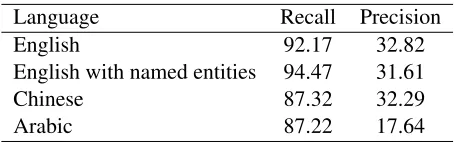
As first step of the mention selection stage, we ex-tracted all the noun phrases (NP), pronouns (PRP), and possessive pronouns (PRP$) for English and Arabic, with the addition of PN pronouns for Chi-nese. This stage is aimed at reaching a high recall of the mentions involved in the coreference chains and results in an overinclusive set of candidates. Table 1 shows the precision and recall figures for the respec-tive languages when extracting mentions from the training set. The precision is significantly lower for Arabic than for English and Chinese.
4.2 Removal of the Pleonasticit
In the English corpus, the pronounitin the first step of the mention extraction stage creates a high num-ber of false positive mentions. We built a classifier
1http://stp.lingfil.uu.se/ nivre/research/Penn2Malt.html
Language Recall Precision
English 92.17 32.82
English with named entities 94.47 31.61
Chinese 87.32 32.29
[image:2.612.313.540.53.124.2]Arabic 87.22 17.64
Table 1: Precision and recall for the mention detection stage on the training set.
Feature name HeadLex
HeadRightSiblingPOS HeadPOS
Table 2: Features used by the pleonasticitclassifier.
to discard as many of these pleonasticitas possible from the mention list.
Table 2 shows the features we used to train the classifier and Table 3 shows the impact on the final system. We optimized the feature set using greedy forward and backward selections. We explored var-ious ways of using the classifier: before, after, and during coreference resolving. We obtained the best results when we applied the pleonastic classifier dur-ing coreference solvdur-ing and we multiplied the prob-ability outputs from the two classifiers. We used the inequality:
Pcoref(Antecedent, it)×(1−Ppleo(it))>0.4,
where we found the optimal threshold of 0.4 using a 5-fold cross-validation.
4.3 Named Entities
The simple rule to approximate entities to noun phrases and pronouns leaves out between∼8% and ∼13 % of the entities in the corpora (Table 1). As the named entities sometimes do not match constituents, we tried to add them to increase the recall. We carried out extensive experiments for the three
lan-English CoNLL score
Without removal 59.15
With removal 59.57
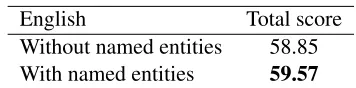
English Total score Without named entities 58.85 With named entities 59.57
Table 4: Impact on the overall score on the English devel-opment set by addition of named entities extracted from the corpus.
Language Without pruning With pruning
English 56.42 59.57
Chinese 50.94 56.62
[image:3.612.95.273.52.96.2]Arabic 48.25 47.10
Table 5: Results on running the system on the develop-ment set with and without pruning for all the languages.
guages. While the named entities increased the score for the English corpus, we found that it lowered the results for Chinese and Arabic. We added all single and multiword named entities of the English corpus except the CARDINAL, ORDINAL, PER-CENT, and QUANTITY tags. Table 1 shows the re-call and precision for English and Table 4 shows the named entity impact on the overall CoNLL score on the development set.
4.4 Pruning
When constituents shared the same head in the list of mentions, we pruned the smaller ones. This in-creased the scores for English and Chinese, but low-ered that of Arabic (Table 5). The results for the latter language are somewhat paradoxical; they are possibly due to errors in the dependency conversion.
5 Decoding
Depending on the languages, we applied different decoding strategies: For Chinese and Arabic, we used a closest-first clustering method as described by Soon et al. (2001) for pronominal anaphors and a best-first clustering otherwise as in Ng and Cardie
English Total score
Without extensions 57.22
With extensions 59.57
Table 6: Total impact of the extensions to the mention extraction stage on the English development set.
(2002). For English, we applied a closest-first clus-tering for pronominal anaphors. For nonpronomi-nal anaphors, we used an averaged best-first cluster-ing: We considered all the chains before the current anaphor and we computed the geometric mean of the pair probabilities using all the mentions in a chain. We linked the anaphor to the maximal scoring chain or we created a new chain if the score was less than 0.5. We discarded all the remaining singletons.
As in Bj¨orkelund and Nugues (2011), we recov-ered some mentions using a post processing stage, where we clustered named entities to chains having strict matching heads.
6 Features
We started with the feature set described in Bj¨orkelund and Nugues (2011) for our baseline sys-tem for English and with the feature set in Soon et al. (2001) for Chinese and Arabic. Due to space limita-tions, we omit the description of these features and refer to the respective papers.
6.1 Naming Convention
We denoted HD, the head word of a mention in a de-pendency tree, HDLMC and HDRMC, the left-most child and the right-most child of the head, HDLSand HDRS, the left and right siblings of the head word, and HDGOV, the governor of the head word.
From these tokens, we can extract the surface form, FORM, the part-of-speech tag, POS, and the grammatical function of the token, FUN, i.e. the la-bel of the dependency edge of the token to its parent. We used a naming nomenclature consisting of the role in the anaphora, where J- stands for the anaphor, I-, for the antecedent, F-, for the mention in the chain preceding the antecedent (previous antecedent), and A- for the first mention of the entity in the chain; the token we selected from the dependency graph, e.g. HD or HDLMC; and the value extracted from the token e.g. POSor FUN. For instance, the part-of-speech tag of the governor of the head word of the anaphor is denoted J-HDGOVPOS.
6.2 Combination of Features
We emulated a simple cluster model by uti-lizing the first mention in the chain and/or the previous antecedent, e.g. A-EDITDISTANCE +F-EDITDISTANCE+EDITDISTANCE, where the edit distance of the anaphor is calculated for the first mention in the chain, previous antecedent, and an-tecedent.
6.3 Notable New Features
Edit Distance Features. We created edit distance-based features between pairs of potentially coreferring mentions: EDITDISTANCE is the character-based edit distance between two strings; EDITDISTANCEWORDis a word-level edit distance, where the symbols are the com-plete words; and PROPERNAMESIMILARITY is a character-based edit distance between proper nouns only.
Discourse Features. We created features to reflect the speaker agreement, i.e. when the pair of mentions corresponds to the same speaker, of-ten in combination with the fact that both men-tions are pronouns. For example, references to the first person pronounI from a same speaker refer probably to a same entity; in this case, the speaker himself.
Document Type Feature. We created the I-HD FORM+J-HDFORM+DOCUMENTTYPE fea-ture to capfea-ture the genre of different document types, as texts from e.g. the New Testament are likely to differ from internet blogs.
6.4 Feature Selection
We carried out a greedy forward selection of the fea-tures starting from Bj¨orkelund and Nugues (2011)’s feature set for English, and Soon et al. (2001)’s for Chinese and Arabic. The feature selection used a 5-fold cross-validation over the training set, where we evaluated the features using the arithmetic mean of MUC, BCUB, and CEAFE.
After reaching a maximal score using forward se-lection, we reversed the process using a backward elimination, leaving out each feature and removing the one that had the worst impact on performance. This backwards procedure was carried out until the score no longer increased. We repeated this
forward-backward procedure until there was no increase in performance.
7 Evaluation
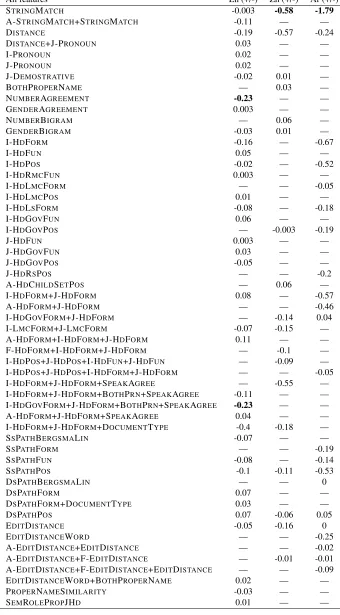
Table 7 shows the final feature set for each language combined with the impact each feature has on the score on the development set when being left out. A dash (—) means that the feature is not part of the feature set used in the respective language. As we can see, some features increase the score. This is due to the fact that the feature selection was carried out in a cross-validated manner over the training set. Table 8 shows the results on the development and test sets as well as on the test set with gold mentions. For each language, the figures are overall consistent between the development and test sets across all the metrics. The scores improve very significantly with the gold mentions: up to more than 10 points for Chinese.
8 Conclusions
The LTH coreference solver used in the CoNLL 2012 shared task uses Soon et al. (2001)’s algorithm and a set of lexical and nonlexical features. To a large extent, we extracted these features from the de-pendency graphs of the sentences. The results we obtained seem to hint that this approach is robust across the three languages of the task.
Our system builds on an earlier system that we evaluated in the CoNLL 2011 shared task (Pradhan et al., 2011), where we optimized significantly the solver code, most notably the mention detection step and the feature design. Although not exactly compa-rable, we could improve the CoNLL score by 4.83 from 54.53 to 59.36 on the English corpus. The mention extraction stage plays a significant role in the overall performance. By improving the qual-ity of the mentions extracted, we obtained a perfor-mance increase of 2.35 (Table 6).
All features En (+/-) Zh (+/-) Ar (+/-)
STRINGMATCH -0.003 -0.58 -1.79
A-STRINGMATCH+STRINGMATCH -0.11 — —
DISTANCE -0.19 -0.57 -0.24
DISTANCE+J-PRONOUN 0.03 — —
I-PRONOUN 0.02 — —
J-PRONOUN 0.02 — —
J-DEMOSTRATIVE -0.02 0.01 —
BOTHPROPERNAME — 0.03 —
NUMBERAGREEMENT -0.23 — —
GENDERAGREEMENT 0.003 — —
NUMBERBIGRAM — 0.06 —
GENDERBIGRAM -0.03 0.01 —
I-HDFORM -0.16 — -0.67
I-HDFUN 0.05 — —
I-HDPOS -0.02 — -0.52
I-HDRMCFUN 0.003 — —
I-HDLMCFORM — — -0.05
I-HDLMCPOS 0.01 — —
I-HDLSFORM -0.08 — -0.18
I-HDGOVFUN 0.06 — —
I-HDGOVPOS — -0.003 -0.19
J-HDFUN 0.003 — —
J-HDGOVFUN 0.03 — —
J-HDGOVPOS -0.05 — —
J-HDRSPOS — — -0.2
A-HDCHILDSETPOS — 0.06 —
I-HDFORM+J-HDFORM 0.08 — -0.57
A-HDFORM+J-HDFORM — — -0.46
I-HDGOVFORM+J-HDFORM — -0.14 0.04
I-LMCFORM+J-LMCFORM -0.07 -0.15 —
A-HDFORM+I-HDFORM+J-HDFORM 0.11 — —
F-HDFORM+I-HDFORM+J-HDFORM — -0.1 —
I-HDPOS+J-HDPOS+I-HDFUN+J-HDFUN — -0.09 — I-HDPOS+J-HDPOS+I-HDFORM+J-HDFORM — — -0.05
I-HDFORM+J-HDFORM+SPEAKAGREE — -0.55 —
I-HDFORM+J-HDFORM+BOTHPRN+SPEAKAGREE -0.11 — — I-HDGOVFORM+J-HDFORM+BOTHPRN+SPEAKAGREE -0.23 — —
A-HDFORM+J-HDFORM+SPEAKAGREE 0.04 — —
I-HDFORM+J-HDFORM+DOCUMENTTYPE -0.4 -0.18 —
SSPATHBERGSMALIN -0.07 — —
SSPATHFORM — — -0.19
SSPATHFUN -0.08 — -0.14
SSPATHPOS -0.1 -0.11 -0.53
DSPATHBERGSMALIN — — 0
DSPATHFORM 0.07 — —
DSPATHFORM+DOCUMENTTYPE 0.03 — —
DSPATHPOS 0.07 -0.06 0.05
EDITDISTANCE -0.05 -0.16 0
EDITDISTANCEWORD — — -0.25
A-EDITDISTANCE+EDITDISTANCE — — -0.02
A-EDITDISTANCE+F-EDITDISTANCE — -0.01 -0.01
A-EDITDISTANCE+F-EDITDISTANCE+EDITDISTANCE — — -0.09
EDITDISTANCEWORD+BOTHPROPERNAME 0.02 — —
PROPERNAMESIMILARITY -0.03 — —
[image:5.612.134.474.61.676.2]SEMROLEPROPJHD 0.01 — —
Metric/Corpus Development set Test set Test set (Gold mentions)
English R P F1 R P F1 R P F1
Mention detection 74.21 72.81 73.5 75.51 72.39 73.92 78.17 100 87.74
MUC 65.27 64.25 64.76 66.26 63.98 65.10 71.22 88.12 78.77
BCUB 69.1 70.94 70.01 69.09 69.54 69.31 64.75 83.16 72.8
CEAFM 57.56 57.56 57.56 56.76 56.76 56.76 66.74 66.74 66.74
CEAFE 43.44 44.47 43.95 42.53 44.89 43.68 71.94 43.74 54.41
BLANC 75.36 77.41 76.34 74.03 77.28 75.52 78.68 81.47 79.99
CoNLL score 59.57 59.36 68.66
Chinese R P F1 R P F1 R P F1
Mention detection 60.55 68.73 64.38 57.65 71.93 64.01 68.97 100 81.63
MUC 54.63 60.96 57.62 52.56 64.13 57.77 63.52 88.23 73.86
BCUB 66.91 74.4 70.46 64.43 77.55 70.38 63.54 88.12 73.84
CEAFM 55.09 55.09 55.09 55.57 55.57 55.57 65.60 65.60 65.60
CEAFE 44.65 39.25 41.78 47.90 38.04 42.41 72.56 42.01 53.21
BLANC 73.23 72.95 73.09 72.74 77.84 75.00 76.96 83.70 79.89
CoNLL score 56.62 56.85 66.97
Arabic R P F1 R P F1 R P F1
Mention detection 55.54 61.7 58.46 56.1 63.28 59.47 56.13 100 71.9
MUC 39.18 43.76 41.34 39.11 43.49 41.18 41.99 69.78 52.43
BCUB 59.16 67.94 63.25 61.57 67.95 64.61 50.45 81.30 62.26
CEAFM 47.8 47.8 47.8 50.16 50.16 50.16 54.00 54.00 54.00
CEAFE 42.57 38.01 40.16 44.86 40.36 42.49 66.16 34.52 45.37
BLANC 62.44 67.18 64.36 66.80 66.94 66.87 67.37 73.46 69.87
[image:6.612.86.527.161.547.2]CoNLL score 48.25 49.43 53.35
Acknowledgments
This research was supported by Vetenskapsr˚adet, the Swedish research council, under grant 621-2010-4800, and the European Union’s seventh framework program (FP7/2007-2013) under grant agreement no. 230902.
References
Anders Bj¨orkelund and Pierre Nugues. 2011. Explor-ing lexicalized features for coreference resolution. In Proceedings of the Fifteenth Conference on Compu-tational Natural Language Learning: Shared Task, pages 45–50, Portland, Oregon, USA, June. Associ-ation for ComputAssoci-ational Linguistics.
Rong-En Fan, Kai-Wei Chang, Cho-Jui Hsieh, Xiang-Rui Wang, and Chih-Jen Lin. 2008. LIBLINEAR: A li-brary for large linear classification. Journal of Ma-chine Learning Research, 9:1871–1874.
Nizar Habash and Ryan Roth. 2009. CATiB: The Columbia Arabic treebank. In Proceedings of the ACL-IJCNLP 2009 Conference Short Papers, pages 221–224, Suntec, Singapore, August. Association for Computational Linguistics.
Richard Johansson and Pierre Nugues. 2007. Extended constituent-to-dependency conversion for English. In Joakim Nivre, Heiki-Jaan Kaalep, Kadri Muischnek, and Mare Koit, editors,NODALIDA 2007 Conference Proceedings, pages 105–112, Tartu, May 25-26. Vincent Ng and Claire Cardie. 2002. Improving machine
laerning approaches to coreference resolution. In Pro-ceedings of the 40th Annual Meeting of the Association for Computational Linguistics, pages 104–111. Joakim Nivre. 2006. Inductive Dependency Parsing.
Springer, Dordrecht, The Netherlands.
Sameer Pradhan, Lance Ramshaw, Mitchell Marcus, Martha Palmer, Ralph Weischedel, and Nianwen Xue. 2011. CoNLL-2011 shared task: Modeling unre-stricted coreference in OntoNotes. InProceedings of the Fifteenth Conference on Computational Natural Language Learning: Shared Task, pages 1–27, Port-land, Oregon, USA, June. Association for Computa-tional Linguistics.
Sameer Pradhan, Alessandro Moschitti, Nianwen Xue, Olga Uryupina, and Yuchen Zhang. 2012. CoNLL-2012 shared task: Modeling multilingual unrestricted coreference in OntoNotes. In Proceedings of the Sixteenth Conference on Computational Natural Lan-guage Learning (CoNLL 2012), Jeju, Korea.
Wee Meng Soon, Hwee Tou Ng, and Daniel Chung Yong Lim. 2001. A machine learning approach to