Original Article
IGF2/IGF2R expression in urothelial bladder cancer and
its implications for tumor recurrence and prognosis
Hanli Wu1, Yumei Li1, Honghong Cui1, Wenbin Wu1, Huanrong Yang1, Xiaoqing Yang2, Yueju Wang3, Peng
Li4
1Department of Nephrology, Yidu Central Hospital of Weifang City, Weifang, China; 2Department of Pathology, Qianfoshan Hospital of Shandong University, Jinan, China; 3The First Affiliated Hospital of Soochow University, Suzhou, China; 4Department of Medical Oncology, The Affiliated Yantai Yuhuangding Hospital of Qingdao University, Yantai, Shandong Province, China
Received April 24, 2016; Accepted May 3, 2016; Epub January 15, 2017; Published January 30, 2017
Abstract: Insulin-like growth factor 2 (IGF2) is a secreted growth factor which has growth-regulating, insulin-like and mitogenic activities. Insulin-like growth factor 2 receptor (IGF2R) is a multifunctional receptor functioning by binding
with many ligands such as IGF2, growth factor-β and pro-cathepsin D, etc. To evaluate the expression and clinical significance of IGF2 and IGF2R in urothelial bladder cancer, 126 cases were collected in validation cohort for detec -tion of IGF2 and IGF2R by immunohistochemistry. Moreover, the correla-tion of IGF2/IGF2R with clinicopathological
factors was evaluated with Chi-square test. The association with recurrence and overall survival rate was analyzed
with univariate and multivariate analysis. Consequently, the association between IGF2 and tumor recurrence or
prognosis was not observed in our study. However, IGF2R overexpression was demonstrated to be significantly correlated with tumor recurrence (P = 0.006) and prognosis (P = 0.019). High expression of IGF2R was identified
as an independent indicator of lower recurrence (P = 0.008) and more favorable prognosis (P = 0.010). In
conclu-sion, IGF2R high expression was significantly associated with lower recurrence and better prognosis, suggesting
that IGF2R could be considered as a suppressor of bladder cancer by reducing the recurrence rate and improving survival time.
Keywords: Bladder cancer, IGF2, IGF2R, prognosis, recurrence
Introduction
Bladder cancer is the fourth common cancer and the second most common urologic cancer type [1, 2]. Bladder cancer comprised of uro-thelial bladder cancer, squamous carcinoma and adenocarincoma, etc. Urothelial bladder cancer takes up for more than 90% in all kinds of bladder cancer. Urothelial bladder cancer comprises of two clinical phenotypes, non-cle-invasive bladder cancer (NMIBC) and mus-cle-invasive bladder cancer (MIBC), which were considered to have distinct molecular path-ways, treatment strategies and clinical out-comes. NMIBC takes up approximately 75%-85% in all bladder cancers and have higher overall survival rate compared with MIBC [3]. Bladder cancer is characterized with its high recurrence rate compared with other cancer types. More than 70% patients with NMIBC would suffer recurrence and up to 15% patients
would undergo cancer progression and suffer MIBC eventually [4]. One important way to reduce mortality rate of bladder cancer is to reduce its recurrence rate, thus more effective and predictive biomarker for cancer recurrence and prognosis is essential.
as a tumor suppressor in cancer progression, which is different from the IGF2 function. Previous studies proved that insulin-like growth factor 1 receptor overexpression was a poorer prognostic factor in invasive urothelial cancer [9]. Other independent studies demonstrated that IGF1R could promote motility and invasion of bladder cancer cells with experiments in vitro [10]. Compared to IGF1R, the expression and function of IGF2R in bladder cancer is almost blank, although the underlying value of IGF2R in bladder cancer has been implied in a cDNA microarray study more than ten years ago [11].
In our experiment, we detected the expression of IGF2 and IGF2R in 126 cases of urothelial
bladder cancer, consisting of 97 NMIBC and 29 MIBC. With Chi-square test, the correlation between IGF2/IGF2R and clinicopathologic fac-tors of bladder cancer was analyzed. The sig -nificance of IGF2/IGF2R in tumor recurrence and prognosis was further evaluated with uni-variate and multiuni-variate analysis.
Patients and materials
Patients and samples
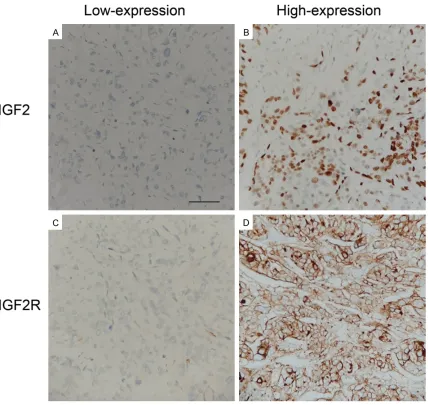
[image:2.612.95.523.71.476.2]Our primary cohort consisted of 329 patients who were diagnosed as bladder cancer and underwent surgical resection (transurethral tumor resection or radical total bladder cystec-tomy) in Yidu Central Hospital of Weifang and Figure 1. Immunohistochemistry figure of IGF2 and IGF2R. Representative figures of high-expression and low-ex
Shandong Cancer Hospital and Institute from 2005 to 2012. Total of 126 patients were enrolled into validation cohort according to the criteria: (1) histologic type is urothelial bladder cancer; (2) patients had available follow-ups and paraffin-embedded samples; (3) no history of other tumors and no neoadjuvant chemo-therapy. In the validation cohort, 97 patients were confirmed as Ta-T1 in routine pathology, while 29 patients were in T2-T4 and underwent radical total bladder cystectomy. The samples were obtained from the Pathological Depart-ment with prior consent of patients and prior approval of the Ethics Committee of the medi-cal centers. Tumor recurrence in our study was defined as new bladder cancer lesion was iden
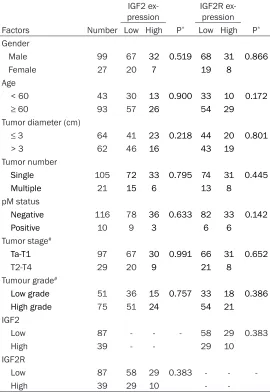
[image:3.612.91.361.98.490.2]-without consensus were re-evaluated by the third pathologist. Staining intensity and posi-tive cell percentage were scored separately and the final IHC score was calculated as the product of staining intensity score multiplied by positive cell percentage score. The staining intensity was defined as weak staining (score 1), medium staining (score 2) or high staining (score 3), and positive stained cell percentage was scored as 25% (score 1), 25%-75% (score 2), 75% (score 3). So the final IHC score ranged from 1 to 9. The cut-off of IHC score was calcu -lated by receiver operating characteristic (ROC) curve. The point with highest sensitivity and specificity was set as the cut-off, dividing cohort into high-expression and low-expression group. Table 1. Correlations between IGF2/IGF2R and
clinicopatho-logic factors
IGF2
ex-pression IGF2R ex-pression Factors Number Low High P* Low High P*
Gender
Male 99 67 32 0.519 68 31 0.866
Female 27 20 7 19 8
Age
< 60 43 30 13 0.900 33 10 0.172
≥ 60 93 57 26 54 29
Tumor diameter (cm)
≤ 3 64 41 23 0.218 44 20 0.801
> 3 62 46 16 43 19
Tumor number
Single 105 72 33 0.795 74 31 0.445
Multiple 21 15 6 13 8
pM status
Negative 116 78 36 0.633 82 33 0.142
Positive 10 9 3 6 6
Tumor stage#
Ta-T1 97 67 30 0.991 66 31 0.652
T2-T4 29 20 9 21 8
Tumour grade#
Low grade 51 36 15 0.757 33 18 0.386
High grade 75 51 24 54 21
IGF2
Low 87 - - - 58 29 0.383
High 39 - - 29 10
IGF2R
Low 87 58 29 0.383 - -
High 39 29 10 -
-*means calculated by Chi-square test; #means referring to WHO 2004
clas-sification.
tified after surgery and the time of recurrence was from the sur-gery to diagnosis of recurrent tumor.
Immnuohistochemical staining Immunohistochemistry (IHC) was performed to evaluate the ex- pression of detected proteins in bladder cancer. Briefly, samples were first de-paraffinized and rehydrated first, and then incu -bated in 0.01 M citric acid (pH 6.0) boiled in microwave for 30 min for antigen retrieval. Endo- genous peroxidase activity was blocked with incubation in 0.3% hydrogen peroxide for 10 min-utes. Slides were incubated in primary antibody (1:50) of IGF2 (ab9574, Abcam, Cambridge, UK) or IGFR2 (sc-25462, Santa Cruz Biotechnology, CA, USA) at 4°C overnight, and HRP-labeled sec-ondary antibody (Beyotime In- stitute of Biotechnology, Shang- hai, China) at 37°C for 2 hours in sequence. Finally, the proteins were visualized by incubation in Diaminobenzidine, and samples were counterstained with hema- toxylin.
Score of IHC
Statistical analysis
The software SPSS 17.0 was used to analyze all the data and generated the P value. Chi-square test was performed for evaluation of the correlations between IGF2/IGF2R expression and clinicopathological features. Kaplan-Meier method was carried out for recurrence-free sur-vival and overall sursur-vival sursur-vival curve, and log-rank test was performed to evaluate the statistical difference. In multivariate analysis, Cox-regression proportional hazards model was used to identify the independent factors identified in univariate analysis. P<0.05 was considered as statistically significant.
Results
Expression of IGF2 and IGF2R in bladder can-cer
IGF2 and IGF2R expression levels and location were detected by IHC. In all the 126 cases of
Significance of IGF2, IGF2R in bladder cancer
recurrence
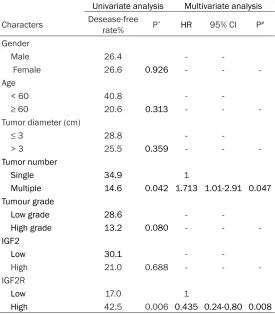
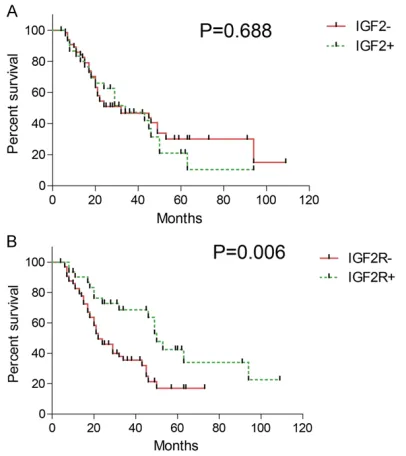
Tumor recurrence is the biggest threat to patients with NIMBC, and is also the most char-acterized feature of bladder cancer. A useful biomarker which can predict tumor recurrence would be very helpful for patients’ examination and individual treatment. We analyzed the cor -relation between IGF2/IGF2R and NIMBC non-tumor survival rate with univariate analysis to evaluate their significance on tumor recurrence (Table 2) (Figure 2A and 2B). In our study, tumor number and IGF2R expression were con-firmed as high-risk factors in tumor recurrence. High expression of IGF2R was associated with lower recurrence-free survival rate (P = 0.006) and patients with multiple tumors may have high rate of recurrence (P = 0.042). No other clinicopathological factors were observed to be related to recurrence, including IGF2 (P = 0.688). To confirm the independent signifi -Table 2. Influence of IGF2/IGF2R on recurrence-free survival in
NMIBC patients
Univariate analysis Multivariate analysis Characters Desease-free rate% P* HR 95% CI P#
Gender
Male 26.4 -
Female 26.6 0.926 - -
-Age
< 60 40.8 -
≥ 60 20.6 0.313 - -
-Tumor diameter (cm)
≤ 3 28.8 -
> 3 25.5 0.359 - -
-Tumor number
Single 34.9 1
Multiple 14.6 0.042 1.713 1.01-2.91 0.047
Tumour grade
Low grade 28.6 -
High grade 13.2 0.080 - -
-IGF2
Low 30.1 -
High 21.0 0.688 - -
-IGF2R
Low 17.0 1
High 42.5 0.006 0.435 0.24-0.80 0.008
*means calculated by Kaplan-Meier method and log-rank test; #means
calculated by Cox-regression model.
bladder cancer, IGF2 expression was observed in the cytoplasm, which was also in accordance with its function as a secreted protein (Figure 1A). Meanwhile, IGF2R mainly existed in both cell cytoplasm and membrane (Figure 1B). As described in Patients and Materials, the vali-dation cohort was divided into high-expression and low-expres-sion group according to the IHC score of detected proteins. In our study, the high expression rate of IGF2 and IGF2R was 30.9% (39/126) and 30.9% (39/126), respectively.
Correlations between IGF2,
IGF2R and clinicopathologic factors
[image:4.612.91.366.98.412.2]cance of IGF2R and tumor number in NIMBC recurrence, multivariate analysis was carried out with Cox-regression model. Both IGF2R (P = 0.008, HR = 0.435, 95% CI = 0.24-0.80) and tumor number (P = 0.047, HR = 1.713, 95% CI = 1.01-2.91) were identified as inde -pendent predictors of NIMBC recurrence in our experiment.
Prognostic value of IGF2 and IGF2R in bladder cancer
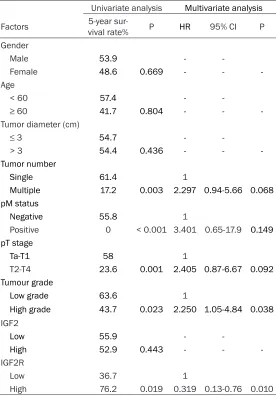
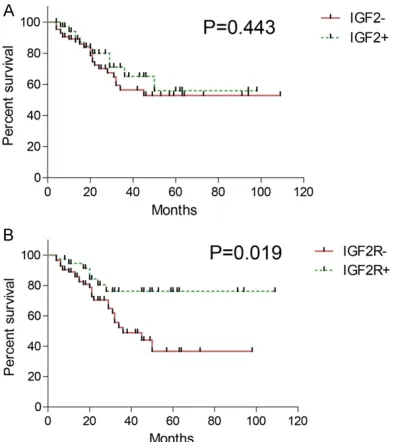
Kaplan-Meier method was first performed to screen out prognostic factor (Table 3) (Figure 3A and 3B). IGF2R high expression was dem-onstrated to be significantly related with more favorable 5-year overall survival rate (P = 0.006, 5-year survival rate: low vs. high = 36.7% vs. 76.2%). Besides IGF2R, tumor num-ber, pM stage, pT stage and tumor grade were also identified as prognostic factors (P = 0.003, P < 0.001, P = 0.001 and P = 0.023, respec-tively). All the verified prognostic factors were enrolled in Cox-regression model for
multivari-ate analysis to define the independent prognos -tic parameters. In our cohort, IGF2R expression was identified as an independent prognostic factor and was considered to predict favorable prognosis (P = 0.010, HI = 0.319, 95% CI = 0.13-0.76). Besides IGF2R, only tumor number was also an independent prognostic factor (P = 0.038, HI = 2.25, 95% CI = 1.05-4.84) in blad-der cancer.
Discussion
The IGF-axis consists of IGF1 and IGF2, IGF receptors IGF1R and IGF2R, the IGF binding proteinfamily (IGFBP1-6), and the proteins involved in intracellular signaling [12]. It con-trols a multifunctional signaling network and is involved in biological processes such as main-taining tissue homeostasis, regulating cell pro-liferation, differentiation and migration [13, 14]. The dysregulation of IGF-axis is observed in many types of cancers. Overexpression of IGF1 or IGF1R was demonstrated to be signifi -cantly associated with progression or progno-sis in cancer such as hepatocellular carcinoma, lung cancer, pancreatic cancer, breast cancer, etc [15-18]. Unlike IGF1R, IGF2R was generally considered as a tumor suppressor. Depletion or decrease of IGF2R was observed in breast cancer, hepatocellular carcinoma and prostate cancer [19]. Experiments in vitro also support the tumor suppression effect of IGF2R. For example, Nicole et al. demonstrated that IGF2R silencing could enhance tumorigenicity in already transformed breast epithelial cells [20]. However, the study of IGF2/IGF2R function in carcinogenesis and cancer progression is insufficient compared to IGF1/IGF1R, in both clinical and basic medicine. Especially in blad-der cancer, the study of expression and clinical significance of IGF2R is almost blank compared with IGF1R.
[image:5.612.89.292.72.300.2]One feature of IGF2R is its large extracellular domain (2264 amino acids), which confers it the ability to bind multiple ligands, including the mitogenic peptide IGF2, mannose-6-phos-phate-bearing proteins such as transforming growth factor-β and pro-cathepsin D and numerous other growth-regulatory molecules, including retinoic acid and the urokinase-type plasminogen activator receptor (uPAR) [20]. The downstream signaling pathway of IGF2R is complicated because of the multiple ligands Figure 2. Recurrence-free curve of IGF2 and IGF2R.
Recurrence-free curve of IGF2 and IGF2R was
plot-ted by Kaplan-Meier method and analyzed by
log-rank test. A. IGF2 is not associated with recurrence of NMIBC (5-year recurrence-free survival rate: low vs. high = 29.0% vs. 19.5%). B. Low expression of
and consequent multiple functions. The tumor-suppress features of IGF2R involve IGF2- dependent and -independent mechanisms. In our study, we did not observe significant correlation between IGF2 and IGF2R, neither the prognostic nor recurrence-predicting value of IGF2. This may be resulted from that IGF2R could suppress bladder cancer recurrence in an IGF2-independent way. As to how IGF2R sup-presses bladder cancer recurrence, the under-lying mechanism needs further experiment to reveal.
Another feature of IGF2R is the correlation between its polymorphisms and carcinogene-sis. More than 1,200 single nucleotide poly-morphisms (SNPs) have been identified in
relation between their expression and clinico-pathologic factors, recurrence-free survival rate and prognosis for the first time as far as we know. As the result, we demonstrated that IGF2R high expression was significantly associ -ated with lower recurrence and more favorable prognosis. Our results proved that IGF2R is a suppressor of bladder cancer and could reduce the recurrence rate, indicating the potency of IGF2R activator as a targeted drug for bladder cancer therapy.
Acknowledgements
[image:6.612.92.368.84.480.2]This study was funded by Science and Technology Project of Yantai City (2015WS018), Table 3. Prognostic value of clinicopathologic factors
Univariate analysis Multivariate analysis Factors 5-year sur-vival rate% P HR 95% CI P Gender
Male 53.9 -
Female 48.6 0.669 - -
-Age
< 60 57.4 -
≥ 60 41.7 0.804 - -
-Tumor diameter (cm)
≤ 3 54.7 -
> 3 54.4 0.436 - -
-Tumor number
Single 61.4 1
Multiple 17.2 0.003 2.297 0.94-5.66 0.068 pM status
Negative 55.8 1
Positive 0 < 0.001 3.401 0.65-17.9 0.149
pT stage
Ta-T1 58 1
T2-T4 23.6 0.001 2.405 0.87-6.67 0.092
Tumour grade
Low grade 63.6 1
High grade 43.7 0.023 2.250 1.05-4.84 0.038 IGF2
Low 55.9 -
High 52.9 0.443 - -
-IGF2R
Low 36.7 1
High 76.2 0.019 0.319 0.13-0.76 0.010 *means calculated by Kaplan-Meier method and log-rank test; #means calculated
by Cox-regression model.
IGF2R [21]. Lots of evidence proved that different malignant tumors (breast cancer, ovary cancer, melanoma, lymphoma and renal carcinoma) frequent- ly exhibited loss of heterozy-gosity at 6q26-27, where IGF2R resides [21, 22]. Previous stud-ies demonstrated that IGF2R polymorphisms contribute to the risks of esophageal-gastric cardia adenocarcinoma, and also to the tumor response to therapy in pancreatic cancer [12, 21]. However, the exact mechanism of how IGF2R poly-morphisms lead to ontogenesis is controversy. It was proposed that aberration of CpG methyla-tion due to polymorphism in- duces expression change. The correlation between IGF2R po- lymorphisms and bladder can-cer progression is still blank. Unfortunately, SNP could not be detected or verified with IHC method. We wish our find -ing could trigger more intere- sts on IGF2R function in blad-der cancer progression and help discover greater break- throughs.
-and Youth Research Initiation Fundation of Yuhuangding Hospital (201511).
Disclosure of conflict of interest
None.
Address correspondence to: Yueju Wang, Depart-ment of Geriatrics, The First Affiliated Hospital of Soochow University, Suzhou 215006, China. E-mail:
[email protected]; [email protected];
Peng Li, Department of Medical Oncology, The Affiliated Yantai Yuhuangding Hospital of
Qing-dao University, Yantai, Shandong 264000, China. E-mail: [email protected]; lipengsdyt@ 163.com
References
[1] Ferlay J, Shin HR, Bray F, Forman D, Mathers C and Parkin DM. Estimates of worldwide burden
of cancer in 2008: GLOBOCAN 2008. Int J Cancer 2010; 127: 2893-2917.
[2] Boyle P and Ferlay J. Cancer incidence and mortality in Europe, 2004. Ann Oncol 2005; 16: 481-488.
[3] Babjuk M, Oosterlinck W, Sylvester R, Kaasinen E, Bohle A, Palou-Redorta J and Roupret M. [EAU guidelines on non-muscle-invasive uro-thelial carcinoma of the bladder, the 2011 up-date]. Actas Urol Esp 2012; 36: 389-402. [4] Smaldone MC, Jacobs BL, Smaldone AM and
Hrebinko RL Jr. Long-term results of selective partial cystectomy for invasive urothelial blad-der carcinoma. Urology 2008; 72: 613-616. [5] Belharazem D, Magdeburg J, Berton AK,
Beissbarth L, Sauer C, Sticht C, Marx A,
Hofheinz R, Post S, Kienle P and Strobel P.
Carcinoma of the colon and rectum with de-regulation of insulin-like growth factor 2 signal-ing: clinical and molecular implications. J Gastroenterol 2016; [Epub ahead of print]. [6] Brouwer-Visser J and Huang GS. IGF2 signaling
and regulation in cancer. Cytokine Growth Factor Rev 2015; 26: 371-377.
[7] Dong Y, Li J, Han F, Chen H, Zhao X, Qin Q, Shi
R and Liu J. High IGF2 expression is associated with poor clinical outcome in human ovarian cancer. Oncol Rep 2015; 34: 936-942. [8] Ghosh P, Dahms NM and Kornfeld S. Mannose
6-phosphate receptors: new twists in the tale. Nat Rev Mol Cell Biol 2003; 4: 202-212. [9] Dahms NM, Olson LJ and Kim JJ. Strategies
for carbohydrate recognition by the mannose 6-phosphate receptors. Glycobiology 2008; 18: 664-678.
[10] Metalli D, Lovat F, Tripodi F, Genua M, Xu SQ,
Spinelli M, Alberghina L, Vanoni M, Baffa R,
Gomella LG, Iozzo RV and Morrione A. The in -sulin-like growth factor receptor I promotes motility and invasion of bladder cancer cells through Akt- and mitogen-activated protein ki-nase-dependent activation of paxillin. Am J Pathol 2010; 176: 2997-3006.
[11] Sanchez-Carbayo M, Socci ND, Lozano JJ, Li W, Charytonowicz E, Belbin TJ, Prystowsky MB, Ortiz AR, Childs G and Cordon-Cardo C. Gene
discovery in bladder cancer progression using
cDNA microarrays. Am J Pathol 2003; 163:
505-516.
[12] Dong X, Javle M, Hess KR, Shroff R, Abbruzzese JL and Li D. Insulin-like growth factor axis gene
polymorphisms and clinical outcomes in pan-creatic cancer. Gastroenterology 2010; 139: 464-73, 473, e1-3.
[13] Withers DJ, Burks DJ, Towery HH, Altamuro SL,
Flint CL and White MF. Irs-2 coordinates Igf-1 receptor-mediated beta-cell development and peripheral insulin signalling. Nat Genet 1999; 23: 32-40.
[14] Dong X, Park S, Lin X, Copps K, Yi X and White
[image:7.612.91.296.72.293.2]MF. Irs1 and Irs2 signaling is essential for hepatic glucose homeostasis and systemic growth. J Clin Invest 2006; 116: 101-114. Figure 3. Overall survival curve of IGF2 and IGF2R.
[15] Tovar V, Alsinet C, Villanueva A, Hoshida Y, Chiang DY, Sole M, Thung S, Moyano S, Toffanin S, Minguez B, Cabellos L, Peix J, Schwartz M, Mazzaferro V, Bruix J and Llovet
JM. IGF activation in a molecular subclass of
hepatocellular carcinoma and pre-clinical effi -cacy of IGF-1R blockage. J Hepatol 2010; 52: 550-559.
[16] Nakagawa M, Uramoto H, Oka S, Chikaishi Y,
Iwanami T, Shimokawa H, So T, Hanagiri T and Tanaka F. Clinical significance of IGF1R expres -sion in non-small-cell lung cancer. Clin Lung Cancer 2012; 13: 136-142.
[17] Badzio A, Wynes MW, Dziadziuszko R, Merrick DT, Pardo M, Rzyman W, Kowalczyk A, Singh S, Ranger-Moore J, Manriquez G, Gaire F, Jassem
J and Hirsch FR. Increased insulin-like growth factor 1 receptor protein expression and gene
copy number in small cell lung cancer. J Thorac
Oncol 2010; 5: 1905-1911.
[18] Browne BC, Eustace AJ, Kennedy S, O’Brien
NA, Pedersen K, McDermott MS, Larkin A, Ballot J, Mahgoub T, Sclafani F, Madden S, Kennedy J, Duffy MJ, Crown J and O’Donovan
N. Evaluation of IGF1R and phosphorylated IGF1R as targets in HER2-positive breast can-cer cell lines and tumours. Breast Cancan-cer Res
Treat 2012; 136: 717-727.
[19] Martin-Kleiner I and Gall Troselj K.
Mannose-6-phosphate/insulin-like growth factor 2 recep-tor (M6P/IGF2R) in carcinogenesis. Cancer Lett 2010; 289: 11-22.
[20] Caixeiro NJ, Martin JL and Scott CD. Silencing
the mannose 6-phosphate/IGF-II receptor dif-ferentially affects tumorigenic properties of normal breast epithelial cells. Int J Cancer 2013; 133: 2542-2550.
[21] Hoyo C, Schildkraut JM, Murphy SK, Chow WH,
Vaughan TL, Risch H, Marks JR, Jirtle RL,
Calingaert B, Mayne S, Fraumeni J Jr and
Gammon MD. IGF2R polymorphisms and risk
of esophageal and gastric adenocarcinomas. Int J Cancer 2009; 125: 2673-2678.
[22] Zavras AI, Pitiphat W, Wu T, Cartsos V, Lam A, Douglass CW and Diehl SR. Insulin-like growth