Int J Clin Exp Med 2017;10(1):307-315
www.ijcem.com /ISSN:1940-5901/IJCEM0041080
Original Article
Three-dimensional finite element stress
analysis of uneven-threaded ti dental implant
Xingchao Li, Fusheng Dong
Department of Oral and Maxillofacial Surgery, Stomatology Hospital of Hebei Medical University, Shijiazhuang 050017, China
Received October 1, 2016; Accepted November 3, 2016; Epub January 15, 2017; Published January 30, 2017
Abstract: This study aims to investigate the influence of different neck structures on implant stress distribution. A computer-aided design (CAD) mandibular model based on adult mandibular computed tomography (CT) informa -tion was first established, and then used to create a mandibular model and a related mandibular implant model by using Solidworks. The implant was then fitted to the mandibular first molar. Four neck-type implants, i.e., uniform-threaded implant (UT), wide-neck implant (WN), implant with single-microuniform-threaded neck (SMN), and implant with double-microthreaded neck (DMN), received axial 100-N, horizontal 50-N, and oblique 100-N loads, by using the Ansys Workbench software; the Von Mises equivalent stress (ES) and maximum principal stress (MPS) in different implant groups were then compared. Axial 100-N load: the maximum ES in the cortical bone area (CB-MES, MPa) was 46.58, 35.25, 20.98, and 58.01 in UT, WN, SMN, and DMN respectively; the MPS at the superior edge of corti -cal bone (CB-MPS, MPa) was 0.97, 0.89, 0.79, and 1.22 in the same four groups respectively. Horizontal 50-N load: CB-MES was 53.21, 41.93, 36.95, and 64.18 in UT, WN, SMN, and DMN respectively; CB-MPS was 41.77, 39.61, 29.67, and 46.99 in the same four groups respectively. Oblique 100-N load: CB-MES was 49.37, 47.78, 34.02, and 78.52 in UT, WN, SMN, and DMN respectively; CB-MPS was 29.35, 21.28, 15.34, and 34.69 in the same four groups respectively. CB-MES and CB-MPS of SMN were the smallest.
Keywords: Dental implant, uneven thread, microthread, wide neck, 3D finite element
Introduction
Thread shapes play very important roles in bio-mechanical optimization designs of implants; some thread parameters such as height, width, vertex angle, pitch, and helix angle determine thread function, and can largely affect the bio -mechanical transmission of the implant [1]. Stress mainly concentrates in the cortical and cancellous bone, and is located at the top and bottom area of the implantation fossa. The stress concentration at the top cortical bone is due to its larger elastic modulus, and is also related to the direct contact of implant top with the prosthetic replacement [2]. Blaszczyszyn et al. [3] reported that an immediate-loading implant with microthreaded neck structures (IMTN) exhibited better results 1 year later than those without a microthreaded neck. Implants with long smooth necks would cause the loss of peri-neck bones, but IMTN could change the direction of force transmission at the sites with highly concentrated neck-stress and increase
resorption have already been demonstrated. However, the influence of the IMTN form, parameters, and its combination with a lower main thread on the stress distribution of corti -cal bone has not been reported. This study focused on comparing the impact of different IMTN designs and their combinations on stress distribution, aiming to provide a theoretical basis for clinically designing and selecting opti -mal IMTN parameters.
Materials and methods
Implant
Four cylindrical implants with different thread forms were selected, with diameter 4.0 mm and length 14.5 mm (Figure 1).
Thread parameters of the uniform-threaded implant (UT): length 11 mm, apex angle 60°, depth 0.40 mm, pitch 0.8 mm.
Thread parameters of the wide-neck implant (WN): length 8 mm, apex angle 60°, depth 0.40 mm, pitch 0.8 mm.
Thread parameters of the implant with single-microthreaded neck (SMN): length 11 mm: lower part 8 mm, apex angle 60°, depth 0.40 mm, pitch 0.8 mm; upper part 3 mm, apex angle 60°, depth 0.25 mm, pitch 0.4 mm.
Thread parameters of the implant with double-microthreaded neck (DMN): length 11 mm: lower part 8 mm, apex angle 60°, depth 0.40 mm, pitch 0.8 mm; upper part 3 mm (dual par-allel microthread), apex angle 60°, depth 0.25 mm, tooth pitch 0.4 mm, pitch 0.8 mm.
Mandibular model
[image:2.612.95.525.74.301.2]Preliminary modeling: 300 images containing a complete mandible were selected from the Digital Imaging and Communications in Medi- cine (DICOM) files of entire cranial computed tomography (CT) scans, and a corresponding new project was established in Mimics 16.0 (Materialise, Belgium). According to the gray values of the CT images, the bony part was extracted with the threshold region determined Figure 1. Geometric parameters of different IMTN.
[image:2.612.92.286.355.484.2]Different neck structures on the implant stress distribution
within 98 to 3071 according to the field CT gray levels in the help documentation of Mimics 16.0, and the pixels within this range were placed in the masking materials of the bone to achieve the separation of muscle and bone. The bony masking materials were edited, and an accurate void-free masking model that only included mandible pixels was obtained. The 3-dimensional (3D) model was then automati-cally calculated by using the intra-masking pix -els, and irrational structures were excluded by observing, inspecting, and editing the 3D model. The final generated preliminary 3D geo -metric model of the mandible was output using the STL format (Standard Template Library).
Model optimization: The STL-formatted prelimi -nary 3D geometric model of the mandible was then introduced into Geomagic studio 2013 (Geomagic Inc., USA), appearing as a polygo- nal surface model; this was followed by preli-minary smoothing using several rapid fair-ing operations. Thereafter, by creatfair-ing a flow pattern, removing spikes and high refractive edges, relaxing, and local sanding, the polygo-nal surface performance was further improved. Complex bad surfaces were deleted directly, and the local features were improved by cur-vature-based filling and hole-bridging opera -tions. Local smooth transition was achieved by removing non-interesting complex features. After examining the polygon qualities and
eli-puter-aided design (CAD) object conversion, the mandibular CAD model was finally obtained.
Generation of cortical and cancellous bones
The cortical bone was about 1.5 mm thick. Accordingly, at the Geomagic polygon phase, the model of the interface of mandibular corti -cal and cancellous bones was obtained by drawing the shell 1.5 mm inward and removing the crossing surface; the above steps were then re-operated step-by-step, so that the cancellous bone CAD model could then be obtained with the interface as the outer con -tour. The overall mandibular CAD model and the cancellous bone CAD model were then in- troduced into Solidworks 2015 (Solidworks Co., USA) to obtain the cortical bone model by a Boolean subtraction operation.
Assembly of implant and mandible
[image:3.612.91.333.84.163.2]The 4 types of implants were then fixed at the same place in the mandibular first molar region through translation and rotation, and the axis of the implant was approximately perpen -dicular to the surface of the mandibular alveo -lar ridge crest at this place. The mandibu-lar cortical and cancellous bones were then duced by the implant using the Boolean sub-traction operation to achieve accurate thread-fitting between the mandible and the implant. After having determined the implant position,
Table 1. Nodes and units of the model
Group overall modelNodes of the overall modelUnits of the the implantNodes at the implantUnits at
UT 642184 428067 11800 6398
WN 635043 427232 12291 6776
SMN 480990 320691 11353 6016
DMN 754098 433957 17817 9959
Note: UT: Uniform thread implant; WN: Wide neck implant; SMN: Implant with single-microthreaded neck; DMN: Implant with double-microthreaded neck.
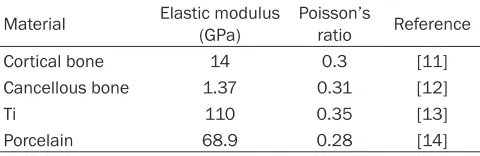
Table 2. Elastic properties of materials
Material Elastic modulus (GPa) Poisson’s ratio Reference
Cortical bone 14 0.3 [11]
Cancellous bone 1.37 0.31 [12]
Ti 110 0.35 [13]
Porcelain 68.9 0.28 [14]
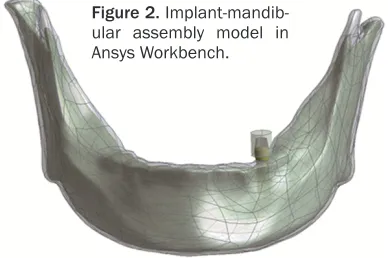
[image:3.612.91.331.230.308.2]-one 3.2-mm high abutment was established on the implant top using Solidworks, on top of which one 2-mm thick ceramic dental prosthet -ic restoration was then established, followed by importing into the Ansys Workbench 14.5 (Ansys Inc., USA) with the SAT format (Figure 2). Meshing
The hexahedron-based and tetrahedron-sup-plemented automatic meshing method was
Constraints
[image:4.612.90.524.70.350.2]The degree of freedom of all the nodes along the top of the bilateral mandibular condyle was set as a rigid constraint to prevent the displa- cement of the mandible; the implant and the bone tissues were set at 100% of osseointe-gration, and these 2 materials did not show relative sliding under loads; the ceramic resto-ration and the implant were set as the immo- bilized contact.
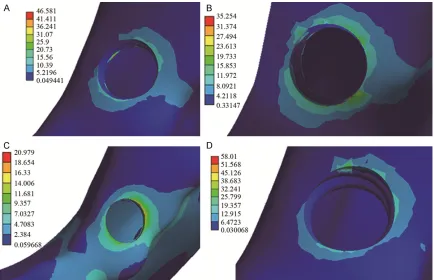
Figure 3. Von-Mises ES distribution of peri-cortical bone area under the axial load.
Figure 4. MPSs at nine sites under the axial load from top to bottom.
used, with a unit size of ap-proximately 0.5 mm, and the densities of the nodes and units at and around the im- plant were properly increas- ed (Table 1).
Material properties
[image:4.612.91.373.394.573.2]Different neck structures on the implant stress distribution
Loading conditions
Uniformly distributed loads under the following 3 conditions were applied onto the implants: axial 100-N load, horizontal 50-N load from the buccal side to the tongue, and oblique 100-N load from the buccal side downward to the tongue and forming a 30° angle with the implant axis.
Evaluation indexes
The observation indexes were the Von Mises equivalent stress (ES) and MPS, and the distri -bution Von Mises ES nephograms of the 4 implant-mandibular models under the 3 load- ing conditions were then obtained; MPS at 9 sites from the superior border of the cortical bone to the implant bottom on the implant-bone interface was then measured.
Results
Axial 100-N load
Maximum ES in the cortical bone area (Figure 3): The maximum ES in the cortical bone area in UT, WN, SMN, and DMN was 46.58 MPa, 35.25 MPa, 20.98 MPa, and 58.01 MPa, re- spectively.
MPS (Figure 4): MPS at the superior border of the cortical bone was 0.97 MPa, 0.89 MPa, 0.79 MPa, and 1.22 MPa, respectively; MPS at the junction of cortical and cancellous bones was 1.72 MPa, 3.89 MPa, 0.45 MPa, and 8.07 MPa, respectively; MPS at the end of the implant was 0.73 MPa, 0.67 MPa, 0.64 MPa, and 0.57 MPa, respectively.
MPS at the mid-point of the cancellous bone area was relatively lower.
Horizontal 50-N load
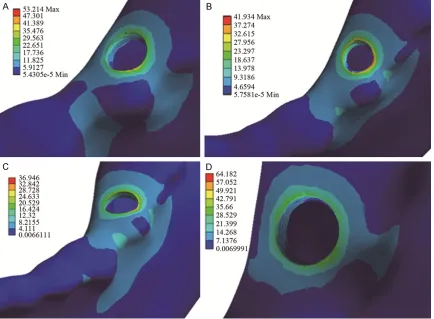
Maximum ES in the cortical bone area (Figure 5): The maximum ES in the cortical bone area in UT, WN, SMN, and DMN was 53.21 MPa, 41.93 MPa, 36.95 MPa, and 64.18 MPa, re- spectively.
MPS (Figure 6): MPS at the superior border of the cortical bone was 41.77 MPa, 39.61 MPa, 29.67 MPa, and 46.99 MPa, respectively; MPS at the junction of cortical and cancellous bones was 9.45 MPa, 2.80 MPa, 1.73 MPa, and 9.49
MPa, respectively; MPS at the end of the implant was 0.07 MPa, 0.09 MPa, 0.15 MPa, and 0.26 MPa, respectively.
MPS in the cortical bone area was relatively higher.
Oblique 100-N load
Maximum ES in the cortical bone area (Figure 7): The maximum ES in the cortical bone area in UT, WN, SMN, and DMN was 49.37 MPa, 47.78 MPa, 34.02 MPa, and 78.52 MPa, re- spectively.
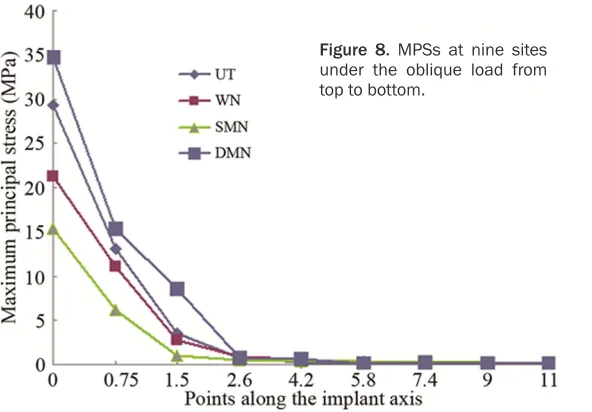
MPS (Figure 8): MPS at the superior border of the cortical bone was 29.35 MPa, 21.28 MPa, 15.34 MPa, and 34.69 MPa, respective- ly; MPS at the junction of cortical and cancel -lous bones was 3.50 MPa, 2.71 MPa, 0.97 MPa, and 8.58 MPa, respectively; MPS at the end of the implant was 0.16 MPa, 0.11 MPa, 0.15 MPa, and 0.10 MPa, respectively.
MPS in the cortical bone area was relatively higher.
Discussion
The impact of a microthreaded neck on the stress was associated with a number of as-sumptions: Song et al. [21] reported that the position of the microthread had great impact on maintaining the bone edge, and that when the thread started 0.5 mm under the implant bone level and was roughly parallel to the bone
[image:6.612.91.525.72.391.2]and MPS in the cortical bone area of SMN were the smallest, followed by WN, UT, and DMN. SMN exhibited obvious effects in confronting vertical loads, possibly due to its smaller rota-tion angle, so that the stress conducrota-tion direc-tion was changed, thus reducing the shear force. In contrast, DMN exhibited larger neck Figure 5. Von-Mises ES distribution of peri-cortical bone area under the horizontal load.
Figure 6. MPSs at nine sites un-der the horizontal load from top to bottom.
[image:6.612.90.373.438.615.2]Different neck structures on the implant stress distribution
stress, possibly due to its larger microthread- ed rotation angle, which led to worse vertical-load confronting ability, consistent with the re-search of Herekar et al. [22]. In addition, the surface area of the implant with microthreaded neck (SMN and DMN) was increased by about
the fact that the smaller rotation angle changed the stress conduction direction, and that the microthread increased the contact area with the bone. WN exhibited smaller stress in the cortical bone area than UT and DMN; this might have resulted from the increased neck diame -Figure 7. Von-Mises ES distribution of peri-cortical bone area under the oblique load.
[image:7.612.90.520.69.369.2]15.40% and 45.52%, com-pared to UT and WN respe-ctively, which might reduce the stress concentration at the neck. When subjected to horizontal and oblique loads, the stress concentrated in the cortical bone area and the stress on the super- ior edge of the cortical bone were the greatest, and de- scended in order. In the corti-cal bone area, SMN exhibited the smallest Von Mises ES and MPS, followed by WN, UT, and DMN. The obvious ef-fects of anti-horizontal and anti-oblique loads on SMN possibly can be explained by Figure 8. MPSs at nine sites
[image:7.612.94.390.412.618.2]ter of the implant, which had greater impact on the stress distribution induced by lateral loads. This study was based on the assumptions of continuous, homogeneous, isotropic, linear elastic, and small deformations; these assump -tions would only simplify the calculation rather than affect the comparability of the results; therefore, the steps of integrating, calculat-ing, and analyzing different nodes had small error probabilities. Meanwhile, a number of confounding factors could also be excluded. During the study, some simplifications and assumptions were also performed: based on an average chewing force in Chinese of 30 N-300 N, the directions of biting force were simplified into axial 100-N, horizontal 100-N, and oblique 50-N loads. In addition, the shape of the dental prosthetic restoration was simpli -fied into a nonanatomic occlusal cylinder, which also differed from clinical reality; however, these did not affect the measurements and data analysis targeting the study purposes because all the models were prepared under the same assumptions and simplified condi -tions; thus, the results were comparable.
The assumptions could also affect the results of finite element analysis, but the effects of the optimized microthread implant neck, including the distribution position, shape, parameters, rotation angle, and combination features with the main thread, on the stress distribution at the implant-bone interface had been initially confirmed. Further studies should target pri-mary stability, spin-out torque, fatigue charac -teristics, clinical preservative effects on the marginal bone, etc., thus providing a complete basis for optimizing the design of the neck thread.
Conclusions
Different neck forms of cylindrical implants with V-shaped microthreads affected implant-bone interface stress and stress distribution; the overall stress concentration area was lo- cated at the cortical bone area and the apical part around the implant neck. SMN with the same thread form significantly reduced the Von Mises ES and MPS in the cortical bone area when axial, horizontal, and oblique loads were applied.
Acknowledgements
This study was funded by the major medical
Disclosure of conflict of interest
None.
Address correspondence to: Fusheng Dong, Depart- ment of Oral and Maxillofacial Surgery, Stomatolo-gy Hospital of Hebei Medical University, No. 383 Zhongshan Road, Changan District, Shijiazhuang 050017, China. Tel: +86 311 86265514; Fax: +86 311 86265748; E-mail: [email protected]
References
[1] Hansson S and Werke M. The implant thread as a retention element in cortical bone: the ef -fect of thread size and thread profile: a finite element study. J Biomech 2003; 36: 1247-1258.
[2] Hudieb M and Kasugai S. Biomechanical ef -fect of crestal bone osteoplasty before implant placement: a three-dimensional finite element analysis. Int J Oral Maxillofac Surg 2011; 40: 200-206.
[3] Blaszczyszyn A, Heinemann F, Gedrange T, Kawala B, Gerber H and Dominiak M. Imme-diate loading of an implant with fine thread-ed neck-bone resorption and clinical outcome of single tooth restorations in the maxilla. Biomed Tech (Berl) 2012; 57: 3-9.
[4] Chowdhary R, Jimbo R, Thomsen CS, Carlsson L and Wennerberg A. The osseointegration stimulatory effect of macrogeometry-modified implants: a study in the rabbit. Clin Oral Im- plants Res 2014; 25: 1051-1055.
[5] Yun HJ, Park JC, Yun JH, Jung UW, Kim CS, Choi SH and Cho KS. A short-term clinical study of marginal bone level change around micro-threaded and platform-switched implants. J Periodontal Implant Sci 2011; 41: 211-217. [6] Choi KS, Park SH, Lee JH, Jeon YC, Yun MJ and
Jeong CM. Stress distribution scalloped im-plants with different microthread and connec -tion configura-tions using three-dimensional finite element analysis. Int J Oral Maxillofac Implants 2012; 27: 29-38.
[7] Calvo-Guirado JL, Gómez-Moreno G, Aguilar-Salvatierra A, Guardia J, Delgado-Ruiz RA and Romanos GE. Marginal bone loss evaluation around immediate non-occlusal microthread-ed implants placmicrothread-ed in fresh extraction sockets in the maxilla: a 3-year study. Clin Oral Implants Res 2015; 26: 761-767.
[8] Hudieb MI, Wakabayashi N and Kasugai S. Magnitude and direction of mechanical stress at the osseointegrated interface of the micro -thread implant. J Periodontol 2011; 82: 1061-1070.
Different neck structures on the implant stress distribution
fixed partial denture: a 3-D FEM study. Acta Odontol Scand 2012; 70: 61-71.
[10] Amid R, Raoofi S, Kadkhodazadeh M, Mo-vahhedi MR and Khademi M. Effect of micro -thread design of dental implants on stress and strain patterns: a three-dimensional finite element analysis. Biomed Tech (Berl) 2013; 58: 457-467.
[11] Cook SD, Klawitter JJ and Weinstein AM. A model for the implant-bone interface charac -teristics of porous dental implants. J Dent Res 1982; 61: 1006-1009.
[12] Borchers L and Reichart P. Three-dimensional stress distribution around a dental implant at different stages of interface development. J Dent Res 1983; 62: 155-159.
[13] Colling EW. The physical metallurgy of titami -um alloys. American Society for Metals, Ohio: Metals Park; 1984. pp. 53-78.
[14] Lewinstein I, Banks-Sills L and Eliasi R. Finite element analysis of a new system (IL) for sup -porting an implant-retained cantilever prosthe-sis. Int J Oral Maxillofac Implants 1995; 10: 355-366.
[15] Schrotenboer J, Tsao YP, Kinariwala V and Wang HL. Effect of microthreads and platform switching on crestal bone stress levels: a finite element analysis. J Periodontol 2008; 79: 2166-2172.
[16] Rahimi A, Bourauel C, Jager A, Gedrange T and Heinemann F. Load transfer by fine thread-ing the implant neck--a FEM study. J Physiol Pharmacol 2009; 60: 107-112.
[17] Almeida EO, Freitas Júnior AC, Bonfante EA, Rocha EP, Silva NR and Coelho PG. Effect of microthread presence and restoration design (screw versus cemented) in dental implant reli-ability and failure modes. Clin Oral Implants Res 2013; 24: 191-196.
[18] Park YS, Lee SP, Han CH, Kwon JH and Jung YC. The microtomographic evaluation of mar -ginal bone resorption of immediately loaded scalloped design implant with various micro-thread configurations in canine mandible: pilot study. J Oral Implantol 2010; 36: 357-362. [19] Abrahamsson I and Berglundh T. Tissue
char-acteristics at microthreaded implants: an ex-perimental study in dogs. Clin implant Dent Relat Res 2006; 8: 107-113.
[20] Lee DW, Choi YS, Park KH, Kim CS and Moon IS. Effect of microthread on the maintenance of marginal bone level: a 3-year prospective study. Clin Oral Implants Res 2007; 18: 465-470.
[21] Song DW, Lee DW, Kim CK, Park KH and Moon IS. Comparative analysis of periimplant mar -ginal bone loss based on microthread location: a 1-year prospective study after loading. J Periodontol 2009; 80: 1937-1944.