Original Article
Screening of TRIM and TLR4 single nucleotide
polymorphisms in patients with different
period of clinical osteosarcoma in China
Ruikai Wu1, Weiling Wang2, Yi Jin3, Zongyan Gao3, Ke Liu3, Yi Hou3, Yunke Liu3, Xiao Chen3, Jia Zheng3,4, Weiqi Wang1
1Department of Orthopedics, Zhejiang Hospital, Hangzhou 310013, Zhejiang, P.R. China; 2Department of
Phar-macy, Wenling First People’s Hospital, Wenling 317500, Zhejiang, P.R. China; 3Department of Orthopedics, Henan
Provincial People’s Hospital, Zhengzhou University, Zhengzhou, P.R. China; 4Department of Cadre Ward, The
181st Hospital of Chinese People’s Liberation Army, Guilin 541002, P.R. China
Received April 18, 2017; Accepted January 28, 2018; Epub May 15, 2018; Published May 30, 2018
Abstract: Osteosarcoma is the most common cancer-caused dead and the prognosis remains incompletely un-derstand. Clinical manifestations of osteosarcoma are caused by gene mutations in interstitial cells range from abnormal cell proliferation to other tumor metastasis. Given the important role of the gene mutations in the clinical outcome of osteosarcoma, it is essential to analyze functional single nucleotide polymorphisms (SNP) in
tumor-related genes contribute to define the clinical manifestations of human osteosarcoma. DNA samples from retro -spective cohort of osteosarcoma individuals in China were used to determine the frequency of SNPs in TRIM and
TLR4 genes. DNA samples were obtained a total of 142 patients with different period of clinical osteosarcoma.
Genotyping of TRIM-412 G/A and TLR4 Asp299Gly and Thr399Ile SNPs was performed by PCR-restriction fragment length polymorphisms. The associations between Allele, genotype, frequencies and SNPs were evaluated in clini-cal groups. Results showed that The G allele in TRIM-412 G/A SNP was found more frequently in individuals with osteosarcoma, and the TLR4 Asp299Gly and Thr399Ile SNP was more frequent in patients with osteosarcoma. No
significant differences in allele frequencies for TRIM and TLR4 were found in patients with different period of clinical osteosarcoma. In conclusion, these resultssuggest that TLR4 gene may contribute to the etiology of osteosarcoma.
Keywords: Osteosarcoma, TRIM, TLR4, SNP
Introduction
Osteosarcoma is one of the most common malignant tumors and the prognosis remains incompletely understand due to the paucity of effective therapeutic targets that significantly influences quality of life and mean survival ra- te of the patients with osteosarcoma [1, 2]. Os- teosarcoma is also a typical systemic malig-nant disease that mainly leads to common symptom of bone and joint pain, lump, claudi-cation and fatigue in patients [3-5]. Many re-ports have been proposed strategies of targ- eted therapies evaluated by the pediatric pre-clinical testing program for osteosarcoma and further promoted hypothesis-driven drug dis-covery and development in the search for new therapies for this pediatric disease [6-8]. Ho-
wever, the poor survival has not been improv- ed for patients with osteosarcoma.
SNP microarray analyses have revealed copy number alterations and progressive genome reorganization during tumor development in SVT/t driven mice breast cancer [13]. Howev- er, the relationships between TRIM-14 and TLR4 SNP and osteosarcoma have not been well understood.
Evidences have showed that TRIM-14 and TL- R4 play vital role in tumor progression and me- tastasis, which has been identified as a ge- ne promoting angiogenesis, invasion and ap- optotic resistance of bone cancer [14, 15]. The aim of this study was to investigate the frequ- ency of SNPs in TRIM-14 and TLR4 genes in individuals with clinical osteosarcoma in Chi- na, and to explore its relationships with the clinical progression with osteosarcoma.
Materials and methods
Study design, subjects and sampling
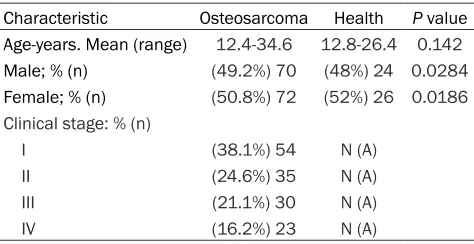
A total of 142 osteosarcoma patients and 150 healthy volunteers were recruited in this an- alysis. The age was 12.4-34.6 and 13.2-38.6 years old in patients and healthy volunteers, respectively. Human biological samples were collected from years May 2010 to March 2016 in Zhejiang Hospital. The frequencies of SNPs in osteosarcoma-related genes were designed in this retrospective pilot case-control study. Inclusion criteria for individuals with osteosar-coma were diagnosed by tumor histopathology. Patients with osteoarthritis, orthopedic surgery and cancer history were excluded in this study. The characteristics of patients with osteosar-coma and healthy volunteers were summarized in Table 1. All patients were required to write informed consent with signature.
phoresis on a 3% agarose gel stained with ethidium bromide.
Quantitative real time PCR (qRT-PCR) analysis
Total RNA was obtained from different clinical stage osteosarcoma cells by using RNAeasy Mini Kit (QIAGEN, Gaithersburg, MD). TRIM-14 and TLR4 expression levels in osteosarcoma and normal bone cancer cells were determin- ed by applying a qRT-PCR [18] (Invitrogen, CA, USA). All the forward and reverse primers we- re synthesized by Invitrogen. Relative mRNA expression level changes were calculated by 2-ΔΔCt. The results are expressed as the n-fold way compared to control.
Western blotting
Osteosarcoma cells were homogenized in ly- sate buffer containing protease-inhibitor and were centrifuged at 8000 rpm/min at 4°C for 10 min. The supernatant of mixture were used for analysis of purpose protein. All anti-bodies were purchased from Abcam (Shang- hai) trading co. LTD (Abcam, Shanghai, China) For western blotting, rabbit anti-human prim- ary antibodies: TRIM-14 (1:1000, ab90541, Ab- cam) and TLR4 (1:1000, ab22048, Abcam) and β-actin (1:1000, ab8826, Abcam) were ad- ded after blocking (5% skimmed milk) for 1 hour at 37°C and then incubated horseradish peroxidase (HRP)-conjugated anti-rabbit IgG antibodies for 24 hours at 4°C. The results were visualized by using chemi-luminescence detection system (Amersham Biosciences, Pis- cataway, NJ).
Statistical analysis
Data were shown as mean ± SD and analyzed by students t test. Multiple groups were
ana-Table 1. Baseline characteristics of the study groups
Characteristic Osteosarcoma Health P value Age-years. Mean (range) 12.4-34.6 12.8-26.4 0.142
Male; % (n) (49.2%) 70 (48%) 24 0.0284
Female; % (n) (50.8%) 72 (52%) 26 0.0186 Clinical stage: % (n)
I (38.1%) 54 N (A)
II (24.6%) 35 N (A)
III (21.1%) 30 N (A)
IV (16.2%) 23 N (A)
DNA genotyping
[image:2.612.91.328.83.205.2]electro-Table 2. Primer sequences and restriction endonucleases used for RFLP analysis and fragment sizes for identification of SNPs
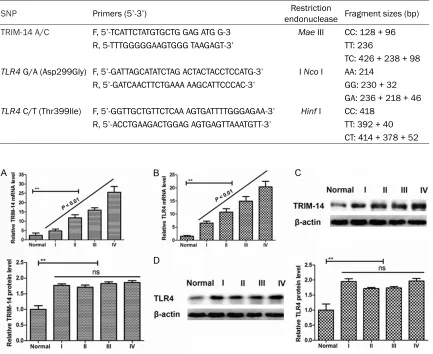
SNP Primers (5’-3’) endonuclease Fragment sizes (bp)Restriction
TRIM-14 A/C F, 5’-TCATTCTATGTGCTG GAG ATG G-3 Mae III CC: 128 + 96 R, 5-TTTGGGGGAAGTGGG TAAGAGT-3’ TT: 236
TC: 426 + 238 + 98
TLR4 G/A (Asp299Gly) F, 5’-GATTAGCATATCTAG ACTACTACCTCCATG-3’ I Nco I AA: 214 R, 5’-GATCAACTTCTGAAA AAGCATTCCCAC-3’ GG: 230 + 32
GA: 236 + 218 + 46
TLR4 C/T (Thr399Ile) F, 5’-GGTTGCTGTTCTCAA AGTGATTTTGGGAGAA-3’ Hinf I CC: 418 R, 5’-ACCTGAAGACTGGAG AGTGAGTTAAATGTT-3’ TT: 392 + 40
CT: 414 + 378 + 52
lyzed by one-way variance (ANOVA). All data were analyzed using SPSS Statistics 19.0 and Graphpad Prism version 5.0 with the help of Microsoft Excel. Allele and genotype frequ- encies were calculated in each group (I-IV pa- tients and healthy individuals) using direct co- unting. Hardy-Weinberg equilibrium (HWE) and the differences between allele and genotype frequencies were calculated using Fisher’s ex- act test or Chi-square test. 95% confidence intervals (CI) and odds ratios (OR) were pres- ented using logistic regression models to as- sess the magnitude of association between osteosarcoma patients and healthy volunteers groups. Hardy-Weinberg tests were used to check the observed genotype distribution in
patients and in the healthy control group. Results of allele and genotype frequencies were determined by STATA SE 12.1 software. Minor allele frequencies (MAF) were calculated using the prop.test function on R 3.1.1 soft-ware. *P<0.05 was considered statistical dif- ferences.
Results
TRIM-14 and TLR4 gene and protein expres-sion in different clinical stage osteosarcoma
TRIM-14 and TLR4 gene and protein expressi- on levels were investigated in different clini- cal stage osteosarcoma. Results showed that Figure 1.TRIM-14 and TLR4 gene and protein expression in different clinical stage osteosarcoma. A. TRIM-14
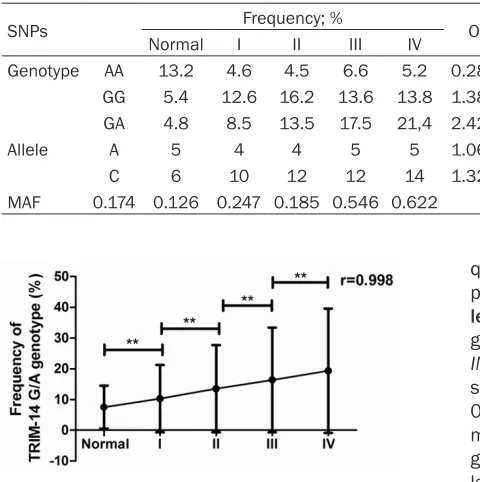
[image:3.612.92.525.96.450.2]Table 3. Genotype, allele frequency and MAF of TRIM-14 gene poly-morphisms in individuals with different stage of osteosarcoma
SNPs Frequency; % OR (95% CI)
Normal I II III IV
Genotype AA 13.2 4.6 4.5 6.6 5.2 0.28 (0.12-1.10) GG 5.4 12.6 16.2 13.6 13.8 1.38 (0.12-1.10) GA 4.8 8.5 13.5 17.5 21,4 2.42 (0.12-1.10)
Allele A 5 4 4 5 5 1.06 (0.12-1.10)
C 6 10 12 12 14 1.32 (0.12-1.10)
MAF 0.174 0.126 0.247 0.185 0.546 0.622
TRIM-14 and TLR4 mRNA expression levels were up-regulated in osteosarcoma tissues compared to normal bone cells (Figure 1A,
1B). We also showed that TRIM-14 and TLR4 protein expression levels were increased in clinical osteosarcoma tissues (Figure 1C, 1D). Data analysis showed that TRIM-14 and TLR4 protein expression levels were increased in clinical stage osteosarcoma (**P<0.01, oste- osarcoma tissues vs. normal tissue). These results showed that TRIM-14 and TLR4 gene and protein expression levels were up-regu- lated in clinical osteosarcoma tissues com-pared to adjacent normal tissues.
TRIM-14 SNP in different clinical stage osteo-sarcoma
DNA samples were collected form a total of 142 patients with different clinical stage ost- eosarcoma and used to TRIM-14 SNP analys- es in this study. The distribution of the geno-typic variants for TRIM-412 G/A SNPs met the HWE (Fisher’s exact test). Alignment of sequence data of 142 patients in clinical І-ІV stage osteosarcoma revealed the following SNPs: Genotype nucleotide AA was decreas-
quently in patients with osteosarcoma com-pared to healthy control (12.5% vs. 6.6%, Tab- le 3). Notably, significant differences in allele, genotype frequencies and MAF values in TR- IM-412G/A were found between the normal samples and osteosarcoma samples (r = 0.998. p<0.01, osteosarcoma tissues vs. nor-mal tissue, Supplementary Figures 1, 2). The genotype nucleotide GA was positively corre-lated with clinical osteosarco-ma stage (Figure 2).
TLR4 SNP in different clinical stage osteosar-coma
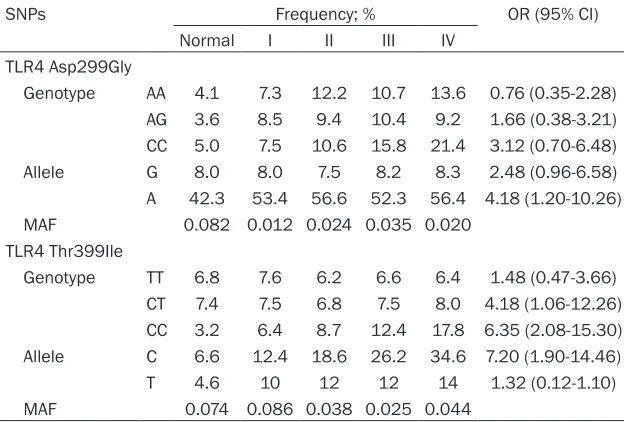
TLR4 SNP was investigated in DNA samples in 142 patients with different clinical stage os- teosarcoma. TLR4 genotyping were obtained from 142 clinical І-ІV stage osteosarcoma sa- mples (Table 4). Results showed that TLR4 Asp299Gly was frequencies AA and AG geno-types in osteosarcoma DNA samples compar- ed to healthy controls [AA, OR = 0.76, 95% CI (0.35-2.28), AG, OR = 1.66 95% CI (0.38- 3.21)]. The CC genotype is frequencies in ost- eosarcoma samples, while is significant differ-ence in among clinical І-ІV stage osteosarco- ma samples. Findings demonstrated that Thr- 399Ileu of the TLR4 frequencies of TT and CT were not significantly between normal and os- teosarcoma DNA samples, while CC was more frequency in osteosarcoma samples compared to healthy controls. We found that the frequ- encies of the G allele in the -1210 position of the promoter region of the TLR4 Asp299Gly gene was similar between osteosarcoma sam-ples and healthy controls, while the A allele was found more frequently in patients with osteosarcoma. Minor allele frequency (MAF) and co-segregation analysis with TLR4 Asp- 299Gly SNP showed significant differences between the normal samples and
osteosarco-Figure 2. Correlation analysis between the genotype nucleotide GA and clinical osteosarcoma stage in
TRIM-14 gene.
fre-Table 4. Genotype, allele frequency and MAF of TLR4 gene polymor-phisms in individuals with different stage of osteosarcoma
SNPs Frequency; % OR (95% CI)
Normal I II III IV
TLR4 Asp299Gly
Genotype AA 4.1 7.3 12.2 10.7 13.6 0.76 (0.35-2.28) AG 3.6 8.5 9.4 10.4 9.2 1.66 (0.38-3.21) CC 5.0 7.5 10.6 15.8 21.4 3.12 (0.70-6.48) Allele G 8.0 8.0 7.5 8.2 8.3 2.48 (0.96-6.58) A 42.3 53.4 56.6 52.3 56.4 4.18 (1.20-10.26) MAF 0.082 0.012 0.024 0.035 0.020
TLR4 Thr399Ile
Genotype TT 6.8 7.6 6.2 6.6 6.4 1.48 (0.47-3.66) CT 7.4 7.5 6.8 7.5 8.0 4.18 (1.06-12.26) CC 3.2 6.4 8.7 12.4 17.8 6.35 (2.08-15.30) Allele C 6.6 12.4 18.6 26.2 34.6 7.20 (1.90-14.46)
T 4.6 10 12 12 14 1.32 (0.12-1.10)
MAF 0.074 0.086 0.038 0.025 0.044
ma samples. No significant differences were found between osteosarcoma groups. Results also showed that C and T alleles in the -784 position of the promoter region of the TLR4 Thr399Ileu were significant differences bet- ween the normal samples and osteosarcoma samples. However, there is no significant am- ong osteosarcoma groups. We also indicate that genotype nucleotide CT was positively cor-related with clinical osteosarcoma stage (Fi- gure 3, P<0.01, R = 0.999). These results sh- owed that frequencies of Thr399Ileu of the TLR4 are differences between the normal sa- mples and osteosarcoma samples and C/T genotype of TLR4 gene is positively correlated with clinical stage of osteosarcoma.
Discussion
Osteosarcoma cancer is a disease that cells
lected the distinct mechanisms of TRIM-14 overexpression. We also found that frequen-cies of CC are higher in DNA samples form osteosarcoma and were concordant with up-regulation of TLR4 gene and protein in pati- ents with osteosarcoma.
[image:5.612.90.402.97.308.2]Recently, the functions of single nucleotide po- lymorphisms for the diagnosis and progres- sion and of osteosarcoma have been wildly investigated in different genes, which related the risk or metastasis of osteosarcoma [21, 22]. Tripartite motif containing-14 (TRIM-14) is identified as an important member of TRIM family proteins, which presents the promontory effects on growth, invasiveness and resistan- ce to cisplatin-induced tumor apoptosis [23]. Previous studies have suggested that TRIM- 14 overexpression could induce an aggressive phenotype in cancer progression through re- gulation of the NF-κB signaling pathway [24]. Therefore, understanding the role of TRIM-14 is necessary for tumor research and treatment in human tumorigenesis and metastasis. The current study analyzed TRIM-14 SNPs in clini- cal osteosarcoma samples. Results showed that TRIM-14 is overexpressed in osteosarco-ma tissues since significant differences in al- lele, genotype frequencies and MAF values in TRIM-412 G/A between normal samples and osteosarcoma samples. Interestingly, the fre-quencies of the A allele in the -400 position of the promoter region of the TRIM gene was
Figure 3. Correlation analysis between the genotype nucleotide CT and clinical osteosarcoma stage in
TLR gene.
[image:5.612.91.288.331.436.2]was found more frequently in patients with osteosarcoma, which may contribute to TRIM-14 overexpression in osteosarcoma tissues. Studies suggest that toll like receptor 4 (TL- R4) plays an important role in the initiation and/or maintenance of pathological pain state in bone cancer pain [25]. Genetic variants in TLR4 gene correlate with many human disease, such as myeloproliferative disorders, infectious diseases and inflammatory disease [26-28]. However, the role of TLR4 SNP in patients with osteosarcoma has not reported yet. Previous reports have indicated that TLR4 co-segregat-ing polymorphisms Asp299Gly and Thr399Ile in TLR4 have been shown to increase the risk of Gram-negative infections, sepsis, and seve- re malaria [29-31]. In this study, we explored
TLR4 SNP in different clinical І-ІV stage osteo -sarcoma samples. Our results showed that TL- R4 Asp299Gly was frequencies between gr- oups for the AA and AG genotypes (72.4 and 17.8%, respectively) and AC genotype is fre-quencies in osteosarcoma samples, while is not significant difference in among clinical І-ІV stage osteosarcoma samples. No significant differences were found between osteosarco- ma groups, but genotype nucleotide CT was positively correlated with clinical osteosarco- ma stage.
In conclusion, the current study found a sig- nificant association between TRIM and TLR4 genes polymorphism and clinical osteosarco-ma stage. The results of SNPs TRIM and TLR4 genes indicate that the efficiency of used as- sociated tumor-related genes to predict clinical stage of human osteosarcoma using the SNPs of TRIM and TLR4, which may contribute to un- derstand the pathology of osteosarcoma and provide possible target therapies.
Acknowledgements
This study was supported by Zhejiang TCM sci-ence and technology project research fund project (2013ZB014) and Zhejiang medical association clinical research fund project. Disclosure of conflict of interest
None.
Address correspondence to: Weiqi Wang,
Depart-ment of Orthopedics, Zhejiang Hospital, No. 12,
Lingyin Road, Hangzhou 310013, Zhejiang, P.R. China. Tel: +86-0571-87987373; E-mail: hongyan_ [email protected]
References
[1] Li YF, Yu CP, Wu ST, Dai MS and Lee HS. Malig -nant mesenchymal tumor with leiomyosarco-ma, rhabdomyosarcoleiomyosarco-ma, chondrosarcoleiomyosarco-ma, and osteosarcoma differentiation: case report
and literature review. Diagn Pathol 2011; 6:
35.
[2] PosthumaDeBoer J, Witlox MA, Kaspers GJ
and van Royen BJ. Molecular alterations as tar-get for therapy in metastatic osteosarcoma: a review of literature. Clin Exp Metastasis 2011; 28: 493-503.
[3] Zhao J, Zhang X, Liu J and Li J. Primary osteo-sarcoma of the breast with abundant
chon-droid matrix and fibroblasts has a good prog -nosis: a case report and review of the literature. Oncol Lett 2013; 6: 745-747.
[4] Navalkele P, Jones SM, Jones JK, Salazar JD,
Toy PC, Iyer RV and Herrington B. Osteosarco-ma tumor thrombus: a case report with a re-view of the literature. Tex Heart Inst J 2013; 40: 75-78.
[5] Liu JJ, Liu S, Wang JG, Zhu W, Hua YQ, Sun W
and Cai ZD. Telangiectatic osteosarcoma: a re -view of literature. Onco Targets Ther 2013; 6: 593-602.
[6] Sampson VB, Gorlick R, Kamara D and Anders
Kolb E. A review of targeted therapies evaluat-ed by the pevaluat-ediatric preclinical testing program for osteosarcoma. Front Oncol 2013; 3: 132. [7] Vijayamurugan N and Bakhshi S. Review of
management issues in relapsed osteosarco-ma. Expert Rev Anticancer Ther 2014; 14: 151-161.
[8] He JP, Hao Y, Wang XL, Yang XJ, Shao JF, Guo FJ and Feng JX. Review of the molecular patho-genesis of osteosarcoma. Asian Pac J Cancer Prev 2014; 15: 5967-5976.
[9] Ene R, Sinescu RD, Ene P, Popescu D, Cirstoiu
MM and Cirstoiu FC. Proximal tibial osteosar-coma in young patients: early diagnosis, modu-lar reconstruction. Rom J Morphol Embryol 2015; 56: 413-417.
[10] Wang Y, Makedon F and Pearlman J. Tumor
classification based on DNA copy number ab -errations determined using SNP arrays. Oncol Rep 2006; 15 Spec no.: 1057-9.
[12] Zin R, Pham K, Ashleigh M, Ravine D, Waring P
and Charles A. SNP-based arrays complement classic cytogenetics in the detection of chro-mosomal aberrations in Wilms’ tumor. Cancer Genet 2012; 205: 80-93.
[13] Standfuss C, Pospisil H and Klein A. SNP mi-croarray analyses reveal copy number altera-tions and progressive genome reorganization during tumor development in SVT/t driven mice breast cancer. BMC Cancer 2012; 12: 380.
[14] Hatakeyama S. TRIM proteins and cancer. Nat Rev Cancer 2011; 11: 792-804.
[15] He W, Liu Q, Wang L, Chen W, Li N and Cao X. TLR4 signaling promotes immune escape of human lung cancer cells by inducing immuno-suppressive cytokines and apoptosis resis-tance. Mol Immunol 2007; 44: 2850-2859. [16] Santin I, Castellanos-Rubio A, Hualde I,
Casta-no L, Vitoria JC and Bilbao JR. Toll-like receptor 4 (TLR4) gene polymorphisms in celiac dis-ease. Tissue Antigens 2007; 70: 495-498. [17] Suzuki S, Hosomichi K, Yokoyama K, Tsuda K,
Hara H, Yoshida Y, Fujiwara A, Mizutani M, Shii-na T, Kono T and Hanzawa K. Primary aShii-nalysis
of DNA polymorphisms in the TRIM region
(MHC subregion) of the Japanese quail, Cotur-nix japonica. Anim Sci J 2013; 84: 90-96. [18] Xiao S, Wang J and Xiao N. MicroRNAs as
non-invasive biomarkers in bladder cancer detec-tion: a diagnostic meta-analysis based on qRT-PCR data. Int J Biol Markers 2016; 31: e276-85.
[19] Song J, Kim DY, Kim CS, Kim HJ, Lee DH, Lee
HM, Ko W and Lee G. The association between Toll-like receptor 4 (TLR4) polymorphisms and the risk of prostate cancer in Korean men. Cancer Genet Cytogenet 2009; 190: 88-92. [20] Herquel B, Ouararhni K and Davidson I. The
TIF1alpha-related TRIM cofactors couple
chro-matin modifications to transcriptional regula -tion, signaling and tumor suppression. Tran-scription 2011; 2: 231-236.
[21] Jin G, Wang M, Chen W, Shi W, Yin J and Gang W. Single nucleotide polymorphisms of nucleo-tide excision repair and homologous recombi-nation repair pathways and their role in the risk of osteosarcoma. Pak J Med Sci 2015; 31: 269-273.
[22] Tie Z, Bai R, Zhai Z, Zhang G, Zhang H, Zhao Z,
Zhou D and Liu W. Single nucleotide polymor -phisms in VEGF gene are associated with an increased risk of osteosarcoma. Int J Clin Exp Pathol 2014; 7: 8143-8149.
[23] Nenasheva VV, Kovaleva GV, Uryvaev LV,
Iono-va KS, DedoIono-va AV, VorkunoIono-va GK, Chernyshen -ko SV, Khaidarova NV and Tarantul VZ. En-hanced expression of trim14 gene suppressed Sindbis virus reproduction and modulated the transcription of a large number of genes of in-nate immunity. Immunol Res 2015; 62:
255-[24] Su X, Wang J, Chen W, Li Z, Fu X and Yang A. Overexpression of TRIM14 promotes tongue squamous cell carcinoma aggressiveness by activating the NF-kappaB signaling pathway. Oncotarget 2016; 7: 9939-9950.
[25] Pan R, Di H, Zhang J, Huang Z, Sun Y, Yu W and
Wu F. Inducible lentivirus-mediated siRNA against TLR4 reduces nociception in a rat
model of bone cancer pain. Mediators Inflamm
2015; 2015: 523896.
[26] Trejo-de la OA, Torres J, Perez-Rodriguez M, Camorlinga-Ponce M, Luna LF, Abdo-Francis JM, Lazcano E and Maldonado-Bernal C. TLR4 single-nucleotide polymorphisms alter muco-sal cytokine and chemokine patterns in Mexi-can patients with Helicobacter pylori-associat-ed gastroduodenal diseases. Clin Immunol 2008; 129: 333-340.
[27] Speletas M, Liadaki K, Kalala F, Daiou C, Kato -dritou E, Mandala E, Korantzis I, Ritis K, Zint-zaras E and Germenis AE. TLR4 single nucleo-tide polymorphisms and thrombosis risk in patients with myeloproliferative disorders. Thromb Res 2008; 122: 27-32.
[28] Mera-Ramirez A, Castillo A, Orobio Y, Gomez MA and Gallego-Marin C. Screening of TNFal-pha, IL-10 and TLR4 single nucleotide polymor-phisms in individuals with asymptomatic and chronic cutaneous leishmaniasis in Colombia:
a pilot study. BMC Infect Dis 2017; 17: 177.
[29] Mockenhaupt FP, Cramer JP, Hamann L, Stege-mann MS, Eckert J, Oh NR, Otchwemah RN,
Dietz E, Ehrhardt S, Schroder NW, Bienzle U
and Schumann RR. Toll-like receptor (TLR) polymorphisms in African children: common TLR-4 variants predispose to severe malaria. Proc Natl Acad Sci U S A 2006; 103: 177-182. [30] Lorenz E, Mira JP, Frees KL and Schwartz DA.
Relevance of mutations in the TLR4 receptor in patients with gram-negative septic shock. Arch Intern Med 2002; 162: 1028-1032.
[31] Agnese DM, Calvano JE, Hahm SJ, Coyle SM,
Corbett SA, Calvano SE and Lowry SF. Human
toll-like receptor 4 mutations but not CD14
polymorphisms are associated with an in-creased risk of gram-negative infections. J
Supplementary Figure 1. PCR-Restriction Fragment Length Polymorphism (PCR-RFLP) TRIM genotyping. Lanes 1, 3 and 5: undigested samples; lanes 2, 4: AccI digested sample; lane 6: homozygous wildtype sample; Lane M: 100
bp DNA ladder.
Supplementary Figure 2. PCR-Restriction Fragment Length Polymorphism (PCR-RFLP) TLR4 genotyping.Lanes 1 and 3: undigested samples; lane 2: Pme I digested sample; lane 4: homozygous wildtype sample. Lane M: 100 bp