Learning to Simplify Sentences with Quasi-Synchronous Grammar and
Integer Programming
Kristian Woodsend and Mirella Lapata
Institute for Language, Cognition and Computation School of Informatics, University of Edinburgh
10 Crichton Street, Edinburgh EH8 9AB
[email protected],[email protected]
Abstract
Text simplification aims to rewrite text into simpler versions, and thus make information accessible to a broader audience. Most pre-vious work simplifies sentences using hand-crafted rules aimed at splitting long sentences, or substitutes difficult words using a prede-fined dictionary. This paper presents a data-driven model based on quasi-synchronous grammar, a formalism that can naturally capture structural mismatches and complex rewrite operations. We describe how such a grammar can be induced from Wikipedia and propose an integer linear programming model for selecting the most appropriate simplifica-tion from the space of possible rewrites gen-erated by the grammar. We show experimen-tally that our method creates simplifications that significantly reduce the reading difficulty of the input, while maintaining grammaticality and preserving its meaning.
1 Introduction
Sentence simplification is perhaps one of the oldest text rewriting problems. Given a source sentence, the goal is to create a grammatical target that is easier to read with simpler vocabulary and syntac-tic structure. An example is shown in Table 1 in-volving a broad spectrum of rewrite operations such as deletion, substitution, insertion, and reordering. The popularity of the simplification task stems from its potential relevance to various applications. Ex-amples include the development of reading aids for people with aphasia (Carroll et al., 1999), non-native
Also contributing to the firmness in copper, the an-alyst noted, was a report by Chicago purchasing agents, which precedes the full purchasing agents re-port that is due out today and gives an indication of what the full report might hold.
Also contributing to the firmness in copper, the an-alyst noted, was a report by Chicago purchasing agents. The Chicago report precedes the full purchas-ing agents report. The Chicago report gives an indica-tion of what the full report might hold. The full report is due out today.
Table 1: Example of a source sentence (top) and its sim-plification (bottom).
speakers (Siddharthan, 2003) and more generally in-dividuals with low literacy (Watanabe et al., 2009). A simplification component could be also used as a preprocessing step to improve the performance of parsers (Chandrasekar et al., 1996), summarizers (Beigman Klebanov et al., 2004) and semantic role labelers (Vickrey and Koller, 2008).
Simplification is related to, but different from paraphrase extraction (Barzilay, 2003). We must not only have access to paraphrases (i.e., rewrite rules), but also be able to combine them to generate new text, in a simpler language. The task is also dis-tinct from sentence compression as it aims to ren-der a sentence more accessible while preserving its meaning. On the contrary, compression unavoidably leads to some information loss as it creates shorter sentences without necessarily reducing complexity. In fact, one of the commonest simplification oper-ations is sentence splitting which usually produces longer rather than shorter output! Moreover,
els developed for sentence compression have been mostly designed with one rewrite operation in mind, namely word deletion, and are thus unable to model consistent syntactic effects such as reordering, sen-tence splitting, changes in non-terminal categories, and lexical substitution (but see Cohn and Lapata 2008 and Zhao et al. 2009 for notable exceptions).
In this paper we propose a sentence simplification model that is able to handle structural mismatches and complex rewriting operations. Our approach is based on quasi-synchronous grammar (QG, Smith and Eisner 2006), a formalism that is well suited for text rewriting. Rather than postulating a strictly syn-chronous structure over the source and target sen-tences, QG identifies a “sloppy” alignment of parse trees assuming that the target tree is in some way “inspired by” the source tree. Specifically, our model is formulated as an integer linear program and uses QG to capture the space of all possible rewrites. Given a source tree, it finds the best target tree li-censed by the grammar subject to constraints such as sentence length and reading ease. Our model is conceptually simple and computationally efficient. Furthermore, it finds globally optimal simplifica-tions without resorting to heuristics or approxima-tions during the decoding process.
Contrary to most previous approaches (see the discussion in Section 2) which rely heavily on hand-crafted rules, our model learns simplifi-cation rewrites automatically from examples of source-target sentences. Our work joins others in us-ing Wikipedia to extract data appropriate for model training (Yamangil and Nelken, 2008; Yatskar et al., 2010; Zhu et al., 2010). Advantageously, the Sim-ple English Wikipedia (henceforth SimSim-pleEW) pro-vides a large repository of simplified language; it uses fewer words and simpler grammar than the or-dinary English Wikipedia (henceforth MainEW) and is aimed at non-native English speakers, children, translators, people with learning disabilities or low reading proficiency. We exploit Wikipedia and cre-ate a (parallel) simplification corpus in two ways: by aligning MainEW sentences to their SimpleEW counterparts, and by extracting training instances from SimpleEW revision histories, thus leveraging Wikipedia’s collaborative editing process.
Our experimental results demonstrate that a sim-plification model can be learned from Wikipedia
data alone without any manual effort. Perhaps un-surprisingly, the quality of the QG grammar rules greatly improves when these are learned from re-vision histories which are less noisy than sentence alignments. When compared against current state-of-the-art methods (Zhu et al., 2010) our model yields significantly simpler output that is both gram-matical and meaning preserving.
2 Related Work
Sentence simplification has attracted a great deal of attention due to its potential impact on society. The literature is rife with attempts to simplify text using mostly hand-crafted syntactic rules aimed at splitting long and complicated sentences into sev-eral simpler ones (Carroll et al., 1999; Chandrasekar et al., 1996; Siddharthan, 2004; Vickrey and Koller, 2008). Other work focuses on lexical simplifications and substitutes difficult words by more common WordNet synonyms or paraphrases found in a pre-defined dictionary (Devlin, 1999; Inui et al., 2003; Kaji et al., 2002).
Our own work formulates sentence simplification in the framework of Quasi-synchronous grammar (QG, Smith and Eisner 2006). QG allows to describe non-isomorphic tree pairs (the grammar rules can comprise trees of arbitrary depth, and fragments can be mapped) and is thus suited to text-rewriting tasks which typically involve a number of local modifi-cations to the input text. We use quasi-synchronous grammar to learn a wide range of rewrite opera-tions capturing both lexical and structural simplifi-cations naturally without any additional rule engi-neering. In contrast to Yatskar et al. (2010) and Zhu et al. (2010), simplification operations (e.g., substi-tution or splitting) are not modeled explicitly; in-stead, we leave it up to our grammar extraction algo-rithm to learn appropriate rules that reflect the train-ing data. Compared to Zhu et al., our model is con-ceptually simpler and more general. The proposed ILP formulation not only allows to efficiently search through the space of many QG rules but also to in-corporate constraints relating to grammaticality and the task at hand without the added computational cost of integrating a language model. Furthermore, our learning framework is not limited to simplifi-cation and could be easily adapted to other rewrit-ing tasks. Indeed, the QG formalism has been pre-viously applied to parser adaptation and projection (Smith and Eisner, 2009), paraphrase identification (Das and Smith, 2009), question answering (Wang et al., 2007), and title generation (Woodsend et al., 2010).
Finally, our work relates to a large body of recent literature on Wikipedia and its potential for a wide range of NLP tasks. Beyond text rewriting, examples include semantic relatedness (Ponzetto and Strube, 2007), information extraction (Wu and Weld, 2010), ontology induction (Nastase and Strube, 2008), and the automatic creation of overview articles (Sauper and Barzilay, 2009).
3 Sentence Simplification Model
Our model takes a single sentence as input and cre-ates a version that is simpler to read. This may involve rendering syntactically complex structures simpler (e.g., through sentence splitting), or sub-stituting rare words with more common words or phrases (e.g., such that a second language learner
may be familiar with), or deleting elements of the original text in order to produce a relatively sim-pler and shallower syntactic structure. In addition, the output must be grammatical and coherent. These constraints areglobalin their scope, and cannot be adequately satisfied by optimizing each one of them individually. Our approach therefore uses an ILP formulation which will provide a globally optimal solution. Given an input sentence, our model decon-structs it into component phrases and clauses, each of which is simplified (lexically and structurally) through QG rewrite rules. We generate all possible simplifications for a given input and use the ILP to find the best target subject to grammaticality con-straints. In what follows we first detail how we ex-tract QG rewrite rules as these form the backbone of our model and then formulate the ILP proper.
3.1 Quasi-synchronous Grammar
Phrase alignment Our model operates on indi-vidual sentences annotated with syntactic informa-tion i.e., phrase structure trees. In our experiments, we obtain this information from the Stanford parser (Klein and Manning, 2003) but any other broadly similar parser could be used instead. Given an input sentence S1 or its parse tree T1, the QG constructs a monolingual grammar for parsing, or generating, possible translation trees T2. A grammar node in the target tree T2 is modeled on a subset of nodes in the source tree, with a rather loose alignment between the trees.
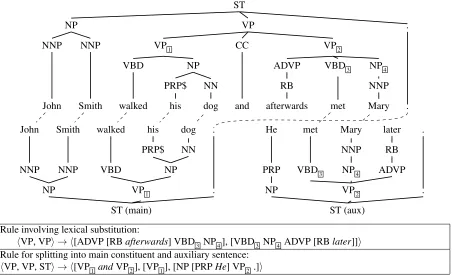
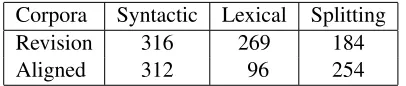
We take aligned sentence pairs represented as phrase structure trees and build up a list of leaf node alignments based on lexical identity. We align direct parent nodes where more than one child node aligns. QG rules are created from aligned nodes above the leaf node level if the all the nodes in the target tree can be explained using nodes from the source. This helps to improve the quality in what is inherently a noisy process, and it is largely responsible for a rel-atively small resulting grammar (see Table 2). Ex-amples of phrase alignments (indicated with dotted lines) are shown in Figure 1.
re-ST
.
. VP
VP2
NP4
NNP
Mary VBD3
met ADVP
RB
afterwards CC
and VP1
NP
NN
dog PRP$
his VBD
walked NP
NNP
Smith NNP
John
ST (main)
. .
VP1 NP
NN dog
PRP$ his
VBD walked
NP NNP Smith
NNP John
ST (aux)
. .
VP2
ADVP RB later
NP4 NNP Mary
VBD3 met
NP PRP
He
Rule involving lexical substitution:
hVP, VPi → h[ADVP [RBafterwards] VBD3 NP4], [VBD3 NP4 ADVP [RBlater]]i
Rule for splitting into main constituent and auxiliary sentence:
[image:4.612.84.539.57.332.2]hVP, VP, STi → h[VP1 andVP2], [VP1], [NP [PRPHe] VP2 .]i
Figure 1: A source sentence (upper tree) is split into two sentences. Dotted lines show word alignments, while boxed subscripts show aligned nodes used to form QG rules. Below, two QG rules learned from this data.
ordered, and for nodes to be flattened. In addition, we allow insertion of punctuation and some func-tion words, identified by a small set of POS tags. To distinguish sentences proper (which have final punc-tuation) from clauses, we modify the output of the parser, changing the root sentence parse tag from S to ST (a “top-level sentence”); this allows clauses to be extracted and rewritten as stand-alone sentences.
Lexical simplification rules Lexical substitutions are an important part of simplification. We learn them from aligned sub-trees, in the same way as described above for syntax rules, by allowing a small number of lexical substitutions to be present in the rules, and provided they do not include proper nouns. The resulting QG rules could be applied by matching the syntax of the whole sub-tree sur-rounding the substitution, but this approach is overly restrictive and suffers from data sparsity. Indeed, Yatskar et al. (2010) learn lexical simplifications without taking syntactic context into account. We therefore add a post-processing stage to the learning process. For rules where the syntactic structures of the source and target sub-trees match, and the only
difference is a lexical substitution, we construct a more general rule by extracting the words and cor-responding POS tags involved in the substitution. Then at the generation stage, identifying suitable rules depends only on the substitution words, rather than the surrounding syntactic context. An example of a lexical substitution rule is shown in Figure 1.
Sentence splitting rules Another important sim-plification technique is to split syntactically compli-cated sentences into several shorter ones. To learn QG rules for this operation, the source sentence is aligned with two consecutive target sentences.
possible for the auxiliary sentence to come before or after the main sentence. In the learning procedure, we try both possible orderings, and record the order in any QG rules successfully produced.
The resulting QG rule is a tuple of three phrase structure elements: the source node, the node in the target main sentence (the top level of this node is typically the same as that of the source node), and the phrase structure of the entire auxiliary sentence.1
In addition, there is a flag to indicate if the auxiliary sentence comes before or after the main sentence. This formalism is able to capture the operations re-quired to split sentences containing coordinate or subordinate clauses, parenthetical content, relative clauses and apposition. An example of a sentence splitting rule is illustrated in Figure 1.
3.2 ILP-based Generation
We cast the problem of finding a suitable target sim-plification given a source sentence as an integer lin-ear program (ILP). Specifically, simplified text is created from source sentence parse trees by identi-fying and applying QG grammar rules. These will have matching structure and may also require lexical matching (shown using italics in the example rules in Figure 1). The generation process starts at the root node of the parse tree, applying QG rules to sub-trees until leaf nodes are reached. We do not use the Bayesian probability model proposed by Smith and Eisner (2006) to identify the best sequence of sim-plification rules. Instead, where there is more than one matching rule, and so more than one simplifi-cation is possible, the alternatives are all generated and incorporated into the target phrase structure tree. The ILP model operates over this phrase structure tree and selects the phrase nodes from which to form the target output.
Applying the QG rules on the source sentence generates a number of auxiliary sentences. Let
S
be this set of sentences. LetP
be the set of nodes in the phrase structure trees of the auxiliary sentences, andP
s⊂P
be the set of nodes in each sentences∈S
.Let the sets
D
i⊂P
,∀i∈P
capture the phrasede-pendency information for each node i, where each set
D
i contains the nodes that depend on the pres-1Note that the target component comprises the second and third elements as a pair, and variables from the source compo-nent are split between them.ence ofi. In a similar fashion, the sets
A
i⊂S
,∀i∈P
capture the indices of any auxiliary sentences that depend on the presence of nodei.
C
⊂P
is the setof nodes involving a choice of alternative simplifi-cations (nodes in the tree where more than one QG rewrite rule can be applied, as mentioned above);
C
i ⊂P
,i∈C
are the sets of nodes that are directchildren of each such node, in other words they are the individual simplifications. Letli(w)be the length of each node iin words, and li(sy) its length in
syl-lables. As we shall see below counts of words and syllables are important cues in assessing readability. The model is cast as an binary integer linear program. A vector of binary decision variables x∈ {0,1}|P| indicates if each node is to be part of the output. A vector of auxiliary binary variables y∈ {0,1}|S| indicates which (auxiliary) sentences have been chosen.
max
x i
∑
∈Pgixi+hw+hsy (1a)s.t. xj→xi ∀i∈
P
,j∈D
i (1b)xi→ys ∀i∈
P
,s∈A
i (1c)xi→ys ∀s∈
S
,i∈P
s (1d)∑
j∈Ci
xj=xi ∀i∈
C
,j∈C
i (1e)∑
s∈Syi≥1 (1f)
xi∈ {0,1} ∀i∈
P
(1g)ys∈ {0,1} ∀s∈
S
. (1h)Our objective function, given in Equation (1a), is the summation of local and global compo-nents. Each phrase is locally given a rewrite penalty gi, where common lexical substitutions,
rewrites and simplifications are penalized less (as we trust them more), compared to rarer QG rules. The penalty is a simple log-probability measure, gi=log
nr
Nr
,wherenr is the number of times the
QG rule r was seen in the training data, and Nr
the number of times all suitable rules for this phrase node were seen. If no suitable rules exist, we setgi=0.
towards simpler language. They draw inspiration from existing measures of readability (the ease with which a document can be read and understood). The primary aim of readability formulas is to assess whether texts or books are suitable for students at particular grade levels or ages (see Mitchell 1985 for an overview). Intuitively, texts ought to be simpler if they correspond to low reading levels. A commonly used reading level measure is the Flesch-Kincaid Grade Level (FKGL) index which estimates read-ability as a combination of the average number of syllables per word and the average number of words per sentence. Unfortunately, this measure is non-linear2 and cannot be incorporated directly into the
objective of the ILP. Instead, we propose a linear ap-proximation. We provide the ILP with targets for the average number of words per sentence (wps), and syllables per word (spw).hw(x,y)then measures the
number of words below this target level that the ILP has achieved:
hw(x,y) =wps×
∑
i∈Syi−i
∑
∈Pl (w)i xi.
When positive, this indicates that sentences are shorter than target, and contributes positively to the readability objective whilst encouraging the appli-cation of sentence splitting and deletion-based QG rules. Similarly, hsy(x,y) measures the number of
syllables below that expected, from the target aver-age and the number of words the ILP has chosen:
hsy(x) =spw×
∑
i∈Pl(w)
i xi−
∑
i∈Pl(sy)
i xi.
This component of the objective encourages the deletion or lexical substitution of complex words. We can use the two target parameters (wps and spw) to control how much simplification the ILP should apply.
Constraint (1b) enforces grammatical correctness by ensuring that the phrase dependencies are re-spected and the resulting structure is a tree. Phrases that depend on phraseiare contained in the set
D
i.Variable xi is true, and therefore phrase i will be
included in the target output, if any of its depen-dents xj∈
D
i are true.3 Constraint (1c) links main2FKGL=0.39 total words total sentences
+1.8total syllablestotal words −15.59 3Constraints (1b), (1c) and (1d) are shown as dependencies for clarity, but they were implemented as inequalities in the ILP.
phrases to auxiliary sentences, so that the latter can only be included in the output if the main phrase has also been chosen. This helps to control coher-ence within the output text. Despite seeming similar to (1c), the role of constraint (1d) is quite different. It links phrase variablesxto sentence variablesy, to ensure the logical integrity of the model is correct. Where the QG provides alternative simplifications, it makes sense of course to select only one. This is controlled by constraint (1e), and by placing all al-ternatives in the set
D
ifor the nodei.With these constraints alone, and faced with a source sentence that is particularly difficult to sim-plify, it is possible for the ILP solver to return a “triv-ial” solution of no output at all, as all other avail-able solutions result in a negative objective value. It is therefore necessary to impose a global mini-mum output constraint (1f). In combination with the dependency relations in (1c), this constraint ensures that at least an element of the root sentence is present in the output. Global maximum length constraints are a frequently occurring aspect of ILP models used in NLP applications. We decided not to incorporate any such constraints into our model, as we did not want to place limitations on the simplification of original content.
4 Experimental Setup
In this section we present our experimental setup for assessing the performance of the simplification model described above. We give details on the cor-pora and grammars we used, model parameters, the systems used for comparison with our approach, and explain how the output was evaluated.
Grammar Extraction QG rules were learned from revision histories and an aligned simplifica-tion corpus, which we obtained from snapshots4of
MainEW and SimpleEW. Wiki-related mark-up and meta-information was removed to extract the plain text from the articles.
Corpora Syntactic Lexical Splitting
Revision 316 269 184
[image:7.612.85.288.54.97.2]Aligned 312 96 254
Table 2: Number of QG rules extracted (after removing singletons) from revision-based and aligned corpora.
We identified suitable revisions for simplification by selecting those where the author had mentioned a keyword (such assimple,clarificationorgrammar) in the revision comments. Each selected revision was compared to the previous version. Because the entire article is stored at each revision, we needed to identify and align modified sentences. We first iden-tified modified sections using the Unix diff pro-gram, and then individual sentences within the sec-tions were aligned using the programdwdiff5. This resulted in 14,831 paired sentences. With regard to the aligned simplification corpus, we paired 15,000 articles from SimpleEW and MainEW following the language link within the snapshot files. Within the paired articles, we identified aligned sentences us-ing macro alignment (at paragraph level) then mi-cro alignment (at sentence level), using tf.idf scores to measure similarity (Barzilay and Elhadad, 2003; Nelken and Schieber, 2006).
All source-target sentences (resulting from revi-sions or alignments) were parsed with the Stanford parser (Klein and Manning, 2003) in order to la-bel the text with syntactic information. QG rules were created by aligning nodes in these sentences as described earlier. A breakdown of the number and type of rules we obtained from the revision and aligned corpora (after removing rules appear-ing only once) is given in Table 2. Examples of the most frequently learned QG rules are shown in Ta-ble 3. Rules (1)–(3) involve syntactic simplification and rules (4)–(6) involve sentence splitting. Exam-ples of common lexical simplifications found by our grammar are: “discovered” → “found”, “defeated” →“won against”, “may refer to”→“could mean”, “original”→“first”, “requires”→“needs”.
Sentence generation We generated simplified versions of MainEW sentences. For each (parsed) source sentence, we created and solved an ILP (see Equation (1)) parametrized as follows: the number
5http://os.ghalkes.nl/dwdiff.html
1. hS, STi → h[NP1 VP2], [NP1 VP2 .]i
2. hS, STi → h[VP1], [ThisVP1 .]i
3. hNP, STi → h[NP1 , NP2], [NP1 wasVP2 .]i
4.hST, ST, STi → h[S1 , andS2], [ST1], [ST2]i
5.hST, ST, STi → h[S1 : S2], [ST1], [ST2]i
[image:7.612.315.549.54.140.2]6.hST, ST, STi → h[S1 , butS2], [ST1], [ST2]i
Table 3: Examples of QG rules involving syntactic sim-plification (1)–(3) and sentence division (4)–(6). The lat-ter are shown as the tuplehsource, target, auxi. The trans-form of nodes from S to ST (for example) rely on the application of syntactic simplification rules rules. Boxed subscripts show aligned nodes.
of target words per sentence (wps) was set to 8, and syllables per word (spw) to 1.5. These two param-eters were empirically tuned on the training set. To solve the ILP model we used the ZIB Optimization Suite software (Achterberg, 2007; Koch, 2004). The solution was converted into a sentence by removing nodes not chosen from the tree representation, then concatenating the remaining leaf nodes in order. Evaluation We evaluated our model on the same dataset used in Zhu et al. (2010), an aligned pus of MainEW and SimpleEW sentences. The cor-pus contains 100/131 source/target sentences and was created automatically. Sentences from this cor-pus (and their revisions) were excluded from train-ing. We evaluated two versions of our model, one with rewrite rules acquired from revision histories of simplified documents and another one with rules extracted from MainEW-SimpleEW aligned sen-tences. These models were compared against Zhu et al. (2010)6 who also learn simplification rules
from Wikipedia, and a simple baseline that uses solely lexical simplifications7 provided by the
Sim-pleEW editor “SpencerK” (Spencer Kelly). An obvi-ous idea would be to treat sentence simplification as an English-to-English translation problem and use an off-the-shelf system like Moses8 for the task.
However, we refrained from doing so as Zhu et al. (2010) show that Moses performs poorly, it cannot model rewrite operations that split sentences or drop words and in most cases generates output identical 6We are grateful to Zhemin Zhu for providing us with his test set and the output of his system.
7http://www.spencerwaterbed.com/soft/simple/
MainEW Wonder has recorded several critically acclaimed albums and hit singles, and writes and produces songs for many of his label mates and outside artists as well.
Zhu et al Wonder has recorded several praised albums and writes and produces songs. Many of his label mates and outside artists as well.
AlignILP Wonder has recorded several critically acclaimed albums and hit singles. He produces songs for many of his label mates and outside artists as well. He writes.
RevILP Wonder has recorded many critically acclaimed albums and hit singles. He writes. He makes songs for many of his label mates and outside artists as well.
SimpleEWHe has recorded 23 albums and many hit singles, and written and produced songs for many of his label mates and other artists as well.
MainEW The London journeys In 1790, Prince Nikolaus died and was succeeded by a thoroughly unmusical prince who dismissed the entire musical establishment and put Haydn on a pension.
Zhu et al The London journeys in 1790, prince Nikolaus died and was succeeds by a son became prince. A son became prince told the entire musical start and put he on a pension.
AlignILP The London journeys In 1790, Prince Nikolaus died. He was succeeded by a thoroughly unmusical prince. He dismissed the entire musical establishment. He put Haydn on a pension.
RevILP The London journeys In 1790, Prince Nikolaus died. He was succeeded by a thoroughly unmusical prince. He dismissed the whole musical establishment. He put Haydn on a pension.
[image:8.612.67.546.50.298.2]SimpleEWThe London journeys In 1790, Prince Nikolaus died and his son became prince. Haydn was put on a pension.
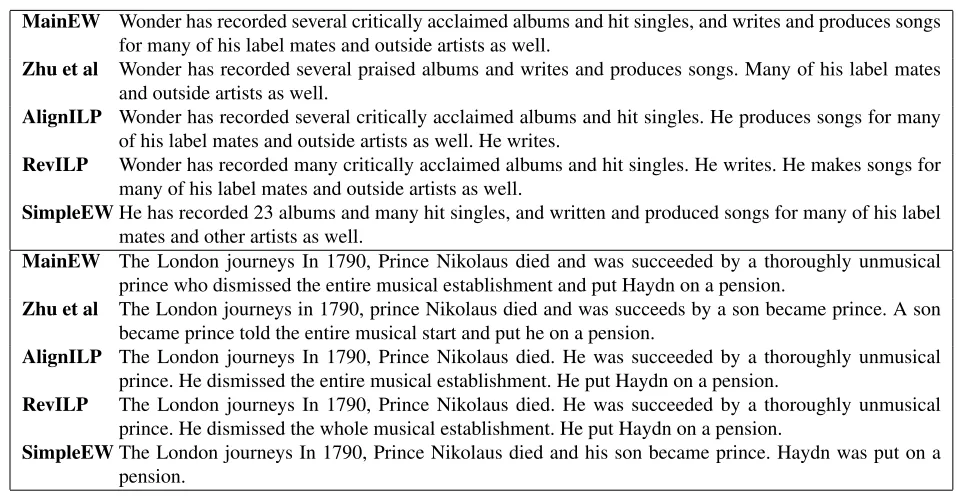
Table 4: Example simplifications produced by the systems in this paper (RevILP, AlignILP) and Zhu et al.’s (2010) model, compared to real Wikipedia text (MainEW: input source, SimpleEW: simplified target).
to the source.
We evaluated model output in two ways, using au-tomatic evaluation measures and human judgments. Intuitively, readability measures ought to be suit-able for assessing the output of simplification sys-tems. We report results with the well-known Flesch-Kincaid Grade Level index (FKGL). Experiments with other readability measures such as the Flesch Reading Ease and the Coleman-Liau index obtained similar results. In addition, we also assessed how the system output differed from the human SimpleEW gold standard by computing BLEU (Papineni et al., 2002) and TERp (Snover et al., 2009). Both mea-sures are commonly used to automatically evaluate the quality of machine translation output. BLEU9
scores the target output by countingn-gram matches with the reference, whereas TERp is similar to word error rate, the only difference being that it allows shifts and thus can account for word order differ-ences. TERp also allows for stem, synonym, and paraphrase substitutions which are common rewrite operations in simplification.
In line with previous work on text rewriting (e.g., Knight and Marcu 2002) we also evaluated 9We calculated single-reference BLEU using the mteval-v13ascript (with the default settings).
system output by eliciting human judgments. We conducted three experiments. In the first experi-ment participants were presented with a source sen-tence and its target simplification and asked to rate whether the latter was easier to read compared to the source. In the second experiment, they were asked to rate the grammaticality of the simplified output. In the third experiment, they judged how well the simplification preserved the meaning of the source. In all experiments participants used a five point rat-ing scale where a high number indicates better per-formance. We randomly selected and automatically simplified 64 sentences from Zhu et al.’s (2010) test corpus using the four models described above. We also included gold standard simplifications. Our ma-terials thus consisted of 320 (64×5) source-target sentences.10 We collected ratings from 45 unpaid
volunteers, all self reported native English speakers. The studies were conducted over the Internet using a custom built web interface. Examples of our ex-perimental items are given in Table 4 (we omit the output of SpencerK as this is broadly similar to the source sentence, modulo lexical substitutions).
Models FKGL BLEU TERP
MainEW 15.12 — —
SimpleEW 11.25 — —
SpencerK 14.67 0.47 0.51
Zhu et al 9.41 0.38 0.59
RevILP 10.92 0.42 0.60
[image:9.612.96.277.54.151.2]AlignILP 12.36 0.34 0.85
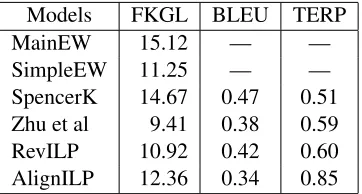
Table 5: Model performance using automatic evaluation measures.
5 Results
The results of our automatic evaluation are summa-rized in Table 5. The first column reports the FKGL readability index of the source sentences (MainEW), of their target simplifications (SimpleEW) and the output of four models: a simple baseline that re-lies on lexical substitution (SpencerK), Zhu et al.’s (2010) model, and two versions of our model, one trained on revision histories (RevILP) and another one trained on the MainEW-SimpleEW aligned cor-pus (AlignILP). As can be seen, the source sentences have the highest reading level. Zhu et al.’s system has the lowest reading level followed by our own models and SpencerK. All models are significantly11
different in reading level from SimpleEW with the exception of RevILP (using a one-way ANOVA with post-hoc Tukey HSD tests). SpencerK is not signif-icantly different in readability from MainEW; Re-vILP is significantly different from Zhu et al. and AlignILP. In sum, these results indicate that RevILP is the closest to SimpleEW and that the provenance of the QG rules has an impact on the model’s perfor-mance.
Table 5 also shows BLEU and TERp scores with SimpleEW as the reference. These scores can be used to examine how close to the gold standard our models are. SpencerK has the highest BLEU and lowest TERp scores.12This is expected as this
base-line performs only a very limited type of rewriting, namely lexical substitution. AlignILP is most differ-ent from the reference, followed by Zhu et al. (2010) and RevILP. Taken together these results indicate
11All significance differences reported throughout this paper are with a level less than 0.01.
12The perfect BLEU score is one and the perfect TERp score is zero.
Models Simplicity Grammaticality Meaning
SimpleEW 3.74 4.89 4.41
SpencerK 1.41 4.87 4.84
Zhu et al 2.92 3.43 3.44
RevILP 3.64 4.55 4.19
[image:9.612.315.543.54.139.2]AlignILP 2.69 4.03 3.98
Table 6: Average human ratings for gold standard Sim-pleEW sentences, a simple baseline (SpencerK) based on lexical substitution, Zhu et al.’s 2010 model, and two ver-sions of our ILP model (RevILP and AlignILP).
Zhu et al AlignILP RevILP SimpleEW SpencerK 2♦4 2♦4 24 24
Zhu et al ♦4 2♦4 2♦4
AlignILP 2♦N 2♦4
[image:9.612.312.536.208.272.2]RevILP N
Table 7:2/: is/not sig. diff. wrt simplicity;♦/: is/not sig. diff. wrt grammaticality; 4/N: is/not sig. diff. wrt meaning.
that the ILP models perform a fair amount of rewrit-ing without simply rehashrewrit-ing the source sentence.
We now turn to the results of our judgment elic-itation study. Table 6 reports the average ratings for Simplicity (is the target sentence simpler than the source?), Grammaticality (is the target sentence grammatical?), and Meaning (does the target pre-serve the meaning of the source?). With regard to simplicity, our participants perceive the gold stan-dard (SimpleEW) to be the simplest, followed by RevILP, Zhu et al, and AlignILP. SpencerK is the least simple model and the most grammatical one as lexical substitutions do not change the structure of the sentence. Interestingly, RevILP and AlignILP are also rated highly with regard to grammaticality. Zhu et al. (2010) is the least grammatical model. Finally, RevILP preserves the meaning of the tar-get as well as SimpleEW, whereas Zhu et al. yields the most distortions. Again SpencerK is rated highly amongst the other models as it is does not substan-tially simplify and thus change the meaning of the source.
Grammat-Original story:There was once a sweet little maidwholived with her father and mother in a pretty little cottage at the edge of the village. At the further end of the woodwas another pretty cottage and in itlived her grandmother. Everybody loved this littlegirl,her grandmother perhaps loved her most of alland gave
her a great many pretty things. Once she gave her a red cloak with a hoodwhich she always wore,sopeople
called her Little Red Riding Hood.
Generated simplification:There was once a sweet little maid. She lived with her father and mother in a pretty little cottage at the edge of the village. At the further end of the wood it lived her grandmother. Everybody loved this little girl. Her grandmother perhaps loved her most of all. She gave her a great many pretty things. Once she gave her a red cloak with a hood, so persons called her Little Red Riding Hood.
Table 8: Excerpt ofLittle Red Riding Hoodsimplified by the RevILP model. Modifications to the original story are highlighted in italics.
icality, Meaning), whereas Zhu et al. differs signif-icantly from RevILP and SimpleEW on all dimen-sions. It is also significantly different from Alig-nILP in terms of grammaticality and meaning but not simplicity. RevILP is significantly more simple and grammatical than AlignILP but performs com-parably with respect to preserving the meaning of the source.
In sum, our results show that RevILP is the best performing model. It creates sentences that are sim-ple, grammatical and adhere to the meaning of the source. The QG rules obtained from the revi-sion histories produce better output compared to the aligned corpus. As revision histories are created by Wikipedia contributors, they tend to be a more ac-curate data source than aligned sentences which are obtained via an automatic and unavoidably noisy procedure. Our results also show that a more gen-eral model not restricted to specific rewrite opera-tions like Zhu et al. (2010) obtains superior results and has better coverage.
We also wanted to see whether a simplification model trained on Wikipedia could be applied to an-other domain. To this end, we used RevILP to sim-plify five children stories from the Gutenburg13
col-lection. The model simplified one sentence at a time and was ran with the Wikipedia settings without any modification. The mean FKGL on the simplified sto-ries was 3.78. compared to 7.04 for the original ones. An example of our system’s output on Little Red Riding Hoodis shown in Table 8.
Possible extensions and improvements to the cur-rent model are many and varied. We have presented an all-purpose simplification model without a target
13http://www.gutenberg.org
audience or application in mind. An interesting re-search direction would be to simplify text accord-ing to readability levels or text genres (e.g., news-paper vs literary text). We could do this by incorpo-rating readability-specific constraints to the ILP or by changing the objective function (e.g., by favoring more domain-specific rules). Finally, we would like to extend the current model so as to simplify entire documents both in terms of style and content. Acknowledgments We are grateful to Lillian Lee whose invited talk at CoNLL-2010 inspired this re-search. We would also like to thank the members of the Probabilistic Models of Language group at the School of Informatics for valuable discussions and comments. We acknowledge the support of EPSRC through project grant EP/F055765/1.
References
Achterberg, Tobias. 2007. Constraint Integer Pro-gramming. Ph.D. thesis, Technische Universit¨at Berlin.
Barzilay, Regina. 2003. Information Fusion for Multi-Document Summarization: Paraphrasing and Generation. Ph.D. thesis, Columbia Univer-sity.
Barzilay, Regina and Noemie Elhadad. 2003. Sen-tence alignment for monolingual comparable cor-pora. InProceedings of the Conference on Em-pirical Methods in Natural Language Processing. Sapporo, Japan, pages 25–32.
Springer, Agia Napa, Cyprus, volume 3290 of Lecture Notes in Computer Science, pages 735– 747.
Carroll, John, Guido Minnen, Darren Pearce, Yvonne Canning, Siobhan Devlin, and John Tait. 1999. Simplifying text for language-impaired readers. InProceedings of the 9th Conference of the European Chapter of the ACL. Bergen, Nor-way, pages 269–270.
Chandrasekar, Raman, Christine Doran, and Ban-galore Srinivas. 1996. Motivations and meth-ods for text simplification. InProceedings of the 16th International Conference on Computational Linguistics. Copenhagen, Denmark, pages 1041– 1044.
Cohn, Trevor and Mirella Lapata. 2008. Sentence compression beyond word deletion. In Pro-ceedings of the 22nd International Conference on Computational Linguistics. Manchester, UK, pages 137–144.
Das, Dipanjan and Noah A. Smith. 2009. Paraphrase identification as probabilistic quasi-synchronous recognition. InProceedings of the ACL-IJCNLP. Suntec, Singapore, pages 468–476.
Devlin, Siobhan. 1999. Simplifying Natural Lan-guage for Aphasic Readers. Ph.D. thesis, Univer-sity of Sunderland.
Inui, Kentaro, Atsushi Fujita, Tetsuro Takahashi, Ryu Iida, and Tomoya Iwakura. 2003. Text sim-plification for reading assistance: A project note. InProceedings of the Second International Work-shop on Paraphrasing. Association for Computa-tional Linguistics, Sapporo, Japan, pages 9–16. Kaji, Nobuhiro, Daisuke Kawahara, Sadao
Kuro-hashi, and Satoshi Sato. 2002. Verb paraphrase based on case frame alignment. InProceedings of 40th Annual Meeting of the Association for Com-putational Linguistics. Association for Compu-tational Linguistics, Philadelphia, Pennsylvania, USA, pages 215–222.
Klein, Dan and Christopher D. Manning. 2003. Ac-curate unlexicalized parsing. In Proceedings of the 41st Annual Meeting of the Association of Computational Linguistics. Sapporo, Japan, pages 423–430.
Knight, Kevin and Daniel Marcu. 2002. Summa-rization beyond sentence extraction: a
probabilis-tic approach to sentence compression. Artificial Intelligence139(1):91–107.
Koch, Thorsten. 2004. Rapid Mathematical Pro-totyping. Ph.D. thesis, Technische Universit¨at Berlin.
Mitchell, James V. 1985. The Ninth Mental Mea-surements Year-book. University of Nebraska Press, Lincoln, Nebraska.
Nastase, Vivi and Michael Strube. 2008. Decoding Wikipedia categories for knowledge acquisition. InProceedings of the 23rd Conference on Artifi-cial Intelligence. pages 1219–1224.
Nelken, Rani and Stuart Schieber. 2006. Towards robust context-sensitive sentence alignment for monolingual corpora. InProceedings of the 11th Conference of the European Chapter of the As-sociation for Computational Linguistics. Trento, Italy, pages 161–168.
Papineni, Kishore, Salim Roukos, Todd Ward, and Wei-Jing Zhu. 2002. BLEU: a method for auto-matic evaluation of machine translation. In Pro-ceedings of the 40th ACL. Philadelphia, PA, pages 311–318.
Ponzetto, Simone Paolo and Michael Strube. 2007. Knowledge derived from Wikipedia for comput-ing semantic relatedness. Journal of Artificial In-telligence Research30:181–212.
Sauper, Christina and Regina Barzilay. 2009. Au-tomatically generating Wikipedia articles: A structure-aware approach. In Proceedings of the Joint Conference of the 47th Annual Meeting of the ACL and the 4th International Joint Con-ference on Natural Language Processing of the AFNLP. Association for Computational Linguis-tics, Suntec, Singapore, pages 208–216.
Siddharthan, Advaith. 2003. Syntactic Simplifica-tion and Text Cohesion. Ph.D. thesis, University of Cambridge, University of Cambridge.
Siddharthan, Advaith. 2004. Syntactic simplifica-tion and text cohesion. in research on language and computation. Research on Language and Computation4(1):77–109.
Transla-tion. Association for Computational Linguistics, New York City, pages 23–30.
Smith, David A. and Jason Eisner. 2009. Parser adaptation and projection with quasi-synchronous grammar features. InProceedings of the EMNLP. Suntec, Singapore, pages 822–831.
Snover, Matthew, Nitin Madnani, Bonnie Dorr, and Richard Schwartz. 2009. Fluency, adequacy, or HTER? Exploring different human judgments with a tunable MT metric. InProceedings of the Fourth Workshop on Statistical Machine Transla-tion. Athens, Greece, pages 259–268.
Vickrey, David and Daphne Koller. 2008. Sentence simplification for semantic role labeling. In Pro-ceedings of ACL-08: HLT. Association for Com-putational Linguistics, Columbus, Ohio, pages 344–352.
Wang, Mengqiu, Noah A. Smith, and Teruko Mita-mura. 2007. What is the Jeopardy model? a quasi-synchronous grammar for QA. In Proceedings of the EMNLP-CoNLL. Prague, Czech Republic, pages 22–32.
Watanabe, Willian Massami, Arnaldo Candido Ju-nior, Vin´ıcius Rodriguez de Uz˜eda, Renata Pon-tin de Mattos Fortes, Thiago Alexandre Salgueiro Pardo, and Sandra Maria Alu´sio. 2009. Facilita: reading assistance for low-literacy readers. In Proceedings of the 27th ACM International Con-ference on Design of Communication. Blooming-ton, IN.
Woodsend, Kristian, Yansong Feng, and Mirella Lapata. 2010. Title generation with quasi-synchronous grammar. In Proceedings of the 2010 Conference on Empirical Methods in Natu-ral Language Processing. Association for Com-putational Linguistics, Cambridge, MA, pages 513–523.
Wu, Fei and Daniel S. Weld. 2010. Open infor-mation extraction using Wikipedia. In Proceed-ings of the 48th Annual Meeting of the Associ-ation for ComputAssoci-ational Linguistics. AssociAssoci-ation for Computational Linguistics, Uppsala, Sweden, pages 118–127.
Yamada, Kenji and Kevin Knight. 2001. A syntax-based statistical translation model. In Proceed-ings of 39th Annual Meeting of the Association for Computational Linguistics. Toulouse, France,
pages 523–530.
Yamangil, Elif and Rani Nelken. 2008. Mining Wikipedia revision histories for improving sen-tence compression. In Proceedings of ACL-08: HLT, Short Papers. Association for Computa-tional Linguistics, Columbus, Ohio, pages 137– 140.
Yatskar, Mark, Bo Pang, Cristian Danescu-Niculescu-Mizil, and Lillian Lee. 2010. For the sake of simplicity: Unsupervised extrac-tion of lexical simplificaextrac-tions from Wikipedia. In Proceedings of the Annual Meeting of the North American Chapter of the Association for Computational Linguistics. pages 365–368. Zhao, Shiqi, Xiang Lan, Ting Liu, and Sheng Li.
2009. Application-driven statistical paraphrase generation. In Proceedings of the Joint Confer-ence of the 47th Annual Meeting of the ACL and the 4th International Joint Conference on Natural Language Processing of the AFNLP. Singapore, pages 834–842.