Proceedings of the 2011 Conference on Empirical Methods in Natural Language Processing, pages 262–272,
Optimizing Semantic Coherence in Topic Models
David Mimno
Princeton University Princeton, NJ 08540
Hanna M. Wallach
University of Massachusetts, Amherst Amherst, MA 01003
Edmund Talley Miriam Leenders
National Institutes of Health Bethesda, MD 20892
{talleye,leenderm}@ninds.nih.gov
Andrew McCallum
University of Massachusetts, Amherst Amherst, MA 01003
Abstract
Latent variable models have the potential to add value to large document collections by discovering interpretable, low-dimensional subspaces. In order for people to use such models, however, they must trust them. Un-fortunately, typical dimensionality reduction methods for text, such as latent Dirichlet al-location, often produce low-dimensional sub-spaces (topics) that are obviously flawed to human domain experts. The contributions of this paper are threefold: (1) An analysis of the ways in which topics can be flawed; (2) an au-tomated evaluation metric for identifying such topics that does not rely on human annotators or reference collections outside the training data; (3) a novel statistical topic model based on this metric that significantly improves topic quality in a large-scale document collection from the National Institutes of Health (NIH).
1 Introduction
Statistical topic models such as latent Dirichlet al-location (LDA) (Blei et al., 2003) provide a pow-erful framework for representing and summarizing the contents of large document collections. In our experience, however, the primary obstacle to accep-tance of statistical topic models by users the outside machine learning community is the presence of poor quality topics. Topics that mix unrelated or loosely-related concepts substantially reduce users’ confi-dence in the utility of such automated systems.
In general, users prefer models with larger num-bers of topics because such models have greater res-olution and are able to support finer-grained distinc-tions. Unfortunately, we have observed that there
is a strong relationship between the size of topics and the probability of topics being nonsensical as judged by domain experts: as the number of topics increases, the smallest topics (number of word to-kens assigned to each topic) are almost always poor quality. The common practice of displaying only a small number of example topics hides the fact that as many as 10% of topics may be so bad that they can-not be shown without reducing users’ confidence.
The evaluation of statistical topic models has tra-ditionally been dominated by either extrinsic meth-ods (i.e., using the inferred topics to perform some external task such as information retrieval (Wei and Croft, 2006)) or quantitative intrinsic methods, such as computing the probability of held-out doc-uments (Wallach et al., 2009). Recent work has focused on evaluation of topics as semantically-coherent concepts. For example, Chang et al. (2009) found that the probability of held-out documents is not always a good predictor of human judgments. Newman et al. (2010) showed that an automated evaluation metric based on word co-occurrence statistics gathered from Wikipedia could predict hu-man evaluations of topic quality. AlSumait et al. (2009) used differences between topic-specific dis-tributions over words and the corpus-wide distribu-tion over words to identify overly-general “vacuous” topics. Finally, Andrzejewski et al. (2009) devel-oped semi-supervised methods that avoid specific user-labeled semantic coherence problems.
specific semantic problems in topic models without human evaluations or external reference corpora; (3) to present an example of a new topic model that learns latent topics by directly optimizing a metric of topic coherence. With little additional computa-tional cost beyond that of LDA, this model exhibits significant gains in average topic coherence score. Although the model does not result in a statistically-significant reduction in the number of topics marked “bad”, the model consistently improves the topic co-herence score of the ten lowest-scoring topics (i.e., results in bad topics that are “less bad” than those found using LDA) while retaining the ability to iden-tify low-quality topics without human interaction.
2 Latent Dirichlet Allocation
LDA is a generative probabilistic model for docu-mentsW ={w(1),w(2), . . . ,w(D)}. To generate a word tokenw(nd)in documentd, we draw a discrete
topic assignmentzn(d)from a document-specific
dis-tribution over theT topicsθd(which is itself drawn
from a Dirichlet prior with hyperparameterα), and
then draw a word type for that token from the topic-specific distribution over the vocabularyφ
zn(d). The inference task in topic models is generally cast as in-ferring the document–topic proportions{θ1, ...,θD}
and the topic-specific distributions{φ1. . . ,φT}.
The multinomial topic distributions are usually drawn from a shared symmetric Dirichlet prior with hyperparameterβ, such that conditioned on{φt}Tt=1 and the topic assignments {z(1),z(2), . . . ,z(D)}, the word tokens are independent. In practice, how-ever, it is common to deal directly with the “col-lapsed” distributions that result from integrating over the topic-specific multinomial parameters. The resulting distribution over words for a topictis then
a function of the hyperparameterβ and the number
of words of each type assigned to that topic, Nw|t.
This distribution, known as the Dirichlet compound multinomial (DCM) or P´olya distribution (Doyle and Elkan, 2009), breaks the assumption of condi-tional independence between word tokens given top-ics, but is useful during inference because the con-ditional probability of a wordwgiven topicttakes
a very simple form: P(w|t, β) = Nw|t+β
Nt+|V|β, where Nt=Pw0Nw0|tand|V|is the vocabulary size.
The process for generating a sequence of words
from such a model is known as the simple P´olya urn model (Mahmoud, 2008), in which the initial prob-ability of word typew in topictis proportional to β, while the probability of each subsequent
occur-rence ofw in topictis proportional to the number of timeswhas been drawn in that topic plusβ. Note
that this unnormalized weight for each word type de-pends only on the count of that word type, and is in-dependent of the count of any other word type w0.
Thus, in the DCM/P´olya distribution, drawing word type w must decreasethe probability of seeing all other word typesw0 6=w. In a later section, we will
introduce a topic model that substitutes a general-ized P´olya urn model for the DCM/P´olya distribu-tion, allowing a draw of word typewtoincreasethe
probability of seeing certain other word types. For real-world data, documentsW are observed, while the corresponding topic assignments Z are
unobserved and may be inferred using either vari-ational methods (Blei et al., 2003; Teh et al., 2006) or MCMC methods (Griffiths and Steyvers, 2004). Here, we use MCMC methods—specifically Gibbs sampling (Geman and Geman, 1984), which in-volves sequentially resampling each topic assign-ment zn(d) from its conditional posterior given the
documents W, the hyperparameters α and β, and Z\d,n (the current topic assignments for all tokens
other than the token at positionnin documentd).
3 Expert Opinions of Topic Quality
Concentrating on 300,000 grant and related jour-nal paper abstracts from the Natiojour-nal Institutes of Health (NIH), we worked with two experts from the National Institute of Neurological Disorders and Stroke (NINDS) to collaboratively design an expert-driven topic annotation study. The goal of this study was to develop an annotated set of baseline topics, along with their salient characteristics, as a first step towards automatically identifying and inferring the kinds of topics desired by domain experts.1
3.1 Expert-Driven Annotation Protocol
In order to ensure that the topics selected for anno-tation were within the NINDS experts’ area of ex-pertise, they selected 148 topics (out of 500), all as-sociated with areas funded by NINDS. Each topic
twas presented to the experts as a list of the thirty
most probable words for that topic, in descending or-der of their topic-specific “collapsed” probabilities,
Nw|t+β
Nt+|V|β. In addition to the most probable words,
the experts were also given metadata for each topic: The most common sequences of two or more con-secutive words assigned to that topic, the four topics that most often co-occurred with that topic, the most common IDF-weighted words from titles of grants, thesaurus terms, NIH institutes, journal titles, and finally a list of the highest probability grants and PubMed papers for that topic.
The experts first categorized each topic as one of three types: “research”, “grant mechanisms and publication types” or “general”.2 The quality of
each topic (“good”, “intermediate”, or “bad”) was then evaluated using criteria specific to the type of topic. In general, topics were only annotated as “good” if they contained words that could be grouped together as a single coherent concept. Addi-tionally, each “research” topic was only considered to be “good” if, in addition to representing a sin-gle coherent concept, the aggregate content of the set of documents with appreciable allocations to that topic clearly contained text referring to the concept inferred from the topic words. Finally, for each topic marked as being either “intermediate” or “bad”, one or more of the following problems (defined by the domain experts) was identified, as appropriate:
• Chained: every word is connected to every other word through some pairwise word chain, but not all word pairs make sense. For exam-ple, a topic whose top three words are “acids”, “fatty” and “nucleic” consists of two distinct concepts (i.e., acids produced when fats are broken down versus the building blocks of DNA and RNA) chained via the word “acids”.
• Intruded: either two or more unrelated sets
of related words, joined arbitrarily, or an oth-erwise good topic with a few “intruder” words.
• Random: no clear, sensical connections
be-tween more than a few pairs of words.
• Unbalanced: the top words are all logically connected to each other, but the topic combines very general and specific terms (e.g., “signal 2Equivalent to “vacuous topics” of AlSumait et al. (2009).
transduction” versus “notch signaling”).
Examples of a good general topic, a good research topic, and a chained research topic are in Table 1.
3.2 Annotation Results
The experts annotated the topics independently and then aggregated their results. Interestingly, no top-ics were ever considered “good” by one expert and “bad” by the other—when there was disagreement between the experts, one expert always believed the topic to be “intermediate.” In such cases, the ex-perts discussed the reasons for their decisions and came to a consensus. Of the 148 topics selected for annotation, 90 were labeled as “good,” 21 as “inter-mediate,” and 37 as “bad.” Of the topics labeled as “bad” or “intermediate,” 23 were “chained,” 21 were “intruded,” 3 were “random,” and 15 were “unbal-anced”. (The annotators were permitted to assign more than one problem to any given topic.)
4 Automated Metrics for Predicting Expert Annotations
The ultimate goal of this paper is to develop meth-ods for building models with large numbers of spe-cific, high-quality topics from domain-specific cor-pora. We therefore explore the extent to which in-formation already contained in the documents being modeled can be used to assess topic quality.
In this section we evaluate several methods for ranking the quality of topics and compare these rankings to human annotations. No method is likely to perfectly predict human judgments, as individual annotators may disagree on particular topics. For an application involving removing low quality top-ics we recommend using a weighted combination of metrics, with a threshold determined by users.
4.1 Topic Size
predic-● ● ● ● ● ● ● ● ● ● ● ● ● ● ● ● ● ● ● ● ● ● ● ● ● ● ● ● ● ● ● ● ● ● ● ● ● ● ● ● ● ● ● ● ● ● ● ● ● ● ● ● ● ● ● ● ● ● ● ● ● ● ● ● ● ● ● ● ● ● ● ● ● ● ● ● ● ● ● ● ● ● ● ● ● ● ● ● ● ●
40000 60000 80000 120000 160000
Tokens good inter bad ● ● ● ● ● ● ● ● ● ● ● ● ● ● ● ● ● ● ● ● ● ● ● ● ● ● ● ● ● ● ● ● ● ● ● ● ● ● ● ● ● ● ● ● ● ● ● ● ● ● ● ● ● ● ● ● ● ● ● ● ● ● ● ● ● ● ● ● ● ● ● ● ● ● ● ● ● ● ● ● ● ● ● ● ● ● ● ● ● ●
−600 −500 −400 −300 −200
Coherence
good
inter
[image:4.612.89.287.75.254.2]bad
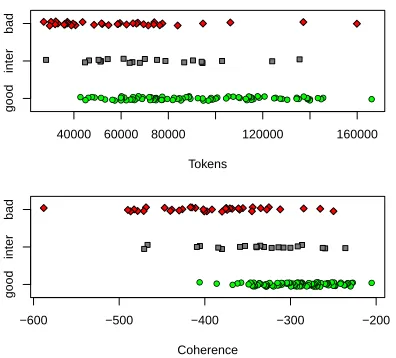
Figure 1:Topic size is a good indicator of quality; the newcoherencemetric is better. Top shows expert-rated topics ranked by topic size (AP 0.89, AUC 0.79), bottom shows same topics ranked by coherence (AP 0.94, AUC 0.87). Random jitter is added to they-axis for clarity.
tor of topic quality. Although there is some overlap, “bad” topics are generally smaller than “good” top-ics. Unfortunately, this observation conflicts with the goal of building highly specialized, domain-specific topic models with many high-quality, fine-grained topics—in such models the majority of top-ics will have relatively few tokens assigned to them.
4.2 Topic Coherence
When displaying topics to users, each topictis
gen-erally represented as a list of theM= 5, . . . ,20most
probable words for that topic, in descending order of their topic-specific “collapsed” probabilities. Al-though there has been previous work on automated generation of labels or headings for topics (Mei et al., 2007), we choose to work only with the ordered list representation. Labels may obscure or detract from fundamental problems with topic coherence, and better labels don’t make bad topics good.
The expert-driven annotation study described in section 3 suggests that three of the four types of poor-quality topics (“chained,” “intruded” and “ran-dom”) could be detected using a metric based on the co-occurrence of words within the documents being modeled. For “chained” and “intruded” top-ics, it is likely that although pairs of words belong-ing to a sbelong-ingle concept will co-occur within a sbelong-ingle
document (e.g., “nucleic” and “acids” in documents about DNA), word pairs belonging to different con-cepts (e.g., “fatty” and “nucleic”) will not. For ran-dom topics, it is likely that few words will co-occur. This insight can be used to design a new metric for assessing topic quality. LettingD(v)be the
doc-ument frequency of word type v (i.e., the number
of documents with least one token of type v) and D(v, v0)beco-document frequencyof word typesv
andv0(i.e., the number of documents containing one
or more tokens of typev and at least one token of
typev0), we definetopic coherenceas
C(t;V(t)) = M
X
m=2
mX−1
l=1
logD(v
(t)
m, vl(t)) + 1 D(v(lt)) , (1)
whereV(t)= (v1(t), . . . , vM(t))is a list of theM most
probable words in topict. A smoothing count of 1 is included to avoid taking the logarithm of zero.
Figure 1 shows the association between the expert annotations and both topic size (top) and our coher-ence metric (bottom). We evaluate these results us-ing standard rankus-ing metrics, average precision and the area under the ROC curve. Treating “good” top-ics as positive and “intermediate” or “bad” toptop-ics as negative, we get average precision values of 0.89 for topic size vs. 0.94 for coherence and AUC 0.79 for topic size vs. 0.87 for coherence. We performed a logistic regression analysis on the binary variable “is this topic bad”. Using topic size alone as a predic-tor gives AIC (a measure of model fit) 152.5. Co-herence alone has AIC 113.8 (substantially better). Both predictors combined have AIC 115.8: the sim-pler coherence alone model provides the best perfor-mance. We tried weighting the terms in equation 1 by their corresponding topic–word probabilities and and by their position in the sorted list of theMmost
probable words for that topic, but we found that a uniform weighting better predicted topic quality.
Our coherence metric relies only upon word co-occurrence statistics gathered from the corpus being modeled, and does not depend on an external ref-erence corpus. Ideally, all such co-occurrence infor-mation would already be accounted for in the model. We believe that one of the main contributions of our work is demonstrating that standard topic models
do notfully utilize available co-occurrence informa-tion, and that a held-out reference corpus is therefore not required for purposes of topic evaluation.
Equation 1 is very similar to pointwise mutual in-formation (PMI), but is more closely associated with our expert annotations than PMI (which achieves AUC 0.64 and AIC 170.51). PMI has a long history in language technology (Church and Hanks, 1990), and was recently used by Newman et al. (2010) to evaluate topic models. When expressed in terms of count variables as in equation 1, PMI includes an additional term for D(v(mt)). The improved
perfor-mance of our metric over PMI implies that what mat-ters isnotthe difference between the joint probabil-ity of wordsmandland the product of marginals,
but the conditionalprobability of each word given the each of the higher-ranked words in the topic.
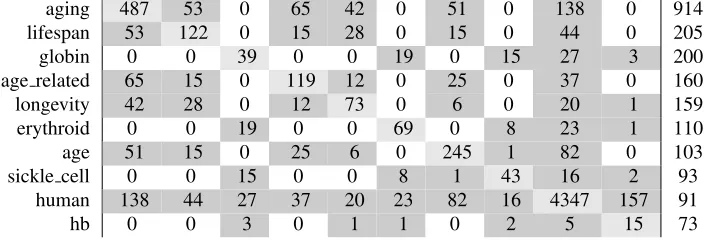
In order to provide intuition for the behavior of our topic coherence metric, table 1 shows three example topics and their topic coherence scores. The first topic, related to grant-funded training pro-grams, is one of the best-scoring topics. All pairs of words have high co-document frequencies. The second topic, on neurons, is more typical of qual-ity “research” topics. Overall, these words occur less frequently, but generally occur moderately in-terchangeably: there is little structure to their co-variance. The last topic is one of the lowest-scoring topics. Its co-document frequency matrix is shown in table 2. The top two words are closely related: 487 documents include “aging” at least once, 122 include “lifespan”, and 55 include both. Meanwhile, the third word “globin” occurs with only one of the top seven words—the common word “human”.
4.3 Comparison to word intrusion
As an additional check for both our expert annota-tions and our automated metric, we replicated the “word intrusion” evaluation originally introduced by Chang et al. (2009). In this task, one of the top ten most probable words in a topic is replaced with a
● ● ● ● ● ● ● ● ● ●●●●● ● ●●●●●●●● ●● ● ●● ●●● ● ●●● ● ● ● ● ● ●● ●● ●● ● ● ●● ●● ● ● ● ● ● ● ● ● ● ● ● ● ● ● ● ● ● ● ● ● ● ● ● ● ● ●● ●● ● ● ● ● ● ● ● ● ●
40000 60000 80000 120000 160000
0
4
8
Comparison of Topic Size to Intrusion Detection
Tokens assigned to topic
Correct Guesses ● ● ● ● ● ●●● ●●● ● ● ●●●●● ●●●●●●●●● ●●●●●●● ●● ● ● ● ● ● ●●● ●● ● ●● ●●● ● ● ●● ●● ● ● ● ● ● ● ● ● ● ● ●● ● ● ● ● ● ● ● ● ● ● ● ● ● ● ● ● ● ● ● ●
−600 −500 −400 −300 −200
0
4
8
Comparison of Coherence to Intrusion Detection
Coherence
Correct Guesses
Good Topics
Correct Guesses
Frequency
0 2 4 6 8 10
0 15 35 Bad Topics Correct Guesses Frequency
0 2 4 6 8 10
0
15
[image:5.612.314.532.81.399.2]35
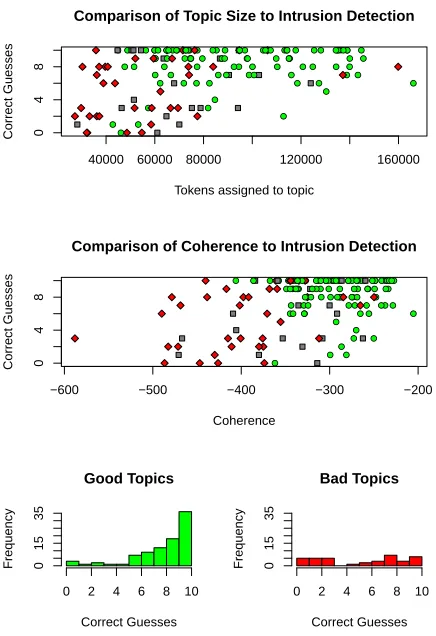
Figure 2: Top: results of the intruder selection task rel-ative to two topic quality metrics. Bottom: marginal in-truder accuracy frequencies of good and bad topics.
another word, selected at random from the corpus. The resulting set of words is presented, in a random order, to users, who are asked to identify the “in-truder” word. It is very unlikely that a randomly-chosen word will be semantically related to any of the original words in the topic, so if a topic is a high quality representation of a semantically coher-ent concept, it should be easy for users to select the intruder word. If the topic is not coherent, there may be words in the topic that are also not semantically related to any other word, thus causing users to se-lect “correct” words instead of the real intruder.
met-Table 1: Example topics (good/general, good/research, chained/research) with different coherence scores (numbers closer to zero indicate higher coherence). The chained topic combines words related to aging (indicated in plain text) and words describing blood and blood-related diseases (bold). The only connection is the common wordhuman.
-167.1 students, program, summer, biomedical, training, experience, undergraduate, career, minority, student, ca-reers, underrepresented, medical students, week, science
-252.1 neurons, neuronal, brain, axon, neuron, guidance, nervous system, cns, axons, neural, axonal, cortical, survival, disorders, motor
[image:6.612.130.485.517.638.2]-357.2 aging, lifespan,globin, age related, longevity, human, age,erythroid,sickle cell,beta globin,hb, senes-cence, adult, older, lcr
Table 2:Co-document frequency matrix for the top words in a low-quality topic (according to our coherence metric), shaded to highlight zeros. The diagonal (light gray) shows the overall document frequency for each wordw. The column on the right isNw|t. Note that “globin” and “erythroid” do not co-occur with any of the aging-related words.
aging 487 53 0 65 42 0 51 0 138 0 914 lifespan 53 122 0 15 28 0 15 0 44 0 205
globin 0 0 39 0 0 19 0 15 27 3 200
age related 65 15 0 119 12 0 25 0 37 0 160
longevity 42 28 0 12 73 0 6 0 20 1 159
erythroid 0 0 19 0 0 69 0 8 23 1 110
age 51 15 0 25 6 0 245 1 82 0 103
sickle cell 0 0 15 0 0 8 1 43 16 2 93
human 138 44 27 37 20 23 82 16 4347 157 91
rics (topic size and coherence) and they-axis is the
number of annotators that correctly identified the true intruder word (accuracy). The histograms be-low these plots show the number of topics with each level of annotator accuracy for good and bad top-ics. For good topics (green circles), the annotators were generally able to detect the intruder word with high accuracy. Bad topics (red diamonds) had more uniform accuracies. These results suggest that top-ics with low intruder detection accuracy tend to be bad, but some bad topics can have a high accuracy. For example, spotting an intruder word in a chained topic can be easy. The low-quality topic recep-tors, cannabinoid, cannabinoids, ligands, cannabis, endocannabinoid, cxcr4, [virus], receptor, sdf1, is a typical “chained” topic, with CXCR4 linked to
cannabinoidsonly throughreceptors, and otherwise unrelated. Eight out of ten annotators correctly iden-tified “virus” as the correct intruder. Repeating the logistic regression experiment using intruder detec-tion accuracy as input, the AIC value is 163.18— much worse than either topic size or coherence.
5 Generalized P´olya Urn Models
Although the topic coherence metric defined above provides an accurate way of assessing topic quality,
preventingpoor quality topics from occurring in the first place is preferable. Our results in the previous section show that we can identify low-quality top-ics without making use of external supervision; the training data by itself contains sufficient information at least to reject poor combinations of words.
In this section, we describe a new topic model that incorporates the corpus-specific word co-occurrence information used in our coherence metric directly into the statistical topic modeling framework. It is important to note that simply disallowing words that never co-occur from being assigned to the same topic is not sufficient. Due to the power-law charac-teristics of language, most words are rare and will not co-occur with most other words regardless of their semantic similarity. It is rather the degree
to which the most prominent words in a topic do not co-occur with the other most prominent words in that topic that is an indicator of topic incoher-ence. We therefore desire models that guide topics towards semantic similarity without imposing hard
constraints.
As an example of such a model, we present a new topic model in which the occurrence of word typew
in topictincreases not only the probability of seeing
that word type again, but also increases the probabil-ity of seeing other related words (as determined by co-document frequencies for the corpus being mod-eled). This new topic model retains the document– topic component of standard LDA, but replaces the usual P´olya urn topic–word component with a gen-eralizedP´olya urn framework (Mahmoud, 2008).
A sequence of i.i.d. samples from a discrete dis-tribution can be imagined as arising by repeatedly drawing a random ball from an urn, where the num-ber of balls of each color is proportional to the prob-ability of that color, replacing the selected ball af-ter each draw. In a P´olya urn, each ball is replaced
along with another ball of the same color. Samples from this model exhibit the “burstiness” property: the probability of drawing a ball of colorwincreases
each time a ball of that color is drawn. This process represents the marginal distribution of a hierarchical model with a Dirichlet prior and a multinomial like-lihood, and is used as the distribution over words for each topic in almost all previous topic models. In ageneralized P´olya urn model, having drawn a ball of colorw, Avw additional balls of each color v ∈ {1, . . . , W}are returned to the urn. GivenW
andZ, the conditional posterior probability of word win topictimplied by this generalized model is
P(w|t,W,Z, β,A) =
P
vNv|tAvw+β Nt+|V|β
, (2)
where A is a W ×W real-valued matrix, known
as theaddition matrixorschema. The simple P´olya urn model (and hence the conditional posterior prob-ability of wordwin topictunder LDA) can be
re-covered by setting the schemaAto the identity ma-trix. Unlike the simple P´olya distribution, we do not know of a representation of the generalized P´olya urn distribution that can be expressed using a con-cise set of conditional independence assumptions. A standard graphical model with plate notation would therefore not be helpful in highlighting the differ-ences between the two models, and is not shown.
1: ford∈ Ddo
2: forwn ∈w(d)do 3: Nzi|di ←Nzi|di−1 4: Nwi|zi ←Nwi|zi−1
5: samplezi ∝(Nz|di+αz)
Nwi|z+β P
z0(Nwi|z0+β) 6: Nzi|di ←Nzi|di+ 1
7: Nwi|zi ←Nwi|zi+ 1
8: end for
9: end for
Algorithm 1: One sweep of LDA Gibbs sampling.
1: ford∈ Ddo
2: forwn ∈w(d)do 3: Nzi|di ←Nzi|di−1
4: for allvdo
5: Nv|zi←Nv|zi−Avwi
6: end for
7: samplezi ∝(Nz|di+αz)
Nwi|z+β P
z0(Nwi|z0+β) 8: Nzi|di ←Nzi|di+ 1
9: for allvdo
10: Nv|zi←Nv|zi+Avwi
11: end for
12: end for
13: end for
Algorithm 2: One sweep of gen. P´olya Gibbs sam-pling, with differences from LDA highlighted in red.
support a generalized P´olya urn model: rather than subtracting exactly one from the count of the word given the old topic, sampling, and then adding one to the count of the word given the new topic, we sub-tract a column of the schema matrix from the entire count vector over words for the old topic, sample, and add the same column to the count vector for the new topic. As long as A is sparse, this operation
adds only a constant factor to the computation. Another property of the generalized P´olya urn model is that it is nonexchangeable—the joint prob-ability of the tokens in any given topic is not invari-ant to permutation of those tokens. Inference ofZ
givenWvia Gibbs sampling involves repeatedly cy-cling through the tokens in W and, for each one,
resampling its topic assignment conditioned on W
and the current topic assignments for all tokens other than the token of interest. For LDA, the sampling distribution for each topic assignment is simply the product of two predictive probabilities, obtained by
treating the token of interest as if it were the last. For a topic model with a generalized P´olya urn for the topic–word component, the sampling distribu-tion is more complicated. Specifically, the topic– word component of the sampling distribution is no longer a simple predictive distribution—when sam-pling a new value for zn(d), the implication of each
possible value for subsequent tokens and their topic assignments must be considered. Unfortunately, this can be very computationally expensive, particularly for large corpora. There are several ways around this problem. The first is to use sequential Monte Carlo methods, which have been successfully applied to topic models previously (Canini et al., 2009). The second approach is to approximate the true Gibbs sampling distribution by treating each token as if it were the last, ignoring implications for subsequent tokens and their topic assignments. We find that this approximate method performs well empirically.
5.1 Setting the SchemaA
Inspired by our evaluation metric, we defineAas
Avv ∝ λvD(v) (3)
Avw ∝ λvD(w, v)
where each element is scaled by a row-specific weight λv and each column is normalized to sum
to 1. Normalizing columns makes comparison to standard LDA simpler, because the relative effect of smoothing parameterβ= 0.01is equivalent. We set λv = log (D / D(v)), the standard IDF weight used
in information retrieval, which is larger for less fre-quent words. The column for word typew can be
interpreted as word types with significant associa-tion with w. The IDF weighting therefore has the
effect of increasing the strength of association for rare word types. We also found empirically that it is helpful to remove off-diagonal elements for the most common types, such as those that occur in more than 5% of documents (IDF< 3.0). Including nonzero off-diagonal values in A for very frequent types
−290
−260
100 Topics
Coherence
50 300 550 800
−290
−260
200 Topics
Coherence
50 300 550 800
−290
−260
300 Topics
Coherence
50 300 550 800
−290
−260
400 Topics
Coherence
50 300 550 800
−400
−340
10 W
orst Coher
50 300 550 800
−400
−340
10 W
orst Coher
50 300 550 800
−400
−340
10 W
orst Coher
50 300 550 800
−400
−340
10 W
orst Coher
50 300 550 800
−1700
−1660
Iteration
HOLP
50 300 550 800
−1700
−1660
Iteration
HOLP
50 300 550 800
−1700
−1660
Iteration
HOLP
50 300 550 800
−1700
−1660
Iteration
HOLP
[image:9.612.89.512.81.294.2]50 300 550 800
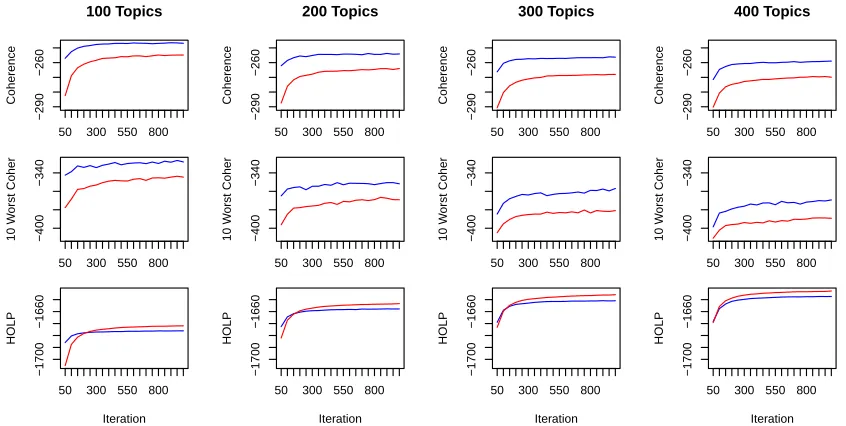
Figure 3: P´olya urn topics (blue) have higher average coherence and converge much faster than LDA topics (red). The top plots show topic coherence (averaged over 15 runs) over 1000 iterations of Gibbs sampling. Error bars are not visible in this plot. The middle plot shows the average coherence of the 10 lowest scoring topics. The bottom plots show held-out log probability (in thousands) for the same models (three runs each of 5-fold cross-validation).
Name Docs Avg. Tok. Tokens Vocab NIH 18756 114.64±30.41 2150172 28702
Table 3:Data set statistics.
types, the mean of the 100 lowest divergences was
0.29±.05(a divergence of 1.0 represents
distribu-tions with no shared support) atT= 200. The
aver-age divergence of the 100 most similar pairs of top-ics for standard LDA (i.e.,A=I) is0.67±.05. The
same statistic for the generalized P´olya urn model without off-diagonal elements for word types with high document frequency is0.822±0.09.
Setting the off-diagonal elements of the schema
Ato zero for the most common word types also has the fortunate effect of substantially reducing prepro-cessing time. We find that Gibbs sampling for the generalized P´olya model takes roughly two to three times longer than for standard LDA, depending on the sparsity of the schema, due to additional book-keeping needed before and after sampling topics.
5.2 Experimental Results
We evaluated the new model on a corpus of NIH grant abstracts. Details are given in table 3. Figure 3
shows the performance of the generalized P´olya urn model relative to LDA. Two metrics—our new topic coherence metric and the log probability of held-out documents—are shown over 1000 iterations at 50 it-eration intervals. Each model was run over five folds of cross validation, each with three random initial-izations. For each model we calculated an overall coherence score by calculating the topic coherence for each topic individually and then averaging these values. We report the average over all 15 models in each plot. Held-out probabilities were calculated us-ing the left-to-right method of Wallach et al. (2009), with each cross-validation fold using its own schema
A. The generalized P´olya model performs very well
in average topic coherence, reaching levels within the first 50 iterations that match the final score. This model has an early advantage for held-out proba-bility as well, but is eventually overtaken by LDA. This trend is consistent with Chang et al.’s observa-tion that held-out probabilities are not always good predictors of human judgments (Chang et al., 2009). Results are consistent overT ∈ {100,200,300}.
P´olya urn model was therefore designed with the goal of directly optimizing that metric. It is pos-sible, however, that optimizing for coherence di-rectly could break the association between coher-ence metric and topic quality. We therefore repeated the expert-driven evaluation protocol described in section 3.1. We trained one standard LDA model and one generalized P´olya urn model, each with
T = 200, and randomly shuffled the 400 resulting
topics. The topics were then presented to the experts from NINDS, with no indication as to the identity of the model from which each topic came. As these evaluations are time consuming, the experts evalu-ated the only the first 200 topics, which consisted of 103 generalized P´olya urn topics and 97 LDA top-ics. AUC values predicting bad topics given coher-ence were 0.83 and 0.80, respectively. Cohercoher-ence effectively predicts topic quality in both models.
Although we were able to improve the average overall quality of topics and the average quality of the ten lowest-scoring topics, we found that the gen-eralized P´olya urn model was less successful reduc-ing the overall number of bad topics. Ignorreduc-ing one “unbalanced” topic from each model, 16.5% of the LDA topics and 13.5% from the generalized P´olya urn model were marked as “bad.” While this result is an improvement, it is not significant atp= 0.05.
6 Discussion
We have demonstrated the following:
• There is a class of low-quality topics that can-not be detected using existing word-intrusion tests, but that can be identified reliably using a metric based on word co-occurrence statistics.
• It is possible to improve the coherence score
of topics, both overall and for the ten worst, while retaining the ability to flag bad topics, all without requiring semi-supervised data or ad-ditional reference corpora. Although adad-ditional information may be useful, it is not necessary.
• Such models achieve better performance with
substantially fewer Gibbs iterations than LDA.
We believe that the most important challenges in fu-ture topic modeling research are improving the se-mantic quality of topics, particularly at the low end, and scaling to ever-larger data sets while ensuring
high-quality topics. Our results provide critical in-sight into these problems. We found that it should be possible to construct unsupervised topic models that do not produce bad topics. We also found that Gibbs sampling mixes faster for models that use word co-occurrence information, suggesting that such meth-ods may also be useful in guiding online stochastic variational inference (Hoffman et al., 2010).
Acknowledgements
This work was supported in part by the Center for Intelligent Information Retrieval, in part by the CIA, the NSA and the NSF under NSF grant # IIS-0326249, in part by NIH:HHSN271200900640P, and in part by NSF # number SBE-0965436. Any opinions, findings and conclusions or recommenda-tions expressed in this material are the authors’ and do not necessarily reflect those of the sponsor.
References
Loulwah AlSumait, Daniel Barbara, James Gentle, and Carlotta Domeniconi. 2009. Topic significance rank-ing of LDA generative models. InECML.
David Andrzejewski, Xiaojin Zhu, and Mark Craven. 2009. Incorporating domain knowledge into topic modeling via Dirichlet forest priors. InProceedings of the 26th Annual International Conference on Machine Learning, pages 25–32.
David M. Blei, Andrew Y. Ng, and Michael I. Jordan. 2003. Latent Dirichlet allocation. Journal of Machine
Learning Research, 3:993–1022, January.
K.R. Canini, L. Shi, and T.L. Griffiths. 2009. Online inference of topics with latent Dirichlet allocation. In
Proceedings of the 12th International Conference on Artificial Intelligence and Statistics.
Jonathan Chang, Jordan Boyd-Graber, Chong Wang, Sean Gerrish, and David M. Blei. 2009. Reading tea leaves: How humans interpret topic models. In
Ad-vances in Neural Information Processing Systems 22,
pages 288–296.
Kenneth Church and Patrick Hanks. 1990. Word asso-ciation norms, mutual information, and lexicography.
Computational Linguistics, 6(1):22–29.
Gabriel Doyle and Charles Elkan. 2009. Accounting for burstiness in topic models. InICML.
Thomas L. Griffiths and Mark Steyvers. 2004. Find-ing scientific topics. Proceedings of the National
Academy of Sciences, 101(suppl. 1):5228–5235.
Matthew Hoffman, David Blei, and Francis Bach. 2010. Online learning for latent dirichlet allocation. InNIPS. Hosan Mahmoud. 2008. P´olya Urn Models. Chapman
& Hall/CRC Texts in Statistical Science.
Qiaozhu Mei, Xuehua Shen, and ChengXiang Zhai. 2007. Automatic labeling of multinomial topic mod-els. InProceedings of the 13th ACM SIGKDD Interna-tional Conference on Knowledge Discovery and Data
Mining, pages 490–499.
David Newman, Jey Han Lau, Karl Grieser, and Timothy Baldwin. 2010. Automatic evaluation of topic coher-ence. InHuman Language Technologies: The Annual Conference of the North American Chapter of the As-sociation for Computational Linguistics.
Yee Whye Teh, Dave Newman, and Max Welling. 2006. A collapsed variational Bayesian inference algorithm for lat ent Dirichlet allocation. InAdvances in Neural Information Processing Systems 18.
Hanna Wallach, Iain Murray, Ruslan Salakhutdinov, and David Mimno. 2009. Evaluation methods for topic models. InProceedings of the 26th Interational
Con-ference on Machine Learning.