Abstract—We introduce speckle noise reduction and active contour model detection in the medical ultrasound images region of cancer or tumor effectively. Medical ultrasound image has called noise of the speckle which is an intrinsic characteristic. To find out cancer or real boundary of tumor region in ultrasound image, it is essential to reduce the noise of speckle which confuses to distinguish detail in medical ultrasound image. We have proposed cellular neural network using a preprocessing for the speckle reducing and the boundary enhancement. The cellular neural network is used to decide a template. Then, we found out the boundary of cancer or tumor and extracted the shape using the level set method based active contour model.
Index Terms—Image segmentation, Speckle noise, Medical Ultrasound Image, Cellular neural network, Level set method.
I. INTRODUCTION
One of the important image analysis techniques is image segmentation or shape extraction for 2D or 3D using image. In the biomedical field, diagnostic matter of course that many tasks applied image processing or analysis. Recently, medical image equipment and processing technology are development occur to medical diagnosis field. Most of the analysis, such as surgical planning, simulation, diagnosis and therapy evaluation depends on the results of the segmentation procedure. Currently it has resolved effort to research or investigators since last century.
Image segmentation methods can be classified into two basic approaches of edge based and region based [1]. Region based approaches like region growing and merging based on local gradients, threshold segmentation is another common method. These approaches are generally less impact on the
Manuscript received July 21, 2008.
H.K Park is with the Graduate School of Information, Production and Systems of Waseda University, Kitakyushu, Fukuoka, Japan (corresponding author to provide; e-mail: [email protected]).
B.C Yoo is with the Graduate School of Information, Production and Systems of Waseda University, Kitakyushu, Fukuoka, Japan (e-mail: [email protected]).
J.G Ryu is with the Graduate School of Information, Production and Systems of Waseda University, Kitakyushu, Fukuoka, Japan (e-mail: [email protected]).
K.S Hwang is with the Graduate School of Information, Production and Systems of Waseda University, Kitakyushu, Fukuoka, Japan (e-mail: [email protected]).
T. Nishimura is with the Graduate School of Information Production and Systems of Waseda University, Kitakyushu, Fukuoka, Japan (e-mail:[email protected]).
noise interference than edge based approaches [2], [3]. Edge based approaches mostly apply the gradient information to detect the edges and contours in image, which are followed by linking operations to extract objects. Most popular image segmentation methods are deformable contour methods. Both edge based and region based approaches can be sub-typed with the contour deformation mechanism as snakes, level set methods, and etc.
The Original snake method by Kass et al. [4], the contour energy minimization is considered as a mechanical process. But this method and performances are greatly limited by the initial contour has to be close to the target contour. Additionally, the original snake does not allow topological change during the contour deformation process. Then, to solve these problems, several methods are researched [5], [6]. However, they still have common defects that it is easy to fall into local minimum or it is too slow to find out global minimum or it is hard to solve topology change.
The original level set method was first proposed as a numerical technique that tracks an evolving contour. It has been used several region boundary based approaches formulation for image segmentation and offers highly robust and accurate techniques for tracking interfaces moving under complex motions [7], [8]. This level set method is topology changing. This paper introduces the level set method based on active contour model to effective boundary detection in medical ultrasound image.
However, medical ultrasound images segmentation has known to be a difficult task because of ultrasound images has characteristic noise called speckle. Then, ultrasound images reduced noise that speckle for segmentation effectiveness better improved. The early approach for speckle noise reduction is the homomorphic filtering Wiener filter developed by Jain [9] and the adaptive weighted median filter proposed by Loupas [10], but these fail to maintain the useful details because of merely low pass filters. Although speckle noise is a hit and miss process. Perona & Malik [11] proposed the anisotropic diffusion method that diffusion has large value in the area which has small variance of intensity, and the contrary, has small value in the large variance of intensity. Yu made SRAD (Speckle Reducing Anisotropic Diffusion) methods based on partial differential equation [12]. Those are also edge sensitive diffusion for images corrupted with additive noise. In this paper, we proposed new method using cellular neural network which the cells made from nonlinear elements.
In this study, the cellular neural network used noise of
The Speckle Reduced Ultrasound Images Using
Cellular Neural Network with Effective
Detection of Active Contour Model
speckle reduction and edge boundary strengthening that a template of cellular neural network has decided using recursive neural network. We perform the learning by algorithm with and ultrasound image having vertical boundary and wedged boundary, respectively.
II. CELLULAR NEURAL NETWORK USING SPECKLE NOISE REDUCED
A. Cellular Neural Network Architecture
A cellular neural network is a two dimensional structure, a cell lattice, composed by identical analogical non-linear processors. The cellular neural network architecture combines the idea of massively parallel analog processing typical for fully connected neural networks with the local interaction between cells, characterizing cellular automata. Each cell is a one dimensional dynamical system. Any cell is connected only to its neighbor cells, and adjacent cells interact directly with each other [13]-[15].
The cell located in location (i, j) of a two dimensional M x
N array is denoted byCij, and its r neighborhood r ij
N is defined by:
{
}
{
}
{
1 ,1 l N}
, max Ckl ≤ ≤ ≤ ≤ ≤ − − = M k r j l i k Nr
ij (1)
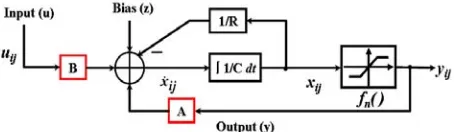
Where, the size of the neighborhood r is a positive integer number. Where, about (i, j) th cell, we should get the state equation same as the equation (2). The following equation (2), (3) is the state equation and output equation of cellular neural network description. State equation: z t u n m j i B t y n m j i B R t x t t x C p i p i m p j p j n mn p i p i m p j p j n mn ij ij + + + − = ∂ ∂ ⋅
∑ ∑
∑ ∑
+ − = + − = + − = + − = ) ( ) , ; , ( ) ( ) , ; , ( ) ( ) ( (2) Output equation:(
)
{
1 ,1 N}
1 ) ( 1 ) ( 2 1 ) ( ≤ ≤ ≤ ≤ − + + = j M i t x t x t
yij ij ij
(3)
About(i,j)th cell,
x
ij is the state,u
mn is external inputs,mn
y
is corresponding internal outputs, and z is internal input bias. Where, A(i, j:m,n) and B(i, j:m,n) is the connection matrices that respectively describe the input and feedback connectivity, and is symmetrical about all(i, j).These are called the template and easily implemented to hardware by dependant current source using amplifiers. Output equation has piecewise linear characteristics. It is a
continuous, piecewise differentiable, bounded, monotonic function, and also easily implemented by differential amplifier. Cellular neural network will process local properties in the input image performing its convolution with a kernel defined by the template. This feature makes the model very well adapted to image processing.
As the network will be dedicated to this kind of tasks, it is convenient to represent equation (2) by the approximation of a difference equation of the form:
( )
(
)
[ ]
( )∑
∑
∈ ∈ + + + − + = + j i N l k c ij j i N l k c ij ij ij ij r r z n u l k j i B n y l k j i A n x R C h n x n x , ) , ( , ) , ( ) , ; , ] [ ) , ; , ( ] [ 1 ( ] [ ] 1 [ (4)The equation can be realized to two dimensional shape digital circuits like time sharing parallel processing. In Figure 1 is cellular neural network architecture block diagram.
B. Template Decision method
The cellular neural network function can be changed variously by the choice of templates. In this paper, we selected the cellular neural network templates at the point of speckle reduced and boundary strengthening by the learning of 3-layered Neural Network with recursive filter at the hidden layer and the output layer.
We used Neural Network using recursive for the learning of neural network to determine template. For learning, two species of ultrasound images were used. The one is as desired images which consist of two different grey level values, and the other is noised images which diffusion speckle is added to desired image. All images are the resolution of 64 * 126 pixels.
[image:2.595.310.537.318.384.2]As shown in the Figure 2, images are simply divided vertical boundary and wedged boundary. And the grey level values are 3 different values per each side that left has 0, 48 and 96, right has 128, 142 and 160. That is, all 9 patterns are used to learn.
III. ACTIVE CONTOUR MODEL DETECTION USED LEVEL SET METHOD
Level set method main idea is to represent a closed curve
( )
tΓ on the plane as the zero level set of a higher dimensional functionΦ. The curve motion is then embedded within the higher dimensional function. Let Γ
( )
t be the closed interface or front propagating along its normal direction.Let Φ
(
x,t =0)
, where ∈Rnbe defined byΦ
(
x,t =0)
=±d , where d is the signed distance from position x to Γ( )
0 and the plus (minus) sign is chosen if the point x is outside (inside) the initial front. The evolution equationΦ, inside which our surface is embedded as the zero level set is then given by the following equation [16], [17]:0
=
Φ
∇
+
Φ
tF
(5)(
x t =)
= givenΦ , 0 (6)
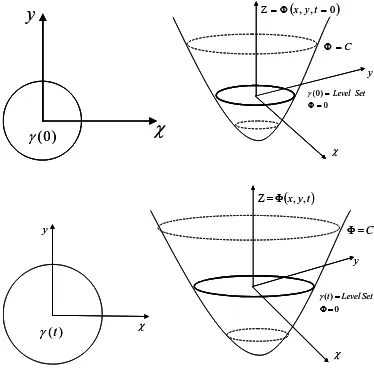
This is an initial value partial differential equation in one higher dimension than the original problem. In Figure 3, we show the outward propagation of and initial curve and the accompanying motion of the level set functionΦ.
Given a closed surfaceΓ
( )
t , bounding a regionΩ , we want to compute its motion in time influenced by a velocityfield. Let us embed the surface as the zero level set ofΦ:
( )
x t =±dΦ , (7)
Where d is the signed distance from x to Γ
( )
t with these properties:( )
( )
( )
= ∈∂ΩΦ
Ω ∉ 〈
Φ
Ω ∈ 〉
Φ
for 0 ,
for 0 ,
for 0 ,
x t
x
x t
x
x t
x
(8)
The Ω boundary is the surfaceΓ:
( )
=[
Φ( )
=]
=∂ΩΓt x w,t 0 (9)
The evolution equation of Φ
( )
x,t is:0
= Φ ∇ ⋅ + ∂
Φ ∂
v
t (10)
Although all level set functions are equally good theoretically, in practice the signed distance function is preferred to avoid stiffness and inaccuracy in numerical computations. However even if we start with a signed distance function the level set function will generally not remain a signed distance function. For instance, in the convection model all level sets are attracted to the data set simultaneously and they become more and more packed together. We need a procedure to force them independently while keeping the zero level set truly. We use a numerical procedure called re-initialization [18], [19]. To resistance the level set function locally without interfering with the motion of the zero level set. As a result the implicit surface is a signed distance function after the deformation procedure stops.
IV. EXPERIMENT RESULTS AND DISCUSSION
A. Preprocessing images Experimental Results
The Figure 4 is the experimental result for medical ultrasound image. It can see that speckle noise was reduced efficiently in neighborhood of lesion domain. Generally, speckle noise reduced could cause the blurring of edge boundary, that is, it could happen to omit the edge boundary of organization or small tumor.
[image:3.595.70.276.49.161.2]
(a) (b)
Fig.4. Results of speckle noise reduction. (a) The original image, (b) Speckle reduced image.
) 0 (
γ χ
y
) 0 (
γ χ
y Ζ=Φ(x,y,t=0)
C
= Φ
y
χ
0 ) 0 (
= Φ
=LevelSet
γ
(, , =0)
Φ = Ζ xyt
C
= Φ
y
χ
0 ) 0 (
= Φ
=LevelSet
γ
) (t
γ y
χ
) (t
γ y
χ
(x,y,t) Φ = Ζ
y
χ
0 ) (
= Φ
=LevelSet t
γ
C
= Φ (x,y,t) Φ = Ζ
y
χ
0 ) (
= Φ
=LevelSet t
γ
C
[image:3.595.75.262.537.722.2]= Φ
Fig. 3. level Set Propagating Circle.
(a) (b)
[image:3.595.314.543.652.745.2]
(c) (d)
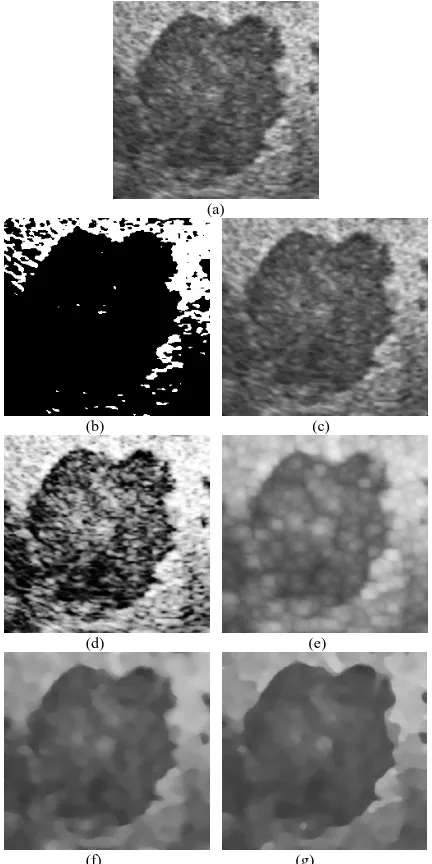
Figure 5 is the result of speckle noise reduction using a medical ultrasound image containing the tumor area. The result Figure 5(g) of proposed method represents that information in the tumor is not disappeared and the boundary of the tumor is shown distinctively.
From the Figure 5(b) to Figure 5(e), the speckle is not sufficiently removed. In the Figure 5(f), the speckle is sufficiently removed by SRAD. But, the boundary of the tumor is also smoothed. The result by a proposed method has the most excellent output, because the boundary of tumor is distinct, speckle noise is removed, and the fine details are preserved.
Therefore, we can confirm the good result which reduced speckle effectively by proposed method than the other methods.
B. Active Contour Model Detection Experimental Result
The following Figure 6 is the result of level set contour about ultrasound image. Figure 6(a) is contour result about original image and Figure 6(b) is contour result about preprocessed image. As seen as figure, the contour result of preprocessed image shows better result than contour result of original image.
V. CONCLUSION
In this paper, we present a medical ultrasound images reduced speckle using cellular neural network with the effective detection of active contour model. Being speckle noise, the medical ultrasound images is hard to divide a cancer or tumor region. Then, lesion image does preprocessing for effectively active contour representation.
The preprocessing method is used cellular neural network detecting template. It is reduced speckle and lesion boundary is clearly better than previous method. And then, we did active contour detection. The experiment show preprocessing result better than not preprocessing.
And with experiment and comparison with conventional contour method, we verified the value of our method.
Future work contains re-initialization problem, moving problem, 3D visualization and so on.
REFERENCES
[1] A.Chakraborty and J.S.Duncan, “game-theoretic integration for image segmentation,” IEEE Trans. Pattern Analogue Machine Intelligence, Vol.22, pp.241-251, Mar.2000.
[2] R.Adams and L.Bischof, “Seeded region growing,” IEEE Trans. Pattern Analogue Machine Intelligence, Vol.16, pp.641-647, June. 1994.
[3] J.R.Beverige, J.Griffith, R.R. Kohler, A.R.Hanson, and E.M.Riseman, “Segmenting images using localizing histograms and region merging,” Int.J.Comput.Vis., Vol.2, No.3, pp.311-347, 1989.
[4] M.Kass, A.Witkin, and D.Terzopoulos, “Snakes:Active contour models,” Int. J. Comput. Vis., Vol. 1, pp. 321-331, 1988.
(a) (b)
[image:4.595.313.530.168.359.2]
(c) (d)
Fig.6. The Contour Result of Level Set Method. (a) For Original Image, (b) For preprocessing proposed Image, (c) For preprocessing SRAD method, (d) For preprocessing Perona&Malik method.
(a)
(b) (c)
(d) (e)
[image:4.595.62.278.259.691.2]
(f) (g)
[5] A.A.Amini, S.Tehrani, and T.E.Weymouth, “Using dynamic programming for minimizing the energy of active contours in the presence of hard constraints,” IEEE International Conference on Computer Vision, pp.95-99, 1988.
[6] D.J.Williams, and M.Shah, “A fast algorithm for active contours and curve ad curvature estimation,” CVGIP:Image Understanding, Vol.55, pp. 14–26, 1992.
[7] S.Osher and J.Sethian, “Fronts propagating with curvature dependent speed: Algorithm based on the Hamilton-Jacobi formulation,” Journal of Computational Physics, Vol. 79, pp. 12–49, 1988.
[8] J.A.Sethian, “Level Set Methods,” Cambridge University Press, 1996. [9] Jain, A.K., “Fundamentals of digital image processing,” Prentice-Hall,
Englewood Cliffs, NJ, USA, 1989.
[10] Loupas, T., McDicken, W.M., and Allen, P.L., “An adaptive weighted medial filter for speckle suppression in medical ultrasonic images,” IEEE Trans. Circuits Systems, vol.36, 1989.
[11] Peitro Perona and Jitendra Malik, “Scale-Space and Edge Detection Using Anisotropic Diffusion,” IEEE Transactions on Pattern Analysis and Machine Intelligence, Vol.12, No.7, pp 629-639, July 1990. [12] Yongjian Yu and Scott T. Acton, “Speckle Reducing Anisotropic
Diffusion,” IEEE Transactions on Image Processing, Vol.11, No.11, November 2002.
[13] Rodriguez-Vazquez, S.Espejo, R.Dominguez-Castro, J.L. Huertas, and E.Sanchez-Sinencio, “Current-Mode Techniques for the Implementation of Continuous-and Discrete-time Cellular Neural networks,” IEEE Transactions on Circuits and Systems II: Analog and Digita Signal Processing, Vol.40, No.3, pp.132-146, Mar.1993. [14] L.O.Chua and T.Roska, “Cellular Neural Networks and Visual
Computing – Foundations and Applications,” Cambridge University Press, ISBN: 05216524732, Amazon Barnes&Noble, 2001.
[15] Leon O.Chua, “CNN: A paradigm for complexity,” World Scientific Pub.Co, ISBN: 981023483X, Amazon Batnes&Noble, 1998. [16] Osher, S., and Sethian, J.A., “Fronts Propagating with Curvature
Dependent speed: Algorithms Based on Hamilton-Jacobi Formulation,” Journal of Computational Physics, Vol. 79, pp. 12–49, 1988.
[17] Sethian, J.A., “Numerical Algorithms for Propagating Interfaces: Hamilton-Jacobi Equations and Conservation Laws,” Journal of Differential Geometry, Vol. 31, pp. 131–161, 1990.
[18] D.Peng, B.Merriman, S.Osher, H.K.Zhao, and M.Kang, “A PDE based fast local level set methods,” Journal of Computational Physics, Vol.155, pp.410-438, 1999.