Rule Filtering by Pattern for Efficient Hierarchical Translation
Gonzalo Iglesias⋆
Adri`a de Gispert‡ ⋆
University of Vigo. Dept. of Signal Processing and Communications. Vigo, Spain {giglesia,erbanga}@gts.tsc.uvigo.es
‡University of Cambridge. Dept. of Engineering. CB2 1PZ Cambridge, U.K.
{ad465,wjb31}@eng.cam.ac.uk
Eduardo R. Banga⋆
William Byrne‡
Abstract
We describe refinements to hierarchical translation search procedures intended to reduce both search errors and memory us-age through modifications to hypothesis expansion in cube pruning and reductions in the size of the rule sets used in transla-tion. Rules are put into syntactic classes based on the number of non-terminals and the pattern, and various filtering strate-gies are then applied to assess the impact on translation speed and quality. Results are reported on the 2008 NIST Arabic-to-English evaluation task.
1 Introduction
Hierarchical phrase-based translation (Chiang, 2005) has emerged as one of the dominant cur-rent approaches to statistical machine translation. Hiero translation systems incorporate many of the strengths of phrase-based translation systems, such as feature-based translation and strong tar-get language models, while also allowing flexi-ble translation and movement based on hierarchi-cal rules extracted from aligned parallel text. The approach has been widely adopted and reported to be competitive with other large-scale data driven approaches, e.g. (Zollmann et al., 2008).
Large-scale hierarchical SMT involves auto-matic rule extraction from aligned parallel text, model parameter estimation, and the use of cube pruning k-best list generation in hierarchical trans-lation. The number of hierarchical rules extracted far exceeds the number of phrase translations typ-ically found in aligned text. While this may lead to improved translation quality, there is also the risk of lengthened translation times and increased memory usage, along with possible search errors due to the pruning procedures needed in search.
We describe several techniques to reduce mem-ory usage and search errors in hierarchical
trans-lation. Memory usage can be reduced in cube pruning (Chiang, 2007) through smart memoiza-tion, and spreading neighborhood exploration can be used to reduce search errors. However, search errors can still remain even when implementing simple phrase-based translation. We describe a ‘shallow’ search through hierarchical rules which greatly speeds translation without any effect on quality. We then describe techniques to analyze and reduce the set of hierarchical rules. We do this based on the structural properties of rules and develop strategies to identify and remove redun-dant or harmful rules. We identify groupings of rules based on non-terminals and their patterns and assess the impact on translation quality and com-putational requirements for each given rule group. We find that with appropriate filtering strategies rule sets can be greatly reduced in size without im-pact on translation performance.
1.1 Related Work
extend the translation of source sentences to trans-lation of input lattices following Chappelier et al. (1999).
Extensions to Hiero Blunsom et al. (2008) discuss procedures to combine discriminative la-tent models with hierarchical SMT. The Syntax-Augmented Machine Translation system (Zoll-mann and Venugopal, 2006) incorporates target language syntactic constituents in addition to the synchronous grammars used in translation. Shen at al. (2008) make use of target dependency trees and a target dependency language model during decoding. Marton and Resnik (2008) exploit shal-low correspondences of hierarchical rules with source syntactic constituents extracted from par-allel text, an approach also investigated by Chiang (2005). Zhang and Gildea (2006) propose bina-rization for synchronous grammars as a means to control search complexity arising from more com-plex, syntactic, hierarchical rules sets.
Hierarchical rule extraction Zhang et al. (2008) describe a linear algorithm, a modified version of shift-reduce, to extract phrase pairs organized into a tree from which hierarchical rules can be directly extracted. Lopez (2007) extracts rules on-the-fly from the training bitext during decoding, search-ing efficiently for rule patterns ussearch-ing suffix arrays. Analysis and Contrastive Experiments Zollman et al. (2008) compare phrase-based, hierarchical and syntax-augmented decoders for translation of Arabic, Chinese, and Urdu into English, and they find that attempts to expedite translation by simple schemes which discard rules also degrade transla-tion performance. Lopez (2008) explores whether lexical reordering or the phrase discontiguity in-herent in hierarchical rules explains improvements over phrase-based systems. Hierarchical transla-tion has also been used to great effect in combina-tion with other translacombina-tion architectures (e.g. (Sim et al., 2007; Rosti et al., 2007)).
1.2 Outline
The paper proceeds as follows. Section 2 de-scribes memoization and spreading neighborhood exploration in cube pruning intended to reduce memory usage and search errors, respectively. A detailed comparison with a simple phrase-based system is presented. Section 3 describes pattern-based rule filtering and various procedures to se-lect rule sets for use in translation with an aim to improving translation quality while minimizing
rule set size. Finally, Section 4 concludes.
2 Two Refinements in Cube Pruning
Chiang (2007) introduced cube pruning to apply language models in pruning during the generation of k-best translation hypotheses via the application of hierarchical rules in the CYK algorithm. In the implementation of Hiero described here, there is the parser itself, for which we use a variant of the CYK algorithm closely related to CYK+ (Chap-pelier and Rajman, 1998); it employs hypothesis recombination, without pruning, while maintain-ing back pointers. Before k-best list generation with cube pruning, we apply a smart memoiza-tion procedure intended to reduce memory con-sumption during k-best list expansion. Within the cube pruning algorithm we use spreading neigh-borhood exploration to improve robustness in the face of search errors.
2.1 Smart Memoization
Each cell in the chart built by the CYK algorithm contains all possible derivations of a span of the source sentence being translated. After the parsing stage is completed, it is possible to make a very ef-ficient sweep through the backpointers of the CYK grid to count how many times each cell will be ac-cessed by the k-best generation algorithm. When k-best list generation is running, the number of times each cell is visited is logged so that, as each cell is visited for the last time, the k-best list as-sociated with each cell is deleted. This continues until the one k-best list remaining at the top of the chart spans the entire sentence. Memory reduc-tions are substantial for longer sentences: for the longest sentence in the tuning set described later (105 words in length), smart memoization reduces memory usage during the cube pruning stage from 2.1GB to 0.7GB. For average length sentences of approx. 30 words, memory reductions of 30% are typical.
2.2 Spreading Neighborhood Exploration
them-HIERO MJ1 HIERO HIERO SHALLOW
X→ hV2V1,V1V2i X → hγ,αi X→ hγs,αsi
X→ hV,Vi γ, α∈({X} ∪T)+
X→ hV,Vi
V → hs,ti V → hs,ti
[image:3.595.121.482.61.132.2]s, t∈T+ s, t∈T+;γs, αs∈({V} ∪T)+
Table 1: Hierarchical grammars (not including glue rules). T is the set of terminals.
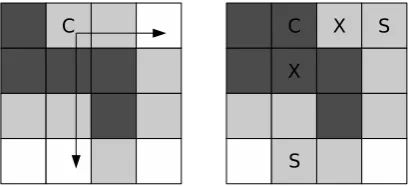
selves may contain non-terminals. For efficiency each cube maintains a queue of hypotheses, called here the frontier queue, ranked by translation and language model score; it is from these frontier queues that hypotheses are removed to create the k-best list for each cell. When a hypothesis is ex-tracted from a frontier queue, that queue is updated by searching through the neighborhood of the ex-tracted item to find novel hypotheses to add; if no novel hypotheses are found, that queue necessar-ily shrinks. This shrinkage can lead to search er-rors. We therefore require that, when a hypothe-sis is removed, new candidates must be added by exploring a neighborhood which spreads from the last extracted hypothesis. Each axis of the cube is searched (here, to a depth of 20) until a novel hypothesis is found. In this way, up to three new candidates are added for each entry extracted from a frontier queue.
Chiang (2007) describes an initialization pro-cedure in which these frontier queues are seeded with a single candidate per axis; we initialize each frontier queue to a depth ofbNnt+1, where Nnt is
the number of non-terminals in the derivation and
b is a search parameter set throughout to 10. By starting with deep frontier queues and by forcing them to grow during search we attempt to avoid search errors by ensuring that the universe of items within the frontier queues does not decrease as the k-best lists are filled.
2.3 A Study of Hiero Search Errors in Phrase-Based Translation
Experiments reported in this paper are based on the NIST MT08 Arabic-to-English transla-tion task. Alignments are generated over all al-lowed parallel data, (∼150M words per language). Features extracted from the alignments and used in translation are in common use: target lan-guage model, source-to-target and target-to-source phrase translation models, word and rule penalties, number of usages of the glue rule, source-to-target and target-to-source lexical models, and three rule
Figure 1: Spreading neighborhood exploration within a cube, just before and after extraction of the item C. Grey squares represent the fron-tier queue; black squares are candidates already extracted. Chiang (2007) would only consider adding items X to the frontier queue, so the queue would shrink. Spreading neighborhood explo-ration adds candidates S to the frontier queue.
count features inspired by Bender et al. (2007). MET (Och, 2003) iterative parameter estimation under IBM BLEU is performed on the develop-ment set. The English language used model is a 4-gram estimated over the parallel text and a 965 million word subset of monolingual data from the English Gigaword Third Edition. In addition to the MT08 set itself, we use a development set mt02-05-tune formed from the odd numbered sentences of the NIST MT02 through MT05 evaluation sets; the even numbered sentences form the validation set mt02-05-test. The mt02-05-tune set has 2,075 sentences.
[image:3.595.307.513.176.269.2]large models used in an evaluation task, the TTM system is reported to run largely without pruning (Blackwood et al., 2008).
The Hiero decoder can easily be made to implement MJ1 reordering by allowing only a restricted set of reordering rules in addition to the usual glue rule, as shown in left-hand column of Table 1, where T is the set of terminals. Constraining Hiero in this way makes it possible to compare its performance to the exact WFST TTM implementation and to identify any search errors made by Hiero.
Table 2 shows the lowercased IBM BLEU scores obtained by the systems for mt02-05-tune with monotone and reordered search, and with MET-optimised parameters for MJ1 reordering. For Hiero, an N-best list depth of 10,000 is used throughout. In the monotone case, all phrase-based systems perform similarly although Hiero does make search errors. For simple MJ1 re-ordering, the basic Hiero search procedure makes many search errors and these lead to degradations in BLEU. Spreading neighborhood expansion re-duces the search errors and improves BLEU score significantly but search errors remain a problem. Search errors are even more apparent after MET. This is not surprising, given that mt02-05-tune is the set over which MET is run: MET drives up the likelihood of good hypotheses at the expense of poor hypotheses, but search errors often increase due to the expanded dynamic range of the hypoth-esis scores.
Our aim in these experiments was to demon-strate that spreading neighborhood exploration can aid in avoiding search errors. We emphasize that we are not proposing that Hiero should be used to implement reordering models such as MJ1 which were created for completely different search pro-cedures (e.g. WFST composition). However these experiments do suggest that search errors may be an issue, particularly as the search space grows to include the complex long-range movement al-lowed by the hierarchical rules. We next study various filtering procedures to reduce hierarchi-cal rule sets to find a balance between translation speed, memory usage, and performance.
3 Rule Filtering by Pattern
Hierarchical rules X → hγ,αi are composed of sequences of terminals and non-terminals, which
Monotone MJ1 MJ1+MET
BLEU SE BLEU SE BLEU SE
a 44.7 - 47.2 - 49.1
-b 44.5 342 46.7 555 48.4 822
[image:4.595.308.532.63.135.2]c 44.7 77 47.1 191 48.9 360
Table 2: Phrase-based TTM and Hiero perfor-mance on mt02-05-tune for TTM (a), Hiero (b), Hiero with spreading neighborhood exploration (c). SE is the number of Hiero hypotheses with search errors.
we call elements. In the source, a maximum of two non-adjacent non-terminals is allowed (Chi-ang, 2007). Leaving aside rules without non-terminals (i.e. phrase pairs as used in phrase-based translation), rules can be classed by their number of non-terminals, Nnt, and their number of elements, Ne. There are 5 possible classes: Nnt.Ne= 1.2,1.3,2.3,2.4,2.5.
During rule extraction we search each class sep-arately to control memory usage. Furthermore, we extract from alignments only those rules which are relevant to our given test set; for computation of backward translation probabilities we log general counts of target-side rules but discard unneeded rules. Even with this restriction, our initial ruleset for mt02-05-tune exceeds 175M rules, of which only 0.62M are simple phrase pairs.
The question is whether all these rules are needed for translation. If the rule set can be re-duced without reducing translation quality, both memory efficiency and translation speed can be increased. Previously published approaches to re-ducing the rule set include: enforcing a mini-mum span of two words per non-terminal (Lopez, 2008), which would reduce our set to 115M rules; or a minimum count (mincount) threshold (Zoll-mann et al., 2008), which would reduce our set to 78M (mincount=2) or 57M (mincount=3) rules. Shen et al. (2008) describe the result of filter-ing rules by insistfilter-ing that target-side rules are well-formed dependency trees. This reduces their rule set from 140M to 26M rules. This filtering leads to a degradation in translation performance (see Table 2 of Shen et al. (2008)), which they counter by adding a dependency LM in translation. As another reference point, Chiang (2007) reports Chinese-to-English translation experiments based on 5.5M rules.
en masse leads to degradation in translation per-formance. Rather than apply a coarse filtering, such as a mincount for all rules, we follow a more syntactic approach and further classify our rules according to their pattern and apply different fil-ters to each pattern depending on its value in trans-lation. The premise is that some patterns are more important than others.
3.1 Rule Patterns
Class Rule Pattern
Nnt.Ne hsource , targeti Types
hwX1, wX1i 1185028
1.2 hwX1, wX1wi 153130
hwX1, X1wi 97889
1.3 hwX1w , wX1wi 32903522
hwX1w , wX1i 989540
2.3 hX1wX2, X1wX2i 1554656
hX2wX1, X1wX2i 39163
hwX1wX2, wX1wX2i 26901823
hX1wX2w , X1wX2wi 26053969 2.4 hwX1wX2, wX1wX2wi 2534510
hwX2wX1, wX1wX2i 349176
hX2wX1w , X1wX2wi 259459
hwX1wX2w , wX1wX2wi 61704299
hwX1wX2w , wX1X2wi 3149516 2.5 hwX1wX2w , X1wX2wi 2330797
hwX2wX1w , wX1wX2wi 275810
hwX2wX1w , wX1X2wi 205801
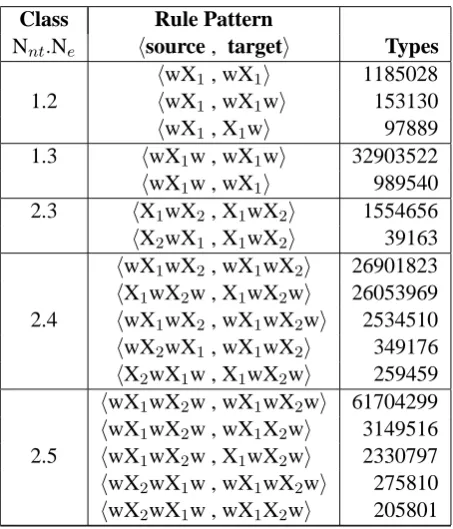
Table 3: Hierarchical rule patterns classed by number of non-terminals, Nnt, number of ele-ments Ne, source and target patterns, and types in the rule set extracted for mt02-05-tune.
Given a rule set, we define source patterns and target patterns by replacing every sequence of non-terminals by a single symbol ‘w’ (indicating word, i.e. terminal string,w∈ T+). Each hierar-chical rule has a unique source and target pattern which together define the rule pattern.
By ignoring the identity and the number of ad-jacent terminals, the rule pattern represents a nat-ural generalization of any rule, capturing its struc-ture and the type of reordering it encodes. In to-tal, there are 66 possible rule patterns. Table 3 presents a few examples extracted for mt02-05-tune, showing that some patterns are much more diverse than others. For example, patterns with two non-terminals (Nnt=2) are richer than pat-terns with Nnt=1, as they cover many more
dis-tinct rules. Additionally, patterns with two non-terminals which also have a monotonic relation-ship between source and target non-terminals are much more diverse than their reordered counter-parts.
Some examples of extracted rules and their cor-responding pattern follow, where Arabic is shown in Buckwalter encoding.
Pattern hwX1, wX1wi:
hw+ qAl X1, the X1saidi Pattern hwX1w , wX1i:
hfy X1kAnwn Al>wl , on december X1i Pattern hwX1wX2, wX1wX2wi:
hHl X1lAzmp X2, a X1solution to the X2crisisi
3.2 Building an Initial Rule Set
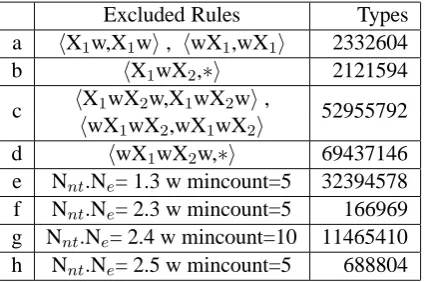
We describe a greedy approach to building a rule set in which rules belonging to a pattern are added to the rule set guided by the improvements they yield on mt02-05-tune relative to the monotone Hiero system described in the previous section. We find that certain patterns seem not to con-tribute to any improvement. This is particularly significant as these patterns often encompass large numbers of rules, as with patterns with match-ing source and target patterns. For instance, we found no improvement when adding the pattern
hX1w,X1wi, of which there were 1.2M instances (Table 3). Since concatenation is already possible under the general glue rule, rules with this pattern are redundant. By contrast, the much less frequent reordered counterpart, i.e. the hwX1,X1wi pat-tern (0.01M instances), provides substantial gains. The situation is analogous for rules with two non-terminals (Nnt=2).
[image:5.595.72.299.206.471.2]Excluded Rules Types a hX1w,X1wi, hwX1,wX1i 2332604
b hX1wX2,∗i 2121594
hX1wX2w,X1wX2wi, c
hwX1wX2,wX1wX2i
52955792
d hwX1wX2w,∗i 69437146
e Nnt.Ne= 1.3 w mincount=5 32394578 f Nnt.Ne= 2.3 w mincount=5 166969 g Nnt.Ne= 2.4 w mincount=10 11465410 h Nnt.Ne= 2.5 w mincount=5 688804
Table 4: Rules excluded from the initial rule set.
3.3 Shallow versus Fully Hierarchical Translation
In measuring the effectiveness of rules in transla-tion, we also investigate whether a ‘fully hierarchi-cal’ search is needed or whether a shallow search is also effective. In constrast to full Hiero, in the shallow search, only phrases are allowed to be sub-stituted into non-terminals. The rules used in each case can be expressed as shown in the 2nd and 3rd columns of Table 1. Shallow search can be con-sidered (loosely) to be a form of rule filtering.
As can be seen in Table 5 there is no impact on BLEU, while translation speed increases by a fac-tor of 7. Of course, these results are specific to this Arabic-to-English translation task, and need not be expected to carry over to other language pairs, such as Chinese-to-English translation. However, the impact of this search simplification is easy to measure, and the gains can be significant enough, that it may be worth investigation even for lan-guages with complex long distance movement.
mt02-05- -tune -test
System Time BLEU BLEU
HIERO 14.0 52.1 51.5
[image:6.595.76.289.62.203.2]HIERO - shallow 2.0 52.1 51.4
Table 5: Translation performance and time (in sec-onds per word) for full vs. shallow Hiero.
3.4 Individual Rule Filters
We now filter rules individually (not by class) ac-cording to their number of translations. For each fixed γ /∈ T+ (i.e. with at least 1 non-terminal), we define the following filters over rules X → hγ,αi:
• Number of translations (NT). We keep the NT most frequentα, i.e. eachγ is allowed to have at most NT rules.
• Number of reordered translations (NRT).
We keep the NRT most frequent α with monotonic non-terminals and the NRT most frequentαwith reordered non-terminals.
• Count percentage (CP). We keep the most
frequent α until their aggregated number of counts reaches a certain percentage CP of the total counts ofX → hγ,∗i. Someγ’s are al-lowed to have moreα’s than others, depend-ing on their count distribution.
Results applying these filters with various thresholds are given in Table 6, including num-ber of rules and decoding time. As shown, all filters achieve at least a 50% speed-up in decod-ing time by discarddecod-ing 15% to 25% of the base-line rules. Remarkably, performance is unaffected when applying the simple NT and NRT filters with a threshold of 20 translations. Finally, the
CM filter behaves slightly worse for thresholds of
90% for the same decoding time. For this reason, we select NRT=20 as our general filter.
mt02-05- -tune -test
Filter Time Rules BLEU BLEU
baseline 2.0 4.20 52.1 51.4
NT=10 0.8 3.25 52.0 51.3
NT=15 0.8 3.43 52.0 51.3
NT=20 0.8 3.56 52.1 51.4
NRT=10 0.9 3.29 52.0 51.3
NRT=15 1.0 3.48 52.0 51.4
NRT=20 1.0 3.59 52.1 51.4
CP=50 0.7 2.56 51.4 50.9
CP=90 1.0 3.60 52.0 51.3
Table 6: Impact of general rule filters on transla-tion (IBM BLEU), time (in seconds per word) and number of rules (in millions).
3.5 Pattern-based Rule Filters
mt02-05- -tune -test
Nnt.Ne Filter Time Rules BLEU BLEU
baseline NRT=20 1.0 3.59 52.1 51.4
2.3 +monotone 1.1 4.08 51.5 51.1
2.4 +monotone 2.0 11.52 51.6 51.0
2.5 +monotone 1.8 6.66 51.7 51.2
1.3 mincount=3 1.0 5.61 52.1 51.3
2.3 mincount=1 1.2 3.70 52.1 51.4
2.4 mincount=5 1.8 4.62 52.0 51.3
2.4 mincount=15 1.0 3.37 52.0 51.4
2.5 mincount=1 1.1 4.27 52.2 51.5
1.2 mincount=5 1.0 3.51 51.8 51.3
[image:7.595.163.437.62.246.2]1.2 mincount=10 1.0 3.50 51.7 51.2
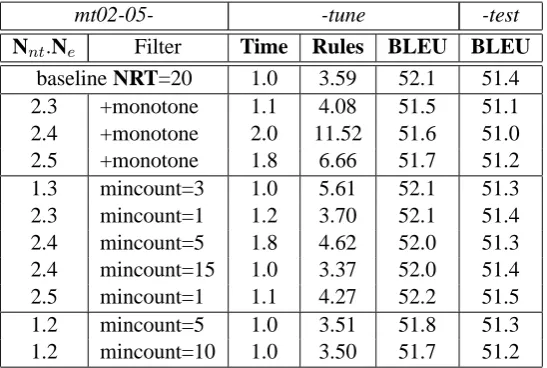
Table 7: Effect of pattern-based rule filters. Time in seconds per word. Rules in millions.
substantially, despite the NRT=20 filter, but leads to degradation in translation performance.
We next reconsider the mincount threshold val-ues for Nnt.Neclasses 1.3, 2.3, 2.4 and 2.5 origi-nally described in Table 4 (rows ’e’ to ’h’). Results under various mincount cutoffs for each class are given in Table 7 (middle five rows). For classes 2.3 and 2.5, the mincount cutoff can be reduced to 1 (i.e. all rules are kept) with slight translation improvements. In contrast, reducing the cutoff for classes 1.3 and 2.4 to 3 and 5, respectively, adds many more rules with no increase in performance. We also find that increasing the cutoff to 15 for class 2.4 yields the same results with a smaller rule set. Finally, we consider further filtering applied to class 1.2 with mincount 5 and 10 (final two rows in Table 7). The number of rules is largely un-changed, but translation performance drops con-sistently as more rules are removed.
Based on these experiments, we conclude that it is better to apply separate mincount thresholds to the classes to obtain optimal performance with a minimum size rule set.
3.6 Large Language Models and Evaluation
Finally, in this section we report results of our shallow hierarchical system with the 2.5 min-count=1 configuration from Table 7, after includ-ing the followinclud-ing N-best list rescorinclud-ing steps.
• Large-LM rescoring. We build sentence-specific zero-cutoff stupid-backoff (Brants et al., 2007) 5-gram language models, estimated using∼4.7B words of English newswire text, and apply them to rescore each 10000-best
list.
• Minimum Bayes Risk (MBR). We then rescore the first 1000-best hypotheses with MBR, taking the negative sentence level BLEU score as the loss function to minimise (Ku-mar and Byrne, 2004).
Table 8 shows results for 05-tune, mt02-05-test, the NIST subsets from the MT06 evalu-ation (nist-nw for newswire data and mt06-nist-ng for newsgroup) and mt08, as measured by lowercased IBM BLEU and TER (Snover et al., 2006). Mixed case NIST BLEU for this system on mt08 is 42.5. This is directly comparable to offi-cial MT08 evaluation results1.
4 Conclusions
This paper focuses on efficient large-scale hierar-chical translation while maintaining good trans-lation quality. Smart memoization and spreading neighborhood exploration during cube pruning are described and shown to reduce memory consump-tion and Hiero search errors using a simple phrase-based system as a contrast.
We then define a general classification of hi-erarchical rules, based on their number of non-terminals, elements and their patterns, for refined extraction and filtering.
For a large-scale Arabic-to-English task, we show that shallow hierarchical decoding is as good
1
mt02-05-tune mt02-05-test mt06-nist-nw mt06-nist-ng mt08 HIERO+MET 52.2 / 41.6 51.5 / 42.2 48.4 / 43.6 35.3 / 53.2 42.5 / 48.6
[image:8.595.91.508.63.106.2]+rescoring 53.2 / 40.8 52.6 / 41.4 49.4 / 42.9 36.6 / 53.5 43.4 / 48.1
Table 8: Arabic-to-English translation results (lower-cased IBM BLEU / TER) with large language mod-els and MBR decoding.
as fully hierarchical search and that decoding time is dramatically decreased. In addition, we describe individual rule filters based on the distribution of translations with further time reductions at no cost in translation scores. This is in direct contrast to recent reported results in which other filtering strategies lead to degraded performance (Shen et al., 2008; Zollmann et al., 2008).
We find that certain patterns are of much greater value in translation than others and that separate minimum count filters should be applied accord-ingly. Some patterns were found to be redundant or harmful, in particular those with two monotonic non-terminals. Moreover, we show that the value of a pattern is not directly related to the number of rules it encompasses, which can lead to discarding large numbers of rules as well as to dramatic speed improvements.
Although reported experiments are only for Arabic-to-English translation, we believe the ap-proach will prove to be general. Pattern relevance will vary for other language pairs, but we expect filtering strategies to be equally worth pursuing.
Acknowledgments
This work was supported in part by the GALE pro-gram of the Defense Advanced Research Projects Agency, Contract No. HR0011- 06-C-0022. G. Iglesias supported by Spanish Government re-search grant BES-2007-15956 (project TEC2006-13694-C03-03).
References
Cyril Allauzen, Michael Riley, Johan Schalkwyk, Wo-jciech Skut, and Mehryar Mohri. 2007. OpenFst: A general and efficient weighted finite-state transducer library. In Proceedings of CIAA, pages 11–23.
Oliver Bender, Evgeny Matusov, Stefan Hahn, Sasa Hasan, Shahram Khadivi, and Hermann Ney. 2007. The RWTH Arabic-to-English spoken language translation system. In Proceedings of ASRU, pages 396–401.
Graeme Blackwood, Adri`a de Gispert, Jamie Brunning, and William Byrne. 2008. Large-scale statistical
machine translation with weighted finite state trans-ducers. In Proceedings of FSMNLP, pages 27–35.
Phil Blunsom, Trevor Cohn, and Miles Osborne. 2008. A discriminative latent variable model for statistical machine translation. In Proceedings of ACL-HLT, pages 200–208.
Thorsten Brants, Ashok C. Popat, Peng Xu, Franz J.
Och, and Jeffrey Dean. 2007. Large language
models in machine translation. In Proceedings of
EMNLP-ACL, pages 858–867.
Jean-C´edric Chappelier and Martin Rajman. 1998. A generalized CYK algorithm for parsing stochastic CFG. In Proceedings of TAPD, pages 133–137.
Jean-C´edric Chappelier, Martin Rajman, Ram´on
Arag ¨u´es, and Antoine Rozenknop. 1999. Lattice parsing for speech recognition. In Proceedings of
TALN, pages 95–104.
David Chiang. 2005. A hierarchical phrase-based
model for statistical machine translation. In
Pro-ceedings of ACL, pages 263–270.
David Chiang. 2007. Hierarchical phrase-based trans-lation. Computational Linguistics, 33(2):201–228.
Markus Dreyer, Keith Hall, and Sanjeev Khudanpur. 2007. Comparing reordering constraints for SMT using efficient BLEU oracle computation. In
Pro-ceedings of SSST, NAACL-HLT 2007 / AMTA Work-shop on Syntax and Structure in Statistical Transla-tion.
Christopher Dyer, Smaranda Muresan, and Philip Resnik. 2008. Generalizing word lattice translation. In Proceedings of ACL-HLT, pages 1012–1020.
Liang Huang and David Chiang. 2007. Forest rescor-ing: Faster decoding with integrated language mod-els. In Proceedings of ACL, pages 144–151.
Shankar Kumar and William Byrne. 2004. Minimum Bayes-risk decoding for statistical machine transla-tion. In Proceedings of HLT-NAACL, pages 169– 176.
Shankar Kumar and William Byrne. 2005.
Lo-cal phrase reordering models for statistiLo-cal machine translation. In Proceedings of HLT-EMNLP, pages 161–168.
Shankar Kumar, Yonggang Deng, and William Byrne. 2006. A weighted finite state transducer translation template model for statistical machine translation.
Zhifei Li and Sanjeev Khudanpur. 2008. A scal-able decoder for parsing-based machine translation with equivalent language model state maintenance. In Proceedings of the ACL-HLT Second Workshop
on Syntax and Structure in Statistical Translation,
pages 10–18.
Adam Lopez. 2007. Hierarchical phrase-based trans-lation with suffix arrays. In Proceedings of
EMNLP-CONLL, pages 976–985.
Adam Lopez. 2008. Tera-scale translation models
via pattern matching. In Proceedings of COLING, pages 505–512.
Yuval Marton and Philip Resnik. 2008. Soft syntac-tic constraints for hierarchical phrased-based trans-lation. In Proceedings of ACL-HLT, pages 1003– 1011.
Franz J. Och. 2003. Minimum error rate training in
statistical machine translation. In Proceedings of
ACL, pages 160–167.
Antti-Veikko Rosti, Necip Fazil Ayan, Bing Xiang, Spyros Matsoukas, Richard Schwartz, and Bonnie Dorr. 2007. Combining outputs from multiple ma-chine translation systems. In Proceedings of
HLT-NAACL, pages 228–235.
Libin Shen, Jinxi Xu, and Ralph Weischedel. 2008. A new string-to-dependency machine translation algo-rithm with a target dependency language model. In
Proceedings of ACL-HLT, pages 577–585.
Khe Chai Sim, William Byrne, Mark Gales, Hichem Sahbi, and Phil Woodland. 2007. Consensus net-work decoding for statistical machine translation
system combination. In Proceedings of ICASSP,
volume 4, pages 105–108.
Matthew Snover, Bonnie J. Dorr, Richard Schwartz,
Linnea Micciulla, and John Makhoul. 2006. A
study of translation edit rate with targeted human an-notation. In Proceedings of AMTA, pages 223–231.
Ashish Venugopal, Andreas Zollmann, and Vogel Stephan. 2007. An efficient two-pass approach to
synchronous-CFG driven statistical MT. In
Pro-ceedings of HLT-NAACL, pages 500–507.
Hao Zhang and Daniel Gildea. 2006. Synchronous binarization for machine translation. In Proceedings
of HLT-NAACL, pages 256–263.
Hao Zhang, Daniel Gildea, and David Chiang. 2008. Extracting synchronous grammar rules from word-level alignments in linear time. In Proceedings of
COLING, pages 1081–1088.
Andreas Zollmann and Ashish Venugopal. 2006. Syn-tax augmented machine translation via chart parsing. In Proceedings of NAACL Workshop on Statistical
Machine Translation, pages 138–141.
Andreas Zollmann, Ashish Venugopal, Franz Och,
and Jay Ponte. 2008. A systematic comparison