Improving Neural Knowledge Base Completion with
Cross-Lingual Projections
Patrick Klein and Simone Paolo Ponzetto and Goran Glavaˇs
Data and Web Science Group University of Mannheim
B6, 26, DE-68159, Mannheim, Germany [email protected]
{simone, goran}@informatik.uni-mannheim.de
Abstract
In this paper we present a cross-lingual ex-tension of a neural tensor network model for knowledge base completion. We ex-ploit multilingual synsets from BabelNet to translate English triples to other lan-guages and then augment the reference knowledge base with cross-lingual triples. We project monolingual embeddings of dif-ferent languages to a shared multilingual space and use them for network initializa-tion (i.e., as initial concept embeddings). We then train the network with triples from the cross-lingually augmented knowledge base. Results on WordNet link prediction show that leveraging cross-lingual informa-tion yields significant gains over exploiting only monolingual triples.
1 Introduction
In the recent years we have witnessed an impres-sive amount of work on the automatic construction of wide-coverage Knowledge Bases (KBs), rang-ing from Web-scale machine readrang-ing systems like NELL (Carlson et al., 2010) all the way through large-scale ontologies like DBpedia (Bizer et al., 2009), YAGO (Hoffart et al., 2013), and BabelNet (Navigli and Ponzetto, 2012b) as a multi-lingual KB covering a wide range of languages. All KBs, however, are incomplete. Researchers have tried to remedy for the issues of KB incompleteness by constructing knowledge bases of ever increasing coverage directly from the Web (Wu et al., 2012; Gupta et al., 2014; Dong et al., 2014) or by involv-ing community efforts (Bollacker et al., 2008).
Neural models have recently been ubiquitously applied to various NLP tasks, and knowledge base completion (KBC) is no exception (Bordes et al., 2011; Jenatton et al., 2012; Bordes et al., 2013;
Socher et al., 2013; Wang et al., 2014; Yang et al., 2015). These models represent KB concepts and relations as vectors, matrices, and most ex-pressive of them, like that of Socher et al. (2013), as three-dimensional tensors. However, none of these models so far tried to exploit cross-lingual knowledge, i.e., informational and linguistic links between different languages.
We set to fill this gap and propose a cross-lingual extension of the neural tensor network model for knowledge base completion, proposed by Socher et al. (2013) (NTNKBC, henceforth). We develop an approach that grounds entities of the multilin-gual KB in a shared multilinmultilin-gual embedding space obtained from monolingual word embeddings us-ing the translation matrix model (Mikolov et al., 2013a). We then exploit cross-lingual triples from BabelNet (Navigli and Ponzetto, 2012a), a multi-lingual knowledge graph as additional information for training the NTNKBC model. Our results show that joining forces across languages and semantics of their corresponding embedding spaces yields significant performance improvements over using monolingual signal only. We believe that a shared multilingual embedding space and cross-lingual knowledge links provide a form of additional reg-ularization for the neural tensor network model and allow for better generalization, consequently yielding significant link prediction improvements.
2 Related Work
In recent years a large body of work has focused on knowledge base completion (Yang et al., 2015; Nickel et al., 2016a). External KBC approaches use outer knowledge like text corpora (Snow et al., ; Aprosio et al., 2013) or other KBs (Wang et al., 2012; Bryl and Bizer, 2014) for acquiring addi-tional knowledge. The text-based external meth-ods typically employ a form of a distant
sion. They first recognize mentions of pairs of KB entities in text and observe what textual pat-terns hold between them. They then associate the recognized patterns to particular KB relations and finally search the corpus for other entity pairs men-tioned using the same patterns (Snow et al., 2004; Snow et al., ; Mintz et al., 2009; Aprosio et al., 2013). A slight modification is the approach by (West et al., 2014) where lexicalized KB relations are posed as queries to a search engine and results are parsed to find pairs of entities between which the initially queried relation holds. Complemen-tary to this, open information extraction methods (Etzioni et al., 2011; Faruqui and Kumar, 2015) extract large amounts of facts from text that can then be used for extending KBs (Dutta et al., 2014).
Text-centered approaches, however, simply can-not capture knowledge that is rarely made explicit in texts. For example, much of the common-sense knowledge that is obvious to people such as, for instance, thatbananas are yellowor thathumans breathare rarely (or never) made explicit in tex-tual corpora. A partial solution to this problem is provided byinternal approachesthat primarily rely on existing information in the KB itself (Bor-des et al., 2011; Jenatton et al., 2012; Socher et al., 2013; Nickel et al., 2016b,inter alia) to simul-taneously learn continuous representations of KB concepts and relations. These models exploit the KB structure as the ground truth for supervision. Obtaining meaningful concept and relation embed-dings allows these models to infer additional KB facts from existing ones in an algebraic fashion.
KBs and text are truly synergistic sources of knowledge, as shown by complementary work from Faruqui et al. (2015), who improve the qual-ity of semantic vectors based on lexicon-derived relational information. Internal models for KB completion, however, make no use of cross-lingual links between entities, which are readily available in existing multilingual resources like BabelNet (Navigli and Ponzetto, 2012b). Here, we extend the model of Socher et al. (2013) with cross-lingual links from BabelNet and demonstrate how introduc-ing additional (cross-lintroduc-ingual) knowledge through these links improves the reasoning over the KB in terms of better performance on the link predic-tion task. Our findings are, in turn, different yet complementary to those found by building cross-lingual embeddings using parallel or comparable data (Upadhyay et al., 2016) or KB-centric
multilin-gual joint approaches to word understanding like, for instance, that of Navigli and Ponzetto (2012b). Assuming that each monolingual embedding space captures a slightly different aspect of a relation be-tween same concepts, by introducing cross-lingual links over a shared embedding space we believe we provide an additional external regularization mechanism for the NTNKBC model.
3 Cross-Lingual Information for Knowledge Base Completion
In Figure 1 we highlight the main steps of our cross-lingual extension of the NTNKBC model. We first use BabelNet to translate KB triples used to train the NTNKBC model to other languages. Next we induce the multilingual embedding space by translating monolingual embedding spaces using the linear translation model (Mikolov et al., 2013a). Finally, we build cross-lingual triples and use them as training data for the NTNKBC model.
Knowledge base translation. We translate an input monolingual knowledge base KBs in the source languages, e.g., the English WordNet (Fell-baum, 1998), to each target languaget∈Tof inter-est by associatingKBsconcepts and entities with those within a multilingual lexical knowledge re-source, e.g., BabelNet synsets (our approach, how-ever, can be used with any multilingual KB provid-ing adequate lexicographic coverage). Multilprovid-ingual synsets allow us to translate the triples in KBs into any of the languages covered by BabelNet. That is, we can translate source language triples (es
1, r, es2) into the corresponding target language
triples(et
1, r, et2)for each target language.
Multilingual embedding space. We indepen-dently train monolingual word embeddings for each of the languages inL = {s} ∪T. Training monolingual word embeddings for each language separately gives us mutually non-associated em-bedding spaces, which do not necessarily contain similar embeddings for the same concept across lan-guages (e.g., for English word“cat”and German word“Katze”). This is why we need to project em-bedding spaces of different languages to a shared multilingual embedding space. To this end, we use the linear mapping model of Mikolov et al. (2013a), where we learn a translation matrixM ∈Rdt×ds
Figure 1: Cross-lingual extension of the NTNKBC model.
space of the target language. Given the training set of word translation pairs of monolingual embed-dings{si, ti}ni=1,M is obtained by minimizing the
following objective: n
X
i=1
||Msi−ti||2,
The obtained matrixMcan then be used to map the embedding of any word from the source language to the embedding space of the target language. To obtain a shared multilingual embedding space we define the embedding space of one of the languages as the target embedding space and project embed-ding spaces of all other languages to that space. We train one matrixMt,sfor each languaget∈T that we translateKBsinto, and use it to project the em-beddings ofKBtentities into the same embedding space as that of the source languages.
Neural tensor networks for knowledge base completion. The NTNKBC model of Socher et al. (2013) models KB relations as tensors that bi-linearly link KB entities, adding them to the lin-ear associations between entities introduced by earlier models (Bordes et al., 2011). The NTN model assigns the following score to each KB triple (e1, r, e2):
s(e1, r, e2) =urTf(eT1Wr1:ke2+Vr[ee12] +br)
whereW1:k
r ∈ Rd×d×kis the relation-specific ten-sor for relationrandeT
1W1:rke2is the bilinear
ten-sor product of entity embeddings e1 and e2 that
results in ak-dimensional vector in which each ele-ment is computed using a different sliceWi
rof the tensorW1:k
r . MatrixVr∈ Rk×2dlinearly links the entities,br ∈ Rkis a bias vector, andur ∈ Rkis a vector of output layer weights. Relation-specific tensors allow for the multi-perspective modeling of KB relations, with each tensor slice capturing one
aspect of the observed relation. For example, for the relation“part of”, one slice might learn that
animalshavelimbs(from triples like(arm, part of, person)), whereas another slice could capture that
machineshavemechanical parts(from examples like(engine, part of, car)).
Parameter values, including relation tensors and entity embeddings, are computed by minimizing the cost functionJ(Ω)that couples each correct tripleFi = (ei
1, ri, ei2)with corrupt triplesFci = (ei
1, ri, eic) in which one entity is replaced with a random KB entity. The correct triples are expected to be scored higher than corrupt triples, which is imposed by forming a standard margin-based ob-jective (i.e., a perfect model will score each correct triple better by at least 1 than any of its correspond-ing corrupt triples):
J(Ω)=XN i=1
C
X
c=1
max(0,1−s(Fi)+s(Fi
c))+λkΩk2
whereΩ ={W, V, U, b, E}is the set of all param-eters, N is the size of the training set, C is the number of corrupt triples for each correct triple, andλis the regularization coefficient.
Cross-lingual neural tensor network. We ex-tend the NTNKBC with multilingual and cross-lingual KB projections. Our hunch is that triples lexicalized in different languages can provide com-plementary evidence for the existence of a semantic relation between entities (cf. Section 4). LetKBti
be the translation of the initial knowledge base
KBsfrom the source languagesinto the target lan-guageti,ti ∈ {t1, . . . , tk}. Our new cross-lingual knowledge base (CLKB) then contains:
1. All triples fromKBs;
3. Cross-lingual triples obtained from monolin-gual triples by replacing one of the entities with its corresponding entity in another lan-guage.
Formally, for each original triple (es
1, r, es2),
CLKB containskadditional monolingual triples (eti
1, r, et2i)and2 k+12
corresponding cross-lingual triples –(eli
1, r, el2j) and (e1lj, r, el2i) for each pair
of languages (li, lj) ∈ L × L, i 6= j, where
L = {s} ∪ T. For example, from the English triple(football player, type of, athlete)and its cor-responding German triple (Fußballspieler, type of, Sportler), we add the following cross-lingual triples(Fußballspieler, type of, athlete)and (foot-ball player, type of, Sportler) to the augmented cross-lingual knowledge base.
Following the NTNKBC approach, we initialize the embeddings of multi-word KB entities by av-eraging the embeddings of their constituent words (Socher et al., 2013). Finally, we translate the monolingual embeddings of all CLKB entities (ob-tained from respective monolingual word embed-dings) to the shared embedding space and train the NTNKBC model on the CLKB triples.
4 Evaluation
In line with previous work (Chen et al., 2013; Socher et al., 2013), we evaluate our approach on the link prediction task, namely the binary clas-sification task of predicting the correctness of a KB triple(e1, r, e2), given entitiese1ande2 and a
semantic relationr.
4.1 Experimental Setting
Dataset. We perform the evaluation on WordNet (Fellbaum, 1998) (i.e., WN11dataset), following the same evaluation setting, i.e., the same train, development, and test split as in the evaluation of the original NTNKBC model (Socher et al., 2013). We translate theWN11dataset to German (WN11DE) and Italian (WN11IT) via multilingual BabelNet synsets. Because not allWN11synsets have German and Italian counterparts in BabelNet,1 WN11DEandWN11IT are somewhat smaller than
WN11. The sizes of train, development, and test portions (in terms of number of correct triples) are given in Table 1 for each of the three monolingual
WN11datasets.
1Cf. Navigli and Ponzetto (2012a) reporting a synset
cov-erage of almost 70% for German and Italian (Table 6).
WN #ent train dev test
WN11 38,696 112,581 2,609 10,544
WN11DE 33,353 91,711 2,295 9,213
WN11IT 33,397 91,933 2,295 9,236
Table 1: Sizes ofWN11datasets.
Mapping P@1 P@5
DE→EN 36% 53%
IT→EN 40% 58%
Table 2: Embedding translation performance.
Word embeddings. We used the WaCky corpora (Baroni et al., 2009) – UkWaC, DeWaC, and ItWaC – to respectively train English, German, and Italian embeddings. We built the 100-dimensional embed-dings using the CBOW algorithm (Mikolov et al., 2013b). We then mapped the German and Italian embeddings into the English embedding space by (1) translating 1100 most frequent English words (1000 pairs for training and 100 for testing) to Ger-man and Italian using Google translate and (2) train-ing the respective German-to-English and Italian-to-English translation matrices. The quality of the obtained translations, measured in terms of P@1 and P@5 (i.e., percentage of cases in which the translation pair was retrieved as the most similar or among the five most similar words from the other language), is shown Table 2. The performance levels we obtain are comparable to translation per-formances reported in the original work (Mikolov et al., 2013a).
Model configuration. The augmented CLKB contains a total of 846K triples (296K monolin-gual and 550K cross-linmonolin-gual). Following (Socher et al., 2013), we set the number of tensor slices to
k= 4and the corruption rate (i.e., number of cor-rupt triples per each correct triple) toC= 10. We also optimize the NTNKBC’s parameters with the minibatched L-BFGS algorithm, with minibatches of sizeN = 20.000triples. We use the develop-ment portion of theWN11dataset to optimize the model hyperparameters – the prediction thresolds for each of the 11 types of relations. Finally, we evaluate different model variants on the test portion ofWN11.
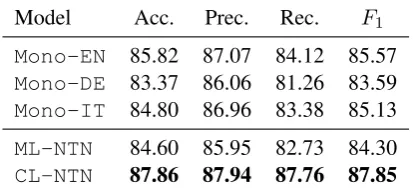
Model Acc. Prec. Rec. F1
Mono-EN 85.82 87.07 84.12 85.57
Mono-DE 83.37 86.06 81.26 83.59
Mono-IT 84.80 86.96 83.38 85.13
ML-NTN 84.60 85.95 82.73 84.30
[image:5.595.78.285.64.158.2]CL-NTN 87.86 87.94 87.76 87.85
Table 3: Performance (%) on link prediction.
the subset of CLKB triples used for training. The final evaluation of the model is always performed on the triples from the test portion of the original (i.e., English) WN11 dataset. We evaluate:
1. Three monolingual models – Mono-EN
(direct reimplementation of the original NTNKBC model),Mono-DE, andMono-IT
– trained respectively using only monolingual English, German, and Italian triples;
2. The multilingual model (ML-NTN), trained us-ing the union of the three sets of monolus-ingual triples;
3. The cross-lingual model (CL-NTN) in which we use all cross-lingual triples in addition to all monolingual triples.
4.2 Results and Discussion
The link prediction performance for all above-mentioned models, measured on the test portion of the originalWN11dataset (containing English triples) is shown in Table 3.
Mono-ENachieves accuracy of85.8%, which is very close to the 86.2%accuracy reported by Socher et al. (2013). The monolingual English modelMono-ENsignificantly (p <0.01)2
outper-forms the other two monolingual models. We credit this performance gap to the significantly larger training set (38.7K entities and 112.5K triples vs. 33.4K entities and 92K triples for both Ger-man and Italian). The Italian monolingual model (Mono-IT) outperforms the German monolingual model (Mono-DE) despite comparable training set sizes, which we credit to the lower quality of the DE→EN translation matrix in comparison with the IT→EN translation matrix (see Table 2).
The multilingual model outperforms only one of the three monolingual models. This is not so sur-prising (although it might seem so at first glance) if
2All performance differences were tested for significance
using the non-parametric stratified shuffling test (Yeh, 2000).
we consider thatML-NTNmerely combines three disjoint KBs which share semantic information only through shared embedding space and relation tensors. Without the direct, cross-lingual links be-tween entities of different monolingual KBs, these signals seem to be insufficient to compensate for a much larger number of parameters (three times larger number of entities) that theML-NTNmodel has to learn compared to monolingual models.
The cross-lingual model (CL-NTN), on the other hand, significantly outperforms all monolingual models. We believe that this is because by adding cross-lingual triples we introduce additional regu-larization to the model – although cross-lingual triples describe the same facts as monolingual triples (i.e., same relations between same entities) the facts get represented slightly differently due to imperfect embedding translation and inherent language differences. We believe that this effect is similar to adding noise when training denoising autoencoders (Vincent et al., 2008), in order to ob-tain more robust entity representations. We believe that the addition of German and Italian monolin-gual triples has the same regularizing effect as the addition of cross-lingual triples, but their number is significantly smaller (184K compared to 550K cross-lingual triples) and alone they do not com-pensate for increased model complexity (i.e., three times larger number of entity vectors to be learned).
5 Conclusion
References
Alessio Palmero Aprosio, Claudio Giuliano, and Al-berto Lavelli. 2013. Extending the coverage of DBpedia properties using distant supervision over Wikipedia. InProceedings of the 2013 Workshop on Natural Language Processing and DBpedia, pages 20–31, Trento, Italy.
Marco Baroni, Silvia Bernardini, Adriano Ferraresi, and Eros Zanchetta. 2009. The wacky wide web: a collection of very large linguistically processed web-crawled corpora. Language resources and evalua-tion, 43(3):209–226.
Christian Bizer, Jens Lehmann, Georgi Kobilarov, S¨oren Auer, Christian Becker, Richard Cyganiak, and Sebastian Hellmann. 2009. DBpedia – A crys-tallization point for the web of data. Journal of Web Semantics, 7(3):154–165.
Kurt D. Bollacker, Colin Evans, Praveen Paritosh, Tim Sturge, and Jamie Taylor. 2008. Freebase: a collaboratively created graph database for struc-turing human knowledge. In Proceedings of the International Conference on Management of Data (SIGMOD), pages 1247–1250, vancouver, British Columbia, 2008.
Antoine Bordes, Jason Weston, Ronan Collobert, and Yoshua Bengio. 2011. Learning structured em-beddings of knowledge bases. In Proceedings of the 2011 AAAI Conference on Artificial Intelligence, pages 301–306, San Francisco, California, USA. Antoine Bordes, Nicolas Usunier, Alberto
Garcia-Duran, Jason Weston, and Oksana Yakhnenko. 2013. Translating embeddings for modeling multi-relational data. In Proceedings of the 2013 An-nual Conference on Neural Information Process-ing Systems (NIPS), pages 2787–2795, Lake Tahoe, Nevada, USA.
Volha Bryl and Christian Bizer. 2014. Learn-ing conflict resolution strategies for cross-language Wikipedia data fusion. InProceedings of the 2014 World Wide Web Conference (WWW), pages 1129– 1134, Seoul, Korea.
Andres Carlson, Justin Betteridge, Bryan Kisiel, Burr Settles, Estevam R. Jr. Hruschka, and Tom M. Mitchell. 2010. Toward an architecture for never-ending language learning. In Proceedings of the 2010 AAAI Conference on Artificial Intelligence, pages 1306–1313, Atlanta, Georgia, USA.
Danqi Chen, Richard Socher, Christopher D. Manning, and Andrew Y. Ng. 2013. Learning new facts from knowledge bases with neural tensor networks and semantic word vectors. In Proceedings of the Workshop Track of the International Conference on Learning Representations (ICLR), page N/A, Scotts-dale, Arizona, USA.
Xin Dong, Evgeniy Gabrilovich, Geremy Heitz, Wilko Horn, Ni Lao, Kevin Murphy, Thomas Strohmann,
Shaohua Sun, and Wei Zhang. 2014. Knowledge vault: A web-scale approach to probabilistic knowl-edge fusion. In Proceedings of the 2014 ACM SIGKDD Conference on Knowledge Discovery and Data Mining (KDD), pages 601–610, New York City, New York, USA.
Arnab Dutta, Christian Meilicke, and Simone Paolo Ponzetto. 2014. A probabilistic approach for integrating heterogeneous knowledge sources. In Proceedings of the 2014 European Semantic Web Conference (ESWC), pages 286–301, Anis-sara/Hersonissou, Crete, Greece.
Oren Etzioni, Anthony Fader, Janara Christensen, Stephen Soderland, and Mausam. 2011. Open in-formation extraction: The second generation. In
Proceedings of the 2011 International Joint Confer-ence on Artificial IntelligConfer-ence (IJCAI), pages 3–10, Barcelona, Spain.
Manaal Faruqui and Shankar Kumar. 2015. Multilin-gual open relation extraction using cross-linMultilin-gual pro-jection. InProceedings of the 2015 Conference of the North American Chapter of the Association for Computational Linguistics Human Language Tech-nologies (NAACL HLT), pages 1351–1356, Denver, Colorado, USA.
Manaal Faruqui, Jesse Dodge, Sujay K. Jauhar, Chris Dyer, Eduard H. Hovy, and Noah A. Smith. 2015. Retrofitting word vectors to semantic lexicons. In
Proceedings of the 2015 Conference of the North American Chapter of the Association for Computa-tional Linguistics Human Language Technologies (NAACL HLT), pages 1606–1615, Denver, Colordao, USA.
Christiane Fellbaum, editor. 1998. WordNet: An Elec-tronic Lexical Database. MIT Press, Cambridge, Mass.
Rahul Gupta, Alon Halevy, Xuezhi Wang, Steven Whang, and Fei Wu. 2014. Biperpedia: An ontol-ogy for search applications. InProceedings of the 2014 International Conference on Very Large Data Bases (VLDB), pages 505–516, Hangzhou, China. Kelvin Guu, John Miller, and Percy Liang. 2015.
Traversing knowledge graphs in vector space. In
Proceedings of the Conference on Empirical Meth-ods in Natural Language Processing (EMNLP), pages 318–327, Lisbon, Portugal.
Johannes Hoffart, Fabian M. Suchanek, Klaus Berberich, and Gerhard Weikum. 2013. YAGO2: a spatially and temporally enhanced knowledge base from Wikipedia. Artificial Intelligence, pages 28– 61.
T. Mikolov, Quoc V. Le, and Ilya Sutskever. 2013a. Ex-ploiting similarities among languages for machine translation. CoRR, abs/1309.4168.
Tomas Mikolov, Ilya Sutskever, Kai Chen, Greg S Cor-rado, and Jeff Dean. 2013b. Distributed representa-tions of words and phrases and their compositional-ity. InProceedings of the 2013 Annual Conference on Neural Information Processing Systems (NIPS), pages 3111–3119, Lake Tahoe, Nevada, USA.
Mike Mintz, Steven Bills, Rion Snow, and Dan Juraf-sky. 2009. Distant supervision for relation extrac-tion without labeled data. In Proceedings of the Joint conference of the 47th Annual Meeting of the Association for Computational Linguistics and the 4th International Joint Conference on Natural Lan-guage Processing of the Asian Federation of Natural Language Processing (ACL-IJCNLP), pages 1003– 1011, Suntec, Singapore.
Roberto Navigli and Simone P. Ponzetto. 2012a. Ba-belnet: The automatic construction, evaluation and application of a wide-coverage multilingual seman-tic network. Artificial Intelligence, 193:217–250.
Roberto Navigli and Simone Paolo Ponzetto. 2012b. Joining forces pays off: Multilingual joint Word Sense Disambiguation. InProceedings of the 2012 Conference on Empirical Methods in Natural Lan-guage Processing (EMNLP), pages 1399–1410, Jeju Island, Korea.
Maximilian Nickel, Kevin Murphy, Volker Tresp, and Evgeniy Gabrilovich. 2016a. A review of relational machine learning for knowledge graphs. Proceed-ings of the IEEE, 104(1):11–33.
Maximilian Nickel, Lorenzo Rosasco, and Tomaso A. Poggio. 2016b. Holographic embeddings of knowl-edge graphs. InProceedings of the 2016 AAAI Con-ference on Artificial Intelligence, pages 1955–1961, Phoenix, Arizona, USA.
Rion Snow, Dan Jurafsky, and Andrew Ng. Semantic taxonomy induction from heterogeneous evidence. In Proceedings of the Joint conference of the Inter-national Committee on Computational Linguistics and the Association for Computational Linguistics (COLING-ACL), pages 801–808, Sydney, Australia.
Rion Snow, Daniel Jurafsky, and Andrew Y. Ng. 2004. Learning syntactic patterns for automatic hypernym discovery. In Proceedings of the 2004 Annual Conference on Neural Information Processing Sys-tems (NIPS), pages 1297–1304, Vancouver, British Columbia, Canada.
Richard Socher, Danqi Chen, Christopher D Manning, and Andrew Ng. 2013. Reasoning with neural ten-sor networks for knowledge base completion. In
Proceedings of the 2013 Annual Conference on Neu-ral Information Processing Systems (NIPS), pages 926–934, Lake Tahoe, Nevada, USA.
Shyam Upadhyay, Manaal Faruqui, Chris Dyer, and Dan Roth. 2016. Cross-lingual models of word em-beddings: An empirical comparison. InProceedings of the 2016 Annual Meeting of the Association of Computational Linguistics (ACL), pages 1661–1670, Berlin, Germany.
Pascal Vincent, Hugo Larochelle, Yoshua Bengio, and Pierre-Antoine Manzagol. 2008. Extracting and composing robust features with denoising autoen-coders. In Proceedings of the 2008 International Conference on Machine Learning (ICML), pages 1096–1103, Helsinki, Finland.
Zhichun Wang, Juanzi Li, Zhigang Wang, and Jie Tang. 2012. Cross-lingual knowledge linking across wiki knowledge bases. In Proceedings of the 2012 World Wide Web Conference (WWW), pages 459– 468, Lyon, France.
Zhen Wang, Jianwen Zhang, Jianlin Feng, and Zheng Chen. 2014. Knowledge graph embedding by trans-lating on hyperplanes. InProceedings of the 2014 AAAI Conference on Artificial Intelligence, pages 1112–1119, Qu´ebec, Canada.
Robert West, Evgeniy Gabrilovich, Kevin Murphy, Shaohua Sun, Rahul Gupta, and Dekang Lin. 2014. Knowledge base completion via search-based ques-tion answering. InProceedings of the 2014 World Wide Web Conference (WWW), pages 515–526, Seoul, Korea.
Wentao Wu, Hongsong Li, Haixun Wang, and Kenny Zhu. 2012. Probase: A probabilistic taxonomy for text understanding. InProceedings of the 2012 Inter-national Conference on Management of Data (SIG-MOD), pages 481–492, Scottsdale, Arizona, USA. Bishan Yang, Wen-tau Yih, Xiaodong He, Jianfeng
Gao, and Li Deng. 2015. Embedding entities and relations for learning and inference in knowledge bases. In Proceedings of the 2015 International Conference on Learning Representations (ICLR), page N/A, San Diego, California, USA.