S T R U C T U R E - D R I V E N G E N E R A T I O N
F R O M S E P A R A T E S E M A N T I C R E P R E S E N T A T I O N S
S t e p h a n B u s e r n a n n
D e u t s c h e s F o r s c h u n g s z e n t r u m fiir K f i n s t l i c h e I n t e l l i g e n z ( D F K I ) G m b H S t u h l s a t z e n h a u s w e g 3, D-6600 S a a r b r f i c k e n 11
u u c p : b u s e m a n n @ d f k i . u n i - s b . d e
A B S T R A C T
A new approach to structure-driven generation is I)resented that is based on a separate seman- tics as input structure. For the first time, a GPSG- based formalism is complemented with a system of pattern-action rules that relate the parts of a se- mantics to appropriate syntactic rules. This way a front end generator can be adapted to some ap- plication system (such as a machine translation system) more easily than would be possible with many previous generators based on modern gram- mar formalisms. 1
I N T R O D U C T I O N
In the licld of unification-based computational linguistics, current research on tactical natural lan- guage (NL) generation concentrates on the folio- wing problem:
i
• Given a semantic representation (which is of- ten called logical form (LF)) and a grammar that includes a lexicon, what are the surface strings corresponding to the semantic repre- sentation?
A variety of approaches to solving this problem in an efficient way has been put forward on the ba- sis of unification-based grammar formalisms with a context-free backbone and complex categories (for some discussion see e.g. [Shieber et al. 1990]). Most of this work shares a Montagovian view of seman- tics by assuming that LF be integrated into the grammar rules, thus assigning to each syntactic ca- tegory its semantic representation.
Within this integrated-semantics approach the generation tmsk mainly consists of reconstructing a
1This work was partially f u n d e d by the G e r m a n Mini- s t e r for Research trod T e d m o l o g y ( B M F T ) mt(ler c o n t r a c t I T W 9002. Most of the research u n d e r l y i n g rids article was a c c o m p l i s h e d within the E U R O ' r H . A - D a c c o m p a n y i n g re- search project K I T - F A S T at t h e Technical University of Ber- lin a n d fimded by t h e B M F T trader c o n t r a c t 1013211.
I wish to t h a n k C h r i s t a l l a u e n s c h i i d , J o h n Nerbo[me, a n d I l a n s Ilszk~weit h,r c o m , , l c n t i n g on earlier ve,.'~ions of this paper.
given LF, thereby ensuring that the result is com- plete (all parts of the input structure are recon- structed) and coherent (no additional structure is built up). Thus, the surface strings then come out as a side effect.
This paper describes a different use of seman- tics for generatio n. llere the semantics is not part of the grammar, but rather expressed within a se- parate semantic representation language (abbrcv.: SRL). This approach, in which the grammar only covers the syntax part, is called the separate se- mantics approach. It has a long tradition in At NL systems, but was rarely used for unification-based syntax and semantics. It will be argued that it can still be useful for interfacing a syntactic generator to some application system.
The main goal of this paper is to describe a ge- nerator using a separate semantics and to suggest a structure-driven strategy that is bascd on a systcm of pattern-action (PA) rules, as they are known from AI production systems (for an overview see [Davis/King 1977]). The purpose of these rulcs is to explicitly relate the semantic (sub)structures to possible syntactic counterparts. The rnappizJg pro- cess is driven by the semantic input structure that is traversed step by step. At each step PA rules are applied, which contribute to successively i)roducing an overall syntactic structure from which the ter- minal string can easily be produced. This new ap- proach allows for a carefully directed and nearly deterministic choice of grammar rules.
K E E P I N G S E M A N T I C S S E P A R A T E F R O M S Y N T A X
The integrated-semantics approach is often illu- strated in a Prolog-like notation using DCG rules. The infix function symbol ' / ' is used in each ca- tegory to separate tile syntactic from the semantic part. Rule (1) introduces complements in an llPSG- style manner by "removing" tile complement from the VP's subcategorization list (cf. [Pollard/Sag 1987]). The relation between the semantics S and the semantics of Comp:l. is established in tile lexical entry for tile verb (2).
(1)
vp(Subcat)/S
- - >vp([CompllSubcat])/S, Compl.
(2) v p ( [ n p ( _ ) / 0 b j , n p ( 3 r d - s i n g ) / S u b j ] ) / k i s s ( S u b j , 0bj) --> [ k i s s e s ] .
Recent work on semantic-head-driven generation [Shieber et al. 1990, Calder et al. 1989, Noord 1990, Russell et al. 1990] provides a very promising step towards efficient, goal-directed reconstruction of LF that is espescially suited for lexicon-centered gram- mar formalisms such as IIPSG or UCG. It was ob- served that top-down generation may not termi- nate. This is illustrated in (1). If the vp node is used for top-down expansion, there is nothing to prevent the subcategorization list from growing in- finitely. If the Comp node is used, the constituent to be generated must completely be guessed due to the uninstantiated semantics. Since the grammar will contain recursive rules (e.g. for relative clau- ses), the guessing procedure will not terminate eit- her. In view of this problem a bottom-up approach was suggested that is guided by semantic informa- tion in a top-down fashion.
The benefits of integrated semantics are mani- fold. Elegant analyses of linguistic phenomena are possible that relate syntactic and semantic pro- perties to each other (cf. the treatment of e.g. 'raising' and 'equi' constructions in [Pollard/Sag 1987]). LF is defined on purely linguistic grounds and as such, it is well-suited to tile contputationai linguist's work.
llowever, if a generator based on an integrated semantics is to be used for conveying the results of some application system into NL, expressions of the application system's SRL have to be adalJted to LF. Given that tile grammar should not be rewritten, this amou,,ts to an additional'step of processing. This step may turn out to be costly since the SRL will typically contain application-dependent infor- mation that must be considered. Take, for instance, a transfer-based machine translation (MT) system (such as EUROTRA [Arnold/des Tombe 1986]). The results of the transfer (say, from German to English) are encoded in a semantic representation that is given to the system's generation component to produce the English target sentence. In a system capable of translating between a variety of langua- ges, representations of this kind may themselves be subject to transfer and will therefore contain infor- mation relevant for translation. 2
SAn exception is tim MiMe2 system [Noord et al. 1990]. T h e price to pay for allowing transfer a t the level of LF was to a c c e p t a n "extremely poor" view of translation by j u s t
preserving the logical m e a n i n g e m d - - a s far as p o s s i b l e - - t h e way in which m e a n i n g is built compositionMiy ( q u o t a t i o n from [Noord et al. 1990]).
The effort of introducing an additional step of processing can be saved to a large extent by ad- opting a separate-semantics approach. The SRL of some application system may directly serve as an interface to the generator. 3 In the case at hand, two additional components must be introduced into the generation scenario: the definition of SRL and PA rules. Instead of mapping SRL onto LF, SRL is di- rectly related to syntax by virtue of the PA rules.
A S T R U C T U R E - D R I V E N G E N E R A T O R
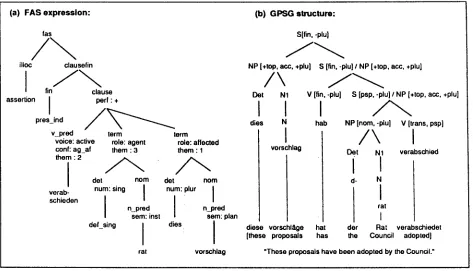
The generator to be described in this section is a module of the Berlin MT system [llauen- schild/Busemann 1988], which translates sentences taken from administrative texts in an EC corpus from German into English and vicc versa. 4 The syntax formalism Used is a constructive version of GPSG [Gazdar e t al. 1985] as described in [Buse- mann/Hauenschild 1988]. The semantic representa- tion language FAS (Functor-Argument Stuctures) [Mahr/Umbach 1990] is employed as an interface between three different processes: it is the target of GPSG-based analysis, for sentence-semantic trans- fer, and as the source for GPSG-based generation. FAS is defined by context-free rule schemata with complex categories consisting of a main category (e.g. 'clause' in Figure la), which is associated with a fixed list of feature specifications. 5 The categories are in canonical order with the functor preceding all of its arguments. In contrast to syntactic structures where agreement relations are established by virtue of feature propagation, FAS categories contain al- nmst no redundant information. For instance, num- ber information is only located at the 'det' category. The use of semantic relations (encoded by the 'role' feature), role configurations ('conf') and semantic features allows us to discriminate between different readings of words that result in different transla- tional equivalents. Moreover, part of the thematic structure of the source language sentence is preser- ved during transfer and encoded by virtue of the feature 'them' with the numerical values indicating which portion should preferrably be presented first, second, third etc. The definitions of FAS for the German and English fragments mainly differ with regard to their terminal symbols.
3This interface does n o t correspond to t h e c o m m o n sepa- r a t i o n between m a k i n g decisions a b o u t w h a t to say a n d how to say it (cf. [ M c K e o w n / S w a r t o u t 1988]). R a t h e r the inter- face in question m u s t be s i t u a t e d somewhere in the 'how to
s a y it' c o m p o n e n t because it presupposes m a n y decisions ab- o u t sentence formulation (e.g. regarding p r o n o m i n a l i z a t i o n , or voice).
4The underlying view of M T is described in [Hauenschild 1988].
Sln the present versions t h e r e a r e u p to seven features in a FAS category. For sake of simplicity m a n y details irrelevant to the present discussion are o m i t t e d in the examples.
(a) FAS expression:
fas
/ \
illoc clauselin
/ \
fin clause
assertion I porf : +
pres_ind J / ~ ' ~ ' ~ , ~ . ~
v__pred term
voice: active role: agent
conf: ag_af them : 3
them : 2 ~ , ~
I
det
nom/ \
verab- num: sing I
schieden I
n w e d sere: inst
de[_sing J
rat
term role: affected them : 1
/-...
det nom
num: plur I
n_pred sem: plan
dies I
vorschlag
(b) G P S G structure:
S[fin, -plul
NP [+top, acc, +plu] S [fin, -plu] / NP [+top, acc. +plu]
/ \
Det N1 V [fro, -plu] S [psp, -plu] / NP [+top, acc. +plu]
dies N hab NP [nom. -plul V [trans, pspl
I
/\
I
vorschlag Dot N1 verabschied
I
I
d- N
I
fal
I
diese vorschl~tge hat der Rat verabschiedet
]these proposals has the Council adopted]
"These proposals have been adopted by the Council."
Figure 1: Sample FAS Expression (a) and Corresponding G P S G S t r u c t u r e (b).
T h e G P S G formalism used includes the I D / L P format, feature co-occurrence restrictions (FCRs) and universal principles of feature instantiation (FIPs). T h e ID rules are interpreted by the gene- rator as providing the basic information for a local tree. T h e categories of each generated local tree are filrther instantiated by the FIPs and FCRz. Finally, the branches are ordered by virtue of the LP state-
lnen|.s.
S t r a t e g i e s f o r s t r u c t u r e b u i l d i n g a n d f e a t u r e i n s t a n t i a t i o n . T h e task of constructing an admis- sible G P S G syntactic s t r u c t u r e call be divided up into the following suhta.sks t h a t can be performed independently of each other, and each according to its own processing strategy:
,, S t r u c t u r e building (by virtue of PA rules, which in turn use ID rules)
. Feature instantiaton and ordering of the bran- ches (by virtue of FIPs, FCRs and LP state- merits)
T h e question arises which strategies are best sui- ted to ellicient generation. For each subtask both a top-down and a b o t t o m - u p strategy h a v e been investigated. As a result it turned out t h a t struc- ture building shouhl occur top-down whereas fea- ture instantiation should be performed in a b o t t o m - up manner.
Before .justifying the result let us have a closer look at the sl.ructure-buiiding algorithm. Tile over-
all syntactic structure (OSS) is successively con- strued in a top-down manner. At each level there is a set of nonterminal leaf nodes available serving
as a t t a c h m e n t points for further expansion steps (initially tile e m p t y category is the only a t t a c h m e n t point). An expansion step consists of
1. generating a local tree t by virtue of an ID rule,
2. unifying its m o t h e r node with one of the a t t a c h m e n t points,
3. removing the a t t a c h m e n t point from the cur- rent set,
4. defining tile daughters of t as the new current set of a t t a c h m e n t points.
Since lexicai entries terminate a branch of the OSS, the fourth of the above points is dropped during expansion of lexical categories: processing continues with the reduced set of a t t a c h m e n t points.
Feature instafftiation and the ordering of bran- ches take place in a b o t t o m - u p m a n n e r after a lo- cal tree has no fuither a t t a c h m e n t points associated with it (i.e. all of its daughters have been expan- ded). T h e n processing returns to tile next higher level o f tile OSS examining the set of a t t a c h m e n t points. Depending on whether or not it is empty, the next step is either feature instantiation or struc- ture building. Given this interlinking of the two subtasks, all OSS is a d m i t t e d by tile g r a m m a r if
[image:3.596.63.536.74.345.2]its top-most local tree has passed feature instantia- tion.
T h e effects of feature instantiation with respect to the G e r m a n example in Figure l b 6 can be b e t t e r understood with the help of the S-expansion rules used; of. (3)-(5). t Rule (3) causes topicalization, (4) introduces a perfect auxiliary, and (5) requires a transitive verb whose object is topicalized.
(3). S , X[+top],S[fin] / X[+top]
(4) s
,v,s[psp]
(5) s / NP[+top, ace]
, NP[nom], V[trans]
T h e solution will now be justified. First of all, note t h a t the top-most part of an FAS expression is re- lated to tile top-most part of the G P S G structure, and that the leaves of a FAS expression usually cor- respond to G P S G lexicon entries. As a consequence, the order the FAS expression is traversed determi- nes the order in which the structure-building sub- task is performed. W h y should then, in the case of FAS, the traversal occur top-down?
T h e answer is motivated by the distribution of in- formation in FAS expressions. In order to apply a certain ID rule deterministically, information from distant portions of tim FAS expression may be nee- ded. For instance, the FAS specification (them : 1), which is part of one of the daughters of c l a u s e in Figure la, is interpreted as requiring topicaliza- tion of a syntactic constituent under the condition t h a t a declarative sentence is being generated. This latter information is, however, only available at the [ i l l o ¢ [ a s n e r t i o n ] ] s part of the FAS expression (of. Figure la).
T w o possible m e t h o d s for collecting this infor- nration present themselves. First, the pattern in- cluding (them : 1) could be required to cover as nmch of the FAS expression as would be needed to include i ] . l o c . In that case, all the information nee- ded is present, and the traversal of the FAS expres- sion could occur b o t t o m - u p as well as top-down. • U n f o r t u n a t e l y the required size of the pattern is not always known in advance because the FAS syn- tax might allow an a r b i t r a r y number of recursively defined local trees to intervene.
T h e second m e t h o d - - w h i c h was eventually a d o p t e d - - r e q u i r e s the patterns to cover not more than one local FAS tree. In order to gather infor- mation t h a t is locally missing, an auxiliary storage is needed. If, for instance, the illocution is mat- ched, information a b o u t whether or not a declara- tive sentence is being generated is stored. Later on, (them : 1) is encountered. Now, the ID rule for to-
6 T h e s e a r e n o t s h o w n for t h e c o n s t i t u e n t s of N P s .
ZNote the different u s e o f t h e s y m b o l ' / ' : h e r e it d e n o t e s
the c a t e g o r y - v a l u e d f e a t u r e ' s l a s h ' .
e S q u a r e b r a c k e t s a r e u s e d h e r e to i n d i c a t e tree s t n i c t u r e .
picalization (3) is triggered iff 'declarative' can be retrieved from the storage.
If the necessary information is not available yet, one must accept either a delay of a mapping or backtracking. With a top-down traversal of FAS expressions, however, such cases are sufficiently re- stricted to ensure efficiency. Note that a b o t t o m - u p traversal or a mixed strategy could be more efficient if the distribution of information in the SRL were different.
T h e problems observed with top-down genera- tots using an integrated semantics c a n n o t occur in the separate-semantics approach. Expansion of g r a m m a r rules can be controlled by the semantic representation if each rule application is explicitly triggered. Situations causing an infinite expansion due to an uninstantiated semantics (as with top- down expansion using the rule (2)) cannot arise at all since the separate semantics is fully specified.
Let us now discuss why feature instantiation should be a b o t t o m - u p process. T h e FIPs apply to tim mother a n d / o r a subset of daughters in a local tree. In general, tile more these categories are instantiated the less likely the l"lPs will have to choose between alternative instantiations, which would be a source for backtracking. A top-down strategy would meet a more completely instan- tiated mother, but still underspecified daughters. With a b o t t o m - u p strategy, howew:r, only tile mo- ther would be underspecified. For instance, consi- der the G P S G account of parasitic gaps, which are handled by the Foot Feature Principle. T h e 'slash' feature may occur at more than one daughter and then require all occurrences of it to unify with the m o t h e r (el. [Gazdar et al. 1985, p. 16211]). While this is easy to handle for a b o t t o m - u p process, a top-down strategy would have to guess at which daughters to instantiate a slash value.
P a t t e r n - a c t i o n r u l e s . A PA rule is a pro- duction rule with a pattern for local FAS trees as its left-hand side and two sets of actions as its right-hand side. T h e information-gathering ac- lions (IGAs) maintain the auxiliary storage. T h e structure-building actions (SBAs) generate G P S G trees. Either one of these sets may be empty.
In:order to minimize tim power of PA rules, the inventory of IGAs and SBAs is restricted. T h e r e are only lthree 1GAs for storing information into and removing from the auxiliary storage. T h e auxiliary storage is a two-dimensional array of a fixed size. It may contain atomic values for a set of features pre- determined by the PA rule writer as well as a single G P S G category. T h e r e are only five SBAs for diffe- rent kinds of mapping, three of which are explained below; cf. [Busemann 1990] for a coml)rehensive dis- cussion. Any SBA' will remove the stored category
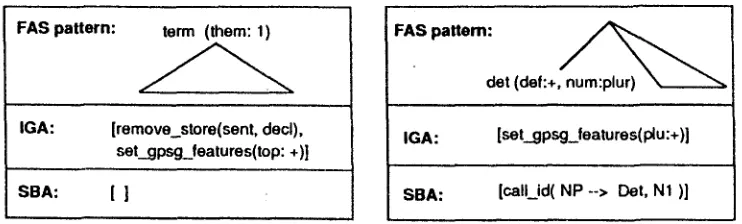
FAS pattern: term (them: 1)
IGA: [removestore(sent, decl),
set_.gpsg, features(top: +)]
SBA: I I
FAS pattern:
dot (def:+, num:plur) \ " ~
IGA: [set_gpsg_features(plu:+)]
SBA: [calUd( NP --> Det, N1 )]
Figure 2: T w o Pattern-Action Rules for NP-Topicalization.
from the storage and unify it with the :mother of the local tree it is a b o u t to generate.
To illustrate this let us return to the topica- lization example. T h e responsible PAl rules are shown in Figure 2. T h e pattern of the first one naatches any local FAS tree whose mbther is a t e r m ( t h e m : 1). T h e 1GAs work as follows: I f a spe- cification (sent : (lecl) can be removed from the sto- rage, the G P S G feature specification [+top] will be added to the stored category (by virtue of the IGA s e t _ g p s g _ f e a t u r e s ) . T h e SBA set is empty. T h e second PA rule matches any local FAS tree whose first daughter is a dcfinite d e t e r m i n e r with plural number followed by zcro or more daughters. Note t h a t both patterns match the same local tree of the FAS expression in Figure la. T h e r e is only one IGA, which adds the number information to the stored G P S G category. T h e single SBA, c a l l _ i d , states that a local G P S G tree is generated by virtue of the ID rule indicated and added to the OSS. Since the mother of the local tree (NP) now contains the spe- cification [+top], it, can only unify with the 'slash' value introduced by the mother of rule (5). Fron- ting of the NP is achieved in accordance with the FIPs and LP statements.
T h r e e kinds of PA rules should be distinguished according to the effects of their SBAS. Figure 2 shows two of tl,em; the first one doesn't create s t r u c t u r e at, all while the second one t r a n s d u c e s a (FAS) local tree into a ( G P S G ) loi:ai tree. A third type of rules generates G P S G structure out of FAS feature specifications. Figure 1 shows its use to generate the non-local subtree including the per- fect auxiliary fs I'v [hab'l, s ( p s p ) ] ] from the local FAS tree dominated by c l a u s o ( p e r f : + ) . Note that this PA rule must be applied be- fore an a t t e m p t is started to attach the subtree f s / n p ( a c c ) [np(nom), v ( t r a n s ) ] ] . This latter subtree is generated by a PA rule whose pattern rnatches the same FAS tree as the previous one. We shall return to this problem in the following section.
C o n t r o l l i n g t h e n t a p l > i n g procc.'dure.. First of all note that PA rules can comrnunicate with each
other only indirectly, i.e. by modifying the content of the auxiliary storage or by successfully apply- ing an SBA, thereby creating a situation in which another rule becomes applicable (or cannot be ap- plied anymore). PA rules do not contain any control knowledge.
A local FAS tree is completely verbalized iff a m a x i m u m number rt > 1 of applicable PA rules are successful. A PA rule is applicable to a local FAS tree t iff its p a t t e r n unifies with t. An applicable PA rule is successful iff all elements of IGA can be executed and an S B A - - i f p r e s e n t - - i s successful. An SBA is successful iff a syntactic subtree can be attached to the OSS as described above.
Since the set of PA rules is not commutative, the order of application is crucial in order to ensure t h a t 72 is maximal. Due to the restricted power of the PA rules possible conflicts can be detected and resolved a priori. A conflict arises if more than one p a t t e r n matches a given FAS tree. All FAS trees matched by more than one p a t t e r n can be identified with help of the FAS grammar. T h e respective PA rules are members of the same conflict set. T h e elements of a conflict set can be partially ordered by virtue of precedence rules operating on pairs of PA rules. For instance, the conflict regarding the perfect auxiliary is resolved by making a precedence rule check the ID rules that would be invoked by the re- spective SBAs. If the mother of the second one can be unified with a daughter of the first one and not vice versa, then the first PA rule must be applied before the second one. Thus a PA rule with an SBA invoking ID rule (4) will apply before another one wifll an SBA invoking ID rule (5).
Note that, in this example, the number of suc- cessful PA rules would not be maximal if the order of application was the other way around since the SBA invoking ID rule (4) would not succeed any- more.
T h e control regime described above guarantees termination, completeness and coherence in the fol- lowing way: T h e traversal of a FAS expression ter- minates since there is only a finite number of local trees to be investigated, and for each of them a
[image:5.596.111.482.70.182.2]finite number of PA rules is applicable. T h e a S S generated is complete because all local FAS trees are processed and for each a maximum rmmber of PA rules is successful. It is coherent because (1) no PA rule may be applied whose pattern is not mat- ched by the FAS expression and (2) all a t t a c h m e n t points nmst be expanded.
C O N C L U S I O N
T h e a d a p t a t i o n of a G P S G - b a s e d generator to an M T system using FAS as its SRL was described as an instance of the separate-semantics approach to surface generation. In this instance, the OSS is most efficiently built top-down whereas feature in- stmltiation is performed b o t t o m - u p .
T h e mapping based on PA rules has proved to be efficient in practice. T h e r e are only a few cases where backtracking is required; most often the local FAS tree being verbalized allows together with the contents of the auxiliary storage and the current set of a t t a c h m e n t points for a deterministic choice of g r a m m a r rules.
T h e generator has been fully implemented and tested with middle-sized fragments of English and G e r m a n . It is part of the Berlin M T system and runs on both an IBM 4381 under V M / S P in Water- loo Core Prolog and a P C X T / A T in Arity Prolog. C o m p a r e d to algorithms based on an integrated semantics the separate-semantics approach pursued here is promising if the generator has to be adapted to the SRL of some application system. Adaptation then consists in modifying the set of PA rules rather than in rewriting the grammar.
R E F E R E N C E S
[Arnold/des Tombe 1986] Doug Arnold and Louis des "Ibmbe (1986), 'Ba.~ic Theory and Methodology in Eurotra', in S. Nirenburg (ed.), Theoretical and Me- thodological Issues in Machine Translation, Cam- bridge: Cambridge University Press, 114-135.
[Busemann 1990] Stephan Busemann (1990), Gcne- rierung nat6rlichcr Sprache mit Generalisierten Phrascnstruktur-Grammatiken, Doctoral Disserta- tion, Universit~t des Saarlandes, Saarbriicken. Also available: TU Berlin, Dept. of Computer Science, KIT Report 87.
[Busemann/Ilauenschild 1988]
Stephan Busemann and Christa Hauenschild (1988), 'A Constructive View of GPSG or Itow to Make it Work', in Proc. leth COLING-88, Budapest, 77-82. [Calder et ai. 1989] Jonathan Calder, Mike Reape, and llenk Zeevat (1989), 'An Algorithm for Generation in Unification Categorial Grammar', in Proc. 4th Conf. of the European Chapter of the ACL, Manchester, 233-240.
[Davis/King 1977] Randall Davis und Jonathan King (1977), 'An Overview of Production Systems', in E. W. Elcock and D. Michie (eds.), Machine Intelligence 8, Chichester: Ellis Itorwood, 300-332.
[Gazdar ct al. 1985] Gerald Gazdar, Ewan Klein, Ge-
offrey Pullum, and Ivan Sag, (1985), Generalized
Phrase Structure Grammar, Oxford: Blackwell. [Hauenschild 1988] Christa Hauenschild (1988), 'Dis-
course S t r u c t u r e - - S o m e Imphcations for Machine
Translation', in D. Maxwell, K. Schubert und A.
P. M. Witkam (eds.), New Directions in Machine Translation, Dordrecht: Foris, 145-156.
[tlauenschild/Busemann 1988] Christa llauen-
schild and Stephan Busemann (1988), 'A Construc- tive Version of GPSG for Machine Translation', in E. Steiner, P. Schmidt, and C. Zelinsky-Wibbelt (eds.), From Syntax to Semantics--Insights From Machine Translation, London: Frances Pinter, 216-238. [MMtr/Umbach 1990] Bernd Mahr and Carla Umbach
(1990), 'Functor-Argument Structures for the Mea- ning of Natural Language Sentences and Their For- mal Interpretation', in K.-H. Bl~sius, U. Hedstiick, and C.-R. Rollinger (eds.), Sorts and Types in Artifi- cial Intelligence, Berlin, New York: Springer (Lecture Notes in Artificial Intelligence 418), 286-304.
[McKeown/Swartout 1988] Kathleen R. McKeown and William R. Swartout, 'Language Generation and Ex- planation', in M. Zock and G. Sabah (eds.), Advan- ces in Natural Language Generation. An blterdisci- plinary Perspective. Vol. 1, London: Frances Pinter,
1-52.
[Noord 1990] Gertjan van Noord (1990), 'An Overview of Head-Driven Bottom-up Generation', in R. Dale, C. Mellish, and M. Zock (eds.), Current Research in Natural Language Generation, Academic, 141-165. [Noord et al. 1990] Gertjan van Noord, Joke Dorre-
paal, Pim van tier Eijk, Maria Florenza, and Louis des qbmbe (1990), 'The MiMo2 Research System', in Proc. 3rd Int. Conf. on Theoretical and Methodolo- gical Issues in Machine Translation, Austin, Texas. [Pollard/Sag 1987] Carl J. Pollard and Ivan A. Sag
(1987), Information-Based Syntax and Semantics. Volume I, Center for the Study of Language and In- formation, CSLI Lecture Notes 13, Chicago: Univer- sity of Chicago Press.
[Russell et al. 1990] Graham Russell, Susan Warwick, and John Carroll (1990), 'Asymmetry in Parsing and Generating with Unification Grammars: Case Stu- dies from ELU', in Prac. Conf. o/ the ~8th Annual Meeting of the ACL, Pittsburgh, 205-211.
[Shieber et al. 1990] Stuart M. Shieber, Gertjan van Noord, Robert C. Moore, and Fernando C. N. Pereira (1990), 'A Semantic-Head-Driven Generation Algo- rithm for Unification-Based Formalisms', in Compu- tational Linguistics, 16(1), 30-42.