XPL: a language for modular homogeneous language
embedding
CLARK, Tony <http://orcid.org/0000-0003-3167-0739>
Available from Sheffield Hallam University Research Archive (SHURA) at:
http://shura.shu.ac.uk/12070/
This document is the author deposited version. You are advised to consult the
publisher's version if you wish to cite from it.
Published version
CLARK, Tony (2015). XPL: a language for modular homogeneous language
embedding. Science of Computer Programming, 98 (4), 589-616.
Copyright and re-use policy
See
http://shura.shu.ac.uk/information.html
XPL: A Language for Modular Homogeneous Language
Embedding
Tony Clark
Department of Computer Science, Middlesex University, London NW4 4BT, UK
Abstract
Languages that are used for Software Language Engineering (SLE) offer a range of fea-tures that support the construction and deployment of new languages. SLE languages offer features for constructing and processing syntax and defining the semantics of lan-guage features. New lanlan-guages may be embedded within an existing lanlan-guage (internal) or may be stand-alone (external). Modularity is a desirable SLE property for which there is no generally agreed approach. This article analyses the current tools for SLE and identifies the key features that are common. It then proposes a language called XPL that supports these features. XPL is higher-order and allows languages to be constructed and manipulated as first-class elements and therefore can be used to represent a range of approaches to modular language definition. This is validated by using XPL to define the notion of alanguage modulethat supports modular language construction and language transformation.
Keywords: domain specific languages, software language engineering, language modules
1. Modular Software Language Engineering
1.1. Background
There is increasing interest inSoftware Language Engineering(SLE) where new lan-guages are defined as part of the system engineering process. In particular Domain Specific Language (DSL) Engineering [1, 2] is an approach whereby a new language is defined or an existing language is extended; in both cases DSLs involve constructing abstractions that directly support the elements of a single problem domain. This is to be contrasted withGeneral Purpose Languages (GPLs) that have features that can be used to represent elements from multiple problem domains.
There are a large number of technologies that are currently used to engineer languages used in Software Engineering. These include:grammarwarethat are traditionally used to process syntax;macros that are used to extend a language with rewrite rules; language IDEs such as XText [3] and MPS [4] that can be used to generate language-specific tooling; TXL [5] and Stratego/XT [6] that are based on language rewriting.
Some of these technologies have been available in languages that were designed many years ago. For example Common Lisp, designed in the 1980’s contains a sophisticated macro system. Some of the tools are very new such as MPS and Stratego/XT. Emerging languages such as Fortress [7] include language extension mechanisms.
Although there are many different technologies that support SLE, they have many similar features. Many provide mechanisms for transforming text to syntax structures that are subsequently processed either in terms of evaluation or translation to other languages. Furthermore, many of these technologies allow new language features to be embedded in an existing language, effectively incrementally extending the host language. This form of host language embedding is calledhomogeneousbecause the new language features aresugarand do not require any new execution mechanisms compared to het-erogeneousembedding that involves both new syntaxandsemantics.
This article aims to identify the key features of languages for SLE and to provide a language, called XPL, that supports these features. Unlike existing technologies for SLE, XPL is not concerned with pragmatic issues such as efficiency and tooling. Therefore, XPL provides a simple basis for the definition of SLE approaches and for designing new language features. To validate this claim, we use XPL to define a feature calledlanguage modulesthat can be used to build, analyse and transform new languages.
This article is constructed as follows: Section 1.2 provides an overview of existing SLE technologies and section 1.3 identifies common features. Section 1.4 reviews issues relating to modular homogeneous SLE and 1.5 describes the problems addressed and the contribution of this work. Section 2 introduces XPL and relates its features to homogeneous language embedding. Section 3 identifies different types of SLE modularity and shows how modularity can be encoded in XPL. Homogeneous language embedding in XPL is described in section 4 and is extended to module templates in section 5 and to module morphisms in section 6.
1.2. Technologies for Software Language Engineering
Languages can be defined using traditional compiler technologies such as Lex, Yacc, ANTLR [8], JavaCC [9], and more recent technologies such as XText [3]. These tech-nologies provide mechanisms for defining grammars. A grammar defines the syntax of a language; grammar translations produce tools for language processing such as parsers and editors. Whilst most are mature, these technologies focus on syntax processing (al-though some provide technology for a limited form of static semantics). Pre-processor languages such as Awk and A* [10] can be used to implement new language features, however typically, a pre-processor has very limited knowledge of the underlying language structure and cannot access contextual information.
MetaML [11] was one of the first languages to identifystagingin language processing where a multi-stage program involves the generation, compilation and execution of code, all within the same process. MetaML introduced four staging annotations that construct syntax, escape from quoted syntax, lift values to produce syntax, and run syntax values within a context. Template Haskell [12] used a similar approach and introduced monads to achieve hygiene.
is type-checked. The limitations of the approach are that the concrete syntax of both languages cannot be extended in any way and compile-time meta-programming cannot be nested.
The approach described in [13] reviews a number of languages that provide macros: the C pre-processor CPP; C++ templates; M4; Tex; Dylan; the Jakarta Tool Suite JTS; Scheme; the Meta Syntactic Macros System MS2. Pre-processors, such as M4 and CPP, are described as being limited due to having no knowledge of the underlying syntax structure. The authors make a distinction between languages with one-pass and multi-pass macro systems and those with macro binding scopes. A distinction is made between macro calls within a macro definition that lazily expand (on each invocation) and those that eagerly expand (once at definition time). Macro systems differ in terms of the amount of error handling they provide, particularly in terms of trailing back from an error to the original syntax. The authors go on to define a macro language that allows new language constructs to be added to the host language in terms of syntax and metamorphism (syntax translation rule) definitions.
In [14] the authors propose a solution to what they term the500 Language Problem
by which they mean the proliferation, and problems arising as a result, of the huge number of languages, public and proprietary, used in commercial software systems. The proposal is to base system engineering around a generic core and to use a grammar-based approach to provide interoperable technology forlanguage renovation. The term
grammarwareis coined in [15] to describe an approach to Software Engineering in terms of the construction, tooling and maintenance of grammars, and by implication of a language driven approach to engineering software systems.
Language Oriented Programming [16] often involves extending an existing language with a macro system. Maya [17] is a system that supports language extensions to Java. New language constructs are added to the current Java language by definingMayans that define grammar rules and how the rules synthesize language constructs. Each Mayan is defined in terms of pattern matching over existing Java language constructs. Maya pro-vides access to the Java abstract syntax so that each Mayan can return an abstract syntax tree that is inserted into the surrounding tree. Maya supports hygiene by detect-ing variable binddetect-ing and generatdetect-ing new variable names for locally bound variables in Mayans. OpenJava [18] is another example where meta-classes that inherit from OJClass implement atranslateDefinition()method to expand occurrences of their instances (class definitions). OpenJava provides a limited form of syntax extension occurring at pre-defined positions in the Java grammar. Nemerle1 is a language defined on the .NET platform that includes a macro definition system. Nemerle macros use quasi-quotes and drop-quotes, can be defined to be hygienic, can construct syntax and can extend the base language by defining new constructs in terms of existing constructs interleaved with newly defined keywords.
The Lisp family of languages provides macros for defining new language constructs. Lisp has an advantage when defining new syntax constructs because of the conflation of program and data into a single structure: the list. Common Lisp [19] macros are top-level definitions that use backquote (‘), comma (,) and comma-at (,@) to construct abstract syntax. The Scheme dialect of Lisp [20] provides similar features, however it goes further by providing syntax pattern-matching, hygiene and local syntax definitions.
1
Grammar composition can be used to define new languages in terms of old. The AHEAD approach [21] allows grammars to be refined by viewing them as being defined in terms of data members (tokens) and methods (syntax productions). Grammar com-position in AHEAD produces the union of two grammars in terms of the sets of data members and methods where overlapping productions are controlled via a run-super
mechanism. Grammar composition operators are described in [22] that allow an existing grammar to be extended with new productions, updates existing productions with new alternatives, and replaces an existing production so that all references are updated ac-cordingly, and includes an early use of quasi-quotes for syntax construction. Attribute grammars can also be used to define extensible languages as described in [23]. A number of authors, including [24] and [25], describe formal properties of grammars that allow grammars to be compiled separately and the resulting combination of the parse tables do not lead to ambiguous languages.
New language constructs are often implemented in terms of a base language. Quasi-quotes are often used for this, but term rewriting is also used in systems such as Phobos [26] (which also uses inheritance between modular language definitions), Stratego/XT and ASD/SDF. An approach to grammar composition and evolution is described in [27].
1.3. Language Engineering Technologies: Key Features and Challenges
The previous section provides an overview of technologies for SLE. There are clear differences in approach and scope between the technologies. Our aim is to define a simple language (XPL) that represents the key features of SLE, study patterns of usage, propose extensions to them, and to devise new SLE features. In order to do this we identify the following key features required by SLE:
syntax definition All technologies for SLE allow new language features to be defined in terms of their concrete syntax. Typically this is achieved through the use of grammarware, although some languages use pattern matching over a uniform syn-tax, as in Lisp. Languages differ in terms of how the scope of the new feature is controlled. Many languages for SLE support only global language scope, although Scheme supports local definitions.
syntax synthesis Some languages for SLE allow syntax constructs to be explicitly syn-thesized. This can be done directly through the use of syntax constructors or indirectly through the use of quasi-quotes. When language features are embed-ded, the issue of variable capture must be addressed. Languages that encapsulate embedding are called hygienic [28].
syntax transformation Many languages for SLE allow syntax to be transformed. This can be done through syntax rewrite rules, or less abstractly through syntax acces-sors and constructors.
embedding Homogeneous language embedding [29] involves a context switch when the host language uses an embedded language feature. This must address the issue of
scopein terms of variables and flow of execution.
nesting Some SLE technologies allow language definition features to be nested. For ex-ample, Common Lisp macros can be written so that macro-expansion of a language feature produces a new macro.
expressivity Perhaps for practical reasons, SLE technologies are usually limited in terms of how languages can be combined and processed. For example, few tech-nologies support parameterization over language definitions that would support language templates. As far as possible, XPL will impose few limitations on the definition and processing of language elements.
precision A major challenge for most SLE technologies is that they are defined with pragmatic considerations in mind. Therefore they are defined to integrate with IDEs and to run efficiently. Few technologies are precisely defined. An exception is PCFDP [30] which is a calculus that addresses homogeneous language embedding in terms of quasi-quotes and embedding (referred to inPCFDP asunquote). The language PCFDP is concerned with allowing a λ-calculus to manipulate its own
syntax in a type-safe way throughliftanddropas defined in the rest of this article, although it does not address modularity issues or embedding different languages through syntax extension. This paper does not describe a formal semantics for XPL; it has been implemented as an interpreter in Java and validated through a series of examples.
1.4. Modular Homogeneous Language Embedding
As discussed in [31] language engineering can benefit from a modular approach in terms of reuse and maintenance providing that the modules are self-contained. It is also argued that the composition of languages must occur at both the syntax and the semantics level. The authors go further: to realise self contained and reusable components it is vital to decouple reusable semantics of a component and semantics interconnection. There have been several attempts to develop approaches and technologies for mod-ular language development. Many of the approaches are syntactic and therefore fall exclusively into the category of grammarware [32]. These include mechanisms such as Generalized-LR [33], Early parsing [34] and Packrat parsers [35] all of which aim to allow languages to be composed at the syntax level.
Different types of language design pattern are defined in [36] and further developed in [37] and [38]. These include:
piggybacking where a DSL uses features of a GPL in order to be a complete language. An example of this type of language is a state-machine DSL that uses C-syntax for an action language on transitions.
specialization where a language is restricted by removing certain features in order to limit its use to the requirements of a particular domain. An example of this type of pattern is the restrictions placed on Ada to become SPARK Ada for use in real-time applications.
The MontiCore language [38] is designed to support the modular development of lan-guages. This is achieved by having a language of grammars that can be composed in terms of multiple-extension. The semantics of the languages are defined in terms of the effects of the extension operators on class models of the synthesized abstract syntax structures.
Few technologies have been developed that address the composition of languages in terms of their semantics. Attribute grammars can encode the semantics of a language as part of the syntax definition, but [39] argues that this approach does not lead to a distinction between the component semantics and the composition semantics, and therefore is not modular.
Software libraries are argued to be language components in [40] where each library is given a DSL syntax front-end. This approach provides a useful mechanism for developing existing libraries as embedded DSLs but does not address the issue of semantics or composition. The authors do, however, raise an interesting issue of the scope of language embedding and define a number of different categories of scope.
All aspects of language components are discussed in [41] including syntax, type-checking, and operational features. The authors describe a system called Hive for ex-pressing all these features which is similar to the Language Factories approach defined in [42], however neither of these systems give a precise definition of the composition mechanisms.
1.5. Problem and Contribution
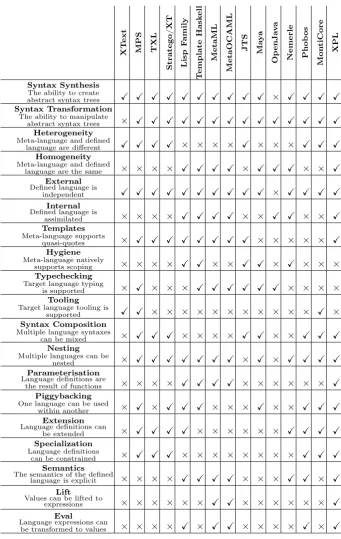
The previous sections have reviewed tools for SLE and identified some common fea-tures. The representative tools and features are summarised in figure 1. It is argued in [39] that language engineering should be modular and that there are multiple ways in which language modules can be extended and combined [36, 38, 37]. However, few tools for SLE offer the precision and flexibility that would allow the design space of modular SLE to be explored.
This article takes a standard λ-calculus and extends it with features for SLE to
XT ext MPS TXL Stratego/XT Lisp F amily T emplate Hask ell MetaML MetaOCAML JTS Ma y a Op enJa v a Nemerle Phob os Mon tiCore XPL Syntax Synthesis
The ability to create
abstract syntax trees X X X X X X X X X X × X X X X
Syntax Transformation
The ability to manipulate
abstract syntax trees × X X X X X X X X X X X X X X
Heterogeneity
Meta-language and defined
language are different X X X X × × × × X × × × X X X
Homogeneity
Meta-language and defined
language are the same × × × × X X X X × X X X × × X
External
Defined language is
independent X X X X X X X X X X × X X X X
Internal
Defined language is
assimilated × × × × X X X X × × X X × × X
Templates
Meta-language supports
quasi-quotes × X X X X X X X X × × × × × X
Hygiene
Meta-language natively
supports scoping × × × × X X × × X X × X × × ×
Typechecking
Target language typing
is supported × X × × × X X X X X X × × × ×
Tooling
Target language tooling is
supported X X × × × × × × × × × × × X ×
Syntax Composition
Multiple language syntaxes
can be mixed × X X X × × × × X X × × X X X
Nesting
Multiple languages can be
nested × X X X X X X X × X × X X X X
Parameterisation
Language definitions are
the result of functions × × × × X X X X × × × × × × X
Piggybacking
One language can be used
within another × X × X X X × × × X × × X X X
Extension
Language definitions can
be extended × X X X X × × × × × × X X X X
Specialization
Language definitions
can be constrained × X X X × × × × × × × × X X X
Semantics
The semantics of the defined
language is explicit × × × × X X X X × × × X X × X
Lift
Values can be lifted to
expressions × × × × × × X X × × × × × × X
Eval
Language expressions can
[image:8.595.126.468.137.677.2]be transformed to values × × × × X × X X × × × × X × X
2. An Extensible Programming Language (XPL)
XPL has been designed by taking a standard call-by-value λ-calculus and adding
features that we hypothesize are characteristic of SLE technologies and are necessary to support modular homogeneous language embedding. An interpreter and read-eval-print-loop (REPL) for XPL has been implemented in Java. The implementation allows XPL definitions to be read from a file and subsequently referenced as part of user REPL interactions. All examples in this article have been implemented and are expressed as file-based definitions of values,name = exp, and functions,name(args) = exp, that are loaded before REPL interactionsexp−→valuewhere an expression is entered, evaluated and its value is printed.
The novelty in XPL is its execution mechanism and how that is used to encode modular languages. There is no formally defined type system for XPL. However, types can be useful in conveying the meaning of modular language semantics. Therefore, types are used as annotations (equivalent to comments) on XPL definitions in this article. Although the type language is used systematically, it lacks expressive power with regard to key aspects of XPL and is the subject of further work. Since a type system for XPL is not the main contribution, types are occasionally omitted when they are difficult to express using standard type language features. A basic understanding of functional programming and associated type systems is assumed.
This section introduces XPL by example. The basic features of XPL are described in section 2.1. Syntax construction and transformation are described in sections 2.2 and 2.3. XPL provides a sub-language for defining grammars; their use to process strings is described in section 2.4, and their use to define embedded languages is described in section 2.5 together with a series of example languages. The section concludes with a review of XPL as a basis for SLE in section 2.6.
2.1. Basic XPL
XPL is a λ-calculus with simple data structures: integer, string, bool, records and
lists. This section provides a series of examples showing basic features. XPL keywords are in bold. The following shows the definition of a function that calculates the length of a list and the definition of a function that adds two-dimensional points that are represented using records:
length : ([ t ]) -> int
length ( l ) = i f l = [] then 0 e l s e 1 + length ( tail ( l ) ) length ([0 ,1 ,2]) −→ 3
length ([ ' zero ' , ' one ' , ' two ']) −→ 3 length ([ true , false , true ]) −→ 3
addvec : ({ x : int ; y : int } ,{ x : int ; y : int }) - >{ x : int ; y : int } addvec ( v1 , v2 ) = { x = v1 . x + v2 . x ; y = v1 . y + v2 . y } addvec ({ x =1; y =2} ,{ x =3; y =4}) −→ { x =4; y =6}
Each example above shows a definition with a preceding type annotation followed by a REPL evaluation. XPL provides three structured data types: lists and records (as shown above) and syntax trees (as defined in section 2.2). For convenience, records can be used as identifier bindings and placed in scope by theimportexpression, for example:
The record bindings override any bindings that are currently in scope, for example:
l e t r = { x =1} x = 2
in import r { x } −→ 1
2.2. Syntax Construction
XPL provides constructors for building syntax. Each XPL language construct has a constructor that takes arguments corresponding to its sub-expressions. The constructors have names that correspond to the expression type that they construct and all start with a capital letter. To save space, the XPL language constructors are not all listed in this article and assumed to be obvious from the context of their use. An AST is decomposed using pattern matching in acase-expression. For example the constructors for if-expressions, binary-expressions, variables, and lists are used to create an expression that is then matched and decomposed using an if-pattern:
case If ( BinExp ( Var ( 'l ') , '= ' , List ([]) ) , Var ( 'x ') , Var ( 'y ') ) { If (t ,c , a ) -> c
} −→ Var ( 'x ')
Working with constructors can lead to highly nested expressions. Therefore, a special syntax is provided called quasi-quotes ([| and |]) that are used to delimit concrete
syntax expressions that are to be processed as though they are constructed using the AST constructors2. This is referred to as liftingthe concrete expression to the syntax level:
case [| i f l = [] then x e l s e y |] { If (t ,c , a ) -> c } −→ [| x |]
As shown above, where possible, AST values are printed out using quasi-quotes by the XPL interpreter. An AST can be translated to a value using theevaloperation. Since an AST might contain identifiers, the evaluation must be performed in the context of some identifier bindings that are supplied toevalas a record:
[| 10 |]. eval ({}) −→ 10 [| x |]. eval ({ x =100}) −→ 100
[| i f l = [] then x e l s e y |]. eval ({ l =[]; x =1; y =2}) −→ 1 [| i f l = [] then x e l s e y |]. eval ({ l =[ ' dog ']; x =1; y =2}) −→ 2
An AST is an expression that denotes an XPL value. If the AST e is evaluated to produce a value of typetthene:[| t |]. A valuevof typetcan be lifted to produce an expressionv.lift():[| t |]. Lifting is a useful mechanism to move from the world of values to the world of expressions.
Quasi-quotes provides a convenient way of constructing ASTs. The examples shown above aregroundin the sense that each AST expression has no variability. It is useful if we can includeholesin the AST so that they can act as patterns or templates. Holes can be left in ASTs usingdrop-quotes (${ and }) to surround an expression or literal that is referred to as beingdropped into the surrounding AST. The following example shows how a pattern can be constructed using a function that can be used to generate field
2
value accessors by mapping a field name to a function that references the value of the named field (wheret’ ≤ {n:t}denotes any record type t’ that has at least one field namednwhose type ist):
c r e a t e A c c e s s o r : Fun( n : str ) [| (t' ≤ { n : t }) -> t |] c r e a t e A c c e s s o r ( name ) = [| fun( record ) record . $ { name } |] c r e a t e A c c e s s o r ('x') −→ [| fun( record ) record . x |] c r e a t e A c c e s s o r ('y') −→ [| fun( record ) record . y |]
XPL provides AST constructors for the entire language and provides quasi-quotes and drop-quotes as a convenience. The ability to freely construct ASTs is the basis for defining modular languages.
2.3. Syntax Transformation
Lift and drop can be used to transform expressions. The following are two simple examples of syntax transformers:
a d d 1 E x p : ([| int |]) -> [| [ int ] |] a d d 1 E x p ( x ) = [| [ $ { x } + 1 ] |]
a p p E x p s : ([| [ t ] |] ,[| [ t ] |]) -> [| [ t ] |] a p p E x p s ( e1 , e2 ) = [| $ { e1 } + $ { e2 } |]
The construction and transformation of non-trivial ASTs will often involve arbitrary collections of expressions. Lift and drop can be used to help. Consider the following definition offoldrthat is used to process a list of elements (note that +is overloaded and used to append lists):
foldr : (( a ) ->b ,( b , b ) ->c ,b ,[ a ]) - >[ c ] foldr (f ,g ,b , l ) =
case l { [] -> b ;
h : t -> g ( f ( h ) , foldr (f ,g ,b , t ) ) }
foldr (fun( x ) [ x +1] ,fun( l1 , l2 ) l1 + l2 ,[] ,[100 ,200]) −→ [101 ,201]
Suppose that instead of a list of integers, we want to transform a list of expressions, each of which denotes an integer, into a single expression that denotes a list of integers where each integer has been incremented by1:
c o n s o l i d a t e : ([ [| int |] ]) -> [| [ int ] |]
c o n s o l i d a t e ( exps ) = foldr ( add1Exp , appExps ,[| [] |] , exps ) c o n s o l i d a t e ([]) −→ [| [] |]
c o n s o l i d a t e ([ [| a |] , [| b |] ]) −→ [| [ a + 1] + ([ b + 1] + []) |] c o n s o l i d a t e ([ [| a |] , [| b |] ] ) . eval ({ a =100; b =200}) −→ [101 ,201]
The ability to define functions over ASTs is important for the modular construction of language expressions and for language transformation. Languagemorphisms are an important feature of SLE as described in section 6.
2.4. Grammars
XPL provides grammars that are essentially functions from strings to values. If a grammar g translates a string s to a value v of type t then g is of type G(t) and
synthesizesvfrom s.
A grammar consists of a collection of rules, the first of which is designated thestart
g1 : G ( int )
g1 = { start -> 'x' { 10 } } g1 . parse ('x',[]) −→ 10
g1 . parse ('y',[]) −→ ERROR : e x p e c t i n g x
The grammarg1consists of a single rule calledstartthat is also the start rule for the grammar. The body of the rule (after->) consists of two rule elements. The first’x’ must match the prefix of the parsed string. The second element{ 10 }is an expression that produces a value synthesized by the parse. The value synthesized by the start rule of the grammar is the value returned by the parse.
A parse is performed by sending a grammar aparse message with two arguments. The first argument is the string and the second is a list of arguments to the start rule. In the example above, parsing’x’returns10and parsing ’y’raises an error.
Rules may contain alternative elements separated by |. The following modification maps’y’to20:
g2 : G ( int )
g2 = { start -> 'x' { 10 } | 'y' { 20 } } g2 . parse ('x',[]) −→ 10
g2 . parse ('y',[]) −→ 20
Repetition is expressed by following a rule element with *. Since every rule element synthesizes a value, the elemente*synthesizes a list of values each of which is produced by usingeto consume 0 or more characters in the supplied string. For example, suppose we want to allow any number ofxor y:
g3 : G ([ int ])
g3 = { start -> ( getx | gety ) *; getx -> 'x' { 10 }; gety -> 'y' { 20 } }
g3 . parse ('xyxyxyxy',[]) −→ [10 ,20 ,10 ,20 ,10 ,20 ,10 ,20]
The example above shows how multiple rules can be defined and how one rule can call another. We might want to allow white-space characters in the input string:
g4 : G ([ int ])
g4 = { start -> ( getx | gety ) *; getx -> spaces 'x' { 10 }; gety -> spaces 'y' { 20 }; spaces -> (32 | 10 | 13 | 9) * }
g4 . parse (' x yxy xy x y',[]) −→ [10 ,20 ,10 ,20 ,10 ,20 ,10 ,20]
Finally, intermediate values may be required during a parse. Rules may have arguments that can be supplied in a rule elementcallas instart^(n+m) below. Identifiers may be bound to the values synthesized by rule elements as in m=(getx | gety) below. The following grammar adds up the values based on an initial value supplied as an argument:
g5 : G ( int )
g5 = { start ( n ) -> m =( getx | gety ) start ^( n + m ) | { n }; getx -> spaces 'x' { 10 };
gety -> spaces 'y' { 20 }; spaces -> (32 | 10 | 13 | 9) * } g5 . parse (' ',[0]) −→ 0
g5 . parse ('x',[0]) −→ 10
It can be useful to embed semantictests during a parse. This is achieved using the ? operator that constructs a rule element by applying a predicate to arguments. The argu-ments are evaluated with respect to the identifiers that are currently in scope including any bindings that have been constructed be preceding elements in the rule. The result is used to determine whether the current parse-alternative can continue. For example a range expression[n,m]is to synthesize a record{low=n;high=m}whenn < m, is to just returnnwhen the two values are the same and return’error’whenm < n:
less : ( int , int ) -> bool eql : ( int , int ) -> bool
range : G ({ low : int ; high : int } + int + str )
less (n , m ) = n < m eql (n , m ) = n = m range = {
start -> '[' low = num ',' high = num ']' range ^( low , high ) ;
range (n , m ) -> ? less (n , m ) { { low = n ; high = m } } | ? eql (n , m ) { n } | {'error'}; num -> i =[48 ,57]+ { asInt ( i ) }
}
range . parse ('[100 ,200]',[]) −→ { low =100; high =200} range . parse ('[100 ,100]',[]) −→ 100
range . parse ('[100 ,20]',[]) −→ 'error'
Note that the rule range(n,m) above contains three alternatives. The first two are guarded by mutually exclusive conditions. The third alternative just synthesizes a string ’error’. Alternatives in XPL grammar rules are tried in order left to right until one suc-ceeds. XPL grammars arecompositional. Given two grammars g1and g2the grammar g1 + g2contains all the rules from the component grammars and starts with the first rule ofg1. Where rule names overlap ing1andg2the rules are merged as alternatives in the composite grammar with theg1rule taking precedence in a parse:
g6 , g7 , g8 , g9 : G ( int )
g6 = { start1 -> 'x' { 10 } } g7 = { start2 -> 'y' { 20 } } g8 = { start -> 'x' { 10 } } g9 = { start -> 'y' { 20 } } ( g6 + g7 ) . parse ('x',[]) −→ 10 ( g6 + g7 ) . parse ('y',[]) −→ ERROR ( g7 + g6 ) . parse ('x',[]) −→ ERROR ( g7 + g6 ) . parse ('y',[]) −→ 20 ( g8 + g9 ) . parse ('x',[]) −→ 10 ( g8 + g9 ) . parse ('y',[]) −→ 20 ( g9 + g8 ) . parse ('x',[]) −→ 10 ( g9 + g8 ) . parse ('y',[]) −→ 20
The quasi-quotes described in section 2.2 assume that the syntax of the language con-tained within the quotes is XPL by default. The default can be overridden by inserting a grammar gas follows [ g | ... |]where the form [| ... |] is equivalent to [ XPL | ... |]. The evaluation of a quasi-quote expression is as follows: evaluateg, use the resulting grammar to parse the text represented by... and delimited by|],lift
l e t g = { start -> 'add (' x = start ')' { [| $ { x } + 1 |] } | '0' { [| 0 |] }
| '<' x = XPL '>' { Drop ( x ) } } x = [| 2 + 3 |]
in [ g | add ( add ( <x >) ) |]
−→ [| ((2 + 3) + 1) + 1 |]
where XPL is the XPL grammar and Drop is the syntax constructor for expressions of the form${...}. The rest of this article will not require the use of quasi-quotes with non-default grammars.
XPL grammars map strings to values. Grammars themselves are first-class values that can be passed to functions, returned as results, stored in structures and composed. Both the synthesis of values and the tests performed during a parse can involve arbitrary XPL expressions. These features are all key to being able to represent, compose and transform language modules.
2.5. Languages
A grammar defines a language which is the set of strings that can be mapped to values by the grammar when it is viewed as a partial function. If the set of values produced by the grammar are ASTs then the grammar can be used to implement homogeneous language embeddings. In this case the grammar has the typeG([| t |])for some type t. A language type is defined as: L(t) = G([| t |]).
In order for internal languages to work, XPL must provide a mechanism that places a grammar in-scope. This is done usingintern:
xory : L ( bool )
xory = { start -> 'x'* { [| true |] } | 'y'* { [| false |] } }
intern xory { xxxx } −→ true
intern xory { yyyyy } −→ false
Theinternexpression has two parts, the first is a grammar that defines a language and the second is a sentence in the language surrounded by { and }. Since grammars are values we can pass them to functions:
parse : ( L ( t ) ) -> t
parse ( g ) = intern g { xxx }
parse ({ start -> 'x'* { [| true |] } }) −→ true parse ({ start -> 'x'* { [| false |] } }) −→ false
Aninternexpression supplies the text in its body as a string to the supplied grammar. The grammar must have a type of the form L(t) for some type t. The value that is synthesized by the grammar is therefore of type[| t |]and can be used as a replacement for theintern expression. If the synthesized expression contains identifiers then they will be resolved by the identifiers currently in scope3. Since the expression returns a value of type t, the type of the intern expression is also t. The rest of this section contains example language definitions.
3
2.5.1. A Language for Libraries
Grammars can be used as rule elements in which case the parse will call the start rule for the grammar. The value of the identifierXPLis the grammar for the XPL language and can be used to embed XPL, or parts thereof, within new languages. Here is a simple example that defines a library to be a header that describes what the library does, and a collection of definitions:
intern l i b r a r y { header
This l i b r a r y p e r f o r m s a r i t h m e t i c . end
add (n , m ) = n + m ; sub (n , m ) = n - m } −→
{ header ='This l i b r a r y p e r f o r m s a r i t h m e t i c .'; defs ={ add = < closure >; sub = < closure >}}
The grammar uses theXPL.fieldsrule to parse the definitions:
l i b r a r y : ∀rec : R e c o r d T y p e L ({ header : str ; defs : rec }) l i b r a r y = {
lib -> h = head f = XPL . fields {
[| { header = $ { h . lift () }; defs = $ { Record ( f ) } } |] };
head -> 'header' s = n o n W h i t e s p a c e C h a r * 'end' { a s S t r i n g ( s ) } }
2.5.2. An Expression Language
The following grammar defines a simple multiplicative expression language. The grammar evaluates an expression as it is parsed and uses the XPL built-in operator asInt to map a sequence of integer character codes to an integer. This is an example of how XPL can be used to processexternal languages where the text is supplied as a string (possibly read from an external file):
a r i t h E x t e r n a l : G ( int ) a r i t h E x t e r n a l = {
start -> a = atom tail ^( a ) ;
atom -> int | '(' a = start ')' { a }; int -> n =(['0','9']) + { asInt ( n ) }; tail ( left ) -> o = op right = start {
case o {
'*' -> left * right ; '/' -> left / right }
};
tail ( left ) -> { left }; op -> ('/' | '*') }
a r i t h E x t e r n a l . parse ('10*20',[]) −→ 200
This article describes how XPL can be used to represent internal languages that are embedded within XPL. An internal language feature is defined by a grammar that syn-thesizes XPL abstract syntax:
start -> a = atom tail ^( a ) ;
atom -> int | '(' a = start ')' { a }; int -> n =(['0','9']) + { Int ( asInt ( n ) ) }; tail ( left ) -> o = op right = start {
case o {
'*' -> [| $ { left } * $ { right } |]; '/' -> [| $ { left } / $ { right } |] }
};
tail ( left ) -> { left }; op -> ('/' | '*') }
intern a r i t h I n t e r n a l { 1 0 * 2 0 } −→ 200
XPL grammars, like those used by Template Haskell or MetaML, are based on a standard encoding using functional combinators [43] and cannot directly encode left recursion. However, XPL relies on the first-class and embedded features of grammars and therefore, providing these properties are preserved, the grammar language can be extended with sophisticated mechanisms such as that described in [44] for left recursion.
2.5.3. Processing Input Streams
Consider a business situation that needs to process serialised data4. This might occur when a company server must process a continuous data feed. Since the data is serialised, it is received as a sequence of character codes. The company wants to impose some structure on the data before it is processed. The following shows the required behaviour represented in XPL:
c u s t o m e r : ([ int ]) -> { c u s t o m e r : str ; a d d r e s s : str ; a c c o u n t : str } c u s t o m e r =
intern i n f l a t o r { c u s t o m e r :5 a d d r e s s :15 a c c o u n t :3 }
c u s t o m e r ('fred 10 Main Road 501'. asList () ) −→
{ c u s t o m e r ='fred ';
a d d r e s s ='10 Main Road '; a c c o u n t ='501'}
The languageinflatoris used to specify a string pattern. It is used to denote a function that maps a string to a record whose fields have the specified names and whose field values are the corresponding sub-strings.
The methodasList()of a string returns the character codes in the string as a list. Thetake anddroplist operators are used to define theinflatorgrammar:
take : ([ t ] , int ) -> [ t ] take ([1 ,2 ,3] ,2) −→ [1 ,2] drop : ([ t ] , int ) -> [ t ] drop ([1 ,2 ,3] ,2) −→ [3]
An extractor, e.g., extractor(’account’,3), is a function that maps a sequence of character codes such as’501xxx’.asList() and a continuation kby supplying kwith a record{account=’501’}and the rest of the list’xxx’.asList():
4
e x t r a c t o r ('account',3) ('501 xxx'. asList () ,k ) −→ k ({ a cc o u n t ='501'} ,'xxx'. asList () )
The continuationkis used to process subsequent fields in the input and append{account=’501’} to the subsequently constructed records. The definition ofextractoris:
e x t r a c t o r : Fun( n : str ) ( int ) -> [| ([ int ] ,({ n : str } ,[ int ]) -> t ) -> t |] e x t r a c t o r (n , i ) =
l e t record = [| { $ { n } = a s S t r i n g ( take (l , $ { i }) ) } |]
in [| fun(l , k ) k ( $ { record } , drop (l , $ { i }) ) |]
Given a definition such as customer above, each field definition is translated into an extractor resulting in a list of extractors that are combined usingfoldr defined in the previous section together with the following operators:
c o m b i n e ( left , right ) = [| fun( l ) $ { left }( l ,fun(r , l ) r + $ { right }( l ) ) |] id ( x ) = x
empty = [| fun( l ) {} |]
Given these operators, the grammar simply maps the field definitions to extractors and combines them:
i n f l a t o r : L (([ int ]) -> r ) i n f l a t o r = {
fields -> fs = field * { foldr ( id , combine , empty , fs ) }; field -> n = name spaces ':' i = int { e x t r a c t o r (n , i ) }; int -> spaces n = n u m e r i c + { Int ( asInt ( n ) ) };
spaces -> (32 | 10 | 9 | 13) *;
name -> spaces l = alpha ls = alpha * { a s S t r i n g ( l : ls ) }; alpha -> ['a','z'];
n u m e r i c -> ['0','9'] }
2.5.4. A Guarded Command Language
Suppose that we want to implement a guarded command language (GCL) and embed it within XPL. The embedding should allow XPL expressions to be referenced within the GCL when they are prefixed by $ and to return values to XPL. The value types are to be limited to booleans and integers. Here is an example of GCL used to implement the
greatest common divisor:
gcd : ( int , int ) -> int gcd (n , m ) :=
intern gcl { a := $n b := $m do
a < b -> b := b - a b < a -> a := a - b od
abort a }
type State = [{ name : str ; value : int }]
type Cont = ( State ) -> int
type Fail = () -> int
type Arm = ( State , Cont , Fail ) -> int
type C o m m a n d = ( State , Cont ) -> int
type Exp = ( State ) -> int
A program is constructed using thebeginoperator. A program state is represented as a list of records binding names to values. Since a command may modify the state, each command takes a state and a continuation, where the continuation represents what to do next and is supplied with the state once the command has completed. A program is supplied with a command and supplies it with an initial state and a final continuation (which by default returns0from the program):
begin : ( C o m m a n d ) -> State begin ( c ) = c ([] ,fun( state ) 0)
Commands can be composed in sequence using theseqoperator:
seq : ( Command , C o m m a n d ) -> C o m m a n d
seq ( c1 , c2 ) = fun( state , cont ) c1 ( state ,fun( state ) c2 ( state , cont ) )
Theupdateoperator constructs a command that changes the value of a variable. Since variable lookup will always use the first binding record, update is performed by adding a new record at the head of the state:
update : ( str , Exp ) -> C o m m a n d
update (n , e ) = fun( state , cont ) cont ({ name = n ; value = e ( state ) }: state )
Both conditional and loop commands are constructed from guarded commands (of type Arm). A guarded command is supplied with three arguments: a state, a continuation that is used if the guarded command is performed, and a fail that is used if the guard fails. In the case of a conditional command, the supplied continuationcontis performed whether the guard succeeds or not. In the case of the loop, if the guard succeeds the loop tries again (with an updated state) and if the guard fails then the loop terminates:
cond : ( Arm ) -> C o m m a n d
cond ( arm ) = fun( state , cont ) arm ( state , cont ,fun() cont ( state ) )
do : ( Arm ) -> C o m m a n d do ( arm ) =
fun( state , cont ) arm ( state ,
fun( state ) do ( arm ) ( state , cont ) ,
fun() cont ( state ) )
To abort with a value, the program ignores the current continuation and returns the value of the supplied variable name (usingrefdefined below):
abort : ( str ) -> C o m m a n d
abort ( n ) = fun( state , cont ) ref ( n ) ( state )
A guarded command is constructed from a boolean expression and a command. If the expression is true then the command is performed otherwise the fail continuation is called:
try : ( Exp , C o m m a n d ) -> Arm
try ( exp , c o m m a n d ) = fun( state , success , fail )
i f exp ( state )
then c o m m a n d ( state , s uc c e s s )
Two guarded commands are composed using alt. The second guarded command is supplied as the fail continuation to the first:
alt : ( Arm , Arm ) -> Arm alt ( a1 , a2 ) =
fun( state , success , fail ) a1 ( state ,
success ,
fun() a2 ( state , success , fail ) )
Expressions are supplied with a state and return an integer. A variable reference finds the first binding record with the required name and returns the associated value:
ref : ( str ) -> Exp ref ( n ) =
fun( state )
case state { r : s ->
i f r . name = n
then r . value
e l s e ref ( n ) ( s ) ; [] -> '?' }
Two expressions are combined usingbin:
bin : ( Exp , str , Exp ) -> Exp bin ( left , op , right ) = fun( state )
case op {
'>' -> left ( state ) > right ( state ) ; '<' -> left ( state ) < right ( state ) ; '+' -> left ( state ) + right ( state ) ; '-' -> left ( state ) - right ( state ) }
A constant expression just returns the constant:
const : ( int ) -> Exp const ( k ) = fun( state ) k
The syntax of the language can be defined as an XPL grammar as follows:
gcl : L ( int ) gcl := {
p r o g r a m -> cs = c o m m a n d s { [| begin ( $ { cs }) |] };
c o m m a n d s -> c1 = c o m m a n d ( c2 = c o m m a n d s { [| seq ( $ { c1 } , $ { c2 }) |] } | { c1 }) ; c o m m a n d -> update | abort | cond | do ;
update -> n = name spaces ':=' e = exp { [| update ( $ { n . lift () } , $ { e }) |] }; abort -> spaces 'abort' n = name { [| abort ( $ { n . lift () }) |] };
cond -> spaces 'i f' as = arms spaces 'fi' { [| cond ( $ { as }) |] }; do -> spaces 'do' as = arms spaces 'od' { [| do ( $ { as }) |] }; arms -> a1 = arm ( a2 = arms { [| alt ( $ { a1 } , $ { a2 }) |] } | { a1 }) ; arm -> g = exp spaces '- >' c = c o m m a n d { [| try ( $ { g } , $ { c }) |] };
exp -> a = atom ( o = op e = exp {[| bin ( $ { a } , $ { o . lift () } , $ { e }) |]} | { a }) ; op -> '>' | '<' | '+' | '-';
atom -> int | var | extern ;
var -> n = name { [| ref ( $ { n . lift () }) |] };
int -> spaces n = n u m e r i c + { [| fun( state ) $ { Int ( asInt ( n ) ) } |] }; extern -> spaces '$' e = XPL { [| fun( state ) $ { e } |] };
spaces -> (32 | 10 | 9 | 13) *;
n u m e r i c -> ['0','9'] }
GCL provides an example of a non-trivial executable language that is embedded in XPL. It demonstrates a number of features that are foundational to SLE; this section concludes with a review of this language in terms of these features.
In order for one language to be truly embeddedin another, there must be some way to link the grammars so that one is aware of the other. GCL achieves this to some degree by referencingXPLin the extern rule. However this is not sufficient to achieve true embedding sinceXPLdoes not really know about gcl. There should be some way to achieve mutual dependence by allowing language definitions to be extensible and somehowtying the knotin the same way that mutually recursive procedures are defined. Languages consist of syntax and semantics. GCL is a good example of a separation of syntax and semantics since it defines a collection of operators that represent the semantics and then the grammar uses these operators to construct the various language elements. However, to achieve composable, extensible language modules, the definition of syntax and semantics must be disciplined.
The next section reviews XPL as a basis for SLE and the rest of the article shows how XPL can be used in a disciplined way to achieve language modules consisting of both syntax and semantics that can be composed, transformed and extended.
2.6. XPL as an SLE Language
XPL is designed to be a simple, flexible, precisely defined language for expressing languages. Section 1.3 defines a list of features for any SLE technology that are reviewed in terms of XPL:
syntax definition XPL provides first-class grammars that are implemented using parser combinators as a record of higher-order functions that map text to XPL syntax.
syntax synthesis XPL provides syntax constructors, lift and drop. XPL is not hy-gienic since this property can be defined as a restriction on free syntax construction, but is not considered further in this article.
syntax transformation As noted above, XPL syntax is a first-class feature of the language. Pattern matching incase expressions can be used to transform syntax.
semantics Section 3 provides many examples where the semantics of embedded lan-guages can be defined in XPL.
embedding XPL provides anintern expression that allows new language features to be embedded.
nesting In XPL, languages are first-class values and can be passed as arguments and returned as results. The normal rules ofλ-scoping apply.
3. Language Modularity
XPL has been designed as a basis for modular homogeneous language embedding. The previous section has introduced XPL. This section discusses a number of scenarios that language modularity must support (3.1), defines a basic encoding for a language module (3.2), defines a simple language module for expressions (3.3) and shows how language modules can be extended (3.4).
3.1. Modularity Scenarios
A language module is a unit of definition that provides the syntax and semantics for a language. Once it is defined, a language module can be used independently or transformed and combined with other language modules. The key modularity scenarios are as follows: (in each case we give references to language modules that are defined in the rest of the article):
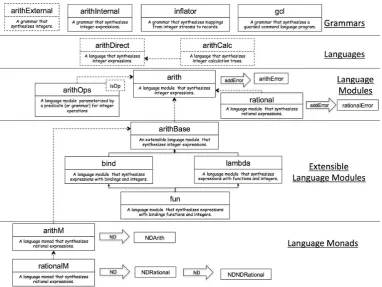
independent An independent language module contains the syntax and semantics of a language, does not depend on the definition of any other language module and can be directly embedded in XPL using intern. The module arithDirect is independent.
substitution A language module contains separate definitions of syntax and semantics. A new language can be defined by substituting for one or other of these components. The modules arithCalc andrational are examples where the syntax of a base module is reused and the semantics are replaced.
extension A new language module can be defined as an extension of another by adding new language constructs. Section 5.2 provides a general pattern for defining exten-sible language modules using fixed points. This encoding is similar to that used to encode extension by inheritance in a functional language.
combination A new language module can be constructed by combining two independent modules. Languages in XPL are records containing higher-order functions that can be combined in various ways as described in section 5.1.
template A language can be defined in terms of one or more unknown features that are to be supplied as parameter values. A language module template (orlanguage factory) is supplied with syntax or semantics features and returns a new language module. The template arithOpsis defined twice: firstly requiring a predicate to define the names of infix operators; secondly requiring a grammar that defines the syntax of infix operators. Other templates includearithExt,lambda, andbind.
3.2. Basic Language Modules
A language module is a pattern of language definition that separates syntax from semantics. In XPL this is done by constructing a record containing two fields. The first field is called syntax whose value is a function mapping a package of semantics to a grammar. The second field, calledsemantics, is a package of semantics definitions. A language is created by supplyingsemanticsto syntax:
lang = {
syntax ( s e m a n t i c s ) = { start ...;
... g r a m m a r rules };
s e m a n t i c s = {
s y n t a x C n s t r ( args ...) = ...; ... s e m a n t i c s for c o n s t r u c t }
}
Language modules allow the syntax to be dependent on the semantics whilst allowing each to be independently transformed. In addition, language modules are a basic pattern whose variations, as we shall see, can be used to express different types of language definition.
3.3. An Independent External Language Module
The following XPL program code represents the arithmetic grammar from section 2.5.2 as a language module:
type E x p S e m a n t i c s ( t : Type ) = { binExp :( t , str , t ) -> t ; int :([ int ]) -> t } a r i t h D i r e c t : {
syntax :( E x p S e m a n t i c s ( t ) ) -> G ( t ) ; s e m a n t i c s : E x p S e m a n t i c s ( int ) }
a r i t h D i r e c t = {
syntax ( s e m a n t i c s ) = {
arith -> a = atom tail ^( a ) ;
atom -> i = int | '(' a = arith ')' { a }; int -> n =(['0','9']) + { s e m a n t i c s . int ( n ) }; tail ( l ) -> o = op r = arith { s e m a n t i c s . binExp (l ,o , r ) }; tail ( l ) -> { l };
op -> ('/' | '*') };
s e m a n t i c s = {
binExp ( left , op , right ) =
case op {
'*' -> left * right ; '/' -> left / right };
int ( cs ) = asInt ( cs ) }
}
a r i t h D i r e c t . syntax ( a r i t h D i r e c t . s e m a n t i c s ) . parse ('10*20',[]) −→ 200
3.4. Changing the Semantics: Substituting Calculations for Integers
Once a language has been expressed as a module, it is possible to change the meaning of denoted values by modifying or replacing the semantics package. Note that the in-terface provided by the semantics package must be preserved by any modifications since the grammar relies on these operations being available.
Suppose that we want to modifyarithDirectso that the grammar synthesizes arith-meticcalculations rather than integers. A calculation [45] is defined to be a tree that records all of the steps taken to evaluate the expression. A calculation has the form {calc=l;value=n;children=cs} where l is a label describing the step that was per-formed (either’int’for an integer-producing leaf-calculation or an operator: ’*’;’/’). A new language modulearithCalcis produced by reusingarithDirectas appropriate:
type Calc = { calc : str ; c h i l d r e n :[ Calc ]; value : int } a r i t h C a l c : {
syntax :( E x p S e m a n t i c s ( t ) ) -> G ( t ) ; s e m a n t i c s : E x p S e m a n t i c s ( Calc ) }
a r i t h C a l c = {
syntax = a r i t h D i r e c t . syntax ; s e m a n t i c s = {
binExp (l , op , r ) = { calc = op ;
c h i l d r e n = [l , r ];
value = a r i t h D i r e c t . s e m a n t i c s . binExp ( l . value , op , r . val ue ) };
int ( cs ) = { calc = 'int'; c h i l d r e n = [];
value = a r i t h D i r e c t . s e m a n t i c s . int ( cs ) }
} }
a r i t h C a l c . syntax ( a r i t h C a l c . s e m a n t i c s ) . parse ('10*20',[]) −→
{ calc ='*'; c h i l d r e n =[
{ calc ='int'; c h i l d r e n =[]; value =10} , { calc ='int'; c h i l d r e n =[]; value =20} ];
value =200}
The definitions ofarithDirectandarithCalcshow that by separating out the syntax and semantics, language modules allow syntax to be reused when defining new languages.
4. Homogeneous Language Embedding
XPL provides support for working with syntax as described in 2.2 in order to sup-port internal languages. The following module is a version of the arithmetic expression language that uses syntax constructors.
arith : {
syntax :( E x p S e m a n t i c s ([| t |]) ) -> L ( t ) ; s e m a n t i c s : E x p S e m a n t i c s ([| int |]) }
arith = {
syntax ( s e m a n t i c s ) = {
arith -> a = atom tail ^( a ) ;
atom -> i = int | '(' a = arith ')' { a }; int -> n =(['0','9']) + { s e m a n t i c s . int ( n ) }; tail ( l ) -> o = op r = arith { s e m a n t i c s . binExp (l ,o , r ) }; tail ( l ) -> { l };
op -> ('/' | '*') };
s e m a n t i c s = {
binExp ( left , op , right ) = BinExp ( left , op , right ) ; int ( cs ) = Int ( cs )
} }
intern arith . syntax ( arith . s e m a n t i c s ) { 1 0 * 2 0 } −→ 200
The embeddable language module above can be transformed into one that supports rational numbers. A rational number is represented as a value {num=n; den=d}where nanddare numerator and denominator respectively. The syntax definition remains the same as given in arith and the semantics are changed to create appropriate rational number expressions:
type R a t i o n a l = { num : int ; den : int } r a t i o n a l : {
syntax :( E x p S e m a n t i c s ([| t |]) ) -> L ( t ) ; s e m a n t i c s : E x p S e m a n t i c s ([| R a t i o n a l |]) }
r a t i o n a l = {
syntax = arith . syntax ; s e m a n t i c s = {
binExp ( left , op , right ) =
case op {
'*' -> [| { num = $ { left }. num * $ { right }. num ; den = $ { left }. den * $ { right }. den } |]; '/' -> r a t i o n a l . s e m a n t i c s . binExp ( left ,'*',
[| { num = $ { right }. den ; den = $ { right }. num } |]) };
int ( cs ) = [| { num = $ { Int ( cs ) }; den =1 } |] }
}
intern r a t i o n a l . syntax ( r a t i o n a l . s e m a n t i c s ) {10/3} −→ { num =10; den =3}
5. Language Module Templates
A language module is a record that conforms to a pattern and as such is a value that can be passed as an argument to a function and returned as a result. Together with lexical scoping rules, this makes language modules a powerful abstraction mechanism for engineering languages. Features of a language can be abstracted as arguments to a function that returns a language module; this is an example of a language factory [42] and a simple example is shown in section 5.1. Language modules can be used to represent extensible languages by abstracting over an extension point. An extensible language module of this kind is instantiated by finding its fixed point. Section 5.2 shows how fixed points are constructed in XPL.
5.1. Parametric Languages
In the arithmetic language modules defined in previous sections we have fixed the collection of operators: *and/. Suppose that we want to set up a language factory that generates language modules where the languages differ in terms of the operators that can be used. The following defines a functionarithOpsthat receives a predicateisOp that tests whether an operator is legal in the resulting language module:
a r i t h O p s : (( str ) -> bool ) -> {
syntax : ( E x p S e m a n t i c s ([| t |]) ) -> L ( t ) ; s e m a n t i c s : E x p S e m a n t i c s ([| int |]) }
a r i t h O p s ( isOp ) = { syntax ( s e m a n t i c s ) = {
arith -> a = atom tail ^( a ) ;
atom -> i = int | '(' a = arith ')' { a }; int -> n =(['0','9']) + { s e m a n t i c s . int ( n ) }; tail ( left ) -> o =. ? isOp ( a s S t r i n g ([ o ]) ) right = arith {
s e m a n t i c s . binExp ( left , a s S t r i n g ([ o ]) , right ) }; tail ( left ) -> { left }
};
s e m a n t i c s = arith . s e m a n t i c s }
module1 , m o d u le 2 : {
syntax : ( E x p S e m a n t i c s ([| t |]) ) -> L ( t ) ; s e m a n t i c s : E x p S e m a n t i c s ([| int |]) }
m o d u l e 1 = a r i t h O p s (fun( o ) o = '*' or o = '/')
intern m o d u l e 1 . syntax ( m o d u l e 1 . s e m a n t i c s ) { 1 0 *2 0 } −→ 200 m o d u l e 2 = a r i t h O p s (fun( o ) o = '+' or o = '-')
intern m o d u l e 2 . syntax ( m o d u l e 2 . s e m a n t i c s ) { 1 0 +2 0 } −→ 30
A more expressive way of achieving a similar result is to pass entire grammars as argu-ments. Likeintern, when a grammar is called, its starting non-terminal is taken to be the first rule in its definition:
a r i t h O p s : ( L ( str ) ) -> {
syntax : ( E x p S e m a n t i c s ([| t |]) ) -> L ( t ) ; s e m a n t i c s : E x p S e m a n t i c s ([| int |]) }
a r i t h O p s ( op ) = {
syntax ( s e m a n t i c s ) = {
arith -> a = atom tail ^( a ) ;
int -> n =(['0','9']) + { s e m a n t i c s . int ( n ) }; tail ( l ) -> o = op r = arith { s e m a n t i c s . binExp (l ,o , r ) }; tail ( l ) -> { l }
};
s e m a n t i c s = arith . s e m a n t i c s }
op1 , op2 : G ( int )
op1 = { op -> '*' | '/' } op2 = { op -> '+' | '-' }
module3 , m o d u le 4 : {
syntax : ( E x p S e m a n t i c s ([| t |]) ) -> L ( t ) ; s e m a n t i c s : E x p S e m a n t i c s ([| int |]) }
m o d u l e 3 = a r i t h O p s ( op1 ) m o d u l e 4 = a r i t h O p s ( op2 )
lang1 , lang2 : L ( int )
lang1 = m o du l e 3 . syntax ( m o d u l e 3 . s e m a n t i c s ) lang2 = m o du l e 4 . syntax ( m o d u l e 4 . s e m a n t i c s )
intern lang1 { 1 0 * 2 0 } −→ 200
intern lang2 { 1 0 + 2 0 } −→ 30
In the definition given above there are two grammarsop1andop2defined as extension points for the language factoryarithOps. The factory is instantiated twice to produce module3and module4that can then be transformed into languages lang1 and lang2. These languages can be used independently or merged using +. A grammar that is produced by combining two base grammars in this way contains all the base rules in the same order that they are defined in the left and then the right grammars. Grammar rules with the same names in each operand grammar are merged as alternative definitions. This leads to the following:
intern lang1 + lang2 { 10 * 20 } −→ 200
intern lang1 + lang2 { 10 + 20 } −→ 30
intern lang1 + lang2 { 10 * 20 + 30 } −→ Error !
Notice that in the last case we do not get the desired result. This is because the grammar that is processing operators is passed as an argument and, in the case oflang1we cannot have+and in the case oflang2we cannot have*, therefore they are mutually exclusive. The grammars have been merged at the wrong level, we want to give rise to options over the operators:
intern a r i t h O p s ( op1 + op2 ) . syntax ( a r i t h O p s ( op1 + op2 ) . s e m a n t i c s ) { 10 + 20 * 30
}−→ 610
This is the subject of the next section.
5.2. Extensible Languages
when they are supplied, can contain constructs from the base languagewithout knowing what they are in advance.
To achieve such incremental and mutually recursive extensions we can use fixed points over language modules. The general structure is as follows:
lang = {
syntax ( root , extension , s e m a n t i c s ) = { start -> ...;
... g r a m m a r rules d e f i n e d in terms ... ... of root , e x t e n s i o n and s e m a n t i c s ... };
s e m a n t i c s = {
s y n t a x C n s t r ( args ...) = ...; ... syntax c o n s t r u c t o r s }
}
Theroot element is a grammar that can parse the extended language,extensionis a grammar that parses new language constructs, andsemanticsis a package of semantics operators as before. The result of thesyntax function is a grammar that processes a basic language but which uses root and extension in specific ways: root used when the grammar wishes to process a root-construct, it is used to allow the language to be recursive;extensionis used when the grammar wishes to grant an extension point. The extension may fail if the language has not been extended.
In the case of arithmetic expressions, the root-element is any integer or binary ex-pression. Therefore, assuming for convenience that arithmetic expressions are right as-sociative, the root elementexpis used to parse the right operand of a binary expression. The extension point is used as an alternative type of expression:
spaces : G ([ int ]) a r i t h B a s e : {
syntax : ( L ( t ) ,L ( t ) , E x p S e m a n t i c s ([| t |]) ) -> L ( t ) ; s e m a n t i c s : E x p S e m a n t i c s ([| int |])
}
spaces = { spaces -> (32 | 10 | 9 | 13) * }
a r i t h B a s e = {
syntax ( exp , extension , s e m a n t i c s ) = { arith -> spaces a = atom tail ^( a ) ; arith -> spaces x = e x t e n s i o n tail ^( x ) ; atom -> i = int | '(' a = exp ')' { a };
int -> n =(['0','9']) + { s e m a n t i c s . int ( n ) };
tail ( l ) -> spaces o = op r = exp { s e m a n t i c s . binExp (l ,o , r ) }; tail ( l ) -> { l };
op -> ('/' | '*') };
s e m a n t i c s = arith . s e m a n t i c s }
l e t r e c lang = a r i t h B a s e . syntax ( lang ,{} , a r i t h B a s e . s e m a n t i c s )
in intern lang { 10 * 20 } −→ 200
l e t r e c lang = a r i t h B a s e . syntax ( lang , extension , a r i t h B a s e . s e m a n t i c s ) e x t e n s i o n = { start -> 'two' -> { [| 2 |] }}
in intern lang { 10 * two } −→ 20
l e t r e c lang = a r i t h B a s e . syntax ( lang , extension , a r i t h B a s e . s e m a n t i c s ) e x t e n s i o n = { start -> 'double (' e = lang ')' -> { [| $ { e } * 2 |] }}
in intern lang { 10 * double (2 * 2) } −→ 80
A typical use of extensible language modules occurs when new language constructs are added that need to reference existing language constructs. For example, suppose we want to extend the arithmetic language with lambda-functions and let-binding. Both of these constructs are independently useful so we want language modules for them and we want to mix them intoarithBase. We can go further than this, because extensible language modules provide control over the way that languages are composed so we will show two variations where let-binding can be interleaved with lambda-functions and secondly where it is limited to the top-level of an expression.
Firstly, we define a language module for lambda-functions. We will assume that there are languages defined elsewhere forvarandnamethat construct variable expressions and legal program names respectively:
type L a m S e m a n t i c s ( x : Type ) = { lambda : ( str , x ) -> x ; app : (x , x ) -> x }
lambda : {
syntax : ( L ( t ) ,L ( t ) , L a m S e m a n t i c s ([| t |]) ) -> L ( t ) ; s e m a n t i c s : L a m S e m a n t i c s ([| t |])
}
lambda = {
syntax ( operator , exp , s e m a n t i c s ) = { start -> lam | app | var ;
lam -> spaces 'lam' arg = name dot body = exp { s e m a n t i c s . lambda ( arg , body ) }; dot -> spaces '.';
app -> e = o p e r a t o r '(' a = exp ')' { s e m a n t i c s . app (e , a ) } };
s e m a n t i c s = {
lambda ( arg , exp ) = Lambda ([ arg ] , exp ) ; app (o , a ) = Apply (o ,[ a ])
} }
There are now two language modules: arithBasewhich provides an extensible basis for arithmetic expressions, andlambdathat can be added to other base language modules. To extendarithBasewe need totie the knotusing a fixed point. The two languages are composed so that each knows about the other:
l e t r e c
e x t e n s i o n = lambda . syntax ( lang . atom , lang , lambda . s e m a n t i c s ) ; lang = a r i t h B a s e . syntax ( lang , extension , a r i t h B a s e . s e m a n t i c s )
in l e t f = intern lang { lam x . x / 2 }
in f (100) −→ 50
type B i n d S e m a n t i c s = Fun( x : Type ) { bind : ( str ,x , x ) -> x } bind : {
syntax : ( L ( t ) , B i n d S e m a n t i c s ([| t |]) ) -> L ( t ) ; s e m a n t i c s : B i n d S e m a n t i c s ([| t |])
}
bind = {
syntax ( value , body , s e m a n t i c s ) = { start -> local | var ;
local -> bind n = name to v = value for b = body { s e m a n t i c s . bind ( n ,v , b ) }; bind -> spaces 'bind';
to -> spaces 'to'; for -> spaces 'for' };
s e m a n t i c s = {
bind ( name , value , body ) =
[| (fun( $ { name }) $ { body }) ( $ { value }) |] }
}
The language modulebindis an extension that takes an argumentexpthat is the gram-mar for the value and body of a local binding expression, for example:
l e t r e c
e x t e n s i o n = bind . syntax ( lang , lang , bind . s e m a n t i c s ) ;
lang = a r i t h B a s e . syntax ( lang , extension , a r i t h B a s e . s e m a n t i c s )
in intern lang { bind x to 30 for x * 10 } −→ 300
Now we can mix the modules together to create a language that allows lambda-functions and local-binding to be interleaved. Notice that, since we have left open an extension point for the operator in an application expression, we can specify the range of variability for operators:
l e t r e c
l e t L a n g = bind . syntax ( lang , lang , bind . s e m a n t i c s ) op = { start -> var | '(' o = lang ')' { o } } f u n L a n g = lambda . syntax ( op , lang , lambda . s e m a n t i c s ) lang = l e t L a n g + f u n La n g
k = 100
in intern lang { bind f to bind g to lam x . x for g for f ( k ) }
−→ 100
The modules can be mixed in a different way to produce a language where let-binding is limited to the top-level of an expression. This is achieved by supplying a different definition for theoplanguage and a different extension point forletLang:
l e t r e c
l e t L a n g = bind . syntax ( funLang , lang , bind . s e m a n t i c s ) op = { start -> var | '(' o = f u n L a n g ')' { o } } f u n L a n g = lambda . syntax ( op , funLang , lambda . s e m a n t i c s ) lang = l e t L a n g + f u n La n g
in intern lang { bind f to bind g to lam x . x for g for f ( k ) } −→ ERROR
Finally, we can mix lambda-functions, local-binding and arithmetic expressions. There are a number of possible value domains for arithmetic expressions so this is done as a language factory where the arithmetic semantics is supplied:
c o m p l e t e ( s e m a n t i c s ) =
l e t r e c