Lightness in Stereoscopic Depth
DANEYKO, Olga
Available from Sheffield Hallam University Research Archive (SHURA) at:
http://shura.shu.ac.uk/16751/
This document is the author deposited version. You are advised to consult the
publisher's version if you wish to cite from it.
Published version
DANEYKO, Olga (2010). Lightness in Stereoscopic Depth. Vision, 22 (3).
Copyright and re-use policy
See
http://shura.shu.ac.uk/information.html
Sheffield Hallam University Research Archive
1.
Introduction
It has been recently demonstrated that both the Delboeuf and the Ebbinghaus size-contrast
illusions have an effect on the lightness (achromatic surface colour) estimation of two
targets equal in size and in luminance1,2). In both the Delboeuf and the Ebbinghaus illusions, the
target that appears bigger appears also more contrasted to the background. In other words, if
targets are decrements to the background (targets darker than the background), the target
that appears bigger appears also darker than the other one. Vice versa, if targets are increments
(targets lighter than the background), the target that appears bigger appears also lighter than the
other target.
Effects of perceived size on lightness have
already been reported in other studies. Brigner3) was the first to show the effect of the Delboeuf
and the Ebbinghaus illusions on lightness, but he failed to notice the role played by the contrast
sign between targets and background in the lightness outcomes. Gilchrist4,5)reported instead
that when a visual scene is comprised of only two surfaces, lightness is positively correlated to
the area of surfaces: as a surface is increased in perceived size it tends to appear brighter. If such
findings were to be extended in terms of a more general area rule, it would not account for the
findings previously reported concerning the effects of lightness caused by the Delboeuf and
the Ebbinghaus illusions.
On the other hand, it has been suggested that
these size-contrast illusions are triggered by different factors, including implicit depth
indexes6,7). This hypothesis is indirectly supported by Vicario8) who reported a density
effect in the texture of targets physically equal inserted in Delboeuf contrast rings: the target
that appeared bigger appeared also to have a more rarefied texture. This effect, however, is
consistent with two opposite depth interpretations of the scene: 1) the target that
appears bigger appears actually closer to the observer, hence the texture rarefaction is a case
of magnification; 2) the target that appears bigger appears also far away, hence the texture
Lightness in Stereoscopic Depth
Olga DANEYKO
Department of Psychology, University of Trieste
E-mail: [email protected]/[email protected]
In the present study I tested the effect of stereoscopic depth on the lightness of two targets equal in size, presented simultaneously so that one target appeared in depth coplanar to the background and the other appeared floating in a frontal plane closer to the observer. When targets were equal in luminance, the target that appeared more distant from the observer appeared also more contrasted to the background: when targets were increments with respect to the luminance of the background the distant target appeared lighter than the closer one; vice versa when targets were decrements the distant target appeared darker. Results are discussed with respect to the Gestalt factor “belongingness”, and to more recent finding of the effect of perceived size on lightness in the Delboeuf and the Ebbinghaus Illusions.
Keywords: lightness, belongingness, perceived size
■ 研究ノート(
VISION Vol. 22, No. 3, 1–000, 2010)rarefaction is directly related to size.
The following experiment draws inspiration from all these issues, as it is the first of a series
of experiments in which I address the hypothetical role of size and distance in the
lightness effects observed in both the Delboeuf and the Ebbinghaus illusions. In this experiment,
however, I did not use those illusory configurations; I used instead square targets
equal in size but that appeared different in size because of their apparent differences in depth
caused by stereopsis: the target that appeared far in depth appeared also bigger than the target
that appeared floating in the front plane.
2.
Experiment
2.1 Participants
Four participants (1 female and 3 male, age 25–55), who were either members or guests of
the Psychology Department of Tohoku Gakuin University in Sendai, volunteered to take part to
the experiment. All participants had normal or corrected-to-normal vision. One participant is
the author of this study (O), another participant was aware of the purpose of the study (D), while
other two participants were completely naïve to the purpose of the study (P and T).
2.2 Stimuli
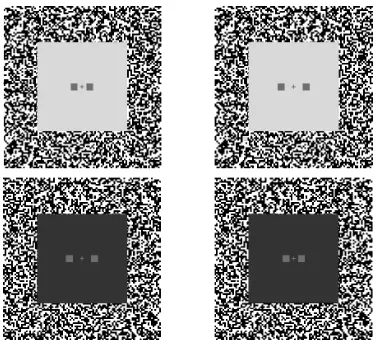
Stimuli were stereograms (Fig. 1) with target
disparities set to 0.24°. Targets consisted in two grey squares (sides 0.5 cm) seen against a
square background (side 6.5 cm) that was surrounded by a random dot frame (width 2.5
cm). The far target was the standard stimulus (ss) and its luminance was 38.8 cd/m2. The near
target (comparison stimulus, cs) had one of the following luminance values: 34.3, 35.5, 36.6,
37.4, 38.8, 40.0, 41.1, 42.1, and 43.2 cd/m2. The left-right positions of ss and cs were balanced.
Targets were seen either on a dark (8.5 cd/m2) or on a bright background (98.4 cd/m2). From
here on, light targets on the dark background
will be denoted as increments, and dark targets on the bright background will be denoted as
decrements. A small red fixation cross was present at the centre of each configuration and
it appeared to be floating in a middle plane, coplanar to the random dot frame.
The combination of cs luminance background luminance determined 18 sscs
configurations, each of which was presented 20 times in random order on a CRT SonyTM
MultiScan G 520® controlled by an AppleTM MacBook Intel Core Duo 2®. Configurations were
viewed through a mirror stereoscope at a distance of 61 cm.
2.3 Procedure
The method of constant stimuli was used with
a forced-choice task: participants were asked to indicate which of two targets appeared darker,
the left one or the right one, by pressing a yellow key for the left target or a red key for the right
target. The yellow key and the red key were positioned at opposite ends of a keyboard.
Participants were first presented with a training task to verify whether they perceived stereo
[image:3.516.269.457.457.628.2]depth correctly. All participants carried out the
Fig. 1. Example of the stereograms used in the
experiment: decrement targets (top) and increment
task easily and quickly without errors. After the
training trials, instructions appeared for the actual task; if there were no questions, the
participant was instructed to press either one of the two response keys to start the experiment. A
pause was set after 5 blocks of trials. Participants were invited to press either one of
the response keys when they were ready to resume the experiment. The entire experiment
lasted for about 30–40 minutes, depending on participants’ response times. At the end of the
experiment, subjects were asked whether the targets appeared equal in size. All subjects saw
the targets in the far plane as bigger than the targets in the near plane.
2.4 Results
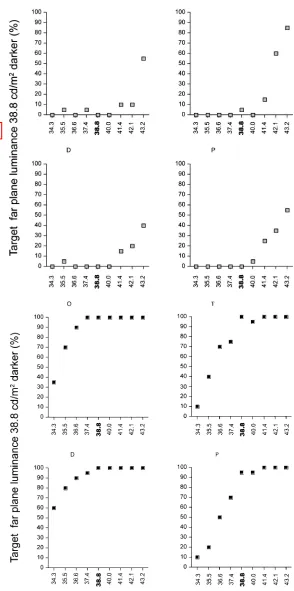
Fig. 2displays the results for increments and
decrements for each participant. As one can readily see, all four participants responded
practically in the same way when the comparison stimulus (near target) and standard
stimulus (far target) had the same luminance (38.8 cd/m2): with increments, the ss appeared
lighter; with decrements it appeared darker than the cs. Furthermore with increment
configurations, for participant D ss appeared lighter with all cs38.8 cd/m2; for participants O
and P the PSE corresponded to cs43.2 cd/m2; for participant T, PSE corresponded to 42.1
cd/m2. With decrement configurations, for participants D and O the PSE corresponded
to cs34.3 cd/m2; for participant P the PSE corresponded to cs36.6 cd/m2; for participant
Tthe PSE corresponded to cs35.5 cd/m2. PSEs are confirmed statistically by binomial tests in
which the theoretical proportion of the ss appearing darker in both increment and
decrement configurations was set respectively to 0.6 and 0.4, given that the ss was physically
either more or less intense than the cs.
2.5 Discussion
In this experiment two targets equal in size were seen at different depths by means of
stereoscopic presentation: the target that appeared in the front plane appeared smaller
and less contrasted with the background, independently from whether the targets were
luminance increments or decrements with respect to the background. This experiment
supports the hypothesis that the lightness effects in the Delboeuf and the Ebbinghaus
illusions are related to a combination of perceived size and perceived depth. The
“magnification” hypothesis, instead, according to which the target that appears closer should
appear also more contrasted to the background, is not supported by the data. Opposite results
are actually found: it is the target that appears more far away that appears more contrasted to
the background.
2.5.1 Lightness, depth, and belongingness
The results presented here are interesting also because they relate to another issue: the
role played by the Gestalt factor belongingness in surface colour contrast. Wolff9)showed that in
simultaneous lightness contrast, the lightness difference between two targets of equal physical
intensity is greatly reduced when the targets are coplanar to each other but separated in depth
from their backgrounds. Yet, while this effect was observed with an actual depth separation, it
was not found when targets and background were seen in different depth planes by means of
stereopsis10,11).
The data from the experiment reported above,
however, clearly supports the role of belongingness in lightness perception: in
incremental displays, for instance, not only does the target seen adjacent to the background
appear lighter than a target of equal luminance floating in a front plane, but it appears also
Fig. 2. Results for increment targets (a) and decrement targets (b): x-axis indicates the proportion (%) of ss
(38.8 cd/m2) indicated as the target that appears darker; y-axis indicates the corresponding luminance of cs.
a
lighter with respect to targets physically lighter.
The luminance difference between targets might be small, but the effect is robust. These findings
are also in line with those reported by Coren12), who studied the Benary cross configuration in
stereoscopic presentations: when the targets were seen floating in front of the cross, the
lightness effect virtually disappeared. Finally, they are also consistent with findings reported
by Kardos13): in his experiments a middle grey disk appeared lighter when it was adjacent to a
dark background in the far plane than when it was floating in a near plane detached from the
same background.
3.
Conclusions
The results from the experiment reported
above support two hypotheses: 1) lightness is affected by perceived size (the target that
appears bigger appears also more contrasted to the background), and 2) lightness is affected by
belongingness (the target that is seen adjacent to the background appears more contrasted.
Only the first hypothesis applies directly to the lightness effects observed in both the Delboeuf
and the Ebbinghaus illusions1,2). Nevertheless, the two hypotheses are not mutually exclusive;
in fact, the effects of size and belongingness may be combined in this experiment. Hence, to test
the role of such effects new experiments are being carried out in which perceived size and
perceived belongingness are contrasting factors within the same visual scene.
Acknowledgements: This experiment was
carried out in the laboratory of Psychology Department of Tohoku Gakuin University in
Sendai. I would like to thank Professor Kenzo Sakurai for his kind welcome in his laboratory
during my stay in Japan. I would also like to thank Daniele Zavagno for his valuable advices
and encouragement.
References
1) L. Zanuttini, O. Daneyko and D. Zavagno:
Illusory modifications of area and apparent
lightness. In Proceedings of the 25° Annual
Meeting of the international Society for
Psychophysics Ed. M Elliott, S Antonijevic,
283–288, 2009.
2) L. Zanuttini, O. Daneyko and D. Zavagno: The
effect of Vicario’s size illusion on lightness.
Perception 38 ECVP Abstract Supplement,
94, 2009.
3) W. Brigner: Effect of perceived size upon
perceived brightness. Perceptual and motor
skills, 51, 1331–1334, 1980.
4) A. Gilchrist, C. Kossifidis, T. Agostini , X. Li , F.
Bonato, J. Cataliotti , B. Spehar , V. Annan and
E. Economou: An anchoring theory of
lightness perception. Psychology review,
106, 795–834,1999.
5) A. Gilchrist and A. Radonjic´: Anchoring of
lightness values by relative luminance and
relative area. Journal of Vision, 9, 1–10,
2009.
6) S. Coren and J. S. Girgus: A size illusion based
upon a minimal interposition cue. Perception,
4, 251–254, 1975.
7) S. Girgus, J. S. Coren and M. Agdern: The
interrelationship between the Ebbinghaus and
Delboeuf illusione. Journal of Experimental
Psychology, 95, 453–455, 1972.
8) G. Vicario: Phenomenal rarefaction and visual
acuity under “illusory” conditions. Perception,
1, 475–482, 1972.
9) W. Wolff: Concerning the contrast-causing
effect of transformed colors. Psychologische
Forschung, 18, 90–97,1933.
10) T. Gibbs and R.B. Lawson: Simultaneous
brightness contrast in stereoscopic space.
Vision Research, 14,983–987, 1974.
11) B. Julesz: Foundations of Cyclopean
Perception. Chicago: University of Chicago
Press, 1971.
space
12) S. Coren: Brightness contrast as a function of
figure ground relations. Journal of
Experimental Psychology, 80, 517–524,
1969.
13) L. Kardos: Ding und Schatten [Object and
shadow]. Zeitschrift für Psychologie, Erg.