A project control framework for the Libyan construction
industry.
TAHIR, Huwaida Abdulmotamad.
Available from Sheffield Hallam University Research Archive (SHURA) at:
http://shura.shu.ac.uk/20417/
This document is the author deposited version. You are advised to consult the
publisher's version if you wish to cite from it.
Published version
TAHIR, Huwaida Abdulmotamad. (2015). A project control framework for the Libyan
construction industry. Doctoral, Sheffield Hallam University (United Kingdom)..
Copyright and re-use policy
See
http://shura.shu.ac.uk/information.html
Sheffield Hailam University Learning and Information Services
Adsetts Centre, City Campus Sheffield S1 1WD
ProQuest Number: 10701063
All rights reserved INFORMATION TO ALL USERS
The qu ality of this repro d u ctio n is d e p e n d e n t upon the q u ality of the copy subm itted. In the unlikely e v e n t that the a u th o r did not send a c o m p le te m anuscript and there are missing pages, these will be note d . Also, if m aterial had to be rem oved,
a n o te will in d ica te the deletion.
uest
ProQuest 10701063
Published by ProQuest LLC(2017). C op yrig ht of the Dissertation is held by the Author. All rights reserved.
This work is protected against unauthorized copying under Title 17, United States C o d e M icroform Edition © ProQuest LLC.
ProQuest LLC.
789 East Eisenhower Parkway P.O. Box 1346
A Project Control Framework for the Libyan
Construction Industry
By
Huwaida Abdulmotamad Tahir
A thesis submitted in partial fulfilment o f the requirement o f
Sheffield Hallam University for the degree
o f Doctor o f Philosophy
DECLARATION
I declare that the work presented in this thesis is my own work, done to the best o f my
knowledge and effort except as acknowledged in the text, and the work referred to in
this thesis has not been submitted, either in whole or in part, for another degree or
ACKNOWLEDGEMENT
First and foremost, I give thanks to God for all the care and help that I had throughout
the different phases o f this research.
Many people, government departments and institutions have been important
contributors to this work. It is difficult to name all those who have provided help,
support, encouragement, information and advice. The author warmly thanks all those
individuals, institutions, firms and many others who have made their documents, notes,
time, knowledge and expertise available to me.
I thank my supervisor, Professor Paul Stephenson, for his inspirational guidance,
encouragement, valuable comments and constructive criticism during the years o f the
research process.
I owe my deepest gratitude to my parents Almotamad and Kawtar who gave me their
moral support, and prayed for my success during my studies. I would especially like to
thank my husband Mohamed as I would never have been able to do this without him.
He has given unconditional love and provided me with power, dreams, courage and the
determination to finish this thesis. Also, I thank all my family, Fatmha, Abdulsalam,
Kawtar, Almotamed, for giving me their inspiration, patience and tolerance throughout
my preoccupation with this work.
I am heartily thankful to my daughter Fatmha, who always found time to listen to my
problems during my research and provided valuable help. She gave me a magnificent
support and she was always cheering me up when I need her during stay abroad.
I will always remember with special gratitude my colleague Mohammed Alzhubi for his
unstinting help, and I am heartily grateful to Anselm Kersten
who proofread my work. Finally, I owe a special a debt to my country Libya for
ABSTRACT
Time and cost overruns are one o f the biggest issues facing the construction industry
and affecting delivery in terms o f time, cost and quality. Libyan construction projects
experience these problems, often to a greater extent than most others. This can be
attributed to both unexpected and expected risk factors that are not effectively dealt
with. A focus on control is therefore vital in order to improve the performance of
construction projects. The chief purpose o f this study is to explore and understand the
main characteristics o f the Libyan construction industry (LCI) and its associated
processes and operations, as well as to identify the major obstacles constraining its
practices. It will also develop and validate a framework through which to manage risk
factors that significantly affect a project’s time and cost performance.
The initial proposed framework for the design o f project cost and time control is based
on previous studies; other practices regarding control are derived from the findings in
the literature. The framework was reviewed and refined through iterative processes.
Semi-structured interviews with professionals in Libyan organisations were used to
investigate how costs and schedules o f construction projects are controlled in practice
and to discover the reasons and related issues that affect the process o f cost and time
control in practice. Survey questionnaire I was conducted to identify the major risk
factors causing time and cost overruns in Libyan projects. The framework for
minimising cost and time overruns was subsequently validated by the perception o f the
professionals (contractors, consultants and owners) involved in the LCI who
participated in questionnaires II and III.
Both, theory and practice have been linked through the literature review and the
involvement o f practitioners to develop a framework by which cost and time overruns in
Libyan construction projects can be minimised. It is envisaged that the developed
framework will lead to changes in LCI projects, since practitioners can be more
systematic in dealing with the factors leading to cost and time overruns. This will
further provide improved current practices in delivering better quality construction
projects that satisfy clients’ requirements and in which cost and time overruns are
minimised.
TABLE OF CONTENTS
Contents
DECLARATIO N ... II A CK NO W LEDG EM ENT...Ill ABSTR ACT... IV TABLE OF C O N T E N T S... V LIST OF F IG U R E S ... XII
LIST OF T A B L E S... XIII
LIST OF A B B R E V IA T IO N S... XVI
Chapter 1 Introduction... 1
1.1 Introduction... 2
1.2 Background o f the Study...2
1.3 Statement o f the research problems... 4
1.4 Research A im ... ...5
1.5 Research Objectives...5
1.6 Research M ethodology.......6
1.7 Thesis structure...8
1.8 Summary...9
Chapter 2 Review o f Factors Influencing Time and Cost Overruns in Construction Projects .10 2.1 Introduction... 11
2.2 Different Definitions and Perspectives on R isk... : 11
2.3 The Distinction between Risk and Uncertainty...15
2.4 Construction Risk... 15
2.5 Concept o f Time and Cost in Construction Projects... 16
2.5.1 Project Cost Considerations... 16
2.5.2 Project Time Considerations... 18
2.6 The Time-Cost Relationship... 19
2.7 Review o f the Causes o f Time and Cost Overruns in Construction Projects...21
2.8 Classification o f the Factors Causing Cost and Time Overruns... 24
2.9 Identification o f Factors Causing Time and Cost Overruns... 29
2.10 Summary... 40
Chapter 3 The Environment o f Libyan Construction Industry... 42
3.1 Introduction... 43
3.2 General Information about Libya... 43
3.2.1 Libya’s Geography ...43
3.2.2 The Libyan Economy... 45
3.2.3 Libyan Culture... 48
3.3 Characteristics o f the Construction Industry in L ibya...52
3.3.1 Traditional Resources for Construction in Libya... 52
3.4 Development o f the Contemporary Construction Industry in Libya... 54
3.4.1 The Construction Industry during the Italian, British and French Occupation Period (1911-1952)...55
3.4.2 Development o f the Construction Industry (1952-1969)... 56
3.4.3 Development o f the Construction Industry (1970-2000)... 57
3.4.4 The Construction Industry (2000-2010)... 59
3.4.5 February 17 2 0 1 1 ... 59
3.4.6 The Future o f the L C I... 61
3.5 Management System o f Projects in L ibya... 62
3.6 Specific Risks o f Libyan Proj ects... 62
3.7 Summary... 64
Chapter 4 Research M ethodology... 65
4.1 Introduction... 66
4.2 Research Questions... 66
4.3 The Research Paradigm... ...67
4.3.1 A x io lo gy... 68
4.3.2 O ntology...68
4.3.3 Epistemology... ... 69
4.3.4 Methodology... ..71
4.4 Research approaches ...72
4.4.1 Deduction: testing theory...72
4.4.2 Induction: building theory... 73
4.4.3 Abduction: explanatory hypothesis...76
4.5 Research Styles... 78
4.5.1 Ethnographic...79
4.5.2 Action research... 80
4.5.3 Case Studies... 81
4.5.4 Survey... 82
4.6 Descriptions o f Methodology and Methods Adopted for the research... 83
4.6.1 Research M ethodology...83
4.6.2 Data Collection M ethods... 86
4.6.2.1 Method 1: Literature review ...86
4.6.2.1.1 The Role o f the Literature...86
4.6.2.2 Method 2: The Questionnaire ( I ) ... 87
4.6.2.3 Method 3: Semi-structured Interviews... 89
4.6.2.4 Method 4: Questionnaire Surveys (II) & (III)...91
4.6.3 The Framework o f the Research Study...92
4.6.4 Data Sample... ...94
4.6.5 Data Analysis... 94
4.6.5.1 Quantitative Data A nalysis... 95
4.6.5.2 Qualitative Data A nalysis... 96
4.7 Research Design Evaluation Criteria... 97
4.7.1 Validity o f the questionnaire ...97
4.7.2 Validity o f the interview... 99
4.8 Ethics in research... 100
4.9 Summary...100
Chapter 5 Theoretical Framework for Project Time and Cost Control ...102
5.1 Introduction ...103
5.2 Concept Definition o f Proj ect Control... 103
5.3 Project Cost and Time Controls... 106
5.3.1 Project cost control... 106
5.3.2 Project time control...107
5.4 Tools to Control Project Time and C o st...108
5.4.1 Bar Charts... 108
5.4.2 Element trend analysis (Line o f Balance)... 109
5.4.3 Critical Path Method (CPM)... 110
5.4.4 S-curve ... I l l 5.4.5 Graphical Evaluation and Review Technique (GERT).'...112
5.4.6 Programme Evaluation and Review Technique (PERT)...113
5.4.7 Arrow Diagram... 115
5.5 Project Control Framework... 115
5.5.1 The Purpose o f the Project Cost and Time Control Framework... 116
5.5.2 Framework for Project Time and Cost Control... 117
5.5.2.1.1 Process o f Project Control... 118
5.6 An Initial Proposed Project Control Framework...124
5.7 Summary... 127
Chapter 6 Quantitative Study (Questionnaire Survey I )...128
6.1 Introduction... .129
6.2 Questionnaire I Approach... 129
6.2.1 Justification o f the selection o f the questionnaire survey method o f data collection... 129
6.2.2 Piloting the questionnaire I o f the study... 131
6.2.3 Questionnaire design... 136
6.2.4 Sampling...137
6.2.4.1 Methods o f questionnaire I sampling...138
6.2.4.1.1 The size o f Questionnaire Survey I sampling... 138
6.2.5 Questionnaire distribution... 140
6.2.6 Forms o f the questionnaires selected for this study ...142
6.3 The characteristics o f the target population o f Survey Questionnaire 1... 142
6.3.1 Types o f respondents’ organizations for Survey Questionnaire 1... 143
6.3.2 Designations o f respondents...143
6.3.3 Type o f organisation... ... 144
6.3.4 Respondent’s experience... ... 145
6.3.5 Construction industry speciality... 145
6.3.6 Annual turnovers o f respondents'organisations... 146
6.3.7 Sizes o f respondents' organisations...147
6.3.8 The importance o f project control in Libyan construction projects... 147
6.4 Project time and cost control practices in Libyan construction projects ... 148
6.4.1 Frequency with which Libyan organisations encounter problems o f time and cost overruns...148
6.4.2 Methods to determine the times and costs o f activities involved in construction projects... 149
6.5 Factors causing time overruns in Libyan projects... 150
6.5.1 Construction...150
6.5.2 Weather and natural calamities... 154
6.5.3 Equipment... 156
6.5.4 Materials... 157
6.5.5 Contractual procedures...160
6.5.6 Design changes... 161
6.5.8 Legal and regulatory changes... 164
6.5.9 Ranking o f all factors causing time overruns from the perceptions o f contractors, clients and consultants ... 166
6.5.10 Comparison between contractors, clients and consultants involved in Libyan construction projects regarding the important factors in time overruns... 169
6.5.11 Ranking o f factors causing delays in Libyan construction projects as perceived by all parties (contractors, clients and consultants)... 173
6.6 Factors causing cost overruns in Libyan projects...177
6.6.1 Construction... 177
6.6.2 Weather and Natural Calamities... 181
6.6.3 Equipment... 182
6.6.4 Materials...182
6.6.5 Contractual procedures... 184
6.6.6 Design Change...185
6.6.7 Funding... 186
6.6.8 Legal and regulatory changes... 187
6.6.9 Ranking o f all factors causing cost overruns from the perceptions o f contractors, clients and consultants... 189
6.6.10 Ranking by all three types o f respondent o f the factors causing cost overruns in Libyan construction projects... 197
6.6.11 A comparison o f rankings o f influencing time control and influencing cost control factors...200
6.7 Categorisation o f time and cost overrun factors based on the party responsible 201 6.8 Summary... 209
Chapter 7 Qualitative Study (Semi-Structured Interviews)... 210
7.1 Introduction... 211
7.2 Semi-Structured Interviews... ... 211
7.2.1 Justification o f the selection o f the semi-structured interview method o f data collection...212
7.2.2 The interview sample com position... 213
7.2.3 The interview process...214
7.2.4 Steps in qualitative data analysis... 214
7.3 The qualitative study output... 216
7.4 Discussion o f the qualitative study findings... 220
7.4.1 Participants’ understanding o f the concept o f project control in the industry 220 7.4.1.1 Identification o f the most important variables needed to exercise control based on professionals’ perceptions...221 7.4.1.2 The extent o f the practical application o f the process o f cost and time control
222
7.4.1.3 The importance o f the application o f proj ect control... 223
7.4.1.4 When the process o f project control b egins... 225
7.4.2 Practical procedures and processes used to control tim e...226
7.4.2.1 Planning...227
7.4.2.2 Monitoring... 228
7.4.2.3 Evaluation... 231
7.4.2.4 Taking corrective action...233
7.4.2.5 Tools used to guarantee that projects do not run over tim e... ..236
7.4.3 Practical procedures and processes used to control c o sts...237
7.4.3.1 Estimating the project cost... 237
7.4.3.2 Monitoring the project’s co st... 239
7.4.3.3 Evaluating the project’s cost... 242
7.4.3.4 Taking corrective action... 243
7.4.3.5 Tools and techniques used to guarantee that projects do not exceed cost...245
7.4.4 The skills and abilities available in Libyan organisations to address risk factors ...246
7.4.5 Responsibility for project control processes... 247
7.4.6 Absence o f risk managers... 249
7.4.7 Identification o f barriers encountered in the process o f cost and time control ..250
7.4.8 Participants’ views o f the specifications required for the project control framework... 260
7.5 Summary...261
Chapter 8 Development and Evaluation o f the Project Cost and Time Control Framework..263
8.1 Introduction... 264
8.2 The stages o f the development o f the project control framework... 264
8.2.1 A comparison between the initial proposed framework and current practice o f project control by Libyan construction companies... 265
8.2.2 Integration o f the process o f cost and time control... 266
8.2.3 An initial improvement o f the proposed framework for project control 269 8.2.4 Final developed framework for project cost and time control... 272
8.3 Discussion o f the development stages o f the proposed project cost and time control framework... 274
8.3.1 Inclusion o f feedback from stakeholders on the project control frame work... 277
8.3.2 Inclusion o f the major factors causing delay and cost overruns in the project control framework... 278
8.3.3 Inclusion o f a list o f core responsibilities in the project control framework 279 8.4 Description o f the framework...285
8.5 Validation o f mitigation measures and evaluation o f the framework... :..288
8.5.1 Objectives o f evaluation processes ... 288
8.5.2 The evaluation processes... 289
8.5.3 The Evaluation Methods... !... 290
8.5.4 The Evaluation Approach... 290
8.5.4.1 Parameters for mitigation measures validation... 291
8.5.4.2 Parameters for project control framework evaluation... 293
8.5.4.3 Justification for validation and evaluation methods... 298
8.5.5 The results o f questionnaire II - validation ... 301
8.5.6 The results o f Questionnaire III - evaluation o f the Framework...308
8.5.7 Comments on the project control framework... 310
8.6 Summary...315
Chapter 9 Conclusions and Recommendations... 317
9.1 Introduction... 318
9.2 Conclusions o f the study...318
9.3 Research contribution to knowledge and practice /significance...323
9.3.1 Contribution to know ledge... 324
9.3.2 Contribution to practice... 325
9.4 Limitations o f the study...328
9.5 Recommendations for future research studies...329
References... 331
Bibliography... 360
Appendices... 373
LIST OF FIGURES
Figure 1-1: Research Objectives Relative to the Methods...7
Figure 2-1: Sequential Relationships between Categories o f Time Overruns...26
Figure 3-1: Boundaries and Major Roads o f Libya (Nicolas, 2011)...44
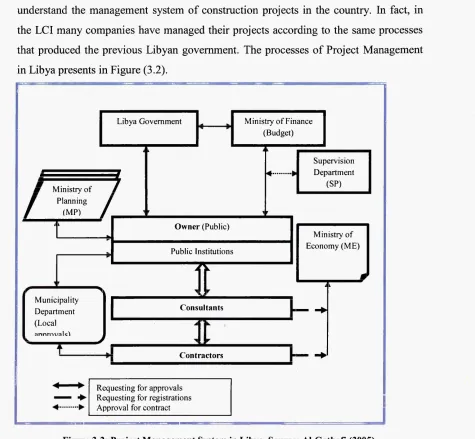
Figure 3-2: Project Management System in Libya, Source: Al-Gathafi (2 0 0 5 )...62
Figure 4-1 The Research Triangle (Klenke, 2 0 0 8 )...72
Figure 4-2 Deductive and Inductive Research Approaches (Russell, 2011)... 76
Figure 5-1: The Control Process (Ritz, 1994)... 118
Figure 5-2: The Process o f Risk Management (Peter & Pinto, 2 0 0 7 )...119
Figure 5-3: The Project Control Process (Venkataraman & Pinto, 2 0 0 8 )... 120
Figure 5-4: Standard Project Control Processes (Harpum, 2 01 0)... 121
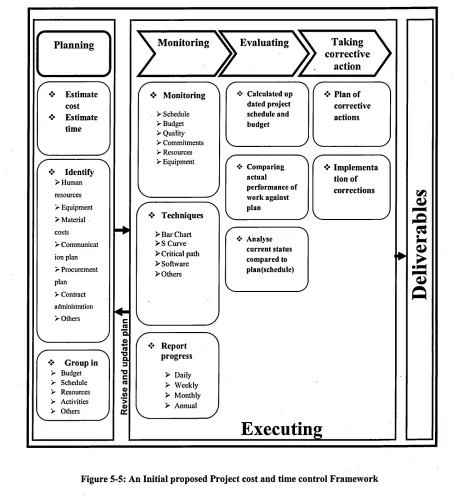
Figure 5-5: An Initial proposed Project cost and time control Framework...126
Figure 6-1: Organisations by type... 143
Figure 6-2: Businesses by ty p e...144
Figure 6-3: Employment o f respondents by sector ty p e... 144
Figure 6-4: Period o f involvement in construction projects...145
Figure 6-5: Specialization by building sector... 146
Figure 6-6: Projects by value... 146
Figure 6-7: Organizations by numbers o f em ployees ... 147
Figure 6-8: Projects ranked by importance given to time and cost control...148
Figure 6-9: Frequency with which Libyan organisations encountered problems o f time and cost overruns... 149
Figure 6-10: Methods to determine the times and costs o f activities involved in construction projects...149
Figure 7-1: Framework o f the time control process for Libyan construction projects in practice ... 235
Figure 7-2: Framework o f the cost control process for Libyan construction projects in practice ... 244
Figure 8-1: An initial improvement o f the proposed framework for project control...271
Figure 8-2: Final developed framework for project cost and time control...273
LIST OF TABLES
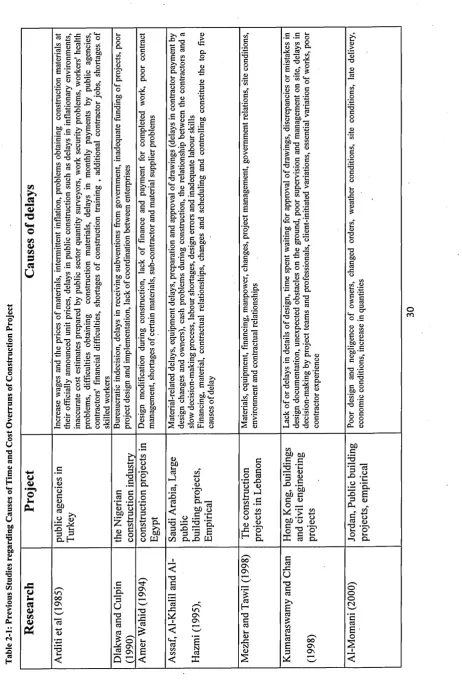
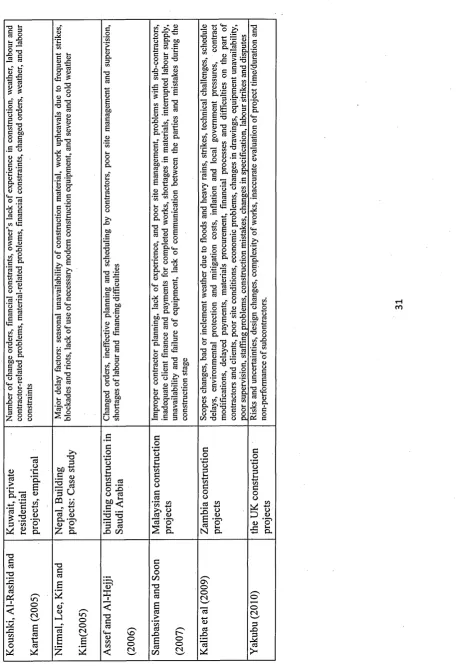
Table 2-1: Previous Studies regarding Causes o f Time and Cost Overruns o f Construction
Project... 30
Table 2-1: Previous Studies regarding Causes of Time and Cost Overruns of Construction Project (con t.) ... 31
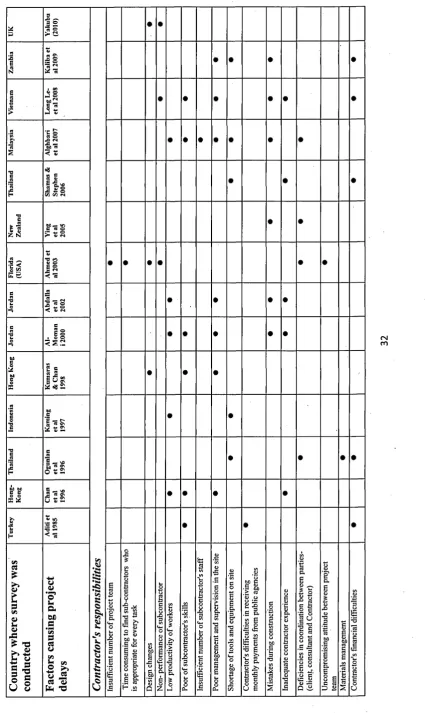
Table 2-2: Factors influencing tim e overruns... 32
Table 2-2: Factors influencing tim e overruns (cont.)... 33
Table 2-2: Factors influencing tim e overruns (cont.) ... 34
Table 2-2: Factors influencing tim e overruns (cont.)... 35
Table 2-2: Factors influencing tim e overruns (cont.)... 36
Table 2-2: Factors influencing tim e overruns (cont.)... 37
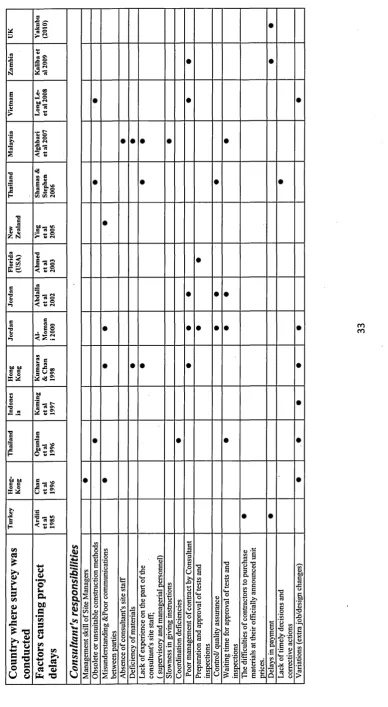
Table 2-3: Factors Influencing Cost Overruns... 38
Table 2-4: The Major Factors Causing Time and Cost Overruns in Construction Projects by Country... 39
Table 4-l:(Cronbach's Alpha) for evaluating th e consistency o f th e tim e fa c to r s ... 98
Table 4-2:(Cronbach's Alpha) for evaluating th e consistency o f th e cost fa c to r s...99
Table 6-1: Determining sam ple size from a given population...139
Table 6-2: Distribution o f Survey Questionnaire I by location...141
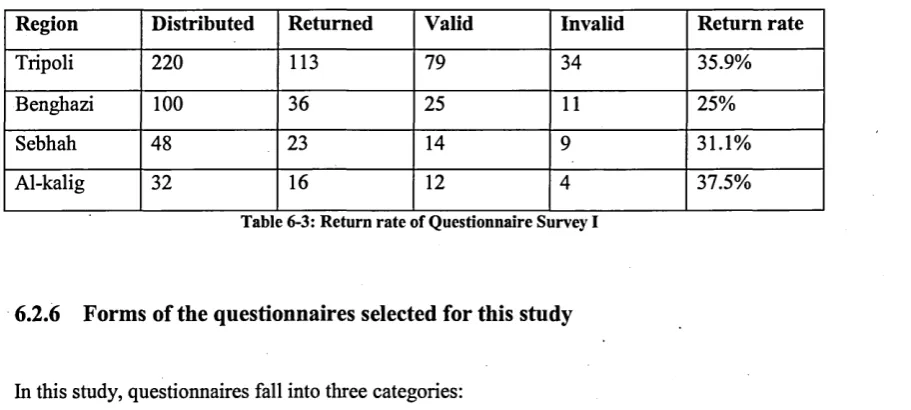
Table 6-3: Return rate of Questionnaire Survey 1...142
Table 6-4: Construction-related factors leading to tim e overruns ... 152
Table 6-4: Construction-related factors leading to tim e overruns (cont.)...153
Table 6-5: Time correlation o f construction factors am ong contractors, consultants and clients ... 154
Table 6-6: W eather and natural calamity-related factors leading to tim e overruns...155
Table 6-7: Time correlation o f w eather and natural calamity-related factors am ong contractors, consultants and o w n e r s ... 155
Table 6-8: Equipment-related factors leading to tim e overruns... 157
Table 6-9: Time correlation of equipm ent factors am ong contractors, consultants and ow ners ... 157
Table 6-10: Materials-related factors leading to tim e overruns... 159
Table 6-11: Time correlation o f materials-related factors am ong contractors, consultants and o w n e r s... 159
Table 6-12: Contractual procedures leading to tim e overruns... 160
Table 6-13: Time correlation of contractual procedures am ong contractors, consultants and o w n e r s...161
Table 6-14: Design change-related factors leading to tim e o verru n s...162
Table 6-15: Time correlation of design changes-related factors among contractors, consultants and o w n e r s...162
Table 6-16: Funding-related factors leading to tim e overruns...164
Table 6-17: Time correlation o f funding-related factors am ong contractors, consultants and o w n e r s...164
Table 6-18: Changes in legal factors leading to tim e overruns...165
Table 6-19: Time correlation of changes in legal factors am ong contractors, consultants and
o w n e r s...166
Table 6-20: Factors causing tim e overruns as ranked by contractors, clients and consultants 167 Table 6-20: Factors causing tim e overruns as ranked by contractors, clients and consultants (co n t.)... 168
Table 6-20: Factors causing tim e overruns as ranked by contractors, clients and consultants (co n t.)...169
Table 6-21: Comparison betw een parties involved in Libyan construction projects regarding th e important factors in tim e o verru n ... 169
Table 6-21: Comparison betw een parties involved in Libyan construction projects regarding th e important factors in tim e overruns (c o n t.)... 170
Table 6-21: Comparison betw een parties involved in Libyan construction projects regarding th e important factors in tim e overrun (con t.)...171
Table 6-21: Comparison betw een parties involved in Libyan construction projects regarding th e important factors in tim e overrun (cont.)...172
Table 6-22: Factors causing delays in Libyan construction projects as ranked by respondents ... 174
Table 6-22: Factors causing delays in Libyan construction projects as ranked by respondents (co n t.)... 175
Table 6-22: Factors causing delays in Libyan construction projects as ranked by respondents (co n t.)... 176
Table 6-23: Construction-related factors leading to cost overruns... 179
Table 6-23: Construction-related factors leading to cost overruns (c o n t.)... 180
Table 6-24: W eather and natural calamity-related factors leading to cost overru n s...181
Table 6-25: Equipment-related factors leading to cost overruns...182
Table 6-26: material-related factors leading to cost overruns... 184
Table 6-27: Contractual procedures leading to cost overru n s... 185
Table 6-28: design change-related factors leading to cost overruns...186
Table 6-29: Funding-related factors leading to cost overruns... 187
Table 6-30: changes in low-related factors leading to cost overrun... 188
Table 6-31: All factors causing cost overruns investigated in this study, as ranked by respondent typ es... 189
Table 6-31: All factors causing cost overruns investigated in this study, as ranked by respondent types (con t.)... ... ... 190
Table 6-31: All factors causing cost overruns investigated in this study, as ranked by respondent types (cont.)... ... 191
Table 6-31: All factors causing cost overruns investigated in this study, as ranked by respondent types (cont.)... 192
Table 6-32: Cost correlation am ong contractors, consultants and client for all fa c to r s ...195
Table 6-33: The ranking by all respondents o f all the factors causing cost overruns...197
Table 6-33: The ranking by all respondents of all the factors causing cost overruns (c o n t.)... 198
Table 6-33: The ranking by all respondents of all the factors causing cost overruns (c o n t.)... 199
Table 6-34: the party responsible for cost and tim e overruns fa cto rs... 202
Table 6-34: the party responsible for cost and tim e overruns factors (cont.)... 203
Table 6-34: th e party responsible for cost and tim e overruns factors (cont.)... 204
Table 6-35: The percentage for risk factors... 206
Table 6-35: The percentage for risk factors (c o n t.)... 207
Table 6-35: The percentage for risk factors (c o n t.)... 208
Table 7-1: Information regarding th e participants in th e in terview s... 213
Table 7-2: Interviews output...220
Table 8-1: Integration o f processes of cost and tim e control in practice... 268
Table 8-2: Responsibilities of parties (contractor, consultant, and client) in construction project 281 Table 8-2: Responsibilities of parties (contractor, consultant, and client) in construction project (co n t.)...282
Table 8-2: Responsibilities of parties (contractor, consultant, and client) in construction project (c o n t.)...283
Table 8-2: Responsibilities of parties (contractor, consultant, and client) in construction project (co n t.)... 284
Table 8-3: Questionnaire III participants ... 297
Table 8-4: Respondents' perceptions o f th e effectiven ess o f risk mitigation m easures for construction w o r k ... ’...302
Table 8-4: Respondents' perceptions o f th e effectiven ess of risk mitigation m easures for construction work (con t.)...303
Table 8-4: Respondents' perceptions o f th e effectiven ess of risk mitigation m easures for construction work (con t.)...304
Table 8-4: Respondents' perceptions o f th e effectiven ess o f risk mitigation m easures for construction work (con t.)...305
Table 8-5: The framework evaluation rating by th e panel o f ex p e rts... 309
LIST OF ABBREVIATIONS
ALE Association of Libyan Engineers
BTC Bromilow’s Time Cost
CPM Critical Path Method
CBS Construction and Building Sector
CCD Contractor Caused Delays
CIRIA Construction Industry Research and Information Association
ESRC Economics and Social Research Council
GCP General Council for Planning
GDP Gross Domestic Product
GERT Graphical Evaluation and Review Technique
GFA Gross Floor Area
GNP Gross National Product
GPC General People's Committee
IMF International Monetary Fund
LCI Libyan Construction Industry
LOB Line O f Balance
LR Literature Review
MP Ministry of Planning
NTC National Transitional Council
OCD Owner Caused Delays
OPEC Organization o f the Petroleum Exporting Countries
PERT Programme Evaluation and Review Technique
PMI Project Management Institute
PMCD Project-specific Matter Caused Delays
SMEs Small and Medium Enterprises
SPSS Statistical Package for the Social Sciences
TPCD Third Party (natural) Caused Delays
TUMC Tripoli University Medical Central
UAE United Arab Emirates
UN United Nations
UNDHA United Nations Department o f Humanitarian Affairs
1.1 Introduction
This chapter presents an overview o f the research study. It provides a background to the
study, the statement o f the research problems, aim and objectives. The chapter also
outlines the research methodology used in actualizing the research and then concludes
with giving an overview o f the structure o f the thesis.
1.2 Background of the Study
The construction industry is one of the most complex and inherently risky businesses
and has a very poor reputation for managing risks, with many major projects failing to
meet deadlines, cost and quality (Smith et al, 2006). Flanagan & Jewell (2005) note that
risk is not handled adequately, resulting in poor performance, increased costs and time
delays. Libyan construction projects, in particular, experience these problems and often
to a greater extent than most other countries. This can be attributed to both expected and
unexpected risk factors, specific to Libya, that are not effectively dealt with at various
stages o f the construction process. Wells (1986a) states that the lack o f an appropriate
approach to address these risks has led to lots o f undesirable results in project execution,
particularly in the Libyan construction industry. According to a report published by the
Libyan General People’s Committee PGC (2003), 97% of construction projects
associated with the public and private sectors between 1991 and 2003 suffered delays
and had a high impact on project cost and time. During this period (which was Libya’s
blockade time) because o f the UN sanctions against Libya following the Lockerbie
bombing in 1988, the price o f construction materials (including steel) was very high and
many projects were stopped in anticipation o f a return to old price levels, causing direct
delays. Contracting parties also created disputes between the contractor and owners,
which further increased projects’ cost and duration. Another report conducted by the
Public Committee o f Project Monitoring and Follow-up (2004) in Libya showed that
time and cost overruns are a common problem in the Libyan Construction Industry
(LCI). Moreover, in early 2011, Libya was mired in political conflict with the
widespread popular protest against the Al-Gaddafi government. These dramatic events
imply that Libya will be faced with substantial challenges in terms o f reconstruction and
reorganisation. There is an urgent need to modernize and restructure the country’s
construction industry.
The chief purpose o f this study is to explore and understand the main characteristics of
the LCI and its associated processes and operations, as well as to identify the major
obstacles constraining its practice and operations. It will also develop and validate a
framework through which to manage risk factors that significantly influence projects’
time and cost performance.
In order to identify the major risk factors, the author reviewed and examined the causes
o f cost and time overruns in various countries worldwide; These include Arditi et al
(1985) in Turkey, Amer Wahid (1994) in Egypt, Mansfield et al. (1994) in Nigeria,
Assaf et al. (1995) in Saudi Arabia, Mezher and Tawil (1998) in Lebanon, Al-Moumani
(2000) in Jordan, Ahmed et al. (2003) in the US, Koushki et al. (2005) in Kuwait,
Yakubu (2010) in the UK.
Most o f these studies have been conducted over 10 years ago. This creates a need for
more up to date research and investigation to reflect latest developments. Some o f these
studies have focused either on cost or time overruns, whereas these two are very much
related in the control o f projects: the greater the time for completion, the higher the cost,
because delays mean more hours worked and more staff, plant, equipment, direct and
indirect costs, as well as potential claims between contractor and client and a greater
concern with the financing o f organisations. Any study devoted to time control should
focus equally on cost control, which is the position taken in the present work.
The author has summarised and tabulated the most important causes o f delays and cost
overruns in different countries by analysing the many previous surveys. The author has
collated these studies and investigated the 15 most frequent delay and cost overruns
factors in those countries’ construction projects. The outcomes are shown in Table 2.4
The quantitative study for this research was carried out through the survey questionnaire
I in order to determine the factors influencing time and cost overruns in Libyan
construction projects. This stage of the research also identifies the methods used to
determine the times and costs o f activities involved in construction projects.
Additionally, the study did not stop at the identification o f the factors causing cost and
time overruns, but continued progress onto finding ways o f mitigating measures for the
identified risk factors in order to develop a framework for minimising cost and time
overruns.
1.3 Statement of the research problems
There is a consensus that the construction industry is subject to more risk and
uncertainty than are other industries. The LCI has a poor image in the construction
market owing in part to its poor performance over the past few decades. Many Libyan
construction projects were, however, found to be completed at a much higher cost over
a longer period o f time than the original plans allowed for (Libya General People's
Committee o f facilities and housing, 2006). In 2007, a new boom took place in the LCI.
Billions o f dollars were offered to rebuild the country and its facilities. For example, in
November 2007 the government announced plans to spend more than $123 billion on
public works over five years; more than $30 billion were allocated for the infrastructure
and housing sectors alone in that year. More than 500,000 housing units were planned
for the next ten years (ICS, 2009).
There are wide gaps in knowledge about the LCI in terms o f its management and
operations and there seems to be a lack of academically based research into the current
practice of project management in Libya. However, the available information relevant
to the LCI was very limited and characterized by contradiction. Therefore, new
regulations and policies are needed. For example, improving construction efficiency by
means of timeliness and cost effectiveness would definitely contribute to cost saving for
the country as a whole.
In order to improve the processes o f the LCI, it is thus necessary to understand the key
factors affecting the construction industry and its associated operations: how the
industry is organized, how construction activities are conducted and what the major
obstacles constraining the industry's operations are. The present work attempts to
answer these questions.
Therefore, it was decided to conduct this research to fill gaps in knowledge o f the LCI
through remedying the unclear understanding o f the process of project control in LCI.
The main purpose o f this research will be to explore and understand the main
characteristics o f the LCI and its associated processes and operations, as well as to
identify the major obstacles constraining its practice and operations. It will also develop
and validate a framework through which to manage risk factors that significantly
influence projects’ time and cost performance.
1.4 Research Aim
The aim o f the research is to investigate Libyan project cost and time control process in
practice and to develop and validate a framework to proactively minimise time and cost
overruns in Libyan construction projects.
1.5 Research Objectives
❖ To examine the current situation regarding time and cost overruns in Libyan
construction projects
❖ To identify the major risk factors causing time and cost overruns in Libyan
projects
♦> To determine the current procedures o f cost and time control tools and
techniques adopted by practitioners in the Libyan construction projects
❖ To explore the perception o f professionals (contractors, consultants and owners)
involved in the LCI regarding the important processes of cost and time control
❖ To establish measures that will assist to mitigate the causes of cost and time
overruns in Libyan construction projects
❖ To develop and validate a project cost and time control framework.
1.6 Research Methodology
Because o f the wide range o f data collection, as well as the nature of the data required to
confirm and validate the situation, this study adopted a quantitative approach initially.
Nevertheless, qualitative methodology was used to complement that approach because
o f its advantages - in particular, to develop a framework that will guide the practitioners
o f Libyan construction projects to the successful adoption o f project control. The
evaluation process o f this study is based on combining qualitative and quantitative
methods. The researcher first adopted a quantitative approach using questionnaire II to
define participants’ responses regarding their perspectives on mitigation measures.
Questionnaire III, however, was designed for open-ended questions to reveal qualitative
information about the project control framework to use the feedback o f participants o f
questionnaire III to re-validate the developed framework elements. The description o f
objectives of the study relative to the methods adopted and processes implemented in
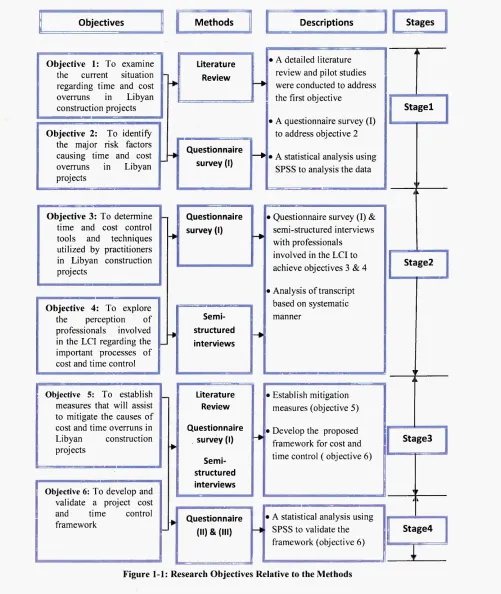
answering the research questions are shown in Figure (1.1)
Objectives M ethods Descriptions Stages
Objective 1: To examine
the current situation regarding tim e and cost overruns in Libyan construction projects
Objective 2: To identify
the major risk factors causing time and cost overruns in Libyan projects
Objective 3: To determine
tim e and cost control tools and techniques utilized by practitioners in Libyan construction projects
Objective 4: To explore
the perception o f professionals involved in the LCI regarding the important processes o f cost and tim e control
Objective 6: To develop and
validate a project cost and tim e control framework
Objective 5: To establish
measures that will assist to mitigate the causes o f cost and tim e overruns in Libyan construction projects
i Literature
Review
► —►
• A detailed literature review and pilot studies ; were conducted to address
the first objective
• A questionnaire survey (I) to address objective 2
S ta g e 1
Q uestionnaire
survey (1) —►• A statistical analysis using SPSS to analysis the data
r i i Q uestionnaire
survey (1)
-►
• Questionnaire survey (I) & sem i-structured interviews with professionals
involved in the LCI to
achieve objectives 3 & 4 S ta e e 2 • Analysis o f transcript
based on systematic manner
Semi stru ctu re d interview s
- >
%f A
Literature Review Q uestionnaire
survey (1)
• Establish mitigation measures (objective 5)
- >• Develop the proposed
framework for cost and S ta g e 3 Semi
stru ctu re d interview s
time control ( objective 6)
f ik Q uestionnaire
(II) & (III)
• A statistical analysis using SPSS to validate the framework (objective 6)
S ta g e 4
Figure 1-1: Research O bjectives Relative to the M ethods
[image:25.612.54.555.22.616.2]1.7 Thesis structure
The thesis comprises four main parts. The first part is focused on exploring and
reviewing the delay and cost overrun factors in the construction industry. The second
part introduces the research methodology and processes, analyses the methodology for
the quantitative and qualitative data, and discusses the study’s findings. The third part
includes the development o f a framework for project cost and time control. Part four
includes the evaluation o f the developed framework, conclusion and recommendation.
Finally, references and appendices are included.
The first chapter o f the thesis presents an introduction to the thesis by providing the
background to the study and highlighting the statement o f the research problem, the
research aim and objectives.
The author believes that the tasks needed to achieve the objectives must be split into
component parts and programmed within a reasonable time-scale. The literature review
process began by investigating project cost and time control processes in order to gain
insight into the structures and theories associated with risk in construction projects.
These theories and project control modelling approaches were thoroughly reviewed and
compared. The literature review’s broad scope was important in increasing the
researcher's knowledge o f the research topic as well as in delineating the research
problem.
The general purpose o f the literature review is to gain an understanding o f the current
state o f knowledge regarding the research topic. The present research examines what
other authors have written about project control, in order to develop a theoretical
framework for successful adoption and implementation of time and cost control in the
construction industry. The author has found that the literature is a fruitful source o f
concepts, theories and evidence about construction project cost and time overruns.
Monographs provided a good introduction to an overview of the issues o f importance in
project control. As well as online sources, most relevant information is to be found in
journal articles and international conference papers.
The second chapter provides a review o f previous studies in this area, deals with the
problems associated with project cost and time, and then classifies the causes and
in various building projects in countries worldwide. Chapter three takes Libya’s
demography and its economy as well as just its construction industry into account in
order to explore the main characteristics o f the LCI and its associated processes and
operations, and to identify the major constraints on those operations.
The fourth chapter o f the thesis provides justification for the primary research
methodology chosen for this project as seen in the chapter. It discusses several
methodologies, including the methods o f data collection. The research methods
considered in this study are literature research, questionnaires and semi-structured
interviews to develop a framework to minimise cost and time overruns in Libyan
construction projects. Data analysis is carried out using Statistical Package for the
Social Sciences (SPSS) for quantitative data and manually based on a systematic
process for qualitative data in chapters six and seven.
Theory and practice have been linked through the literature review and the involvement
o f practitioners in an attempt to develop a framework for minimising cost and time
overruns in the Libyan construction projects in the third part o f the thesis. The
developed framework was refined and evaluated and the proposed mitigation measures
were validated. This was achieved using the perceptions o f experts in the Libyan
construction projects in the fourth part o f the thesis in chapter eight. The conclusions
derived from the research study and recommendations for promoting good practice are
presented in last chapter o f the thesis.
1.8 Summary
This chapter has presented an introduction to the thesis by providing the background to
the study and highlighting the statement o f the research problem, the research aim and
objectives. This chapter also presented a brief overview o f the research methodology
and concluded by giving a structure to the thesis.
Chapter 2 Review of Factors
Influencing Time and Cost
Overruns in Construction
2.1 Introduction
Modem constmction projects do not allow risks and uncertainties to be dealt with at the
whim of project owners’ and contractors’ experience and intuition. Risk management is
therefore increasingly a prerequisite in the industry. All organisations face a huge
variety o f risks including physical risks to property or people, failure o f service de
livery, financial loss, information management and damage to the organisation's reputa
tion. The importance o f risk management to the industry is expressed in pragmatic
constmction project management methods to identify and remove risk factors before
dangerous situations are created. Risk management is not about predicting the future. It
is about understanding a project and making better decisions regarding the management
o f that project in the immediate future.
Constmction delays and cost overruns are the biggest issues facing constmction projects
and affecting delivery in terms o f time, budget and required quality. The characteristics
o f delay factors and their level o f impact vary from project to project, ranging from a
few days to years. They have significant financial, environmental and social impacts in
constmction projects; therefore, it is vital to investigate the causes of delays and cost
overruns and analyse their impact. Although many studies have examined the causes
affecting delays and cost overruns in constmction projects, they have rarely discussed
the common causes o f such delays or cost increases.
Because o f one o f this study’s objectives is to identify the critical factors affecting time
and cost within the constmction industry, this chapter starts by outlining the concepts
involved in risk and uncertainty. It then reviews previous studies in the area o f time and
cost overrun o f constmction projects, presents the problems associated with project
costs and timings, and classifies the causes and factors contributing to overruns so as to
determine the most important causes o f delays within building projects in different
countries.
2.2 Different Definitions and Perspectives on Risk
The word “risk” originated from the French word “risque”, and began to appear in Eng
land, in its anglicised form, around 1830, when it was used in insurance transactions
(Smith, 1999). Risk is a multi-faceted concept that differs according to viewpoint,
experience and attitude, which is why it has several meanings and definitions.
Contractors, engineers and designers conceptualize risk from the technological
perspective, developers and lenders see it financially and economically, and chemical
engineers, health professionals and environmentalists view it through the lens of
environment and safety. Any concept o f risk can thus be uncertain or variable.
The majority o f English dictionaries define "risk" as the hazard or danger o f something
that may have unlikely outcome, or as the probability o f an inconvenient incident
depending on the circumstances. The Oxford English Dictionary defines risk as danger,
hazard, exposure to peril or mischance, and also as the hazard o f commercial loss. The
Oxford Advanced Learner’s Dictionary (1995) describes risk as the “chance o f failure;
the possibility o f meeting danger or o f suffering harm or loss”. (Hornby, 1995)
Many researchers have attempted to define risk. Among them are the following:
❖ “The probability o f occurrence o f some uncertain, unpredictable and even
undesirable events that would change the prospects for the profitability on a
given investment” (Kartam, & Kartam, 2001)
❖ The “exposure to loss/gain or the probability o f occurrence o f loss/gain
multiplied by its respective magnitude” (Jaafari, 2001)
❖ The “possibility that events, their resulting impact and dynamic interactions may
turn out differently than anticipated” (Miller and Lessard, 2001)
♦>' “A situation where the future outcome is not known with certainty, but where
the various possible outcomes can be predicted from knowledge o f past or
existing events” (Ejinimma, 2004)
❖ “The chance o f an unfortunate event times the cost if such an event occurred”
(Hubbard, 2009)
❖ “The threat or possibility that an action or event will adversely or beneficially
affect an organisation’s ability to achieve its objectives” (Burtonshow-Gunn,
2009)
❖ “A combination o f the uncertainty o f occurrence of a possible outcome from an
initial event and associated positive or negative payoff o f the outcome on our
intelligent agent with respect to achieving its goal(s)” (Yaxin & Williams, 2010)
❖ The possibility o f loss or injury (Rounds & Segner, 2011)
Construction involves working with dangerous materials, tools and equipment, which
makes it risky and depends to a great extent on workers, which entails a great deal o f
variability that results in an entire class o f performance risk. Cretu et al. (2011)
conclude that risk represents an uncertain outcome.
Many organisations have also attempted to identify the meaning o f risk
❖ The UN’s approach is distinctly techno centric: “expected losses of (persons
injured, lives, economic activity disrupted and property damaged) by reason o f a
severe hazard for a given region and reference period” (UNDHA, 1992).
❖ “A combination or frequency o f occurrence o f a defined threat or opportunity
and the magnitude o f that occurrence” (The Association for Project
Management, 2002).
❖ “A significant uncertain occurrence... defined by the combination o f the
probability o f an event occurring and its consequences on objectives...the term
“risk” is generally used to embrace the possibility o f both negative and/or
positive consequences” (the UK’s MoD Risk Management Guidance, 2002).
❖ “Risk is the possibility for realisation o f unwanted, health, property, adverse
consequences to human life, or the environment; estimation o f risk is usually
based on the expected value of the conditional probability o f the event occurring
times the consequence o f the event given that it has occurred” (Society o f Risk
Analysis, 2003).
❖ That recognition o f both positive and negative impacts resulting from risks is
echoed by the Project Management Institute: “an uncertain event or condition
that, if it occurs, has a positive or negative effect on a project’s objectives” (PMI
2004).
Furthermore, the parties involved in a construction project all view risk from their own
perspectives. Clients or financiers are concerned in a broad way with how possible
changes in estimated costs, benefits and timing will affect their rate o f return.
Contractors have similar concerns, but might see risks as relating to maintaining short
term cash flows and maximizing long-term profitability. Professional consultants view
project risks from the point of accurate fee estimates, good management, prompt and
full payment o f fees, costs o f uninsured risks and the future costs o f insurance
premiums. In the construction industry, great risks can lead to catastrophe as time and
cost overruns turn profitable projects into loss-making ventures.
Risk, seen as chance, can sometimes be viewed as advantageous, as long as it is allowed
for (Mills, 2001). Generally, it appears that there are two options by which risk is
determined:
❖ Risk is an umbrella expression with two dimensions:
> Opportunity, i.e. risks with positive outcomes
> Threat, i.e. risks with negative outcome
❖ Uncertainty is the "overarching" term with two formations:
> Risk, i.e. uncertainty with negative outcomes
> Opportunity, i.e. uncertainty with positive outcome. (Hillson, 2002)
Aven & Renn (2010) state that definitions o f risk have the following properties:
❖ They accommodate both undesirable and desirable outcomes
❖ They address uncertainties instead o f probabilities and expected values
❖ They are not restricted to specific consequences and quantities
Basically, construction risks can result in:
❖ Failure to keep within budget
❖ Failure to keep within time schedules
❖ Failure to meet the required quality
2.3 The Distinction between Risk and Uncertainty
Construction practically never operates under conditions of certainty. Chapman and
Ward (2002) define uncertainty as “a lack of certainty; involving variability and
ambiguity”. Winch (2010) state that “it is the absence o f information required for the
decision that needs to be taken at a point in time”. Aven & Renn (2010) see it as the
difficulty o f predicting the occurrence o f events and/or their consequences based on
incomplete or invalid databases, possible changes o f the causal chains and their context
conditions, extrapolation methods when making inferences from experimental results,
modelling inaccuracies or variations in expert judgments. According to Cretu et al.
(2011), uncertainty poses project management a particular set o f problems, as it can
potentially affect outcomes for ill as well as for good.
The expressions “risk” and “uncertainty” can be applied in different ways, and it would
be useful at this stage to clarify the difference between them. From the above definitions
o f risk and uncertainty, it can be seen that there is a difference between the two. Risk
and uncertainty are distinguished by Merrett and Sykes (1973) as follows: “uncertainty
exists when there is more than one possible outcome to a course o f action but the
probability of each outcome is not known”. Uncertain events are random events which
defy prediction. Risk events can be managed; uncertain events cannot. It should
therefore be a fundamental rule o f risk management to reduce uncertainties to a
minimum. Although in a practical situation, the distinction between risk and uncertainty
is not critical, the concepts o f risk must strictly reflect the realities o f a decision
situation. For example, the change o f a government's policies may not be a risk to a
Western construction firm, but it is an uncertainty.
2.4 Construction Risk
Flanagan & Jewell (2005) have suggested that, in relation to cost and time, the
construction industry is, perhaps more than most, at particular risk. They note that this
risk is not dealt with sufficiently, resulting in poor performance with increased costs and
causing them to overrun their predetermined due date and cost, because delays mean
more hours worked and more staff, plant, equipment, direct and indirect costs, as well as
potential claims between contractor and client and a greater concern with the financing
of organisations.
2.5 Concept of Time and Cost in Construction Projects
The purpose o f time and cost calculations in the construction industry is to ensure that
projects deliver on time and within budget. Construction professionals around the world
pay attention to time and cost overruns in projects; their likely query is: “has the project
been finished and delivered on time, within budget and to the specified quality?”
The construction industry has a generally poor reputation in terms o f delivering projects
to cost and on time. Kartam & Koushki (2004) find that most construction projects
experience cost overruns and time delays during the construction stage. According to
Murray and Langford (2003), the factors leading to failure in construction projects are
budget (cost) overruns, lack of value for money, failure to finish on time and poor
quality of work. Turner (2006) suggests that time and cost control are inherent elements
o f project management.
Because the ways that processes, timings and costs of construction projects are
controlled differ from one organisation to another, many researchers state that time and
cost objectives in any construction project involves dealing with specific problems and
risks.
2.5.1 Project Cost Considerations
Project cost is defined in various ways. For Kwakye (1997), the total project cost is the
client’s total expenditure on the project, which is the sum total o f factors such as land
and construction costs, interest charges and fees. Hendrikson and Au (2000) maintain
that “the capital cost for a construction project includes the expenses related to the
initial establishment o f the facility: planning and feasibility studies, land acquisition,
architectural and engineering design, equipment and labour, construction (including
materials), and equipment and furnishings not included in construction”. According to
Lock (2007), every project should be controlled against detailed cost budgets so as to
ensure that the expenditure authorised in its contract or charter is not exceeded. Zwikael
& Smyrk, (2011) define a project’s cost as the outlays required to purchase resources
for the project. Generally, a project’s cost depends on its size, type, form, location,
complexity, level o f specification, tendering climate, predicted inflation, risks and
procurement method. It can be concluded that project cost is the amount o f money that
is required to complete all project activities. It concluded that the cost o f the project is
influenced by:
• specifications o f the end products such as levels o f performance, quality, and
reliability
• compliance with governmental, institutional, or internal standards
• technical requirements such as the need to upgrade computer hardware, and
administrative needs including a company’s financial policies
• The Project Cost Estimate
For a detailed project, a budget or cost plan and cost estimate are usually prepared as
soon as the design has been finalized. The aim o f a cost estimate is to give an indication
o f the possible cost o f the project. Cost estimates fall into two groups:
( • Unit methods o f cost estimate
These unit costs are extrapolated forward in time to reflect current market conditions,
the project’s location and the particular character o f the job being considered.
• Element cost per square metre - GFA method
In this method the element cost is divided by the gross floor area (GFA). This gives the
cost per square metre of GFA.
• Project Cost Overrun
Cost can be used as an indicator for project control performance. But cost estimates in a
project are revised at various stages to improve their accuracy; after every such revision,
they invariably increase. According to Choudhury (1988), “Cost overrun, the expression
which is used to represent the variance between the original sanctioned cost and the
final cost incurred, would then provide no indication of managerial performance”.
Jackson (1999) defines cost overruns as the difference between the final contract
amount and the original contract amount divided by the original contract award amount.
Cost overrun = Final Contract Amount - Original Contract Amount Original Contract Amount
For Choudhry and Phatak (2004), cost overruns are the difference between the original
cost estimate and actual construction cost on completion o f commercial sector
construction projects. Cretu et al. (2011) defines cost overruns as the difference between
the low bid and the actual incurred cost at the time o f construction completion.
2.5.2 Project Time Considerations
Various definitions o f project time have been given. According to Clough et al. (2000),
project time is the completion o f the project on the interim completion dates required for
phases o f the work, or the date stated in the contract. Sunny and Kim Baker (2000)
define project time as the period needed to finish the work starting from location until
completion, while for Kerzner (2009) it is the period from the beginning until the end o f
the work. Estimating the time o f tasks is o f great importance. Unfortunately, this is like
trying to predict the future. It is only a guess, but there are better ways to guess than
others. It should be obvious that the actual project time has to match or improve upon
planned progress. All significant stages o f the project must take place no later than their
specified dates so completion occurs on or before the planned finish date.
• The Project Time Estimate
There are several methods that can apply to make guesses or estimates o f the project
time as accurate as possible. They are as following:
• Depending on records o f preceding project paperwork or files.
• Trying to find similar project that has been completed.
• Seeking expert opinion, this should be used whenever possible.
❖ Project Time Overrun
The meaning o f completion may also differ from project to project. How much time a
project eventually takes and who has contributed to overruns are questions that no one
can answer without undertaking research. According to Trigunarsyah (2004), time
overrun is the extension o f time beyond the time estimated as stipulated in the approval
contract or planned completion dates traceable to the contractors. Badiru (2009)
suggested that time slips away too easily and is irrecoverable. If time is not managed
effectively, a project that has a fixed term for completion cannot succeed. Managing
time implies eliminating inessential activities from the project’s schedule. In summary,
time overruns are the extra time taken to finish the project over and above the time
schedule; these overruns are caused by both external and internal factors.
2.6 The Time-Cost Relationship
The relationship between cost and time has been explored by many studies over a long
period o f time. Since the late 1960s many researchers have explored the apparent
relationship between the duration of a building project and its price.
Recently, many researchers have turned their attention to long-term trends in the
relationship between time and value, developing models that allow the rapid forecast o f
project duration using only the budgeted cost and current cost indices.
Bromilow (1969) identifies the relationship between project cost and time as
T = KCb
Where
T is the actual construction time in working days
C is the cost of building in millions of dollars
K is a constant-characteristic o f building time performance in Australia, and
B is a constant-indicative o f the sensitivity of time performance to cost level.
Extensive use has been made of Bromilow’s time-cost model (the BTC model) in
estimating project duration. The model indicates that a construction project’s duration is
with the construction process can establish a fairly accurate probable duration o f a
project measured in days, given the estimated cost o f the project.
Since Bromilow (1969) first presented the relationship between a construction project’s
cost and time, numerous studies have been carried out for civil engineering and building
projects around the