The construction and interrogation of actor based
simulation histories
CLARK, Tony <http://orcid.org/0000-0003-3167-0739>, KULKARNI, Vinay,
BARN, Balbir and BARAT, Souvik
Available from Sheffield Hallam University Research Archive (SHURA) at:
http://shura.shu.ac.uk/17356/
This document is the author deposited version. You are advised to consult the
publisher's version if you wish to cite from it.
Published version
CLARK, Tony, KULKARNI, Vinay, BARN, Balbir and BARAT, Souvik (2017). The
construction and interrogation of actor based simulation histories. In: CABANILLAS,
Cristina, ESPAÑA, Sergio and FARSHIDI, Siamak, (eds.) Proceedings of the ER
Forum 2017 and the ER 2017 Demo Track co-located with the 36th International
Conference on Conceptual Modelling (ER 2017), Valencia, Spain, - November 6-9,
2017. CEUR Workshop Proceedings (1979). CEUR-WS, 334-347.
Copyright and re-use policy
See
http://shura.shu.ac.uk/information.html
Sheffield Hallam University Research Archive
The Construction and Interrogation of Actor
Based Simulation Histories
Tony Clark1
, Vinay Kulkarni3
, Balbir S. Barn2
, and Souvik Barat3
1
Sheffield Hallam University, UK 2
Middlesex University, UK 3
Tata Consultancy Services Research, India
Abstract Large socio-technical systems are complex to comprehend in their entirety because information exchanges between system compo-nents lend an emergent nature to the overall system behaviour. Although Individual system component behaviour may be known at the outset, such components may exhibit uncertainty and further exacerbate issues of a priori prediction of the overall system behaviour. Multi-agent sys-tems and the use of simulation is a possible recourse in such situations however, simulation results need to be correctly interpreted so as to nudge the overall system behaviour towards a desired objective. We pro-pose a solution wherein the system is modelled as a set of actors ex-changing messages, a simulation engine producing execution trace for an actor as its history, and a querying mechanism to identify patterns that may span across individual actor histories to ascertain property of the overall system. The proposed solution is evaluated using a representative sample from real life.
1 Introduction
Our work on simulation has led to the design of a simulation work-bench built around an actor language [12] called ESL [4]. The language ESL is used to construct agent-based simulation models that are run to produce histories. Each history contains a sequence of events produced by the behaviour of the agents in the simulation and thereby captures their emergent behaviour. A history is a temporal database of facts describing the states of, and communications between, agents in the simulation.
The challenge is to provide a suitable technology that allows the tem-poral database to be interrogated in order to support the sense-making described above. We describe an approach to the construction and in-terrogation of simulation histories. History construction is achieved by extending the standard operational actor model of computation [7] in order to capture temporal events during simulation execution. History interrogation is achieved by extending standard logic programming with temporal operators that are defined in terms of a supplied history con-taining time-stamped events.
The approach is defined in terms of meta-interpreters for both con-struction, in section 2, and interrogation, in section 3. The approach has been implemented by extending the ESL language with history and in-terrogation features; the implementation is briefly described in section 4 and used to implement and interrogate the simulation of a retail shop.
2 History Construction
An agent-based simulation model consists of agents, each of which has lo-cal knowledge, goals and behaviour. Such a model can be operationalised in terms of the actor model of computation whereby each actor has an independent thread of control, has a private state and communicates with other actors via asynchronous messages to either update a local variable or change behaviour.
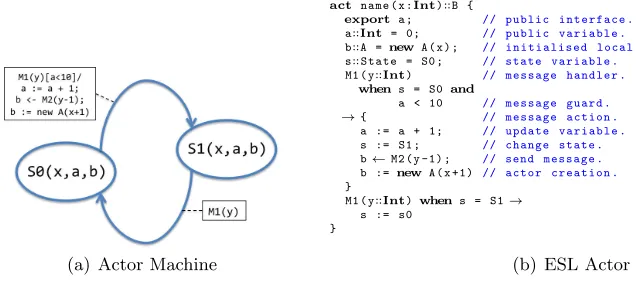
ESL is a text-based language that compiles to an actor-based VM. Actor behaviour can be represented using state machines as shown in figure 1 where figure 1(a) is a state machine representation of the ESL actor definition in figure 1(b). The rest of this paper will use state machine
representation for actors with transitions between states labelled M[Q]/A
whereMis a message,Qis a guard condition, andAis an action. Note that
not all ESL programs can be represented as state machines, however this is sufficient for the behaviours considered in this paper.
(a) Actor Machine
act name ( x :Int)::B {
export a ; // public i n t e r f a c e . a::Int = 0; // public v a r i a b l e . b::A = newA ( x ) ; // i n i t i a l i s e d local . s::State = S0 ; // state v a r i a b l e . M1 ( y::Int) // m e s s a g e h a n d l e r .
whens = S0 and
a < 10 // m e s s a g e guard .
→{ // m e s s a g e action . a := a + 1; // update v a r i a b l e . s := S1 ; // change state . b←M2 (y -1) ; // send m e s s a g e . b :=new A ( x +1) // actor c r e a t i o n . }
M1 ( y::Int)when s = S1→
s := s0 }
[image:4.612.136.454.118.265.2](b) ESL Actor
Figure 1.Example Actor Behaviour
1 type Id = Int; 2 type Time = Int;
3 type B e h a v i o u r = [ H a n d l e r (Str,[ C o m m a n d ]) ];
4 data C o m m a n d = Send ( Id ,Str) | Update (Str) | Block ([ C o m m a n d ]) | Become (Str) | New (Str) ; 5 type Queue = [ M e s s a g e (Str) ];
6 type Actor = M a c h i n e ( Id ,[ C o m m a n d ] , Behaviour , Queue , Time ) ; 7 type DB = [ Fact ( Time , C o m m a n d ) ];
8 type ESL = State (Set{ Actor } , DB , Time ) ;
Figure 2.An Abstract Model of Actor Programs
of ESL type definitions. All details relating to how variables are man-aged within an actor has been elided and can be understood in terms of
standard operational models of programming languages. The term State(
a,db,t)represents the state of an executing actor configuration whereais
a set of actors,dbis a history database, andtis the current time. We are
interested in specifying how db is constructed through the conventional
operational semantics of actors. This is achieved by defining a single-step
operational semantics:s2=step(s1)where system states1performs an
ex-ecution step in order to become state s2. The complete execution of a
system can be constructed by repeated application of step.
It is useful in simulations to be able to refer to global time via a clock. This can be used to schedule future computation or to allow actors to perform joint actions. To support the notion of global time, each actor in
our operational model receives a regular Timemessage where each global
A history databasedbis created from an initial configuration of actors
a by repeated application of step until a terminal state is achieved such
that all actors are exhausted and have no pending messages,db=run(a):
i s T e r m i n a l :: ( ESL )→Bool;
i s T e r m i n a l ( State (a ,_ , _ ) ) = a l l T e r m i n a t e d ( a ) ;
a l l T e r m i n a t e d :: (Set{ Actor })→Bool; a l l T e r m i n a t e d (set{}) = true ;
a l l T e r m i n a t e d (set{ a | as }) = i s T e r m i n a t e d ( a ) and a l l T e r m i n a t e d ( as ) ; i s T e r m i n a t e d::( Actor )→Bool;
i s T e r m i n a t e d ( M a c h i n e (_ ,[] , _ ,[] , _ ) ) = true ; i s T e r m i n a t e d ( _ ) = false; run::([ Actor ])→DB ;
run ( a ) = repeat ( step , State (a ,[] ,0) , i s T e r m i n a l )
Summarising, a history is a collection of facts of the form Fact(t,f)
where t is a timestamp and f is a term representing an actor execution
step. The next section describes how the histories are interrogated using a temporal extension to standard relational programming.
3 Interrogation of Histories
Simulations consist of many autonomous agents with independent be-haviour and motivation. Consequently, system bebe-haviour is difficult to predict. Furthermore, the highly concurrent nature of the actor model of computation makes the simulation difficult to instrument in order to detect situations of interest. Therefore, we propose the construction of simulation histories as a suitable approach to simulation interrogation. Given such a history we would like to construct queries that determine whether particular relationships exist, where the relationships are defined in terms of the key features of actor computation. Logic programming, as exemplified by Prolog, would seem to be an ideal candidate for the construction of such queries, however standard Prolog does not provide intrinsic support for expressing the temporal features of the histories that are generated in section 2.
non-temporal subset of itself that is a statically typed version of Prolog:
append [ T ] :: ([ T ] ,[ T ] ,[ T ]) ; append [ T ]([] , l , l )←!; append [ T ]([ x | l1 ] , l2 ,[ x | l3 ])←
append [ T ]( l1 , l2 , l3 ) ;
length [ T ] :: ([ T ] ,Int) ; length [ T ]([] ,0)←!; length [ T ]([ h | t ] , n )←
length [ T ]( t , m ) , n := m + 1;
member [ T ] :: (T ,[ T ]) ; member [ T ]( x ,[ x | _ ]) ; member [ T ]( x ,[ _ | l ])←
member [ T ]( x , l ) ;
subset [ T ] :: ([ T ] ,[ T ]) ; subset [ T ]([] ,[]) ; subset [ T ]([ x | l ] ,[ x | s ])←
subset [ T ]( l , s ) ; subset [ T ]( l ,[ _ | s ])←
subset [ T ]( l , s ) ;
lookup [ V ] :: (Str,V ,[ Bind (Str, V ) ]) ; lookup [ V ]( n ,v ,[ Bind (n , v ) | _ ]) ; lookup [ V ]( n ,v ,[ _ | env ])←
lookup [ V ]( n ,v , env ) ;
The examples above are standard Prolog rules that have been elaborated with static type information that is checked by the ESL Workbench before
execution. The ruleslengthandmemberuse parametric polymorphism over
the typeTof elements in a list. The rulelookupis parametric with respect
to the type of the bindings in the environment list.
The rules shown above do not reference simulation history facts. In order to support rules over histories we introduce new rule features based
on temporal logic. The following data type Body describes the elements
that can occur in a rule body:
data Value = Term (Str,[ Value ]) | Var (Str) | I (Int) | S (Str) ;
data Body = Call (Str,[ Value ]) | Is (Str, Value ) | Start | End | Next ([ Body ]) | Prev ([ Body ]) | Always ([ Body ]) | E v e n t u a l l y ([ Body ]) | Past ([ Body ]) | Forall ([ Body ] , Value , Value ) ;
The termsCallandIsrepresent standard Prolog body elements; all other
elements are extensions to standard Prolog. The extensions all relate to current time which is the time-stamp associated with the facts in the history:
type Time = Int;
type Entry = Fact ( Time ,Str,[ Value ]) ;
type DB = [ Entry ];
Elements Start and End are satisfied when the current time is 0 and the
end of the history respectively. An elementNext(es) is satisfied when the
elements esare satisfied in current time +1, similarly Prev(es)in current
time −1. An element Always(es) is satisfied when the elements es are
satisfied at all times from now, similarly Past(es) all times before now.
Element Eventually(es) is satisfied when es are satisfied at some time in
the future.
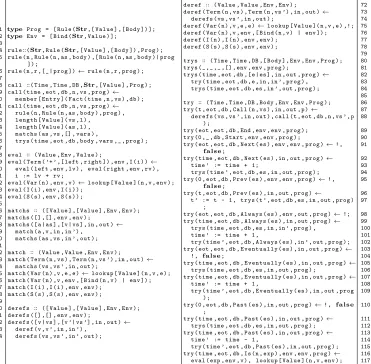
Figure 3 defines a meta-interpreter for the history query language.
Given a query q(v1,. . .,vn), a program prog, a database db and a history
end timet, the query is satisfied whencall(0,t,db,’q’,[v1,. . .,vn],prog)is
satisfied with respect to the definitions given in figure 3.
1 type Prog = [ Rule (Str,[ Value ] ,[ Body ]) ]; 2 type Env = [ Bind (Str, Value ) ];
3
4 rule::(Str, Rule (Str,[ Value ] ,[ Body ]) , Prog ) ; 5 rule (n , Rule (n , as , body ) ,[ Rule (n , as , body ) | prog
]) ;
6 rule (n ,r ,[ _ | prog ])←rule (n ,r , prog ) ; 7
8 call ::( Time , Time , DB ,Str,[ Value ] , Prog ) ; 9 call ( time , eot , db ,n , vs , prog )←
10 member [ Entry ]( Fact ( time ,n , vs ) , db ) ; 11 call ( time , eot , db ,n , vs , prog )←
12 rule (n , Rule (n , as , body ) , prog ) , 13 length [ Value ]( vs , l ) ,
14 length [ Value ]( as , l ) , 15 matchs ( as , vs ,[] , vars ) ,
16 trys ( time , eot , db , body , vars ,_ , prog ) ; 17
18 eval :: ( Value , Env , Value ) ;
19 eval ( Term ( ’+ ’ ,[ left , right ]) , env , I ( i ) )←
20 eval ( left , env , lv ) , eval ( right , env , rv ) , 21 i := lv + rv ;
22 eval ( Var ( n ) , env , v )←lookup [ Value ]( n ,v , env ) ; 23 eval ( I ( i ) , env , I ( i ) ) ;
24 eval ( S ( s ) , env , S ( s ) ) ; 25
26 matchs :: ([ Value ] ,[ Value ] , Env , Env ) ; 27 matchs ([] ,[] , env , env ) ;
28 matchs ([ a | as ] ,[ v | vs ] , in , out )←
29 match (a ,v , in , in ’) , 30 matchs ( as , vs , in ’ , out ) ; 31
32 match ::( Value , Value , Env , Env ) ; 33 match ( Term (n , vs ) , Term (n , vs ’) ,in , out )←
34 matchs ( vs , vs ’ , in , out ) ;
35 match ( Var ( n ) ,v ,e , e )←lookup [ Value ]( n ,v , e ) ; 36 match ( Var ( n ) ,v , env ,[ Bind (n , v ) | env ]) ; 37 match ( I ( i ) ,I ( i ) , env , env ) ;
38 match ( S ( s ) ,S ( s ) , env , env ) ; 39
40 derefs :: ([ Value ] ,[ Value ] , Env , Env ) ; 41 derefs ([] ,[] , env , env ) ;
42 derefs ([ v | vs ] ,[ v ’| vs ’] , in , out )←
43 deref (v ,v ’ , in , in ’) , 44 derefs ( vs , vs ’ , in ’ , out ) ;
72 deref :: ( Value , Value , Env , Env ) ;
73 deref ( Term (n , vs ) , Term (n , vs ’) ,in , out )←
74 derefs ( vs , vs ’ , in , out ) ;
75 deref ( Var ( n ) ,v ,e , e )←lookup [ Value ]( n ,v , e ) ,!;
76 deref ( Var ( n ) ,v , env ,[ Bind (n , v ) | env ]) ;
77 deref ( I ( n ) ,I ( n ) , env , env ) ;
78 deref ( S ( s ) ,S ( s ) , env , env ) ;
79 80 trys :: ( Time , Time , DB ,[ Body ] , Env , Env , Prog ) ;
81 trys (_ ,_ ,_ ,[] , env , env , prog ) ;
82 trys ( time , eot , db ,[ e | es ] , in , out , prog )←
83 try ( time , eot , db ,e , in , in ’ , prog ) ,
84 trys ( time , eot , db , es , in ’ , out , prog ) ;
85 86 try :: ( Time , Time , DB , Body , Env , Env , Prog ) ;
87 try (t , eot , db , Call (n , vs ) ,in , out , p )←
88 derefs ( vs , vs ’ , in , out ) , call (t , eot , db ,n , vs ’ , p
) ;
89 try ( eot , eot , db , End , env , env , prog ) ;
90 try (0 , _ , db , Start , env , env , prog ) ;
91 try ( eot , eot , db , Next ( es ) , env , env , prog )←! ,
false;
92 try ( time , eot , db , Next ( es ) ,in , out , prog )←
93 time ’ := time + 1;
94 trys ( time ’ , eot , db , es , in , out , prog ) ;
95 try (0 , eot , db , Prev ( es ) , env , env , prog )←! ,
false;
96 try (t , eot , db , Prev ( es ) ,in , out , prog )←
97 t ’ := t - 1 , trys (t ’ , eot , db , es , in , out , prog )
;
98 try ( eot , eot , db , A lways ( es ) , env , out , prog )←!;
99 try ( time , eot , db , Always ( es ) ,in , out , prog )←
100 trys ( time , eot , db , es , in , in ’ , prog ) ,
101 time ’ := time + 1 ,
102 try ( time ’ , eot , db , Always ( es ) ,in ’ , out , prog ) ;
103 try ( eot , eot , db , E v e n t u a l l y ( es ) ,in , out , prog )←
104 ! , false;
105 try ( time , eot , db , E v e n t u a l l y ( es ) ,in , out , prog )←
106 trys ( time , eot , db , es , in , out , prog ) ;
107 try ( time , eot , db , E v e n t u a l l y ( es ) ,in , out , prog )←
108 time ’ := time + 1 ,
109 try ( time ’ , eot , db , E v e n t u a l l y ( es ) ,in , out , prog
) ;
110 try (0 , eot , db , Past ( es ) ,in , out , prog )←! , false
;
111 try ( time , eot , db , Past ( es ) ,in , out , prog )←
112 trys ( time , eot , db , es , in , out , prog ) ;
113 try ( time , eot , db , Past ( es ) ,in , out , prog )←
114 time ’ := time - 1 ,
115 try ( time ’ , eot , db , Past ( es ) ,in , out , prog ) ;
116 try ( time , eot , db , Is (n , exp ) , env , env , prog )←
[image:7.612.129.500.200.564.2]117 eval ( exp , env , v ) , lookup [ Value ]( n ,v , env ) ;
(the definition of Forall is omitted, but is consistent with standard
Pro-log). The rulecallis used to process a body element of the formCall(n,vs)
wherenis the name of a fact andvsare the arguments. Conventional
Pro-log processes such a call using the definition ofcall defined on lines 11 –
16 where a rule namednwith an appropriate arity is found in the program
and is supplied with the argument values usingmatchs.
Figure 3 extends conventional Prolog rule calling by allowing the fact
to be present in the historyat the current time(lines 9-10). Therefore, the
facts in the history become added to the facts that can be conventionally deduced using the rules.
The semantics of the additional types of body elements are processed
by the tryrule (lines 89–115) by modifying the value of the current time
appropriately, For example, the rule for Next (lines 91–94) fails if the
end of the history has been reached, otherwise it attempts to satisfy the
elements es after incrementing the current time by1.
An example rule iscustomerswhere customers(cs) is satisfied when cs
is a list of all the customer actor identifiers in the history:
1 c u s t o m e r s :: ([Int]) ; 2 c u s t o m e r s ([])←end , !; 3 c u s t o m e r s ( cs )←
4 f o r a l l[ actor (a , ’ customer ’ , _ ) ]( a , cs ’) , next[ c u s t o m e r s ( cs ’ ’) ] , 5 appen d [Int]( cs ’ , cs ’ ’ , cs ) ;
Line 2 defines that there can be no customers if we are at the end of the history. Lines 3–5 define how to extract the customer identifiers from this
point in the history: line 4 uses forall to match all database facts of the
formactor(a,’customer’,_)where this fact has been added to the database
when a new customer actor is created. Then,nextis used to advance the
time so that cs’’ are all the customer actors from this point onwards.
4 Evaluation
This section provides an overview of the implementation, describes a simulation that produces a history, and shows how the query language can interrogate the history.
[image:9.612.183.436.232.391.2]4.1 Implementation
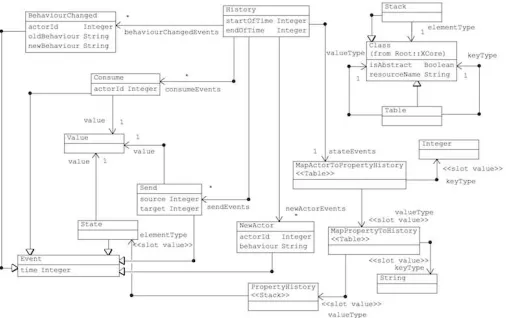
Figure 4.History Implementation
ESL compiles to a virtual machine that is similar to the Java VM where actors are the equivalent of objects. The ESL VM manages a his-tory that is automatically updated when actors are created, change be-haviour, updated and send messages. Given the scale of simulations, it is important that the history is represented as efficiently as possible, both for construction and interrogation. Figure 4 shows the Java classes that are used to implement the history.
Once constructed, a history is interrogated by the ESL query language that compiles to a VM which is based on a standard Warren Abstract Machine [15].
In a WAM, Choice-points are represented as pointers into a frame on a fail stack. The ESL query language VM extended the fail stack with a
new form of fail-frame that indexes the history. For example, a queryactor
(a,b,t) relates to actor creation events wherea is the unique identifier, b
is the behaviour, and t is the time, any of which may be logic variables.
to the fail-frame, then the index is incremented. A history is any Java object that implements the following interface which is used by the call and fail mechanism within the VM:
1 public i n t e r f a c e DB {
2 b o o l e a n h a s F a c t ( String name , int arity , int time , int index , M a c h i n e m a c h i n e ) ;
3 Objec t g e t F a c t A r g ( S tring name , int arity , int time , int index , int argNumber , M a c h i n e m a c h i n e ) ;
4 int e n d O f T i m e () ; 5 }
The method hasFact is used by the query VM when performing a call to
determine whether the hitsory database contains a fact corresponding to
the call. The first time this occurs the supplied indexis0. If this succeeds
then the VM constructs a fail-frame that captures the name, arity, time
and the next index: 1. Each time the fail-frame is used for backtracking,
the index is incremented. The method getFactArg is used to extract the
individual fact arguments and subsequently unify them in the query VM.
4.2 Case Study Application
In this paper we use a case study that is based on existing work on agent-based organisation simulations [13] and as such is seen as a reference example. The case study will be used to demonstrate the construction of an agent model that produces a history and the subsequent interroga-tion via a query. The query is chosen to demonstrate the utility of logic programming using the ESL query language and will also be analysed in terms of its efficiency based on the implementation described in the previous section.
Case study description: A shop provides stock on the shop-floor. Cus-tomers enter the shop and may browse until they either leave, seek help or decide on a purchase. Items must be purchased at tills and multiple cus-tomers are serviced via a queue. Shop assistants may be on the shop-floor, helping a customer or may service a till. A queueing customer can only make a purchase when they reach the head of a queue at a serviced till. A customer who waits too long at an unserviced till, or for whom help is not available, will become unhappy and leave the shop. The shop would like to minimise unhappiness. In addition the shop owner has noticed that stock is going missing. A criminal gang is known to be operating in the area. Typically they operate by engaging all the assistants in a shop whilst one of the gang members leaves the shop without paying for the goods.
Figure 5.Structure of Shop Actors
which we make the distinction between behaviour types and behaviours. The difference between these two concepts corresponds to the difference between software module types and modules in that a behaviour type is an interface definition and a behaviour provides an implementation of the interface. There may be many actors that are instances of the same behaviour.
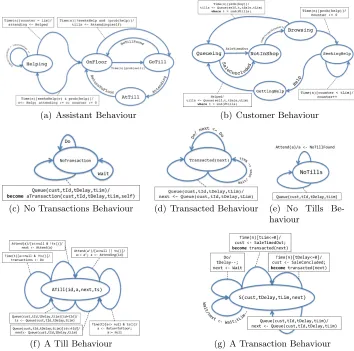
The model shown in figure 6 organises a shop as a collection of cus-tomers, assistants and tills. Each till is an actor that is associate with a sequence of transactions, also represented as actors. Each transaction
may be serviced by sending it a Domessage, or may be delayed, by
send-ing it a Wait message. When a transaction is successfully terminated the
corresponding actor will change its behaviour totransactedwhich means
that it acts as a proxy for the next transaction in the queue.
In addition to normal customers, the simulation represents a special
type of customer calledgangMember. These unscrupulous actors are
organ-ised by a gang leader to occupy sales assistants in order that the leader can steal merchandise. We will not explicitly consider the behaviour of the gang leader, however we will be interested in examining the simulation history in order to detect potential gang member behaviour.
Figure 6 shows the behaviour definitions for the shop simulation
ac-tors. The simulation is driven by Timemessages and all actors implement
aTimetransition for all states; the empty transitions arising fromTimeare
(a) Assistant Behaviour (b) Customer Behaviour
(c) No Transactions Behaviour (d) Transacted Behaviour (e) No Tills Be-haviour
[image:12.612.136.490.111.462.2](f) A Till Behaviour (g) A Transaction Behaviour
Figure 6.Shop Actor Behaviour
transaction istLim which determines how long a customer is prepared to
wait without a sale being concluded.
Customers who leave the shop because they have waited too long to
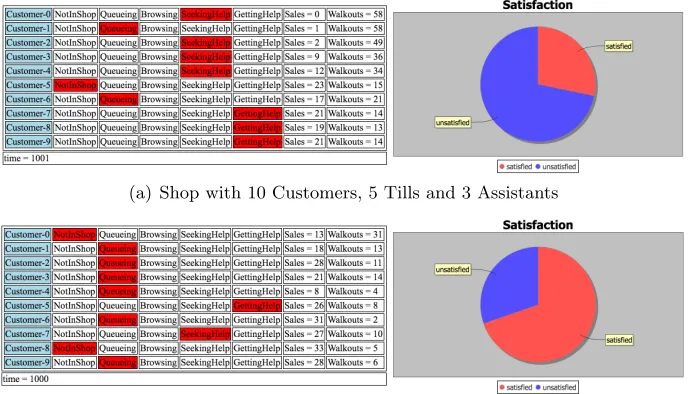
be serviced at a till are deemed to be unhappy. the shop is interested in
(a) Shop with 10 Customers, 5 Tills and 3 Assistants
[image:13.612.139.484.112.309.2](b) Shop with 10 Customers, 5 Tills and 5 Assistants
Figure 7.Shop Simulation Output
random elements and therefore each run is different, but the two outputs characterise the relative differences.
5 Related Work
Simulation of multi agent systems (MAS) is quite close to the problem we are addressing. Several simulation approaches have been suggested
but none seem to address the querying need. In [2], Bosse et al.present
a generic language for the formal specification and analysis of dynamic properties of MAS. This language supports the specification of both qual-itative and quantqual-itative aspects, and therefore subsumes specification lan-guages based on differential equations. However, this is not an executable language. In fact, it has been specialised for simulation domain leading to LEADSTO language[3]. The LEADSTO is essentially a declarative order-sorted temporal language extended with quantitative notions (like integer, and real). Time is considered linear, continuous, described by real values. Dynamics is modelled as direct temporal dependencies between state properties in successive states. Though quite useful in specifying simulations of dynamic systems, it does not provide any help in querying
the resultant behaviour. Bosseet al.further propose a multi-agent model
ma-chinery to validate a pre-defined property over simulation trace. However, there is no support for temporal logic operators in specifying a property. Sukthankar and Sycara, in contrast, propose an algorithm to recog-nize team behaviour from spacio-temporal traces of individual agent be-haviours using dynamic programming techniques[14]. Though quite close as regards the solution space, this result lays strong emphasis on team behaviour thus hinting collaboration. Our proposed machinery is neutral to the nature of environment - collaborative or competitive or both.
Vas-concelos et al. present mechanisms based on first-order unification and
constraint solving techniques for the detection and resolution of norma-tive conflicts concerning adoption and removal of permissions, obligations and prohibitions in societies of agents[16]. Though we too propose Pro-log based realisation for querying generated histories, our focus is more quantitative.
6 Conclusion
In this paper, we have sought to address the challenge of analysing simula-tions that exhibit emergent behaviour for unforseen condisimula-tions. Our basic architectural approach to this problem was to extend our actor based lan-guage ESL with a Prolog based meta interpreter that is able to execute queries over simulation histories. The extensions to ESL and the Prolog variant include new rule features based on temporal logic that reference simulation history facts that are both global across the system or local to specific actors within the system. The technology was evaluated using a reference case study. While we recognise the limitations of such an eval-uation approach, the case study is sufficiently realistic in generating rich and complex simulation histories. Our long-term goal for this research is the construction of robust, scaleable, encompassing technology that com-plex dynamic decision making situations that deal with uncertainty and emergent behaviour.
References
1. Tibor Bosse, Rob Duell, Zulfiqar A Memon, Jan Treur, and C Natalie Van Der Wal. Multi-agent model for mutual absorption of emotions.ECMS, 2009:212–218, 2009. 2. Tibor Bosse, Catholijn M Jonker, Lourens Van der Meij, Alexei Sharpanskykh, and Jan Treur. Specification and verification of dynamics in cognitive agent models. InIAT, pages 247–254. Citeseer, 2006.
4. Tony Clark, Vinay Kulkarni, Souvik Barat, and Balbir Barn. Actor monitors for adaptive behaviour. In Ravi Prakash Gorthi, Santonu Sarkar, Nenad Medvidovic, Vinay Kulkarni, Atul Kumar, Padmaja Joshi, Paola Inverardi, Ashish Sureka, and Richa Sharma, editors,Proceedings of the 10th Innovations in Software Engineering Conference, ISEC 2017, Jaipur, India, February 5-7, 2017, pages 85–95. ACM, 2017.
5. Jacques Ferber and Olivier Gutknecht. A meta-model for the analysis and design of organizations in multi-agent systems. InMulti Agent Systems, 1998. Proceedings. International Conference on, pages 128–135. IEEE, 1998.
6. Paul A Fishwick. Computer simulation: growth through extension. Transactions of the Society for Computer Simulation, 14(1):13–24, 1997.
7. Carl Hewitt. Actor model of computation: scalable robust information systems. arXiv preprint arXiv:1008.1459, 2010.
8. Rajesh K Karmani, Amin Shali, and Gul Agha. Actor frameworks for the jvm plat-form: a comparative analysis. InProceedings of the 7th International Conference on Principles and Practice of Programming in Java, pages 11–20. ACM, 2009. 9. Tom McDermott, William Rouse, Seymour Goodman, and Margaret Loper.
Multi-level modeling of complex socio-technical systems. Procedia Computer Science, 16:1132–1141, 2013.
10. Geoffrey P Morgan and Kathleen M Carley. An agent-based framework for active multi-level modeling of organizations. 2016.
11. David V Pynadath and Milind Tambe. An automated teamwork infrastructure for heterogeneous software agents and humans. Autonomous Agents and Multi-Agent Systems, 7(1-2):71–100, 2003.
12. Alessandro Ricci, Gul Agha, Rafael H Bordini, and Assaf Marron. Special issue on programming based on actors, agents and decentralized control. Science of Computer Programming, 98:117–119, 2015.
13. Peer-Olaf Siebers and Uwe Aickelin. A first approach on modelling staff proac-tiveness in retail simulation models. J. Artificial Societies and Social Simulation, 14(2), 2011.
14. Gita Sukthankar and Katia Sycara. Simultaneous team assignment and behavior recognition from spatio-temporal agent traces. InAAAI, volume 6, pages 716–721, 2006.
15. Terrance Swift and David Scott Warren. An abstract machine for slg resolution: Definite programs. InILPS, pages 633–652. Citeseer, 1994.