A field analysis of a 14-19 educational partnership
HOLMES, StephenAvailable from Sheffield Hallam University Research Archive (SHURA) at: http://shura.shu.ac.uk/15854/
This document is the author deposited version. You are advised to consult the publisher's version if you wish to cite from it.
Published version
HOLMES, Stephen (2017). A field analysis of a 14-19 educational partnership. Doctoral, Sheffield Hallam University.
Copyright and re-use policy
See http://shura.shu.ac.uk/information.html
Sheffield Hallam University Research Archive
1
A Field Analysis of a
14-19 Educational Partnership
Stephen Holmes
A thesis submitted in partial fulfilment of the requirements of Sheffield Hallam University
for the degree of Doctor of Education
2
Candidate’s Statement
3
Abstract
Over the 2002 to 2010 period of New Labour administration, a key strand of educational policy was the notion of 14-19 education. A key component of which was a belief that for this to be delivered most effectively, organisations needed to work in partnership.
This research aimed to understand and explain the operation of a 14-19
partnership, of which I was a member, and to suggest possible ways in which its operation could be improved. It was carried out as the Conservative Liberal Democrat Coalition was introducing significantly different accountability measures for the 14-16 age group.
A critical realist methodology was used as the ontological and epistemological basis (Bhaskar 1998; Bhaskar 2008). Since such a methodology does not have a preferred underpinning theoretical framework, results were predominantly analysed through the lens of Bourdieu’s triad of sociological principles of habitus, field, and capital (Bourdieu and Wacquant 1992). Where appropriate, results were also framed by performativity (Lyotard 1984) and partnership perspectives from education (Hodgson and Spours 2006) and organisational studies (Contractor and Lorange 2004).
Two key data collection methods, both from the perspective of an insider researcher, were used. Participant observation was used to obtain in situ evidence of partnership operation. In addition, eleven senior managers from partnership organisations were interviewed using semi-structured interviews. An analysis of field positions and a reflexive self-analysis were also carried out.
This study identified that, for this partnership, the introduction of ‘Progress Eight’ led to the partnership’s demise. Using empirical evidence, the study provides theorised explanations of factors that affected partner engagement within this particular ‘weakly-collaborative’ 14-19 partnership, thus providing a number of original contributions to knowledge. It extended conceptions of educational partnership based upon theories of social capital by linking partnership
engagement to capital exchange, capital cost-benefit analysis and the influence of government statist capital. The study also provided an early indication of the likely influence of ‘Progress Eight’ on partnership behaviour and, more
4
List of Contents
Abstract…….…. ... 3
List of Appendices ... 7
List of Tables ... 8
List of Figures ... 9
Abbreviations ... 10
Chapter 1. Introduction ... 12
1.1 Introduction ... 12
1.2 Background ... 12
1.3 Research Questions ... 15
1.4 The Partnership ... 18
1.5 Overview of Dissertation Structure ... 20
Chapter 2. Literature Review ... 21
2.1 Introduction ... 21
2.2 Bourdieu’s Sociology ... 23
2.3 Social Capital ... 39
2.4 Bourdieun Concepts of Domination ... 48
2.5 Performativity ... 51
2.6 Partnerships ... 55
2.7 Theoretical Framework Synthesis ... 60
Chapter 3. Methodology and Methods ... 64
3.1 Introduction ... 64
3.2 Methodology ... 65
3.3 Methods ... 79
3.4 Conclusions ... 98
Chapter 4. Mapping the Field ... 100
4.1 Introduction ... 100
5
4.3 The Changing Policy Context ... 105
4.4 Field Positions Based on Different Types of Capital ... 110
Chapter 5. Findings: Overview of Themes Identified from Observations and Interviews ... 123
5.1 Introduction ... 123
5.2 Identification of Key Themes ... 123
5.3 Analysis of Key Themes within Level 3 Codes ... 130
5.4 Conclusions on Analysis of Themes ... 135
Chapter 6. Findings: Analysis of Themes Relating to Capital Accumulation and Exchange ... 136
6.1 Introduction ... 136
6.2 Capitals Accumulated by Partnership Membership ... 136
6.3 Social Capital ... 144
6.4 Habitus ... 151
6.5 Conclusions ... 151
Chapter 7. Findings: Capital Values and How these are Determined .. 153
7.1 Introduction ... 153
7.2 Perceived Value of Vocational Qualifications ... 153
7.3 Impact of Performance Table Equivalences ... 157
7.4 Conclusions on Capital Values ... 162
Chapter 8. Discussion ... 164
8.1 Introduction ... 164
8.2 Research Question 1 ... 165
8.3 Research Question 2 ... 174
8.4 Summary Mechanism ... 181
Chapter 9. Conclusions ... 184
9.1 Introduction ... 184
6
9.3 Contributions to Knowledge ... 194
9.4 Key Outcomes ... 197
9.5 Implications for Future Professional Practice ... 198
9.6 Concluding Comments... 198
References... 200
7
List of Appendices
Appendix A- Organisations Referred to in this Study ... 212
Appendix B- Interview Question Grid ... 213
Appendix C- Research Consent Form and Information Given to Participants ... 215
Appendix D- Extra Interview Questions for Pilot ... 218
Appendix E-Example of Initial Coding of Transcript ... 219
Appendix F-Level 2 Codes ... 221
Appendix G- Level 3 Codes... 225
Appendix H- Themes Identified in Level 3 Codes ... 226
Appendix I- Key Recommendations from Wolf Reforms ... 234
8
List of Tables
Table 3.1- Those interviewed and their roles within their organisation ... 92
Table 3.2- How interview themes relate to my research objectives ... 95
Table 4.1- Key to column headings in tables and axis labels in graphs in chapter 4 ... 111
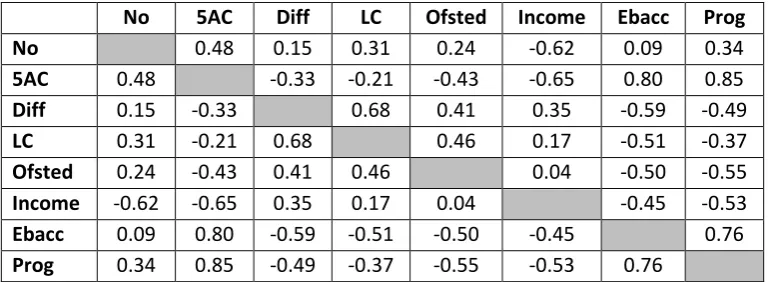
Table 4.2- The correlation between the various scores in chapter 4 ... 114
Table 5.1- Observation statements for each Level 3 code by organisation . 127
Table 5.2- Interview statements for each Level 3 code by organisation ... 129
Table J1- Data that was used in the field analysis ... 237
Table J2- Ranking of schools in the learning community based on 5A*-C measure ... 238
Table J3- Ranking of schools in the learning community based on Learning Community engagement ... 239
Table J4- Ranking of schools in the learning community based upon reliance on vocational qualifications ... 240
Table J5- Ranking of schools in the learning community based on number of Y11 students ... 242
Table J6- Ranking of schools in the learning community based on percentage Y11 students achieving the EBacc measure ... 244
9
List of Figures
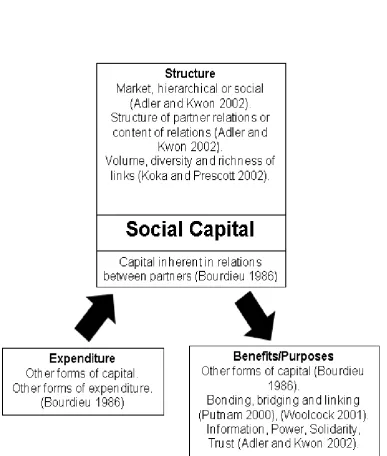
Figure 2.1- Interrelationship between different social capital concepts ... 47
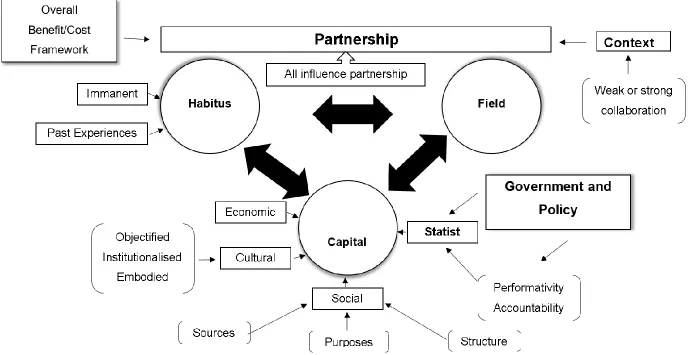
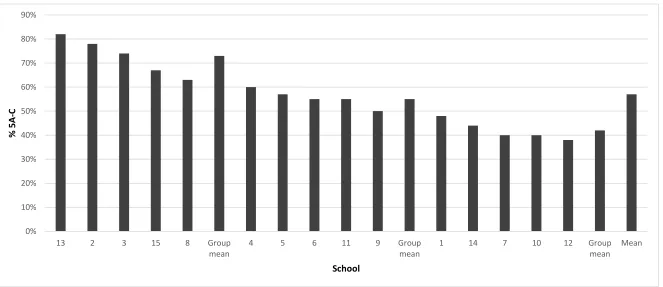
Figure 2.2- Key theoretical concepts synthesised from my literature review . 61 Figure 4.1- Ranking based on 5A*-C measure ... 112
Figure 4.2- Ranking based on LC engagement measure ... 115
Figure 4.3- Ranking based on reliance on vocational qualifications ... 117
Figure 5.1- Distribution of responses across Level 3 categories ... 125
Figure 8.1- My explanatory mechanism ... 182
Figure H1- Distribution of different themes from responses coded as positive towards or benefits of partnership ... 226
Figure H2- Chart showing distribution of different themes from responses coded as limiting factors ... 227
Figure H3- Chart showing distribution of different themes from responses coded as relating to curriculum reform ... 228
Figure H4- Chart showing distribution of different themes from responses coded as relating to financial factors ... 229
Figure H5- Chart showing distribution of different themes from responses coded as relating to BTEC equivalences ... 230
Figure H6- Chart showing distribution of different themes from responses related to different groups of student ... 231
Figure H7- Chart showing distribution of different themes from responses relating to performance table influences ... 232
Figure H8- Chart showing distribution of different themes from responses coded as relating to different stakeholders ... 233
Figure J1- Ranking of schools in the learning community based on number of Y11 students ... 241
Figure J2- Ranking of schools in the learning community based on EBacc score ... ... 243
10
Abbreviations
EBacc- English Baccalaureate
IAG- Information Advice and Guidance
IF- Increased Flexibility
LA- Local Authority
LC- Learning Community
NEET- Not in Education Employment or Training
11
Acknowledgements
I am very grateful to my Sheffield Hallam University supervisors, Dr Bronwen Maxwell, Dr Andrew Morrison and Dr Paul Garland for their support and constructive, detailed and timely comments.
12
Chapter 1.
Introduction
1.1 Introduction
The purpose of this research was to understand and explain the operation of a
14-19 partnership, of which I was a member, and to suggest possible
improvements in the partnership’s operation. A theoretical framework, based
predominantly upon Bourdieun social theories, linked to a critical realist
methodology was used to amplify this understanding and explanation. Although
this research focussed on the partnership that I belonged to, it also aimed to
provide explanations that would be generally applicable to the operation of
educational partnerships.
This chapter provides a contextual background to this research that explains:
why I undertook this research; why I considered using a particular theoretical
framework and methodological approach; what I was hoping to achieve with this
research; key features of the partnership that I would be researching; the overall
format of this thesis. Each of these themes are addressed over the following
sections.
1.2 Background
Over the eight years prior to the start of this research in Spring 2010, the New
Labour government had continually emphasised the need for schools, colleges
and other organisations or agencies to form collaborative partnerships in order
to deliver their educational priorities. Such partnerships included: multi-agency
safeguarding alliances (Department for Education and Skills 2004a);
partnerships for improving school performance and alleviating disadvantage
(Department for Education and Employment 1997a); collaborations for
delivering extended wrap-around children’s services (Department for Education
and Skills 2002a); alliances for the delivery of 14-19 education (Department for
Education and Skills 2002b). One of the major initiatives that had been
implemented by New Labour was the idea of a variety of organisations working
in partnership to deliver a broader, generally vocational, 14-19 curriculum
(Department for Education and Skills 2002b). When I started this research the
Conservative-Liberal Coalition, who had significantly different views on both
13
curriculum, had just been elected. It was clear that researching partnership
operation in a time of major policy change would be of relevance to those
working within the 14-19 field.
The New Labour government had identified a number of key benefits for such
partnership development. It had suggested that only partnerships can provide,
at a suitable cost, the breadth of curriculum needed to meet its 14-19 agenda
(Department for Education and Skills 2005; Department for Children Schools
and Families 2009). An initial pilot for this study (Holmes 2010) suggested that
most of this discussion focused on the process of successful partnership
working with much of its analysis axiomatically presenting collaborative working
as unproblematic and uncritically beneficial to all partners. This pilot also
indicated that, although there was a growing body of knowledge relating to
educational partnership working, with much of this knowledge having been
accumulated from relatively large-scale empirical studies across a variety of
educational partnership contexts, findings were mainly presented in an
atheoretical fashion. Government sponsored research, such as Office for
Standards in Education (2009) or Qualifications and Curriculum Authority
(2007), produced mainly descriptive accounts that: identify partners; the scale
and scope of provision; the key criteria for successful partnership
implementation. By using my research to explain partnership operation
theoretically, I aimed to introduce an element of originality into my research that
appeared to be missing from much previous educational partnership research.
For eight years prior to the start of my research I had been involved in 14-19
partnership work, initially as coordinator of an Increased Flexibility (IF)
partnership and latterly as a pre-16 manager within a further education college.
During this phase I had to adapt to the rigours of working within a
multi-organisational partnership and had been increasingly aware of the difficulties
and challenges this presented. Additionally, my day-to-day work in this area
gave me unique, long-term and opportunistic access to a number of key
managers and processes involved in the operation of local 14-19 learning
partnerships. From this personal and professional context, it was clear that my
findings would be useful to me and to partners in our day-to-day partnership
14
Within another pilot study (Holmes 2009) I had investigated, via a realist
interview (Pawson and Tilley, 1997), the types of capital (Bourdieu 1986)
possessed by members of a 14-19 partnership. As an outcome of this pilot I
was able to make a number of key conclusions in relation to the theoretical
framework and methodological position that I wished to adopt for this
dissertation. My own experiences had led me to favour critical realism (Bhaskar
1978, Bhaskar 1998) as a methodology that supported explanations not reliant
on the polarised positions of positivism or interpretivism (Bhaskar and Hartwig
2010, pp236-237). Additionally, although critical realism had been
operationalised by researchers, in terms of general social scientific method by
Sayer (2000), in relation to evaluation research by Pawson and Tilley (1997)
and in organisational studies by Fleetwood and Ackroyd (2004), it had the
distinct advantage of not being tied to any particular theoretical framework (Fleetwood and Ackroyd 2004, p3), working as the ‘underlabourer’ to other
theories (Mutch 2005, p781).
From the pilot, I was aware that capital was only one component of Pierre Bourdieu’s sociological project and on its own, and as suggested by certain
authors (Reay 2004; Emibayer and Johnson 2008), capital alone would not
provide the breadth of explanation that I needed. I was clear that my theoretical
framework needed to have the three interrelated heuristic concepts of field,
habitus and capital proposed by Bourdieu (Bourdieu and Wacquant 1992). Bourdieu’s sociology, although well theorised, did not appear to have a
particularly clear or useful ontological base. However, in common with the
critical realist ontology, Bourdieu also sought to produce a sociology that
overcame the contradictions of positivism and interpretivism (Bourdieu 1988,
p780). Additionally, various writers, (Wainwright 2000; Sayer 2000; Mutch
2002; Ozibilgin and Tatley 2005), had discussed the compatibility between Bourdieu’s sociology and critical realism. I therefore felt that by combining the
theoretical framework offered by Bourdieu with the ontology of critical realism I would be best able to provide the ‘mechanistic’ explanation of partnership
operation that I sought.
I was therefore able to identify key points that would describe what my research
15
the research would involve an investigation into the partnership that both my own organisation and I belonged to;
the subject of my research would be managers of partnership organisations;
the key outcome of this research would be a ‘mechanistic’ explanation of factors that affect organisations’ engagement with the partnership;
the research would predominantly adopt Bourdieun sociological theories as my underpinning theoretical framework;
this Bourdieun framework would be used alongside a critical realist ontology in order to make theorised links between my observations and
provide potential explanations of partnership behaviour that would be of
benefit specifically to educational partnerships and more generally all
types of inter-organisational partnership.
The perceived benefits and novelty of this research could be summarised as
follows:
This research will be an in-depth, rigorously theorised study of 14-19 partnership that, by using a predominantly Bourdieun theoretical
framework combined with a critical realist methodology, will illuminate potential ‘mechanisms’ that explain how and why organisations work in
partnership.
My final dissertation will make a contribution to the ongoing national debate about the effectiveness of educational partnership working by
providing key explanatory links between organisational behaviour,
government policy and established social theories.
My theoretical framework, although predominantly based upon Bourdieun social theory, will be a novel synthesis of a variety of complementary
theories that will position my findings within the social theory, educational
studies and organisational studies fields.
1.3 Research Questions
Reviewing the points in the previous section, I was able to identify two general
16
i. To understand and explain, using a variety of theoretical perspectives,
the operation of the 14-19 partnership that I was a member of.
ii. To suggest possible ways in which the operation of the partnership could
be improved.
Following an initial review of literature and the political context at the time, I was
able to suggest a number of themes that would feature in research objectives,
which would frame what I was trying to find out and clarify the types of
theoretical lenses that I would use. My review of government policy indicated
that, given the change from the New Labour to Coalition government, this
research would be carried out against a background of significant change in
14-19 educational policy, which was likely to favour the notion of competition above
the notion of partnership (Gove 2010). It also appeared important to make
explicit the link between government policy at the top level and effects on
organisational partnership engagement at a lower level. My first three
objectives were therefore:
i. To explore partnership dynamics specifically in relation to the tension
between collaboration and competition.
ii. To understand how a partnership operates within a volatile environment
iii. To explain how the government influences partnership behaviour.
My initial review of Bourdieun sociology indicated that actions at the individual
level depend upon the interaction between dispositions of individuals and the individuals’ positions within a field (Bourdieu 1992, p66). These field positions
ultimately depend upon the amount and configuration of capital possessed by
an individual (Bourdieu 1986). Although my theoretical review indicated that
these concepts are not necessarily transferable to organisations, this
combination of field, disposition and capital led to the following three objectives.
iv. To identify those factors which might enable a map of the 14-19 field of
education to be formulated and to use this map to help explain the
dynamics of 14-19 partnership operation.
v. To determine the different forms of capital possessed by organisations
17
vi. To investigate how dispositions of organisational members affect an organisation’s engagement with a 14-19 partnership.
Cohen, Manion and Morrison (2011, p81) have suggested one of the key
purposes in operationalising research is converting these broad, often abstract,
objectives into tighter and more precise research questions. Similarly,
Silverman (2011, p33) is clear that a key purpose of formulating research questions is to: ‘narrow down your topic’ and ‘give focus to your research’. He
also believes the research questions need to be sensitively tied to some form of
theoretical perspective. From an organisational studies and qualitative research
viewpoint, King (2004, p14) suggested research questions need framing in
terms of how respondents interpret the problem being considered. Sayer
(2000, p21), working in the critical realist paradigm, suggests that the method of abstraction dictates the sorts of research questions to be adopted. In Sayer’s
terms I had been planning research that was intensive, research that is ’…concerned with what makes things happen in specific cases (Sayer 2000, p20)’. He indicates that questions within intensive modes of research need to
focus on the particularity of the case that is being researched and the specific ‘mechanisms’ that explain what has been researched.
Review of my objectives indicated a number of key themes: 14-19 partnership;
Bourdieun theoretical concepts; a volatile environment. The constraints of the
particular intensive type approach that I planned to adopt clearly limited my key
research questions to the partnership that I was planning to study. My planned
methodological position, alongside my opportunistic access to a variety of
managers within this 14-19 partnership, also made it clear that the key source
of data for this research would be partnership managers. These considerations, alongside the previous paragraph’s concepts, led me to the following two
research questions:
How do Bourdieun, and other related, theoretical concepts explain organisations’ engagement with the partnership, when analysed from
18
Which external political factors influence organisations’ engagement with the partnership, when analysed from the perspective of managers
involved in a particular 14-19 partnership?
At this point, although the first of these questions was clearly linked to theory,
such theoretical framing was not well-developed. A key purpose of the
literature review was to further develop this theoretical background in order to
produce a synthesised theoretical framework and thus explicitly identify the
range of theoretical concepts I included in this question. These research
questions were operationalised into a method which involved a field analysis of
the partnership, a reflexive account identifying my position both within the field
that I was researching and in relation to the ontology that I used, a period of
observation and interviews with managers of organisations that comprised the
partnership.
1.4 The Partnership
The partnership that I investigated was a 14-19 partnership based within one
Local Authority (LA) administrative county in the north midlands of England. It
referred to itself as a Learning Community (LC). It had evolved from a
partnership that had been convened in 2002 to develop the Increased Flexibility
(IF) 14-16 initiative (Department for Education and Skills 2002a). At the start of
this research the LC comprised all fifteen schools from across three different district or borough council areas, the area’s only college, four local training
providers and representatives from the LA and the local Connexions1 service. The college and several schools were based in the area’s main town. All of the
other schools were based in satellite villages or towns. The area had slightly
higher than average levels of deprivation, with certain school catchment areas
characterised by high levels of deprivation: the average Index of Multiple
Deprivation for the area was 22.41 compared to the national average of 21.67;
eleven (6%) areas within the LC were in the 10% most deprived nationally with
a further 25 (14%) being in the 20% most deprived nationally (Department for
19
Communities and Local Government 2011). In 2010 (Department for Education
2010a) the average score for percentage of students gaining 5A*-C at GCSE
including English and maths was 54% compared to 55% nationally and 55% for
the LA. Most students progressed post-16 into either schools with sixth-forms
or the college, although some progressed into training providers or moved out
of county to organisations in neighbouring authorities. The average figure for
Y11 progression into positive destinations for partnership schools for 2010 was
93.4% compared to the LA average of 95.5%. Although precise national
comparators were not available, the county figures for students Not in
Education Employment or Training (NEET) appeared to be somewhat higher
than national figures (Department for Education 2011a). The partnership was
managed by a dedicated Partnership Manager, who had been seconded from
the LA and who, for legal reasons, remained an employee of the LA. The
anonymised composition of schools is detailed in Appendix 1.
When this research started the partnership’s main activity was the provision of
vocational qualifications for 14-16 year old students, which were delivered by
the college, training providers or schools with particular specialisms. In
September 2010 a total of 879 (15%) Y10 and Y11 students from LC schools
attended this provision, which covered a variety of vocational specialisms at
both Level 1 and Level 2. All of the courses enabled students to obtain
qualifications that carried performance table equivalences. In addition to the
curriculum delivery focus, the LC also had a remit to improve Information Advice
and Guidance (IAG) processes across the district, particularly in relation to
post-16 progression. It had also been involved in the development of specialist
partnership provision that aimed to reduce numbers of permanently excluded
Key Stage 4 students. At the start of this research, one post-16 partnership
activity, involving the college and schools with sixth-forms delivering
collaborative provision in poorly-recruited A-level subject areas was being
terminated. At the same time a new partnership between the college and 11-16
schools with a planned rebuild under the Building Schools for the Future
initiative (Department for Education and Skills 2003) had been convened to plan
20
During this research I was employed as the college’s pre-16 manager. At the
college-level this role included day-to-day responsibility for the operational delivery and business management of the college’s 14-16 provision and
pastoral care of students on this provision. In order to carry out this role, I
regularly, on a weekly or more frequent basis, communicated with senior
members of staff within schools who were responsible for students on
college-based provision. It was predominantly these staff who were the focus of this research. In addition, I also represented the college at the LC’s curriculum, IAG
and inclusion group meetings. Prior to and throughout this research I frequently
represented the college principal at LC strategy meetings.
1.5 Overview of Dissertation Structure
This chapter identified why I decided to undertake this research, gave a brief
indication of its broader relevance and novelty and discussed how my initial
ideas were operationalised into research questions. The next chapter will
discuss, via a literature review, how I have synthesised a broad theoretical
framework with the potential to provide explanatory answers to my research
questions. Chapter 3 has two main sections. The first section identifies the
ontological and epistemological assumptions that I have made. The second
section explains how my research questions have been operationalised into a
variety of research methods. Chapter 4 provides an overall contextual map of
the field that I have studied. This contains not only my own reflexive account
and a Bourdieun mapping of the field, but also a brief overview of the policy
context both at the start of the research and over its duration. Chapters 5, 6
and 7 record and evaluate my key findings from the observation and interview
phases. Chapter 8 presents mechanistic answers to my research questions. In
the final chapter I evaluated the research that I undertook, commented on how
this research and underpinning theories could be developed and reviewed how
21
Chapter 2.
Literature Review
2.1 Introduction
This chapter seeks to: synthesise a theoretical framework that will underpin my
research, and detect key gaps in this research and theorising, by providing a
theoretical framework that will enable answers to my research questions:
How do Bourdieun, and other related, theoretical concepts explain
organisations’ engagement with the partnership, when analysed from the
perspective of managers involved in a particular 14-19 partnership? Which external political factors influence organisations’ engagement with
the partnership, when analysed from the perspective of managers involved
in a particular 14-19 partnership?
As discussed in the introduction, this review also seeks to clarify which ‘other related theoretical concepts’ will form part of the first question.
This review followed the critical review method described by Grant and Booth
(2009) and Booth, Papaioannou and Sutton (2012, p25). This appeared to be a
suitable method since it requires a synthesis of ideas from the literature into a
new conceptual framework, model or hypothesis. Rumrill and Fitzgerald (2001,
p166) describe such reviews as narrative or synthetic, with their key purpose
being:
…to develop or advance theoretical models to explain the behaviour and experiences of people...
Linked to this,my review thus seeks to identify theories that may explain organisations’ engagement with this specific 14-19 partnership. The key
methodological purpose of my research will be to identify which of these theories most appropriately explain organisations’ engagement with the 14-19
partnership.
Grant and Booth (2009, p94) have described in outline the procedure adopted
in such reviews. Regarding search strategies, they have suggested that rather
22
theory, in a ‘conceptual’ or ‘chronological’ order. Grant and Booth (2009, p93) see the key weakness of such an approach as its lack of ‘systematicity’ but do
concede that the subjective and interpretivist outcomes are the starting point for
further evaluation, in my case by suggesting critical realist explanations that link
the identified behaviour of the partnership with my empirical findings.
My research questions suggest various themes that can be used to frame this review or, in terms of the review strategy, indicate ‘the research area (Rumrill and Fitzgerald 2001, p166)’. Rather than produce the specific inclusion criteria
that Rumrill and Fitzgerald suggested, I used the research questions alongside
exploratory reading and my proposed methodological position to identify the
ranges of theories that I would include in my review.
As suggested by Pawson (2006, pp87-89), arguing from a critical realist perspective, I selected theories on their basis of ‘clarifying the particular explanatory challenge’ my research questions raised. The only theories
explicitly mentioned within these questions are those of Bourdieu. Within the first question there is the notion of ‘other related theoretical concepts’. As key
themes were emerging from exploratory reading or from nascent research, it
was possible to explicitly clarify which other theories would provide possible theoretical frames for my research questions. First, Bourdieu’s theorisation of
social capital was not the only such theorisation, with a number of these other
theories having been used to explain partnership or networks. Thus it appeared pertinent to expand Bourdieu’s conceptions to include other formulations of
social capital within this review. Second, and as explicitly mentioned in the
second research question, much partnership engagement appeared to depend
upon external political factors. Given the purpose of this literature review, it was
important to identify a theoretical basis for such political influence. Whilst certain
notions of Bourdieun capital appeared to be relevant to an analysis of
governmental power, implicit within much of the trajectory of this period’s public
sector policy discourse was the notion of performativity, related to measurement of performance. To fully appreciate how policy influenced this partnership’s
functioning it appeared important to integrate a review of the literature relating
23
The notion of partnership engagement appears in both research questions, thus
this review also needed to include theories that could specifically explain why
and how organisations work in partnership. I made two decisions in terms of
which types of theory to add to my framework. First, I decided to limit my
review to theories that could be applied alongside Bourdieun social theory to
explain the very specific financial and resource decisions that I had observed
taking place at LC meetings. Second, since a key feature of critical realism is
the notion of context, I decided to incorporate partnership theory that clarified this partnership’s context.
I started by locating and evaluating key original articles about each of the
relevant theories. I then traced and evaluated articles by others who had either
used or critiqued these theories specifically within the partnership, educational
and organisational studies areas. Each section concludes with an indication of
how each theoretical concept will be used in my analysis of research findings.
2.2
Bourdieu’s Sociology
2.2.1 General Features of Bourdieu’s Sociology
Bourdieu describes the key purpose of his sociological project as overcoming the bipolar ‘opposition between objectivism and subjectivism (Bourdieu 1988, p780)’ by:
‘…integrating into a single model the analysis of the experience of social agents and the analysis of the objective structures that make this experience possible (Bourdieu 1988, p782)’.
This integration of subjectivity and objectivity is mediated by two concepts that
Bourdieu labels habitus and field (Bourdieu 1992, p66; Bourdieu and Wacquant
1992, p128; Bourdieu 1993, p73; Bourdieu 1998, vii; Bourdieu 2000, p151). The final ‘fundamental concept’ that Bourdieu (1998, vii) considers essential within his ‘philosophy’ is that of capital. It is the accumulation and movement of
capital that Bourdieu believes structures the ‘social world’ (Bourdieu 1986).
24
his attempt to reconcile the interplay between structure and action, significantly
in relation to the critical realist methodology I adopted, by interlacing empirical
research with abstract theorising. Likewise, working in the educational field,
Gale and Lingard (2015, p10) suggest that within the rapidly changing social world, the intimate link between theory and research in Bourdieu’s work means
that not only can researchers use theory but reconstruct this theory from an
empirical base in order to explain newly discovered educational phenomena or
theorise concepts that Bourdieu himself had not yet investigated or
hypothesised. It is the link between the empirically evidenced experiences of
managers and objective structures that will be fundamental to the critical realist approach that I intend taking. By looking at the interface between Bourdieu’s
theories of habitus, field and capital I should be able to provide that key connection between individuals’ accounts and potential critical realist explanations of organisations’ engagement with the partnership.
Other authors have described the use of Bourdieu within educational research;
however, Gale and Lingard (2015, p1) suggested most have considered the
efficacy of just one part of his framework. Whilst supporting the use of
Bourdieu, and specifically the use of habitus in educational research, Reay (2004) argued that his concepts have often been used merely to add ‘gravitas’
to academic pieces by applying them in a post hoc descriptive manner rather
than using them as an analytical lens to interrogate data. Grenfell and James
(1998, p16) also felt that much educational use of Bourdieu lacked theoretical
rigour and was at times misinterpreted. Likewise, within the field of
organisational studies Emirbayer and Johnson (2008, p1) suggested that
although certain Bourdieun concepts, particularly capital and field, have been widely used in organisational studies, authors’ lack of attention to either habitus or relational modes of interpretation means that a full appreciation of Bourdieu’s
usefulness has not been realised.
In summary, to synthesise elements of Bourdieu’s sociology into my broad
theoretical framework I need to make two key considerations. First I need to
adopt a methodological position that will enable me to reconcile the opposing ‘antimonies’ (Bourdieu 1988, p777) of objectivity and subjectivity. Next, within
25
fashion that takes full account of their various facets, and thus avoid using Bourdieu ‘for bestowing gravitas without doing any theoretical work (Reay 2004, p232)’. However, given Bourdieu’s often changing, contradictory and
complicated framework, rather than slavishly following the minutiae of his
sociology, I need to use Bourdieu, as suggested by Jenkins (2002, p11), as a
thinking tool that is applied and adapted to my particular context. Furthermore,
to gain a full perspective on my findings I will have to combine Bourdieun ideas
with those of others.
2.2.2 Habitus
2.2.2.1 Bourdieu’s Conceptions of Habitus
Since the overarching methodological aim of this research will be to link the
discourse of partnership managers to existing theoretical structures, I will start this evaluation of Bourdieu’s framework with the notion of habitus, which
Bourdieu (1988) identifies as the concept that is key to comprehending the polemical relationship between the objective and subjective. Bourdieu’s idea of
habitus is best defined in Outline of a Theory of Practice as:
The structures constitutive of a particular type of environment (e.g. the material conditions of existence characteristic of class condition) produce habitus, systems of durable, transposable dispositions, structured structures predisposed to function as structuring structures, that is principles of the generation and structuring of practices and representations which can be objectively ‘regulated’ and ‘regular’ without in any way being the product of obedience to rules, objectively adapted to their goals without presupposing a conscious aiming at ends or an express mastery of the operations necessary to attain them and, being all this, collectively orchestrated without being the product of the orchestrating action of a
conductor. (Bourdieu, 1977, p72).
This definition introduces a number of key themes. First Bourdieu is clear that
habitus is fashioned by the structures to which a subject is exposed. He
explicitly identifies this structuring element as a field (Bourdieu and Wacquant
1992, p127). Elsewhere Bourdieu (2004a, p42) suggests the habitus can be
structured by:
…principles such as educational or even social
26
Bourdieu (1990a, p54) also stipulates that habitus is a ‘…product of history… in the form of schemes of perception, thought and action…’ By ‘product of history’ Bourdieu (1990a, p54) is referring to the ‘past experiences’ of agents that are ‘deposited in each organism’. Bourdieu (Bourdieu and Wacquant 1992, p124)
uses this notion of history to suggest action is not only a reflex response to a stimulus but also depends upon an agent’s past experiences and perceptions. Bourdieu (2000, p148) claims historical experiences are the ‘instruments of construction’ of the habitus by virtue of history incorporated in both agents and
structures (Bourdieu 2000, p150).
The second theme identifies the main characteristics of the habitus: ‘systems of durable, transposable dispositions, structured structures’. Bourdieu (1977,
p214) indicates a disposition has certain conceptual features:
It expresses first the result of an organizing action, with a meaning close to that of words such as structure; it also designates a way of being, a habitual state (especially of the body) and, in particular, a predisposition, tendency, propensity, or inclination.
Clarifying these features is somewhat problematic since Bourdieu often appears
to treat dispositions as the habitus itself rather than being constituents of it. In the following account I have used a combination of Bourdieu’s
conceptualisations of both habitus and disposition to characterise these
features. In relation to ‘organizing action’ Bourdieu again discusses the notion of ‘history’: individual history (Bourdieu 1993, p86) in terms of ‘practical
knowledge of the world (Bourdieu 2000, p148)’; the continual exposure to changing experiences (Bourdieu and Wacquant 1992, 133); the ‘active presence of past experiences (Bourdieu 1990a, p54)’. In outline, the past
experiences of an agent, via the habitus, contribute to particular physical and
mental actions being taken by an agent in a specific context. Bourdieu (2000,
p144) explains that these experiences are intellectual perceptual experiences and the physical bodily ‘practical knowledge’ of how to move or change posture in a particular situation. The ideas of ‘practical’ and ‘experiences’ are
particularly key to this: this accumulation of history is not passive, but involves
an agent being actively and physically engaged in amassing this knowledge of
27
Bourdieu (1977, pp93-94) is clear about the embodiment of these dispositions, using the word ‘hexis’ to describe embodiment as: ‘a durable manner of
standing, speaking and thereby of feeling and thinking. The idea of ‘inclination’ is central to the effect of the habitus on an individual’s actions. For Bourdieu
(1977, p78) it is the habitus that inclines individuals to act in a particular way. This leads to ‘distinct’ and ‘distinctive practices’ across a range of everyday
activities and indeed beliefs (Bourdieu 1998, p8). This reaction to habitus may involve ‘conscious’ and ‘strategic calculation’ (Bourdieu 1990a, p53), with the ‘unconscious’ merely being the forgetting of those factors which have structured the habitus. Bourdieu has suggested that habitus inculcates a ‘feel for the game’ (Bourdieu and Wacquant, 1992, p129) that enables individuals to ‘”read” the future that fits them (Bourdieu and Wacquant, 1992, p130)’. The historical ‘conditioning’ of the habitus occurs over a number of generations and means
that strategies adopted by participants are dictated by the accumulated history
of the results of previous games, leading Bourdieu (2000, pp214-215) to suggest that success in the ‘game’ is not based on chance but upon historical
precedents.
Durability seems a conceptually inaccurate term. Bourdieu (Bourdieu and Wacquant 1992, p133) suggested these dispositions are ‘durable but not eternal!’ When new situations are experienced, all new stimuli are focussed
through previous categorical lenses of experience rather than becoming
themselves new categories (Bourdieu and Wacquant 1992, p133). This leads to a ‘non radical’ change of habitus that is based on the ‘…premises established in the previous case (Bourdieu 2000, p161)’: it is the chronological and iterative
accumulation of past experiences, structured by a pre-existing habitus, which leads to the ‘durable but not eternal’, or perhaps more accurately transformable
character of dispositions. Within this research these notions of history will be central in determining how managers’ prior experiences have impacted upon
their partnership decisions. A full and clear analysis of habitus will require not only a description of participants’ histories but also an analysis of how such
histories have been iteratively transformed.
28
escape structural mechanism (Wacquant 1989, p9)’; however, within his key
definitions Bourdieu identifies the notion of structures and structuring as being
key to the concept of both habitus and dispositions. This apparent confusion in
the structural basis of dispositions or habitus is perhaps best resolved by the
idea that although the habitus is a structure it only behaves in a structural or
deterministic fashion in relation to the particular situations to which it is exposed
(Bourdieu and Wacquant (1992, p135). Such a contextual activation of habitus,
suggests that within this research I will need to pay particular attention to how
the specific environments of organisations link with the habituses of managers
to explain partnership behaviour.
In relation to ‘transposability’, Bourdieu (1990a, p104) has indicated that dispositions enable actors to deal with situations that are ‘uncertain and ambiguous’ or allow ‘actors to cope with unforeseen and ever-changing situations (Bourdieu 1977, p72)’. However, at a later stage Bourdieu (2000,
pp160-161) discusses the contrasting situation whereby the habitus only
partially adapts to a new field, particularly in situations of crisis or when the field rapidly changes, and thus attempts to ‘…perpetuate structures corresponding to the conditions of production’. This situation he labels ‘hysteresis’. For those in
this position:
…dispositions become dysfunctional and the efforts they make to perpetuate them help to plunge them deeper into failure.
Given the rapid change in the nature of educational fields it will be interesting to
note whether managers display aspects of such hysteresis.
2.2.2.2 Commentaries on Habitus
Certain writers have been critical of Bourdieu’s explanations of how the habitus
works, particularly its inherent determinism. Jenkins (2002, p82) suggests that
the habitus is just another form of determinism: the structures that produce
habitus lead to the habitus determining behaviours and actions. Robbins (1998, p35) attempts to refute such objections by suggesting that part of an agent’s habitus is that agent’s ability to reflect upon their own and others’ situations and
29
(Grenfell 2004, p27) and state of flux make it different to the standard
sociological structure. It is this dynamism of habitus that is of use in the current
research: it will be interesting to identify how habituses change as a
consequence of the volatility of the educational field.
Defending Bourdieu against others, Reay (1995, p357) is clear that a strength of habitus is its ambiguity, in terms of Bourdieu’s own changing conceptions and
in the looseness of its definition by Bourdieu. Such ambiguity means that it can
be adapted to fit a variety of empirical settings. However, Reay (1995, p358) warns against ‘…habitus becoming whatever the data reveals’. To best use the
inherent contradictions within various readings of habitus Reay suggests that habitus is conceptualised as a method: ‘a way of seeing the world’, and is
particularly adept at uniting the macro and micro-levels of society.
Similarly, from organisational studies Emirbayer and Johnson (2008, p4), in a theorisation of Bourdieu’s concepts for use in organisational sociology, believe
that using habitus is a good way to investigate the links between micro and
macro-level organisational processes. In a manner that takes account of managers’ full spectrum of experiences, Emirbayer and Johnson (2008, p29)
further link habitus to position takings of individuals, suggesting that such
habituses are structured both by exposure to the current organisation and past
professional and personal experiences. It is the interaction of these individual habituses with an organisation’s field that determines macro-level organisational
action. Emirbayer and Johnson (2008, p19) suggest that overall organisational
behaviour is the consequence of a mixture of individual habituses and that
organisational executives will make decisions not only on self-interest, directed
by their own habitus, but on the needs of the organisation within the
marketplace. Since a key task of my research will be to translate empirical
perceptions of individual managers into actual behaviours of organisations,
habitus would thus seem to be of key importance in determining links between
these two elements. Once again such an analysis will depend upon gaining clear conception of those factors that have structured managers’ habituses.
Linked to some of these ideas and Bourdieu’s concept of hysteresis, Tomlinson,
30
public sector leaders’ habituses with the changing fields in which they operate.
Tomlinson, O'Reilly and Wallace (2013, p86) believe that by operating in such a field leaders will develop dispositions, ‘including deeply engrained beliefs and values about appropriate modes of action’, that enable them to work within a culture of ‘accountability and flexibility’. Leaders’ habituses will have been
developed by exposure to the management field and will have been conditioned in such a way that they accept the centrality of the notion of ‘accountability’ in
public sector management. Tomlinson, O'Reilly and Wallace (2013, p86)
further contend that these dispositions will cause leaders to behave in ways that further the ‘accountability’ aims and that the precise fit between these leaders’
habituses and the fields that they operate in will lead to them being seen as
natural leaders within the field.
Similarly, McDonough and Polzer (2012) and Collyer (2015), while researching
the change to New Public Sector ways of working in higher education, found
that such hysteresis of habitus led to major personal, including health, difficulties for some of those affected. Participants in Collyer’s (2015, p320)
study linked their:
…dissonance’ [to ]‘…the way marketization violates, or threatens to violate, highly valued academic norms and practices.
Collyer also found that those who were most comfortable with the new reforms
had developed their habituses, in prior jobs and experiences, within
managerialist fields. Once again the flux in educational policy would suggest
that it would be fruitful to look both for the hysteresis effect and for examples of
dissonance within the experiences of partnership managers. In addition, it will also be interesting to identify if elements of managers’ past experiences make
them less or more prone to these effects.
2.2.2.3 Conclusions on Habitus
Habitus appears to be key to identifying a link between managers’ explanations,
values, their behaviours within the partnership and their past experiences: in
effect the key link between the macro and the micro. Given the apparently novel, in terms of partnership, context in which I am using habitus, habitus’s
31
to be careful not to use it in a lax and superficial manner: for instance, by simply
conflating it with attitude and not considering the immanent factors that have
contributed to the habitus. Other aspects of habitus will also be important within
the final theoretical synthesis. Since partnership involves organisations
interacting with each other through the mediation of individual members of
those organisations it will be important to identify whether the habituses of
various members of the partnership have been conditioned by exposure to
similar past experiences, both personally and professionally, and whether this
conditioning has an impact on their partnership decisions.
2.2.3 Field
2.2.3.1 Bourdieu’s Conceptions of Field
As indicated previously, the objective and subjective aspects of Bourdieu's
social theory are mediated by the reciprocal relationship between habitus and
field. Bourdieu (Bourdieu and Wacquant 1992, pp98-100) describes the field as
being analogous to a game. Within this game field members compete for the
stakes, or the various forms of capital discussed below. Bourdieu (Wacquant
1989b, pp37-41) describes a number of the key elements of a field. First the
field is a network, or a configuration, of objective relations between positions
with these positions depending upon the relative distribution of species of capital that are important within the field. For Bourdieu (1993, p73) the field’s
structure is a consequence of the power relations between those within the
field. Elsewhere Bourdieu (Bourdieu and Wacquant 1992, p114) is very clear
these relations depend on this distribution of capital and not merely on the
linkages between different members of the field. Bourdieu (1996c, p205) also
suggests it is not only the relative distribution of capital that identifies these
relations but the relative struggles for this capital that define and transform the
field. Society is made of a number of mainly autonomous fields (Bourdieu and Wacquant 1992, p97) each with their own specific ‘logic’ and with different
values granted to the various forms of capital depending upon their worth within
that field. Other fields influence a specific field not by directly acting upon its members but by ‘mediation of the specific forms and forces of the field’ in
32
Although fields are mainly autonomous, Bourdieu (Wacquant 1989b, p41) is clear they all contain a number of ‘homologies’, or characteristics that share a ‘resemblance’ across different fields but are structured in a specific way in each field. Thus, all fields contain notions such as ‘dominant’, ‘dominated’ and
struggles for capital; however, the precise nature and operation of these
concepts depends upon the field in question. Elsewhere, Bourdieu (1998, p83) suggested that each field has its own set of ‘laws’ that are independent from
laws of other fields. Bourdieu (1993, p72) explains this apparent contradiction by suggesting that although all fields have different ‘specific properties’, in terms of the configurations of capitals at stake, they also have ‘secondary variables’
which are universal across all fields.
Bourdieu (1990a, p66) is also clear that if habitus is the subjective part of his
sociological project the field is the objective element. Bourdieu (Bourdieu and Wacquant 1992, p127) suggests that ‘field structures habitus’ and ‘Habitus contributes to constituting the field as a meaningful world’. The dispositions inherent within habitus are conditioned by an individual’s encounter with the
field. The habitus endows the field with meaning to the actor and since the habitus has been structured by exposure to the field it feels ‘at home’ in this field, or: ‘implies knowledge and recognition of the immanent laws of the field (Bourdieu 1993, p72)’. Using the metaphor of a game (Bourdieu 2000 p151)
proposes:
It is in the relationship between habitus and the field, between the feel for the game and the game itself, that the stakes of the game are generated…
Here the field dictates, by influencing the habitus, the strategies to be adopted
by those playing the game. In turn, the habitus will influence the value
accorded to capitals.
My partnership appears to constitute a field, with partnership members having
objective relationships to each other depending upon the different capitals that
they possess. One of the key aims of this research will be to identify which
capitals are important within this field and thus map the relative positions of
organisations. By relating the field positions to the habituses of those involved
33
empirical findings and the behaviours of organisations. In the following
paragraphs I have indicated key items from the literature that will support my
use of field in this study.
2.2.3.2 Commentaries on Field
Emirbayer and Johnson (2008, p2) have identified the advantages of using the
Bourdieun field concept within organisational studies. They indicate that the
Bourdieun field concept can be used to analyse distribution of resources, and
hence sources of power, within an organisation. They are also critical about its application, suggesting that researchers have often failed to evaluate the ‘social configurations’ of the field and have frequently isolated the idea of the field from
the other key Bourdieun concepts, thus rendering the analytical power of the
field descriptive rather than explanatory. A field analysis will enable me to
identify both which sources of capital are most powerful in this partnership and
how their relative values structure the power relationships within the
partnership. In order to harness the explanatory potential of the field concept,
these field configurations will be used in conjunction with the concept of habitus
to explain organisational behaviour. By examining how the process of capital accumulation, and hence field position, links to the ‘social configuration’ of
partnership it should be possible to propose explanations for partnership
engagement.
2.2.3.3 Conclusions on Field
From this critical analysis of Bourdieu’s idea of field, a number of conclusions
can be made about the relevance of field to my research questions and the
formulation of my overall research framework. With my first research question,
identifying positions within the 14-19 field will support explanations of
partnership engagement. In order to clarify such explanations, as with other areas of Bourdieu’s sociology, it is important to co-locate the idea of field with
his other concepts. Obviously positions within the field will closely match levels
and sorts of capital possessed and contested by field members; reciprocally,
the relative values of these capitals within the field will depend upon the nature
of the field. The concept of field will also be relevant to my second research
34
the intra-organisational. Although not specifically tied to field, study of this field
oriented literature also suggested that Bourdieun concepts, alongside other
concepts such as performativity, need to be at the heart of any explanation of
how educational policy affects partnership engagement.
2.2.4 Capital
2.2.4.1 Bourdieu’s Conception of Capital
The final component of Bourdieu’s triad of ‘fundamental concepts’ is that of
capital. Capital both structures and is competed for within the field. Again, it is
very difficult to pin Bourdieu down to a clear and consistent general definition of
capital, although Bourdieu (2010, p108) does suggest it can be understood as ‘usable resources and power’. The general nature of capital is perhaps best
captured by identifying its effects within the field. Bourdieu (Bourdieu and Wacquant 1992, p98) has suggested that capital’s very existence depends
upon the presence of a field within which it has a value. Furthermore, the total
amounts of capital and the relative amounts of the different types of capital possessed by ‘players’ in the field dictates the structure of the field and the
relative positions of those within the field (Bourdieu and Wacquant 1992, p99). Such distribution of capital: determines ‘the chances for success of practices (Bourdieu 1986, p46)’ and, presumably, by its influence on habitus, the strategic
adoption of these practices. In order for a specific type of capital to have
significance there must be a certain field that endows it with a value (Bourdieu
and Wacquant 1992, p98), thus the values of different species of capital depend
upon the field within which it is being used. A final key property of capital is
that it can be converted from one form into another (Bourdieu 1986, p47).
Specifically, Bourdieu (1986, p54) suggests that all forms of capital are ultimately ‘reducible’ to economic capital. As discussed above, it is this
distribution of capital that will be used to map the different field positions within
the partnership. Additionally, part of my research will examine the differential
values of various capitals within this field and explore potential ways in which
this capital will be converted from one form to another.
Bourdieu has identified three principal forms of capital: economic, cultural and
social (Bourdieu 1986; Bourdieu and Wacquant 1992, p119). Social capital will
35
(1986) has explicitly clarified in one document what he means by key forms of
capital. Unfortunately, there is very little discussion of economic capital within this document, simply referring to it as ‘money’ or ‘property rights’. Likewise Bourdieu’s other works have significantly less discussion of economic capital than the other forms, indeed stating: ‘I shall not dwell on the notion of economic capital (Bourdieu and Wacquant 1992, p119) and: ‘As regards economic capital, I leave that to others; it’s not my area’ (Bourdieu 1993, p32). Bourdieu (1998;
2010) also discusses the idea that positions within a variety of social fields are
heavily influenced by the balance between economic and cultural capital,
without ever clearly defining economic capital. However, Bourdieu (2004b, p75)
does explicitly define financial capital as:
direct or indirect mastery … of financial resources, which are the main condition … for the accumulation and conservation of all other kinds of capital.
Given his lack of discussion, combined with this somewhat circular definition, it
can be inferred that his conception of economic capital is no more complex than
our common-sense understanding of what constitutes capital.
In contrast, Bourdieu frequently discusses the idea of cultural capital, defining
its three forms as:
…the embodied state, i.e., in the form of long-lasting dispositions of the mind and body; in the objectified state, in the form of cultural goods (pictures, books dictionaries, instruments, machines, etc.), which are the trace or realization of theories or critiques of these theories,
problematics, etc.; and in the institutionalized state, a form of objectification which must be set apart because, as will be seen in the case of educational qualifications, it confers entirely original properties on the cultural capital which it is presumed to guarantee (Bourdieu 1986, p86).
These conceptions were theoretically derived to take account of differing
achievements of children in relation to their social class on the basis of cultural
capital possessed by members of these different social classes (Bourdieu
1986).
Bourdieu (1986 ) suggests embodied cultural capital, being embodied, needs to
36
passed on directly or instantaneously to another. This accumulation can either
be by inheritance or schooling. Economic investment in its acquisition is by
expenditure of time and its conversion into economic capital is mediated by
conversion into objectified cultural capital. Within this work Bourdieu is not clear
about what sorts of dispositions make up embodied cultural capital; however, Grenfell and James (1998, p21) suggest that it is ‘…connected to individuals in their general educated character…’. Therefore, depending on which field it is
active in, embodied cultural capital could refer to abilities as diverse as linguistic
ability, practical competences, tastes, knowledge and understanding.
Bourdieu (1986) suggests that objectified cultural capital that is inherent within
physical artefacts requires possession of embodied cultural capital to enable the
objects to be either appreciated or used. Just owning such objects without the
required embodied cultural capital merely renders them as economic capital.
Given that key aptitudes related to the use of vocational tools or machinery can
be classified as cultural capital, it is reasonable to extend the concept of
objectified cultural capital to include such objects.
The final form of cultural capital is institutionalised cultural capital. This is
embodied cultural capital that is objectified in its holder as an academic
qualification (Bourdieu 1986). Institutionalised cultural capital is the medium,
through which conversion, via the labour market, of embodied cultural capital to
economic capital is mediated. The value of capital exchange rates are
symbolically set and are also a function of the relative scarcity of the capital in
question (Bourdieu and Passeron 1990, pp181-182). Further expansion of the
function of qualifications characterised them as a medium that would enable ‘technical selection’ for various occupations (Bourdieu and Passeron 1990,
pp164-167).
Each of these forms of capital appears to have a role within this particular
partnership: institutionalised in the form of qualifications that students gain from
partnership provision; embodied in terms of both experiences and knowledge
that students gain from this provision or skills and knowledge that partners
possess; objectified as the specialist objects and resources that partners
37
research will not only need to identify which capitals partners possess but also
which conversions are taking place and how capital values influence an organisation’s field position.
Although these forms of capital are those most commonly attributed to
Bourdieu, to explain the behaviour of organisations, within what he terms the
economic field, Bourdieu (2004b, p75) introduced a broader range of capitals,
two of which are relevant to my study. First there is the idea of technological
capital: those scientific and technical capabilities or resources that enable
production or development of a product. Although the resources and
capabilities that organisations in my study possess are not used to produce a
product, this concept relates very closely to those professional competences,
such as expertise in a practical vocational area, and resources, such as
specialist vocational workshops, that certain organisations possess. The
second relevant form of capital discussed is organisational capital. Bourdieu
does not define this beyond the idea of information about the field, but it also
presumably includes skills in running the organisation. For my study, this would
relate to information and skills in administering, rather than merely delivering,
specialist vocational qualifications. These capitals operate within the economic
field in the way that other capitals operate. Use of these concepts will enable exploration of partnership engagement in terms that go beyond Bourdieu’s core
capital concepts.
2.2.4.2 Commentaries on Capital
Capital has been widely used both within educational and organisational
research. Much of its uses are particularly relevant to this current research.
Nash (1990, p431), in common with previously identified commentaries on other
concepts, feels that it has been discussed in isolation, without the full
consideration of the entire Bourdieun framework, a similar point made by
Emirbayer and Johnson (2008, p3) in relation to organisational studies. Nash
(1990) also suggested that a key property of capital is the fact that it can be
converted from one form to another and that agents employ various strategies
to facilitate and maximise this exchange. Likewise Gunter (2002, p11)
suggested, whilst discussing the field of education leadership, that for full
38
agents pursue to accumulate capital. Emirbayer and Johnson (2008, p11)
introduced the idea that field strategies adopted by the dominant relate to
conserving values of key resources; for the dominated strategies of
‘subversion’, which attempt to change the values of these key resources, are
adopted. In this research it will be the combination of the ideas of capital with
those of habitus and field that will underpin much of my explanatory discussion.
It will not be sufficient to merely identify configurations of capital and their
influence on field position if these explanations are to be proposed, it will also
be necessary to explore how strategies of capital accrual or conversion
influenced partnership engagement and identify whether those in dominant or
dominated field positions adopt strategies to either conserve or devalue capital.
Lareau and Weininger (2003) reviewed the use of cultural capital in educational
studies, which is particularly useful in clarifying this concept. They argued that most work discussing cultural capital has seen it as merely ‘…knowledge of or competence with