• No results found

Studies on Tapeworm Physiology

N/A
N/A
Protected

Academic year: 2020

Share "Studies on Tapeworm Physiology"

Copied!
6
0
0

Loading.... (view fulltext now)

Full text

(1)

[ 3<M ]

STUDIES ON TAPEWORM PHYSIOLOGY

VI. EFFECT OF TEMPERATURE ON THE MATURATION IN VITRO OF SCHISTOCEPHALUS SOLIDUS

BY J. D. SMYTH

Department of Zoology, Trinity College, Dublin, Eire

(Received 6 August 1951)

(With Fifteen Text-figures) INTRODUCTION

It has been shown that the pleroceroid larvae of the bird cestode Schistocephalus solidus matures rapidly when cultured aseptically in suitable media at 400 C. provided pH and oxygen tension are controlled (Smyth, 1946, 1950). This tempera-ture of 40° C. represents the average body temperatempera-ture of birds, in the gut of which pleroceroids normally develop (Hopkins & Smyth, 1952).

It is the object of this paper to investigate the maturation of the pleroceroid at subnormal temperatures (i.e. < 400 C.) in vitro.

METHODS

Sticklebacks infected with pleroceroids were obtained from Roundwood Reservoir, and aseptic cultures prepared by the technique previously described. Horse serum + 1 % glucose was used throughout as a culture medium, 50 c.c. in 3 x 20 cm. plugged, rimless tubes. Scarcity of infected fish did not allow more than the following range of temperatures to be investigated: 40, 35, 34, 33 and 300 C. Ten larvae were cultured at each temperature.

At intervals during cultivation, larvae were removed and fixed for histological and cytological examination. Thus, a complete histological picture of the progress of maturation of the genitalia at different temperatures was obtained. Bouin, Carnoy, Flemming-with-acetic and 5% formol were used as fixatives; Carnoy being especially satisfactory for nuclear changes in spermatogenesis. In addition to the usual routine staining such as Heidenhain's Iron Alum Haematoxylin and Delafield's Haematoxylin and Eosin, Unna's Methyl Green Pyronin and Feulgen were particu-larly useful for demonstrating nuclear abnormalities that appeared at lower tempera-tures. Shell formation was followed by means of the specific method recently developed, using aqueous methyl green after formalin fixation (Smyth, 1951). In addition to sections aceto-carmine squashs and smears were used with some success.

(2)

Studies on tapeworm physiology 305

numbers of eggs were produced, as some loss was inevitable in the subsequent handling. This difficulty was successfully overcome by the following technique. A trace of vaseline jelly was dabbed on to a 3 x 1 micro slide and rubbed vigorously with the finger until the vaseline was spread out as a thin invisible film. The eggs were concentrated, as far as possible, in about 2 c.c. of water at the bottom of the culture tube and picked up into a fine pipette. The drop of water containing the eggs was released carefully on to the slide surface and allowed to stand for about 10 min. The eggs sank in the drop and adhered to the glass. The slide was then placed, face downwards, on to two glass rods (acting as supports) in the trough, through which passed the stream of warmed water. The slide was removed at intervals for microscopic examination of the eggs.

EXPERIMENTAL RESULTS

[image:2.595.114.482.351.569.2]

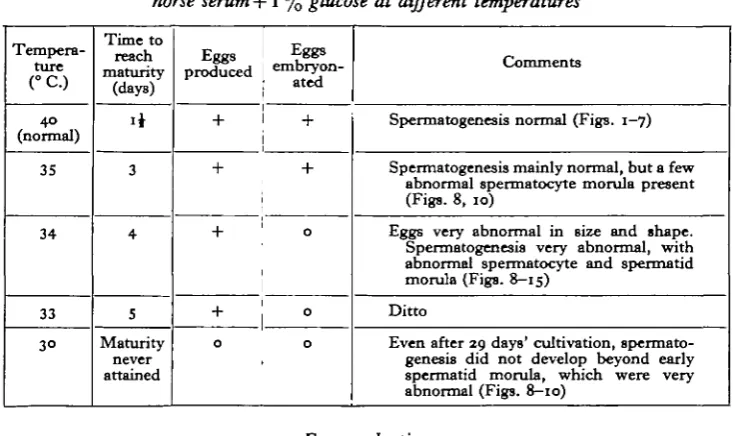
The main results of culturing larvae at 40-300 C. are summarized in Table 1. Table 1. Results of culturing plerocercoids of Schistocephalus in

horse serum +1 % glucose at different temperatures

Tempera-ture PC) 40 (normal) 35 34 33 3° Time to reach maturity (days) i * 3 4 5 Maturity never attained Eggs produced + + + + Eggs embryon-ated + + 0 0 0 0 Comments

Spermatogenesis normal (Figs. 1—7)

Spermatogenesis mainly normal, but a few abnormal spermatocyte morula present (Figs. 8, 10)

Eggs very abnormal in size and shape. Spermatogenesis very abnormal, with abnormal spermatocyte and spermatid morula (Figs. 8—15)

Ditto

Even after 29 days' cultivation, spermato-genesis did not develop beyond early spermatid morula, which were very abnormal (Figs. 8—10)

40'

c.

Egg production

At this, the normal temperature, eggs appeared in the uterus after approximately 36 hr. cultivation, but seldom were ejected through the uterine pore in less than 40 hr.

350 C. At this temperature, eggs have never been found in the uterus earlier than 70 hr. Such eggs did not appear to differ morphologically from normal eggs, but not more than 20% showed embryonation on testing.

(3)

306 J. D. SMYTH

330 C. At this temperature, worms produced a few, very abnormal, eggs on the fifth day of cultivation: such eggs failed to embryonate on testing.

300 C. Worms cultured at this temperature failed entirely to produce eggs, even after 29 days' cultivation.

Cytological abnormalities

The histological and cytological changes occurring in larvae matured at the various temperatures were examined in considerable detail. The small size of the cells made observation difficult but, so far as could be ascertained, the only effect of reducing the temperature on the oogenesis, yolk and shell production, was to slow down these processes and no abnormalities were observed. On the other hand, very marked abnormalities appeared in spermatogenesis. Before describing these abnor-malities, a brief account of the normal spermatogenesis must be given.

Normal spermatogenesis (i.e. at 400 C). Spermatogenesis follows the typical pattern of Platyhelminthia in general. The spermatogonia, which occur at the periphery of the testis capsule, give rise, by repeated divisions, to a primary spermatocyte morula (Fig. 1) which undergoes meiosis, resulting in a secondary morula which gives rise to a spermatid morula. This last stage is readily recognizable by the elongated nuclei directed radially. At the periphery, centrioles appear from which tails grow out (Figs. 4, 5), and the nuclei undergo considerable lengthening, the head-piece becoming proportionately narrower. The extreme tip of the spermatozoan head appears coiled slightly at first, but gradually becomes almost straight. The fully formed spermatozoa break free from the residual protoplasm and appear as a bundle (Fig. 7), in which the spermatozoan heads all point in the same direction.

35° C. Although at this temperature eggs capable of embryonation are produced, the testes show some abnormal cells. These cells, termed in earlier papers (Smyth, 1946, 1950) 'giant poryploid cells', are spherical and their cytoplasm is markedly basophilic. Their nuclear material consists of a large number of chromosomes (Fig. 8) in various stages of division, being sometimes concentrated into definite nuclei (Fig. 10). The abnormal cells are rare, only one occurring in about every fifty testes capsules.

340 C. In worms matured at this temperature, 'giant polyploid cells' are common, one at least being found in almost every testis capsule; such cells do not differ significantly from those described above. In addition, very remarkable abnormal spermatid morula are very common. These (Figs. 11—15) have the form of a spindle-shaped oval or spherical cytoplasmic body, from which issue a number of spermato-zoan tails. In the body can be distinguished chromatid material in various forms. In some the chromatin material is, in the main, granular (Fig. 11); in others, it forms well-defined spermatid nuclei (Fig. 12) similar to those occurring in normal spermatid morula (Fig. 3); in others, nuclei with the shape of a typical spermatozoan head can be identified (Figs. 14, 15), though considerable fusion of the chromatin material seems to occur; in others, irregular masses of chromatin are found.

(4)

Figs. 1-7. Stages in normal spermatogenesis (i.e. at 40 ° C). Fig. 1. Primary spermatocyte morula. Fig. 2. Secondary spermatocyte morula. Fig. 3. Spermatid morula with centrioles visible. Fig. 4. Enlarged spermatid with tail growing out from centriole. Fig. 5. Late spermatid showing curved head. Fig. 6. Mature morula with spermatozoa embedded in residual cytoplasm. Fig. 7. Bunch of mature spermatozoa.

(5)

308 J. D. SMYTH

30° C. Normal spermatozoa were never found at this temperature. After 4 days cultivation, the latest stage of spermatogenesis reached was the spermatocyte morula. By the eighth day, early spermatid morula appeared and about 25 % of the testis capsules contained 'giant polyploid cells'. By the nineteenth day of cultivation, every testis capsule contained these cells and many had up to five in each capsule. A few abnormal early spermatid morula occurred, but sperm tails were never found and it is doubtful if, at this temperature, cells can even develop beyond the early spermatid stage for, even after 29 days' cultivation, no more advanced stages were observed.

DISCUSSION

It is clear from these results that normal maturation of pleroceroid larvae of Schistocephalus into sexually mature tapeworms producing eggs capable of embryona-tion cannot take place below 35° C. and that even at this temperature abnormalities of spermatogenesis appear. Below this temperature, spermatogenesis becomes exceedingly abnormal.

The occurrence of the peculiar ' giant polyploid' cells, containing large numbers of chromosomes and abnormal spermatid cells, is interpreted as being due to the degeneration and death of the cytoplasm with the survival, for some time at any rate, of the nuclear material. This explains all the types of abnormalities described at the various temperatures. The nuclei appear to be capable of considerable differentia-tion, even after the death of the cytoplasm, and sperm heads may even be formed, though at a later stage they become pycnotic and fuse in deeply staining masses.

It is evident from these results that, of the cells undergoing differentiation during maturation, those of the testes are the most sensitive to unfavourable conditions.

Similar abnormal cells have been described in Schistocephalus and Ligula matured in vitro at normal temperature, in poorly buffered media in which the acidic metabolic by-products rapidly produced a marked drop in pH (Smyth, 1949, 1950). These cells can now be identified as degenerating spermatocyte morula, as they do not differ in any way from those that occur in larvae cultured at 350 C. When first described (Smyth, 1946), their true nature was not recognized—since late abnormal spermatid morula with tails did not appear—though it was speculated that they were either abnormal cells or 'nurse' cells of some kind. There are, thus, two factors at least—subnormal incubation temperature and low pH, which can induce cellular degeneration in the testes, and probably several other factors could do likewise. Hence, investigation of the cytology of cultured worms forms a useful ancillary method for the assessment of the in vitro environment, the appearance of abnormal testes cells serving as an indication of unsuitable cultivation conditions.

SUMMARY

1. Plerocercoid larva of the cestode Schistocephalus solidus were cultured in vitro in horse serum + 1 % glucose at the following temperatures: 35, 34, 33 and 300 C.; the temperature at which maturation normally takes place being 400 C.

(6)

Studies on tapeworm physiology 309

3. Below this temperature, spermatogenesis became markedly abnormal, resulting in the production of polyploid cells and degenerating spermatid morula.

4. No abnormalities in the vitellaria or ovaries were observed at these subnormal temperatures.

REFERENCES

HOPKINS, C. A. (1950). Studies on cestode metabolism. I. Glycogen metabolism in Schistocephalus tolidus in vivo. J. Parasit. 36, 384-90.

HOPKINS, C. A. & SMYTH, J. D. (1952). Notes on the morphology and life history of Schiitocephalus solidus. Parasitology (in the Press).

SMYTH, J. D. (1946). Studies on tapeworm physiology. I. The cultivation of Sckutocephahu solidus in vitro. J. Exp. Biol. 23, 47-70.

SMYTH, J. D. (1949). Studies on tapeworm physiology. IV. Further observations on the develop-ment of Ugula intestinalis in vitro. J. Exp. Biol. 26, 1-14.

SMYTH, J. D. (1950). Studies on tapeworm physiology. V. Further observations on the maturation of Schistocephalus solidus under sterile conditions in vitro. J. Parasit. 36, 371—81.

Figure

Table 1. Results of culturing plerocercoids of Schistocephalus in %

References

Related documents