If you can’t beat them, join them:
the University of Alberta system description
Garrett Nicolai, Bradley Hauer, Mohammad Motallebi, Saeed Najafi, Grzegorz Kondrak Department of Computing Science
University of Alberta, Edmonton, Canada
{nicolai,bmhauer,motalleb,snajafi,gkondrak}@ualberta.ca
Abstract
We describe our approach and exper-iments in the context of the CoNLL-SIGMORPHON 2017 Shared Task on Universal Morphological Reinflection. We combine a discriminative transduction system with neural models. The results on five languages show that our approach works well in the low-resource setting. We also investigate adaptations designed to handle small training sets.
1 Introduction
In this paper, we describe our system as partici-pants in the CoNLL-SIGMORPHON 2017 Shared Task on Universal Morphological Reinflection (Cotterell et al., 2017). Our focus is on the sub-task of inflection generation under the low-resource scenario, in which the training data is limited to 100 labeled examples, with and with-out monolingual corpora. Our principal approach followsNicolai et al.(2015), performing discrim-inative string transduction with a modified version of the DIRECTL+ program (Jiampojamarn et al.,
2008). Taking into account the results of the SIG-MORPHON 2016 Shared Task on Morphological Reinflection (Cotterell et al.,2016), we investigate ways to combine the strengths of DIRECTL+ with those of neural models. In addition, we experi-ment with various adaptations designed to handle small training sets, such as splitting and reordering morphological tags, and synthetic training data.
We derive inflection models for five languages: English, German, Persian, Polish, and Spanish. These languages display varying degrees of in-flectional complexity, but are mostly suffixing, fu-sional languages. We combine three systems for each language: a discriminative transduction sys-tem, an ensemble of neural encoder-decoder
mod-els, and the affix-matching baseline provided by the task organizers. We test two methods of sys-tem combination: linear combination and an SVM reranker. The results demonstrate that our trans-duction approach is strongly competitive in the low-resource setting. Further gains can be ob-tained via tag reordering heuristics and system combination.
2 Methods
We followNicolai et al.(2015,2016) in approach-ing inflection generation as discriminative strapproach-ing transduction. After aligning source lemmas to target word forms, conversion operations are ex-tracted and applied to transform a lemma-tag se-quence into an inflected form. In this section, we describe several novel adaptations to the low-resource setting, as well as the system combina-tion methods.
2.1 String transduction
We perform string transduction with a modi-fied version of DIRECTL+, a tool originally designed for grapheme-to-phoneme conversion.1
DIRECTL+ is a feature-rich, discriminative char-acter string transducer that searches for a model-optimal sequence of character transformation rules for its input. The core of the engine is a dy-namic programming algorithm capable of trans-ducing many consecutive characters in a single op-eration. Using a structured version of the MIRA algorithm (McDonald et al., 2005), training at-tempts to assign weights to each feature so that its linear model separates the gold-standard deriva-tion from all others in its search space.
From aligned source-target pairs, our version of DIRECTL+ extracts statistically-supported feature templates: source context, targetn-gram, and joint
1https://github.com/GarrettNicolai/DTL
n-gram features. Context features conjoin the rule with indicators for all source character n-grams
within a fixed window of where the rule is being applied. Targetn-grams provide indicators on tar-get character sequences, describing the shape of the target as it is being produced, and may also be conjoined with our source context features. Joint
n-grams build indicators on rule sequences,
com-bining source and target context, and memorizing frequently-used rule patterns. We also add an ab-stract copy feature that corresponds to preserving the source characters unchanged.
We perform source-target pair alignment with a modified version of the M2M aligner ( Jiampo-jamarn et al., 2007). The program applies the Expectation-Maximization algorithm with the ob-jective to maximize the conditional likelihood of its aligned source and target pairs. In order to encourage alignments between identical charac-ters, we modify the aligner to generalize all iden-tity transformations into a single match operation, which corresponds to the transduction copy fea-ture.
2.2 Tag splitting
Training instances in the inflection generation task consist of a lemma and a tag sequence which specifies the inflection slot. Tag se-quences consist of smaller units, which we re-fer to as subtags, that determine specific aspects of the inflection. For example, the tag sequence “V;PTCP;PST;FEM;SG” indicates that the target form is a verbal (V) feminine (FEM) singular (SG) past (PST) participle (PTCP).
In the small training data scenario, it is not prac-tical to treat tag sequences as atomic units, as we did inNicolai et al.(2016), because many tag se-quences may be represented by only a single train-ing instance, or not at all. We follow Kann and Sch¨utze (2016) in separating each tag sequence into its component subtags, in order to share infor-mation across inflection slots. Our system treats each subtag as an indivisible atomic symbol. An example is shown in Figure1.
From the linguistic point of view, tag splitting may seem counter-intuitive, as composite inflec-tional affixes in fusional languages can rarely be separated into individual morphemes. However, on the character level, many affixes share letter substrings across inflection slots. For example, the Spanish word lavemos could be analyzed as
desperdiciar + V + COND + 3 + SG = desperdiciaría desperdiciar + V;COND;3;SG = desperdiciaría
Figure 1: Splitting a tag into subtags to mitigate data sparsity.
lav+e+mos, where the three substrings corre-spond to the stem, the subjunctive marker, and the first-person ending, respectively. In the single-tag setting, a model must learn the subjunctive inflec-tion for each person; in the split-tag setting, the model can learn the subjunctive modification sep-arately from the personal suffixes.
After splitting the tags, we perform an addi-tional operation of prepending the part-of-speech symbol to each subtag, in order to distinguish be-tween identically named subtags that correspond to different parts of speech (e.g., V:SG vs. N:SG).
2.3 Subtag reordering
Because our alignment and transduction systems are monotonic, tag splitting introduces the issue of subtag ordering. The provided data files are not always consistent in terms of the relative order in which subtags appear in sequence. We enforce the consistency by establishing a global ordering of all subtags in a given language. Our objective is to make as few changes as possible with respect to the original tag sequences. We achieve this by adapting the set ordering algorithm ofHauer and Kondrak(2016), which uses a beam search to min-imize the number of subtag swaps within the tag sequences. We then reorder all tag sequences that are inconsistent with the resulting ordering. Our development experiments suggest that the consis-tent ordering never leads to a decrease in accuracy with respect to the original ordering.
2.4 Particle handling
Some languages, including Spanish, German, and Polish, contain particles that complicate the inflec-tion process. For example, some Spanish verbs contain the reflexive particlese(e.g. levantarse), which may be detached, inflected, and moved to the front (e.g.me levanto). In order to simplify our inflection model, we treat these particles as atomic characters. In this approach,seis a single-symbol affix of the lemma which is substituted bymeand transposed in the output sequence. These par-ticles were identified via language-specific rules, and processed prior to training.
2.5 RNNs and synthetic training data
Recurrent encoder-decoder neural networks (RNNs) can generate a target sequence given an input sequence. Sutskever et al.(2014) introduce this sequence-to-sequence architecture for ma-chine translation. Kann and Sch¨utze(2016) adapt RNNs to perform morphological reinflection by training the models on the character level.
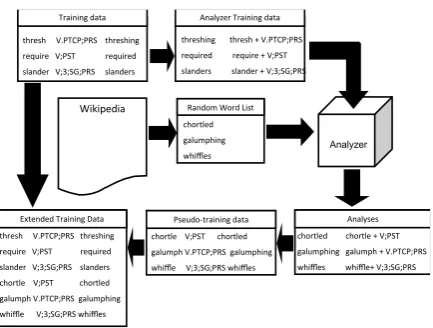
RNNs are sensitive to the amount of training data. In our preliminary experiments, RNNs per-formed poorly in the low-resource setting. In order to increase the accuracy of the RNNs, we supple-ment the training data with morphological analy-ses generated by a DIRECTL+ model trained on the 100 training forms, and applied to randomly-chosen words from an unlabeled corpus using the method ofNicolai and Kondrak(2017). Many of these analyses are incorrect, but overall they pro-vide information to the neural model that enforces inflectional patterns observed in the original train-ing data. This process is shown schematically in Figure2.
Because RNNs train with a stochastic learning algorithm, they are very dependent upon their ini-tialization method (Goodfellow et al., 2016). In order to improve the stability of the RNNs, we en-semble five distinct models, each initialized with a different random seed. We produce ann-best list
from each network, and combine them with equal weighting. This ensembling process is a common technique intended to stabilize neural networks, and lessen the impact of local optima. Our de-velopment experiments confirmed that ensembling can reduce the error rate over individual networks by more than 20%, while reducing the variance by
half.
Analyzer
thresh V.PTCP;PRS threshing require V;PST required slander V;3;SG;PRS slanders
Training data
threshing thresh + V.PTCP;PRS required require + V;PST slanders slander + V;3;SG;PRS
Analyzer Training data
Wikipedia
chortled galumphing whiffles
Random Word List
chortled chortle + V;PST galumphing galumph + V.PTCP;PRS whiffles whiffle+ V;3;SG;PRS
Analyses chortle V;PST chortled
galumph V.PTCP;PRS galumphing whiffle V;3;SG;PRS whiffles
Pseudo-training data thresh V.PTCP;PRS threshing
require V;PST required slander V;3;SG;PRS slanders chortle V;PST chortled galumph V.PTCP;PRS galumphing whiffle V;3;SG;PRS whiffles
[image:3.595.310.527.58.222.2]Extended Training Data
Figure 2: Generation of synthetic training data for RNNs.
2.6 Language models
Transduction models trained on small amounts of data often produce output forms that vio-late the phonotactic constraints of a language. Character-level language models offer the possi-bility of reducing the number of implausible out-puts. For each language, we produce a list of word types from the first million lines of the provided Wikipedia corpus, and create a 4-gram character language model using the CMU language mod-eling toolkit.2 This language model, however, is
very noisy, because the corpus contains many hy-perlinks and filenames.
We attempt to improve the quality of the lan-guage models using the following two methods. The first method is to disregard the corpus, and instead produce a small language model derived exclusively from the target forms in the training data. The second method, which we refer to as affix-matching, is to use only those word types in the corpus that match the affixes seen in training. We identify the affixes by extracting any charac-ter sequence in the training set that is aligned to a subtag byM2M-aligner.
2.7 System combination
In an attempt to leverage their unique strengths, we combine DIRECTL+ with a neural network en-semble. Both approaches produce ranked n-best
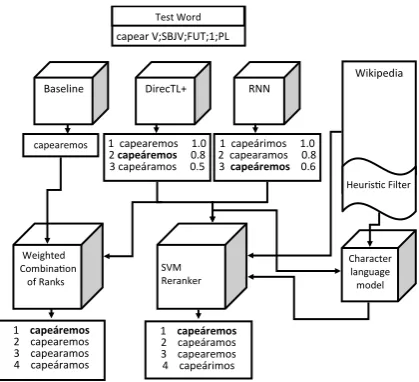
lists. In addition, we include the provided baseline system, which produces a single output form for each input instance. A diagram of our two system combination methods is shown in Figure3.
Test Word capear V;SBJV;FUT;1;PL
RNN Baseline DirecTL+
capearemos 1 capearemos 1.0 2 capeáremos 0.8 3 capeáramos 0.5
1 capeárimos 1.0 2 capearamos 0.8 3 capeáremos 0.6
Weighted Combination of Ranks
1 capeáremos 2 capearemos
3 capearamos 4 capeáramos
SVM Reranker
Wikipedia
Character language
model Heuristic Filter
1 capeáremos 2 capeáramos
[image:4.595.77.287.60.251.2]3 capearemos 4 capeárimos
Figure 3: Two methods of system combination. Correct outputs are shown in bold.
The first method is a simple linear combina-tion, which selects the prediction with the highest weighted average of the three ranks. Combining ranks, rather than numerical scores, circumvents issues with scaling, and allows the integration of the baseline, which produces no score.
The second combination method is the rerank-ing of then-best list produced by DIRECTL+ us-ing other system outputs as features. By fram-ing the rerankfram-ing of an n-best list as a
classifi-cation task (Joachims, 2002), we can also lever-age other sources of information, such as the lan-guage model described in Section2.6. Our SVM reranker includes four features: (1) the normalized score produced by DIRECTL+, (2) the normalized score produced by the RNN ensemble, (3) a binary indicator of the presence of a prediction in a cor-pus, and (4) the normalized probability assigned to the prediction by a character language model. The general objective is to promote high-scoring predictions shared by multiple systems that occur in the corpus or look like real words.
3 Experiments
We conduct experiments on five languages: En-glish (EN), German (DE), Persian (FA), Polish (PL), and Spanish (ES). The training data in the low-resource setting of the inflection generation task is limited to 100 instances. The DIRECTL+ models are trained on the subtag sequences made consistent with the method described in Sec-tion 2.3. For two languages, we identified best subtag orderings that are different from the initial
orderings; the Spanish ordering was found with the alignment-based method. while the Persian or-dering was hand-crafted by a native speaker using linguistic analysis.
Our other systems take advantage of the first one million lines of the Wikipedia dumps from 2017/03/01 provided by the task organizers. Our RNN models are trained on the original train-ing set augmented with 16,000 synthetic instances generated by the DIRECTL+ morphological ana-lyzers, as described in Section 2.5. For the lan-guage models that inform our SVM reranker, we use the entire Persian corpus, training data only for English and Polish, and the affix-match method for German and Spanish (Section 2.6). The reranker is trained using 2-fold cross-validation on the training data.
3.1 Development results
Our development results are summarized in Ta-ble1. We see that our DIRECTL+ models (DTL) substantially outperform the official baseline (BL). even without subtag reordering. The only excep-tion is Persian, in which the best ordering strategy (BO) makes a dramatic difference. Further, mod-est gains are obtained via linear combination (LC) and reranking (RR) of the best individual systems.
BL RNN DTL BO LC RR
EN 76.2 76.3 88.0 88.0 88.0 DE 53.7 43.3 66.6 68.6 68.8 FA 27.3 8.1 23.9 40.8 41.4 40.7 PL 41.9 36.0 48.2 49.3 49.0 ES 58.6 38.9 65.8 68.3 68.3 68.4
Table 1: Results on the development sets.
The most striking outcome is the disappoint-ing performance of the RNN ensembles, which in most cases is well below the baseline, even with the addition of the synthetic data.3 In this context,
it is not surprising that system combination only minimally improves over DIRECTL+ by itself.
Based on the development results, we decided to submit 3 versions for each of the 5 languages (DTL, LC, and RR) plus two runs that correspond to the best subtag ordering (BO) for Spanish and Persian.
3Without synthetic data, our RNN ensembles completely
3.2 Test results
Our results on the test set are shown in Table 2. The numerical tags of the submitted runs are shown in the top row. In the cases of incorrect files being mistakenly submitted, we provide the actual results, which may differ from the official ones. With the exception of Persian, our results are among the best in the low-resource setting.
01 02 03 04
BL RNN DTL BO LC RR
EN 80.6 78.4 90.6 90.6 90.3 DE 55.3 57.1 66.0 66.8 66.2 FA 24.5 8.1 19.5 38.3 39.0 37.7 PL 42.3 28.2 45.2 45.3 45.9 ES 57.1 37.9 64.6 68.2 68.0 67.3 Table 2: Results on the test sets. Runs corrected after the submission deadline are in italics.
The system combination results largely confirm the development experiments. Notably, the simple linear combination, which has no access to lan-guage models, performs slightly better on average than the SVM reranker, and seems to be more sta-ble as well. One possista-ble explanation is the neces-sary subdivision of an already small training set in order to train the reranker, which further reduces the amount of the training data. The linear com-bination requires no training, but its weights are tuned on a relatively large development set.
3.3 Error analysis
English is characterized by a relatively simple in-flectional morphology, with only 5 verbal inflec-tion slots. Most words are regular, and pose no problem even to an inflection model trained on only 100 instances. The errors tend to reflect ir-regular verbs, as well as orthographic rules, such as the consonant doubling insplitting. The current RNN-based systems are unlikely to achieve signif-icantly better results in the low-resource setting.
A number of German errors can be attributed to implicit information that can only be learned by observing multiple forms. For example, the itive singular suffix differs depending on the gen-der of the noun. Certain suffixes, such as -in, often indicate the gender of a noun to be feminine. However, the only genitive feminine singular in the training data does not end in -in, and thus, our system fails to correctly predict the genitive singular ofK¨ochin.
Persian results seem to be affected by subtag or-derings to a greater degree than other languages. The verbal morphology demonstrates some agglu-tinative properties, where individual subtags may match their own affix. One of the authors hand-crafted a subtag ordering, which turned out to be much more effective than the orderings derived by our algorithmic methods. The other sources of difficulty that set Persian apart are the differences between formal and colloquial inflectional forms, which are both represented in the training data, as well as the preponderance of multi-word inflection forms (86% of the test instances), which compli-cates the task of the language model.
Many Polish outputs are non-words, which we expected to be filtered out by the language model. In many cases, the reranker has no chance to suc-ceed, as none of the models includes the correct form in its top-n list. In other cases, the signal
from the language model is not strong enough to overrule the top DIRECTL+ prediction.
An interesting type of error in Spanish are forms that involve orthographically illegal bigrams like ze. DIRECTL+ has a set of bigram features on the target side, but their weights are established on the training set, which is too small to learn such con-straints. In the future, we would like to investigate ways to integrate the unlabeled corpus information directly into the DIRECTL+ generation process.
The languages that we consider in this paper are mostly fusional. Another avenue for future work is adapting our approach to other types of languages.
4 Conclusion
Acknowledgments
This research was supported by the Natural Sciences and Engineering Research Council of Canada, Alberta Innovates – Technology Futures, and Alberta Advanced Education.
References
Ryan Cotterell, Christo Kirov, John Sylak-Glassman, G´eraldine Walther, Ekaterina Vylomova, Patrick Xia, Manaal Faruqui, Sandra K¨ubler, David Yarowsky, Jason Eisner, and Mans Hulden. 2017. The CoNLL-SIGMORPHON 2017 shared task: Universal morphological reinflection in 52 languages. In Proceedings of the CoNLL-SIGMORPHON 2017 Shared Task: Universal
Mor-phological Reinflection. Association for
Computa-tional Linguistics, Vancouver, Canada.
Ryan Cotterell, Christo Kirov, John Sylak-Glassman, David Yarowsky, Jason Eisner, and Mans Hulden. 2016. The SIGMORPHON 2016 shared task—morphological reinflection. In
Proceedings of the 14th SIGMORPHON Work-shop on Computational Research in Phonetics,
Phonology, and Morphology. pages 10–22.
http://www.aclweb.org/anthology/W16-2002.
Ian Goodfellow, Yoshua Bengio, and Aaron Courville. 2016. Deep Learning. MIT Press.
http://www.deeplearningbook.org.
Bradley Hauer and Grzegorz Kondrak. 2016. De-coding anagrammed texts written in an unknown language and script. Transactions of the
As-sociation of Computational Linguistics 4:75–86.
http://aclweb.org/anthology/Q16-1006.
Sittichai Jiampojamarn, Colin Cherry, and Grzegorz Kondrak. 2008. Joint process-ing and discriminative trainprocess-ing for letter-to-phoneme conversion. In ACL. pages 905–913.
http://www.aclweb.org/anthology/P/P08/P08-1103.
Sittichai Jiampojamarn, Grzegorz Kondrak, and Tarek Sherif. 2007. Applying many-to-many align-ments and hidden markov models to letter-to-phoneme conversion. InNAACL-HLT. pages 372– 379. http://www.aclweb.org/anthology/N/N07/N07-1047.
Thorsten Joachims. 2002. Optimizing search en-gines using clickthrough data. InProceedings of the Eighth ACM SIGKDD International Conference
on Knowledge Discovery and Data Mining. ACM,
New York, NY, USA, KDD ’02, pages 133–142.
https://doi.org/10.1145/775047.775067.
Katharina Kann and Hinrich Sch¨utze. 2016. MED: The LMU system for the SIGMORPHON 2016 shared task on morphological reinflection. In
Proceedings of the 14th SIGMORPHON Work-shop on Computational Research in
Phonet-ics, Phonology, and Morphology. pages 62–70.
http://www.aclweb.org/anthology/W16-2010.
Ryan McDonald, Koby Crammer, and Fernando Pereira. 2005. Online large-margin training of dependency parsers. In Proceedings of the 43rd Annual Meeting of the Association
for Computational Linguistics (ACL’05).
Associa-tion for ComputaAssocia-tional Linguistics, pages 91–98.
http://aclweb.org/anthology/P05-1012.
Garrett Nicolai, Colin Cherry, and Grzegorz Kon-drak. 2015. Inflection generation as discrimina-tive string transduction. In Proceedings of the 2015 Conference of the North American Chap-ter of the Association for Computational
Linguis-tics: Human Language Technologies.
Associa-tion for ComputaAssocia-tional Linguistics, pages 922–931.
http://aclweb.org/anthology/N15-1093.
Garrett Nicolai, Bradley Hauer, Adam St Arnaud, and Grzegorz Kondrak. 2016. Morphologi-cal reinflection via discriminative string
transduc-tion. InProceedings of the 14th SIGMORPHON
Workshop on Computational Research in
Phonet-ics, Phonology, and Morphology. pages 31–35.
http://www.aclweb.org/anthology/W16-2005.
Garrett Nicolai and Grzegorz Kondrak. 2017. Morpho-logical analysis without expert annotation. In Pro-ceedings of the 15th Conference of the European Chapter of the Association for Computational
Lin-guistics: Volume 2, Short Papers. Association for
Computational Linguistics, Valencia, Spain, pages 211–216. http://www.aclweb.org/anthology/E17-2034.
Ilya Sutskever, Oriol Vinyals, and Quoc V Le. 2014.
Sequence to sequence learning with neural net-works. In Z. Ghahramani, M. Welling, C. Cortes, N. D. Lawrence, and K. Q. Weinberger, editors,
Advances in Neural Information Processing
Sys-tems 27, Curran Associates, Inc., pages 3104–