Study on Non-Catalytic and Catalytic Wij’s Method
of IV Analysis of some Vegetable Oils and Fats
using Catalyst
Dr. Shashikant Pardeshi Scientific Officer, DPHL, Jalgaon.
Abstract: In the present work, a rapid method is used for the measurement of iodine value, wherein mercuric acetate is directly used in the powder form. An attempt has been made to reduce the time of the Wijs method by use of mercuric acetate as a catalyst/accelerator. The iodine value of different vegetable oils such as soyabean (Sb),groundnut(Gn), palmolein (Pm) and sunflower(Sn) were determined by regular Wijs method for 30 minutes whereas when we apply catalytic Wijs method with use of 2 mg, 5 mg and 10 mg of mercuric acetate to perform as catalyst then it is reducing the time of analysis to 3 minutes. Thus when catalyst is used the different values obtained for coefficient of variations are 0.11 to 0.47 for 2mg, 0.08 to 0.54 for 5mg and 0.17 to 0.54 for 10 mg whereas 0.31 to 0.84 for non catalyst addition. Finding of the study is there is significant reduction in the analysis time, measurement accuracy and reproducibility of data when we apply mercuric acetate as a catalyst/accelerator Keywords: IV (Iodine Value), mercuric acetate, vegetable oils etc
I. INTRODUCTION
The official methods for determination of iodine value (IV) involve the reaction of double bonds in oils with halogenating reagent ( Wijs solution) over 30 min followed by iodometric titration of the liberated iodine obtained through reaction of excess Wijs reagent with potassium iodide with sodium thiosulphate solution using starch as an indicator. Wijs method is generally adopted for the measurement of iodine value [1, 3].
Generally Wijs method is used for measurement of iodine value and this method has a drawback that duration of the reaction is as long as 30-60 minutes. In this paper mercuric acetate is used as a catalyst/accelerator to achieve a reduction in the reaction time. According to Jnmiat et al, various methods and modifications that have been proposed on time to time for the determination of the Iodine values of fats and oils, Hubl's and Wijs' are the only two methods which have found more or less general application [7]. Hoffman and Green used mercuric acetate as a catalyst in the Wijs method to obtain complete iodine absorption in three minutes [6]. Benhen and Klee modified the Rosenmund-Kuhnhenn Method so that only one minute reaction time was required [2].
Mukherjee,S.(1955) investigated and developed a rapid method for the estimation of unsaturation of fats and oils by use of an aqueous solution of sodium hypochloro us acid reagent as a absorption reagent with a reaction time of 4 to 5 minutes was recommend, the estimations are more rapid or all drying or non drying group oils give accurate results within the specified time [9]. Shin-ichi Kikuno et al (1975) investigated the methods of quick determination of iodine value especially for the oil in the hydrogenation process and have found after all the Wijs method could be appropriate by only shortening the reaction time to three minutes for the oils of iodine value less than about 100. It also studied the effect of catalyst, temperature, time and I/CL ratio during the determination of iodine value [10].
Hashemy et al (1977) studied the IV of 121 samples of butter as well as some common oils and fats by applying both the standard and rapid Wij’s and Hanus methods. In the rapid method a 2.5% of mercuric acetate in acetic acid was used. The result obtained are close and comparable for 1 min Wij’s and 3 min Hanus methods as compared with 30 min reaction time of standard procedures [5]. According to the united state patent (1981) when the magnesium acetate or sodium acetate is used in the form of a solution in glacial acetic acid, preferably having a concentration of 3-5 wt. %. In this method; the reaction time of a sample with the Wij’s solution is as short as short as about 3 minutes. Then, the iodine value is measured in the same manner as in the Wijs method. Since The analysis time is thus remarkably shortened [11].
ZHONG GUO-ging (2004) investigated a new method for the determining the IV of oil and fat was only requires to add catalyst mercuric acetate in the process of determination without changing the operational procedure of Hanus method to reduce the reaction time of 30 minutes to 4 minutes. The experimental results indicate that the relative error is lower than 0.5 % and coefficient of variation is lower than 0.2% [13].
According to Yang Li,Ji Dong-bing et al (2014) investigated the improved determination method was tested by adding Wijs reagent and 10 ml 3% magnesium acetate solution as catalyst reacting for 13 min., Acc. The result showed that there was no great difference between 2 methods with relative error less than 2%. It indicated that catalyst magnesium acetate had no adverse effect on accuracy of determination results [12].
Aim of the study is to develop a method by which time of the Wijs method can be reduced by use of mercuric acetate as a catalyst/accelerator.
II. MATERIAL AND METHODS
A. Procurement of Materials
Vegetable oils such as soyabean(Sb),groundnut(Gn), palmolein(Pm) and sunflower(Sn) oils have been purchased from the local market and used in the present study for the determination of iv analysis.All the chemicals and reagents used in present experimental methodology are analytical grades.
B. Methods
1) Experimental Methodology: In the present work, an attempt has been made to reduce the time of the Wijs method by use of mercuric acetate as a catalyst/accelerator. It provides a rapid method for the measurement of iodine value, wherein mercuric acetate is directly used in the powder form. The methodology includes addition of Wijs solution to a sample in an ordinary manner and then a powder form of the catalyst is added.The iodine value for a sample is determined in three set of experiments with 2 mg, 5 mg and 10 mg of mercuric acetate as a catalyst. The sample is allowed to react with the Wijs solution for reaction time about 3 minutes and then the iodine value is measured in the same manner as in the Wijs method.
2) Experimental Procedure For Determination Of IV Is According To Wijs Method [3,4]: The only variation is the use of mercuric acetate as a catalyst to reduce the analysis time. To a 500ml conical flask with glass topper was weighed accurately an appropriate quantity of the dry oil/fat as per expected value (0.2-0.22mg),to which 25ml of carbon tetrachloride have been added and agitated for proper mixing. To this was added 25 ml Wijs reagent and mercuric acetate. The sample was evaluated in three set of experiments with 2 mg, 5mg, and 10 mg of mercuric acetate as catalyst. The flask was fitted with glass stopper wetted with KI solution, swirled for proper mixing and kept in a dark for about 3 minutes for reaction. The test was also performed in absence of mercuric acetate where it was kept in darks for 30 minutes. Simultaneously a blank test was also performed. At the end of reaction, to the flask was added 15 ml KI solution followed by 100 ml freshly boiled and cooled water with rinsing of the stopper. Liberated iodine was titrated with standardised sodium thiosulphate solution (0.0998 N) using starch as indicator until the blue colour formed disappears after through shaking. The iodine value was determined as follows: Iodine value = 12.69* (B-S)* Normality of Na2S2O3 /Weight of Sample taken Table 1.1reports the iodine value of different vegetable
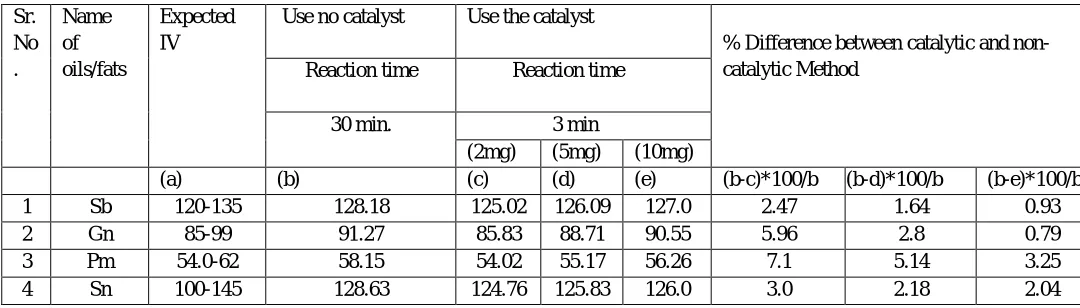
[image:2.612.44.584.568.722.2]oils determined by regular Wijs method and by the catalytic Wijs method with use of 2 mg, 5 mg and 10 mg mercuric acetate.
Table 1.1 IV Analysis of IV of vegetable oils by non-catalytic and catalytic Wijs method with reaction time of 30 and 3 min Sr.
No .
Name of oils/fats
Expected IV
Use no catalyst Use the catalyst
% Difference between catalytic and non-catalytic Method
Reaction time Reaction time
30 min. 3 min
(2mg) (5mg) (10mg)
(a) (b) (c) (d) (e) (b-c)*100/b (b-d)*100/b (b-e)*100/b
1 Sb 120-135 128.18 125.02 126.09 127.0 2.47 1.64 0.93
2 Gn 85-99 91.27 85.83 88.71 90.55 5.96 2.8 0.79
3 Pm 54.0-62 58.15 54.02 55.17 56.26 7.1 5.14 3.25
Table-1.2 Accuracy of Iodine value in use of the catalyst and no catalyst Sr.N
o oil/f ats
Use the Catalyst Use no Catalyst
2mg 5mg 10mg
IV CV
(%)
IV CV(%) IV CV
(%)
IV CV (%)
1 Sb 125.02 0.14 0.11 126.09 0.09 0.08 127.0 0.29 0.23 128.18 0.66 0.51
2 Gn 85.83 0.41 0.47 88.71 0.31 0.35 90.55 0.48 0.54 91.27 0.49 0.54 3 Pm 54.02 0.21 0.39 55.17 0.3 0.54 56.26 0.23 0.41 58.15 0.49 0.84 4 Sn 124.76 0.22 0.17 125.83 0.37 0.29 126.0 0.21 0.17 128.63 0.4 0.31
Average values of three measurements, -standard deviation, CV-coefficient of variation
Fig1. Shows comparison of IV between reaction time of 30min and 3min using 2mg mercuric acetate catalyst
Fig2. Shows comparison of IV between reaction time of 30min and 3min using 5mg mercuric acetate catalyst 0
20 40 60 80 100 120 140
Sb Gn Pm Sn
I V
Oils
IV-2mg
Series1
Series2
0 20 40 60 80 100 120 140
Sb Gn Pm Sn
IV
Oils
IV-5mg
Series1
Fig3. Shows comparison of IV between reaction time of 30min and 3min using 10mg mercuric acetate catalyst
Fig4. Shows comparison between % difference in catalytic and non catalytic IV in 3min using 2,5 and 10mg of mercuric acetate
III. RESULTS AND DISCUSSIONS
It is apparent from the Table 1.1 that the iodine value for oil/fat obtained by the Wijs method and by the experimental method (modified Wijs method) is not significantly different. All the experimental values are average of five readings with good reproducibility of results. Also results obtained by use of mercuric acetate lies within the expected range, as per Food safety and standards act 2006 and Food product and Standards regulation 2011 [column (a) of Table] [4] , of iodine value for respective oil/fat. The presence of catalyst has facilitated the increased reaction rate with reduction in time of analysis. It is observed that with increase in the quantity of catalyst reduces the difference in iodine value obtained by regular Wijs method and modified Wijs method. Accordingly use of 10mg of mercuric acetate gives least variation in the values obtained for all the studied oil samples. Comparatively more difference is noted in case iodine value by Wijs method and modified Wijs method for palmolein , wherein the allowed time of 3 minutes is not sufficient for reaction between iodine monochloride and palmolein. This has however reduced with the increase of catalyst quantity. Higher time of reaction may favour the reduction in difference in values of IV by regular Wijs method and modified Wijs method. The obtained value of IV for all studied samples by modified Wijs method represents the success of mercuric acetate to perform as catalyst in reducing the time of analysis to 3 minutes. Moreover, as all the reported values are average of five readings, has demonstrated the reproducibility of the analysis data. Table 1.2 shows the variance of the measured values of the method of setting it to 3 minutes. The coefficient of variation in case of 2mg is 0.11 to 0.47while in case of 5mg (catalyst addition) 0.08 to 0.54 and in 10 mg, 0.17 to 0.54, even for non catalyst addition, 0.31 to 0.84.
0 20 40 60 80 100 120 140
Sb Gn Pm Sn
IV
Oils
IV-10mg
Series1
Series2
0 1 2 3 4 5 6 7 8
Sb Gn Pm Sn
% diff. in IV
Oils/Fats
Series1
Series2
IV. CONCLUSION
Present research examines the comparison between catalytic or accelerated method with original or non-catalytic Wijs method for IV analysis. The accuracy, reproducibility and validity aspect of IV analysis has been conducted using mercuric acetate catalyst. It is found that there is no significant difference between the IV obtained by this catalytic method and standard AOAC method. This present work introduces significant reduction in the analysis time, measurement accuracy and reproducibility of data for the determination of non-catalytic and catalytic IV analysis. Thus as a result catalytic Wijs method can be adopted as online quality control technique for rapid analysis during hydrogenation of oils and fats. The use of 10 mg of mercuric acetate gives least variation in the values obtained for all the studied oil samples.
REFERENCES
[1] AOAC (2000), Association of official Analytical chemists, 17th edition, Official Method 920.159-Iodine absorption number of oils and Fats/ISI Handbook of food analysis(part XIII)1984,76.
[2] Benhem et al (1950), Benhem,G.H.,and Kell,L.1950,An improved method for the determination of iodine number. Journal of American Oil Chemists Soc. 27:127-129.
[3] DGHS (2012), Directorate of General Health Service, Manual of Methods of Test and Analysis for Food(Oil and Fats),Ministry of Health and family welfare, Government of India, New Delhi.31-34.
[4] FSSA 2006 (2014), Food Safety and Standards Act 2006, Rules 2008, Regulations of food Product and Standards 2011, 8th edition professional book publishers, New Delhi.
[5] Hashemy et al (1977), S.E.Hashemy-Tonkabony, Rapid lodine value determination using mercuric acetate as accelerator .,journal of American oil chemists society, 54(6) ,233.
[6] Hoffman et al (1939), Hoffman,H.D, and Green,C.E.,1939,A rapid method for the determination of iodine number, oil and soap,16:236-38.
[7] Jnmiat et al (1916) , Jnmiat Vishindas LaMani and John Joseph Sudborough, The determination of the Iodine values of Fats and Oils by Winkler's Bromate Method.,173-177.
[8] LI Hua et al(1999),LI Hua,Eniwer Arboundrar, Ahemeity Manlihar.,A fast determination method of IV of oil and Fat, Journal of Xuzhou Normal University ,Fine Chemicals,03.
[9] Mukherjee,S.(1955), A rapid method for estimating unsaturation of Fats and oils by the use of hypochlorous acid reagent. Journal of American Oil Chemists Soc. 32,351-353.
[10] Shin-ichi Kikuno et al (1975),Shin-ichi Kikuno,Yukinobu Murase,Shouji Maruzeni and Minoru ,On the Determination of Iodine Value by the Wijs Method, Okamoto.Journal of Japan Oil Chemists Society,24(12),876-878.
[11] US Patent 4297106 (1981),United States Patent , Rapid method of the measurement of Iodine Value (11)4, 297,106, Makino, (45).
[12] Yang Li et al(2014),Yang Li,Ji Dong-bing Xue Dun-hui, Chen Rong, DU Hong-ying, LU Wet-tong., A rapid method for the determination of edible oil iodine value ., Journal of Science and Technology of cereals, oils and Foods.