163
Improving Natural Language Understanding by Reverse Mapping
Bytepair Encoding
Chaodong Tong1,2
Huailiang Peng1,2
( ) Qiong Dai1,2
Lei Jiang1,2
Jianghua Huang3
1
Institute of Information Engineering, Chinese Academy of Sciences, Beijing, China
2
School of Cyber Security, University of Chinese Academy of Sciences, Beijing, China
3
Meituan-Dianping Group, Beijing, China
{tongchaodong, penghuailiang, daiqiong, jianglei}@iie.ac.cn
{huangjianghua}@meituan.com
Abstract
Recently, language models (LMs) or language representation models are widely used in nat-ural language understanding (NLU) tasks. However, these LMs are usually trained on large unlabeled text corpora, while the fine-tuning process simply takes words or word-pieces as model input. Because of the differ-ences between language model and NLU task objectives, the problem of lack of concern on some key words exists. Thus in this paper, we propose a method called reverse mapping bytepair encoding, which maps named-entity information and other word-level linguistic features back to subwords during the encod-ing procedure of bytepair encodencod-ing (BPE). We employ this method to the Generative
Pre-trained Transformer (OpenAI GPT) (
Rad-ford et al.,2018) by adding a weighted linear layer after the embedding layer. We also pro-pose a new model architecture named as the multi-channel separate transformer to evalu-ate the effectiveness of the newly introduced information by employing a training process
without parameter-sharing. Experiments on
Story Cloze, RTE, SciTail and SST-2 datasets demonstrate the effectiveness of our approach. Compared with the original results in GPT, our approach gains 1.58% absolute increase on Stories Cloze, 6.4% on RTE, 0.69% on SciTail and 0.8% on SST-2.
1 Introduction
Recently, language models are widely used as the feature extractor for many NLU tasks. Statistical language models learn the joint probability func-tion of sequences of words in a language (Bengio et al.,2003). Trained on large corpora and differ-ent domains give LMs generalization abilities, and enable them to capture latent or deep senmantics. Normally, statistical language models take the
fol-lowing objective to maximize:
L1(u) =X i
logP(ui|ui−k, ..., ui−1; Θ) (1)
wherekis the size of the context window, and the conditional probabilityP is modeled using a neu-ral network with parametersΘ.
However, this formal simplicity determines that they can not deal well with the ambiguity of words nor low-frequency words. In fact, low-frequency words may appear once or little times in the whole corpus, thus the embeddings of them may over-fit or underover-fit the corpus. In practice, we usu-ally truncate them from the vocabulary and re-place them with an “UNK” label. In this situ-ation, we partially lose their meanings. For ex-ample, in “15 million tonnes of rubbish are pro-duced daily in Cairo.”, the number “15” can hardly be trained to gain its proper representation even if it is replaced by a specific label representing numbers. Besides, out of vocabulary (OOV) is a big problem while predicting. Some kinds of word segmentation technologies have been pro-posed (Joulin et al.,2017;ray Su and yi Lee,2017) to solve these problems.
nouns are missing while simply applying it to some NLU tasks. Consider the following textual entailment example:
Example 1. t. Traditionally, the Brahui of the Raisanitribe are in charge of the law and order situation through the Pass area. This tribe is still living in present dayBalochistanin Pakistan.
h.TheRaisanitribe resides in Pakistan. t→h:entailment
BPE:
Brahui: bra hu i
Raisani: rai san i
Balochistan: bal o chi stan
In this example, proper nouns play an important role, but they are divided into wordpieces shared with other words. Especially they have common pieces such as “i” and “o”. Therefore, inferring from the encoded sequence can be quite difficult.
Apart from this, let us motivate the lack of concern on some key words or phrases of such method. Here is another example:
Example 2. t.Cairo is now home tosome 15 mil-lion people - a burgeoning population that pro-ducesapproximately 10,000 tonnesof rubbish per day, putting an enormous strain on public ser-vices...
h. 15 million tonnes of rubbish are produced dailyin Cairo.
t→h:not entailment
In this case, “15 million tonnes” is the key phrase while “15”, “million” and “tonnes” also ap-pear in the context. Word-level or subword-level information is obviously not enough.
To alleviate these issues, we propose a reverse mapping bytepair encoding method to integrate prior knowledge into subwords. The prior knowl-edge mentioned here includes named-entity in-formation, part-of-speech (POS) tags and depen-dency parsing labels. Our method has two forms and both of them modify the encoding procedure of BPE. In the conventional form, firstly we tag and parse the target sentence which needs to be tagged with NER, POS taggers as well as a depen-dency parser. After that, we handle the target sen-tence with the original BPE algorithm. Note that the taggers and the parser work on the word-level while BPE works on the wordpiece-level. Finally, we encode every wordpiece as a combination of linguistic features of its parent word and itself. To avoid over-reliance on the performance of external tools and error propagation, we modify the former
as named-entity phrase based reverse mapping, which adds named-entity phrases to the vocabu-lary during the scanning process of the whole cor-pus and encodes a wordpiece as the combination of the named-entity phrase where the wordpiece comes from and itself. We evaluate our method on a set of NLU tasks by applying it to GPT. More specifically, we add a weighted layer after the em-bedding layer to get different weighted combina-tions of the inputs. We also propose a new model architecture named as the multi-channel separate transformer to employ a training process without parameter-sharing for wordpieces and additional features. We evaluate our approach on two natural language inference tasks (RTE, SciTail), a ques-tion answering task (Story Cloze Test) and a clas-sification task (SST-2), showing the benifits of our approach.
2 Related Work
There is also a class of method, instead of re-lying a lot on external knowledge, it takes advan-tage of the linguistic features that exist in natural language. Levy (Levy and Goldberg,2014a) gen-eralized the skip-gram model to include arbitrary contexts by dependency parsing. The dependency-based embeddings are less topical and exhibit more functional similarity than the original skip-gram embeddings. Multimodal representations of chinese characters (ray Su and yi Lee,2017) have also been studied, and the research showed the ef-fectiveness of glyph features in some cases. Sen-nrich (Sennrich and Haddow, 2016) proposed an approach to employ linguistic features for neu-ral machine translation (NMT). These features in-clude lemmas, subword tags, morphological fea-tures, POS tags and dependency labels. Differ-ent from us, they paid more attDiffer-ention on how to improve NMT from the morphological level. Be-sides, they did not consider named entities. An-other work relevant to us is (Nallapati et al.,2016). They proposed a feature-rich encoder to capture keywords in summarization. Their model employs a word-level vocabulary, and the words are embed-ded by concatenating all kinds of features includ-ing POS, NER tags and discretized TF and IDF values. Different from them, our approach works on the subword level and leverages linguistic fea-tures at the semantic level.
There are many kinds of neural networks that can deal with NLU tasks. Recently, pre-trained language models or language representation mod-els have been widely used and these works got sig-nificant improvements (Peters et al., 2018; Rad-ford et al., 2018; Devlin et al., 2018). Trained on large corpora will inevitably face the big-vocabulary problem and the OOV problem. Thus researchers have proposed several methods to han-dle them. FastText (Joulin et al.,2017) employed n-grams thus it could predict the zero-shot word
embeddings. However, n-gram is an arbitrary
method of word segmentation. Sennrich (Sennrich
et al., 2016) adapted the original byte pair
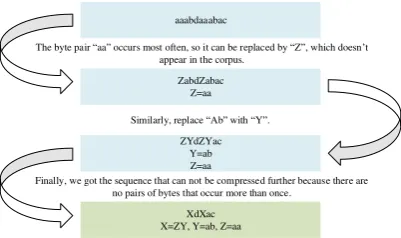
en-coding (BPE) compression algorithm to NMT and got significant success. This method iteratively merges most frequent adjacent characters or char-acter sequences in a word until it can not be done, based on the well learned token rank. Therefore it can encode any word with a pre-learned token vocalulary. We give an illustration as Figure 1, showing the ranking process of BPE. GPT (
Rad-ford et al.,2018) applied BPE to its training pro-cess and got impressive achievements in a series of NLU tasks. Due to the greedy nature of BPE algorithm, the results produced by BPE are deter-ministic, resulting in insufficient robustness in ma-chine translation. Kudo (Kudo,2018) located this problem and proposed a subword regularization method to handle it. He trained the NMT model with multiple subword segmentations generated in a probability manner and got improvements espe-cially on low resource and out-of-domain settings. This study provides an interesting insight, but we argue that it may not bring significant improve-ment in NLU tasks. In fact, BPE is proposed to model open-vocabulary translation in NMT, which is inconsistent with the goal of some natural lan-guage understanding tasks. That motivates us to start our work.
aaabdaaabac
ZabdZabac Z=aa
ZYdZYac Y=ab Z=aa
The byte pair “aa” occurs most often, so it can be replaced by “Z”, which doesn’t appear in the corpus.
Similarly, replace “Ab” with “Y”.
XdXac X=ZY, Y=ab, Z=aa
[image:3.595.316.517.333.452.2]Finally, we got the sequence that can not be compressed further because there are no pairs of bytes that occur more than once.
Figure 1: Ranking process of bytepair encoding.
3 Methods
15 million tonnes of rubbish are produced daily in Cairo. LB-BPE 15</w> million</w> ton nes</w> of</w> rubbish</w> are</w> produced</w> daily</w> in</w> cairo</w> .</w> QUANTITY QUANTITY QUANTITY QUANTITY NaN NaN NaN NaN DATE NaN GPE NaN _compound_ _nummod_ _nsubjpass_ _nsubjpass_ _prep_ _pobj_ _auxpass_ _ROOT_ _advmod_ _prep_ _pobj_ _punct_ NUM NUM NOUN NOUN ADP NOUN VERB VERB ADV ADP PROPN PUNCT
Token NER Label
[image:4.595.94.509.71.293.2]Synactic Dependency Label POS Tag QUANTITY GPE NPB-BPE* 15</w> million</w> ton nes</w> of</w> rubbish</w> are</w> produced</w> daily</w> in</w> cairo</w> .</w> Token ENTITY1 ENTITY1 ENTITY1 ENTITY1 UNE UNE UNE UNE UNE UNE ENTITY2 UNE Named-entity Phrase ENTITY1 ENTITY2 DATE
Figure 2: “tonnes” is encoded to be two tokens: “ton”, “nesh/wi”. (Left)LB-BPE result. Each token consists
of four parts: token, NER label, synactic dependency label and POS tag. Words in the original text pass their
linguistic features to the tokens generated from them.(Right)NPB-BPE∗result. Each token consists of two parts:
token and corresponding entity.
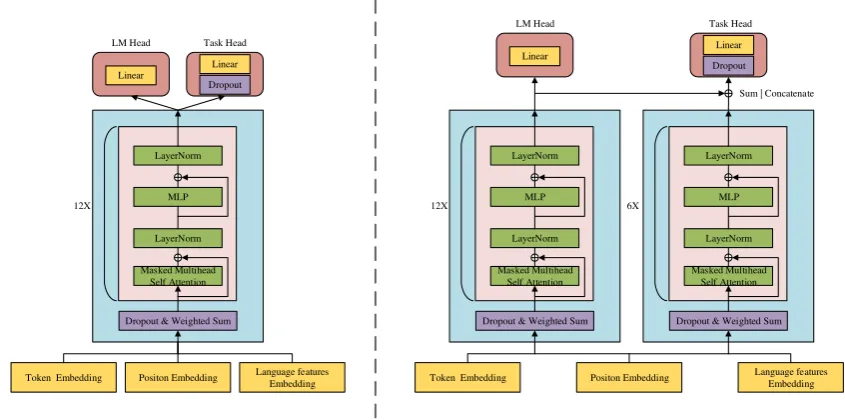
Token Embedding Positon Embedding Language features Embedding Linear Dropout Task Head Linear LM Head
Sum | Concatenate
Token Embedding
Dropout & Weighted Sum
Positon Embedding Language features Embedding 12X Masked Multihead Self Attention LayerNorm MLP LayerNorm Linear Linear Dropout LM Head Task Head
Dropout & Weighted Sum 12X Masked Multihead Self Attention LayerNorm MLP LayerNorm
Dropout & Weighted Sum 6X Masked Multihead Self Attention LayerNorm MLP LayerNorm
Figure 3: (Left)Parameter-sharing training procedure. (Right)Multi-channel separate transformer. Language
model loss is only generated by the left transformer. The input of the task specific head is the sum or concatenation of both transformers outputs.
3.1 Label Based Reverse Mapping Bytepair Encoding
We extend a token t generated by BPE to four parts{t, tpos, tner,tdep}, wheret is the same as
the original encoded token in BPE,tposis the POS
tag of the word which generates this token,
sim-ilar with tner and tdep. Not all words are tagged
with named-entity labels, therefore we tag these tokens without NER labels as “NaN”. We regard
tpos, tner, tdep as additional features that could
[image:4.595.85.508.384.594.2]Feature type Amount
NER 20
POS 19
[image:5.595.84.282.62.119.2]DEP 51
Table 1: Amount of different types of features.
Schemes come from Spacy Annotation Specifi-cations1. We usespaCy2to tokenize, tag and parse the datasets during our experiments. We simply use the dependency labels instead of the whole de-pendency parsing tree because of two reasons: one is it brings complex changes to the input architec-ture, the other is that we assume the transformer architecture has the ability to establish some kinds of patterns to capure the dependencies between to-kens generated by BPE.
3.2 Named-entity Phrase Based Bytepair Encoding
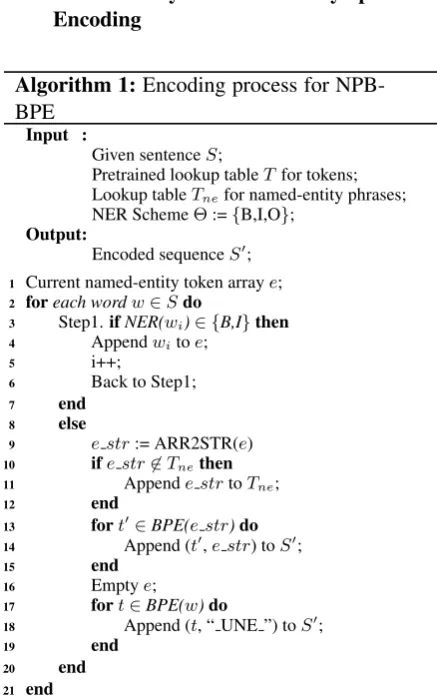
Algorithm 1:Encoding process for NPB-BPE
Input :
Given sentenceS;
Pretrained lookup tableTfor tokens; Lookup tableTnefor named-entity phrases;
NER SchemeΘ:={B,I,O};
Output:
Encoded sequenceS′;
1 Current named-entity token arraye; 2 foreach wordw∈Sdo
3 Step1.ifNER(wi)∈ {B,I}then
4 Appendwitoe;
5 i++;
6 Back to Step1;
7 end
8 else
9 e str:= ARR2STR(e) 10 ife str6∈Tnethen
11 Appende strtoTne;
12 end
13 fort′∈BPE(e str)do 14 Append (t′,e str) toS′;
15 end
16 Emptye;
17 fort∈BPE(w)do
18 Append (t, “ UNE ”) toS′;
19 end
20 end
21 end
As we mentioned in Introduction 1, some
key words are low-frequency. Such as a
per-son name “Kevin Federline”, it can be encoded
1
https://spacy.io/api/annotation# title 2https://spacy.io/
as “kevinh/wi”, “feder” and “lineh/wi”, and the meaning will be changed. Passing the keyword information to tokens is a simple and feasible ap-proach to solve this problem. There are many ways of defining which words are key words and thus the problem can be defined as following:
Definition 1.Find an algorithmA,∀k∈S,A(k) = 1ifkis a key word, elseA(k) = 0.
whereSrepresents a sentence.
This is a two-category classification problem. In fact, these key words usually perform as peo-ple’s names, organizations or other types of named entities. Therefore, we choose a NER algorithm3 as algorithmA and we modify the encoding pro-cess of BPE algorithm as algorithm1to pass the entity attribute to tokens. By reverse mapping named-entity words or phrases appeared in the corpus back to BPE tokens, key information has a way to be preserved. Some kinds of named entities (ep. DATE, TIME, PERCENT, MONEY, QUAN-TITY, ORDINAL, etc) contain numbers and they usually express general attributes, such as “22-year-old”. We add a switch in practice to control whether processing these words with NPB-BPE or not.
The main difference between LB-BPE and NPB-BPE is that LB-BPE makes ordinary use of additional semantic information that can not be easily captured by statistical language models in a specific language, while NPB-BPE provides a way to share important concepts within a corpus.
3.3 Training Process
GPT is followed by many studies for its excel-lent generalization performance and we will give a brief introduction to it in the first subsubsec-tion. Due to the expensive cost of pre-training, we reuse the OpenAI pre-trained language model4 pa-rameters, and we train new embeddings and fine-tune all parameters during the fine-tuning process. Figure 4 shows the modified preprocess proce-dure. Considering the input is enhanced by ferent kinds of new features, we propose two dif-ferent processes for training.
Generative Pre-trained Transformer
The Generative Pre-trained Transformer (Radford et al.,2018), also known as OpenAI GPT or called as GPT, is a language representation model which
3
https://spacy.io/api/entityrecognizer
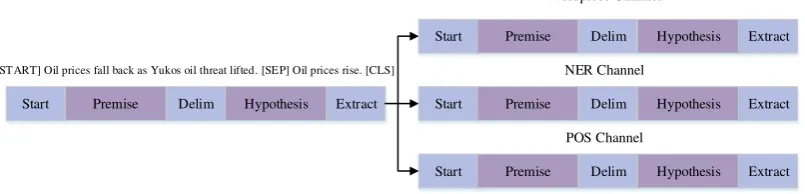
[image:5.595.70.289.324.673.2]Start Premise Delim Hypothesis Extract
Start Premise Delim Hypothesis Extract
Start Premise Delim Hypothesis Extract
Start Premise Delim Hypothesis Extract Wordpiece Channel
NER Channel
[image:6.595.103.506.80.177.2]POS Channel [START] Oil prices fall back as Yukos oil threat lifted. [SEP] Oil prices rise. [CLS]
Figure 4: The preprocess procedure of RTE dataset by LB-BPE (NER+POS). Others are similar with this example.
is pre-trained on large corpora and fine-tunes all pre-trained parameters on the downsteam tasks. Its main architechture was originally described in (Vaswani et al., 2017). Unless otherwise stated, the GPT mentioned in this paper refers to a 12-layer decoder-only transformer with masked self-attention heads (768 dimensional states and 12 at-tention heads). For the position-wise feed-forward networks, we use 3072 dimensional inner states. Other hyperparameters are set as well as the GPT paper (Radford et al.,2018) for comparison.
Sharing Parameters
With this method, we treat additional features like positional encoding. We add these tags to the vo-cabulary and random initialize their embeddings in the embedding layer, thus the input can be de-scribed as following:
h0=wwtEt+wwpEp+
X
i∈Clf
wwliEli (2)
where Et, Ep, Eli represent the token
embed-ding matrix, position embedembed-ding matrix and lin-guistic feature embedding matrix, Cl is the
col-lection of all types of linguistic features andwwt,
wwp, wwli are the corresponding weight scalars.
The following data flow is the same as GPT (Liu
et al., 2018). We use the following objective to
minimize:
L3(C) =L2(C) +λL1(C) (3)
where C represents the labeled dataset, L2(C)
is the cross entropy loss of classification got on
C,L1(C)is the cross entropy loss of the language
model got onC andλis a weight parameter be-tween 0 and 1.
Multi-channel Separate Transformer
GPT uses a multi-layer transformer decoder as the language model, and it learns patterns in the language by simply observing the token-level se-quences. In this part, we use LB-BPE to encode sequences and with this method we have multi-ple input channels. We employ two stand-alone multi-layer transformer decoder to separate the pa-rameters learned on different perspectives. One is the 12-layer pre-trained transformer released by OpenAI GPT, and the other is an entirely new one which has different amount of layers with the for-mer and takes responsibility for linguistic features.
4 Experiments and Analysis
4.1 Setup
We follow the model hyperparameters mentioned in the GPT (Liu et al.,2018) paper. We use learned position embeddings with variable length depend-ing on downstream tasks. We perform a pilot ex-periment and the result shows that it is almost the best to set the weighted layer as 1.0 for each chan-nel. We use a 16GASPEED Graphics Family (rev 30)card for training.
4.2 Supervised Fine-tuning
Datasets
Story Cloze Test Story Cloze Test
(Mostafazadeh et al., 2017) is a new
com-monsense reasoning framework for evaluating story understanding, story generation, and script learning. This test requires a system to choose the correct ending to a four-sentence story. We choose it as a part of our evaluation corpora because it requires the model to capture rich linguistic phenomena.
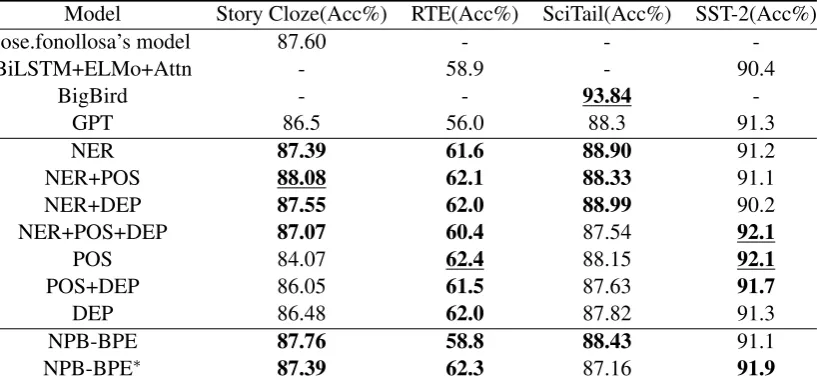
in-Model Story Cloze(Acc%) RTE(Acc%) SciTail(Acc%) SST-2(Acc%)
jose.fonollosa’s model 87.60 - -
-BiLSTM+ELMo+Attn - 58.9 - 90.4
BigBird - - 93.84
-GPT 86.5 56.0 88.3 91.3
NER 87.39 61.6 88.90 91.2
NER+POS 88.08 62.1 88.33 91.1
NER+DEP 87.55 62.0 88.99 90.2
NER+POS+DEP 87.07 60.4 87.54 92.1
POS 84.07 62.4 88.15 92.1
POS+DEP 86.05 61.5 87.63 91.7
DEP 86.48 62.0 87.82 91.3
NPB-BPE 87.76 58.8 88.43 91.1
NPB-BPE∗ 87.39 62.3 87.16 91.9
[image:7.595.96.505.63.254.2]The details of the models for comparison in this table can be found in the leaderboards of the cor-responding dataset official websites. Each row in the second block represents a LB-BPE result with different combination of features. NER represents using named-entity labels, POS represents part of speech tags and DEP represents synactic dependency parsing tags. NPB-BPE∗ represents filtering out named entities within these types (DATE, TIME, PERCENT, MONEY, QUANTITY, ORDINAL).
Table 2: Reverse mapping bytepair encoding results on Story Cloze Test, RTE, SciTail and SST-2.
ference also called textual entailment tasks which given a textt and a hypothesis h, tentails h, if, typically, a human readingtwould infer thathis most likely true. The relation is directional. These two datasets differ from each other in size and do-main.
SST-2 SST-2 (Socher et al., 2013) is related to sentiment analysis, containing 56.4k movie re-views and each of them has a binary label.
Evaluation of Label Based Reverse Mapping Bytepair Encoding
We evaluate LB-BPE on these datatsets and con-duct multiple controlled trials based on different combinations of linguistic features by employing the parameter-sharing training procedure. De-tails is described in Table 2. The result shows that incorporating named-entity features usually works well, while utilizing POS tags sometimes can bring significant performance improvement. Besides, it is not a good way to use external fea-tures as many as possible, most likely because of the error propagation. However, combinations of named-entity information and others may bring a small boost. Compared with GPT, we achieved an absolute increase of 1.58% on Story Cloze Test, 6.4% on RTE, 0.69% on SciTail and 0.8% on SST-2 at our best.
Evaluation of Named-entity Phrase Based Bytepair Encoding
We evaluate NPB-BPE with the parameter-sharing training procedure. Details are shown in Table2. Overall, NPB-BPE improves the performances for all datasets while not overly relying on external features. On Story Cloze Test, both kinds of NPB-BPE are not worse than LB-NPB-BPE (NER). On RTE, NPB-BPE∗ nearly achieves the best performance of LB-BPE. Little performance boost is shown on SciTail, probably because sentences in SciTail are more focused on the expressions of concepts and knowledge, and thus key words are more about verbs and nouns rather than named entities. How-ever, as we unexpected, applying NPB-BPE∗ to SST-2 gains a 0.6% absolute increase. We also collect the statistics of named entities on these datasets. Details is shown in Table 3. We ob-serve that there is a positive correlation between named entities percentage and performance im-provement.
Evaluation of Different Training Processes
Dataset Amount Percentage(%) Top10(non-numeric)
Story Cloze 2354 7.3 (“One day”, 241), (“John”, 196), (“Amy”, 195),
(“Bob”, 189), (“Joe”, 156), (“Tom”, 152), (“Tim”, 148), (“Sam”, 114), (“Gina”, 101), (“Jim”, 95)
RTE 15548 21.9 (“U.S.”, 294), (“Iraq”, 262), (“US”, 243), (“the
United States”, 180), (“China”, 166), (“today”, 150), (“France”, 148), (“Monday”, 144), (“American”, 144), (“Bush”, 142)
SciTail 7631 4.8 (“Earth”, 670), (“earth”, 632), (“Sun”, 358),
(“Mer-cury”, 262), (“Oxygen”, 139), (“Hydrogen”, 134), (“Venus”, 103), (“Jupiter”, 101), (“Weight”, 101), (“Mars”, 92)
SST-2 728 1.6 (“american”, 141), (“years”, 128), (“summer”, 122),
[image:8.595.76.523.60.291.2](“the year”, 119), (“year”, 90), (“today”, 87), (“2002”, 60), (“this year”, 54), (“two hours”, 53), (“saturday”, 51)
Table 3: Statistics of named entities on Story Cloze Test, RTE, SciTail, SST-2.
2 4 6 8 10 12 Number of layers
85.5 86.0 86.5 87.0 87.5 88.0
Accuracy (%)
Accuray of LB-BPE(NER+POS)+MCST on Story Cloze Test
2 4 6 8 10 12 Number of layers
59.5 60.0 60.5 61.0 61.5 62.0 62.5
Accuracy (%)
Accuray of LB-BPE(POS)+MCST on RTE
2 4 6 8 10 12 Number of layers
87.50 87.75 88.00 88.25 88.50 88.75 89.00
Accuracy (%)
Accuray of LB-BPE(NER+DEP)+MCST on SciTail
2 4 6 8 10 12 Number of layers
90.0 90.5 91.0 91.5 92.0
Accuracy (%)
Accuray of LB-BPE(POS)+MCST on SST-2
Figure 5: Accuracy of LB-BPE+MCST on all datasets. The red dotted line in each subgraph represents the best result of LB-BPE+GPT got on that dataset.
we perform a series of experiments based on dif-ferent amount of blocks in the new transformer. As shown in Figure5, employing non-parameter-sharing training process will generally reduce the performance. We infer that it is probably due to the lack of pre-training procedure for newly intro-duced features. However, MCST predicts labels based on both transformers while the accuracy rates do not drop too much, which suggests that the newly introduced linguistic features work at least to some extent and the transformer
[image:8.595.98.519.318.552.2][START] traditionally</w> ,</w>
tribe</w> are</w> in</w> charge</w> of</w>
through</w> the</w> pass</w> living</w> in</w>
present</w> day</w>
the</w> bra hu i</w> rai san i</w>
the</w> law</w> and</w> order</w> situation</w>
area</w> .</w> this</w> tribe</w> is</w> still</w>
bal o chi stan</w> in</w> pakistan</w> .</w> [SEP] the</w> rai san i</w>
tribe</w> resides</w> in</w> pakistan</w> .</w> [CLS]
of</w> the</w>
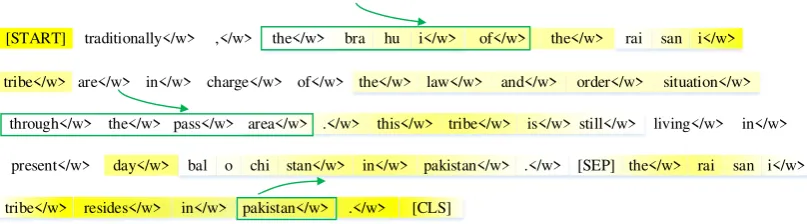
Figure 6: Attention weights of a textual entailment case in RTE. Yellow parts represent the attention weights of our approach. Green arrows and boxes represent the weight changes compared with GPT.
4.3 Case Study
We compare the attention weights of GPT and our LB-BPE (NER+POS) approach in a textual intail-ment example as shown in Figure 6. GPT labels it asnot entailmentwhile our approach labels it as entailment which is the right answer. The atten-tion weights come from the same attenatten-tion head in the last transformer block. Changes in some parts lead to the correct answer.
5 Conclusion and Future Work
In this paper, we introduce a simple approach called reverse mapping bytepair encoding to im-prove natural language understanding based on pre-trained language models. The reverse map-ping bytepair encoding has two forms: One is label based and the other is named-entity phrase based. Both forms introduce extra information to the tokens generated by BPE while the for-mer ordinarily employs linguistic features, and the latter provides a way to share concepts through named-entity phrases. In addition, in the second form, we summarize the problem we are trying to solve into a two-category problem that judges whether a word is a key word. By applying them to the fine-tuning process of GPT, we gain about 1-6% improvement on downsteam NLU tasks. We also propose a new model architecture named as MCST and experiments based on it shows its ef-fectiveness in some cases. Besides, the experi-mental results show that linguistic features usually perform at a higher level compared with words and wordpieces. It is quite easy to apply our method to the existing language models.
There could be several directions to be explored for future works. Language models have many
forms, we only test our approach on GPT, a fol-low up direction is finding if it is generic enough. In this paper, we don’t employ pre-training for lin-guistic features, it might be better by doing this. There are several researches focusing on incor-porating knowledge into systems to improve their performances, thus we are looking forward to find-ing a smooth way to utilize named entities with prior knowledge or knowledge graphs.
Acknowledgments
This work is supported by National Key Re-search and Development Program of China
un-der Grant No. 2017YFB0803003 and No.
2016YFB0801302. We also thank the anonymous reviewers and the area chairs for their valuable comments and suggestions that help improve the quality of this manuscript.
References
Yoshua Bengio, R´ejean Ducharme, Pascal Vincent, and Christian Jauvin. 2003. A neural probabilistic
lan-guage model. Journal of machine learning research,
3(Feb):1137–1155.
Luisa Bentivogli, Ido Dagan, Hoa Trang Dang, Danilo Giampiccolo, and Bernardo. Magnini. 2009. The fifth PASCAL recognizing textual entailment chal-lenge.
Piotr Bojanowski, Edouard Grave, Armand Joulin, and
Tomas Mikolov. 2017. Enriching word vectors with
subword information. Transactions of the Associa-tion for ComputaAssocia-tional Linguistics, 5:135–146.
Xinxiong Chen, Lei Xu, Zhiyuan Liu, Maosong Sun, and Huanbo Luan. 2015. Joint learning of character
and word embeddings. In Twenty-Fourth
Jacob Devlin, Ming-Wei Chang, Kenton Lee, and
Kristina Toutanova. 2018. Bert: Pre-training of deep
bidirectional transformers for language understand-ing. arXiv preprint arXiv:1810.04805.
Eric H Huang, Richard Socher, Christopher D
Man-ning, and Andrew Y Ng. 2012. Improving word
representations via global context and multiple word prototypes. InProceedings of the 50th Annual Meet-ing of the Association for Computational LMeet-inguis- Linguis-tics: Long Papers-Volume 1, pages 873–882. Asso-ciation for Computational Linguistics.
Ignacio Iacobacci, Mohammad Taher Pilehvar, and
Roberto Navigli. 2015. SensEmbed: Learning sense
embeddings for word and relational similarity. In
Proceedings of the 53rd Annual Meeting of the Association for Computational Linguistics and the 7th International Joint Conference on Natural Lan-guage Processing (Volume 1: Long Papers). Associ-ation for ComputAssoci-ational Linguistics.
Armand Joulin, Edouard Grave, Piotr Bojanowski, and
Tomas Mikolov. 2017. Bag of tricks for efficient
text classification. InProceedings of the 15th Con-ference of the European Chapter of the Association for Computational Linguistics: Volume 2, Short
Pa-pers. Association for Computational Linguistics.
Tushar Khot, Ashish Sabharwal, and Peter Clark. 2018. Scitail: A textual entailment dataset from science
question answering. In Thirty-Second AAAI
Con-ference on Artificial Intelligence.
Taku Kudo. 2018. Subword regularization:
Im-proving neural network translation models with
multiple subword candidates. arXiv preprint
arXiv:1804.10959.
Omer Levy and Yoav Goldberg. 2014a.
Dependency-based word embeddings. InProceedings of the 52nd Annual Meeting of the Association for Computa-tional Linguistics (Volume 2: Short Papers). Asso-ciation for Computational Linguistics.
Omer Levy and Yoav Goldberg. 2014b. Neural word
embedding as implicit matrix factorization. In
Ad-vances in neural information processing systems, pages 2177–2185.
Peter J Liu, Mohammad Saleh, Etienne Pot, Ben
Goodrich, Ryan Sepassi, Lukasz Kaiser, and
Noam Shazeer. 2018. Generating wikipedia by
summarizing long sequences. arXiv preprint
arXiv:1801.10198.
Tomas Mikolov, Kai Chen, Greg Corrado, and
Jef-frey Dean. 2013a. Efficient estimation of word
representations in vector space. arXiv preprint
arXiv:1301.3781.
Tomas Mikolov, Ilya Sutskever, Kai Chen, Greg S Cor-rado, and Jeff Dean. 2013b. Distributed representa-tions of words and phrases and their
compositional-ity. InAdvances in neural information processing
systems, pages 3111–3119.
Nasrin Mostafazadeh, Michael Roth, Annie Louis,
Nathanael Chambers, and James Allen. 2017.
LSD-Sem 2017 shared task: The story cloze test. In Pro-ceedings of the 2nd Workshop on Linking Models of Lexical, Sentential and Discourse-level Semantics. Association for Computational Linguistics.
Ramesh Nallapati, Bowen Zhou, Cicero dos Santos,
Caglar Gulcehre, and Bing Xiang. 2016.
Ab-stractive text summarization using sequence-to-sequence RNNs and beyond. InProceedings of The 20th SIGNLL Conference on Computational Natural Language Learning. Association for Computational Linguistics.
Jeffrey Pennington, Richard Socher, and Christopher
Manning. 2014. Glove: Global vectors for word
representation. In Proceedings of the 2014 Con-ference on Empirical Methods in Natural Language Processing (EMNLP). Association for Computa-tional Linguistics.
Matthew E Peters, Mark Neumann, Mohit Iyyer, Matt Gardner, Christopher Clark, Kenton Lee, and Luke
Zettlemoyer. 2018. Deep contextualized word
rep-resentations.arXiv preprint arXiv:1802.05365.
Alec Radford, Karthik Narasimhan, Tim Salimans, and Ilya Sutskever. 2018. Improving language
under-standing by generative pre-training. URL
https://s3-us-west-2. amazonaws. com/openai-assets/research-covers/languageunsupervised/language under-standing paper. pdf.
Rico Sennrich and Barry Haddow. 2016. Linguistic
input features improve neural machine translation. InProceedings of the First Conference on Machine Translation: Volume 1, Research Papers. Associa-tion for ComputaAssocia-tional Linguistics.
Rico Sennrich, Barry Haddow, and Alexandra Birch.
2016.Neural machine translation of rare words with
subword units. InProceedings of the 54th Annual Meeting of the Association for Computational Lin-guistics (Volume 1: Long Papers). Association for Computational Linguistics.
Richard Socher, Alex Perelygin, Jean Wu, Jason Chuang, Christopher D Manning, Andrew Ng, and
Christopher Potts. 2013. Recursive deep models
for semantic compositionality over a sentiment tree-bank. In Proceedings of the 2013 conference on empirical methods in natural language processing, pages 1631–1642.
Yangqiu Song, Haixun Wang, Zhongyuan Wang, Hongsong Li, and Weizhu Chen. 2011. Short text conceptualization using a probabilistic
knowledge-base. InTwenty-Second International Joint
Confer-ence on Artificial IntelligConfer-ence.
Tzu ray Su and Hung yi Lee. 2017. Learning chinese
word representations from glyphs of characters. In
Ashish Vaswani, Noam Shazeer, Niki Parmar, Jakob Uszkoreit, Llion Jones, Aidan N Gomez, Łukasz Kaiser, and Illia Polosukhin. 2017. Attention is all
you need. InAdvances in Neural Information
Pro-cessing Systems, pages 5998–6008.
Yang Xu, Jiawei Liu, Wei Yang, and Liusheng Huang.
2018. Incorporating latent meanings of
morpholog-ical compositions to enhance word embeddings. In
Proceedings of the 56th Annual Meeting of the As-sociation for Computational Linguistics (Volume 1: Long Papers). Association for Computational Lin-guistics.
Jinxing Yu, Xun Jian, Hao Xin, and Yangqiu Song.
2017. Joint embeddings of chinese words,
charac-ters, and fine-grained subcharacter components. In
Proceedings of the 2017 Conference on Empirical Methods in Natural Language Processing. Associa-tion for ComputaAssocia-tional Linguistics.
Zhengyan Zhang, Xu Han, Zhiyuan Liu, Xin Jiang,
Maosong Sun, and Qun Liu. 2019. ERNIE: